Corporate Governance and Social Responsibility: Adani Mine Case Study
VerifiedAdded on 2022/10/08
|20
|4296
|25
Report
AI Summary
This report provides a detailed analysis of corporate governance and social responsibility, focusing on the case of the Adani Group's Carmichael mine in Queensland, Australia, and its implications for Indigenous communities. It examines the ethical questions surrounding the mine's approval and the challenges posed by Indigenous landowners. The report explores various corporate governance theories, including agency, resource dependency, stakeholder, transaction cost, and stewardship theories, to understand the relationships between the government, Adani, and the Indigenous stakeholders. Furthermore, it delves into the concepts of Corporate Social Responsibility (CSR), Creating Shared Value (CSV), and Corporate Social Performance (CSP), evaluating Adani's actions against these frameworks and analyzing the stakeholder perspectives, particularly those of the Wangan and Jagalingou people. The report also addresses diversity and inclusion, the application of ASX 2010 corporate governance principles, and concludes with ethical analysis, recommendations, and references. The Carmichael Mine case is used as a case study to understand the ethical implications of corporate social responsibility and the impact of the mine on the land, water, flora, fauna, and cultural heritage of the Indigenous people.
Running Head: CORPORATE GOVERNANCE AND SOCIAL RESPONSIBILITY
CORPORATE GOVERNANCE AND SOCIAL RESPONSIBILITY
Name of the Student
Name of the University
Author’s Note
CORPORATE GOVERNANCE AND SOCIAL RESPONSIBILITY
Name of the Student
Name of the University
Author’s Note

Paraphrase This Document
Need a fresh take? Get an instant paraphrase of this document with our AI Paraphraser
1CORPORATE GOVERNANCE AND SOCIAL RESPONSIBILITY
Table of Contents
EXECUTIVE SUMMARY:............................................................................................................1
INTRODUCTION:..........................................................................................................................2
ETHICAL QUESTION:..................................................................................................................2
CORPORATE GOVERNANCE:....................................................................................................2
AGENCY THEORY:...........................................................................................................2
RESOURCE DEPENDENCY THEORY.............................................................................3
STAKEHOLDER THEORY................................................................................................4
TRANSACTION COST THEORY......................................................................................4
STEWARDSHIP THEORY.................................................................................................5
CORPORATE SOCIAL RESPONSIBILITY (CSR), CREATING SHARES VALUE (CSV) and
CORPORATE SOCIAL PERFORMANCE (CSP):........................................................................5
STAKEHOLDER ANALYSIS:......................................................................................................9
DIVERSITY:.................................................................................................................................10
CORPORATE GOVERNANCE and ASX 2010 MODEL:..........................................................11
ETHICAL ANALYSIS:................................................................................................................12
CONCLUSION:............................................................................................................................13
RECOMMENDATIONS:..............................................................................................................13
REFERENCES:.............................................................................................................................15
Table of Contents
EXECUTIVE SUMMARY:............................................................................................................1
INTRODUCTION:..........................................................................................................................2
ETHICAL QUESTION:..................................................................................................................2
CORPORATE GOVERNANCE:....................................................................................................2
AGENCY THEORY:...........................................................................................................2
RESOURCE DEPENDENCY THEORY.............................................................................3
STAKEHOLDER THEORY................................................................................................4
TRANSACTION COST THEORY......................................................................................4
STEWARDSHIP THEORY.................................................................................................5
CORPORATE SOCIAL RESPONSIBILITY (CSR), CREATING SHARES VALUE (CSV) and
CORPORATE SOCIAL PERFORMANCE (CSP):........................................................................5
STAKEHOLDER ANALYSIS:......................................................................................................9
DIVERSITY:.................................................................................................................................10
CORPORATE GOVERNANCE and ASX 2010 MODEL:..........................................................11
ETHICAL ANALYSIS:................................................................................................................12
CONCLUSION:............................................................................................................................13
RECOMMENDATIONS:..............................................................................................................13
REFERENCES:.............................................................................................................................15

2CORPORATE GOVERNANCE AND SOCIAL RESPONSIBILITY
⊘ This is a preview!⊘
Do you want full access?
Subscribe today to unlock all pages.

Trusted by 1+ million students worldwide
3CORPORATE GOVERNANCE AND SOCIAL RESPONSIBILITY
EXECUTIVE SUMMARY:
The thesis explains the implications of the corporate social responsibility with that of the
case between the Indigenous people and the Adani Group for the mining in the Carmichael mine.
The mines were approved by the Central Queensland Government and the approval was
challenged by the Indigenous people on the grounds of effects being imposed on the land, water,
flora and fauna of the land which also included the endangered species. It was also claimed that
the mining would affect the Great Barrier reef which is a geographical indication for Australia
and also a cultural heritage.
The thesis has provided the in detail explanation of corporate social responsibility and
creating shared value with that of the corporate social performance with respect to the
expectations held by the Indigenous people and the past implications of Adani projects. Further
the diversity and their inclusion has been explained with the recognition of Corporate
Governance ASX Principles and Recommendation 2010. The conclusions and Recommendations
in the report has been laid down on the basis of the complete analysis of the thesis.
EXECUTIVE SUMMARY:
The thesis explains the implications of the corporate social responsibility with that of the
case between the Indigenous people and the Adani Group for the mining in the Carmichael mine.
The mines were approved by the Central Queensland Government and the approval was
challenged by the Indigenous people on the grounds of effects being imposed on the land, water,
flora and fauna of the land which also included the endangered species. It was also claimed that
the mining would affect the Great Barrier reef which is a geographical indication for Australia
and also a cultural heritage.
The thesis has provided the in detail explanation of corporate social responsibility and
creating shared value with that of the corporate social performance with respect to the
expectations held by the Indigenous people and the past implications of Adani projects. Further
the diversity and their inclusion has been explained with the recognition of Corporate
Governance ASX Principles and Recommendation 2010. The conclusions and Recommendations
in the report has been laid down on the basis of the complete analysis of the thesis.
Paraphrase This Document
Need a fresh take? Get an instant paraphrase of this document with our AI Paraphraser
4CORPORATE GOVERNANCE AND SOCIAL RESPONSIBILITY
INTRODUCTION:
Carmichael Mine was an approved thermal coal mine in central Queensland and the
mining was supposed to be conducted in the mine by Adani Mining, a wholly owned subsidiary
of India’s Adani Group. However, the Indigenous landowners challenged the viability of the
Indigenous Land Use Agreement with Adani and hence, initiated a suit to refuse the lease for
mining granted to Adani Mining (Adani Mining Pty Ltd and Another vs. Adrian Burragubba,
Patrick Malone and Irene White on behalf of the Wangan and Jagalingou People). The suit was
initiated on the claims made by the traditional owners of the land that the development would
hamper and destroy the lands, water, animals, plants and cultural heritage that has formed the
part of their ancestry.
Thus, the thesis aims to provide analysis of the litigation with respect to Corporate
governance and social performance with respect to diversity.
ETHICAL QUESTION:
The ethical issue in the case is whether the acquiring of land by the Government and
pushing the mine ahead with its activities ethically justified.
CORPORATE GOVERNANCE:
Following are the Governance Theories which can be explained as follows (Muller
2016):
AGENCY THEORY: this theory establishes that there exists a relationship of a
principal and that of an agent between the corporate and its members. Thus, the corporate
INTRODUCTION:
Carmichael Mine was an approved thermal coal mine in central Queensland and the
mining was supposed to be conducted in the mine by Adani Mining, a wholly owned subsidiary
of India’s Adani Group. However, the Indigenous landowners challenged the viability of the
Indigenous Land Use Agreement with Adani and hence, initiated a suit to refuse the lease for
mining granted to Adani Mining (Adani Mining Pty Ltd and Another vs. Adrian Burragubba,
Patrick Malone and Irene White on behalf of the Wangan and Jagalingou People). The suit was
initiated on the claims made by the traditional owners of the land that the development would
hamper and destroy the lands, water, animals, plants and cultural heritage that has formed the
part of their ancestry.
Thus, the thesis aims to provide analysis of the litigation with respect to Corporate
governance and social performance with respect to diversity.
ETHICAL QUESTION:
The ethical issue in the case is whether the acquiring of land by the Government and
pushing the mine ahead with its activities ethically justified.
CORPORATE GOVERNANCE:
Following are the Governance Theories which can be explained as follows (Muller
2016):
AGENCY THEORY: this theory establishes that there exists a relationship of a
principal and that of an agent between the corporate and its members. Thus, the corporate
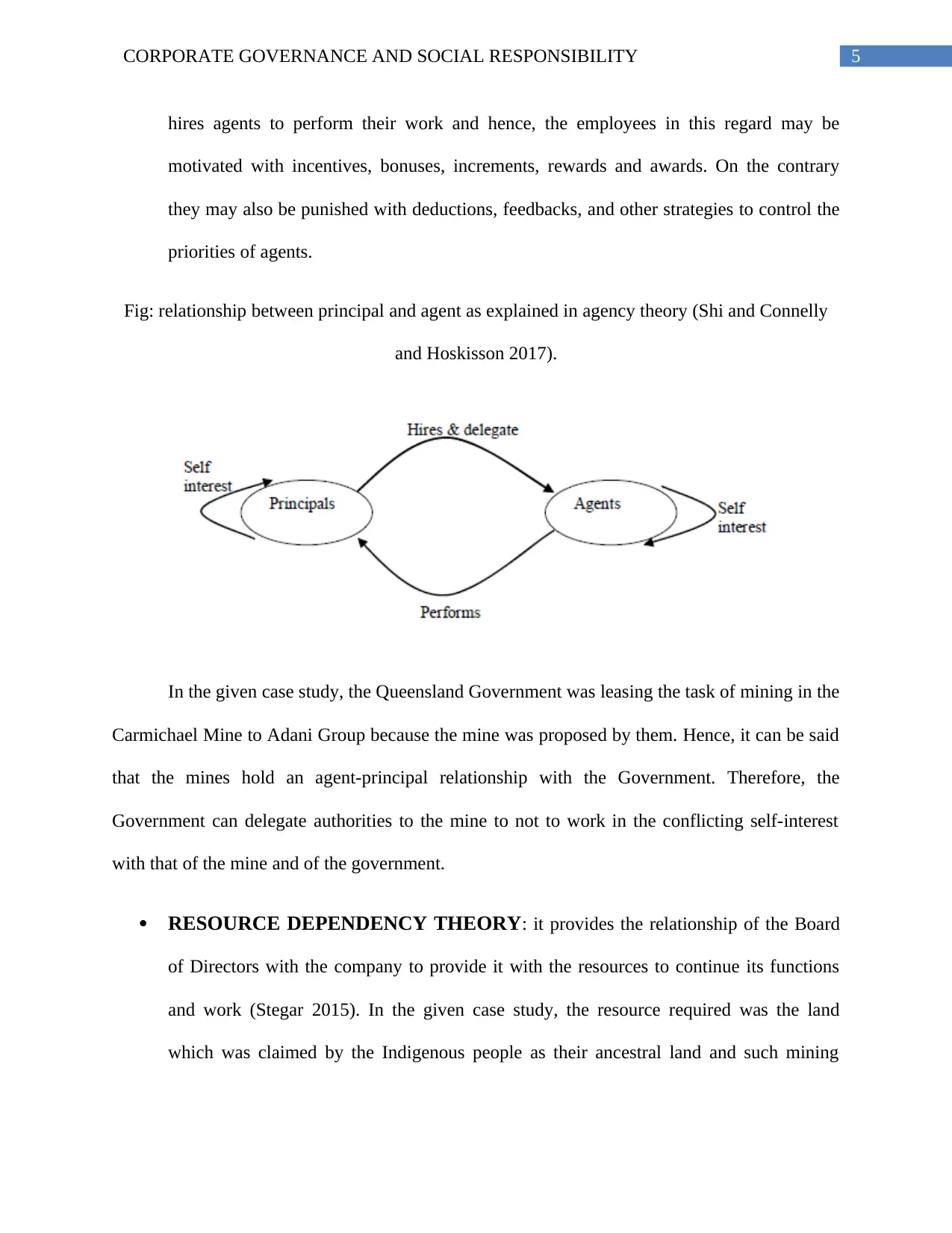
5CORPORATE GOVERNANCE AND SOCIAL RESPONSIBILITY
hires agents to perform their work and hence, the employees in this regard may be
motivated with incentives, bonuses, increments, rewards and awards. On the contrary
they may also be punished with deductions, feedbacks, and other strategies to control the
priorities of agents.
Fig: relationship between principal and agent as explained in agency theory (Shi and Connelly
and Hoskisson 2017).
In the given case study, the Queensland Government was leasing the task of mining in the
Carmichael Mine to Adani Group because the mine was proposed by them. Hence, it can be said
that the mines hold an agent-principal relationship with the Government. Therefore, the
Government can delegate authorities to the mine to not to work in the conflicting self-interest
with that of the mine and of the government.
RESOURCE DEPENDENCY THEORY: it provides the relationship of the Board
of Directors with the company to provide it with the resources to continue its functions
and work (Stegar 2015). In the given case study, the resource required was the land
which was claimed by the Indigenous people as their ancestral land and such mining
hires agents to perform their work and hence, the employees in this regard may be
motivated with incentives, bonuses, increments, rewards and awards. On the contrary
they may also be punished with deductions, feedbacks, and other strategies to control the
priorities of agents.
Fig: relationship between principal and agent as explained in agency theory (Shi and Connelly
and Hoskisson 2017).
In the given case study, the Queensland Government was leasing the task of mining in the
Carmichael Mine to Adani Group because the mine was proposed by them. Hence, it can be said
that the mines hold an agent-principal relationship with the Government. Therefore, the
Government can delegate authorities to the mine to not to work in the conflicting self-interest
with that of the mine and of the government.
RESOURCE DEPENDENCY THEORY: it provides the relationship of the Board
of Directors with the company to provide it with the resources to continue its functions
and work (Stegar 2015). In the given case study, the resource required was the land
which was claimed by the Indigenous people as their ancestral land and such mining
⊘ This is a preview!⊘
Do you want full access?
Subscribe today to unlock all pages.
Trusted by 1+ million students worldwide
6CORPORATE GOVERNANCE AND SOCIAL RESPONSIBILITY
would interfere with the resources of land like water, animals, plants, cultural heritage
and so on.
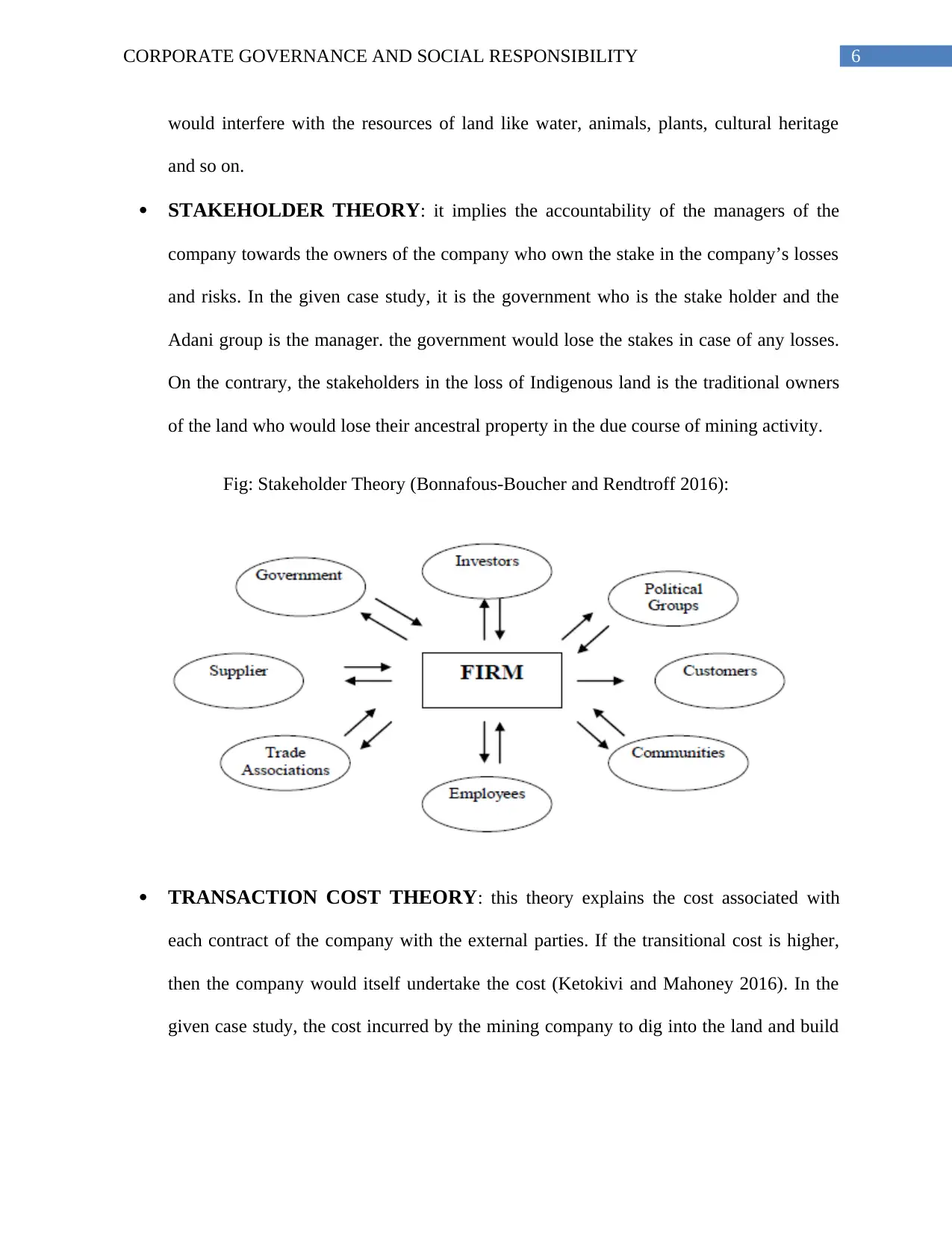
STAKEHOLDER THEORY: it implies the accountability of the managers of the
company towards the owners of the company who own the stake in the company’s losses
and risks. In the given case study, it is the government who is the stake holder and the
Adani group is the manager. the government would lose the stakes in case of any losses.
On the contrary, the stakeholders in the loss of Indigenous land is the traditional owners
of the land who would lose their ancestral property in the due course of mining activity.
Fig: Stakeholder Theory (Bonnafous-Boucher and Rendtroff 2016):
TRANSACTION COST THEORY: this theory explains the cost associated with
each contract of the company with the external parties. If the transitional cost is higher,
then the company would itself undertake the cost (Ketokivi and Mahoney 2016). In the
given case study, the cost incurred by the mining company to dig into the land and build
would interfere with the resources of land like water, animals, plants, cultural heritage
and so on.
STAKEHOLDER THEORY: it implies the accountability of the managers of the
company towards the owners of the company who own the stake in the company’s losses
and risks. In the given case study, it is the government who is the stake holder and the
Adani group is the manager. the government would lose the stakes in case of any losses.
On the contrary, the stakeholders in the loss of Indigenous land is the traditional owners
of the land who would lose their ancestral property in the due course of mining activity.
Fig: Stakeholder Theory (Bonnafous-Boucher and Rendtroff 2016):
TRANSACTION COST THEORY: this theory explains the cost associated with
each contract of the company with the external parties. If the transitional cost is higher,
then the company would itself undertake the cost (Ketokivi and Mahoney 2016). In the
given case study, the cost incurred by the mining company to dig into the land and build
Paraphrase This Document
Need a fresh take? Get an instant paraphrase of this document with our AI Paraphraser
7CORPORATE GOVERNANCE AND SOCIAL RESPONSIBILITY
networks for communication and carriages shall be borne by the company itself because
these costs are the values more than the market.
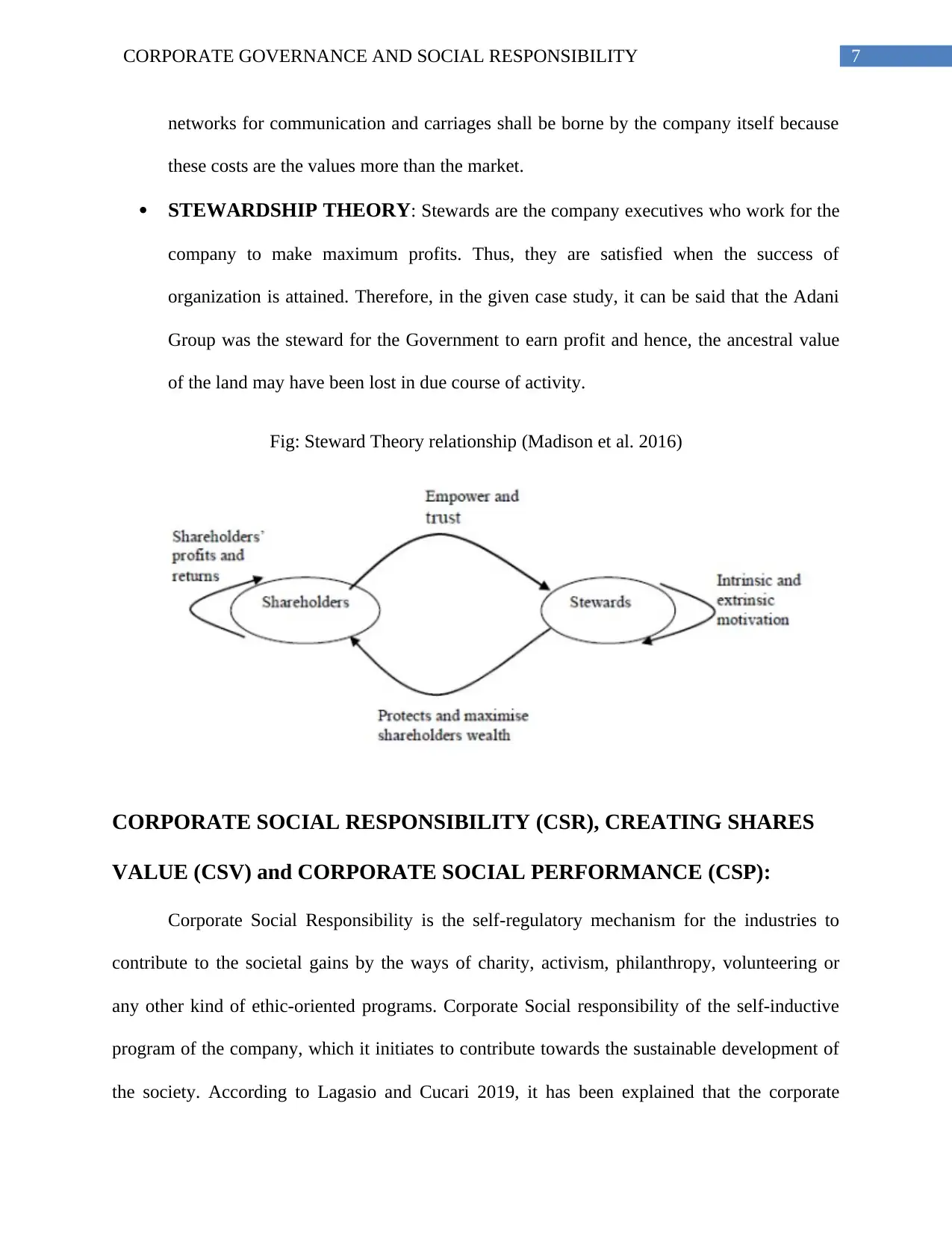
STEWARDSHIP THEORY: Stewards are the company executives who work for the
company to make maximum profits. Thus, they are satisfied when the success of
organization is attained. Therefore, in the given case study, it can be said that the Adani
Group was the steward for the Government to earn profit and hence, the ancestral value
of the land may have been lost in due course of activity.
Fig: Steward Theory relationship (Madison et al. 2016)
CORPORATE SOCIAL RESPONSIBILITY (CSR), CREATING SHARES
VALUE (CSV) and CORPORATE SOCIAL PERFORMANCE (CSP):
Corporate Social Responsibility is the self-regulatory mechanism for the industries to
contribute to the societal gains by the ways of charity, activism, philanthropy, volunteering or
any other kind of ethic-oriented programs. Corporate Social responsibility of the self-inductive
program of the company, which it initiates to contribute towards the sustainable development of
the society. According to Lagasio and Cucari 2019, it has been explained that the corporate
networks for communication and carriages shall be borne by the company itself because
these costs are the values more than the market.
STEWARDSHIP THEORY: Stewards are the company executives who work for the
company to make maximum profits. Thus, they are satisfied when the success of
organization is attained. Therefore, in the given case study, it can be said that the Adani
Group was the steward for the Government to earn profit and hence, the ancestral value
of the land may have been lost in due course of activity.
Fig: Steward Theory relationship (Madison et al. 2016)
CORPORATE SOCIAL RESPONSIBILITY (CSR), CREATING SHARES
VALUE (CSV) and CORPORATE SOCIAL PERFORMANCE (CSP):
Corporate Social Responsibility is the self-regulatory mechanism for the industries to
contribute to the societal gains by the ways of charity, activism, philanthropy, volunteering or
any other kind of ethic-oriented programs. Corporate Social responsibility of the self-inductive
program of the company, which it initiates to contribute towards the sustainable development of
the society. According to Lagasio and Cucari 2019, it has been explained that the corporate
8CORPORATE GOVERNANCE AND SOCIAL RESPONSIBILITY
governance is the influence of the company upon the social, economic and environmental aspects
of the society through voluntary initiated programs. As opined by Jain and Jamali 2016, it can be
explained that the corporate governance initiates the compliance of the law with that of the
activities of the company. The compliance of law with that of the activities of the companies
includes the evaluation of corporate social responsibility and the steps taken by the company to
ensure that the impact of its industrial wastes are reduced to the extent of it fulfillment of duty
towards the society to ensure that the society develops in a sustainable manner (Rodriguez-
Fernandez 2016). In other words, it means that the society should be improved and sustained in
the status as it was in before the activity of such industry. If the company takes initiatives to
ensure that the condition of the society and its environment is restored in the manner as it was in
the condition before the establishment of such society, then the corporate governance may imply
that the corporate social responsibility has been fulfilled (Wang and Sarkis 2017).
Creating Shared Value is the concept by which the values are developed by the
organization’s leadership and such values are adopted by the members of the organization. These
values can be in the form of policies or regulations, which are shared by the members of the
organization while acting on behalf of the organization. These values can be referred to as the
policies or regulations of the company which is established as the code of conduct or the terms of
employment to be adhered to while in the course of employment contract with the company.
According to Porter and Kraner 2013, the problem with the organizations is that they tend to be
ramped in the outdated values which are not developed time to time. However, as opined by
Creane et al. 2014, it has been explained that the strength of the idea of value is evaluated in
terms of its popularity and if as many people are accepting the values and sharing it with
adherence as per the terms, then such strategy and social goals shall be connected to the
governance is the influence of the company upon the social, economic and environmental aspects
of the society through voluntary initiated programs. As opined by Jain and Jamali 2016, it can be
explained that the corporate governance initiates the compliance of the law with that of the
activities of the company. The compliance of law with that of the activities of the companies
includes the evaluation of corporate social responsibility and the steps taken by the company to
ensure that the impact of its industrial wastes are reduced to the extent of it fulfillment of duty
towards the society to ensure that the society develops in a sustainable manner (Rodriguez-
Fernandez 2016). In other words, it means that the society should be improved and sustained in
the status as it was in before the activity of such industry. If the company takes initiatives to
ensure that the condition of the society and its environment is restored in the manner as it was in
the condition before the establishment of such society, then the corporate governance may imply
that the corporate social responsibility has been fulfilled (Wang and Sarkis 2017).
Creating Shared Value is the concept by which the values are developed by the
organization’s leadership and such values are adopted by the members of the organization. These
values can be in the form of policies or regulations, which are shared by the members of the
organization while acting on behalf of the organization. These values can be referred to as the
policies or regulations of the company which is established as the code of conduct or the terms of
employment to be adhered to while in the course of employment contract with the company.
According to Porter and Kraner 2013, the problem with the organizations is that they tend to be
ramped in the outdated values which are not developed time to time. However, as opined by
Creane et al. 2014, it has been explained that the strength of the idea of value is evaluated in
terms of its popularity and if as many people are accepting the values and sharing it with
adherence as per the terms, then such strategy and social goals shall be connected to the
⊘ This is a preview!⊘
Do you want full access?
Subscribe today to unlock all pages.
Trusted by 1+ million students worldwide
9CORPORATE GOVERNANCE AND SOCIAL RESPONSIBILITY
systemized idea of sharing. Beschorner 2014 as opined the idea of Creating Shared Value as a
trick to unite the ethical grounds of the members of the organization and ensure the code of
conduct and the policies adhered by them is in complete good faith and interest of the company
or the organization. Piftzer, Bockstette and Stamp 2013 has explained that the shared value
should be innovated with the changing times and demands of the business. In other words, it can
be explained that the amendments of law imbibe changes in the policies of the organization also
and hence, to ensure that the corporate governance has been complied with, innovations with the
changes in time and law is important. Moore 2014 has explained the basic difference between the
corporate social responsibility and the creating shared Value as where the former is about the
responsibility of the corporation towards the sustainable development of the society, the latter
explains the importance of creating value within the organization to ensure that the responsibility
is carried out in a unified manner.
Corporate Social Performance (CSP) refers to the behavior and practices and principles
of the business and their relationships with their stake holders and other external parties related
to the business (Kang and Grewal 2016). It is a constitution of three elements which lead to the
assessment of social performance of a corporate body (Wood 2015). They are:
Categories of Social Responsibility
Social Responsiveness and its modes
Stakeholders and their social issues
These elements include the social responsibilities projects as undertaken by the corporate body
like charity, volunteering, donations and so on, and the response of the corporate towards the
social issues which can be proactive, defensive, reactionary and accommodating (Shaukat, Qiu
systemized idea of sharing. Beschorner 2014 as opined the idea of Creating Shared Value as a
trick to unite the ethical grounds of the members of the organization and ensure the code of
conduct and the policies adhered by them is in complete good faith and interest of the company
or the organization. Piftzer, Bockstette and Stamp 2013 has explained that the shared value
should be innovated with the changing times and demands of the business. In other words, it can
be explained that the amendments of law imbibe changes in the policies of the organization also
and hence, to ensure that the corporate governance has been complied with, innovations with the
changes in time and law is important. Moore 2014 has explained the basic difference between the
corporate social responsibility and the creating shared Value as where the former is about the
responsibility of the corporation towards the sustainable development of the society, the latter
explains the importance of creating value within the organization to ensure that the responsibility
is carried out in a unified manner.
Corporate Social Performance (CSP) refers to the behavior and practices and principles
of the business and their relationships with their stake holders and other external parties related
to the business (Kang and Grewal 2016). It is a constitution of three elements which lead to the
assessment of social performance of a corporate body (Wood 2015). They are:
Categories of Social Responsibility
Social Responsiveness and its modes
Stakeholders and their social issues
These elements include the social responsibilities projects as undertaken by the corporate body
like charity, volunteering, donations and so on, and the response of the corporate towards the
social issues which can be proactive, defensive, reactionary and accommodating (Shaukat, Qiu
Paraphrase This Document
Need a fresh take? Get an instant paraphrase of this document with our AI Paraphraser
10CORPORATE GOVERNANCE AND SOCIAL RESPONSIBILITY
and Trojanowski 2016). In general terms a socially responsive corporate body would be
proactive in their approaches towards the social issues. The attention of the stakeholders and an
analysis of their social issues is the last element for the establishment of the corporate social
performance model (Cooper 2017).
In the given case study, the Indigenous people who are the traditional owners of the land,
have claimed that the mining activity would result in the devastation of the land including the
water, flora and fauna surrounding it. If the property is devastated then the cultural heritage of
the land would be lost due to the destruction of the land and its resources. The owners of the land
claim that the resources cannot be sustained by any means of environmental, social or economic
efforts. In January 2015, the Mackay Conservation group had challenged the project of
Carmichael mines under the Environment Protection and Biodiversity Conservation Act 1999.
The contention involved three basic claims. They are:
The greenhouse gas emissions from burning of coal from the mine and its effects upon
the environment was not considered while approving the project.
The Adani group has been known for its poor environment management in India
including the building approvals and illegal clearing of mangroves (Australia 2017).
Section 139 of the Environment Protection and Biodiversity Conservation Act 1999 had
included yakka snake and ornamental snake as endangered species and these would be
affected by the mining activities.
Following these contentions, the Federal Court had overturned the approval of Carmichael mines
to the Adani Group. However, the law is proposed to be changed wherein, it has been proposed
that the third parties who are not affected by the activities or the claim made, shall be restricted
and Trojanowski 2016). In general terms a socially responsive corporate body would be
proactive in their approaches towards the social issues. The attention of the stakeholders and an
analysis of their social issues is the last element for the establishment of the corporate social
performance model (Cooper 2017).
In the given case study, the Indigenous people who are the traditional owners of the land,
have claimed that the mining activity would result in the devastation of the land including the
water, flora and fauna surrounding it. If the property is devastated then the cultural heritage of
the land would be lost due to the destruction of the land and its resources. The owners of the land
claim that the resources cannot be sustained by any means of environmental, social or economic
efforts. In January 2015, the Mackay Conservation group had challenged the project of
Carmichael mines under the Environment Protection and Biodiversity Conservation Act 1999.
The contention involved three basic claims. They are:
The greenhouse gas emissions from burning of coal from the mine and its effects upon
the environment was not considered while approving the project.
The Adani group has been known for its poor environment management in India
including the building approvals and illegal clearing of mangroves (Australia 2017).
Section 139 of the Environment Protection and Biodiversity Conservation Act 1999 had
included yakka snake and ornamental snake as endangered species and these would be
affected by the mining activities.
Following these contentions, the Federal Court had overturned the approval of Carmichael mines
to the Adani Group. However, the law is proposed to be changed wherein, it has been proposed
that the third parties who are not affected by the activities or the claim made, shall be restricted
11CORPORATE GOVERNANCE AND SOCIAL RESPONSIBILITY
from bringing the suit against such activities. Further in Adani Mining Pty limited vs. Land
Services of Coast and Country Inc. [2014] QLC 48, contentions for the environmental issues
were raised due to the impacts from the burning of coal, threat to the endangered species which
are nr recoverable by any financial or economic or social efforts made by the company. In
Australian Conservation Foundation Inc vs. Minister for the Environment [2016] FCA
1042, a judicial review application was made under the Environment Protection and Biodiversity
Conservation Act 1999 which was dismissed in 2016. The dismissal was followed by an appeal
in the Federal Court of Australia where the appellant lost the claim on the ground of the impact
of cause and effect of the greenhouse emissions and its impact on the Great Barrier Reef.
Following the suit, the environmental approval was made which is supposed to last for next 99
years. In Australian Conservation Foundation Inc vs. Minister for Environment [2018]
FCAFC 134, it was contended by the plaintiff that the legislations and statutory requirements
regarding the maintenance of water was not referred to while approving the lease to the Adani
Group by the Government. However, it was held by the court that the water related provisions
were included in the Environment Protection and Biodiversity Conservation Act 1999 was made
in 2013 and it was contended by Adani that since the mining was a controlled act, it need not
undergo the process of Environmental Impact Assessment for the purpose of conducting a
controlled activity.
STAKEHOLDER ANALYSIS:
Stakeholder Analysis is the process of identification of stakeholders and grouping them
into categories on the basis of their levels of participation and hence, these groups are determined
from bringing the suit against such activities. Further in Adani Mining Pty limited vs. Land
Services of Coast and Country Inc. [2014] QLC 48, contentions for the environmental issues
were raised due to the impacts from the burning of coal, threat to the endangered species which
are nr recoverable by any financial or economic or social efforts made by the company. In
Australian Conservation Foundation Inc vs. Minister for the Environment [2016] FCA
1042, a judicial review application was made under the Environment Protection and Biodiversity
Conservation Act 1999 which was dismissed in 2016. The dismissal was followed by an appeal
in the Federal Court of Australia where the appellant lost the claim on the ground of the impact
of cause and effect of the greenhouse emissions and its impact on the Great Barrier Reef.
Following the suit, the environmental approval was made which is supposed to last for next 99
years. In Australian Conservation Foundation Inc vs. Minister for Environment [2018]
FCAFC 134, it was contended by the plaintiff that the legislations and statutory requirements
regarding the maintenance of water was not referred to while approving the lease to the Adani
Group by the Government. However, it was held by the court that the water related provisions
were included in the Environment Protection and Biodiversity Conservation Act 1999 was made
in 2013 and it was contended by Adani that since the mining was a controlled act, it need not
undergo the process of Environmental Impact Assessment for the purpose of conducting a
controlled activity.
STAKEHOLDER ANALYSIS:
Stakeholder Analysis is the process of identification of stakeholders and grouping them
into categories on the basis of their levels of participation and hence, these groups are determined
⊘ This is a preview!⊘
Do you want full access?
Subscribe today to unlock all pages.
Trusted by 1+ million students worldwide

1 out of 20


Related Documents


Your All-in-One AI-Powered Toolkit for Academic Success.
+13062052269
info@desklib.com
Available 24*7 on WhatsApp / Email
![[object Object]](/_next/static/media/star-bottom.7253800d.svg)
Unlock your academic potential
Copyright © 2020–2026 A2Z Services. All Rights Reserved. Developed and managed by ZUCOL.