Business Ethics Assignment: Social Responsibility of Business

Verified

Added on  2023/06/04

|4
|948
|401
Essay
AI Summary
This essay delves into the complex realm of business ethics, specifically examining the concept of social responsibility as viewed through the lens of Milton Friedman. The essay begins by identifying the core problem: the difficulty for corporations, as artificial entities, to embody social responsibility. It outlines Friedman's argument that businesses should prioritize profit maximization for shareholders, as this is the most effective way to contribute to societal well-being. The context of the debate is defined, highlighting the ambiguity of "social responsibility" and the limitations of corporations acting in this capacity. The essay then explores several alternatives, including the adoption of private competitive enterprise, the political principle of market mechanism as unanimity, and conformity. The author ultimately argues that organizations should focus on increasing profits within the bounds of the law and ethical considerations. The reasoning behind this choice is provided, emphasizing the potential for corporations to deliver greater value to society by focusing on shareholder interests and ethical practices. The essay concludes with a reflective section, considering alternative perspectives and suggesting that organizations can effectively support social welfare by designing programs that encourage individual participation and accountability in social initiatives. This provides a comprehensive analysis of the debate surrounding corporate social responsibility and Milton Friedman's views.

Document Page
Running header: Business Ethics 1
Business Ethics
Students Name
Institutional Affiliation
tabler-icon-diamond-filled.svg

Paraphrase This Document

Need a fresh take? Get an instant paraphrase of this document with our AI Paraphraser
Document Page
Business Ethics 2
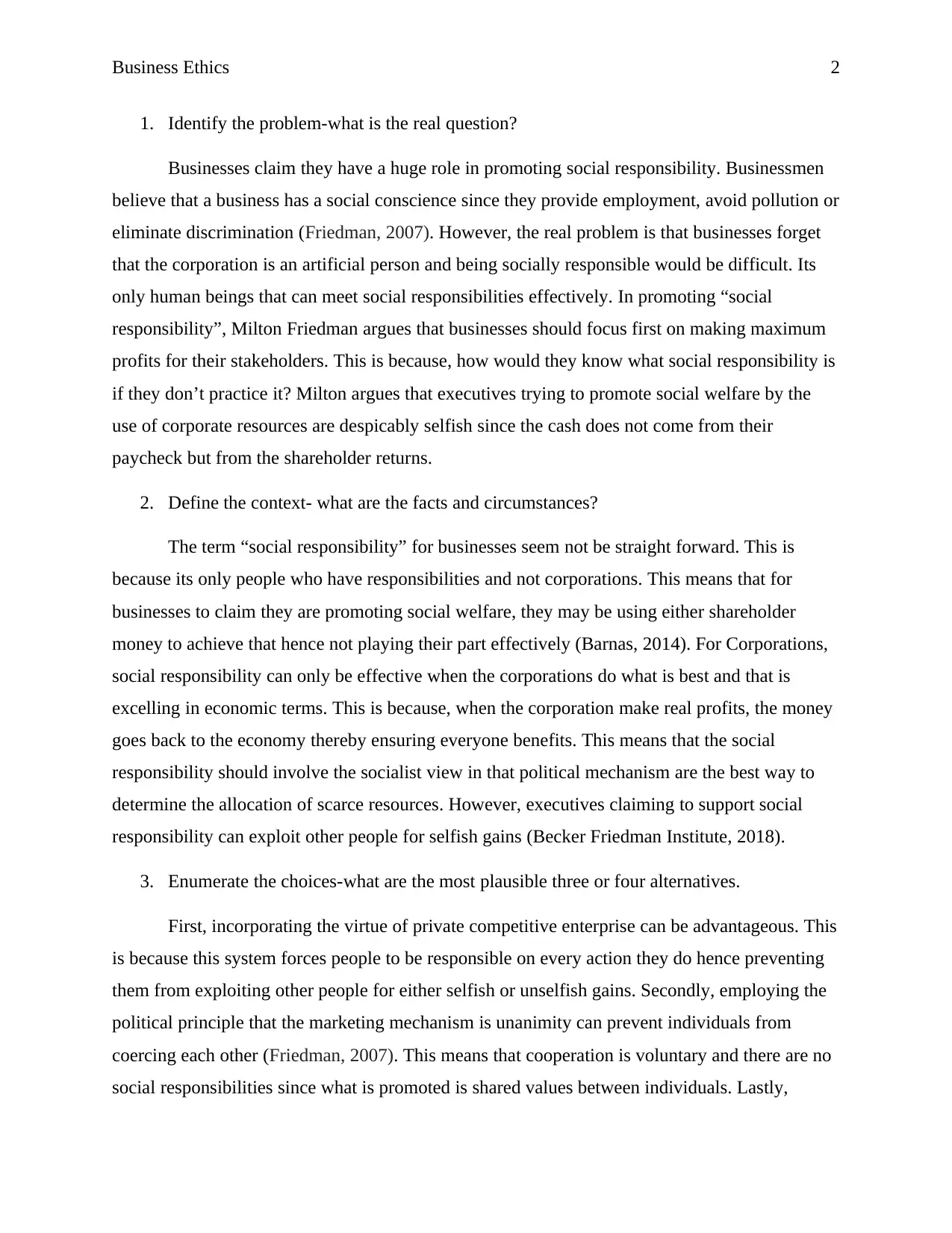
1. Identify the problem-what is the real question?
Businesses claim they have a huge role in promoting social responsibility. Businessmen
believe that a business has a social conscience since they provide employment, avoid pollution or
eliminate discrimination (Friedman, 2007). However, the real problem is that businesses forget
that the corporation is an artificial person and being socially responsible would be difficult. Its
only human beings that can meet social responsibilities effectively. In promoting “social
responsibility”, Milton Friedman argues that businesses should focus first on making maximum
profits for their stakeholders. This is because, how would they know what social responsibility is
if they don’t practice it? Milton argues that executives trying to promote social welfare by the
use of corporate resources are despicably selfish since the cash does not come from their
paycheck but from the shareholder returns.
2. Define the context- what are the facts and circumstances?
The term “social responsibility” for businesses seem not be straight forward. This is
because its only people who have responsibilities and not corporations. This means that for
businesses to claim they are promoting social welfare, they may be using either shareholder
money to achieve that hence not playing their part effectively (Barnas, 2014). For Corporations,
social responsibility can only be effective when the corporations do what is best and that is
excelling in economic terms. This is because, when the corporation make real profits, the money
goes back to the economy thereby ensuring everyone benefits. This means that the social
responsibility should involve the socialist view in that political mechanism are the best way to
determine the allocation of scarce resources. However, executives claiming to support social
responsibility can exploit other people for selfish gains (Becker Friedman Institute, 2018).
3. Enumerate the choices-what are the most plausible three or four alternatives.
First, incorporating the virtue of private competitive enterprise can be advantageous. This
is because this system forces people to be responsible on every action they do hence preventing
them from exploiting other people for either selfish or unselfish gains. Secondly, employing the
political principle that the marketing mechanism is unanimity can prevent individuals from
coercing each other (Friedman, 2007). This means that cooperation is voluntary and there are no
social responsibilities since what is promoted is shared values between individuals. Lastly,
Document Page
Business Ethics 3
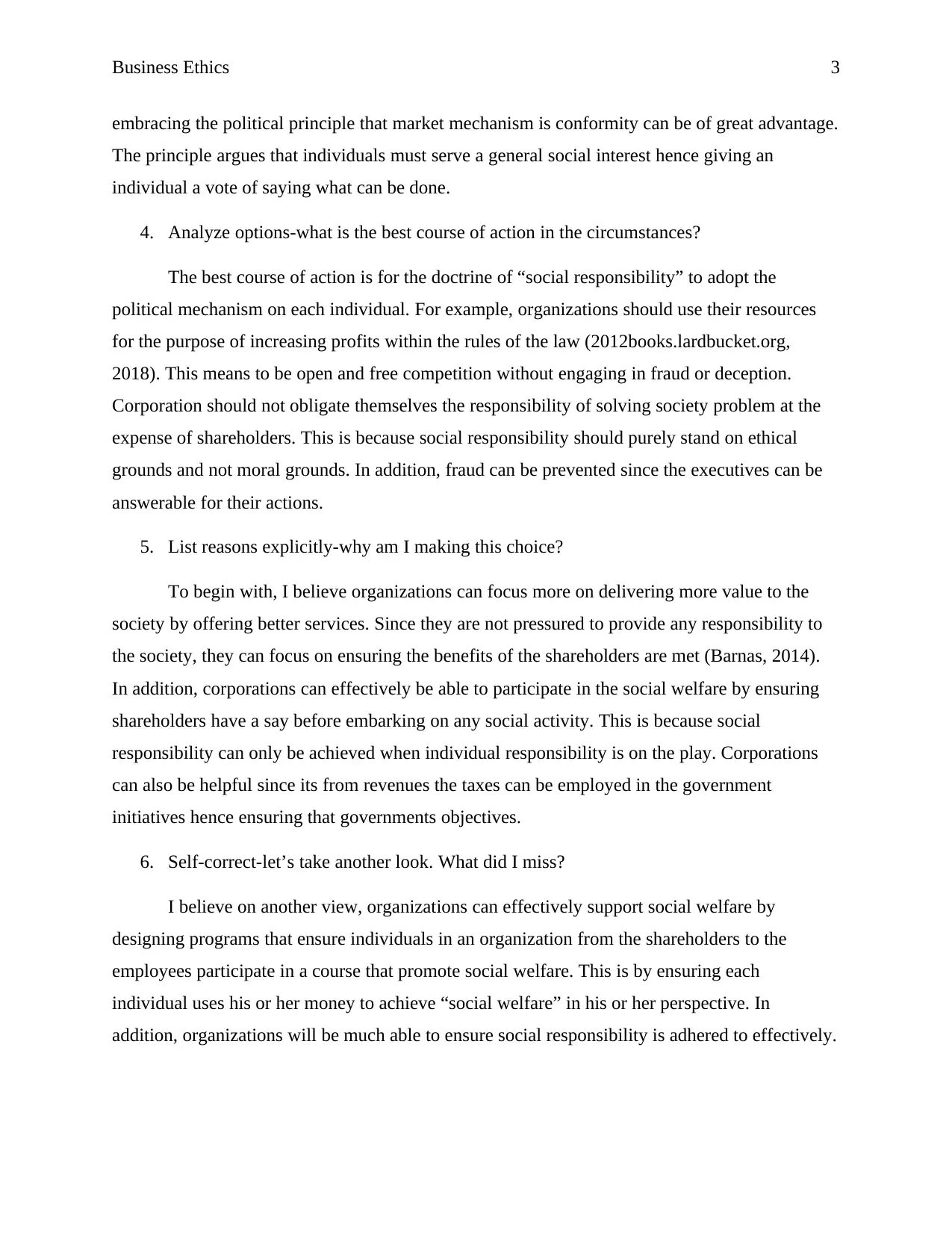
embracing the political principle that market mechanism is conformity can be of great advantage.
The principle argues that individuals must serve a general social interest hence giving an
individual a vote of saying what can be done.
4. Analyze options-what is the best course of action in the circumstances?
The best course of action is for the doctrine of “social responsibility” to adopt the
political mechanism on each individual. For example, organizations should use their resources
for the purpose of increasing profits within the rules of the law (2012books.lardbucket.org,
2018). This means to be open and free competition without engaging in fraud or deception.
Corporation should not obligate themselves the responsibility of solving society problem at the
expense of shareholders. This is because social responsibility should purely stand on ethical
grounds and not moral grounds. In addition, fraud can be prevented since the executives can be
answerable for their actions.
5. List reasons explicitly-why am I making this choice?
To begin with, I believe organizations can focus more on delivering more value to the
society by offering better services. Since they are not pressured to provide any responsibility to
the society, they can focus on ensuring the benefits of the shareholders are met (Barnas, 2014).
In addition, corporations can effectively be able to participate in the social welfare by ensuring
shareholders have a say before embarking on any social activity. This is because social
responsibility can only be achieved when individual responsibility is on the play. Corporations
can also be helpful since its from revenues the taxes can be employed in the government
initiatives hence ensuring that governments objectives.
6. Self-correct-let’s take another look. What did I miss?
I believe on another view, organizations can effectively support social welfare by
designing programs that ensure individuals in an organization from the shareholders to the
employees participate in a course that promote social welfare. This is by ensuring each
individual uses his or her money to achieve “social welfare” in his or her perspective. In
addition, organizations will be much able to ensure social responsibility is adhered to effectively.
Document Page
Business Ethics 4
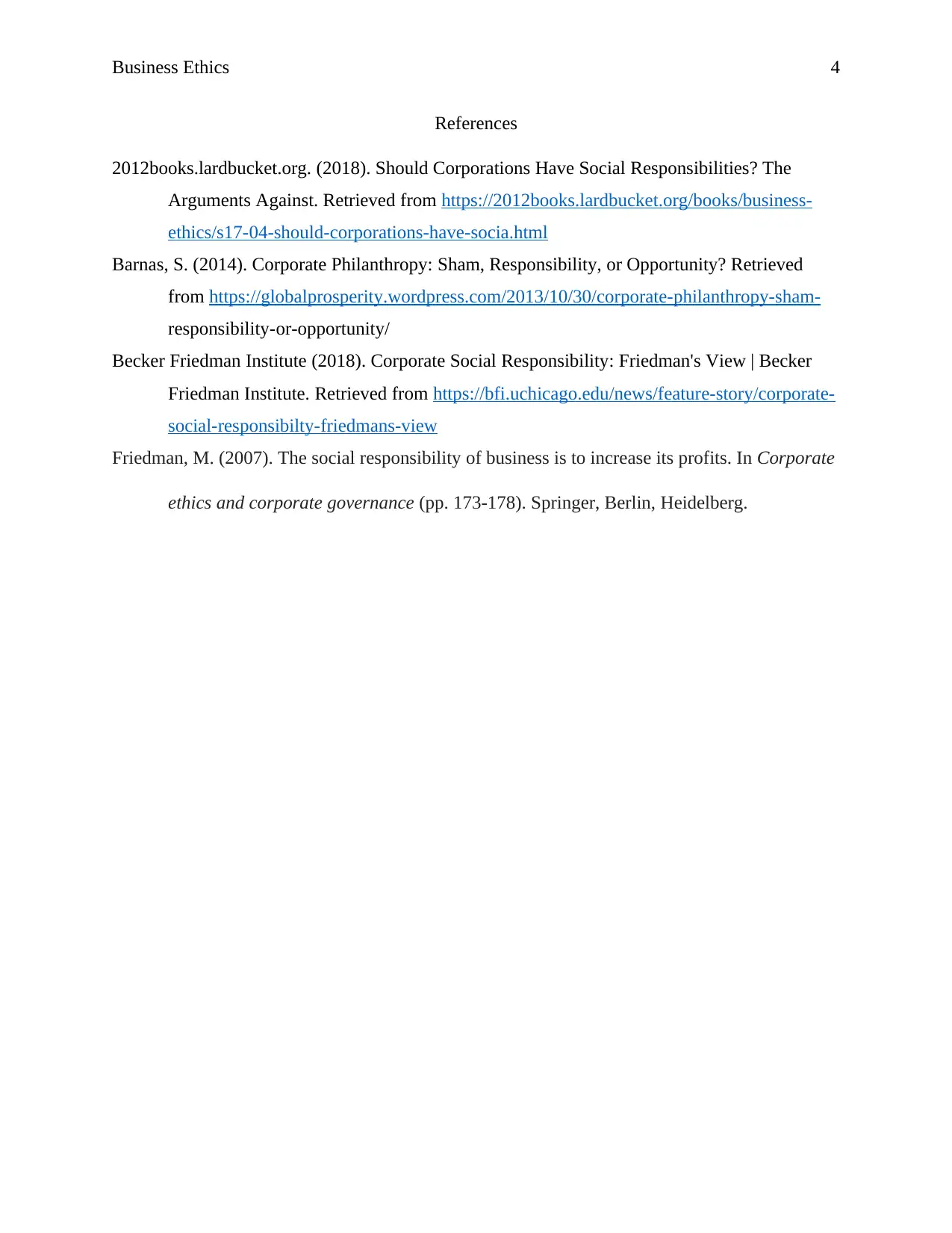
References
2012books.lardbucket.org. (2018). Should Corporations Have Social Responsibilities? The
Arguments Against. Retrieved from https://2012books.lardbucket.org/books/business-
ethics/s17-04-should-corporations-have-socia.html
Barnas, S. (2014). Corporate Philanthropy: Sham, Responsibility, or Opportunity? Retrieved
from https://globalprosperity.wordpress.com/2013/10/30/corporate-philanthropy-sham-
responsibility-or-opportunity/
Becker Friedman Institute (2018). Corporate Social Responsibility: Friedman's View | Becker
Friedman Institute. Retrieved from https://bfi.uchicago.edu/news/feature-story/corporate-
social-responsibilty-friedmans-view
Friedman, M. (2007). The social responsibility of business is to increase its profits. In Corporate
ethics and corporate governance (pp. 173-178). Springer, Berlin, Heidelberg.
chevron_up_icon
1 out of 4
circle_padding
hide_on_mobile
zoom_out_icon
[object Object]