Reflective Portfolio Report: Leadership and CSR Seminar Analysis
VerifiedAdded on 2020/12/30
|8
|2437
|330
Report
AI Summary
This report presents a reflective portfolio analysis focusing on Corporate Social Responsibility (CSR) and leadership, derived from seminar discussions. The student's portfolio explores key concepts such as CSR activities, business ethics, stakeholder engagement, and the role of whistleblowers. The report summarizes the main sources and ideas related to CSR, including business-based social purpose, clear theory of change, and concentrated effort. It also synthesizes the learning about CSR overall, comparing different approaches and highlighting the importance of CSR for businesses. The analysis covers how companies should address cultural and social issues and the need for proper guidelines, especially in low-income countries. The report concludes with an overview of the insights gained and the implications for leadership and responsible business practices.

Reflective Portfolio
Contents
INTRODUCTION...........................................................................................................................3
Task 1...............................................................................................................................................3
Contents
INTRODUCTION...........................................................................................................................3
Task 1...............................................................................................................................................3

Paraphrase This Document
Need a fresh take? Get an instant paraphrase of this document with our AI Paraphraser
a) Summarise the main sources and ideas and SLS topic related to seminar and issues in social
responsibility..........................................................................................................................3
TASK 2............................................................................................................................................6
b) Synthesise the learning about CSR overall and comparison the learning points...............6
CONCLUSION................................................................................................................................7
REFERENCES................................................................................................................................8
INTRODUCTION
Reflective portfolio is important because it develops and summarise the insights about the
practical assignments which is experienced by the students. It reflects the students engagement in
the work. The aim of this report is to analyse the reflective portfolio which is analysed by the
students in the seminar. This report covers the following topics like: reflective approach to
responsibility..........................................................................................................................3
TASK 2............................................................................................................................................6
b) Synthesise the learning about CSR overall and comparison the learning points...............6
CONCLUSION................................................................................................................................7
REFERENCES................................................................................................................................8
INTRODUCTION
Reflective portfolio is important because it develops and summarise the insights about the
practical assignments which is experienced by the students. It reflects the students engagement in
the work. The aim of this report is to analyse the reflective portfolio which is analysed by the
students in the seminar. This report covers the following topics like: reflective approach to
exploring, insights form the SLS discussion and issues in Corporate social responsibility in
depth. Apart from this it also mentioned the synthesis about the CSR and its comparision.
Task 1.
a) Summarise the main sources and ideas and SLS topic related to seminar and issues in social
responsibility
Corporate social responsibility is a responsibility of an organisation which is needed to be
performed by the organisation. A company has operates its business operations in society so it is
the responsibility of the organisation to contributes towards the society (Corporate social
responsibility. 2018). A company is accountable to its stakeholders and the public. If a
corporates has sufficient profits and it is profit making enterprise than it is compulsory to
contribute towards the society and its persons. Reflects portfolio helps the students to write and
summarise the insights and experiences which are gained by the students from the practical
assignment. It reflects the ability of a student to use theoretical knowledge in the applied setting
and shows the interest and engagement of students in the seminar. It can help the to learn new
things and help to develops the practical knowledge in the students. A portfolio itself take many
types of forms which includes notebook, binder of short writing and documentary evidence
(Dana and Yendol-Hoppey, 2014). In the seminar students know about the corporate social
responsibility which is needed to be fulfil by the corporates. In the seminar there are various
topics are also discussed like: business imperatives including competitive differentiation, sales,
leader, attracting and retaining talent, operational efficiency, return on investment and
profitability (Wilhelm, 2016). Roles and objectives of corporate social responsibility are also
discussed in the seminar. In the seminar there are various types of CSR activities are discussed
which are such are follows:
Business based social purpose:
According to the author Walter Block corporate social responsibility is essential for the
company because it helps to improve the image and goodwill of the organisation in front of
persons. People thinks that organisation is concern and think about the persons who lives in a
society. Company can avoid the core business fundamentals to earn more profits. It says that an
organisation can do anything to survive in the market and it can ignore the business
fundamentals. There are various examples in which company has avoid the social purpose to
depth. Apart from this it also mentioned the synthesis about the CSR and its comparision.
Task 1.
a) Summarise the main sources and ideas and SLS topic related to seminar and issues in social
responsibility
Corporate social responsibility is a responsibility of an organisation which is needed to be
performed by the organisation. A company has operates its business operations in society so it is
the responsibility of the organisation to contributes towards the society (Corporate social
responsibility. 2018). A company is accountable to its stakeholders and the public. If a
corporates has sufficient profits and it is profit making enterprise than it is compulsory to
contribute towards the society and its persons. Reflects portfolio helps the students to write and
summarise the insights and experiences which are gained by the students from the practical
assignment. It reflects the ability of a student to use theoretical knowledge in the applied setting
and shows the interest and engagement of students in the seminar. It can help the to learn new
things and help to develops the practical knowledge in the students. A portfolio itself take many
types of forms which includes notebook, binder of short writing and documentary evidence
(Dana and Yendol-Hoppey, 2014). In the seminar students know about the corporate social
responsibility which is needed to be fulfil by the corporates. In the seminar there are various
topics are also discussed like: business imperatives including competitive differentiation, sales,
leader, attracting and retaining talent, operational efficiency, return on investment and
profitability (Wilhelm, 2016). Roles and objectives of corporate social responsibility are also
discussed in the seminar. In the seminar there are various types of CSR activities are discussed
which are such are follows:
Business based social purpose:
According to the author Walter Block corporate social responsibility is essential for the
company because it helps to improve the image and goodwill of the organisation in front of
persons. People thinks that organisation is concern and think about the persons who lives in a
society. Company can avoid the core business fundamentals to earn more profits. It says that an
organisation can do anything to survive in the market and it can ignore the business
fundamentals. There are various examples in which company has avoid the social purpose to
⊘ This is a preview!⊘
Do you want full access?
Subscribe today to unlock all pages.

Trusted by 1+ million students worldwide
fulfil its own requirements (Daunert and Price, 2014). According to the author Campbell
company has introduces its business of producing the soup in new Toronto in the year 1931. It is
famous for the soup and it observes that its more than half employees do not recommend its
products to their friends, relatives and neighbours. The reason that they are not recommend its
products because it was not not healthy. It contains high salt added chicken broth and its are not
Halal certified so no one wants to use it if they are already aware about the ingredients. It shows
that company does not take care about the health of its consumers. CSR responsibility should be
the priority of the organisation if it wants to survive in the society. An organisation should focus
the following things related to the CSR activities which are such as follows:
Company should follow its business purpose and meet its objectives.
It should engage with its people, resource and follow the core business activities.
Organisation should commit towards to fulfil the social responsibility.
Take the needs and interest of the persons who lives in the society.
It says that there are CSR initiative can be reinforce by the organisations business purpose and
seamlessly leverage its operational competencies.
Clear theory of change:
According to the Canada's Healthy Communities there should be health and environment
programme should be designed for the academic leaders so that they can aware about it (Tsingos
and Smith, 2015). Canadian extractive organisation are contributing little to the health sector in
the countries who have low income and it also appraise the performance of Corporate social
responsibility in these countries (Farrell, 2015).Canada's Healthy Communities analyse the
catchment areas of mining operations are typically exposed to a range of adverse health and
social impacts. Pollution in the environment can leads the various diseases like: occupational
diseases. Companies can minimise the adverse impact of these consequences so that health of
persons can be improves. There are health and occupational safety standards are established by
the companies and all employees are needed to follow it so that they does not get affected by the
consequences of it. In poor and low income group countries, They does not much concern about
the health and safety its people. Persons does not aware that their health is getting down if they
work in unhealthy environment. The main problem of these countries are poor governance,
slower macro- economic growth, corruption and inequalities social development. To minimise
the impact of resource curse, there are many development agencies motivates and encourage the
company has introduces its business of producing the soup in new Toronto in the year 1931. It is
famous for the soup and it observes that its more than half employees do not recommend its
products to their friends, relatives and neighbours. The reason that they are not recommend its
products because it was not not healthy. It contains high salt added chicken broth and its are not
Halal certified so no one wants to use it if they are already aware about the ingredients. It shows
that company does not take care about the health of its consumers. CSR responsibility should be
the priority of the organisation if it wants to survive in the society. An organisation should focus
the following things related to the CSR activities which are such as follows:
Company should follow its business purpose and meet its objectives.
It should engage with its people, resource and follow the core business activities.
Organisation should commit towards to fulfil the social responsibility.
Take the needs and interest of the persons who lives in the society.
It says that there are CSR initiative can be reinforce by the organisations business purpose and
seamlessly leverage its operational competencies.
Clear theory of change:
According to the Canada's Healthy Communities there should be health and environment
programme should be designed for the academic leaders so that they can aware about it (Tsingos
and Smith, 2015). Canadian extractive organisation are contributing little to the health sector in
the countries who have low income and it also appraise the performance of Corporate social
responsibility in these countries (Farrell, 2015).Canada's Healthy Communities analyse the
catchment areas of mining operations are typically exposed to a range of adverse health and
social impacts. Pollution in the environment can leads the various diseases like: occupational
diseases. Companies can minimise the adverse impact of these consequences so that health of
persons can be improves. There are health and occupational safety standards are established by
the companies and all employees are needed to follow it so that they does not get affected by the
consequences of it. In poor and low income group countries, They does not much concern about
the health and safety its people. Persons does not aware that their health is getting down if they
work in unhealthy environment. The main problem of these countries are poor governance,
slower macro- economic growth, corruption and inequalities social development. To minimise
the impact of resource curse, there are many development agencies motivates and encourage the
Paraphrase This Document
Need a fresh take? Get an instant paraphrase of this document with our AI Paraphraser
enterprises and corporates to improves the health of persons who lives in its country. Corporates
social responsibility helps the organisation to make and improves its image and goodwill of its
business. Canada stands out as case in point in terms of both its significant market share in the
international extractive enterprises and its regulations and policies aimed at aligning CSR
activities in the extractive industries with the objectives as per the international development.
Concentrated effort:
According to Colin Powell Leaders encourage themselves as well as other people to do
the correct things. According to the author persons are capable to solve only one objective at a
time. Organisation has various social issues but it cannot address all of them. Effective
leadership can help to address the social issues and along with the internal and external resources
with this issue. They set bearing, form a motivating vision, and make something new. Authority
is tied in with mapping out where you have to go to "win" as a group or an association; and it is
dynamic, energizing, and motivating. However, while pioneers set the bearing, they should
likewise utilize administration abilities to direct their kin to the correct goal, in a smooth and
productive way (Howatson-Jones, 2016). In this article, we'll centre around the procedure of
administration. Specifically, we'll examine the "transformational administration" show, first
proposed by James MacGregor Burns and afterwards created by Bernard Bass. This model
features visionary reasoning and realizing change, rather than administration forms that are
intended to keep up and consistently enhance current execution. A whistle blower is a man, who
could be a representative of an organization, or an administration office, revealing data to the
general population or some higher specialist about any awful behaviour, which could be as
extortion, defilement, and so on (Kong and Song, 2015). A shriek blower is a man who
approaches and offers his/her insight on any bad behaviour which he/she supposes is going on in
the entire association or in a particular office. Whistle blower could be a worker, temporary
worker, or a provider who winds up mindful of any unlawful exercises. The Government
Department of Business, Innovation and Skills (BIS) characterize corporate social duty as the
obligation of an association for the effects of its choices and exercises on society and nature
through straightforward and moral conduct well beyond its statutory necessities.
https://www.sciencedirect.com/science/article/pii/S2214790X17300539
social responsibility helps the organisation to make and improves its image and goodwill of its
business. Canada stands out as case in point in terms of both its significant market share in the
international extractive enterprises and its regulations and policies aimed at aligning CSR
activities in the extractive industries with the objectives as per the international development.
Concentrated effort:
According to Colin Powell Leaders encourage themselves as well as other people to do
the correct things. According to the author persons are capable to solve only one objective at a
time. Organisation has various social issues but it cannot address all of them. Effective
leadership can help to address the social issues and along with the internal and external resources
with this issue. They set bearing, form a motivating vision, and make something new. Authority
is tied in with mapping out where you have to go to "win" as a group or an association; and it is
dynamic, energizing, and motivating. However, while pioneers set the bearing, they should
likewise utilize administration abilities to direct their kin to the correct goal, in a smooth and
productive way (Howatson-Jones, 2016). In this article, we'll centre around the procedure of
administration. Specifically, we'll examine the "transformational administration" show, first
proposed by James MacGregor Burns and afterwards created by Bernard Bass. This model
features visionary reasoning and realizing change, rather than administration forms that are
intended to keep up and consistently enhance current execution. A whistle blower is a man, who
could be a representative of an organization, or an administration office, revealing data to the
general population or some higher specialist about any awful behaviour, which could be as
extortion, defilement, and so on (Kong and Song, 2015). A shriek blower is a man who
approaches and offers his/her insight on any bad behaviour which he/she supposes is going on in
the entire association or in a particular office. Whistle blower could be a worker, temporary
worker, or a provider who winds up mindful of any unlawful exercises. The Government
Department of Business, Innovation and Skills (BIS) characterize corporate social duty as the
obligation of an association for the effects of its choices and exercises on society and nature
through straightforward and moral conduct well beyond its statutory necessities.
https://www.sciencedirect.com/science/article/pii/S2214790X17300539
TASK 2.
b) Synthesise the learning about CSR overall and comparison the learning points
Corporate social responsibility helps the company to fulfil its social obligations towards the
society. It is the responsibility of the organisation to take necessary steps to ensure about the
positive social and environmental effects associated with the way in which business operates. It
is essential for the company to address cultural and social issues so that a good and healthy
society can be developed (Lam, 2014). All corporate has its own CSR models and according to
that they fulfil it. It is mandatory for the enterprises to contribute certain amount or percentage
out of its overall profits towards the corporate social responsibility. It shows the company’s
culture and values towards the society and its people. CSR helps the cooperates to build good
image in front of public and it’s develop the faith and beliefs into the market about the company.
It also help to improve the goodwill of the business. There are various types of CSR activities
which can be performed by the organisations and there are various compliances which are
needed to be fulfilled. It includes labour and social security arrangements, human right standards,
consumer protection etc. These all things are necessary to manage properly. Some countries does
not follow the CSR guidelines because lack of appropriate information about it. A mostly low
income group nation does not follow the instructions regarding corporate social responsibility
because they does not aware the consequences of it. So it is important to aware those countries
who does not much aware about the CSR activities and the consequences of it when any
organisations does not involve in the corporate social responsibility (Mummalaneni, 2014).
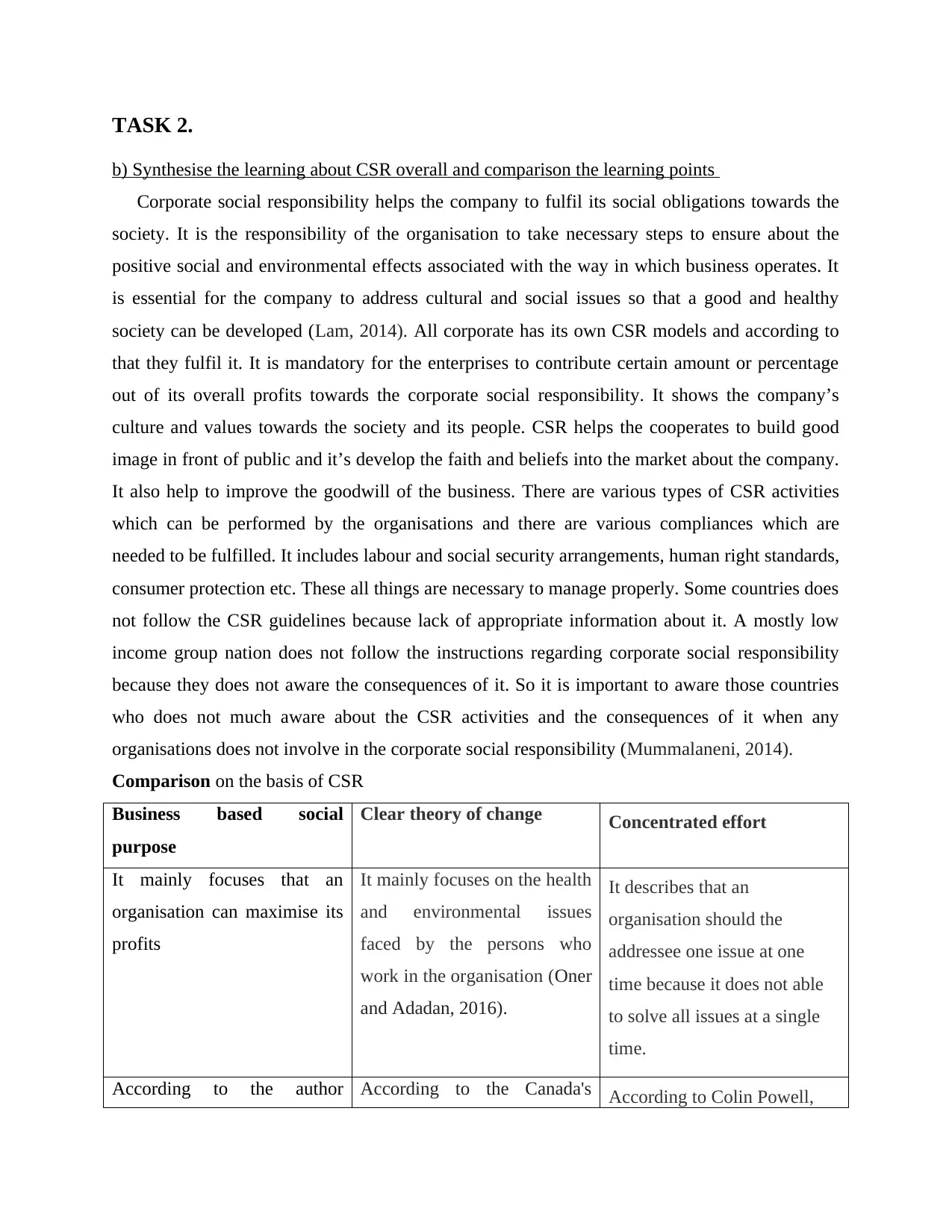
Comparison on the basis of CSR
Business based social
purpose
Clear theory of change Concentrated effort
It mainly focuses that an
organisation can maximise its
profits
It mainly focuses on the health
and environmental issues
faced by the persons who
work in the organisation (Oner
and Adadan, 2016).
It describes that an
organisation should the
addressee one issue at one
time because it does not able
to solve all issues at a single
time.
According to the author According to the Canada's According to Colin Powell,
b) Synthesise the learning about CSR overall and comparison the learning points
Corporate social responsibility helps the company to fulfil its social obligations towards the
society. It is the responsibility of the organisation to take necessary steps to ensure about the
positive social and environmental effects associated with the way in which business operates. It
is essential for the company to address cultural and social issues so that a good and healthy
society can be developed (Lam, 2014). All corporate has its own CSR models and according to
that they fulfil it. It is mandatory for the enterprises to contribute certain amount or percentage
out of its overall profits towards the corporate social responsibility. It shows the company’s
culture and values towards the society and its people. CSR helps the cooperates to build good
image in front of public and it’s develop the faith and beliefs into the market about the company.
It also help to improve the goodwill of the business. There are various types of CSR activities
which can be performed by the organisations and there are various compliances which are
needed to be fulfilled. It includes labour and social security arrangements, human right standards,
consumer protection etc. These all things are necessary to manage properly. Some countries does
not follow the CSR guidelines because lack of appropriate information about it. A mostly low
income group nation does not follow the instructions regarding corporate social responsibility
because they does not aware the consequences of it. So it is important to aware those countries
who does not much aware about the CSR activities and the consequences of it when any
organisations does not involve in the corporate social responsibility (Mummalaneni, 2014).
Comparison on the basis of CSR
Business based social
purpose
Clear theory of change Concentrated effort
It mainly focuses that an
organisation can maximise its
profits
It mainly focuses on the health
and environmental issues
faced by the persons who
work in the organisation (Oner
and Adadan, 2016).
It describes that an
organisation should the
addressee one issue at one
time because it does not able
to solve all issues at a single
time.
According to the author According to the Canada's According to Colin Powell,
⊘ This is a preview!⊘
Do you want full access?
Subscribe today to unlock all pages.
Trusted by 1+ million students worldwide
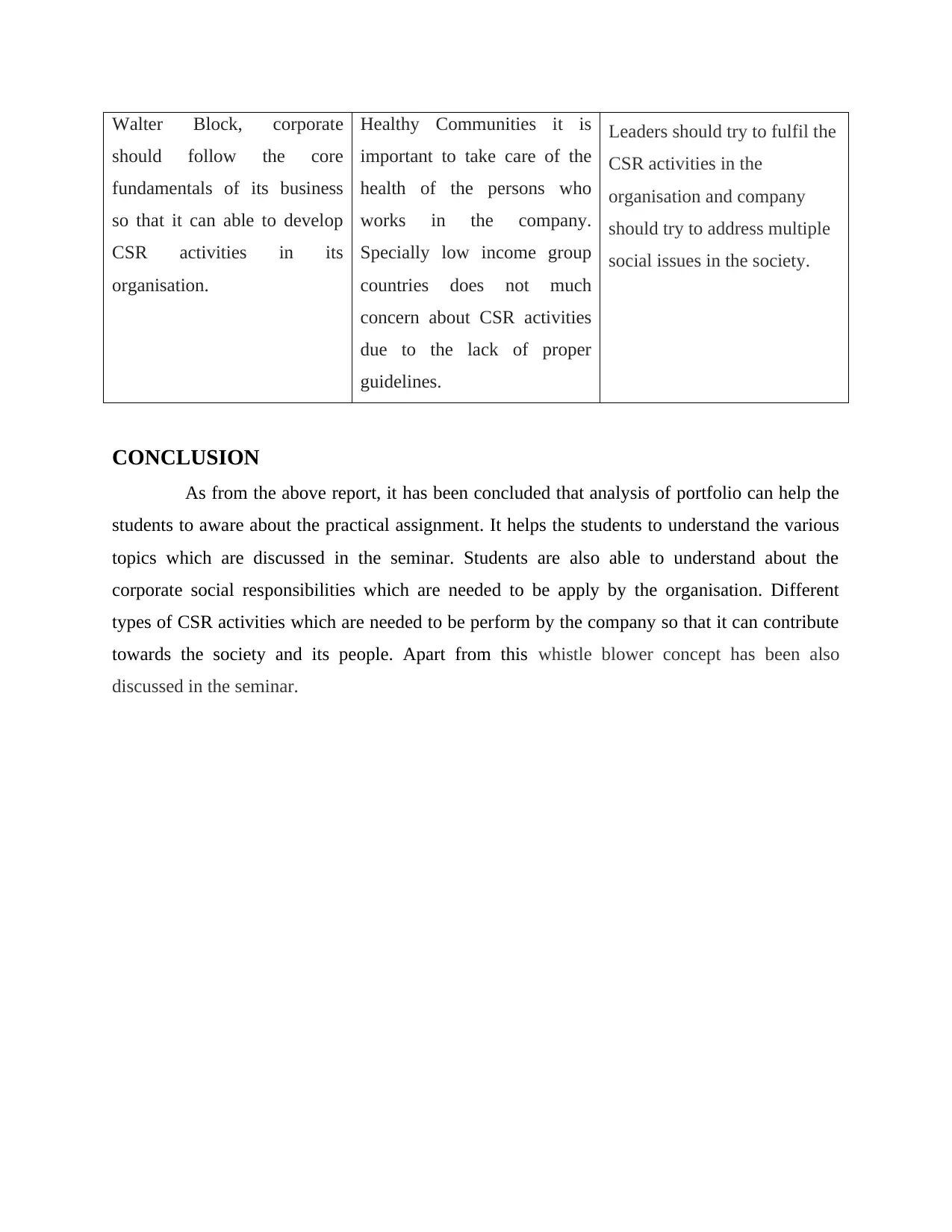
Walter Block, corporate
should follow the core
fundamentals of its business
so that it can able to develop
CSR activities in its
organisation.
Healthy Communities it is
important to take care of the
health of the persons who
works in the company.
Specially low income group
countries does not much
concern about CSR activities
due to the lack of proper
guidelines.
Leaders should try to fulfil the
CSR activities in the
organisation and company
should try to address multiple
social issues in the society.
CONCLUSION
As from the above report, it has been concluded that analysis of portfolio can help the
students to aware about the practical assignment. It helps the students to understand the various
topics which are discussed in the seminar. Students are also able to understand about the
corporate social responsibilities which are needed to be apply by the organisation. Different
types of CSR activities which are needed to be perform by the company so that it can contribute
towards the society and its people. Apart from this whistle blower concept has been also
discussed in the seminar.
should follow the core
fundamentals of its business
so that it can able to develop
CSR activities in its
organisation.
Healthy Communities it is
important to take care of the
health of the persons who
works in the company.
Specially low income group
countries does not much
concern about CSR activities
due to the lack of proper
guidelines.
Leaders should try to fulfil the
CSR activities in the
organisation and company
should try to address multiple
social issues in the society.
CONCLUSION
As from the above report, it has been concluded that analysis of portfolio can help the
students to aware about the practical assignment. It helps the students to understand the various
topics which are discussed in the seminar. Students are also able to understand about the
corporate social responsibilities which are needed to be apply by the organisation. Different
types of CSR activities which are needed to be perform by the company so that it can contribute
towards the society and its people. Apart from this whistle blower concept has been also
discussed in the seminar.
Paraphrase This Document
Need a fresh take? Get an instant paraphrase of this document with our AI Paraphraser
REFERENCES
Books and Journals
Dana, N. F. and Yendol-Hoppey, D., 2014. The reflective educator's guide to classroom
research: Learning to teach and teaching to learn through practitioner inquiry. Corwin
Press.
Daunert, A. L. and Price, L., 2014. E-portfolio: a practical tool for self-directed, reflective, and
collaborative professional learning. In Discourses on professional learning (pp. 231-
251). Springer, Dordrecht.
Farrell, T. S., 2015. Reflective language teaching: From research to practice. Bloomsbury
Publishing.
Howatson-Jones, L., 2016. Reflective practice in nursing. Learning Matters.
Kong, S. C. and Song, Y., 2015. An experience of personalized learning hub initiative
embedding BYOD for reflective engagement in higher education. Computers &
Education. 88. pp.227-240.
Lam, R., 2014. Promoting self-regulated learning through portfolio assessment: Testimony and
recommendations. Assessment & Evaluation in Higher Education. 39(6). pp.699-714.
Mummalaneni, V., 2014. Reflective essay and e-portfolio to promote and assess student learning
in a capstone marketing course. Marketing Education Review. 24(1). pp.43-46.
Oner, D. and Adadan, E., 2016. Are integrated portfolio systems the answer? An evaluation of a
web-based portfolio system to improve preservice teachers’ reflective thinking skills.
Journal of Computing in Higher Education. 28(2). pp.236-260.
Tsingos, C., Bosnic-Anticevich, S. and Smith, L., 2015. Learning styles and approaches: Can
reflective strategies encourage deep learning?. Currents in Pharmacy Teaching and
Learning. 7(4). pp.492-504.
Wilhelm, J. D., 2016. " You gotta be the book": teaching engaged and reflective reading with
adolescents. Teachers College Press.
Online
Corporate social responsibility. 2018. [Online]. Available Through:
< https://www.investopedia.com/terms/c/corp-social-responsibility.asp>
Books and Journals
Dana, N. F. and Yendol-Hoppey, D., 2014. The reflective educator's guide to classroom
research: Learning to teach and teaching to learn through practitioner inquiry. Corwin
Press.
Daunert, A. L. and Price, L., 2014. E-portfolio: a practical tool for self-directed, reflective, and
collaborative professional learning. In Discourses on professional learning (pp. 231-
251). Springer, Dordrecht.
Farrell, T. S., 2015. Reflective language teaching: From research to practice. Bloomsbury
Publishing.
Howatson-Jones, L., 2016. Reflective practice in nursing. Learning Matters.
Kong, S. C. and Song, Y., 2015. An experience of personalized learning hub initiative
embedding BYOD for reflective engagement in higher education. Computers &
Education. 88. pp.227-240.
Lam, R., 2014. Promoting self-regulated learning through portfolio assessment: Testimony and
recommendations. Assessment & Evaluation in Higher Education. 39(6). pp.699-714.
Mummalaneni, V., 2014. Reflective essay and e-portfolio to promote and assess student learning
in a capstone marketing course. Marketing Education Review. 24(1). pp.43-46.
Oner, D. and Adadan, E., 2016. Are integrated portfolio systems the answer? An evaluation of a
web-based portfolio system to improve preservice teachers’ reflective thinking skills.
Journal of Computing in Higher Education. 28(2). pp.236-260.
Tsingos, C., Bosnic-Anticevich, S. and Smith, L., 2015. Learning styles and approaches: Can
reflective strategies encourage deep learning?. Currents in Pharmacy Teaching and
Learning. 7(4). pp.492-504.
Wilhelm, J. D., 2016. " You gotta be the book": teaching engaged and reflective reading with
adolescents. Teachers College Press.
Online
Corporate social responsibility. 2018. [Online]. Available Through:
< https://www.investopedia.com/terms/c/corp-social-responsibility.asp>

1 out of 8


Related Documents


Your All-in-One AI-Powered Toolkit for Academic Success.
+13062052269
info@desklib.com
Available 24*7 on WhatsApp / Email
![[object Object]](/_next/static/media/star-bottom.7253800d.svg)
Unlock your academic potential
Copyright © 2020–2026 A2Z Services. All Rights Reserved. Developed and managed by ZUCOL.