Corporate Social Responsibility: An Analysis of Siemens' Scandal
VerifiedAdded on 2023/06/05
|9
|2135
|358
Report
AI Summary
This report provides an in-depth analysis of the Corporate Social Responsibility (CSR) crisis faced by Siemens, a German engineering giant, stemming from a bribery scandal that involved millions of Euros. The report examines the systemic nature of the corruption, including the use of false bills and shell firms to disguise bribes paid to secure contracts, violating legal, ethical, and cultural CSR responsibilities. It details Siemens' response to the crisis, including internal and external investigations, the appointment of anti-corruption advisors, and the implementation of new CSR policies and compliance programs. The analysis applies the theory of legal responsibility, highlighting Siemens' efforts to ensure employee adherence to legal practices. It reflects on the actions taken, suggesting additional measures such as specialized training for managers and contract terminations to underscore the seriousness of the issue. The report concludes by emphasizing the importance of ethical conduct and the need for proactive measures to prevent future CSR crises, offering valuable insights into corporate governance and responsibility.
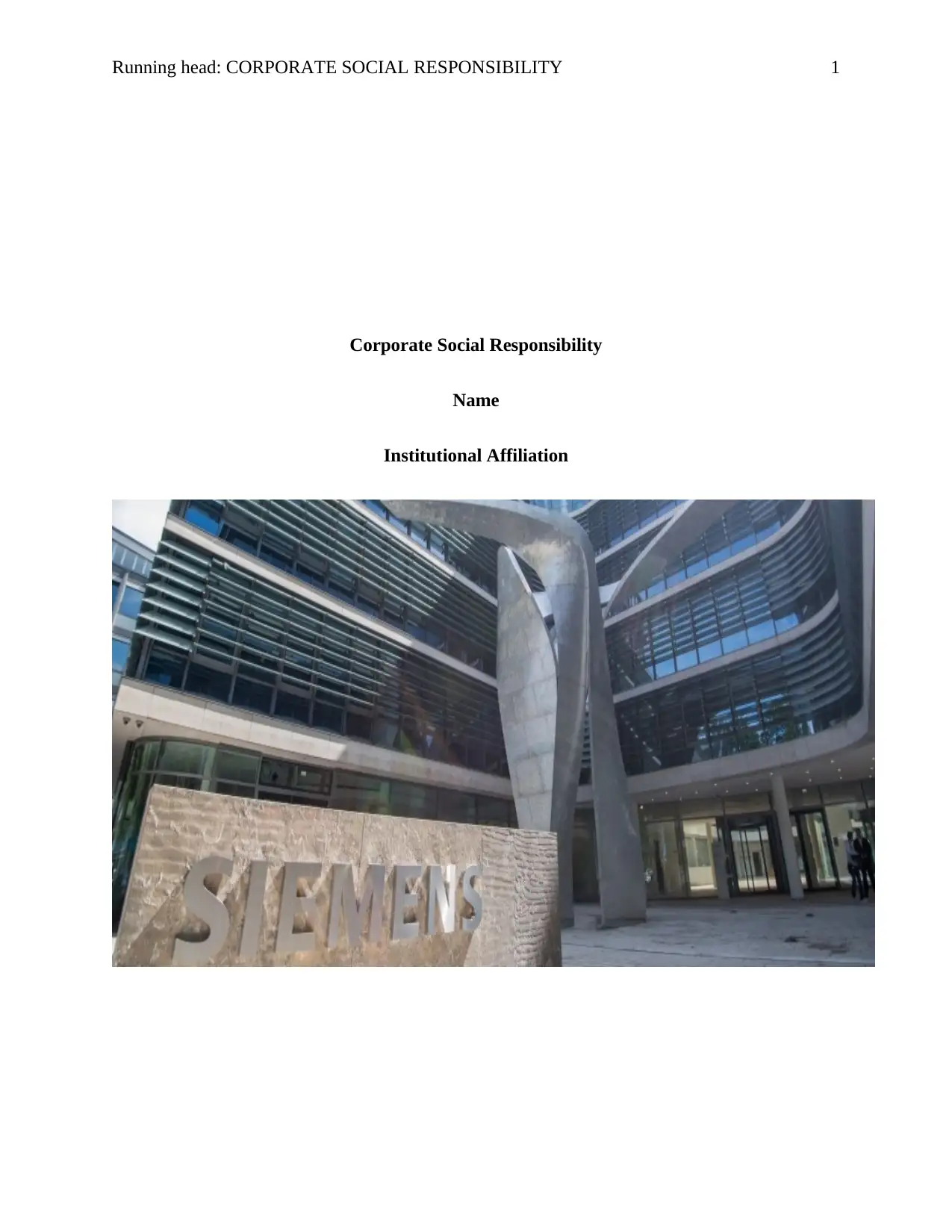
Running head: CORPORATE SOCIAL RESPONSIBILITY 1
Corporate Social Responsibility
Name
Institutional Affiliation
Corporate Social Responsibility
Name
Institutional Affiliation

Paraphrase This Document
Need a fresh take? Get an instant paraphrase of this document with our AI Paraphraser
CORPORATE SOCIAL RESPONSIBILITY 2
Introduction of the Chosen Media Report
Corporate social responsibility is an approach to business whereby organizations are urged to
make a contribution in achieving sustainable development through the deliverance of social,
environmental and economic gains to all stakeholders. CSR is a broad field that covers a variety
of aspects such as corporate governance, environmental effects, human rights, contribution to
economic development, working conditions, as well as health and safety. Different companies
around the globe implement different CSR initiatives and thus the reason why the levels of social
responsibility achievements vary in various companies. It can, therefore, be conclusively said
that Corporate Social Responsibility is some form of drive that steers organizations towards
being aware of how their undertakings will affect the rest of the society, inclusive of all
stakeholders and the environment. This essay will base its arguments on a post from The
Guardian dated Monday 26th, 2012. The post is titled “Rebuilding trust: How Siemens atoned for
its sins” and explains how Siemens, a German conglomerate was caught up in a series of CSR
crisis and how it responded to the same (Dietz & Gillespie, 2012).
Identification of CSR Issues
It was not until November 2006 when investigations by the regulators of Siemens, a German
engineering giant, made revelations about the about the millions of Euros being siphoned by
hundreds of employees. But how and on what basis? The employees would disguise the
disbursements as false bills, shell firms, and ‘phony consultants' contracts whereas in the real
sense they were bribes being paid to various contract awardees. The main intentions were to
increase their chances of winning contracts. It is a legal offense to give and receive bribes for
whatever reasons. It is also ethically and morally wrong because bribes reduce the chances of
winning a contract for the legally qualified party and the contract goes to the party that has given
Introduction of the Chosen Media Report
Corporate social responsibility is an approach to business whereby organizations are urged to
make a contribution in achieving sustainable development through the deliverance of social,
environmental and economic gains to all stakeholders. CSR is a broad field that covers a variety
of aspects such as corporate governance, environmental effects, human rights, contribution to
economic development, working conditions, as well as health and safety. Different companies
around the globe implement different CSR initiatives and thus the reason why the levels of social
responsibility achievements vary in various companies. It can, therefore, be conclusively said
that Corporate Social Responsibility is some form of drive that steers organizations towards
being aware of how their undertakings will affect the rest of the society, inclusive of all
stakeholders and the environment. This essay will base its arguments on a post from The
Guardian dated Monday 26th, 2012. The post is titled “Rebuilding trust: How Siemens atoned for
its sins” and explains how Siemens, a German conglomerate was caught up in a series of CSR
crisis and how it responded to the same (Dietz & Gillespie, 2012).
Identification of CSR Issues
It was not until November 2006 when investigations by the regulators of Siemens, a German
engineering giant, made revelations about the about the millions of Euros being siphoned by
hundreds of employees. But how and on what basis? The employees would disguise the
disbursements as false bills, shell firms, and ‘phony consultants' contracts whereas in the real
sense they were bribes being paid to various contract awardees. The main intentions were to
increase their chances of winning contracts. It is a legal offense to give and receive bribes for
whatever reasons. It is also ethically and morally wrong because bribes reduce the chances of
winning a contract for the legally qualified party and the contract goes to the party that has given
CORPORATE SOCIAL RESPONSIBILITY 3
bribes. The acts were, therefore, a total violation of the legal, cultural, and ethical corporate
social responsibilities that the companies owe all its stakeholders as discussed henceforth in
details.
A description of the act by a trial judge was "a system of organized irresponsibility that was
implicitly condoned." The judge made these sentiments because investigations revealed that
managers were the key masterminds behind these shameful acts (Dietz & Gillespie, 2012).
Removable sticky notes were used by senior managers to authorize documents of potential
incrimination. This scandal was a shame not only to Siemens but also to various stakeholders and
investors who were raging with furiousness. The act also brought with it an enormous
humiliation to the organization's employees, even to those who were innocent and had played no
part in the wicked act. The integrity of the firm became questionable henceforth with intense
scrutiny being imparted on its trustworthiness. The leadership more so became of great interest
to various ethics and anti-corruption bodies. Siemen, however, responded fully to the issue and
the approach that it adopted became acceptable by a majority of ethics and anti-corruption
bodies. The US Federal Authorities and the Organization for Economic Co-operation and
Development were among the bodies that praised Siemens for its approach to the issue.
Application of Theory to Justify Various Actions.
Initially, Siemens claimed that the issue involved only a few million. In a month's time, however,
the company had calculated an estimate of 350 million Euros as the involved amount. The
executives had all this time denied their involvement and awareness of the issue. With, however,
transparency prevailed. In addition to four international investigations that were conducted, a
New York law firm, Debevoise & Plimpton, was hired by Siemens to conduct an internal inquiry
into the issue. Clear revelations came into the limelight the following year after the departure of
bribes. The acts were, therefore, a total violation of the legal, cultural, and ethical corporate
social responsibilities that the companies owe all its stakeholders as discussed henceforth in
details.
A description of the act by a trial judge was "a system of organized irresponsibility that was
implicitly condoned." The judge made these sentiments because investigations revealed that
managers were the key masterminds behind these shameful acts (Dietz & Gillespie, 2012).
Removable sticky notes were used by senior managers to authorize documents of potential
incrimination. This scandal was a shame not only to Siemens but also to various stakeholders and
investors who were raging with furiousness. The act also brought with it an enormous
humiliation to the organization's employees, even to those who were innocent and had played no
part in the wicked act. The integrity of the firm became questionable henceforth with intense
scrutiny being imparted on its trustworthiness. The leadership more so became of great interest
to various ethics and anti-corruption bodies. Siemen, however, responded fully to the issue and
the approach that it adopted became acceptable by a majority of ethics and anti-corruption
bodies. The US Federal Authorities and the Organization for Economic Co-operation and
Development were among the bodies that praised Siemens for its approach to the issue.
Application of Theory to Justify Various Actions.
Initially, Siemens claimed that the issue involved only a few million. In a month's time, however,
the company had calculated an estimate of 350 million Euros as the involved amount. The
executives had all this time denied their involvement and awareness of the issue. With, however,
transparency prevailed. In addition to four international investigations that were conducted, a
New York law firm, Debevoise & Plimpton, was hired by Siemens to conduct an internal inquiry
into the issue. Clear revelations came into the limelight the following year after the departure of
⊘ This is a preview!⊘
Do you want full access?
Subscribe today to unlock all pages.

Trusted by 1+ million students worldwide
CORPORATE SOCIAL RESPONSIBILITY 4
Klaus Kleinfeld, the then CEO and Heinrich Von Pierer- chairman. Peter Loscher, Kleinfield’s
successor announced an amnesty valid for one month for employees. Incriminating evidence was
then received from about 40 whistleblowers, all which extended participation to the previous
board.
There are various reasons that could have probably resulted in the emergence of the crisis. The
most significant one is the existence of aggressive growth strategies (Loughman & Sibery,
2011). It is the desire of many managers to see their assigned units growing and acquiring the
maximum market share and value. Subsequently, Siemens managers could have been compelled
to giving bribes as a short-cut of achieving tough performance targets (Wells & Hymes, 2012).
Also, a complex structure of a matrix-like form that made it possible for divisions to run
themselves independently could be another contributor (Søreide, 2014). Poor accounting
management is also to blame for they would have identified incorrect recordings and
expenditures. Above all, perhaps employees had developed a feeling that bribes were acceptable
and encouraged due to the open tolerance of bribes by the then Siemens’ corporate culture as
explained by (Manacorda, Centonze, & Forti, 2014).
To show its seriousness on the issue, and the desire to affiliate itself with an anti-corruption
expert, Siemens appointed Transparency International’s co-founder, Michael Hershman as its
adviser. The conglomerate further made bold steps forward and developed new Corporate Social
Responsibility policies as supported by (Carr & Outhwaite, 2015). Amongst them, anti-
corruption and compliant processes, as well as new and strict rules, were coined. The number of
compliance officers was adjusted from 86 to 500 through new full-time hiring. A former
International Police (Interpol) official was also hired as the head of the newly formed unit of
investigation. Compliance hotlines, as well as an external online worldwide ombudsman, were
Klaus Kleinfeld, the then CEO and Heinrich Von Pierer- chairman. Peter Loscher, Kleinfield’s
successor announced an amnesty valid for one month for employees. Incriminating evidence was
then received from about 40 whistleblowers, all which extended participation to the previous
board.
There are various reasons that could have probably resulted in the emergence of the crisis. The
most significant one is the existence of aggressive growth strategies (Loughman & Sibery,
2011). It is the desire of many managers to see their assigned units growing and acquiring the
maximum market share and value. Subsequently, Siemens managers could have been compelled
to giving bribes as a short-cut of achieving tough performance targets (Wells & Hymes, 2012).
Also, a complex structure of a matrix-like form that made it possible for divisions to run
themselves independently could be another contributor (Søreide, 2014). Poor accounting
management is also to blame for they would have identified incorrect recordings and
expenditures. Above all, perhaps employees had developed a feeling that bribes were acceptable
and encouraged due to the open tolerance of bribes by the then Siemens’ corporate culture as
explained by (Manacorda, Centonze, & Forti, 2014).
To show its seriousness on the issue, and the desire to affiliate itself with an anti-corruption
expert, Siemens appointed Transparency International’s co-founder, Michael Hershman as its
adviser. The conglomerate further made bold steps forward and developed new Corporate Social
Responsibility policies as supported by (Carr & Outhwaite, 2015). Amongst them, anti-
corruption and compliant processes, as well as new and strict rules, were coined. The number of
compliance officers was adjusted from 86 to 500 through new full-time hiring. A former
International Police (Interpol) official was also hired as the head of the newly formed unit of
investigation. Compliance hotlines, as well as an external online worldwide ombudsman, were
Paraphrase This Document
Need a fresh take? Get an instant paraphrase of this document with our AI Paraphraser
CORPORATE SOCIAL RESPONSIBILITY 5
established. All these steps undertaken by the firm to fight the crisis conforms to the theory of
legal responsibility which states that all corporations are to be responsible for all actions
undertaken in their premises (Kelsen, 2009). It further states that it is upon a corporation to
ensure that its employees perform their duties in legally acceptable ways.
Further on, a comprehensive anti-corruption education and training program was launched by
Siemens to impart knowledge on its workforce as supported by (Idowu, 2015). It had managed to
educate half of its 40000o workers by 2008. The complex matrix structure of the company was
replaced by a more streamlined structure which was made up of only three divisions. The
managing directors sat on the board. Bank account documents, transactions, and statements were
reviewed and loopholes identified. In addition to the aforementioned steps that were taken to
fight bribery by Siemens, there are a variety of theoretical frameworks that have been coined to
fight bribery and corruption in general. First, it is suggested third parties should be monitored
closely since they are the most common means through which bribes are obscured (Biegelman &
Biegelman, 2010). Another step would be to follow money closely. For bribery to occur in a
certain department, the firm's money must be accessible to that department. Authorization for
payments should, therefore, be limited to relevant officials only.
Personal Reflection on how Issues were handled.
In my opinion, the departure of CEO Kleinfeld and Chairman Pierer was a much-needed step for
the sake of Siemens. The steps that Loscher adopted to solve the crisis were justifiable and
legally right. Coining new rules ensured that severe disciplinary measures would be taken on
employees caught indulging in similar bribery situations as well as other fraudulent acts.
Implementation of anti-corruption and various compliance processes ensured that employees
worked in systems that had no room for corruption. I, therefore, view this as another self-
established. All these steps undertaken by the firm to fight the crisis conforms to the theory of
legal responsibility which states that all corporations are to be responsible for all actions
undertaken in their premises (Kelsen, 2009). It further states that it is upon a corporation to
ensure that its employees perform their duties in legally acceptable ways.
Further on, a comprehensive anti-corruption education and training program was launched by
Siemens to impart knowledge on its workforce as supported by (Idowu, 2015). It had managed to
educate half of its 40000o workers by 2008. The complex matrix structure of the company was
replaced by a more streamlined structure which was made up of only three divisions. The
managing directors sat on the board. Bank account documents, transactions, and statements were
reviewed and loopholes identified. In addition to the aforementioned steps that were taken to
fight bribery by Siemens, there are a variety of theoretical frameworks that have been coined to
fight bribery and corruption in general. First, it is suggested third parties should be monitored
closely since they are the most common means through which bribes are obscured (Biegelman &
Biegelman, 2010). Another step would be to follow money closely. For bribery to occur in a
certain department, the firm's money must be accessible to that department. Authorization for
payments should, therefore, be limited to relevant officials only.
Personal Reflection on how Issues were handled.
In my opinion, the departure of CEO Kleinfeld and Chairman Pierer was a much-needed step for
the sake of Siemens. The steps that Loscher adopted to solve the crisis were justifiable and
legally right. Coining new rules ensured that severe disciplinary measures would be taken on
employees caught indulging in similar bribery situations as well as other fraudulent acts.
Implementation of anti-corruption and various compliance processes ensured that employees
worked in systems that had no room for corruption. I, therefore, view this as another self-
CORPORATE SOCIAL RESPONSIBILITY 6
justifiable measure. Hiring more compliance officers ensured that all compliance and anti-
corruption processes adhered to the letter. If I would be in charge, I would have done the same.
Offering education and training programs on corruption is another activity that I fully concur
with. Lastly, I also agree with the steps taken to replace the complex matrix structure, and to
review bank account documents, statements and transactions.
Conclusion and suggestions.
In conclusion, Siemens, an engineering giant headquartered in Germany, has been identified as a
multinational company that has faced Corporate Social Responsibility crisis. The crisis affected
the organization's legal, ethical and cultural operations. On the legal side, the corporation was hit
when employees participated in bribe giving so as to win various contracts. This is an illegal act
against the laws of various nations. Ethically, it is wrong to give bribes in order to get privileges
or opportunities that one does not deserve. On the cultural sector, the firm’s management had
developed a culture where giving bribes was condoned. The managers actively and openly
encouraged it. The various steps that were embarked on to solve the crisis have also been
discussed in details. Development of new rules that were strict, as well as anti-corruption and
compliance procedures, is one intervention that worked out perfectly for the organization. It has
also been mentioned that training and educational programs were initiated to create awareness on
anti-corruption policies.
When handling the issue, however, the company would have considered taking the managers of
various departments and division for training and education separately (Barnes, 2008). Since
they were the individuals who had built the bribe giving culture, and being the leaders in the
firm, they required comprehensive education. The executive would have also considered
terminating the contracts that had been won after giving bribes and had not yet been performed.
justifiable measure. Hiring more compliance officers ensured that all compliance and anti-
corruption processes adhered to the letter. If I would be in charge, I would have done the same.
Offering education and training programs on corruption is another activity that I fully concur
with. Lastly, I also agree with the steps taken to replace the complex matrix structure, and to
review bank account documents, statements and transactions.
Conclusion and suggestions.
In conclusion, Siemens, an engineering giant headquartered in Germany, has been identified as a
multinational company that has faced Corporate Social Responsibility crisis. The crisis affected
the organization's legal, ethical and cultural operations. On the legal side, the corporation was hit
when employees participated in bribe giving so as to win various contracts. This is an illegal act
against the laws of various nations. Ethically, it is wrong to give bribes in order to get privileges
or opportunities that one does not deserve. On the cultural sector, the firm’s management had
developed a culture where giving bribes was condoned. The managers actively and openly
encouraged it. The various steps that were embarked on to solve the crisis have also been
discussed in details. Development of new rules that were strict, as well as anti-corruption and
compliance procedures, is one intervention that worked out perfectly for the organization. It has
also been mentioned that training and educational programs were initiated to create awareness on
anti-corruption policies.
When handling the issue, however, the company would have considered taking the managers of
various departments and division for training and education separately (Barnes, 2008). Since
they were the individuals who had built the bribe giving culture, and being the leaders in the
firm, they required comprehensive education. The executive would have also considered
terminating the contracts that had been won after giving bribes and had not yet been performed.
⊘ This is a preview!⊘
Do you want full access?
Subscribe today to unlock all pages.
Trusted by 1+ million students worldwide
CORPORATE SOCIAL RESPONSIBILITY 7
This would have been an indicator of their seriousness and how much they wanted not to be
associated with corruption.
This would have been an indicator of their seriousness and how much they wanted not to be
associated with corruption.
Paraphrase This Document
Need a fresh take? Get an instant paraphrase of this document with our AI Paraphraser
CORPORATE SOCIAL RESPONSIBILITY 8
References
Barnes, D. (2008). Operations Management: An International Perspective (illustrated ed.).
Cengage Learning EMEA.
Biegelman, M. T., & Biegelman, D. R. (2010). Foreign Corrupt Practices Act Compliance
Guidebook: Protecting Your Organization from Bribery and Corruption (illustrated ed.).
John Wiley & Sons.
Carr, I., & Outhwaite, O. (2015, May 07). Controlling Corruption through Corporate Social
Responsibility and Corporate Governance: Theory and Practice. Journal of Corporate
Law Studies, 11(2). Retrieved October 2, 2018, from
https://www.tandfonline.com/doi/abs/10.5235/147359711798110592?
journalCode=rcls20
Dietz, G., & Gillespie, N. (2012, March 26). Guardian sustainable business - Rebuilding trust:
How Siemens atoned for its sins. Retrieved from The Guardian:
https://www.theguardian.com/sustainable-business/recovering-business-trust-siemens
Idowu, S. O. (2015). Key Initiatives in Corporate Social Responsibility: Global Dimension of
CSR in Corporate Entities (illustrated ed.). Springer.
Kelsen, H. (2009). General Theory of Law and State. The Lawbook Exchange, Ltd.
Loughman, B. P., & Sibery, R. A. (2011). Bribery and Corruption: Navigating the Global Risks
(illustrated ed.). John Wiley & Sons.
Manacorda, S., Centonze, F., & Forti, G. (2014). Preventing Corporate Corruption: The Anti-
Bribery Compliance Model (illustrated ed.). Springer Science & Business.
References
Barnes, D. (2008). Operations Management: An International Perspective (illustrated ed.).
Cengage Learning EMEA.
Biegelman, M. T., & Biegelman, D. R. (2010). Foreign Corrupt Practices Act Compliance
Guidebook: Protecting Your Organization from Bribery and Corruption (illustrated ed.).
John Wiley & Sons.
Carr, I., & Outhwaite, O. (2015, May 07). Controlling Corruption through Corporate Social
Responsibility and Corporate Governance: Theory and Practice. Journal of Corporate
Law Studies, 11(2). Retrieved October 2, 2018, from
https://www.tandfonline.com/doi/abs/10.5235/147359711798110592?
journalCode=rcls20
Dietz, G., & Gillespie, N. (2012, March 26). Guardian sustainable business - Rebuilding trust:
How Siemens atoned for its sins. Retrieved from The Guardian:
https://www.theguardian.com/sustainable-business/recovering-business-trust-siemens
Idowu, S. O. (2015). Key Initiatives in Corporate Social Responsibility: Global Dimension of
CSR in Corporate Entities (illustrated ed.). Springer.
Kelsen, H. (2009). General Theory of Law and State. The Lawbook Exchange, Ltd.
Loughman, B. P., & Sibery, R. A. (2011). Bribery and Corruption: Navigating the Global Risks
(illustrated ed.). John Wiley & Sons.
Manacorda, S., Centonze, F., & Forti, G. (2014). Preventing Corporate Corruption: The Anti-
Bribery Compliance Model (illustrated ed.). Springer Science & Business.
CORPORATE SOCIAL RESPONSIBILITY 9
Søreide, T. (2014). Drivers of Corruption: A Brief Review (reprint ed.). World Bank
Publications.
Wells, J. T., & Hymes, L. (2012). Bribery and Corruption Casebook: The View from Under the
Table. John Wiley & Sons.
Søreide, T. (2014). Drivers of Corruption: A Brief Review (reprint ed.). World Bank
Publications.
Wells, J. T., & Hymes, L. (2012). Bribery and Corruption Casebook: The View from Under the
Table. John Wiley & Sons.
⊘ This is a preview!⊘
Do you want full access?
Subscribe today to unlock all pages.
Trusted by 1+ million students worldwide

1 out of 9


Your All-in-One AI-Powered Toolkit for Academic Success.
+13062052269
info@desklib.com
Available 24*7 on WhatsApp / Email
![[object Object]](/_next/static/media/star-bottom.7253800d.svg)
Unlock your academic potential
Copyright © 2020–2026 A2Z Services. All Rights Reserved. Developed and managed by ZUCOL.