Corporate Veil: Comprehensive UK Case Law Analysis and Implications

Verified

Added on  2022/12/18

|3
|459
|1
Case Study
AI Summary
This case study examines the concept of the corporate veil within the framework of UK case law. It analyzes key legal principles and landmark cases, including Salomon v Salomon and Prest v Petrodel, to understand the circumstances under which the corporate veil may be pierced. The assignment explores the 'concealment principle' and the 'evasion principle' as they relate to the lifting of the corporate veil, as well as the implications for corporate liability. The analysis focuses on the evolution of doctrinal approaches, providing a comprehensive overview of the topic and its relevance in the UK legal system. The study also highlights the reluctance of UK courts to lift the veil of incorporation while also considering the instances when it is necessary for the sake of justice.
Document Page
Running head: CORPORATE VEIL
CORPORATE VEIL
Name of the Student
Name of the University
Author Note
tabler-icon-diamond-filled.svg

Paraphrase This Document

Need a fresh take? Get an instant paraphrase of this document with our AI Paraphraser
Document Page
1CORPORATE VEIL
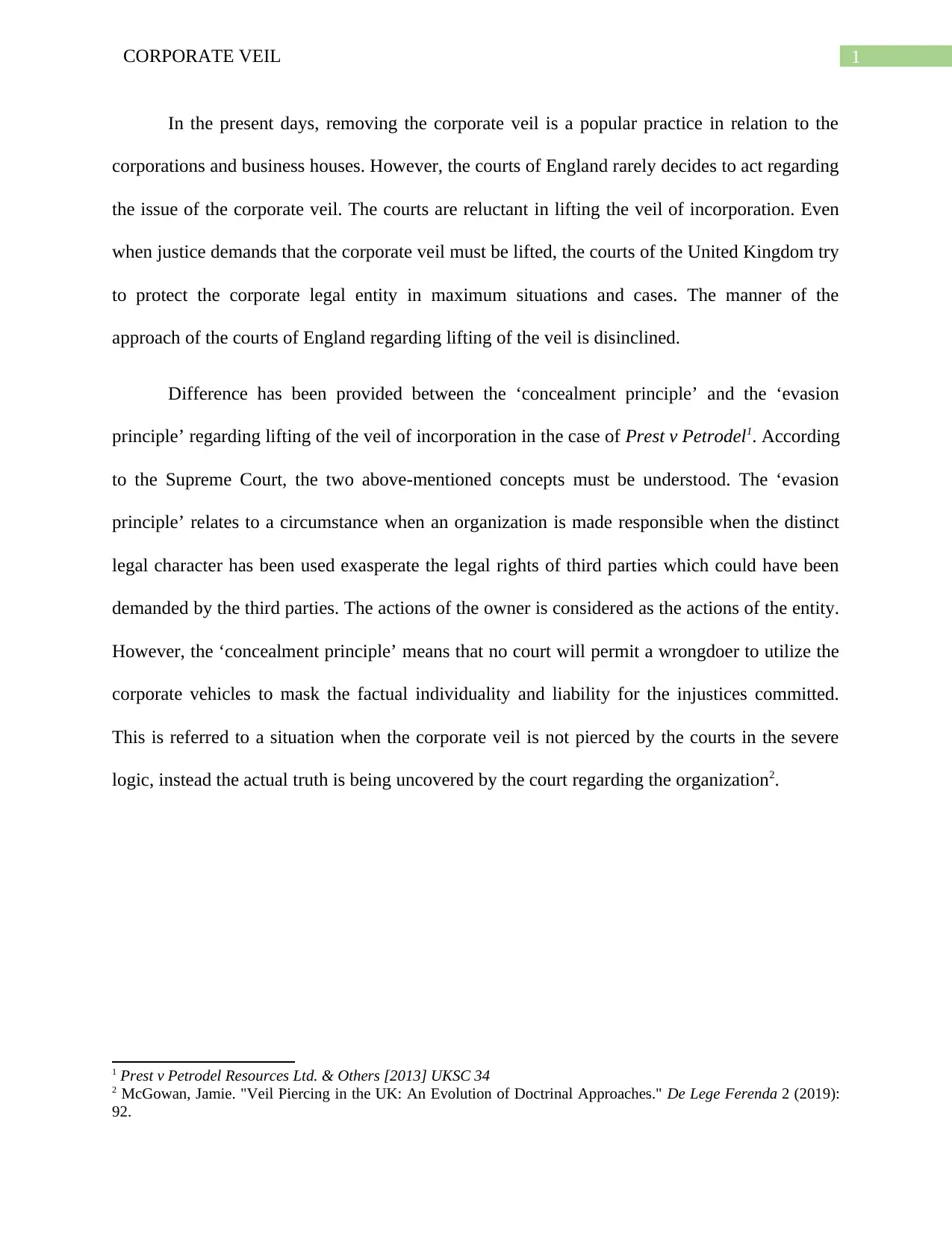
In the present days, removing the corporate veil is a popular practice in relation to the
corporations and business houses. However, the courts of England rarely decides to act regarding
the issue of the corporate veil. The courts are reluctant in lifting the veil of incorporation. Even
when justice demands that the corporate veil must be lifted, the courts of the United Kingdom try
to protect the corporate legal entity in maximum situations and cases. The manner of the
approach of the courts of England regarding lifting of the veil is disinclined.
Difference has been provided between the ‘concealment principle’ and the ‘evasion
principle’ regarding lifting of the veil of incorporation in the case of Prest v Petrodel1. According
to the Supreme Court, the two above-mentioned concepts must be understood. The ‘evasion
principle’ relates to a circumstance when an organization is made responsible when the distinct
legal character has been used exasperate the legal rights of third parties which could have been
demanded by the third parties. The actions of the owner is considered as the actions of the entity.
However, the ‘concealment principle’ means that no court will permit a wrongdoer to utilize the
corporate vehicles to mask the factual individuality and liability for the injustices committed.
This is referred to a situation when the corporate veil is not pierced by the courts in the severe
logic, instead the actual truth is being uncovered by the court regarding the organization2.
1 Prest v Petrodel Resources Ltd. & Others [2013] UKSC 34
2 McGowan, Jamie. "Veil Piercing in the UK: An Evolution of Doctrinal Approaches." De Lege Ferenda 2 (2019):
92.
Document Page
2CORPORATE VEIL
References
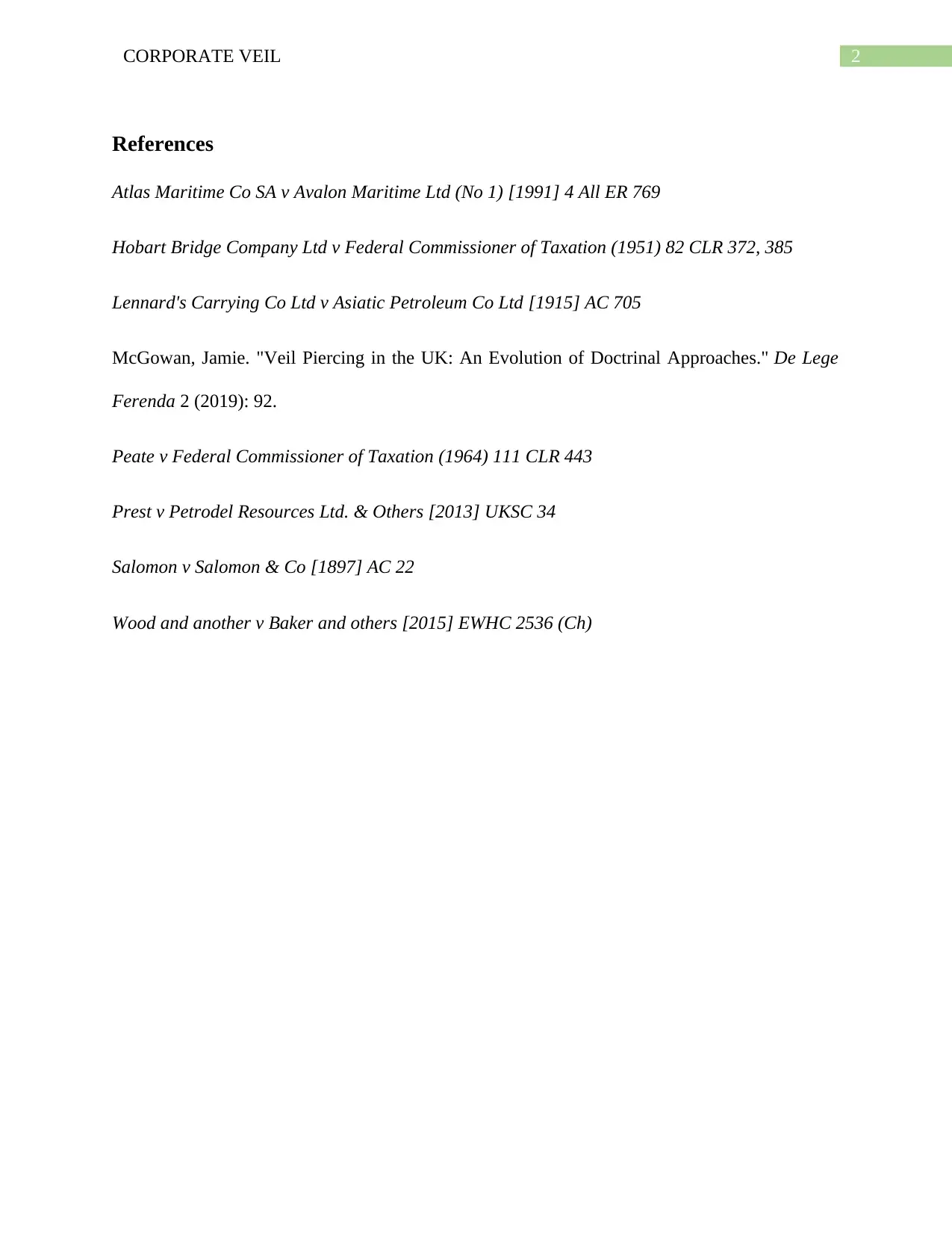
Atlas Maritime Co SA v Avalon Maritime Ltd (No 1) [1991] 4 All ER 769
Hobart Bridge Company Ltd v Federal Commissioner of Taxation (1951) 82 CLR 372, 385
Lennard's Carrying Co Ltd v Asiatic Petroleum Co Ltd [1915] AC 705
McGowan, Jamie. "Veil Piercing in the UK: An Evolution of Doctrinal Approaches." De Lege
Ferenda 2 (2019): 92.
Peate v Federal Commissioner of Taxation (1964) 111 CLR 443
Prest v Petrodel Resources Ltd. & Others [2013] UKSC 34
Salomon v Salomon & Co [1897] AC 22
Wood and another v Baker and others [2015] EWHC 2536 (Ch)
chevron_up_icon
1 out of 3
circle_padding
hide_on_mobile
zoom_out_icon
[object Object]