Corporations Law Assignment: Business Formation and Contracts Analysis
VerifiedAdded on 2022/11/14
|9
|2884
|447
Report
AI Summary
This report addresses two key questions related to Corporations Law. The first question examines the process of incorporating a company, comparing the advantages and disadvantages of operating as a company versus other business structures such as sole trader and partnership, and the seven steps of company incorporation as per ASIC. The second question involves a case study analyzing a contract dispute, focusing on the principles of agency, actual and apparent authority, and the rule of indoor management, to determine the validity of a contract made by a company employee. The report provides a detailed application of relevant legislation and case law to support its conclusions, offering a comprehensive analysis of the legal issues involved in business formation and contract law.
1
Contents
Question 1.......................................................................................................................................2
Question 2........................................................................................................................................3
Issue.................................................................................................................................................3
Relevant Law...............................................................................................................................4
Application of law........................................................................................................................4
Conclusion...................................................................................................................................5
Reference list...................................................................................................................................6
Contents
Question 1.......................................................................................................................................2
Question 2........................................................................................................................................3
Issue.................................................................................................................................................3
Relevant Law...............................................................................................................................4
Application of law........................................................................................................................4
Conclusion...................................................................................................................................5
Reference list...................................................................................................................................6

Paraphrase This Document
Need a fresh take? Get an instant paraphrase of this document with our AI Paraphraser
2
Question 1
Michael owns a restaurant which was very popular. He recently purchased another restaurant.
Michael was operating his business by way of a sole trader. Now the business is flourishing and
his two sons, Adam and John, wish to join their fathers business. Both Adam and John wish to
expand the business and wants to raise capital for the business expansion.
Both Adam and John wish to operate their business by way of a company.
If both Adam and John wish to operate their business by way of a company, then, it is important
that they must follow the seven steps that are laid down by ASIC for the incorporation of a
company. Thus, before analyzing the pros and cons of a company, it is important to understand
the steps by which a company can be operated.
Stepss for the incorporation of the company
i. Is a company a right choice – It is first important to decide whether the company is a
right choice to operate as a business or not. In Salomon v A Salomon & Co Ltd
[1896], it was submitted that when a corporation is established, then, it is an artificial
person authorized in law which has its own persona and has the capacity to act like a
normal human being, that is, make contract, take legal actions, purchase and sell
properties, etc. The status that is acquired is though artificial but has all the capacity
and act like a normal human being.
Whereas, in sole trader ship, there is only one person who carries on the business and
is responsible for all the profits and loss of the business all alone.
In partnership, there is a requirement of 2 or more persons (as per section 115 the
maximum number to a partnership is 20) to follow the trade with the aim to earn
profits. However, there are chances of conflicts and lack of confidentiality amid the
partners (Canny Gabriel Jackson Advertising Pty Ltd v Volume Sales (Finance) Pty
Ltd (1974). Also, as per Re Griffin;ex parte Board of Trade (1890) the partnership
must carried out on continuous basis.
Thus, considering the situations, in hand, it is submitted that Adam and John must
operate their business by way of a company. They cannot operate as a sole trader .
This is because one a single person is required for the formulation of a sole trader
Question 1
Michael owns a restaurant which was very popular. He recently purchased another restaurant.
Michael was operating his business by way of a sole trader. Now the business is flourishing and
his two sons, Adam and John, wish to join their fathers business. Both Adam and John wish to
expand the business and wants to raise capital for the business expansion.
Both Adam and John wish to operate their business by way of a company.
If both Adam and John wish to operate their business by way of a company, then, it is important
that they must follow the seven steps that are laid down by ASIC for the incorporation of a
company. Thus, before analyzing the pros and cons of a company, it is important to understand
the steps by which a company can be operated.
Stepss for the incorporation of the company
i. Is a company a right choice – It is first important to decide whether the company is a
right choice to operate as a business or not. In Salomon v A Salomon & Co Ltd
[1896], it was submitted that when a corporation is established, then, it is an artificial
person authorized in law which has its own persona and has the capacity to act like a
normal human being, that is, make contract, take legal actions, purchase and sell
properties, etc. The status that is acquired is though artificial but has all the capacity
and act like a normal human being.
Whereas, in sole trader ship, there is only one person who carries on the business and
is responsible for all the profits and loss of the business all alone.
In partnership, there is a requirement of 2 or more persons (as per section 115 the
maximum number to a partnership is 20) to follow the trade with the aim to earn
profits. However, there are chances of conflicts and lack of confidentiality amid the
partners (Canny Gabriel Jackson Advertising Pty Ltd v Volume Sales (Finance) Pty
Ltd (1974). Also, as per Re Griffin;ex parte Board of Trade (1890) the partnership
must carried out on continuous basis.
Thus, considering the situations, in hand, it is submitted that Adam and John must
operate their business by way of a company. They cannot operate as a sole trader .
This is because one a single person is required for the formulation of a sole trader
3
ship. Also, in order to avoid any conflicting situations, they must avoid the
formulation of partnership.
Further, as per SECTION 119 a company can only exists upon registration.
ii. To select the name of the company – It is then advisable that a company name must
be selected. As per section 147(1) of the Act, the name must be available. There are
few points which must be taken into consideration before deciding the company
name, that is:
a. The name so selected must not be identical with any other name;
b. There are few words which should not be made part of the name of the company
such as, bank, royal, incorporated, trust, etc. These words can only be included
provided the approval of the minster is sought.
c. Words which are misleading are not allowed;
Now, both Adam and John wish that the name of the company should be Sicilian
Treats, whereas, Michael wants to keep the original name. It is not submitted that the
name Sicilian Treats is permissible provided it is not similar to any other name nor
gave any kind of mislead to the public.
iii. Then it is important to decide the way in which the company would operate. By
constitution or by the replaceable rules or by both. It is important to decide the same
for the smooth running of the business .
iv. The officer holder must ensure that all of its obligations are met. He must assure that
the details of the company are kept up to date, the annual and lodgment fees must be
paid and the records of the company are maintained;
v. The various consents from the office holders, occupiers and members must be kept;
vi. The company must then be registered;
i. As per section 118(1) of the Act, once a company is registered, then, the ACN/ABN
number must be displayed on all the documents as per National Education
Advancement Programs Pty Ltd v Ashton (1996);
ii. As per section Section 1274(7A) of the Act, the certificate of registration is the
conclusive evidence that the company is formed.
The company once registered has the separate legal personality in law. There are various
advantages and disadvantages that can be attributed to a company.
ship. Also, in order to avoid any conflicting situations, they must avoid the
formulation of partnership.
Further, as per SECTION 119 a company can only exists upon registration.
ii. To select the name of the company – It is then advisable that a company name must
be selected. As per section 147(1) of the Act, the name must be available. There are
few points which must be taken into consideration before deciding the company
name, that is:
a. The name so selected must not be identical with any other name;
b. There are few words which should not be made part of the name of the company
such as, bank, royal, incorporated, trust, etc. These words can only be included
provided the approval of the minster is sought.
c. Words which are misleading are not allowed;
Now, both Adam and John wish that the name of the company should be Sicilian
Treats, whereas, Michael wants to keep the original name. It is not submitted that the
name Sicilian Treats is permissible provided it is not similar to any other name nor
gave any kind of mislead to the public.
iii. Then it is important to decide the way in which the company would operate. By
constitution or by the replaceable rules or by both. It is important to decide the same
for the smooth running of the business .
iv. The officer holder must ensure that all of its obligations are met. He must assure that
the details of the company are kept up to date, the annual and lodgment fees must be
paid and the records of the company are maintained;
v. The various consents from the office holders, occupiers and members must be kept;
vi. The company must then be registered;
i. As per section 118(1) of the Act, once a company is registered, then, the ACN/ABN
number must be displayed on all the documents as per National Education
Advancement Programs Pty Ltd v Ashton (1996);
ii. As per section Section 1274(7A) of the Act, the certificate of registration is the
conclusive evidence that the company is formed.
The company once registered has the separate legal personality in law. There are various
advantages and disadvantages that can be attributed to a company.
⊘ This is a preview!⊘
Do you want full access?
Subscribe today to unlock all pages.

Trusted by 1+ million students worldwide
4
Advantages
i. The accountability of the owners is limited to the extent of their shareholdings. Thus,
the liability is limited in nature Whereas in partnership the liability is unlimited
(Kendall v Hamilton (1879).
ii. The ownership is easily transferable as by selling the shares;
iii. Shareholders can be employed in the company;
iv. Shareholder can keep hold of the power by holding 51% shares in the company. Now,
Michael can retain the control by holding 51% shares in the company.
v. The corporation has the choice to trade anywhere in the country.
vi. The rates of the taxation are more favorable when compared to other kinds of
business structures;
Disadvantages
i. The company can be very costly to establish, to survive and at the time of wound up;
ii. The reporting requirements of the company is very complex as per section 292(1) and
(2) of the Act ;
i. As per ASIC Regulatory Guide RG 115, there is much auditing requirements and is
held in Incat Australia Pty Ltd v ASIC (2000) 33 ACSR 462; Re SRKKK and ASIC
(2002) 42 ACSR 551.
ii. If the directors are found to be in breach of their duties then they can be held
individually accountable for the same
iii. The profits which are distrusted to the owners are taxable in nature.
Thus, these are the pros and cons that can be associated with the company.
Now, a company can be proprietary or public in nature.
As per SECTION 113(1) and (3) of the Corporation Act 2001, a Proprietary company is a
company which must have at least one owner and not more than 50 non employees’
shareholders. It also has one director. Whereas, a public company must have one shareholder and
with no maximum limit. It must have minimum 3 directors out of which 2 reside in Australia.
As per SECTION 45A(2) – (4), a proprietor company can be small or large.
Advantages
i. The accountability of the owners is limited to the extent of their shareholdings. Thus,
the liability is limited in nature Whereas in partnership the liability is unlimited
(Kendall v Hamilton (1879).
ii. The ownership is easily transferable as by selling the shares;
iii. Shareholders can be employed in the company;
iv. Shareholder can keep hold of the power by holding 51% shares in the company. Now,
Michael can retain the control by holding 51% shares in the company.
v. The corporation has the choice to trade anywhere in the country.
vi. The rates of the taxation are more favorable when compared to other kinds of
business structures;
Disadvantages
i. The company can be very costly to establish, to survive and at the time of wound up;
ii. The reporting requirements of the company is very complex as per section 292(1) and
(2) of the Act ;
i. As per ASIC Regulatory Guide RG 115, there is much auditing requirements and is
held in Incat Australia Pty Ltd v ASIC (2000) 33 ACSR 462; Re SRKKK and ASIC
(2002) 42 ACSR 551.
ii. If the directors are found to be in breach of their duties then they can be held
individually accountable for the same
iii. The profits which are distrusted to the owners are taxable in nature.
Thus, these are the pros and cons that can be associated with the company.
Now, a company can be proprietary or public in nature.
As per SECTION 113(1) and (3) of the Corporation Act 2001, a Proprietary company is a
company which must have at least one owner and not more than 50 non employees’
shareholders. It also has one director. Whereas, a public company must have one shareholder and
with no maximum limit. It must have minimum 3 directors out of which 2 reside in Australia.
As per SECTION 45A(2) – (4), a proprietor company can be small or large.
Paraphrase This Document
Need a fresh take? Get an instant paraphrase of this document with our AI Paraphraser
5
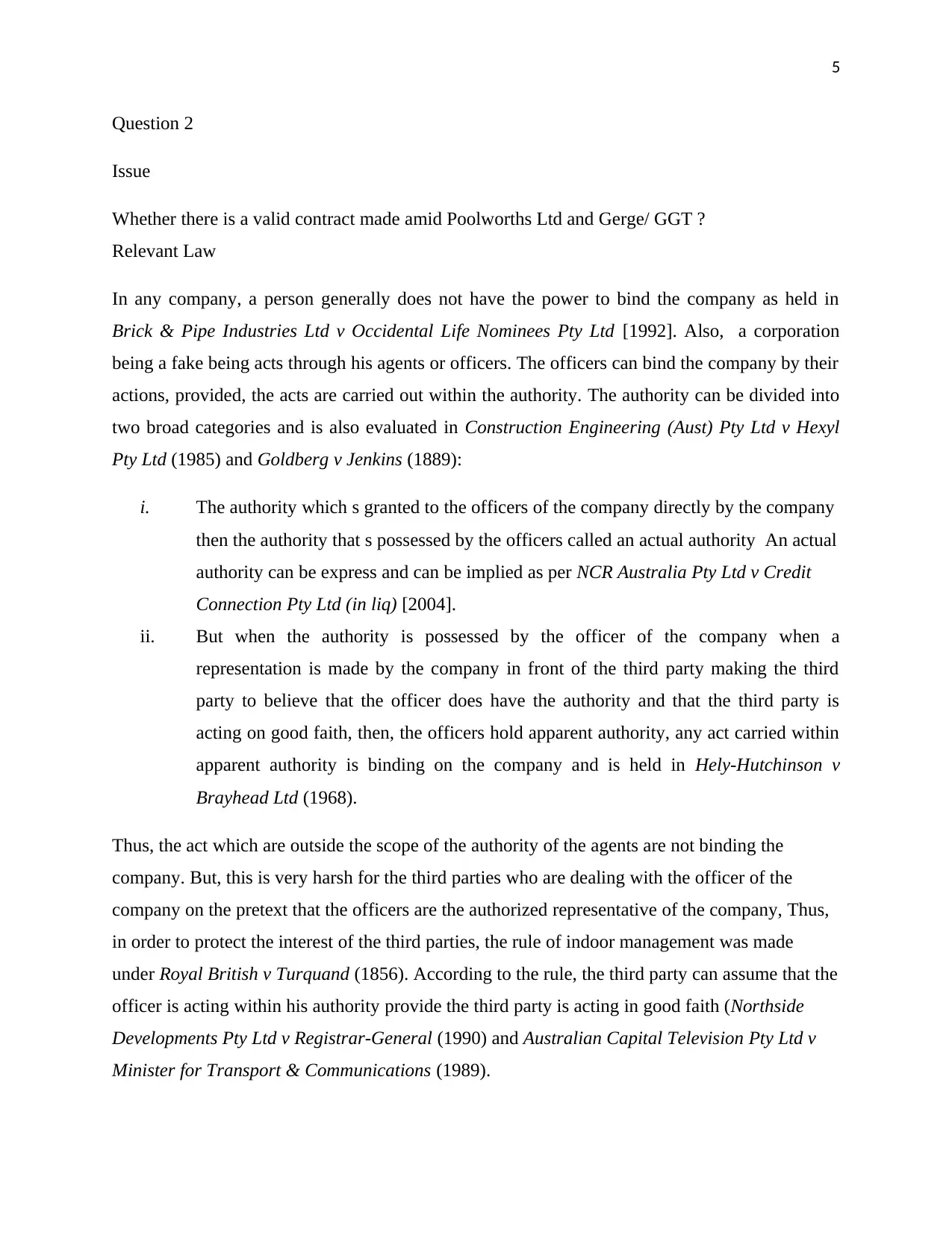
Question 2
Issue
Whether there is a valid contract made amid Poolworths Ltd and Gerge/ GGT ?
Relevant Law
In any company, a person generally does not have the power to bind the company as held in
Brick & Pipe Industries Ltd v Occidental Life Nominees Pty Ltd [1992]. Also, a corporation
being a fake being acts through his agents or officers. The officers can bind the company by their
actions, provided, the acts are carried out within the authority. The authority can be divided into
two broad categories and is also evaluated in Construction Engineering (Aust) Pty Ltd v Hexyl
Pty Ltd (1985) and Goldberg v Jenkins (1889):
i. The authority which s granted to the officers of the company directly by the company
then the authority that s possessed by the officers called an actual authority An actual
authority can be express and can be implied as per NCR Australia Pty Ltd v Credit
Connection Pty Ltd (in liq) [2004].
ii. But when the authority is possessed by the officer of the company when a
representation is made by the company in front of the third party making the third
party to believe that the officer does have the authority and that the third party is
acting on good faith, then, the officers hold apparent authority, any act carried within
apparent authority is binding on the company and is held in Hely-Hutchinson v
Brayhead Ltd (1968).
Thus, the act which are outside the scope of the authority of the agents are not binding the
company. But, this is very harsh for the third parties who are dealing with the officer of the
company on the pretext that the officers are the authorized representative of the company, Thus,
in order to protect the interest of the third parties, the rule of indoor management was made
under Royal British v Turquand (1856). According to the rule, the third party can assume that the
officer is acting within his authority provide the third party is acting in good faith (Northside
Developments Pty Ltd v Registrar-General (1990) and Australian Capital Television Pty Ltd v
Minister for Transport & Communications (1989).
Question 2
Issue
Whether there is a valid contract made amid Poolworths Ltd and Gerge/ GGT ?
Relevant Law
In any company, a person generally does not have the power to bind the company as held in
Brick & Pipe Industries Ltd v Occidental Life Nominees Pty Ltd [1992]. Also, a corporation
being a fake being acts through his agents or officers. The officers can bind the company by their
actions, provided, the acts are carried out within the authority. The authority can be divided into
two broad categories and is also evaluated in Construction Engineering (Aust) Pty Ltd v Hexyl
Pty Ltd (1985) and Goldberg v Jenkins (1889):
i. The authority which s granted to the officers of the company directly by the company
then the authority that s possessed by the officers called an actual authority An actual
authority can be express and can be implied as per NCR Australia Pty Ltd v Credit
Connection Pty Ltd (in liq) [2004].
ii. But when the authority is possessed by the officer of the company when a
representation is made by the company in front of the third party making the third
party to believe that the officer does have the authority and that the third party is
acting on good faith, then, the officers hold apparent authority, any act carried within
apparent authority is binding on the company and is held in Hely-Hutchinson v
Brayhead Ltd (1968).
Thus, the act which are outside the scope of the authority of the agents are not binding the
company. But, this is very harsh for the third parties who are dealing with the officer of the
company on the pretext that the officers are the authorized representative of the company, Thus,
in order to protect the interest of the third parties, the rule of indoor management was made
under Royal British v Turquand (1856). According to the rule, the third party can assume that the
officer is acting within his authority provide the third party is acting in good faith (Northside
Developments Pty Ltd v Registrar-General (1990) and Australian Capital Television Pty Ltd v
Minister for Transport & Communications (1989).
6
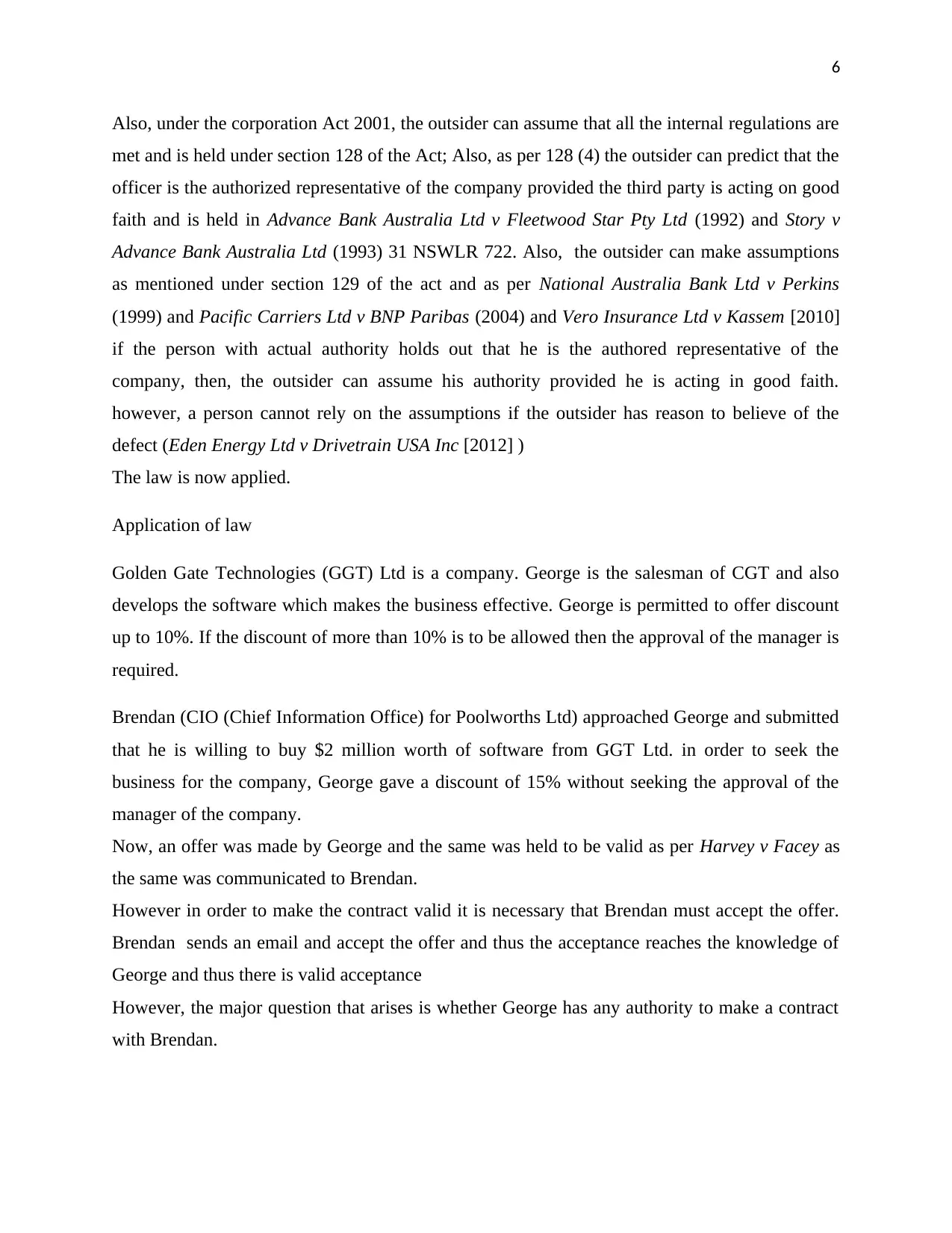
Also, under the corporation Act 2001, the outsider can assume that all the internal regulations are
met and is held under section 128 of the Act; Also, as per 128 (4) the outsider can predict that the
officer is the authorized representative of the company provided the third party is acting on good
faith and is held in Advance Bank Australia Ltd v Fleetwood Star Pty Ltd (1992) and Story v
Advance Bank Australia Ltd (1993) 31 NSWLR 722. Also, the outsider can make assumptions
as mentioned under section 129 of the act and as per National Australia Bank Ltd v Perkins
(1999) and Pacific Carriers Ltd v BNP Paribas (2004) and Vero Insurance Ltd v Kassem [2010]
if the person with actual authority holds out that he is the authored representative of the
company, then, the outsider can assume his authority provided he is acting in good faith.
however, a person cannot rely on the assumptions if the outsider has reason to believe of the
defect (Eden Energy Ltd v Drivetrain USA Inc [2012] )
The law is now applied.
Application of law
Golden Gate Technologies (GGT) Ltd is a company. George is the salesman of CGT and also
develops the software which makes the business effective. George is permitted to offer discount
up to 10%. If the discount of more than 10% is to be allowed then the approval of the manager is
required.
Brendan (CIO (Chief Information Office) for Poolworths Ltd) approached George and submitted
that he is willing to buy $2 million worth of software from GGT Ltd. in order to seek the
business for the company, George gave a discount of 15% without seeking the approval of the
manager of the company.
Now, an offer was made by George and the same was held to be valid as per Harvey v Facey as
the same was communicated to Brendan.
However in order to make the contract valid it is necessary that Brendan must accept the offer.
Brendan sends an email and accept the offer and thus the acceptance reaches the knowledge of
George and thus there is valid acceptance
However, the major question that arises is whether George has any authority to make a contract
with Brendan.
Also, under the corporation Act 2001, the outsider can assume that all the internal regulations are
met and is held under section 128 of the Act; Also, as per 128 (4) the outsider can predict that the
officer is the authorized representative of the company provided the third party is acting on good
faith and is held in Advance Bank Australia Ltd v Fleetwood Star Pty Ltd (1992) and Story v
Advance Bank Australia Ltd (1993) 31 NSWLR 722. Also, the outsider can make assumptions
as mentioned under section 129 of the act and as per National Australia Bank Ltd v Perkins
(1999) and Pacific Carriers Ltd v BNP Paribas (2004) and Vero Insurance Ltd v Kassem [2010]
if the person with actual authority holds out that he is the authored representative of the
company, then, the outsider can assume his authority provided he is acting in good faith.
however, a person cannot rely on the assumptions if the outsider has reason to believe of the
defect (Eden Energy Ltd v Drivetrain USA Inc [2012] )
The law is now applied.
Application of law
Golden Gate Technologies (GGT) Ltd is a company. George is the salesman of CGT and also
develops the software which makes the business effective. George is permitted to offer discount
up to 10%. If the discount of more than 10% is to be allowed then the approval of the manager is
required.
Brendan (CIO (Chief Information Office) for Poolworths Ltd) approached George and submitted
that he is willing to buy $2 million worth of software from GGT Ltd. in order to seek the
business for the company, George gave a discount of 15% without seeking the approval of the
manager of the company.
Now, an offer was made by George and the same was held to be valid as per Harvey v Facey as
the same was communicated to Brendan.
However in order to make the contract valid it is necessary that Brendan must accept the offer.
Brendan sends an email and accept the offer and thus the acceptance reaches the knowledge of
George and thus there is valid acceptance
However, the major question that arises is whether George has any authority to make a contract
with Brendan.
⊘ This is a preview!⊘
Do you want full access?
Subscribe today to unlock all pages.
Trusted by 1+ million students worldwide
7
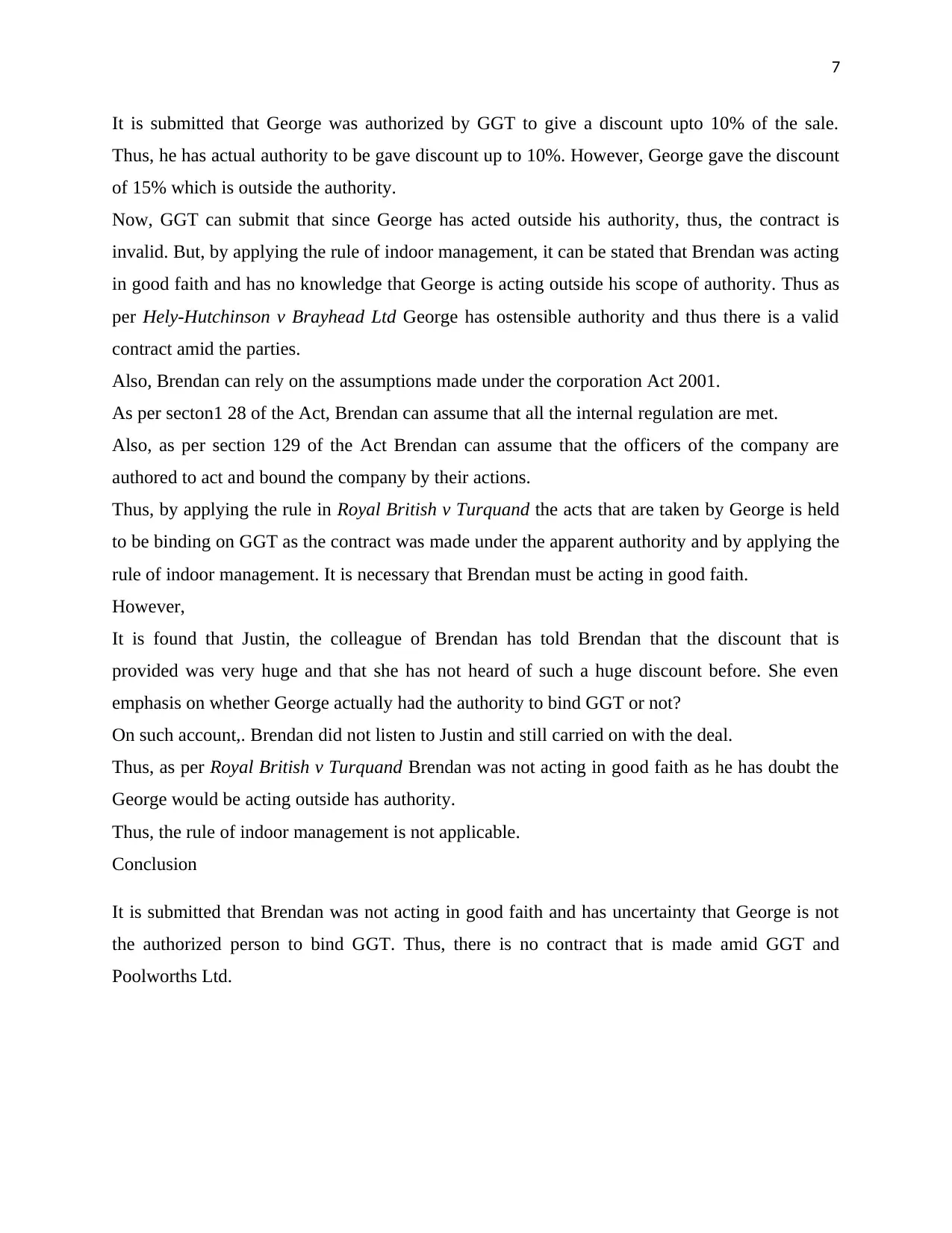
It is submitted that George was authorized by GGT to give a discount upto 10% of the sale.
Thus, he has actual authority to be gave discount up to 10%. However, George gave the discount
of 15% which is outside the authority.
Now, GGT can submit that since George has acted outside his authority, thus, the contract is
invalid. But, by applying the rule of indoor management, it can be stated that Brendan was acting
in good faith and has no knowledge that George is acting outside his scope of authority. Thus as
per Hely-Hutchinson v Brayhead Ltd George has ostensible authority and thus there is a valid
contract amid the parties.
Also, Brendan can rely on the assumptions made under the corporation Act 2001.
As per secton1 28 of the Act, Brendan can assume that all the internal regulation are met.
Also, as per section 129 of the Act Brendan can assume that the officers of the company are
authored to act and bound the company by their actions.
Thus, by applying the rule in Royal British v Turquand the acts that are taken by George is held
to be binding on GGT as the contract was made under the apparent authority and by applying the
rule of indoor management. It is necessary that Brendan must be acting in good faith.
However,
It is found that Justin, the colleague of Brendan has told Brendan that the discount that is
provided was very huge and that she has not heard of such a huge discount before. She even
emphasis on whether George actually had the authority to bind GGT or not?
On such account,. Brendan did not listen to Justin and still carried on with the deal.
Thus, as per Royal British v Turquand Brendan was not acting in good faith as he has doubt the
George would be acting outside has authority.
Thus, the rule of indoor management is not applicable.
Conclusion
It is submitted that Brendan was not acting in good faith and has uncertainty that George is not
the authorized person to bind GGT. Thus, there is no contract that is made amid GGT and
Poolworths Ltd.
It is submitted that George was authorized by GGT to give a discount upto 10% of the sale.
Thus, he has actual authority to be gave discount up to 10%. However, George gave the discount
of 15% which is outside the authority.
Now, GGT can submit that since George has acted outside his authority, thus, the contract is
invalid. But, by applying the rule of indoor management, it can be stated that Brendan was acting
in good faith and has no knowledge that George is acting outside his scope of authority. Thus as
per Hely-Hutchinson v Brayhead Ltd George has ostensible authority and thus there is a valid
contract amid the parties.
Also, Brendan can rely on the assumptions made under the corporation Act 2001.
As per secton1 28 of the Act, Brendan can assume that all the internal regulation are met.
Also, as per section 129 of the Act Brendan can assume that the officers of the company are
authored to act and bound the company by their actions.
Thus, by applying the rule in Royal British v Turquand the acts that are taken by George is held
to be binding on GGT as the contract was made under the apparent authority and by applying the
rule of indoor management. It is necessary that Brendan must be acting in good faith.
However,
It is found that Justin, the colleague of Brendan has told Brendan that the discount that is
provided was very huge and that she has not heard of such a huge discount before. She even
emphasis on whether George actually had the authority to bind GGT or not?
On such account,. Brendan did not listen to Justin and still carried on with the deal.
Thus, as per Royal British v Turquand Brendan was not acting in good faith as he has doubt the
George would be acting outside has authority.
Thus, the rule of indoor management is not applicable.
Conclusion
It is submitted that Brendan was not acting in good faith and has uncertainty that George is not
the authorized person to bind GGT. Thus, there is no contract that is made amid GGT and
Poolworths Ltd.
Paraphrase This Document
Need a fresh take? Get an instant paraphrase of this document with our AI Paraphraser
8
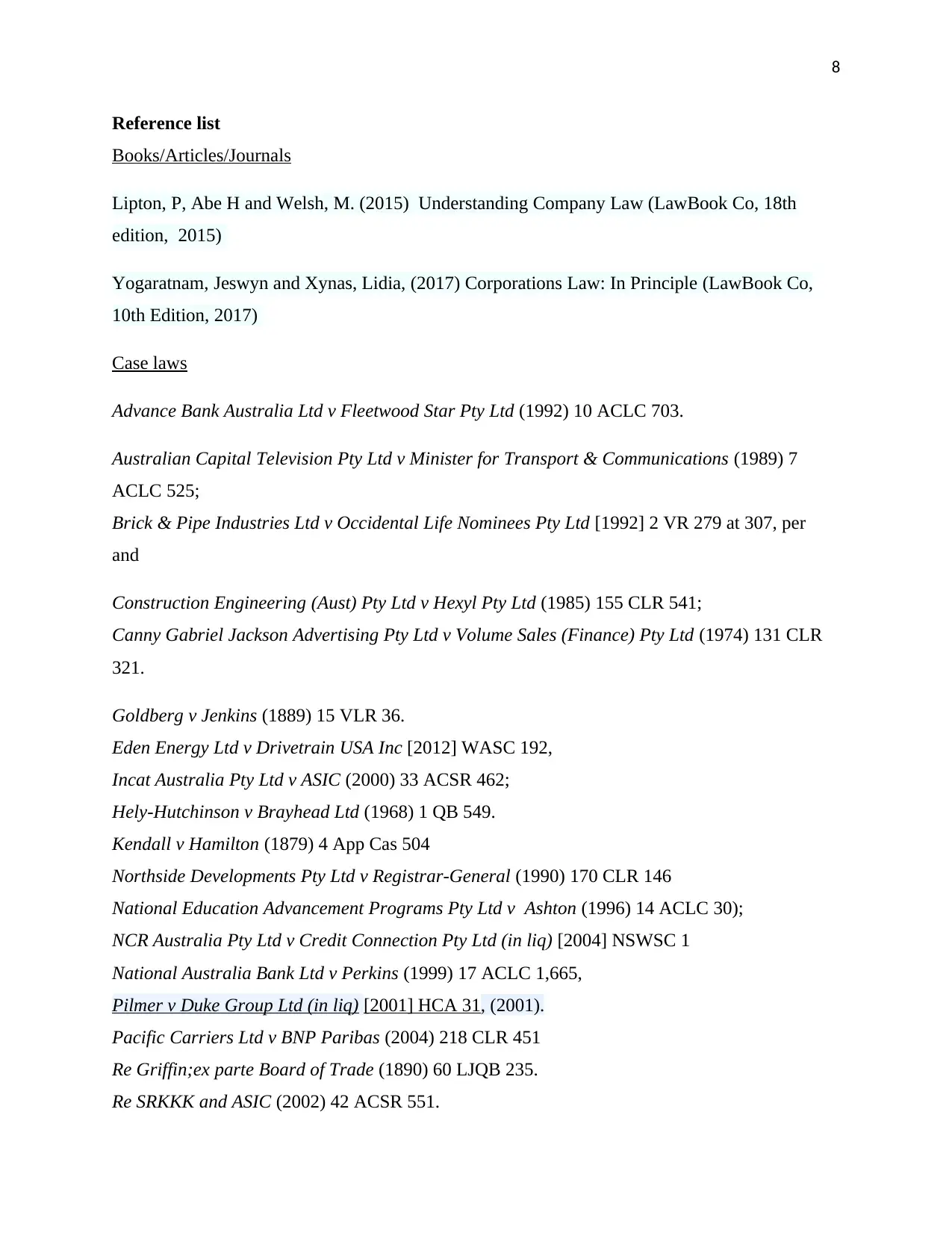
Reference list
Books/Articles/Journals
Lipton, P, Abe H and Welsh, M. (2015) Understanding Company Law (LawBook Co, 18th
edition, 2015)
Yogaratnam, Jeswyn and Xynas, Lidia, (2017) Corporations Law: In Principle (LawBook Co,
10th Edition, 2017)
Case laws
Advance Bank Australia Ltd v Fleetwood Star Pty Ltd (1992) 10 ACLC 703.
Australian Capital Television Pty Ltd v Minister for Transport & Communications (1989) 7
ACLC 525;
Brick & Pipe Industries Ltd v Occidental Life Nominees Pty Ltd [1992] 2 VR 279 at 307, per
and
Construction Engineering (Aust) Pty Ltd v Hexyl Pty Ltd (1985) 155 CLR 541;
Canny Gabriel Jackson Advertising Pty Ltd v Volume Sales (Finance) Pty Ltd (1974) 131 CLR
321.
Goldberg v Jenkins (1889) 15 VLR 36.
Eden Energy Ltd v Drivetrain USA Inc [2012] WASC 192,
Incat Australia Pty Ltd v ASIC (2000) 33 ACSR 462;
Hely-Hutchinson v Brayhead Ltd (1968) 1 QB 549.
Kendall v Hamilton (1879) 4 App Cas 504
Northside Developments Pty Ltd v Registrar-General (1990) 170 CLR 146
National Education Advancement Programs Pty Ltd v Ashton (1996) 14 ACLC 30);
NCR Australia Pty Ltd v Credit Connection Pty Ltd (in liq) [2004] NSWSC 1
National Australia Bank Ltd v Perkins (1999) 17 ACLC 1,665,
Pilmer v Duke Group Ltd (in liq) [2001] HCA 31, (2001).
Pacific Carriers Ltd v BNP Paribas (2004) 218 CLR 451
Re Griffin;ex parte Board of Trade (1890) 60 LJQB 235.
Re SRKKK and ASIC (2002) 42 ACSR 551.
Reference list
Books/Articles/Journals
Lipton, P, Abe H and Welsh, M. (2015) Understanding Company Law (LawBook Co, 18th
edition, 2015)
Yogaratnam, Jeswyn and Xynas, Lidia, (2017) Corporations Law: In Principle (LawBook Co,
10th Edition, 2017)
Case laws
Advance Bank Australia Ltd v Fleetwood Star Pty Ltd (1992) 10 ACLC 703.
Australian Capital Television Pty Ltd v Minister for Transport & Communications (1989) 7
ACLC 525;
Brick & Pipe Industries Ltd v Occidental Life Nominees Pty Ltd [1992] 2 VR 279 at 307, per
and
Construction Engineering (Aust) Pty Ltd v Hexyl Pty Ltd (1985) 155 CLR 541;
Canny Gabriel Jackson Advertising Pty Ltd v Volume Sales (Finance) Pty Ltd (1974) 131 CLR
321.
Goldberg v Jenkins (1889) 15 VLR 36.
Eden Energy Ltd v Drivetrain USA Inc [2012] WASC 192,
Incat Australia Pty Ltd v ASIC (2000) 33 ACSR 462;
Hely-Hutchinson v Brayhead Ltd (1968) 1 QB 549.
Kendall v Hamilton (1879) 4 App Cas 504
Northside Developments Pty Ltd v Registrar-General (1990) 170 CLR 146
National Education Advancement Programs Pty Ltd v Ashton (1996) 14 ACLC 30);
NCR Australia Pty Ltd v Credit Connection Pty Ltd (in liq) [2004] NSWSC 1
National Australia Bank Ltd v Perkins (1999) 17 ACLC 1,665,
Pilmer v Duke Group Ltd (in liq) [2001] HCA 31, (2001).
Pacific Carriers Ltd v BNP Paribas (2004) 218 CLR 451
Re Griffin;ex parte Board of Trade (1890) 60 LJQB 235.
Re SRKKK and ASIC (2002) 42 ACSR 551.
9
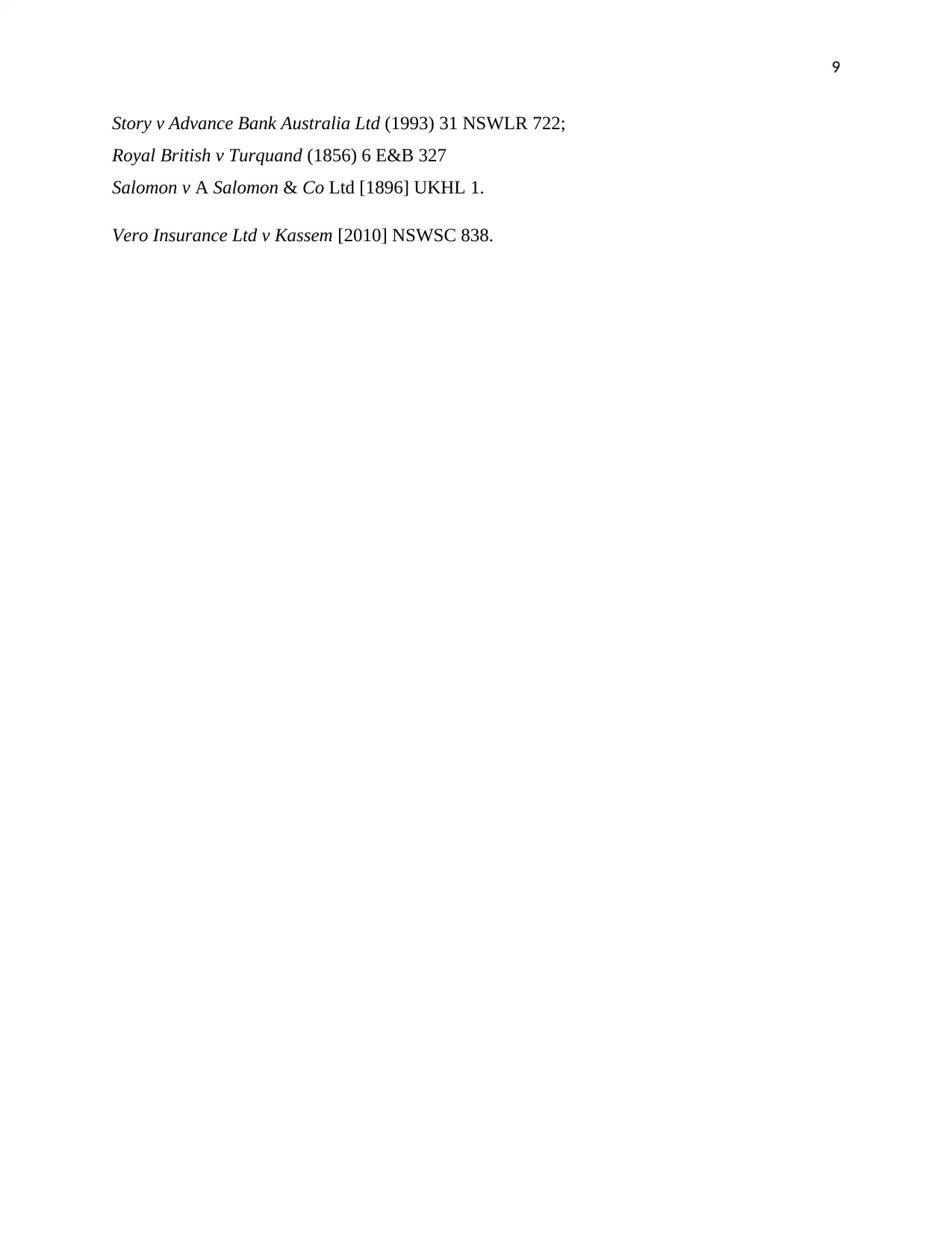
Story v Advance Bank Australia Ltd (1993) 31 NSWLR 722;
Royal British v Turquand (1856) 6 E&B 327
Salomon v A Salomon & Co Ltd [1896] UKHL 1.
Vero Insurance Ltd v Kassem [2010] NSWSC 838.
Story v Advance Bank Australia Ltd (1993) 31 NSWLR 722;
Royal British v Turquand (1856) 6 E&B 327
Salomon v A Salomon & Co Ltd [1896] UKHL 1.
Vero Insurance Ltd v Kassem [2010] NSWSC 838.
⊘ This is a preview!⊘
Do you want full access?
Subscribe today to unlock all pages.
Trusted by 1+ million students worldwide

1 out of 9


Related Documents


Your All-in-One AI-Powered Toolkit for Academic Success.
+13062052269
info@desklib.com
Available 24*7 on WhatsApp / Email
![[object Object]](/_next/static/media/star-bottom.7253800d.svg)
Unlock your academic potential
Copyright © 2020–2026 A2Z Services. All Rights Reserved. Developed and managed by ZUCOL.