Business and Corporations Law: Contract and Corporations Law Report
VerifiedAdded on 2023/06/04
|11
|2457
|451
Report
AI Summary
This report is a comprehensive analysis of business law, addressing both contract law and corporations law principles. Part A focuses on a contract law case study, examining issues of offer, acceptance, and consideration, with reference to key cases such as Carlill v Carbolic Smoke Ball Company and R v Clarke. The analysis explores whether a valid contract was formed in a scenario involving an advertisement and subsequent revocation. Part B delves into corporations law, examining the duties and liabilities of company directors. It addresses issues of insolvent trading, breaches of fiduciary duty, and the importance of directors acting in the best interests of the company, referencing relevant sections of the Corporations Act 2001 (Cth) and cases such as ASIC v Fortescue Metals Group Ltd. The report provides a detailed application of legal principles to the facts, drawing conclusions on the legal responsibilities and potential liabilities of the parties involved.
Running head: BUSINESS LAW
Business law
Name of the Student
Name of the University
Author Note
Business law
Name of the Student
Name of the University
Author Note

Paraphrase This Document
Need a fresh take? Get an instant paraphrase of this document with our AI Paraphraser
1BUSINESS LAW
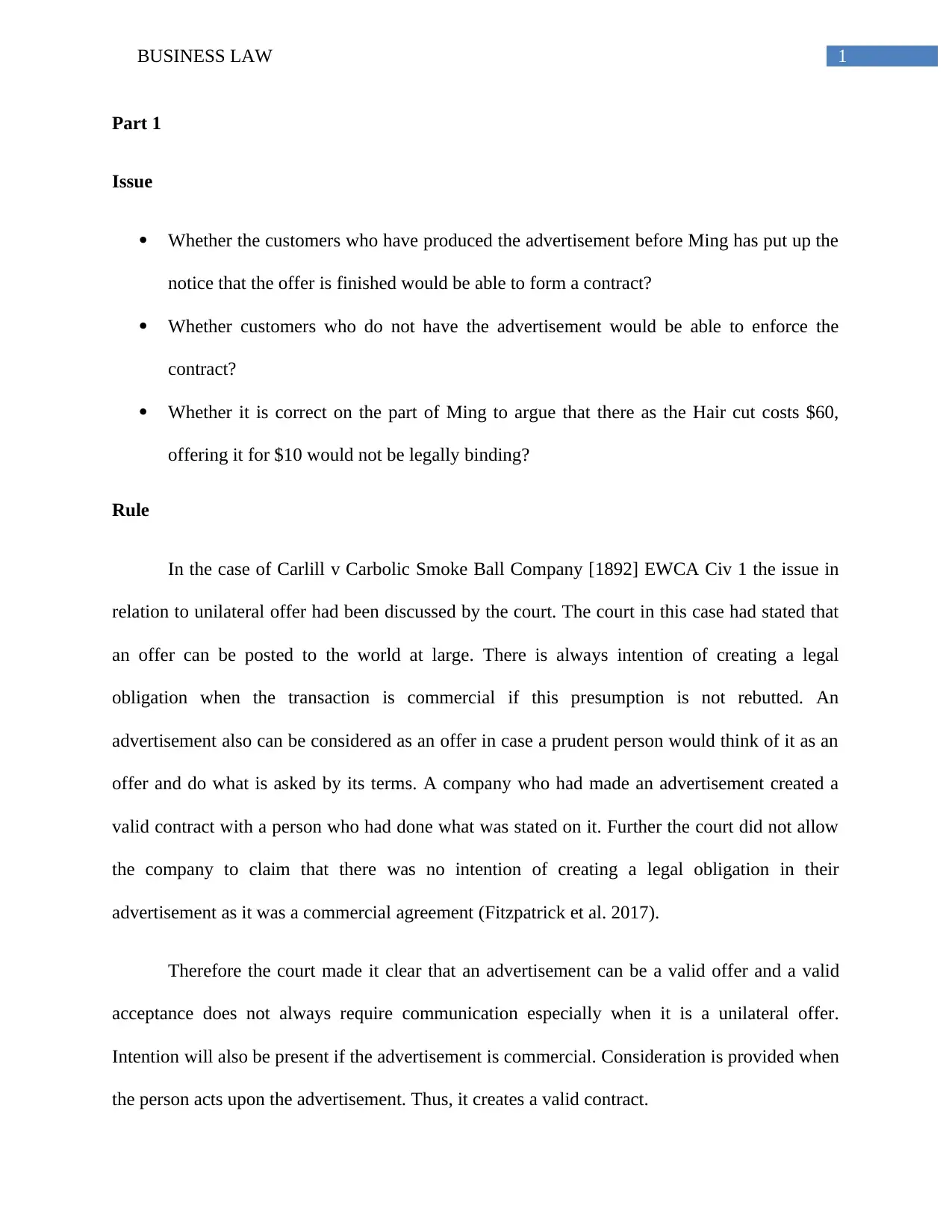
Part 1
Issue
Whether the customers who have produced the advertisement before Ming has put up the
notice that the offer is finished would be able to form a contract?
Whether customers who do not have the advertisement would be able to enforce the
contract?
Whether it is correct on the part of Ming to argue that there as the Hair cut costs $60,
offering it for $10 would not be legally binding?
Rule
In the case of Carlill v Carbolic Smoke Ball Company [1892] EWCA Civ 1 the issue in
relation to unilateral offer had been discussed by the court. The court in this case had stated that
an offer can be posted to the world at large. There is always intention of creating a legal
obligation when the transaction is commercial if this presumption is not rebutted. An
advertisement also can be considered as an offer in case a prudent person would think of it as an
offer and do what is asked by its terms. A company who had made an advertisement created a
valid contract with a person who had done what was stated on it. Further the court did not allow
the company to claim that there was no intention of creating a legal obligation in their
advertisement as it was a commercial agreement (Fitzpatrick et al. 2017).
Therefore the court made it clear that an advertisement can be a valid offer and a valid
acceptance does not always require communication especially when it is a unilateral offer.
Intention will also be present if the advertisement is commercial. Consideration is provided when
the person acts upon the advertisement. Thus, it creates a valid contract.
Part 1
Issue
Whether the customers who have produced the advertisement before Ming has put up the
notice that the offer is finished would be able to form a contract?
Whether customers who do not have the advertisement would be able to enforce the
contract?
Whether it is correct on the part of Ming to argue that there as the Hair cut costs $60,
offering it for $10 would not be legally binding?
Rule
In the case of Carlill v Carbolic Smoke Ball Company [1892] EWCA Civ 1 the issue in
relation to unilateral offer had been discussed by the court. The court in this case had stated that
an offer can be posted to the world at large. There is always intention of creating a legal
obligation when the transaction is commercial if this presumption is not rebutted. An
advertisement also can be considered as an offer in case a prudent person would think of it as an
offer and do what is asked by its terms. A company who had made an advertisement created a
valid contract with a person who had done what was stated on it. Further the court did not allow
the company to claim that there was no intention of creating a legal obligation in their
advertisement as it was a commercial agreement (Fitzpatrick et al. 2017).
Therefore the court made it clear that an advertisement can be a valid offer and a valid
acceptance does not always require communication especially when it is a unilateral offer.
Intention will also be present if the advertisement is commercial. Consideration is provided when
the person acts upon the advertisement. Thus, it creates a valid contract.
2BUSINESS LAW
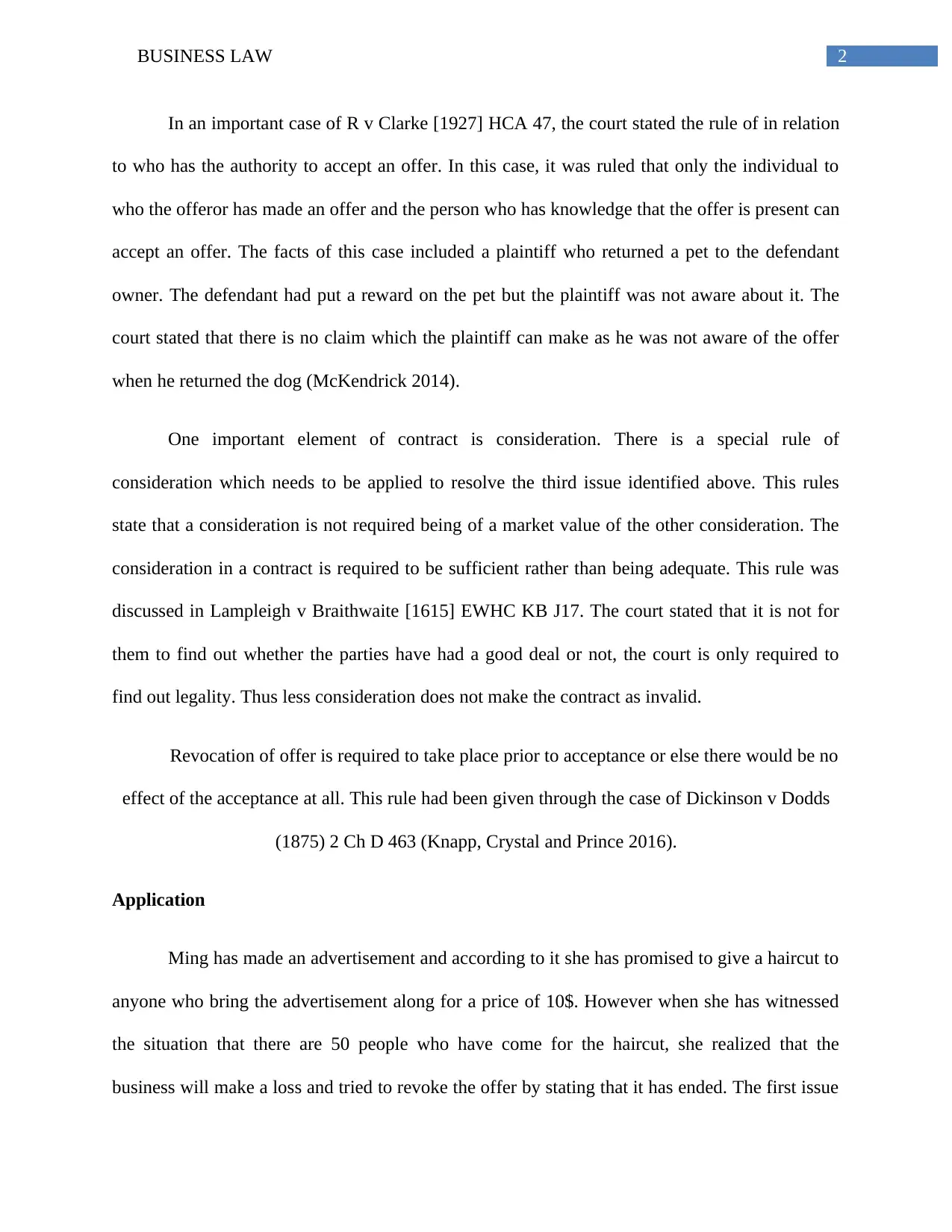
In an important case of R v Clarke [1927] HCA 47, the court stated the rule of in relation
to who has the authority to accept an offer. In this case, it was ruled that only the individual to
who the offeror has made an offer and the person who has knowledge that the offer is present can
accept an offer. The facts of this case included a plaintiff who returned a pet to the defendant
owner. The defendant had put a reward on the pet but the plaintiff was not aware about it. The
court stated that there is no claim which the plaintiff can make as he was not aware of the offer
when he returned the dog (McKendrick 2014).
One important element of contract is consideration. There is a special rule of
consideration which needs to be applied to resolve the third issue identified above. This rules
state that a consideration is not required being of a market value of the other consideration. The
consideration in a contract is required to be sufficient rather than being adequate. This rule was
discussed in Lampleigh v Braithwaite [1615] EWHC KB J17. The court stated that it is not for
them to find out whether the parties have had a good deal or not, the court is only required to
find out legality. Thus less consideration does not make the contract as invalid.
Revocation of offer is required to take place prior to acceptance or else there would be no
effect of the acceptance at all. This rule had been given through the case of Dickinson v Dodds
(1875) 2 Ch D 463 (Knapp, Crystal and Prince 2016).
Application
Ming has made an advertisement and according to it she has promised to give a haircut to
anyone who bring the advertisement along for a price of 10$. However when she has witnessed
the situation that there are 50 people who have come for the haircut, she realized that the
business will make a loss and tried to revoke the offer by stating that it has ended. The first issue
In an important case of R v Clarke [1927] HCA 47, the court stated the rule of in relation
to who has the authority to accept an offer. In this case, it was ruled that only the individual to
who the offeror has made an offer and the person who has knowledge that the offer is present can
accept an offer. The facts of this case included a plaintiff who returned a pet to the defendant
owner. The defendant had put a reward on the pet but the plaintiff was not aware about it. The
court stated that there is no claim which the plaintiff can make as he was not aware of the offer
when he returned the dog (McKendrick 2014).
One important element of contract is consideration. There is a special rule of
consideration which needs to be applied to resolve the third issue identified above. This rules
state that a consideration is not required being of a market value of the other consideration. The
consideration in a contract is required to be sufficient rather than being adequate. This rule was
discussed in Lampleigh v Braithwaite [1615] EWHC KB J17. The court stated that it is not for
them to find out whether the parties have had a good deal or not, the court is only required to
find out legality. Thus less consideration does not make the contract as invalid.
Revocation of offer is required to take place prior to acceptance or else there would be no
effect of the acceptance at all. This rule had been given through the case of Dickinson v Dodds
(1875) 2 Ch D 463 (Knapp, Crystal and Prince 2016).
Application
Ming has made an advertisement and according to it she has promised to give a haircut to
anyone who bring the advertisement along for a price of 10$. However when she has witnessed
the situation that there are 50 people who have come for the haircut, she realized that the
business will make a loss and tried to revoke the offer by stating that it has ended. The first issue
⊘ This is a preview!⊘
Do you want full access?
Subscribe today to unlock all pages.

Trusted by 1+ million students worldwide
3BUSINESS LAW
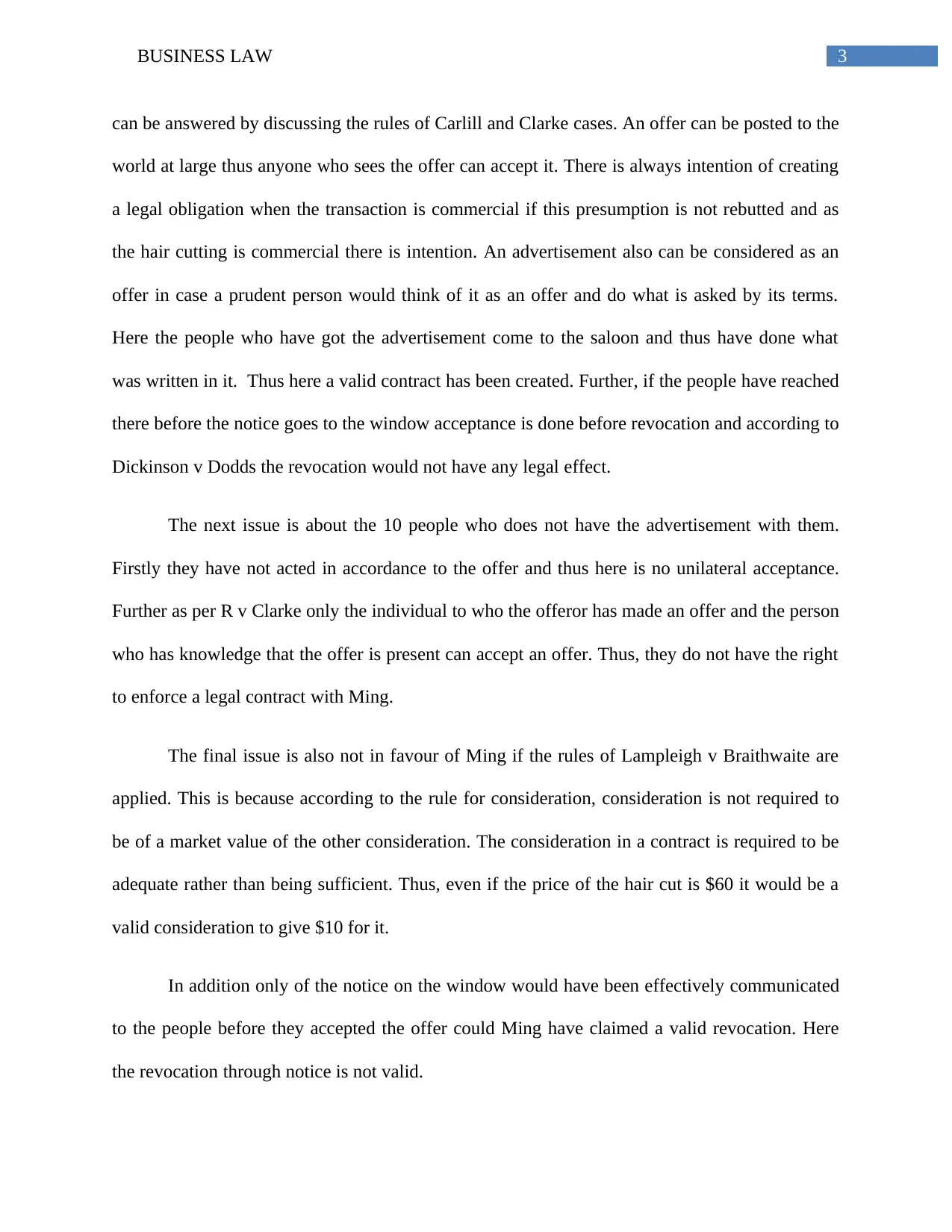
can be answered by discussing the rules of Carlill and Clarke cases. An offer can be posted to the
world at large thus anyone who sees the offer can accept it. There is always intention of creating
a legal obligation when the transaction is commercial if this presumption is not rebutted and as
the hair cutting is commercial there is intention. An advertisement also can be considered as an
offer in case a prudent person would think of it as an offer and do what is asked by its terms.
Here the people who have got the advertisement come to the saloon and thus have done what
was written in it. Thus here a valid contract has been created. Further, if the people have reached
there before the notice goes to the window acceptance is done before revocation and according to
Dickinson v Dodds the revocation would not have any legal effect.
The next issue is about the 10 people who does not have the advertisement with them.
Firstly they have not acted in accordance to the offer and thus here is no unilateral acceptance.
Further as per R v Clarke only the individual to who the offeror has made an offer and the person
who has knowledge that the offer is present can accept an offer. Thus, they do not have the right
to enforce a legal contract with Ming.
The final issue is also not in favour of Ming if the rules of Lampleigh v Braithwaite are
applied. This is because according to the rule for consideration, consideration is not required to
be of a market value of the other consideration. The consideration in a contract is required to be
adequate rather than being sufficient. Thus, even if the price of the hair cut is $60 it would be a
valid consideration to give $10 for it.
In addition only of the notice on the window would have been effectively communicated
to the people before they accepted the offer could Ming have claimed a valid revocation. Here
the revocation through notice is not valid.
can be answered by discussing the rules of Carlill and Clarke cases. An offer can be posted to the
world at large thus anyone who sees the offer can accept it. There is always intention of creating
a legal obligation when the transaction is commercial if this presumption is not rebutted and as
the hair cutting is commercial there is intention. An advertisement also can be considered as an
offer in case a prudent person would think of it as an offer and do what is asked by its terms.
Here the people who have got the advertisement come to the saloon and thus have done what
was written in it. Thus here a valid contract has been created. Further, if the people have reached
there before the notice goes to the window acceptance is done before revocation and according to
Dickinson v Dodds the revocation would not have any legal effect.
The next issue is about the 10 people who does not have the advertisement with them.
Firstly they have not acted in accordance to the offer and thus here is no unilateral acceptance.
Further as per R v Clarke only the individual to who the offeror has made an offer and the person
who has knowledge that the offer is present can accept an offer. Thus, they do not have the right
to enforce a legal contract with Ming.
The final issue is also not in favour of Ming if the rules of Lampleigh v Braithwaite are
applied. This is because according to the rule for consideration, consideration is not required to
be of a market value of the other consideration. The consideration in a contract is required to be
adequate rather than being sufficient. Thus, even if the price of the hair cut is $60 it would be a
valid consideration to give $10 for it.
In addition only of the notice on the window would have been effectively communicated
to the people before they accepted the offer could Ming have claimed a valid revocation. Here
the revocation through notice is not valid.
Paraphrase This Document
Need a fresh take? Get an instant paraphrase of this document with our AI Paraphraser
4BUSINESS LAW
Conclusion
50 customers would be able to form a contract
10 customers would not be able to enforce the contract
Low consideration is a valid consideration
Conclusion
50 customers would be able to form a contract
10 customers would not be able to enforce the contract
Low consideration is a valid consideration
5BUSINESS LAW
References
Carlill v Carbolic Smoke Ball Company [1892] EWCA Civ 1
Dickinson v Dodds (1875) 2 Ch D 463.
Fitzpatrick J, Symes C, Veljanovski A & Parker D, Business and Corporations Law 3rd ed.
(2017), LexisNexis Butterworths Australia.
Knapp, C.L., Crystal, N.M. and Prince, H.G., 2016. Problems in Contract Law: cases and
materials. Wolters Kluwer Law & Business.
Lampleigh v Braithwaite [1615] EWHC KB J17
McKendrick, E., 2014. Contract law: text, cases, and materials. Oxford University Press (UK).
R v Clarke [1927] HCA 47
References
Carlill v Carbolic Smoke Ball Company [1892] EWCA Civ 1
Dickinson v Dodds (1875) 2 Ch D 463.
Fitzpatrick J, Symes C, Veljanovski A & Parker D, Business and Corporations Law 3rd ed.
(2017), LexisNexis Butterworths Australia.
Knapp, C.L., Crystal, N.M. and Prince, H.G., 2016. Problems in Contract Law: cases and
materials. Wolters Kluwer Law & Business.
Lampleigh v Braithwaite [1615] EWHC KB J17
McKendrick, E., 2014. Contract law: text, cases, and materials. Oxford University Press (UK).
R v Clarke [1927] HCA 47
⊘ This is a preview!⊘
Do you want full access?
Subscribe today to unlock all pages.
Trusted by 1+ million students worldwide
6BUSINESS LAW
Part B
Issues
1. Whether the directors are involved in insolvent trading
2. Whether Llyych has breached his fiduciary duty by signing chubby house deal with
another company
3. Whether Vesna has breached her duty as director by not informing board that she has
personal interest in contract with Designer Pty Ltd.
4. Liability of Sergey for not taking part in company affairs
Rule
The directors of a company have been imposed with duties by the application of common law.
These duties mandate the directors to act in company’s best interest as a whole, not act in an
improper purpose, retaining discretion, doing their work with diligence and care, avoiding
conflict of interest and not disclosing confidential data to third parties (Fitzpatrick et al. 2017).
The directors also have duties specifically set out by statues and in the present situation the
Corporations Act 2001 (Cth). The corporation Act duties are under s 180-184 and also s 588G
and 191. The doing of their work with diligence and care is given under s 180(1). The need to act
in company’s best interest as a whole and not act in an improper purpose is given under s 181.
Avoiding conflict of interest and not disclosing confidential data to third parties are indirectly
provided in s 182 and 183. They must report all material interest in dealing to the board as
required by s191 (Milman 2017). They must restrain from trading when the company is likely to
be insolvent or have already become insolvent as required under s 588G.
Part B
Issues
1. Whether the directors are involved in insolvent trading
2. Whether Llyych has breached his fiduciary duty by signing chubby house deal with
another company
3. Whether Vesna has breached her duty as director by not informing board that she has
personal interest in contract with Designer Pty Ltd.
4. Liability of Sergey for not taking part in company affairs
Rule
The directors of a company have been imposed with duties by the application of common law.
These duties mandate the directors to act in company’s best interest as a whole, not act in an
improper purpose, retaining discretion, doing their work with diligence and care, avoiding
conflict of interest and not disclosing confidential data to third parties (Fitzpatrick et al. 2017).
The directors also have duties specifically set out by statues and in the present situation the
Corporations Act 2001 (Cth). The corporation Act duties are under s 180-184 and also s 588G
and 191. The doing of their work with diligence and care is given under s 180(1). The need to act
in company’s best interest as a whole and not act in an improper purpose is given under s 181.
Avoiding conflict of interest and not disclosing confidential data to third parties are indirectly
provided in s 182 and 183. They must report all material interest in dealing to the board as
required by s191 (Milman 2017). They must restrain from trading when the company is likely to
be insolvent or have already become insolvent as required under s 588G.
Paraphrase This Document
Need a fresh take? Get an instant paraphrase of this document with our AI Paraphraser
7BUSINESS LAW
Under The Charitable Corporation v Sutton (1742) 26 ER 642, the directors were said to have
the same duties which a trustee has in relation to trust and must not quickly judge decisions of
directors having hindsight. Aberdeen Railway Co v Blaikie Brothers (1854) 1 Macq HL 461
stated that in case a director has an interest in a transaction it may be made voidable at the
discretion of the company. Percival v Wright [1902] 2 Ch 401 stated that the directors are
required to be loyal in relation to the company. Re Smith and Fawcett Ltd. [1942] Ch 304 stated
that it is the duty of the directors to act in the best interest of the company. Section 180(1) is
applied in a very wide sense and is entitled to be breached by even a non executive director who
did not retain discretion. The section just compares the action of a director to a reasonable person
in the same circumstances as the directors and if better diligence and care would have been taken
by the reasonable person the directors is declared to be guilty of the breach. This situation had
been discussed by the court in the case of ASIC v Fortescue Metals Group Ltd (2011) 190 FCR
364 (Talbot 2015).
Under s 9 of CA a person can be directors of a company even if they have not been appointed as
the directors officially. They can be considered as de-facto directors if they have the capacity of
influencing the decisions taken by the Company.
Application
The company is continuing to trade amidst its financial difficulties under the leadership of the
directors. The directors must restrain from trading when the company is likely to be insolvent or
have already become insolvent as required under s 588G. Thus, it is likely that if they continue to
trade in times of financial difficulties they may be liable for breaching the rules of this section.
This would make them personally liable to any loss which the company had incurred during such
Under The Charitable Corporation v Sutton (1742) 26 ER 642, the directors were said to have
the same duties which a trustee has in relation to trust and must not quickly judge decisions of
directors having hindsight. Aberdeen Railway Co v Blaikie Brothers (1854) 1 Macq HL 461
stated that in case a director has an interest in a transaction it may be made voidable at the
discretion of the company. Percival v Wright [1902] 2 Ch 401 stated that the directors are
required to be loyal in relation to the company. Re Smith and Fawcett Ltd. [1942] Ch 304 stated
that it is the duty of the directors to act in the best interest of the company. Section 180(1) is
applied in a very wide sense and is entitled to be breached by even a non executive director who
did not retain discretion. The section just compares the action of a director to a reasonable person
in the same circumstances as the directors and if better diligence and care would have been taken
by the reasonable person the directors is declared to be guilty of the breach. This situation had
been discussed by the court in the case of ASIC v Fortescue Metals Group Ltd (2011) 190 FCR
364 (Talbot 2015).
Under s 9 of CA a person can be directors of a company even if they have not been appointed as
the directors officially. They can be considered as de-facto directors if they have the capacity of
influencing the decisions taken by the Company.
Application
The company is continuing to trade amidst its financial difficulties under the leadership of the
directors. The directors must restrain from trading when the company is likely to be insolvent or
have already become insolvent as required under s 588G. Thus, it is likely that if they continue to
trade in times of financial difficulties they may be liable for breaching the rules of this section.
This would make them personally liable to any loss which the company had incurred during such
8BUSINESS LAW
time. Thus it is not a good idea for them to continue trading. Sergey is found to be not taking part
in company affairs. Section 180(1) is entitled to be breached by even a non executive director
who did not retain discretion. The section just compares the action of a director to a reasonable
person in the same circumstances as the directors and if better diligence and care would have
been taken by the reasonable person the directors is declared to be guilty of the breach. Thus he
may be acting in the breach of s 180(1) and also the same duty under common law. Llyych has
signed chubby house deal with another company. Under the general duties of directors there
must not be a conflict of interest situation created by the director. Percival v Wright stated that
the directors are required to be loyal in relation to the company. Re Smith and Fawcett Ltd stated
that it is the duty of the directors to act in the best interest of the company. Here Llyych is not
being loyal to the company as she is working and thus there may be a breach of these duties on
the part of Llyych. Vesna has personal interest in contract with Designer Pty Ltd. Avoiding
conflict of interest and not disclosing confidential data to third parties are indirectly provided in s
182 and 183 as well as under common law. Further, the directors must report all material interest
in dealing to the board as required by s191. Here, she has not reported about her connection with
Designer Pty Ltd to the board of directors that its owner is her brother. Aberdeen Railway Co v
Blaikie Brothers stated that in case a director has an interest in a transaction it may be made
voidable at the discretion of the company and in this situation also the same thing can happen as
Vesna was the one who convinced the board about the deal. She has also misused and position
and information of company and notified her brother to quote less as he would be provided with
more work in the future.
Conclusion
Directors are involved in insolvent trading
time. Thus it is not a good idea for them to continue trading. Sergey is found to be not taking part
in company affairs. Section 180(1) is entitled to be breached by even a non executive director
who did not retain discretion. The section just compares the action of a director to a reasonable
person in the same circumstances as the directors and if better diligence and care would have
been taken by the reasonable person the directors is declared to be guilty of the breach. Thus he
may be acting in the breach of s 180(1) and also the same duty under common law. Llyych has
signed chubby house deal with another company. Under the general duties of directors there
must not be a conflict of interest situation created by the director. Percival v Wright stated that
the directors are required to be loyal in relation to the company. Re Smith and Fawcett Ltd stated
that it is the duty of the directors to act in the best interest of the company. Here Llyych is not
being loyal to the company as she is working and thus there may be a breach of these duties on
the part of Llyych. Vesna has personal interest in contract with Designer Pty Ltd. Avoiding
conflict of interest and not disclosing confidential data to third parties are indirectly provided in s
182 and 183 as well as under common law. Further, the directors must report all material interest
in dealing to the board as required by s191. Here, she has not reported about her connection with
Designer Pty Ltd to the board of directors that its owner is her brother. Aberdeen Railway Co v
Blaikie Brothers stated that in case a director has an interest in a transaction it may be made
voidable at the discretion of the company and in this situation also the same thing can happen as
Vesna was the one who convinced the board about the deal. She has also misused and position
and information of company and notified her brother to quote less as he would be provided with
more work in the future.
Conclusion
Directors are involved in insolvent trading
⊘ This is a preview!⊘
Do you want full access?
Subscribe today to unlock all pages.
Trusted by 1+ million students worldwide
9BUSINESS LAW
Llyych has breached his fiduciary duty by signing chubby house deal with another
company Vesna has breached her duty as director by not informing board that she has
personal interest in contract with Designer Pty Ltd.
Sergey is liable for not taking part in company affairs
Llyych has breached his fiduciary duty by signing chubby house deal with another
company Vesna has breached her duty as director by not informing board that she has
personal interest in contract with Designer Pty Ltd.
Sergey is liable for not taking part in company affairs
Paraphrase This Document
Need a fresh take? Get an instant paraphrase of this document with our AI Paraphraser
10BUSINESS LAW
References
Aberdeen Railway Co v Blaikie Brothers (1854) 1 Macq HL 461
ASIC v Fortescue Metals Group Ltd (2011) 190 FCR 364.
Corporations Act 2001 (Cth).
Fitzpatrick et al. 2017 Business and Corporations Law 3rd edition
Milman, D., 2017. A review of developments in partnership law 2017. Sweet and Maxwell's
Company Law Newsletter, (399), pp.1-5.
Percival v Wright [1902] 2 Ch 401
Re Smith and Fawcett Ltd. [1942] Ch 304
Talbot, L., 2015. Critical company law. Routledge.
The Charitable Corporation v Sutton (1742) 26 ER 642
References
Aberdeen Railway Co v Blaikie Brothers (1854) 1 Macq HL 461
ASIC v Fortescue Metals Group Ltd (2011) 190 FCR 364.
Corporations Act 2001 (Cth).
Fitzpatrick et al. 2017 Business and Corporations Law 3rd edition
Milman, D., 2017. A review of developments in partnership law 2017. Sweet and Maxwell's
Company Law Newsletter, (399), pp.1-5.
Percival v Wright [1902] 2 Ch 401
Re Smith and Fawcett Ltd. [1942] Ch 304
Talbot, L., 2015. Critical company law. Routledge.
The Charitable Corporation v Sutton (1742) 26 ER 642

1 out of 11


Related Documents


Your All-in-One AI-Powered Toolkit for Academic Success.
+13062052269
info@desklib.com
Available 24*7 on WhatsApp / Email
![[object Object]](/_next/static/media/star-bottom.7253800d.svg)
Unlock your academic potential
Copyright © 2020–2025 A2Z Services. All Rights Reserved. Developed and managed by ZUCOL.