Business Development: Correlation Analysis for Market Expansion

Verified

Added on  2023/01/13

|6
|1122
|51
Report
AI Summary
This report examines the application of correlation analysis to assess market opportunities for Big D Incorporated, focusing on the potential expansion into the indoor sporting goods market. The analysis begins with an introduction to correlation, differentiating between positive, negative, and minimal correlations, and explaining how the correlation coefficient is used to measure the strength of relationships between variables. The report then analyzes specific variables relevant to Big D Incorporated's potential market entry, such as the number of indoor basketball leagues, demographic data, and the presence of indoor sporting facilities. It assesses the correlations between these variables and potential market outcomes, such as consumer interest and sales potential. Furthermore, the report considers the implications of these correlations for Big D Incorporated's strategic planning, including the identification of long-term objectives and the evaluation of the indoor sporting goods market in Atlanta. The report also discusses how correlation tools can be used to identify key variables in market research and forecasting. Finally, the report includes a list of references to support the analysis.

Document Page
Running head: CORRELATIONS IP5 1
Statistics: Correlations IP5
Student
Institutional affiliation
tabler-icon-diamond-filled.svg

Paraphrase This Document

Need a fresh take? Get an instant paraphrase of this document with our AI Paraphraser
Document Page
CORRELATIONS IP5 2
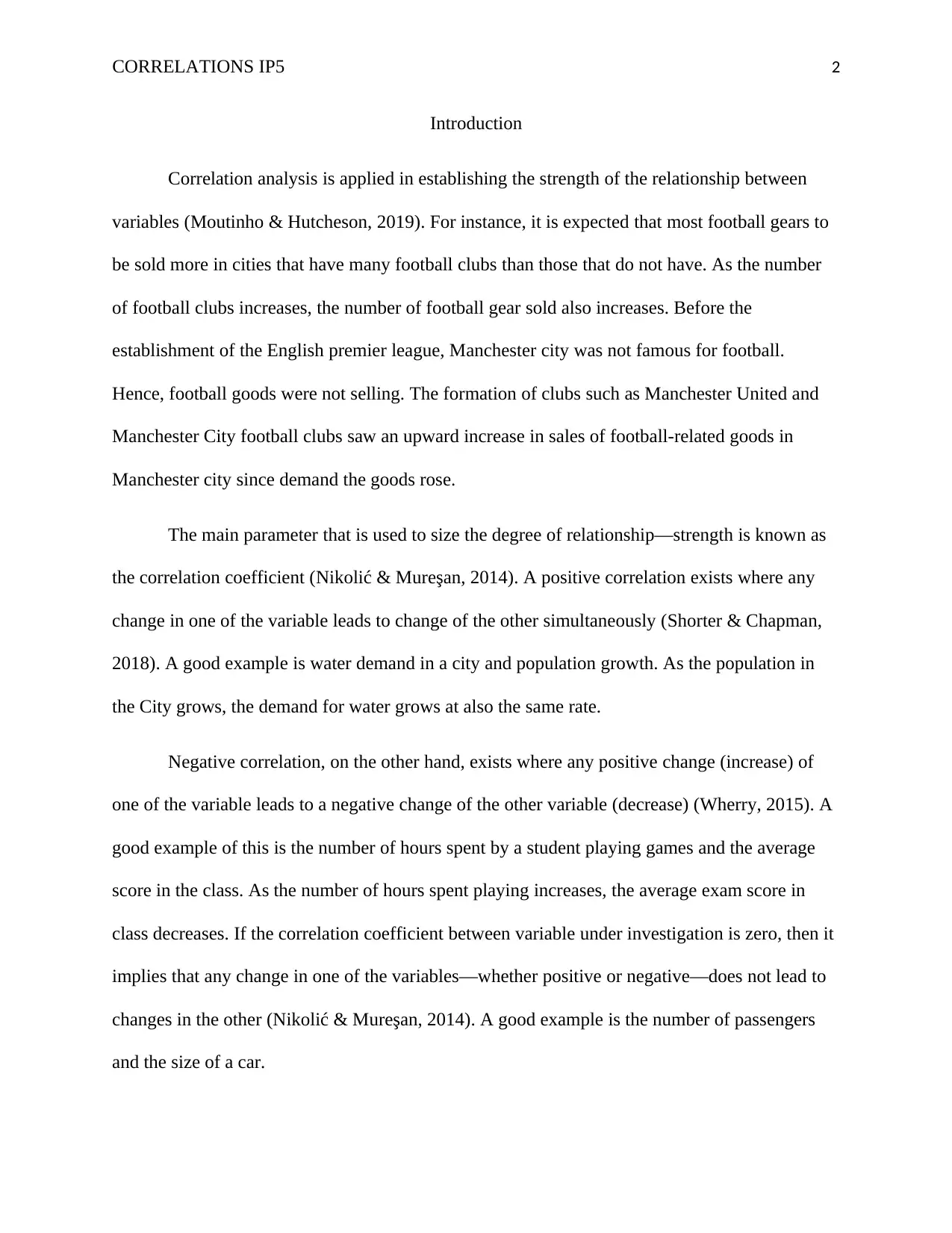
Introduction
Correlation analysis is applied in establishing the strength of the relationship between
variables (Moutinho & Hutcheson, 2019). For instance, it is expected that most football gears to
be sold more in cities that have many football clubs than those that do not have. As the number
of football clubs increases, the number of football gear sold also increases. Before the
establishment of the English premier league, Manchester city was not famous for football.
Hence, football goods were not selling. The formation of clubs such as Manchester United and
Manchester City football clubs saw an upward increase in sales of football-related goods in
Manchester city since demand the goods rose.
The main parameter that is used to size the degree of relationship—strength is known as
the correlation coefficient (Nikolić & Mureşan, 2014). A positive correlation exists where any
change in one of the variable leads to change of the other simultaneously (Shorter & Chapman,
2018). A good example is water demand in a city and population growth. As the population in
the City grows, the demand for water grows at also the same rate.
Negative correlation, on the other hand, exists where any positive change (increase) of
one of the variable leads to a negative change of the other variable (decrease) (Wherry, 2015). A
good example of this is the number of hours spent by a student playing games and the average
score in the class. As the number of hours spent playing increases, the average exam score in
class decreases. If the correlation coefficient between variable under investigation is zero, then it
implies that any change in one of the variables—whether positive or negative—does not lead to
changes in the other (Nikolić & Mureşan, 2014). A good example is the number of passengers
and the size of a car.
Document Page
CORRELATIONS IP5 3
Entry into a new market requires informed evaluation of the business environment to
ensure positive operations in the anticipated market (Moutinho & Hutcheson, 2019). Big D
company is considering expanding its operations. Correlation can be a good tool for forecasting.
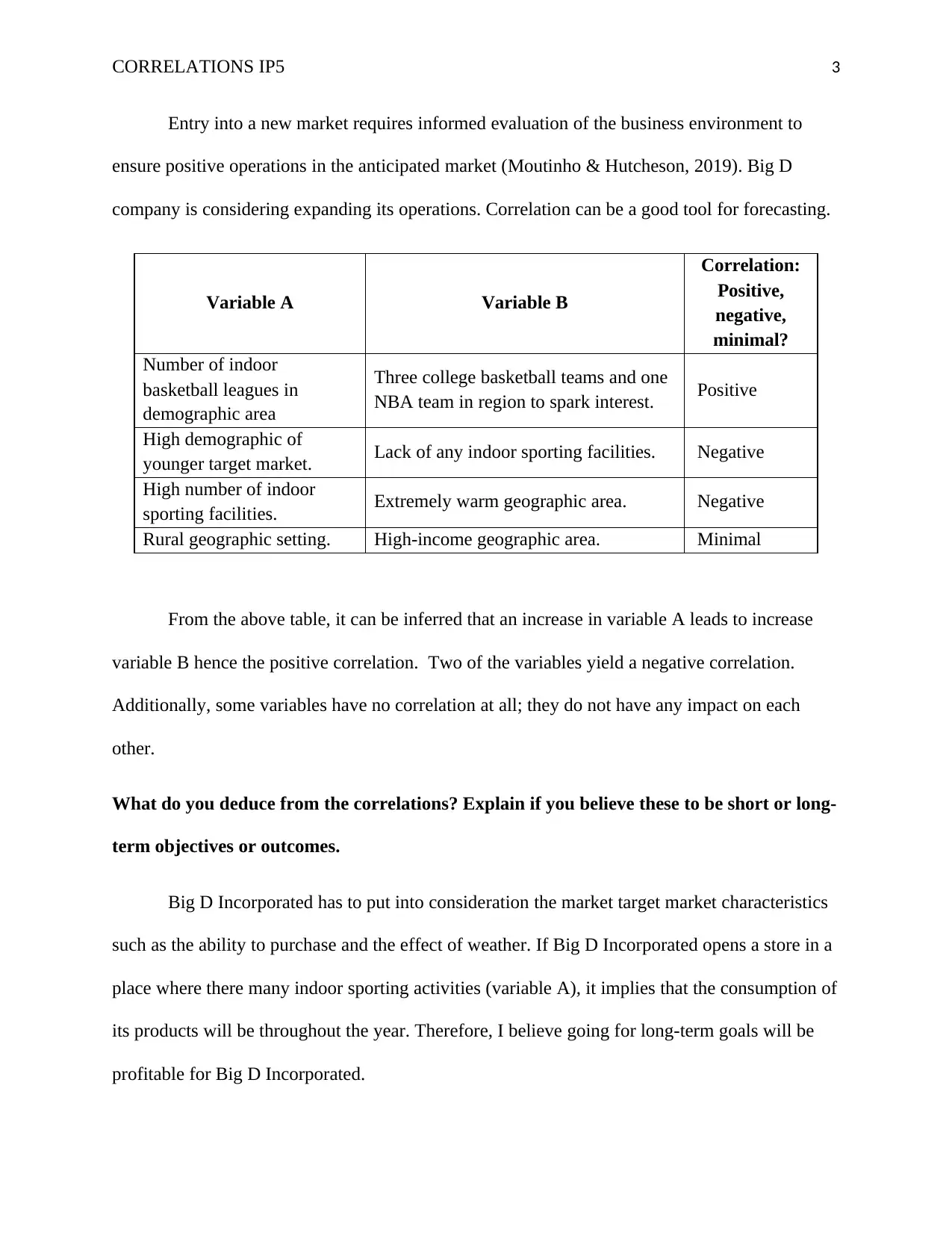
Variable A Variable B
Correlation:
Positive,
negative,
minimal?
Number of indoor
basketball leagues in
demographic area
Three college basketball teams and one
NBA team in region to spark interest. Positive
High demographic of
younger target market. Lack of any indoor sporting facilities. Negative
High number of indoor
sporting facilities. Extremely warm geographic area. Negative
Rural geographic setting. High-income geographic area. Minimal
From the above table, it can be inferred that an increase in variable A leads to increase
variable B hence the positive correlation. Two of the variables yield a negative correlation.
Additionally, some variables have no correlation at all; they do not have any impact on each
other.
What do you deduce from the correlations? Explain if you believe these to be short or long-
term objectives or outcomes.
Big D Incorporated has to put into consideration the market target market characteristics
such as the ability to purchase and the effect of weather. If Big D Incorporated opens a store in a
place where there many indoor sporting activities (variable A), it implies that the consumption of
its products will be throughout the year. Therefore, I believe going for long-term goals will be
profitable for Big D Incorporated.
Document Page
CORRELATIONS IP5 4
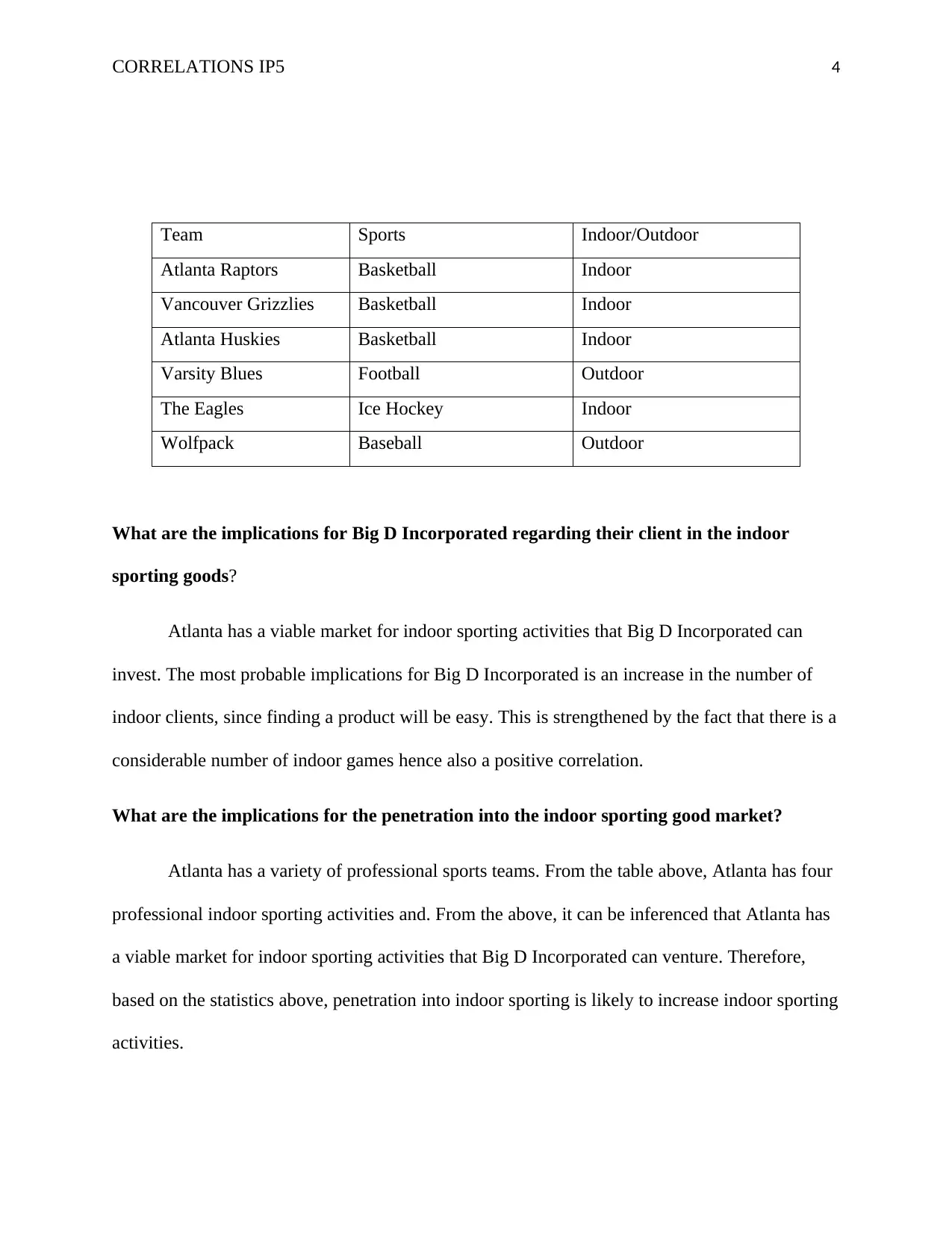
Team Sports Indoor/Outdoor
Atlanta Raptors Basketball Indoor
Vancouver Grizzlies Basketball Indoor
Atlanta Huskies Basketball Indoor
Varsity Blues Football Outdoor
The Eagles Ice Hockey Indoor
Wolfpack Baseball Outdoor
What are the implications for Big D Incorporated regarding their client in the indoor
sporting goods?
Atlanta has a viable market for indoor sporting activities that Big D Incorporated can
invest. The most probable implications for Big D Incorporated is an increase in the number of
indoor clients, since finding a product will be easy. This is strengthened by the fact that there is a
considerable number of indoor games hence also a positive correlation.
What are the implications for the penetration into the indoor sporting good market?
Atlanta has a variety of professional sports teams. From the table above, Atlanta has four
professional indoor sporting activities and. From the above, it can be inferenced that Atlanta has
a viable market for indoor sporting activities that Big D Incorporated can venture. Therefore,
based on the statistics above, penetration into indoor sporting is likely to increase indoor sporting
activities.
tabler-icon-diamond-filled.svg

Paraphrase This Document

Need a fresh take? Get an instant paraphrase of this document with our AI Paraphraser
Document Page
CORRELATIONS IP5 5
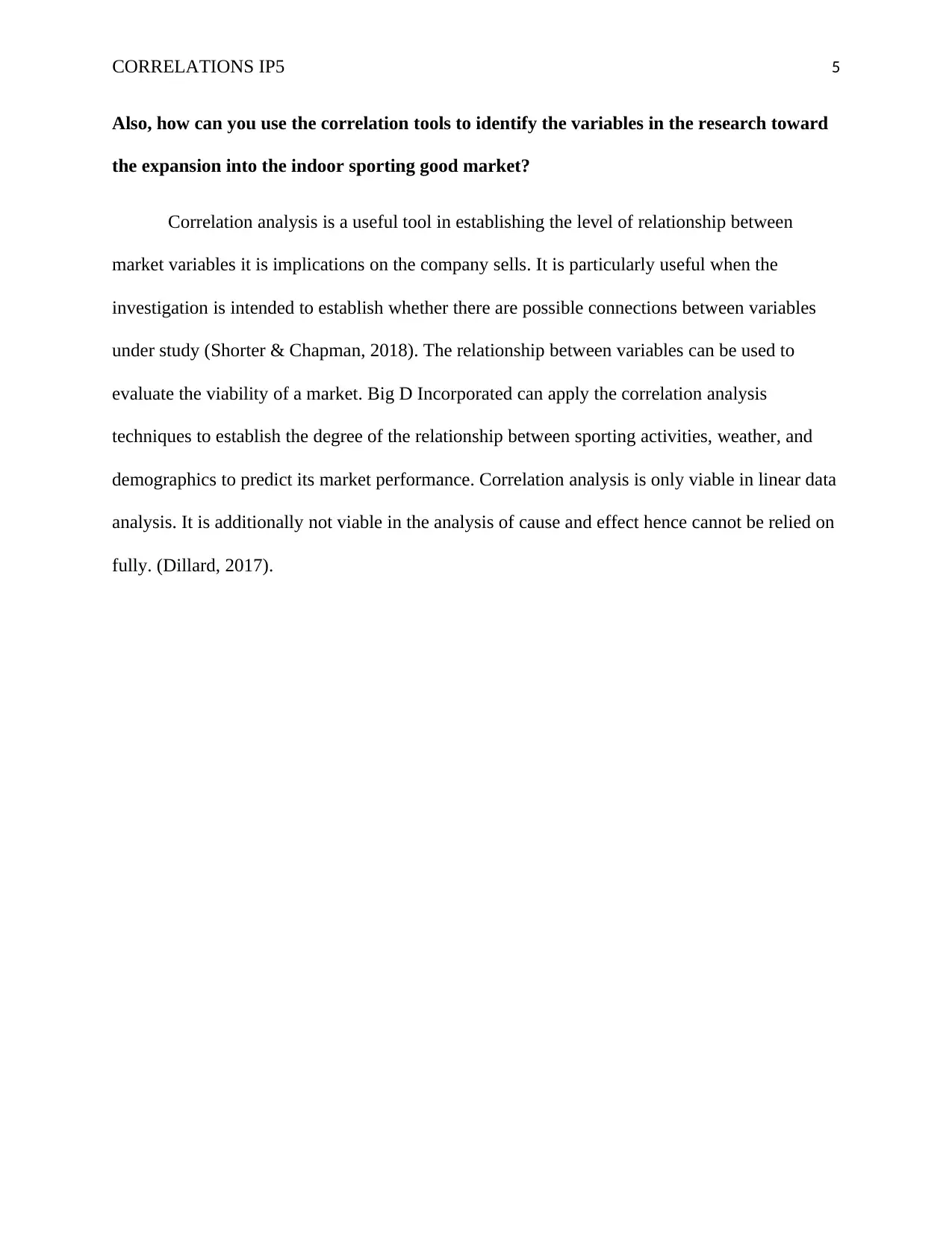
Also, how can you use the correlation tools to identify the variables in the research toward
the expansion into the indoor sporting good market?
Correlation analysis is a useful tool in establishing the level of relationship between
market variables it is implications on the company sells. It is particularly useful when the
investigation is intended to establish whether there are possible connections between variables
under study (Shorter & Chapman, 2018). The relationship between variables can be used to
evaluate the viability of a market. Big D Incorporated can apply the correlation analysis
techniques to establish the degree of the relationship between sporting activities, weather, and
demographics to predict its market performance. Correlation analysis is only viable in linear data
analysis. It is additionally not viable in the analysis of cause and effect hence cannot be relied on
fully. (Dillard, 2017).
Document Page
CORRELATIONS IP5 6
References
Dillard, J. (2017). 5 Most Important Methods For Statistical Data Analysis. Retrieved from
https://www.bigskyassociates.com/blog/bid/356764/5-Most-Important-Methods-For-
Statistical-Data-Analysis
Moutinho, L., & Hutcheson, G. (2019). Correlation Analysis. Retrieved from
https://ori.hhs.gov/education/products/n_illinois_u/datamanagement/datopic.html
Nikolić, D., & Mureşan, R. (2014). Scaled correlation analysis: a better way to compute a cross-
correlogram. European Journal Of Neuroscience, 35(5), 742-762. doi: 10.1111/j.1460-
9568.2011.07987.x
Shorter, J., & Chapman, N. (2018). Correlation data analysis. Retrieved from https://medical-
dictionary.thefreedictionary.com/data+analysis
Thompson, B. (2016). Quantitative management research. Retrieved from
http://www.businessdictionary.com/definition/data-analysis.html
Wherry, R. (2015). Data Statistical Analysis Retrieved from https://ctb.ku.edu/en/table-of-
contents/evaluate/evaluate-community-interventions/collect-analyze-data/main
chevron_up_icon
1 out of 6
circle_padding
hide_on_mobile
zoom_out_icon
[object Object]