An Examination of Corruption and Legal Institutions in Libya
VerifiedAdded on 2021/04/24
|20
|4191
|22
Report
AI Summary
This report examines the pervasive issue of corruption in Libya, its impact on economic development, and the failures of governmental bodies to effectively combat it. It details the legal and institutional frameworks in place, including the United Nations Convention against Corruption, and analyzes the criminalization and law enforcement efforts. The report explores specific offenses such as bribery, money laundering, embezzlement, and obstruction of justice, while also addressing the liability of legal persons. It highlights the challenges posed by political instability and the lack of detailed information, offering an overview of Libya's attempts to address corruption within its legal and administrative systems. The report points to the lack of success in creating policies or establishing institutions that adequately contain corruption and the need for further improvements in the fight against corruption.
The present-day literature points out corruption cases in Libya, for
example, the incompetence of authorities in reducing corruption as well
as eradicating the corrupt culture. It is the broad idea of the issue among
Libyans that corruption has turned into a social standard, and certain
dishonest activities do not appear to be corrupt according to them.
Evidence has emerged of severe consequences of corruption on
economic development. Corruption in Libya has adversely influenced
outside relations and created the notoriety of the political framework,
particularly with nations and organizations that have had an enthusiasm
for putting resources into Libya's economy, which has prompted
diminished economic advancement.
In Libya, the legislature has neglected the battle against corruption. Also,
the new income created through the exploitation of oil has opened
doors for corruption among Libyan authorities on an enormous scale.
"Libyans have gone in for so much uncontrolled spending and grafting
that a money deficiency has emerged.”
example, the incompetence of authorities in reducing corruption as well
as eradicating the corrupt culture. It is the broad idea of the issue among
Libyans that corruption has turned into a social standard, and certain
dishonest activities do not appear to be corrupt according to them.
Evidence has emerged of severe consequences of corruption on
economic development. Corruption in Libya has adversely influenced
outside relations and created the notoriety of the political framework,
particularly with nations and organizations that have had an enthusiasm
for putting resources into Libya's economy, which has prompted
diminished economic advancement.
In Libya, the legislature has neglected the battle against corruption. Also,
the new income created through the exploitation of oil has opened
doors for corruption among Libyan authorities on an enormous scale.
"Libyans have gone in for so much uncontrolled spending and grafting
that a money deficiency has emerged.”

Paraphrase This Document
Need a fresh take? Get an instant paraphrase of this document with our AI Paraphraser

Corruption has for some time been widespread in Libya, particularly
under Gadhafi. Governments since the 2011 upheaval have not been
fruitful in creating strategies or building up establishments that
adequately contain corruption. As indicated by Borzou Daragahi, Libya
has a commission put in place to fight corruption which flaunts 200 staff
members and a yearly spending plan of $20 million, yet it isn't seen as
successful, and no effect has been recorded. Corruption stays prevalent
in numerous divisions, including the equity, wellbeing and oil areas. This
has escalated because of the political precariousness and extension of
volunteer armies. Corruption claims have been attached to the political
divisions after 2011 and especially to the oil business. In 2013, Prime
Minister Ali Zeidan was blamed for corruption by the federalist
association, headed by an ex-revolutionary administrator and previous
leader of Cyrenaica's Oil Facilities Guard, Ibrahim Jathran. He blamed the
central government for corruption and wouldn't open the oil terminals
until an appropriate inquiry into the corruption issues was made. There
have additionally been endeavours by common society associations,
including youth gatherings and H2O, to counter corruption. Be that as it
may, their effect stays constrained.
under Gadhafi. Governments since the 2011 upheaval have not been
fruitful in creating strategies or building up establishments that
adequately contain corruption. As indicated by Borzou Daragahi, Libya
has a commission put in place to fight corruption which flaunts 200 staff
members and a yearly spending plan of $20 million, yet it isn't seen as
successful, and no effect has been recorded. Corruption stays prevalent
in numerous divisions, including the equity, wellbeing and oil areas. This
has escalated because of the political precariousness and extension of
volunteer armies. Corruption claims have been attached to the political
divisions after 2011 and especially to the oil business. In 2013, Prime
Minister Ali Zeidan was blamed for corruption by the federalist
association, headed by an ex-revolutionary administrator and previous
leader of Cyrenaica's Oil Facilities Guard, Ibrahim Jathran. He blamed the
central government for corruption and wouldn't open the oil terminals
until an appropriate inquiry into the corruption issues was made. There
have additionally been endeavours by common society associations,
including youth gatherings and H2O, to counter corruption. Be that as it
may, their effect stays constrained.
Introduction: Summary of the legal and institutional system of the State
of Libya with regards to usage of the United Nations Convention against
Corruption. The State of Libya marked the United Nations Convention
against Corruption on 23 December 2003, confirmed it through Act No.
10 of 2005 and saved its instrument of confirmation with the Secretary-
General of the United Nations on 7 June 2005. As indicated by the
Constitutional Declaration of 3 August 2011, the National Transitional
Council, made up of Local Council representatives, executes the job of
the Government as the most astounding authority in the State amid the
transitional period. The implementation of policies is tasked to the
Executive Office of the National Transitional Council, which issues official
guidelines identifying with declared laws. Concerning the status of global
shows, Libya, through Constitutional Appeal No. 57/1 S of 23 December
2013, has built up that global shows outweigh household enactment.
Legal standards received by the Supreme Court are authoritative on all
courts and all other legal substances in Libya, as per Law No. 6 of 1982,
as altered by Law No. 33 of 2012. A similar standard has likewise been
built up in article 13 of the draft constitution of Libya, which stipulates
that approved arrangements and shows have a higher status than laws;
however a lower rank than the Constitution. The national enemy of
of Libya with regards to usage of the United Nations Convention against
Corruption. The State of Libya marked the United Nations Convention
against Corruption on 23 December 2003, confirmed it through Act No.
10 of 2005 and saved its instrument of confirmation with the Secretary-
General of the United Nations on 7 June 2005. As indicated by the
Constitutional Declaration of 3 August 2011, the National Transitional
Council, made up of Local Council representatives, executes the job of
the Government as the most astounding authority in the State amid the
transitional period. The implementation of policies is tasked to the
Executive Office of the National Transitional Council, which issues official
guidelines identifying with declared laws. Concerning the status of global
shows, Libya, through Constitutional Appeal No. 57/1 S of 23 December
2013, has built up that global shows outweigh household enactment.
Legal standards received by the Supreme Court are authoritative on all
courts and all other legal substances in Libya, as per Law No. 6 of 1982,
as altered by Law No. 33 of 2012. A similar standard has likewise been
built up in article 13 of the draft constitution of Libya, which stipulates
that approved arrangements and shows have a higher status than laws;
however a lower rank than the Constitution. The national enemy of
⊘ This is a preview!⊘
Do you want full access?
Subscribe today to unlock all pages.

Trusted by 1+ million students worldwide
corruption system contains provisions from a few authoritative
instruments, prominently, “the Criminal Code; the Criminal Procedure
Code; the Law on the Establishment of the National Anti-Corruption
Commission; the Law on Economic Crimes; and the Law on Countering
Money-Laundering and the Financing of Terrorism.” Libya has a few
enemies of corruption offices and bodies, including, most remarkably,
“the National Anti-Corruption Commission, the Office of the Attorney
General, the Administrative Control Authority, the Accountancy Bureau
and the Financial Information Unit.” The rundown contained in this
relates to the nation audit led in the fourth year of the primary survey
cycle. 2. Section III: Criminalization and law authorization Libya has a
legal and institutional system set up to battle corruption at the political
dimension. Inferable from an absence of relevant information, be that as
it may, it is hard to make a point by point evaluation of Libyan work on
concerning criminalization and law requirement in corruption cases. 2.1.
Perceptions of the execution of the articles under audit.
Bribery and trading in influence: Libya has embraced an expansive
definition of "open authority" that covers all authorities of the
authoritative, official and legal specialists as stipulated in article 16 (4) of
instruments, prominently, “the Criminal Code; the Criminal Procedure
Code; the Law on the Establishment of the National Anti-Corruption
Commission; the Law on Economic Crimes; and the Law on Countering
Money-Laundering and the Financing of Terrorism.” Libya has a few
enemies of corruption offices and bodies, including, most remarkably,
“the National Anti-Corruption Commission, the Office of the Attorney
General, the Administrative Control Authority, the Accountancy Bureau
and the Financial Information Unit.” The rundown contained in this
relates to the nation audit led in the fourth year of the primary survey
cycle. 2. Section III: Criminalization and law authorization Libya has a
legal and institutional system set up to battle corruption at the political
dimension. Inferable from an absence of relevant information, be that as
it may, it is hard to make a point by point evaluation of Libyan work on
concerning criminalization and law requirement in corruption cases. 2.1.
Perceptions of the execution of the articles under audit.
Bribery and trading in influence: Libya has embraced an expansive
definition of "open authority" that covers all authorities of the
authoritative, official and legal specialists as stipulated in article 16 (4) of
Paraphrase This Document
Need a fresh take? Get an instant paraphrase of this document with our AI Paraphraser
the Criminal Code and article 2 of the Law on Economic Crimes. Article
226 of the Criminal Code and article 21 of the Law on Economic Crimes
set up as an offence the requesting or acknowledgement by the
authority of rewards to act or hold back from arts working in the activity
of his or her obligations or to break his or her responsibilities. Article 226
additionally builds up as an offence the acknowledgement by an
authority of a blessing to act in the activity of his or her duties. Section
229 of the Criminal Code and article 22 of the Law on Economic Crimes
set up as an offence the dynamic pay off of an official, regardless of
whether the payoff it won't. If there should emerge an occurrence of
acknowledgement, the briber is criminally subject under article 226 of
the Criminal Code and article 21 of the Law on Economic Crimes, which
set up that the discipline applies to both the briber and the middle
person, along these lines covering instances of aberrant pay off. Libyan
enactment does not set up as an offence the dynamic or inactive
payment off of outside open authorities or authorities of free worldwide
associations. Article 227 of the Criminal Code builds up as an offence the
requesting or acknowledgement by an authority of a reward for utilizing
his or her genuine or assumed influence to acquire or endeavor to get a
favorable position of any sort from any open expert or any substance
226 of the Criminal Code and article 21 of the Law on Economic Crimes
set up as an offence the requesting or acknowledgement by the
authority of rewards to act or hold back from arts working in the activity
of his or her obligations or to break his or her responsibilities. Article 226
additionally builds up as an offence the acknowledgement by an
authority of a blessing to act in the activity of his or her duties. Section
229 of the Criminal Code and article 22 of the Law on Economic Crimes
set up as an offence the dynamic pay off of an official, regardless of
whether the payoff it won't. If there should emerge an occurrence of
acknowledgement, the briber is criminally subject under article 226 of
the Criminal Code and article 21 of the Law on Economic Crimes, which
set up that the discipline applies to both the briber and the middle
person, along these lines covering instances of aberrant pay off. Libyan
enactment does not set up as an offence the dynamic or inactive
payment off of outside open authorities or authorities of free worldwide
associations. Article 227 of the Criminal Code builds up as an offence the
requesting or acknowledgement by an authority of a reward for utilizing
his or her genuine or assumed influence to acquire or endeavor to get a
favorable position of any sort from any open expert or any substance
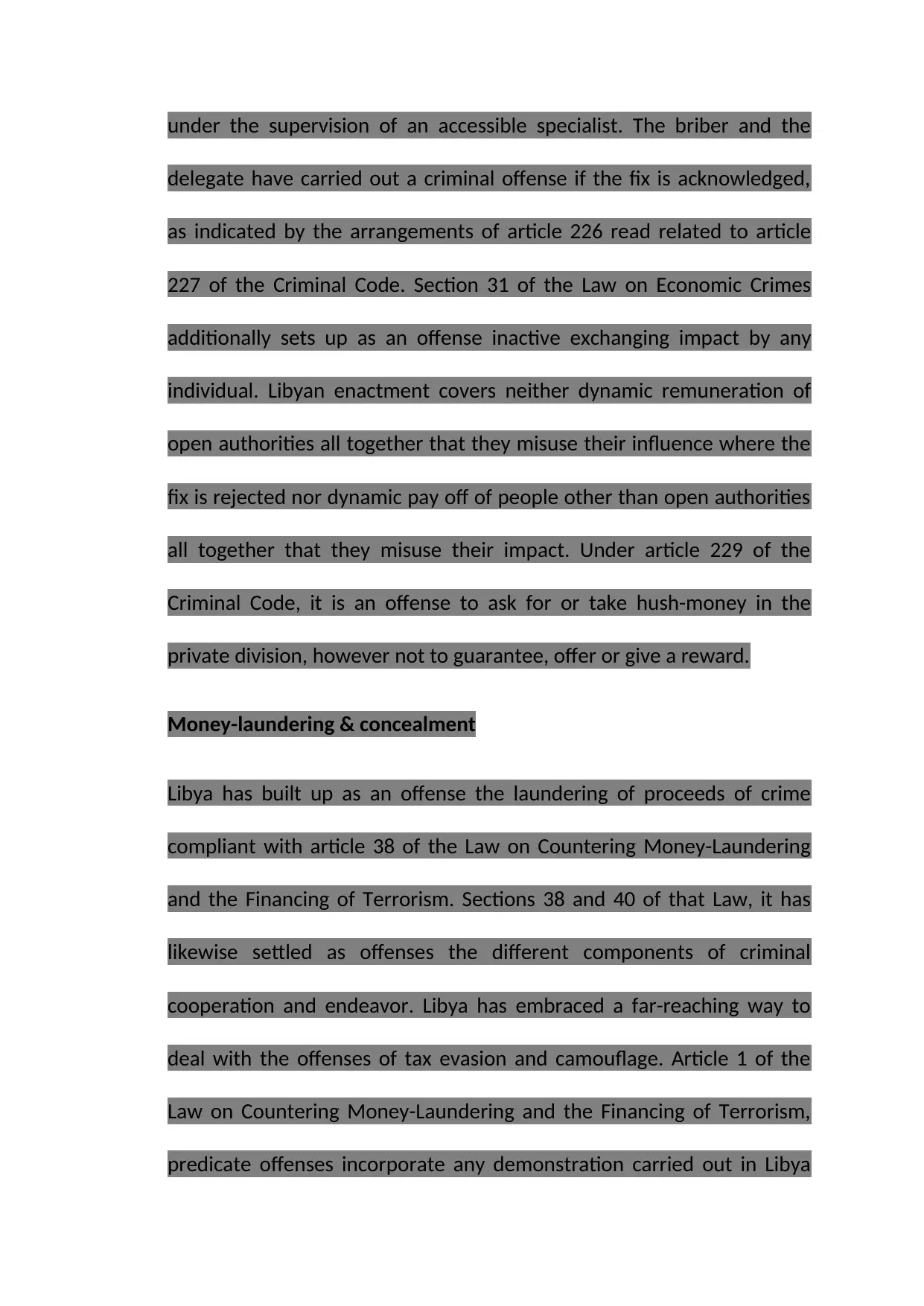
under the supervision of an accessible specialist. The briber and the
delegate have carried out a criminal offense if the fix is acknowledged,
as indicated by the arrangements of article 226 read related to article
227 of the Criminal Code. Section 31 of the Law on Economic Crimes
additionally sets up as an offense inactive exchanging impact by any
individual. Libyan enactment covers neither dynamic remuneration of
open authorities all together that they misuse their influence where the
fix is rejected nor dynamic pay off of people other than open authorities
all together that they misuse their impact. Under article 229 of the
Criminal Code, it is an offense to ask for or take hush-money in the
private division, however not to guarantee, offer or give a reward.
Money-laundering & concealment
Libya has built up as an offense the laundering of proceeds of crime
compliant with article 38 of the Law on Countering Money-Laundering
and the Financing of Terrorism. Sections 38 and 40 of that Law, it has
likewise settled as offenses the different components of criminal
cooperation and endeavor. Libya has embraced a far-reaching way to
deal with the offenses of tax evasion and camouflage. Article 1 of the
Law on Countering Money-Laundering and the Financing of Terrorism,
predicate offenses incorporate any demonstration carried out in Libya
delegate have carried out a criminal offense if the fix is acknowledged,
as indicated by the arrangements of article 226 read related to article
227 of the Criminal Code. Section 31 of the Law on Economic Crimes
additionally sets up as an offense inactive exchanging impact by any
individual. Libyan enactment covers neither dynamic remuneration of
open authorities all together that they misuse their influence where the
fix is rejected nor dynamic pay off of people other than open authorities
all together that they misuse their impact. Under article 229 of the
Criminal Code, it is an offense to ask for or take hush-money in the
private division, however not to guarantee, offer or give a reward.
Money-laundering & concealment
Libya has built up as an offense the laundering of proceeds of crime
compliant with article 38 of the Law on Countering Money-Laundering
and the Financing of Terrorism. Sections 38 and 40 of that Law, it has
likewise settled as offenses the different components of criminal
cooperation and endeavor. Libya has embraced a far-reaching way to
deal with the offenses of tax evasion and camouflage. Article 1 of the
Law on Countering Money-Laundering and the Financing of Terrorism,
predicate offenses incorporate any demonstration carried out in Libya
⊘ This is a preview!⊘
Do you want full access?
Subscribe today to unlock all pages.
Trusted by 1+ million students worldwide
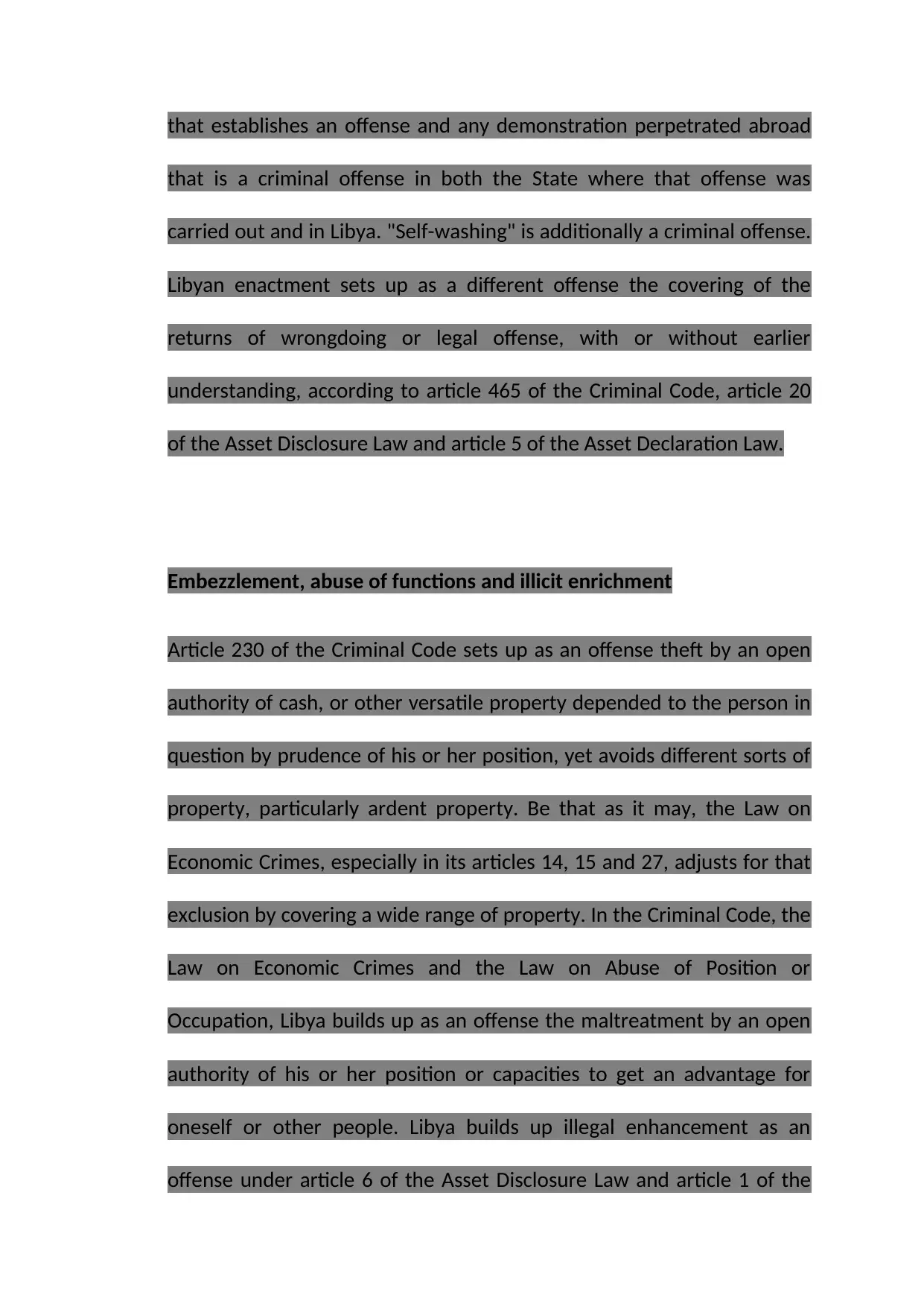
that establishes an offense and any demonstration perpetrated abroad
that is a criminal offense in both the State where that offense was
carried out and in Libya. "Self-washing" is additionally a criminal offense.
Libyan enactment sets up as a different offense the covering of the
returns of wrongdoing or legal offense, with or without earlier
understanding, according to article 465 of the Criminal Code, article 20
of the Asset Disclosure Law and article 5 of the Asset Declaration Law.
Embezzlement, abuse of functions and illicit enrichment
Article 230 of the Criminal Code sets up as an offense theft by an open
authority of cash, or other versatile property depended to the person in
question by prudence of his or her position, yet avoids different sorts of
property, particularly ardent property. Be that as it may, the Law on
Economic Crimes, especially in its articles 14, 15 and 27, adjusts for that
exclusion by covering a wide range of property. In the Criminal Code, the
Law on Economic Crimes and the Law on Abuse of Position or
Occupation, Libya builds up as an offense the maltreatment by an open
authority of his or her position or capacities to get an advantage for
oneself or other people. Libya builds up illegal enhancement as an
offense under article 6 of the Asset Disclosure Law and article 1 of the
that is a criminal offense in both the State where that offense was
carried out and in Libya. "Self-washing" is additionally a criminal offense.
Libyan enactment sets up as a different offense the covering of the
returns of wrongdoing or legal offense, with or without earlier
understanding, according to article 465 of the Criminal Code, article 20
of the Asset Disclosure Law and article 5 of the Asset Declaration Law.
Embezzlement, abuse of functions and illicit enrichment
Article 230 of the Criminal Code sets up as an offense theft by an open
authority of cash, or other versatile property depended to the person in
question by prudence of his or her position, yet avoids different sorts of
property, particularly ardent property. Be that as it may, the Law on
Economic Crimes, especially in its articles 14, 15 and 27, adjusts for that
exclusion by covering a wide range of property. In the Criminal Code, the
Law on Economic Crimes and the Law on Abuse of Position or
Occupation, Libya builds up as an offense the maltreatment by an open
authority of his or her position or capacities to get an advantage for
oneself or other people. Libya builds up illegal enhancement as an
offense under article 6 of the Asset Disclosure Law and article 1 of the
Paraphrase This Document
Need a fresh take? Get an instant paraphrase of this document with our AI Paraphraser
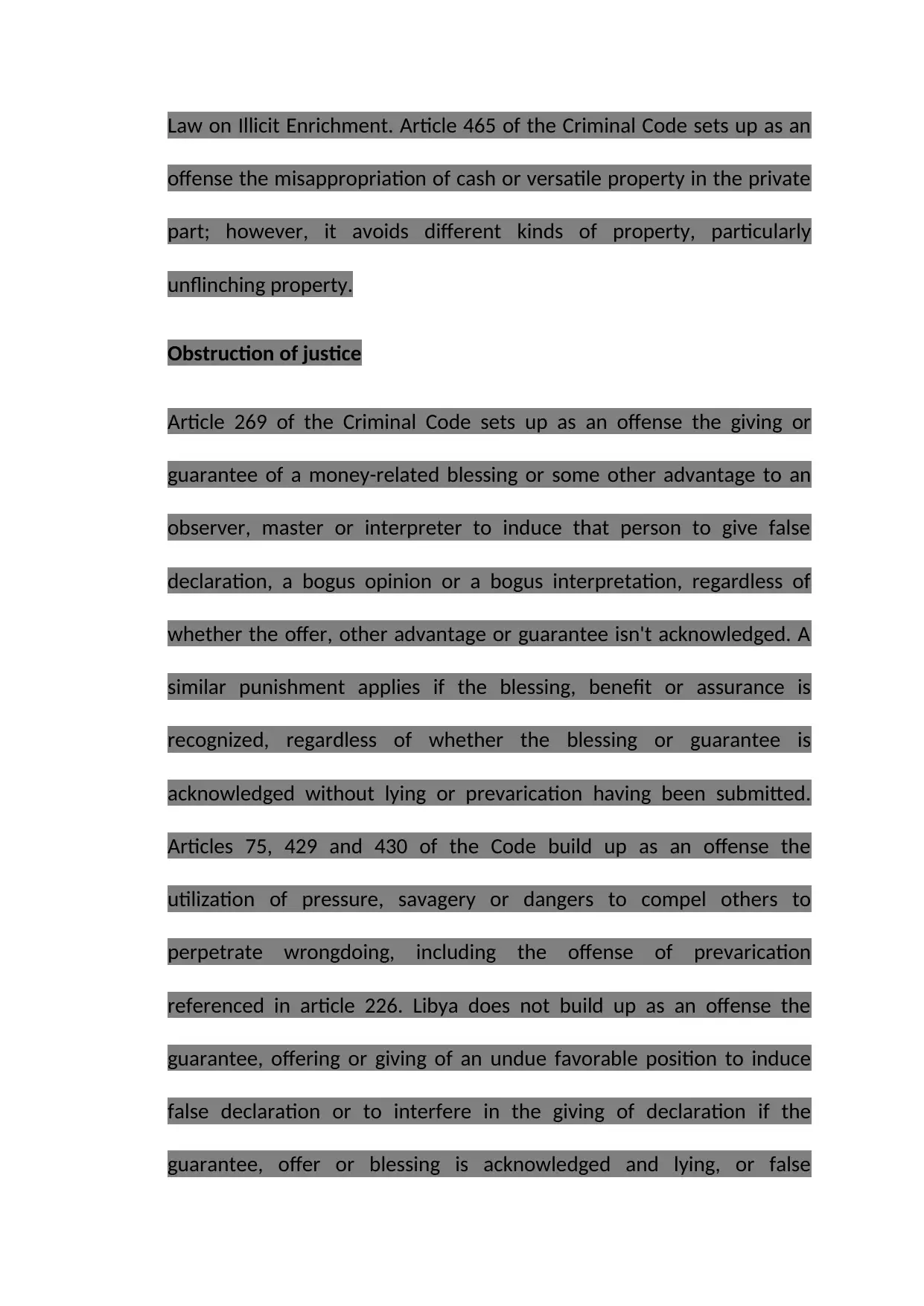
Law on Illicit Enrichment. Article 465 of the Criminal Code sets up as an
offense the misappropriation of cash or versatile property in the private
part; however, it avoids different kinds of property, particularly
unflinching property.
Obstruction of justice
Article 269 of the Criminal Code sets up as an offense the giving or
guarantee of a money-related blessing or some other advantage to an
observer, master or interpreter to induce that person to give false
declaration, a bogus opinion or a bogus interpretation, regardless of
whether the offer, other advantage or guarantee isn't acknowledged. A
similar punishment applies if the blessing, benefit or assurance is
recognized, regardless of whether the blessing or guarantee is
acknowledged without lying or prevarication having been submitted.
Articles 75, 429 and 430 of the Code build up as an offense the
utilization of pressure, savagery or dangers to compel others to
perpetrate wrongdoing, including the offense of prevarication
referenced in article 226. Libya does not build up as an offense the
guarantee, offering or giving of an undue favorable position to induce
false declaration or to interfere in the giving of declaration if the
guarantee, offer or blessing is acknowledged and lying, or false
offense the misappropriation of cash or versatile property in the private
part; however, it avoids different kinds of property, particularly
unflinching property.
Obstruction of justice
Article 269 of the Criminal Code sets up as an offense the giving or
guarantee of a money-related blessing or some other advantage to an
observer, master or interpreter to induce that person to give false
declaration, a bogus opinion or a bogus interpretation, regardless of
whether the offer, other advantage or guarantee isn't acknowledged. A
similar punishment applies if the blessing, benefit or assurance is
recognized, regardless of whether the blessing or guarantee is
acknowledged without lying or prevarication having been submitted.
Articles 75, 429 and 430 of the Code build up as an offense the
utilization of pressure, savagery or dangers to compel others to
perpetrate wrongdoing, including the offense of prevarication
referenced in article 226. Libya does not build up as an offense the
guarantee, offering or giving of an undue favorable position to induce
false declaration or to interfere in the giving of declaration if the
guarantee, offer or blessing is acknowledged and lying, or false
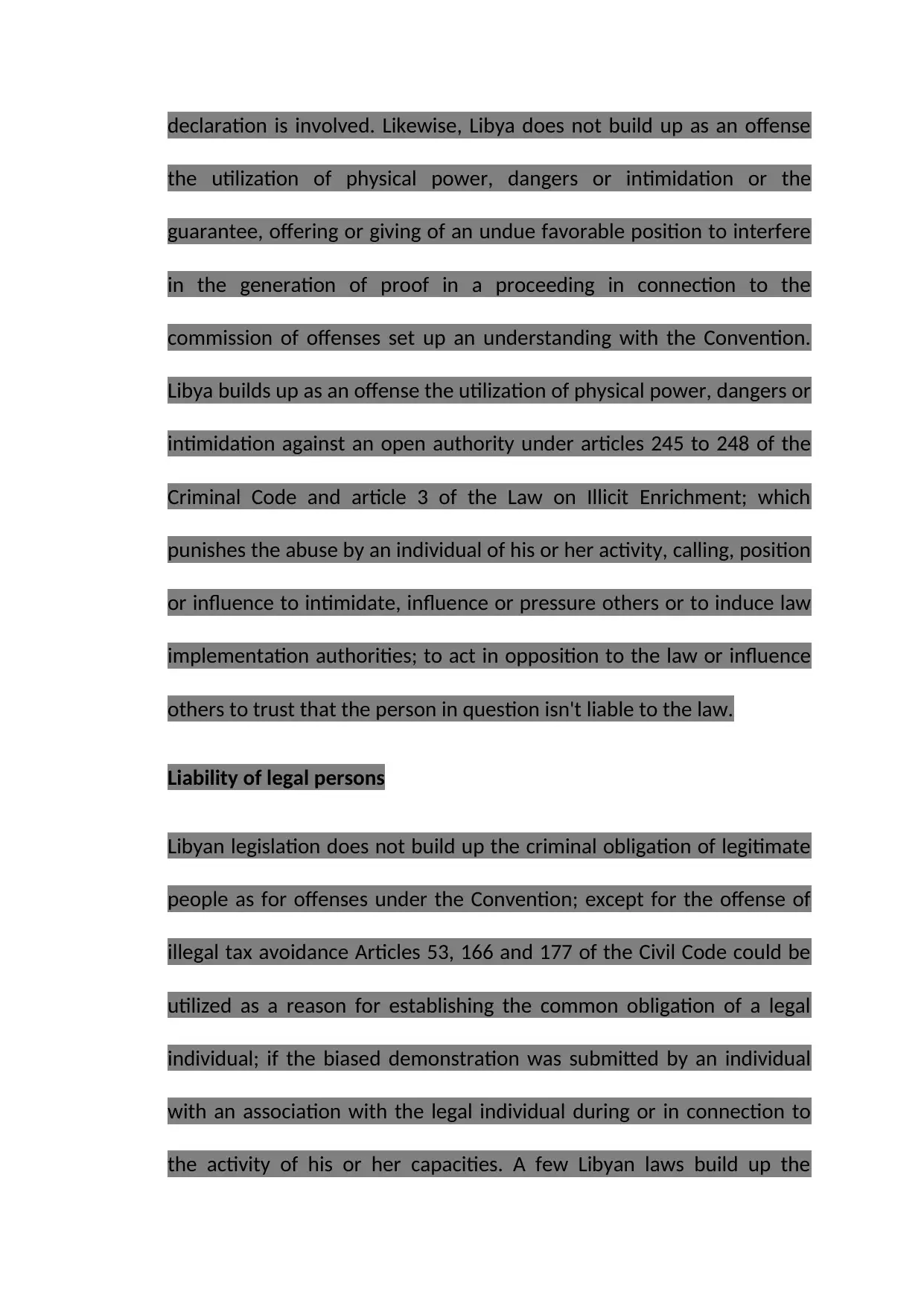
declaration is involved. Likewise, Libya does not build up as an offense
the utilization of physical power, dangers or intimidation or the
guarantee, offering or giving of an undue favorable position to interfere
in the generation of proof in a proceeding in connection to the
commission of offenses set up an understanding with the Convention.
Libya builds up as an offense the utilization of physical power, dangers or
intimidation against an open authority under articles 245 to 248 of the
Criminal Code and article 3 of the Law on Illicit Enrichment; which
punishes the abuse by an individual of his or her activity, calling, position
or influence to intimidate, influence or pressure others or to induce law
implementation authorities; to act in opposition to the law or influence
others to trust that the person in question isn't liable to the law.
Liability of legal persons
Libyan legislation does not build up the criminal obligation of legitimate
people as for offenses under the Convention; except for the offense of
illegal tax avoidance Articles 53, 166 and 177 of the Civil Code could be
utilized as a reason for establishing the common obligation of a legal
individual; if the biased demonstration was submitted by an individual
with an association with the legal individual during or in connection to
the activity of his or her capacities. A few Libyan laws build up the
the utilization of physical power, dangers or intimidation or the
guarantee, offering or giving of an undue favorable position to interfere
in the generation of proof in a proceeding in connection to the
commission of offenses set up an understanding with the Convention.
Libya builds up as an offense the utilization of physical power, dangers or
intimidation against an open authority under articles 245 to 248 of the
Criminal Code and article 3 of the Law on Illicit Enrichment; which
punishes the abuse by an individual of his or her activity, calling, position
or influence to intimidate, influence or pressure others or to induce law
implementation authorities; to act in opposition to the law or influence
others to trust that the person in question isn't liable to the law.
Liability of legal persons
Libyan legislation does not build up the criminal obligation of legitimate
people as for offenses under the Convention; except for the offense of
illegal tax avoidance Articles 53, 166 and 177 of the Civil Code could be
utilized as a reason for establishing the common obligation of a legal
individual; if the biased demonstration was submitted by an individual
with an association with the legal individual during or in connection to
the activity of his or her capacities. A few Libyan laws build up the
⊘ This is a preview!⊘
Do you want full access?
Subscribe today to unlock all pages.
Trusted by 1+ million students worldwide
administrative obligation of legitimate people. In any case, that
obligation seems, by all accounts, to be limited to the infringement of
important laws and does not stretch out to corruption offenses. The risk
of a legal individual, when built up, does not partiality the criminal
obligation of the normal individual who carried out the offense. Aside
from the criminal assents built up for the offense of tax evasion, Libyan
enactment does not force on legal people viable, proportionate and
dissuasive authorizes if there should be an occurrence of interest in acts
set up as offenses in understanding with the Convention.
Participation and attempt
Criminal cooperation is managed in articles 100 to 103 of the Criminal
Code. Articles 59, 60 and 61 of that Code additionally set up as an
offense endeavor to submit any legal offense or crime, including acts
built up as offenses in agreement with the Convention. Readiness for an
offense isn't an offense under Libyan law.
Prosecution, adjudication, and sanctions; cooperation with law
enforcement authorities
For offenses built up in agreement with the Convention, Libya has
embraced custodial punishments ranging from 24 hours' detainment to
obligation seems, by all accounts, to be limited to the infringement of
important laws and does not stretch out to corruption offenses. The risk
of a legal individual, when built up, does not partiality the criminal
obligation of the normal individual who carried out the offense. Aside
from the criminal assents built up for the offense of tax evasion, Libyan
enactment does not force on legal people viable, proportionate and
dissuasive authorizes if there should be an occurrence of interest in acts
set up as offenses in understanding with the Convention.
Participation and attempt
Criminal cooperation is managed in articles 100 to 103 of the Criminal
Code. Articles 59, 60 and 61 of that Code additionally set up as an
offense endeavor to submit any legal offense or crime, including acts
built up as offenses in agreement with the Convention. Readiness for an
offense isn't an offense under Libyan law.
Prosecution, adjudication, and sanctions; cooperation with law
enforcement authorities
For offenses built up in agreement with the Convention, Libya has
embraced custodial punishments ranging from 24 hours' detainment to
Paraphrase This Document
Need a fresh take? Get an instant paraphrase of this document with our AI Paraphraser
life detainment, connected based on the gravity of the offense,
excluding the offenses of unlawful enhancement, inactive pay off in the
private area and theft in the private segment. What're more, fines,
expulsion from office and seizure are relevant to some of those offenses.
Insusceptibilities don't seem to comprise an obstruction to the powerful
indictment of such offenses. Libya applies the principle of legality
concerning arraignment as stated in article 1 of the Code of Criminal
Procedure. Pre-trial confinement is conceivable in connection to
corruption offenses. Discharge pending preliminary might be allowed
subject to the introduction of financial or different assurances. People
condemned to the hardship of freedom might be restrictively discharged
in the wake of serving seventy-five percent of their jail sentence and
paying all their financial commitments, except if they can demonstrate
their inability to pay. Open authorities might be suspended if doing so is
in the open interest or the interest of an investigation by articles 31 and
32 of the Law establishing the Administrative Control Authority. An open
authority in pre-trial confinement or serving a criminal sentence might
be suspended by law while detained or detained as stated in article 158
of the Law on the Organization of Labor Relations. The Criminal Code
excluding the offenses of unlawful enhancement, inactive pay off in the
private area and theft in the private segment. What're more, fines,
expulsion from office and seizure are relevant to some of those offenses.
Insusceptibilities don't seem to comprise an obstruction to the powerful
indictment of such offenses. Libya applies the principle of legality
concerning arraignment as stated in article 1 of the Code of Criminal
Procedure. Pre-trial confinement is conceivable in connection to
corruption offenses. Discharge pending preliminary might be allowed
subject to the introduction of financial or different assurances. People
condemned to the hardship of freedom might be restrictively discharged
in the wake of serving seventy-five percent of their jail sentence and
paying all their financial commitments, except if they can demonstrate
their inability to pay. Open authorities might be suspended if doing so is
in the open interest or the interest of an investigation by articles 31 and
32 of the Law establishing the Administrative Control Authority. An open
authority in pre-trial confinement or serving a criminal sentence might
be suspended by law while detained or detained as stated in article 158
of the Law on the Organization of Labor Relations. The Criminal Code
accommodates exclusion from holding open office, without
unequivocally covering preclusion from work in State-claimed ventures.
Notwithstanding criminal approvals, disciplinary punishments might be
forced in corruption cases under article 155 of the Law on the
Organization of Labor Relations. Libya has no devoted program to screen
the reintegration into society of indicted people after their discharge
(aftercare). Be that as it may, those people may go to a few instructive,
training and recovery programs during their detainment. The Code of
Criminal Procedure gives that an indicted individual might be restored
for a certain period after the finish of his or her sentence. Libya has not
received any measures to give cooperating guilty parties invulnerability
from the indictment, and the advantages offered to people involved in
corruption offenses who are urged to report such offenses are restricted
to exclusion from punishments in instances of remuneration, illegal tax
avoidance and covering, or relief of the punishment in instances of
money laundering. People who collaborate with the equity framework
might be exempted from discipline on the off chance that they report
the offense before it is submitted in compliance with article 24 of the
Law on Economic Crimes in connection to the briber and the
intermediary in pay off offenses, or be exempted from discipline or have
unequivocally covering preclusion from work in State-claimed ventures.
Notwithstanding criminal approvals, disciplinary punishments might be
forced in corruption cases under article 155 of the Law on the
Organization of Labor Relations. Libya has no devoted program to screen
the reintegration into society of indicted people after their discharge
(aftercare). Be that as it may, those people may go to a few instructive,
training and recovery programs during their detainment. The Code of
Criminal Procedure gives that an indicted individual might be restored
for a certain period after the finish of his or her sentence. Libya has not
received any measures to give cooperating guilty parties invulnerability
from the indictment, and the advantages offered to people involved in
corruption offenses who are urged to report such offenses are restricted
to exclusion from punishments in instances of remuneration, illegal tax
avoidance and covering, or relief of the punishment in instances of
money laundering. People who collaborate with the equity framework
might be exempted from discipline on the off chance that they report
the offense before it is submitted in compliance with article 24 of the
Law on Economic Crimes in connection to the briber and the
intermediary in pay off offenses, or be exempted from discipline or have
⊘ This is a preview!⊘
Do you want full access?
Subscribe today to unlock all pages.
Trusted by 1+ million students worldwide

1 out of 20


Your All-in-One AI-Powered Toolkit for Academic Success.
+13062052269
info@desklib.com
Available 24*7 on WhatsApp / Email
![[object Object]](/_next/static/media/star-bottom.7253800d.svg)
Unlock your academic potential
Copyright © 2020–2026 A2Z Services. All Rights Reserved. Developed and managed by ZUCOL.