Cosmos Chocolate: Entry Mode and HR Strategy for Export to India

Verified

Added on  2023/06/11

|7
|2003
|437
Report
AI Summary
This report assesses Cosmos Chocolate's strategy to export its chocolate products to India, a market with significant growth potential. The analysis covers the pros and cons of exporting, highlighting benefits such as increased revenue and market exposure, as well as challenges like competition and cultural differences. Franchising is identified as a suitable entry mode due to its lower risk and high motivation for employees. The report suggests a decentralized manufacturing strategy to adapt to local market needs and recommends the United Kingdom as a potential subsidiary location due to its favorable business environment. A leadership-focused HR approach, utilizing local talent, is also proposed to effectively manage and motivate the workforce. The conclusion emphasizes the potential for Cosmos to achieve long-term competitive advantages through strategic exporting to India.
Document Page
Running head: International business
International business
tabler-icon-diamond-filled.svg

Paraphrase This Document

Need a fresh take? Get an instant paraphrase of this document with our AI Paraphraser
Document Page
International business
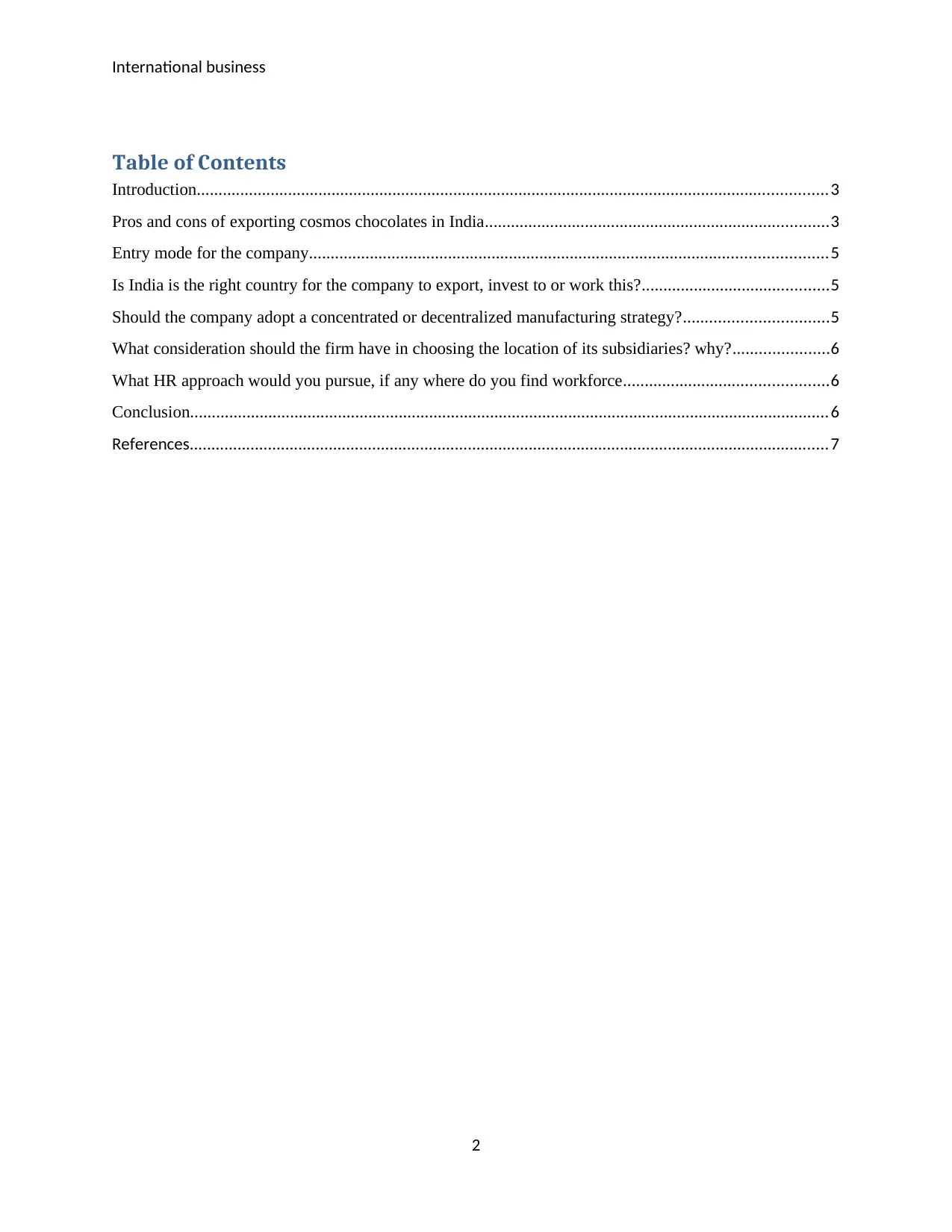
Table of Contents
Introduction.................................................................................................................................................3
Pros and cons of exporting cosmos chocolates in India...............................................................................3
Entry mode for the company.......................................................................................................................5
Is India is the right country for the company to export, invest to or work this?...........................................5
Should the company adopt a concentrated or decentralized manufacturing strategy?.................................5
What consideration should the firm have in choosing the location of its subsidiaries? why?......................6
What HR approach would you pursue, if any where do you find workforce...............................................6
Conclusion...................................................................................................................................................6
References...................................................................................................................................................7
2
Document Page
International business
Introduction
The primary aim of this paper is to outline the significance of exporting process. The
hypothetical company Cosmos has been taken in the task which is producing chocolate products
in Australia. The company has decided to export the chocolate in India. Chocolate is one of the
effective products of the firm therefore the organization wants to export this product in India for
increasing and enhancing the sale volume. The paper explains that which entry mode has been
chosen by the company for entering in the Indian market. Along with this, it discusses the HR
approach that would be pursued by the organization while exporting the chocolates in India.
Further detail of the task has been discussed below.
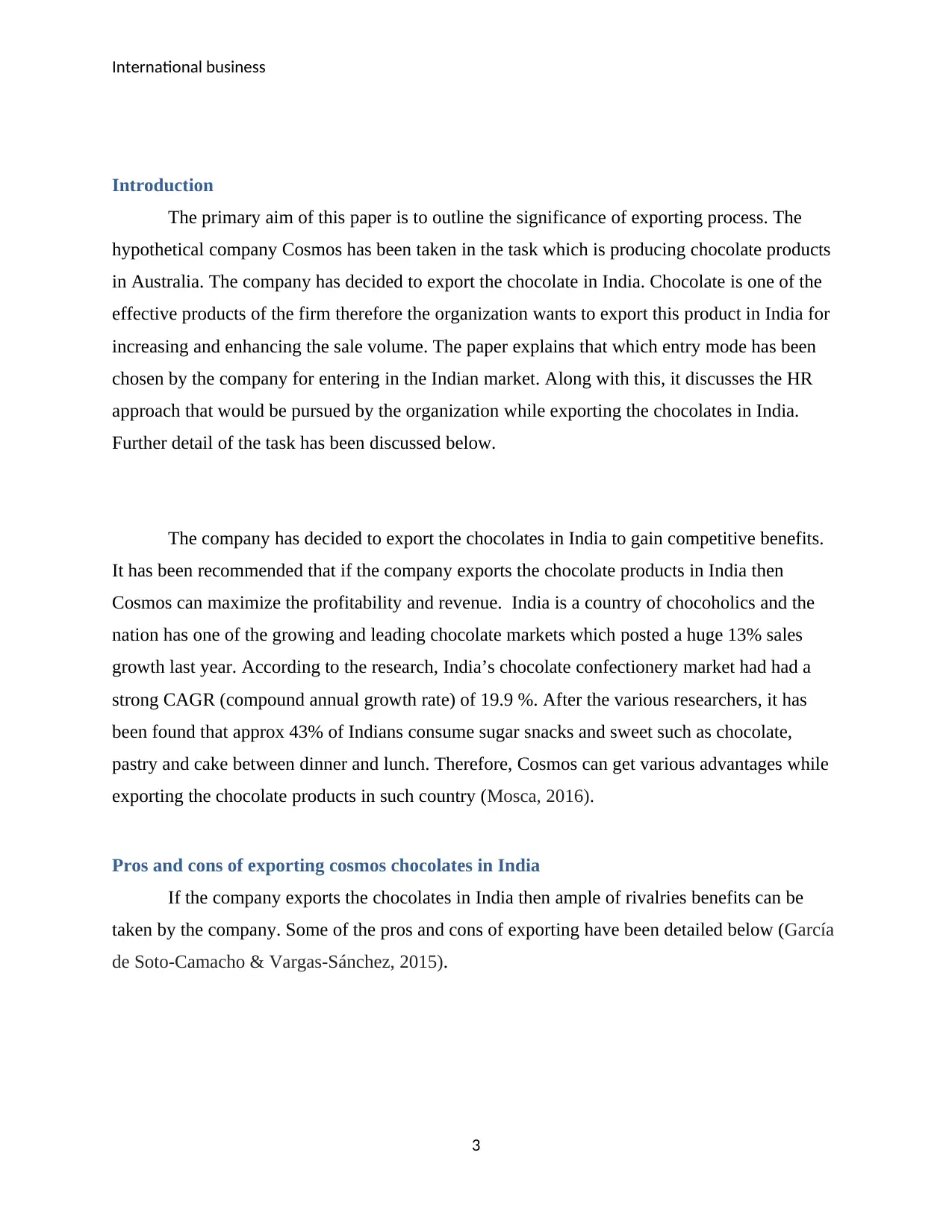
The company has decided to export the chocolates in India to gain competitive benefits.
It has been recommended that if the company exports the chocolate products in India then
Cosmos can maximize the profitability and revenue. India is a country of chocoholics and the
nation has one of the growing and leading chocolate markets which posted a huge 13% sales
growth last year. According to the research, India’s chocolate confectionery market had had a
strong CAGR (compound annual growth rate) of 19.9 %. After the various researchers, it has
been found that approx 43% of Indians consume sugar snacks and sweet such as chocolate,
pastry and cake between dinner and lunch. Therefore, Cosmos can get various advantages while
exporting the chocolate products in such country (Mosca, 2016).
Pros and cons of exporting cosmos chocolates in India
If the company exports the chocolates in India then ample of rivalries benefits can be
taken by the company. Some of the pros and cons of exporting have been detailed below (García
de Soto-Camacho & Vargas-Sánchez, 2015).
3
Document Page
International business
Pros
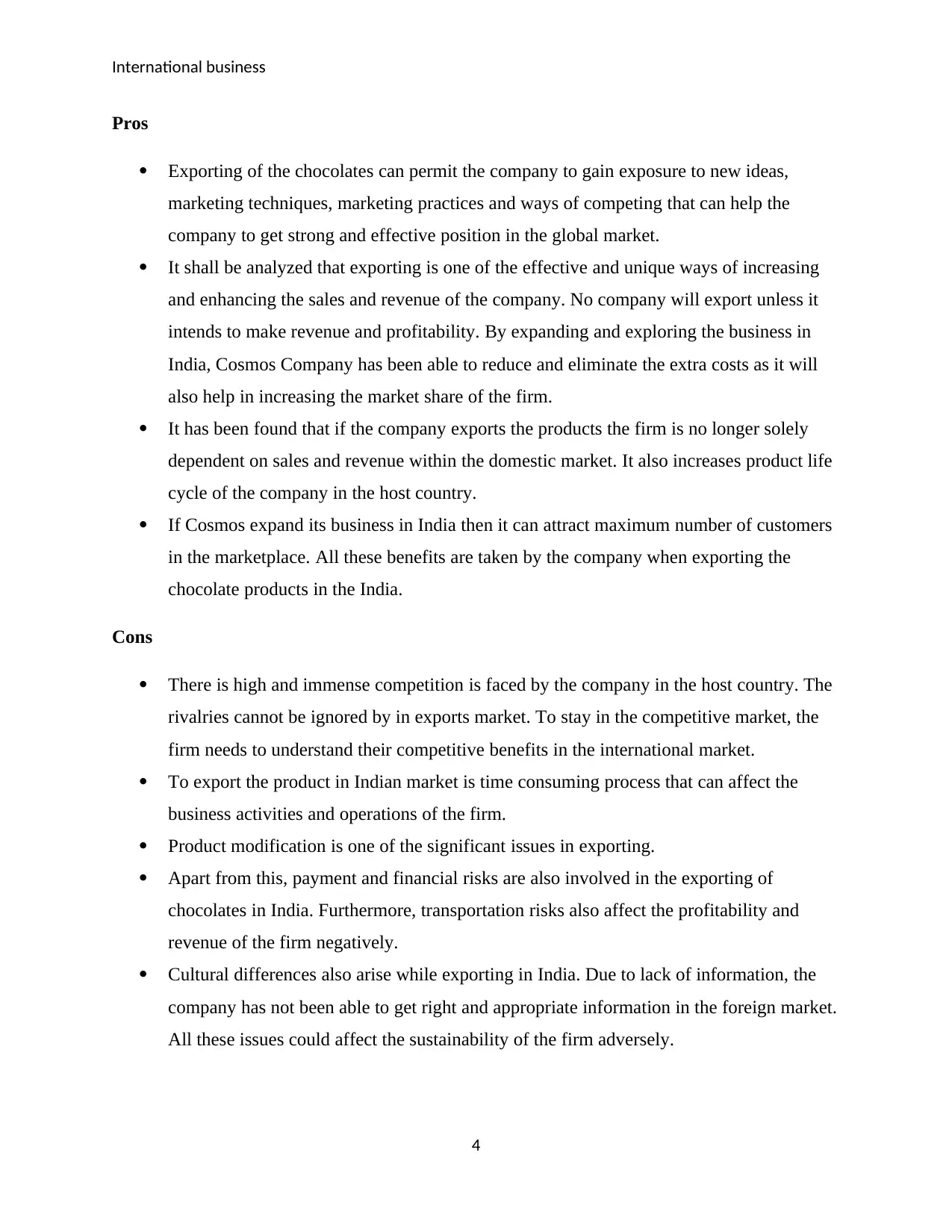
Exporting of the chocolates can permit the company to gain exposure to new ideas,
marketing techniques, marketing practices and ways of competing that can help the
company to get strong and effective position in the global market.
It shall be analyzed that exporting is one of the effective and unique ways of increasing
and enhancing the sales and revenue of the company. No company will export unless it
intends to make revenue and profitability. By expanding and exploring the business in
India, Cosmos Company has been able to reduce and eliminate the extra costs as it will
also help in increasing the market share of the firm.
It has been found that if the company exports the products the firm is no longer solely
dependent on sales and revenue within the domestic market. It also increases product life
cycle of the company in the host country.
If Cosmos expand its business in India then it can attract maximum number of customers
in the marketplace. All these benefits are taken by the company when exporting the
chocolate products in the India.
Cons
There is high and immense competition is faced by the company in the host country. The
rivalries cannot be ignored by in exports market. To stay in the competitive market, the
firm needs to understand their competitive benefits in the international market.
To export the product in Indian market is time consuming process that can affect the
business activities and operations of the firm.
Product modification is one of the significant issues in exporting.
Apart from this, payment and financial risks are also involved in the exporting of
chocolates in India. Furthermore, transportation risks also affect the profitability and
revenue of the firm negatively.
Cultural differences also arise while exporting in India. Due to lack of information, the
company has not been able to get right and appropriate information in the foreign market.
All these issues could affect the sustainability of the firm adversely.
4
tabler-icon-diamond-filled.svg

Paraphrase This Document

Need a fresh take? Get an instant paraphrase of this document with our AI Paraphraser
Document Page
International business
Entry mode for the company
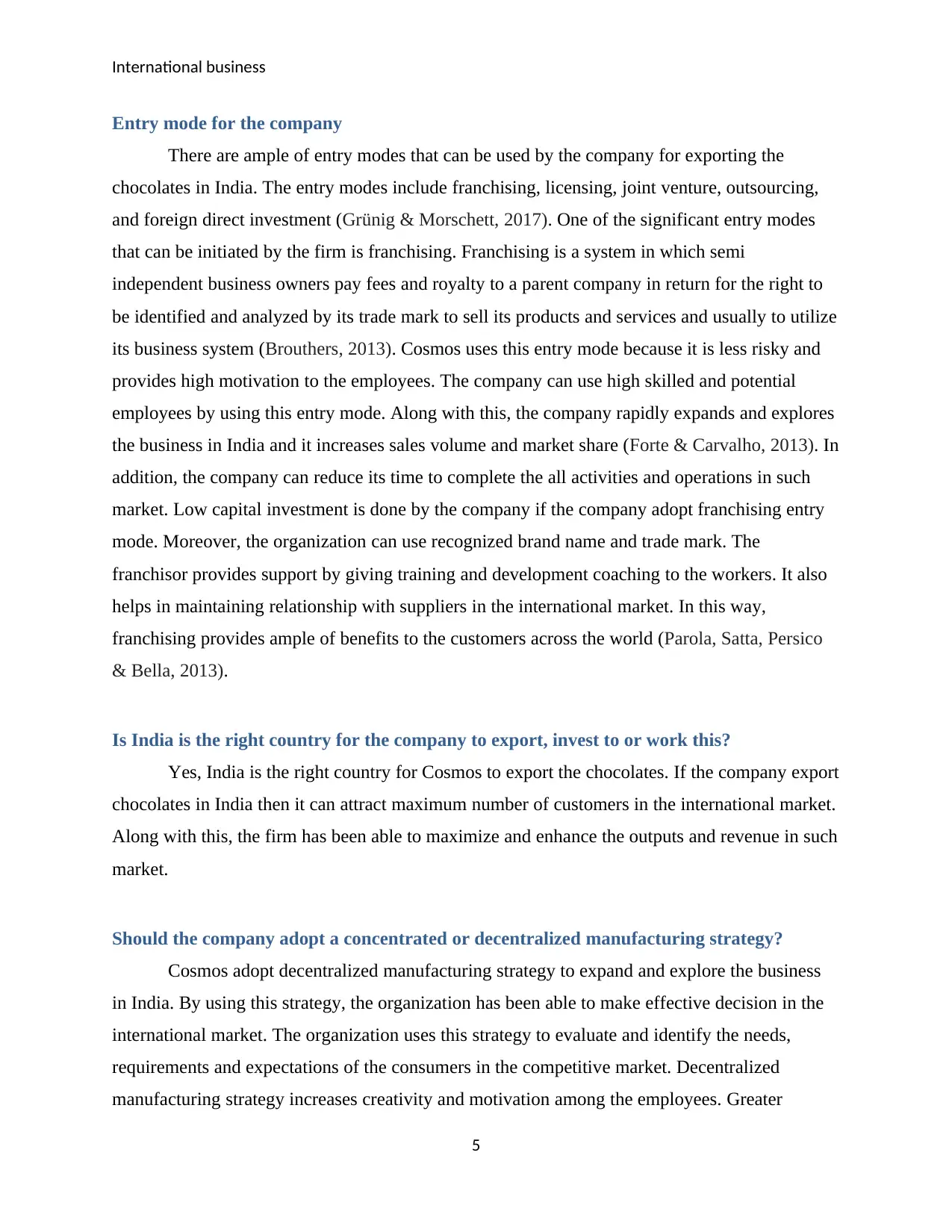
There are ample of entry modes that can be used by the company for exporting the
chocolates in India. The entry modes include franchising, licensing, joint venture, outsourcing,
and foreign direct investment (Grünig & Morschett, 2017). One of the significant entry modes
that can be initiated by the firm is franchising. Franchising is a system in which semi
independent business owners pay fees and royalty to a parent company in return for the right to
be identified and analyzed by its trade mark to sell its products and services and usually to utilize
its business system (Brouthers, 2013). Cosmos uses this entry mode because it is less risky and
provides high motivation to the employees. The company can use high skilled and potential
employees by using this entry mode. Along with this, the company rapidly expands and explores
the business in India and it increases sales volume and market share (Forte & Carvalho, 2013). In
addition, the company can reduce its time to complete the all activities and operations in such
market. Low capital investment is done by the company if the company adopt franchising entry
mode. Moreover, the organization can use recognized brand name and trade mark. The
franchisor provides support by giving training and development coaching to the workers. It also
helps in maintaining relationship with suppliers in the international market. In this way,
franchising provides ample of benefits to the customers across the world (Parola, Satta, Persico
& Bella, 2013).
Is India is the right country for the company to export, invest to or work this?
Yes, India is the right country for Cosmos to export the chocolates. If the company export
chocolates in India then it can attract maximum number of customers in the international market.
Along with this, the firm has been able to maximize and enhance the outputs and revenue in such
market.
Should the company adopt a concentrated or decentralized manufacturing strategy?
Cosmos adopt decentralized manufacturing strategy to expand and explore the business
in India. By using this strategy, the organization has been able to make effective decision in the
international market. The organization uses this strategy to evaluate and identify the needs,
requirements and expectations of the consumers in the competitive market. Decentralized
manufacturing strategy increases creativity and motivation among the employees. Greater
5
Document Page
International business
flexibility can be enjoyed by the company by using decentralized manufacturing strategy.
Cosmos can get up to date and important information by initiating the decentralized
manufacturing strategy (Digani, Sabattini, Secchi & Fantuzzi, 2014).
What consideration should the firm have in choosing the location of its subsidiaries? why?
If Cosmos need to choose a subsidiary location then United Kingdom would be choose
by the company. The United Kingdom is top ranked in Europe in terms of doing business and
trade in the world. Therefore, the company can choose United Kingdom for expanding and
exploring the business. There are ample of factors that should be considered by the company
while choosing location. Firstly, the firm should focus on the level of competition, business rates,
tax rates, and accessibility of the market. It will help the company to predict the future risks and
challenges of the market. Potential growth and skills of the employees must also be considered
while initiating the business in United Kingdom (Shenkar, Luo & Chi, 2014).
What HR approach would you pursue, if any where do you find workforce
Leadership is one of the significant approaches that need to be focused by the company
while exporting the business in India. Leadership is essential just because it helps in assisting and
controlling the workforce and further it also helps in motivating the employees within the
organization (Antonakis & Day, 2017). Various advertisement and promotions have been done
by the firm to appoint the candidate from the local market. In addition, leaders delegate
authorities and responsibilities amongst the workers with the help of leadership. Therefore, this
approach would be pursued by the company in the Indian market (Purce, 2014).
Conclusion
From the above mentioned limelight event, it is concluded that Cosmos can attain long
term competitive advantages by exporting the chocolates in India. The above analysis shows that
the company uses unique and effective franchising entry mode to enter in the Indian market.
Along with this, here is the discussion about the pros and cons of exporting and HR approach
that will make easy the exporting process.
6
Document Page
International business
References
Antonakis, J., & Day, D. V. (Eds.). (2017). The nature of leadership. Sage publications.
Brouthers, K. D. (2013). A retrospective on: Institutional, cultural and transaction cost influences
on entry mode choice and performance. Journal of International Business Studies, 44(1),
14-22.
Digani, V., Sabattini, L., Secchi, C., & Fantuzzi, C. (2014, May). Hierarchical traffic control for
partially decentralized coordination of multi agv systems in industrial environments.
In Robotics and Automation (ICRA), 2014 IEEE International Conference on (pp. 6144-
6149). IEEE.
Forte, R., & Carvalho, J. (2013). Internationalisation through franchising: the Parfois case
study. International Journal of Retail & Distribution Management, 41(5), 380-395.
García de Soto-Camacho, E., & Vargas-Sánchez, A. (2015). Choice of entry mode, strategic
flexibility and performance of international strategy in hotel chains: an approach based on
real options. European Journal of Tourism Research, 9, 92-114.
Grünig, R., & Morschett, D. (2017). Determining the Market Entry Modes. In Developing
International Strategies (pp. 105-123). Springer, Berlin, Heidelberg.
Mosca, F. (Ed.). (2016). Global marketing strategies for the promotion of luxury goods. IGI
Global.
Parola, F., Satta, G., Persico, L., & Bella, E. D. (2013). Entry mode choices in international
markets: Examining the antecedents of service firms’ strategies. International Journal of
Globalisation and Small Business, 5(1-2), 34-57.
Purce, J. (2014). The impact of corporate strategy on human resource management. New
Perspectives on Human Resource Management (Routledge Revivals), 67.
Shenkar, O., Luo, Y., & Chi, T. (2014). International business. Routledge.
7
chevron_up_icon
1 out of 7
circle_padding
hide_on_mobile
zoom_out_icon
[object Object]