Regression Analysis and Cost Estimation in Management Accounting
VerifiedAdded on 2024/05/14
|19
|3296
|218
Report
AI Summary
This report provides a comprehensive analysis of cost estimation using regression analysis within a management accounting context. It includes an overhead cost equation derived from regression results, calculations of total costs for specific projects, and explanations for discrepancies between regression-based overhead rates and preliminary estimates. The report also presents a bid calculation for a landscaping project, incorporating overtime considerations. Furthermore, it contains a literature review comparing traditional and contemporary costing systems, highlighting the importance of identifying various cost drivers for informed decision-making. The literature review also delves into the classification of costs into fixed, variable, and semi-variable categories, illustrating their impact on business operations. This student contributed report is available on Desklib, where students can find similar solved assignments and study tools.
Management Accounting
1
1

Paraphrase This Document
Need a fresh take? Get an instant paraphrase of this document with our AI Paraphraser
Contents
Part I – Part I Report........................................................................................................................3
Introduction:.................................................................................................................................3
Q1. Overhead cost equation developed based on regression results........................................3
Q2. Calculate total cost for 500 square metres of landscaping using the overhead formula
that was derived from the regression analysis..........................................................................3
Q3. Explain why the overhead rate calculated from the regression analysis is different from
preliminary estimate of $ 19 per direct labour hour.................................................................3
Q4. Calculate and include a bid on a landscaping project consisting of 100 000 square
metres. Mary estimates that 20% of the direct labour hours required for the project will be
on overtime...............................................................................................................................4
Q5. Explain as to how Greenery Pty Ltd relies on the overhead formula derived from the
regression analysis as the basis for the variable overhead component of its cost estimate......4
Recommendation and Conclusion:..............................................................................................5
Part II Literature Review.................................................................................................................6
Executive summary:.....................................................................................................................6
Content:........................................................................................................................................7
Conclusion:................................................................................................................................13
References:....................................................................................................................................14
Appendices:...................................................................................................................................15
2
Part I – Part I Report........................................................................................................................3
Introduction:.................................................................................................................................3
Q1. Overhead cost equation developed based on regression results........................................3
Q2. Calculate total cost for 500 square metres of landscaping using the overhead formula
that was derived from the regression analysis..........................................................................3
Q3. Explain why the overhead rate calculated from the regression analysis is different from
preliminary estimate of $ 19 per direct labour hour.................................................................3
Q4. Calculate and include a bid on a landscaping project consisting of 100 000 square
metres. Mary estimates that 20% of the direct labour hours required for the project will be
on overtime...............................................................................................................................4
Q5. Explain as to how Greenery Pty Ltd relies on the overhead formula derived from the
regression analysis as the basis for the variable overhead component of its cost estimate......4
Recommendation and Conclusion:..............................................................................................5
Part II Literature Review.................................................................................................................6
Executive summary:.....................................................................................................................6
Content:........................................................................................................................................7
Conclusion:................................................................................................................................13
References:....................................................................................................................................14
Appendices:...................................................................................................................................15
2

3
⊘ This is a preview!⊘
Do you want full access?
Subscribe today to unlock all pages.

Trusted by 1+ million students worldwide
Part I – Part I Report
Introduction:
The report is concerned with performing a regression analysis for a given project which is related
with management accounting concepts and costing systems. The report will present an overhead
cost equation which will help in making costing decision for the project under consideration. The
total cost associated with the given problem will be identified and analysis will be performed in
this report. The observations related with overhead cost allocation and absorption will be
discussed in this report.
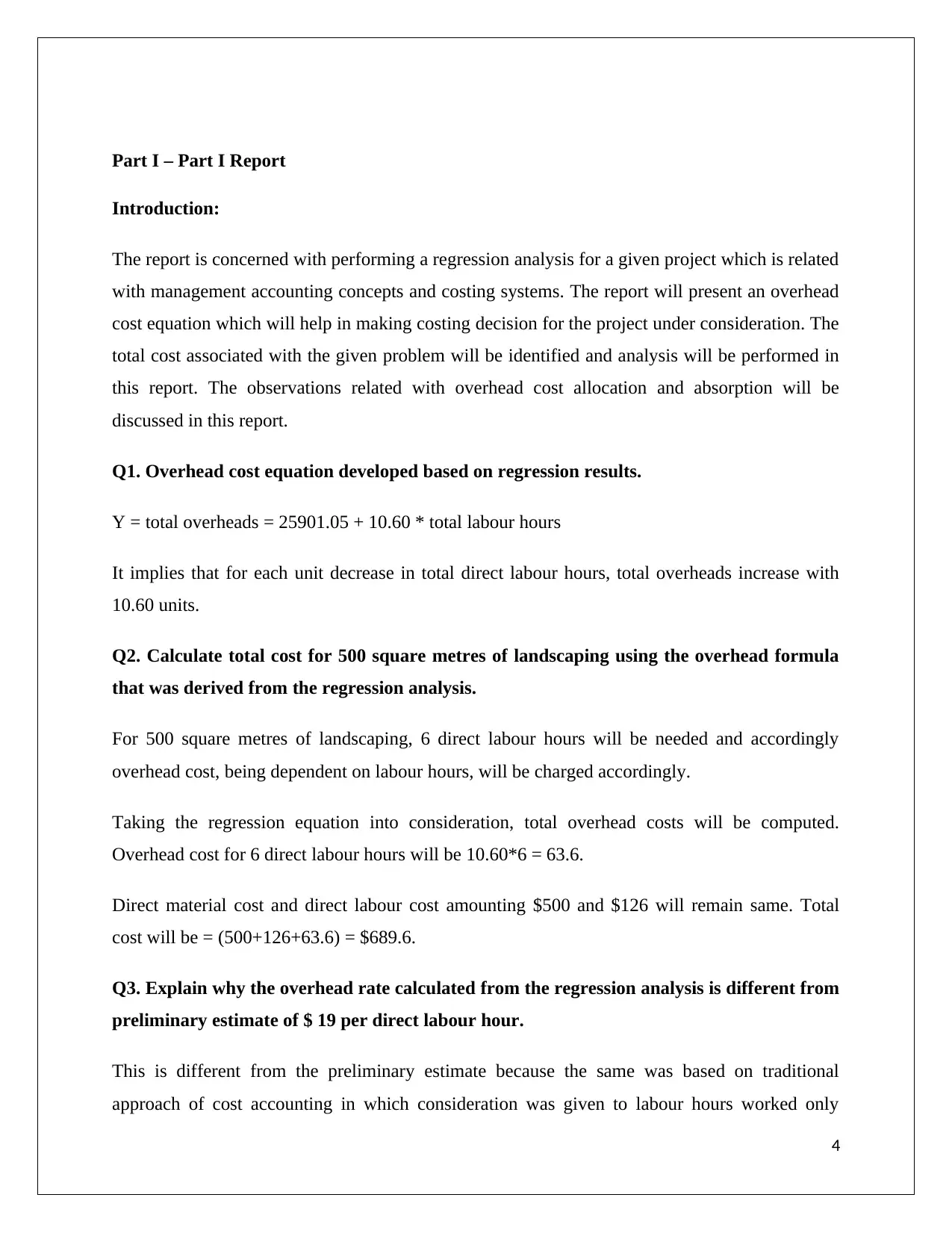
Q1. Overhead cost equation developed based on regression results.
Y = total overheads = 25901.05 + 10.60 * total labour hours
It implies that for each unit decrease in total direct labour hours, total overheads increase with
10.60 units.
Q2. Calculate total cost for 500 square metres of landscaping using the overhead formula
that was derived from the regression analysis.
For 500 square metres of landscaping, 6 direct labour hours will be needed and accordingly
overhead cost, being dependent on labour hours, will be charged accordingly.
Taking the regression equation into consideration, total overhead costs will be computed.
Overhead cost for 6 direct labour hours will be 10.60*6 = 63.6.
Direct material cost and direct labour cost amounting $500 and $126 will remain same. Total
cost will be = (500+126+63.6) = $689.6.
Q3. Explain why the overhead rate calculated from the regression analysis is different from
preliminary estimate of $ 19 per direct labour hour.
This is different from the preliminary estimate because the same was based on traditional
approach of cost accounting in which consideration was given to labour hours worked only
4
Introduction:
The report is concerned with performing a regression analysis for a given project which is related
with management accounting concepts and costing systems. The report will present an overhead
cost equation which will help in making costing decision for the project under consideration. The
total cost associated with the given problem will be identified and analysis will be performed in
this report. The observations related with overhead cost allocation and absorption will be
discussed in this report.
Q1. Overhead cost equation developed based on regression results.
Y = total overheads = 25901.05 + 10.60 * total labour hours
It implies that for each unit decrease in total direct labour hours, total overheads increase with
10.60 units.
Q2. Calculate total cost for 500 square metres of landscaping using the overhead formula
that was derived from the regression analysis.
For 500 square metres of landscaping, 6 direct labour hours will be needed and accordingly
overhead cost, being dependent on labour hours, will be charged accordingly.
Taking the regression equation into consideration, total overhead costs will be computed.
Overhead cost for 6 direct labour hours will be 10.60*6 = 63.6.
Direct material cost and direct labour cost amounting $500 and $126 will remain same. Total
cost will be = (500+126+63.6) = $689.6.
Q3. Explain why the overhead rate calculated from the regression analysis is different from
preliminary estimate of $ 19 per direct labour hour.
This is different from the preliminary estimate because the same was based on traditional
approach of cost accounting in which consideration was given to labour hours worked only
4
Paraphrase This Document
Need a fresh take? Get an instant paraphrase of this document with our AI Paraphraser
however the regression analysis helps in considering the different factors and variables resulting
in costs occurred (Renz, et. al., 2016).
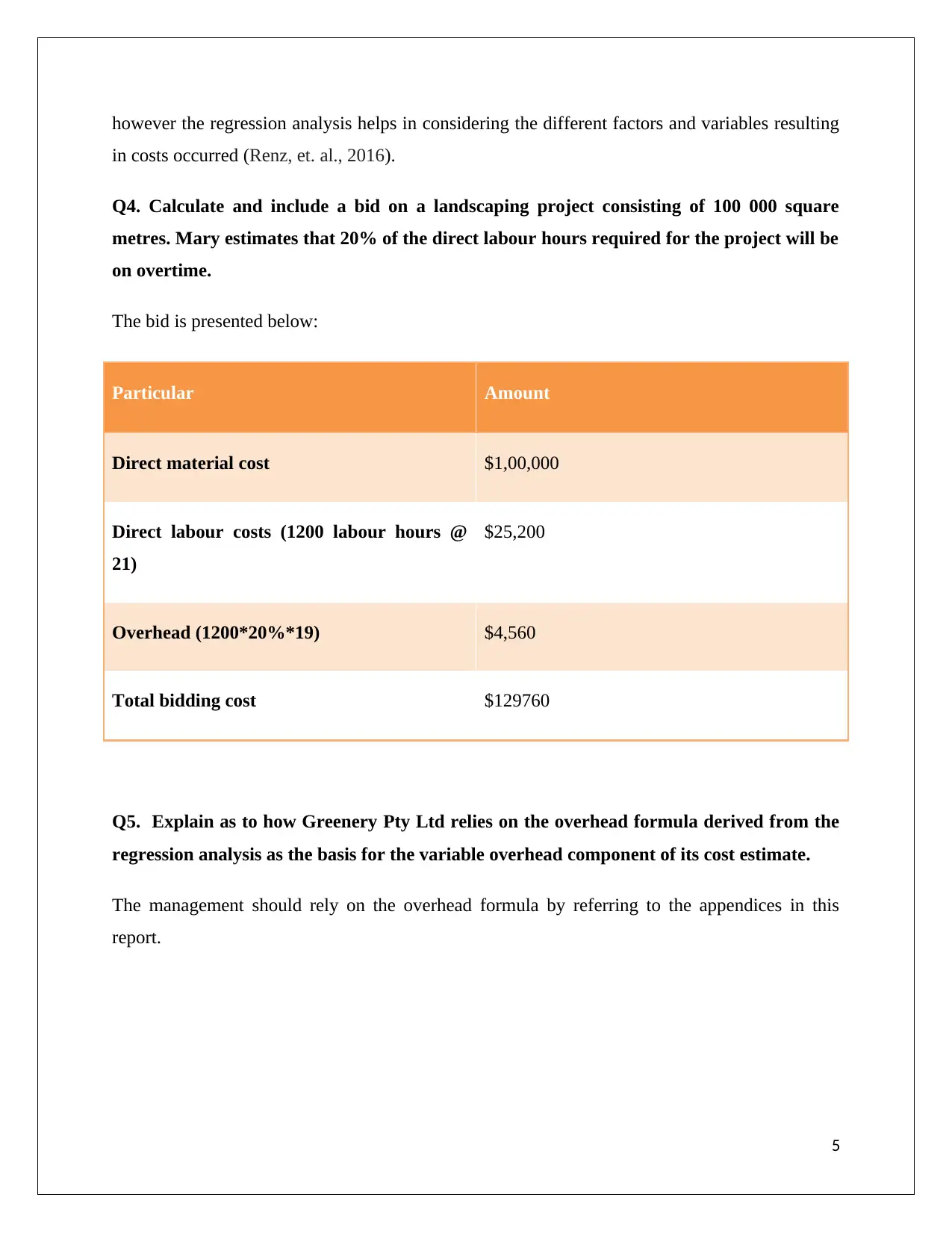
Q4. Calculate and include a bid on a landscaping project consisting of 100 000 square
metres. Mary estimates that 20% of the direct labour hours required for the project will be
on overtime.
The bid is presented below:
Particular Amount
Direct material cost $1,00,000
Direct labour costs (1200 labour hours @
21)
$25,200
Overhead (1200*20%*19) $4,560
Total bidding cost $129760
Q5. Explain as to how Greenery Pty Ltd relies on the overhead formula derived from the
regression analysis as the basis for the variable overhead component of its cost estimate.
The management should rely on the overhead formula by referring to the appendices in this
report.
5
in costs occurred (Renz, et. al., 2016).
Q4. Calculate and include a bid on a landscaping project consisting of 100 000 square
metres. Mary estimates that 20% of the direct labour hours required for the project will be
on overtime.
The bid is presented below:
Particular Amount
Direct material cost $1,00,000
Direct labour costs (1200 labour hours @
21)
$25,200
Overhead (1200*20%*19) $4,560
Total bidding cost $129760
Q5. Explain as to how Greenery Pty Ltd relies on the overhead formula derived from the
regression analysis as the basis for the variable overhead component of its cost estimate.
The management should rely on the overhead formula by referring to the appendices in this
report.
5
Recommendation and Conclusion:
It can be recommended and concluded that the modern technique of identifying cost drivers will
help in achieving better decision making. The application of management accounting techniques
such as regression analysis can help the management in taking appropriate decision and cost
estimates.
6
It can be recommended and concluded that the modern technique of identifying cost drivers will
help in achieving better decision making. The application of management accounting techniques
such as regression analysis can help the management in taking appropriate decision and cost
estimates.
6
⊘ This is a preview!⊘
Do you want full access?
Subscribe today to unlock all pages.
Trusted by 1+ million students worldwide
Part II Literature Review
Executive summary:
The modern business organisation and business managers have realized the importance of
measuring the behaviour of cost in an enterprise for vital decision making purposes.
Understanding the behaviour of costs in relation to the production activities helps the managers
in making important and critical decision in the business. The concept of fixed, variable and semi
variable cost have evolved over the last decade and the management needs to consider the same
while making decisions about the cost aspects of the company. The report will help in evaluating
the key components associated with traditional costing system and the contemporary costing
system in an enterprise. The explanation regarding the different elements of cost associated with
fixed and variable costs will be explained in this report. This will help the management in
analysing the change in identifying the cost drivers in contemporary costing system and
traditional costing system of company.
7
Executive summary:
The modern business organisation and business managers have realized the importance of
measuring the behaviour of cost in an enterprise for vital decision making purposes.
Understanding the behaviour of costs in relation to the production activities helps the managers
in making important and critical decision in the business. The concept of fixed, variable and semi
variable cost have evolved over the last decade and the management needs to consider the same
while making decisions about the cost aspects of the company. The report will help in evaluating
the key components associated with traditional costing system and the contemporary costing
system in an enterprise. The explanation regarding the different elements of cost associated with
fixed and variable costs will be explained in this report. This will help the management in
analysing the change in identifying the cost drivers in contemporary costing system and
traditional costing system of company.
7
Paraphrase This Document
Need a fresh take? Get an instant paraphrase of this document with our AI Paraphraser
Content:
As per (Renz, et. al., 2016), the traditional system of cost accounting can be referred to as the
system of accounting in which manufacturing overheads associated with the production
operation for company are allocated between the various products manufactured by the company
on the basis of volume of production. In traditional system of cost accounting the indirect
overheads related with the production operations are segregated and distributed on the basis of
volumes which includes number of units produced, based on the direct labour hours or the
production of machine hours on the company. The traditional costing system thus used only one
variable component to distribute the costs to different products of company. This may imply that
only that one variable component is the cause of factory overheads incurred in the company. On
the traditional perspective that seems to be sufficient for the company in preparing its external
financial statements. However in the modern business environment the manufacturing overheads
of the many are driven or caused by various other factors present in the manufacturing operations
(Kren, 2018). For example some of the customers may be likely to demand the additional
manufacturing operations for the diversified products of company while some wants greater
quantities of uniformed products of company. Therefore in order to acquire ad obtain the actual
or real cost of manufacturing which are specific to certain products or specific customers the
traditional costing system seems to be inadequate.
The different components associated with costing system in a company are related with:
Cost object – It represents something for which, measurement of cost is desired. In general these
represent the products or services provided by the company in ordinary course of business.
Direct costs – The direct cost represents the type of cost that can be directly attributable or traced
with the product or service of a company.
Indirect cost – Te indirect costs represents that portion of overall cost which can’t be directly
traced or attribute to a particular product or service of the company.
8
As per (Renz, et. al., 2016), the traditional system of cost accounting can be referred to as the
system of accounting in which manufacturing overheads associated with the production
operation for company are allocated between the various products manufactured by the company
on the basis of volume of production. In traditional system of cost accounting the indirect
overheads related with the production operations are segregated and distributed on the basis of
volumes which includes number of units produced, based on the direct labour hours or the
production of machine hours on the company. The traditional costing system thus used only one
variable component to distribute the costs to different products of company. This may imply that
only that one variable component is the cause of factory overheads incurred in the company. On
the traditional perspective that seems to be sufficient for the company in preparing its external
financial statements. However in the modern business environment the manufacturing overheads
of the many are driven or caused by various other factors present in the manufacturing operations
(Kren, 2018). For example some of the customers may be likely to demand the additional
manufacturing operations for the diversified products of company while some wants greater
quantities of uniformed products of company. Therefore in order to acquire ad obtain the actual
or real cost of manufacturing which are specific to certain products or specific customers the
traditional costing system seems to be inadequate.
The different components associated with costing system in a company are related with:
Cost object – It represents something for which, measurement of cost is desired. In general these
represent the products or services provided by the company in ordinary course of business.
Direct costs – The direct cost represents the type of cost that can be directly attributable or traced
with the product or service of a company.
Indirect cost – Te indirect costs represents that portion of overall cost which can’t be directly
traced or attribute to a particular product or service of the company.
8
Cost pool – The cost pool refers to the grouping associated with individual cost items in a
company. The cost pools are formed when the company uses more allocation base in allocating
the costs to different products and services.
Cost allocation base – It refers to the factor which links the systematic way for indirect cost
relating with the particular product or service.
The traditional costing system of management accounting used a single predetermined overhead
rate in order to distribute the indirect cost to products and these were as follows:
Job order costing – In this costing system the direct labour costs was assumed to be
relevant for the activity base and the costs are allocated on the basis of jobs performed.
Process costing – In the accounting system the machine hours are assumed to be relevant
activity base for the company. The processes are allocated the costs based on the machine
hours used.
The difference between contemporary management accounting system can be established with
traditional cost accounting system in the following manner:
There are limited number of cost accounting pools identified in the traditional accounting
system and the allocation is restricted to only one variable cost driver however in
contemporary cost accounting various or many cost drivers are identified and used for
reflecting different activities in the manufacturing operations (Christopher, 2016).
The allocation of overheads in this type of costing system is associated with assigning the
overhead cost first to departments and then they are distributed among different products
and services while in contemporary cost accounting system the overhead costs are
assigned to different activity pools and then they are charged to different products and
services.
The focus associated with traditional costing system is related with managing costs
aspects of different functional departments or the responsibility centres however the
focus in contemporary costing system is associated with managing processes and
activities and solving the cross functional problems associated with cost in the company.
9
company. The cost pools are formed when the company uses more allocation base in allocating
the costs to different products and services.
Cost allocation base – It refers to the factor which links the systematic way for indirect cost
relating with the particular product or service.
The traditional costing system of management accounting used a single predetermined overhead
rate in order to distribute the indirect cost to products and these were as follows:
Job order costing – In this costing system the direct labour costs was assumed to be
relevant for the activity base and the costs are allocated on the basis of jobs performed.
Process costing – In the accounting system the machine hours are assumed to be relevant
activity base for the company. The processes are allocated the costs based on the machine
hours used.
The difference between contemporary management accounting system can be established with
traditional cost accounting system in the following manner:
There are limited number of cost accounting pools identified in the traditional accounting
system and the allocation is restricted to only one variable cost driver however in
contemporary cost accounting various or many cost drivers are identified and used for
reflecting different activities in the manufacturing operations (Christopher, 2016).
The allocation of overheads in this type of costing system is associated with assigning the
overhead cost first to departments and then they are distributed among different products
and services while in contemporary cost accounting system the overhead costs are
assigned to different activity pools and then they are charged to different products and
services.
The focus associated with traditional costing system is related with managing costs
aspects of different functional departments or the responsibility centres however the
focus in contemporary costing system is associated with managing processes and
activities and solving the cross functional problems associated with cost in the company.
9
⊘ This is a preview!⊘
Do you want full access?
Subscribe today to unlock all pages.
Trusted by 1+ million students worldwide
The use of traditional costing methods were easy but it does not involve any type of value
added function which could help in decision making function while the contemporary
cost accounting system proves to be capital intensive function, product diversified and
have higher capabilities of assisting in decision making function of managers in the
company (Kren, 2018). The reports obtained in this modernized accounting system helps
in analysing the current cost aspects of company and this will help the business managers
in taking critical decisions.
In the past researches related with cost the costs has been classified into three categories
concerning with fixed, variable and semi variable costs. The classification of these types of costs
helps the company in identifying the nature of activity performed and the decisions can be taken
effectively. The various components are explained below:
Fixed costs – The fixed cost as the name suggest represents the portion of costs that remain
constant over the given period of time and range of activities in spite of different types of
fluctuations associated with the level of production. However the per unit fixed cost of
production varies with the level of activity performed in a company but the overall fixed cost
remain constant during the period (Otley, 2016). This leads to the fact that if the production
volumes increases in the company the per unit fixed cost decreases for the company and if the
volume of production decreases the per unit fixed cost increases. In order to explain this concept
in relation to company two examples have been explained:
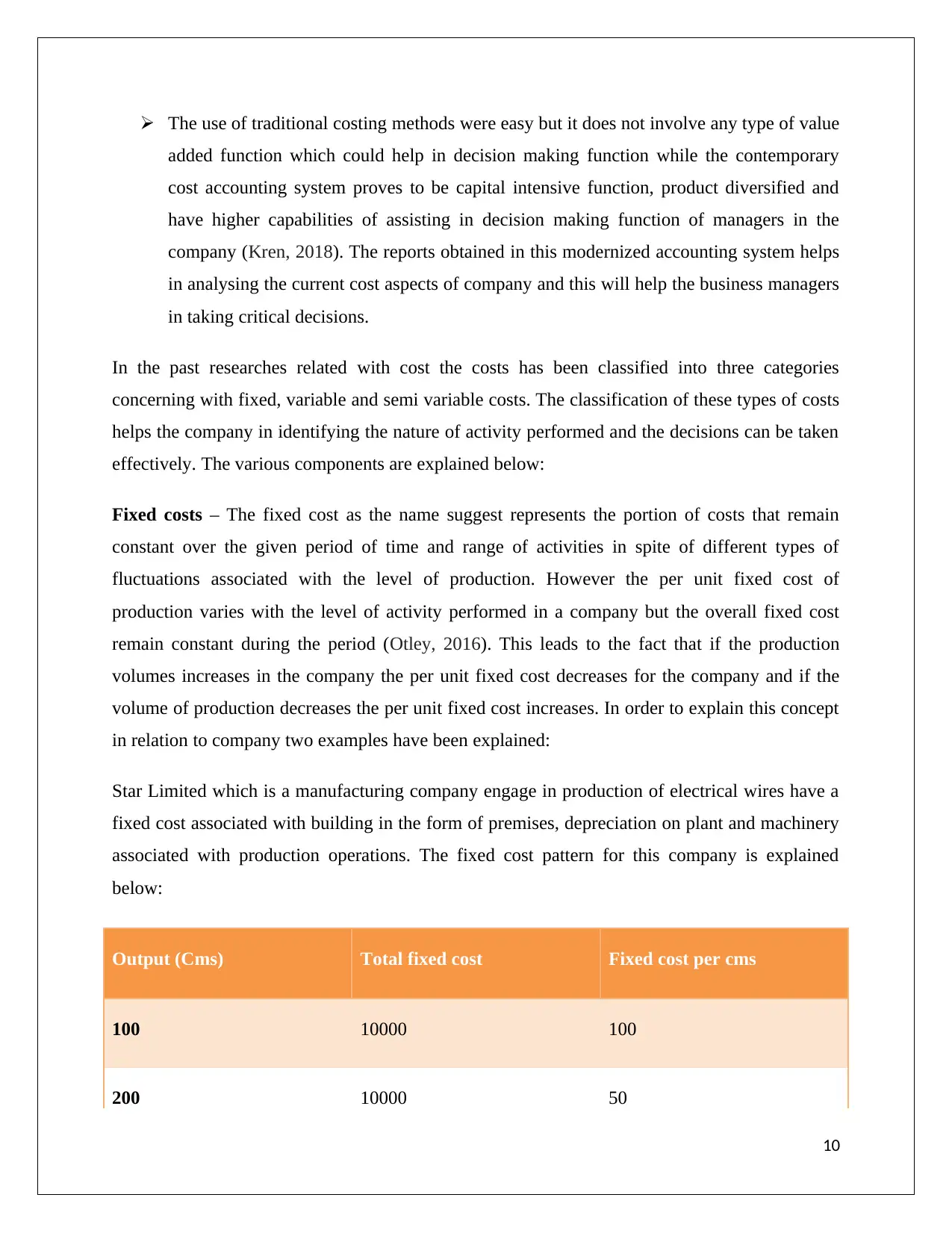
Star Limited which is a manufacturing company engage in production of electrical wires have a
fixed cost associated with building in the form of premises, depreciation on plant and machinery
associated with production operations. The fixed cost pattern for this company is explained
below:
Output (Cms) Total fixed cost Fixed cost per cms
100 10000 100
200 10000 50
10
added function which could help in decision making function while the contemporary
cost accounting system proves to be capital intensive function, product diversified and
have higher capabilities of assisting in decision making function of managers in the
company (Kren, 2018). The reports obtained in this modernized accounting system helps
in analysing the current cost aspects of company and this will help the business managers
in taking critical decisions.
In the past researches related with cost the costs has been classified into three categories
concerning with fixed, variable and semi variable costs. The classification of these types of costs
helps the company in identifying the nature of activity performed and the decisions can be taken
effectively. The various components are explained below:
Fixed costs – The fixed cost as the name suggest represents the portion of costs that remain
constant over the given period of time and range of activities in spite of different types of
fluctuations associated with the level of production. However the per unit fixed cost of
production varies with the level of activity performed in a company but the overall fixed cost
remain constant during the period (Otley, 2016). This leads to the fact that if the production
volumes increases in the company the per unit fixed cost decreases for the company and if the
volume of production decreases the per unit fixed cost increases. In order to explain this concept
in relation to company two examples have been explained:
Star Limited which is a manufacturing company engage in production of electrical wires have a
fixed cost associated with building in the form of premises, depreciation on plant and machinery
associated with production operations. The fixed cost pattern for this company is explained
below:
Output (Cms) Total fixed cost Fixed cost per cms
100 10000 100
200 10000 50
10
Paraphrase This Document
Need a fresh take? Get an instant paraphrase of this document with our AI Paraphraser
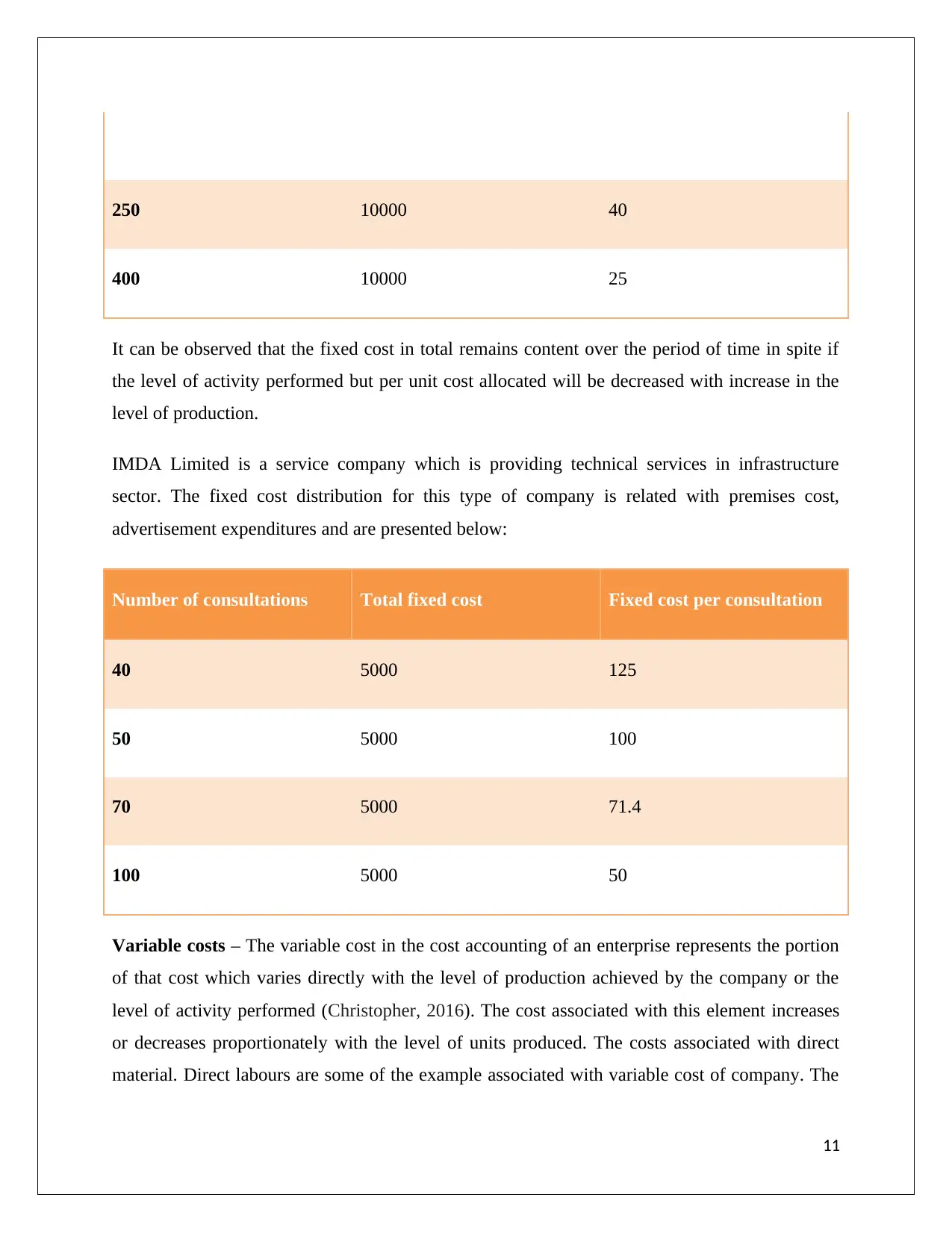
250 10000 40
400 10000 25
It can be observed that the fixed cost in total remains content over the period of time in spite if
the level of activity performed but per unit cost allocated will be decreased with increase in the
level of production.
IMDA Limited is a service company which is providing technical services in infrastructure
sector. The fixed cost distribution for this type of company is related with premises cost,
advertisement expenditures and are presented below:
Number of consultations Total fixed cost Fixed cost per consultation
40 5000 125
50 5000 100
70 5000 71.4
100 5000 50
Variable costs – The variable cost in the cost accounting of an enterprise represents the portion
of that cost which varies directly with the level of production achieved by the company or the
level of activity performed (Christopher, 2016). The cost associated with this element increases
or decreases proportionately with the level of units produced. The costs associated with direct
material. Direct labours are some of the example associated with variable cost of company. The
11
400 10000 25
It can be observed that the fixed cost in total remains content over the period of time in spite if
the level of activity performed but per unit cost allocated will be decreased with increase in the
level of production.
IMDA Limited is a service company which is providing technical services in infrastructure
sector. The fixed cost distribution for this type of company is related with premises cost,
advertisement expenditures and are presented below:
Number of consultations Total fixed cost Fixed cost per consultation
40 5000 125
50 5000 100
70 5000 71.4
100 5000 50
Variable costs – The variable cost in the cost accounting of an enterprise represents the portion
of that cost which varies directly with the level of production achieved by the company or the
level of activity performed (Christopher, 2016). The cost associated with this element increases
or decreases proportionately with the level of units produced. The costs associated with direct
material. Direct labours are some of the example associated with variable cost of company. The
11
variability of variable cost depends on the level of output achieved by the company or the level
of production achieved.
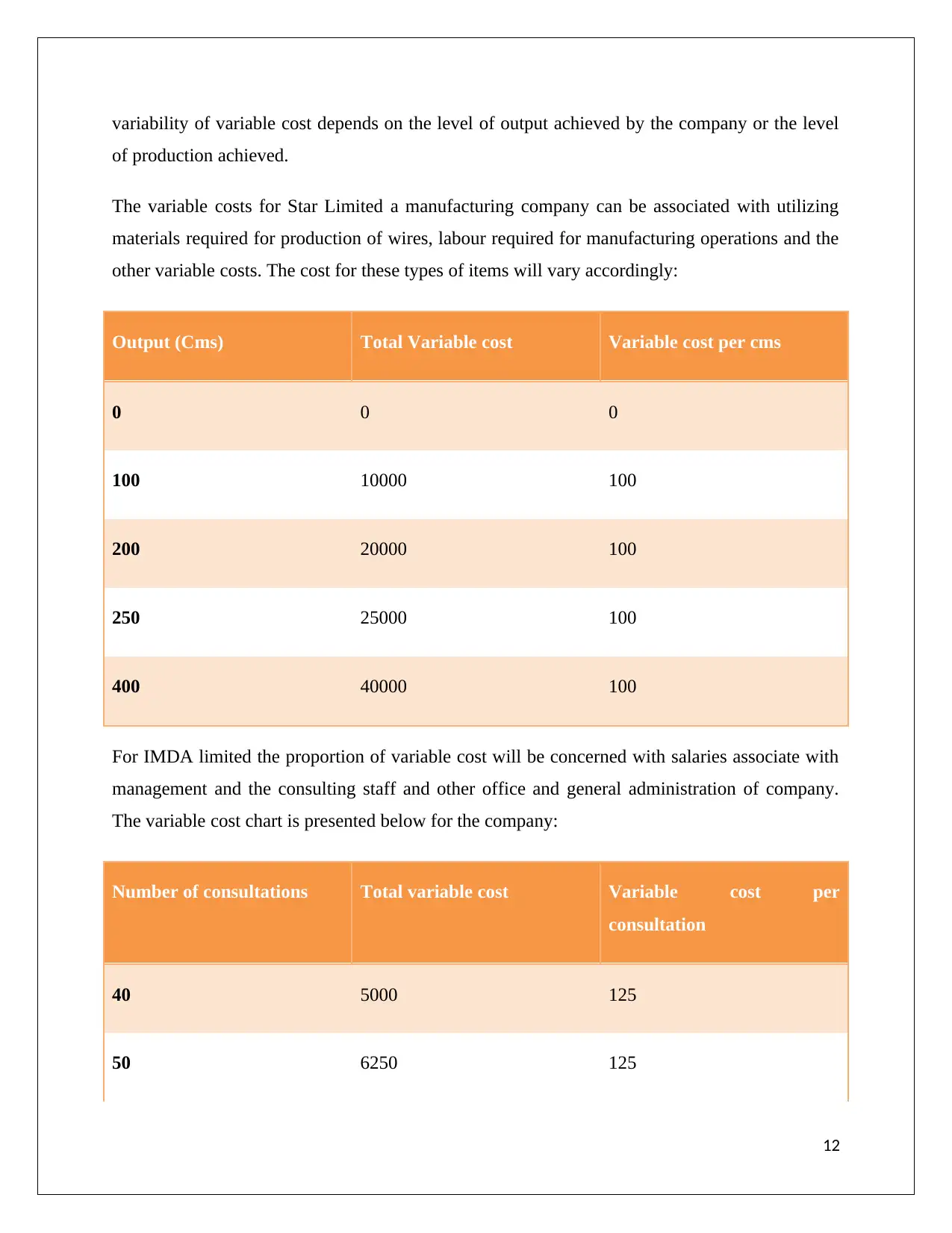
The variable costs for Star Limited a manufacturing company can be associated with utilizing
materials required for production of wires, labour required for manufacturing operations and the
other variable costs. The cost for these types of items will vary accordingly:
Output (Cms) Total Variable cost Variable cost per cms
0 0 0
100 10000 100
200 20000 100
250 25000 100
400 40000 100
For IMDA limited the proportion of variable cost will be concerned with salaries associate with
management and the consulting staff and other office and general administration of company.
The variable cost chart is presented below for the company:
Number of consultations Total variable cost Variable cost per
consultation
40 5000 125
50 6250 125
12
of production achieved.
The variable costs for Star Limited a manufacturing company can be associated with utilizing
materials required for production of wires, labour required for manufacturing operations and the
other variable costs. The cost for these types of items will vary accordingly:
Output (Cms) Total Variable cost Variable cost per cms
0 0 0
100 10000 100
200 20000 100
250 25000 100
400 40000 100
For IMDA limited the proportion of variable cost will be concerned with salaries associate with
management and the consulting staff and other office and general administration of company.
The variable cost chart is presented below for the company:
Number of consultations Total variable cost Variable cost per
consultation
40 5000 125
50 6250 125
12
⊘ This is a preview!⊘
Do you want full access?
Subscribe today to unlock all pages.
Trusted by 1+ million students worldwide

1 out of 19


Your All-in-One AI-Powered Toolkit for Academic Success.
+13062052269
info@desklib.com
Available 24*7 on WhatsApp / Email
![[object Object]](/_next/static/media/star-bottom.7253800d.svg)
Unlock your academic potential
Copyright © 2020–2025 A2Z Services. All Rights Reserved. Developed and managed by ZUCOL.