Evaluating the Cost of Production in Australian Manufacturing Sector

Verified

Added on  2023/06/13

|10
|1598
|93
Report
AI Summary
This report examines the escalating cost of production within the Australian manufacturing sector, highlighting its impact on the nation's economy. It identifies key factors contributing to the slowdown in manufacturing, including rising energy costs, a strong Australian dollar, and the closure of the automotive industry. The analysis incorporates the Manufacturing Purchasing Managers Index (PMI) to illustrate the sector's performance trends, revealing a recent decline attributed to increased input costs like electricity and gas, which have significantly reduced profit margins. Economic theories are applied to evaluate how these rising costs affect firms' profitability and supply. The report concludes with recommendations focused on reducing energy prices through subsidized rates and improving the efficiency of power stations, as well as enhancing the skills of the labor force through training and development programs to mitigate wage costs. This document is available on Desklib, a platform offering study tools and resources for students.
Document Page
Running Head: COST OF PRODUCTION IN AUSTRALIAN INDUSTRY
Cost of Production in Australian Industry
Name of the Student
Name of the University
Author note
tabler-icon-diamond-filled.svg

Paraphrase This Document

Need a fresh take? Get an instant paraphrase of this document with our AI Paraphraser
Document Page
1
COST OF PRODUCTION IN AUSTRALIAN INDUSTRY
Table of Contents
Introduction................................................................................................................................2
Article Summary........................................................................................................................2
Evaluation using economic theories...........................................................................................3
Recommendation........................................................................................................................5
Conclusion..................................................................................................................................6
References..................................................................................................................................7
Document Page
2
COST OF PRODUCTION IN AUSTRALIAN INDUSTRY
Introduction
The manufacturing industry in Australia has always been an important contributor of
Australian economy. The largest manufacturing industry in Australia is the food and
beverage industry (Wilde 2017). Other important industries in the manufacturing sector
include textile industry, Motor vehicles and chemical industry. The manufacturing industry
has recorded a decline in recently mainly due to a rising cost of energy. The manufacturing
industry in Australia is the most energy intensive sector in world. As per statistics in 2000,
Australian manufacturing is in the third highest level in terms of energy intensity
(smh.com.au 2018). In recent years however a rising energy price seemed as a significant
obstacle in the industry’s growth.
Article Summary
Rising cost in manufacturing has become one of the major concern for Australian
economy. There are three major factors contributing to the slowdown of manufacturing
industry – rising cost of energy, a high relative price of Australian dollar and shut down of
automotive industry. The manufacturing Purchasing Managers Index (PMI) in this year has
accounted a down fall by 3.1 points to 51.1 which is the lowest in a year. Just a few months
ago, the index was at the highest level of 59.8 (businessinsider.com.au 2018).
Document Page
3
COST OF PRODUCTION IN AUSTRALIAN INDUSTRY
Figure 1: Australia’s manufacturing PMI
(Source: businessinsider.com.au 2018).
The figure above shows the trend in manufacturing performance of Australia. The
PMI is a measure tracing changes in the level of manufacturing activity in Australia. Any
value of this index above 50 implies that there is an improvement in manufacturing activity
while any measure less than the threshold value means that the performances are
deteriorating performances. The distances from the recorded index from threshold value
works as an indicator of manufacturing performance. The value 51.1 is though above the
benchmark value of 50 but performance has worsened when compared with the performance
in 2016. The PMI index has stood above the threshold of 50 for 13 consecutive months. This
is the longest stretch involving continuous improvement in performance ever since 2007.
The positive effect on manufacturing sector is coming from an increased local
demand generated from infrastructure construction an apartment, mining, defense and
agricultural equipment and renewables. However, positive influence from the demand side
has more than offset by the increased cost of inputs such as electricity cost and gas. The input
cost has contributed to a significant reduction in profit margins of all manufacturers. The
tabler-icon-diamond-filled.svg

Paraphrase This Document

Need a fresh take? Get an instant paraphrase of this document with our AI Paraphraser
Document Page
4
COST OF PRODUCTION IN AUSTRALIAN INDUSTRY
non-metallic sub-sectors and food and beverage sector have accounted a better performance.
This helps to keep the PMI measure to stay above the benchmark value. Sales and orders
have expanded but at relatively low rate as compared to that recorded in September
(businessinsider.com.au 2018). The rising cost has direct impact on level of output.
Production has declined significantly leading to a decline in export and level of inventory.
The weak export though strengthens the value of Australian dollar but it significantly hurt
manufacturers.
Evaluation using economic theories
In the price and output decision of a firm costs specifically average costs play an
important role. Average cost is defined as the cost associated with per unit of output. The
objective of the firm is to lower its cost as minimum as possible in order to maximize profit.
average cost of a firm includes both fixed and variable cost. In the long run as all the factor
inputs are any change in average change is cause by the change in variable sector (McKenzie
and Lee 2016). For Australian manufacturing sector, rising cost of input hampers the
profitability of the concerned sector (gizmodo.com.au 2018). The figure below depicts how
an increasing cost reduce profitability of firms.
Document Page
5
COST OF PRODUCTION IN AUSTRALIAN INDUSTRY
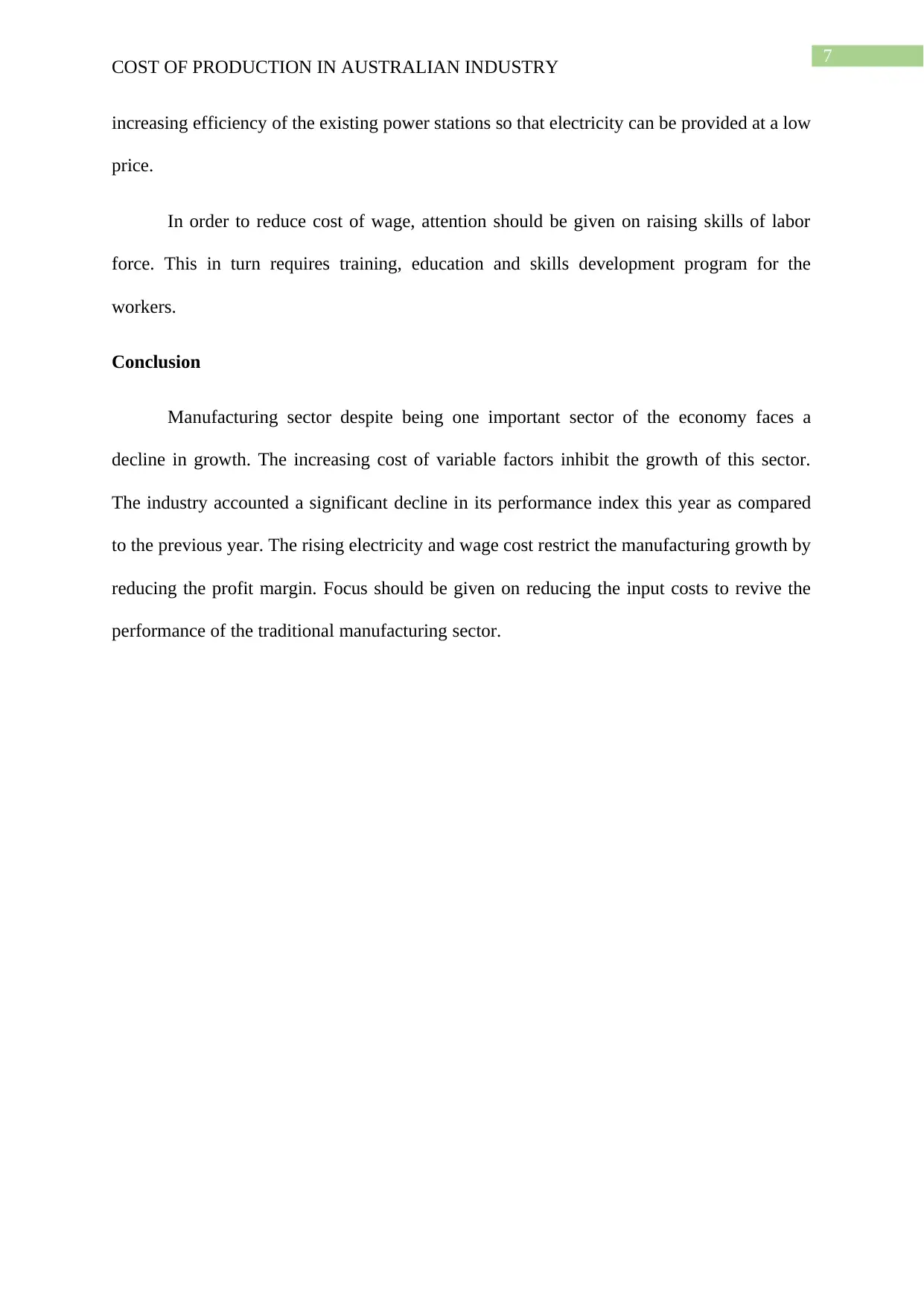
Figure 1: Effect of rising cost in manufacturing
(Source: as created by Author)
The AC and MC curves in the above figure represents the initial average and marginal
cost of the firms. The profit maximizing equilibrium point is at E. At E, firm produces Q*
amount of outputs and sells the output at price at P*. This yields a profit equals to area of the
rectangle P*FGH. Now suppose cost of factor inputs increases. This shifts the cost curves
upward. Consequently, the new average cost curve is AC1 and the new marginal cost curve is
MC1. The equilibrium is now shifted from E to E1 where price increases from P* to P1 while
quantity reduces to Q* to Q1. With the new set of cost curves, the firm earns a much less
profit as shown by P1IJP*.
There are different factors that contributes to a rising electricity cost of manufacturing
firms. The affordability of retail electricity is really at stake in Australia. The problem is
further manifested by a rising price in gas stations following a shortage of supply. Another
Document Page
6
COST OF PRODUCTION IN AUSTRALIAN INDUSTRY
source of rising cost in manufacturing is the cost of labor. The Australian manufacturing
industry is currently suffering from a higher wage growth of the workers
(businessinsider.com.au 2018). The shortage of required skilled further contribute to an
increase in cost of labor.
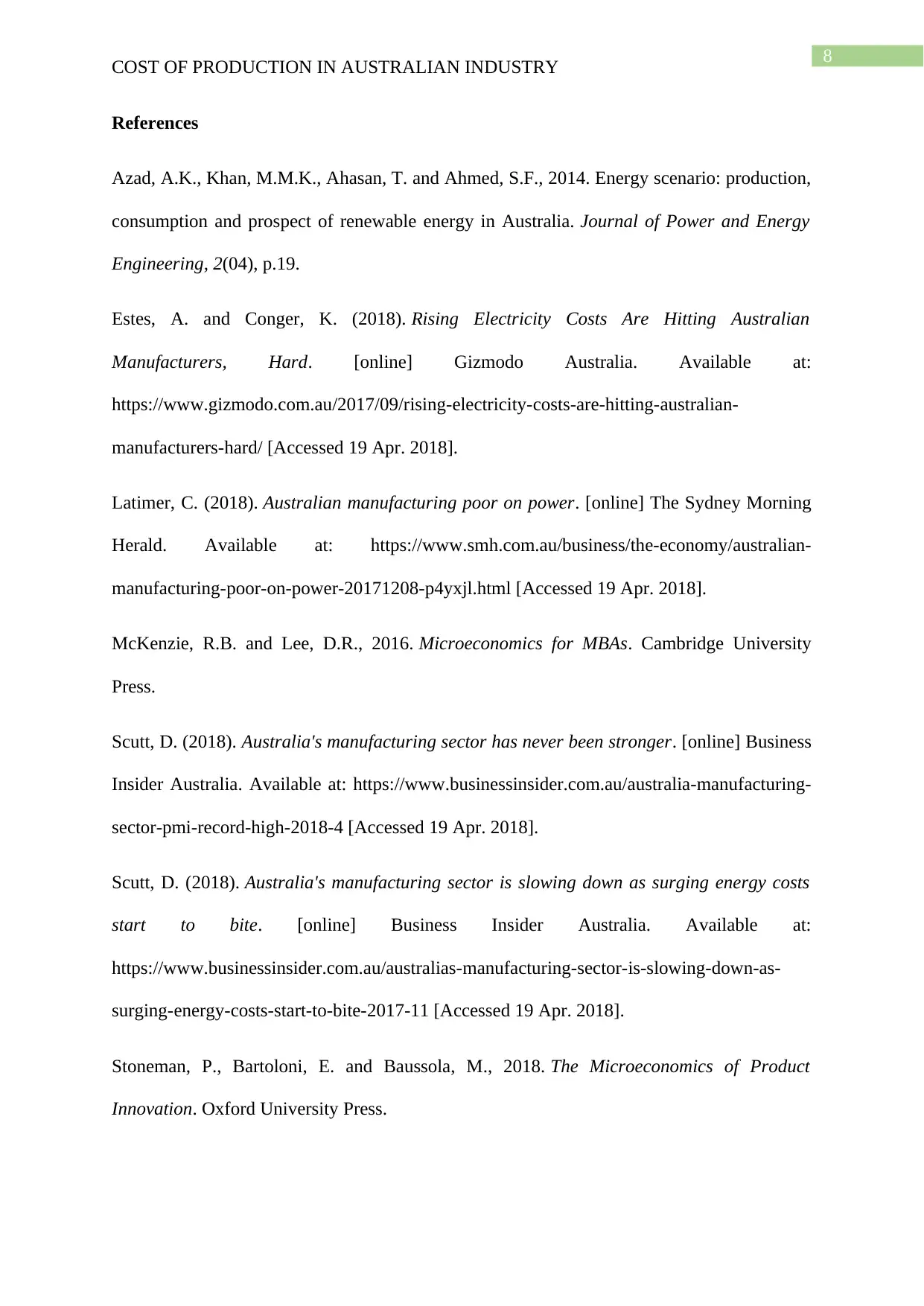
A direct consequence of rising input cost is on the supply of manufacturing output.
Following an increasing cost, the supply in manufacturing sector has reduced significantly
causing an upward pressure on price (Stoneman, Bartoloni and Baussola 2018). This is
shown in the figure below.
Figure 2: Effect of a reduction in manufacturing supply
(Source: as created by Author)
Recommendation
The rising cost of energy seems to be a vital problem to Australian manufacturing.
Therefore, focus should be given to reduce the price of electricity at an affordable level. The
clean energy target and increasing attention to renewable energy is one factor contributing to
a rising power bills (Azad et al. 2014). The large scale manufacturing should provide
electricity at a subsidized price to curb production cost. Moreover, state should focus on
tabler-icon-diamond-filled.svg

Paraphrase This Document

Need a fresh take? Get an instant paraphrase of this document with our AI Paraphraser
Document Page
7
COST OF PRODUCTION IN AUSTRALIAN INDUSTRY
increasing efficiency of the existing power stations so that electricity can be provided at a low
price.
In order to reduce cost of wage, attention should be given on raising skills of labor
force. This in turn requires training, education and skills development program for the
workers.
Conclusion
Manufacturing sector despite being one important sector of the economy faces a
decline in growth. The increasing cost of variable factors inhibit the growth of this sector.
The industry accounted a significant decline in its performance index this year as compared
to the previous year. The rising electricity and wage cost restrict the manufacturing growth by
reducing the profit margin. Focus should be given on reducing the input costs to revive the
performance of the traditional manufacturing sector.
Document Page
8
COST OF PRODUCTION IN AUSTRALIAN INDUSTRY
References
Azad, A.K., Khan, M.M.K., Ahasan, T. and Ahmed, S.F., 2014. Energy scenario: production,
consumption and prospect of renewable energy in Australia. Journal of Power and Energy
Engineering, 2(04), p.19.
Estes, A. and Conger, K. (2018). Rising Electricity Costs Are Hitting Australian
Manufacturers, Hard. [online] Gizmodo Australia. Available at:
https://www.gizmodo.com.au/2017/09/rising-electricity-costs-are-hitting-australian-
manufacturers-hard/ [Accessed 19 Apr. 2018].
Latimer, C. (2018). Australian manufacturing poor on power. [online] The Sydney Morning
Herald. Available at: https://www.smh.com.au/business/the-economy/australian-
manufacturing-poor-on-power-20171208-p4yxjl.html [Accessed 19 Apr. 2018].
McKenzie, R.B. and Lee, D.R., 2016. Microeconomics for MBAs. Cambridge University
Press.
Scutt, D. (2018). Australia's manufacturing sector has never been stronger. [online] Business
Insider Australia. Available at: https://www.businessinsider.com.au/australia-manufacturing-
sector-pmi-record-high-2018-4 [Accessed 19 Apr. 2018].
Scutt, D. (2018). Australia's manufacturing sector is slowing down as surging energy costs
start to bite. [online] Business Insider Australia. Available at:
https://www.businessinsider.com.au/australias-manufacturing-sector-is-slowing-down-as-
surging-energy-costs-start-to-bite-2017-11 [Accessed 19 Apr. 2018].
Stoneman, P., Bartoloni, E. and Baussola, M., 2018. The Microeconomics of Product
Innovation. Oxford University Press.
Document Page
9
COST OF PRODUCTION IN AUSTRALIAN INDUSTRY
Wilde, P.D., 2017. Economic restructuring and Australia’s changing role in the world
economic system. In Industrialization in Developing and Peripheral Regions (pp. 16-43).
Routledge.
chevron_up_icon
1 out of 10
circle_padding
hide_on_mobile
zoom_out_icon
[object Object]