Managerial Accounting: Costing System Analysis and Recommendations
VerifiedAdded on 2023/06/05
|12
|2132
|205
Homework Assignment
AI Summary
This assignment solution delves into managerial accounting, analyzing Pristine Limited's traditional costing system and its associated problems, such as the use of a single cost driver and missing allocations. It identifies indicators highlighting the system's flaws, including complexities in operations and inaccurate profit calculations. The solution proposes an activity-based costing (ABC) approach, detailing activity cost rates and providing an income statement comparison between metal and plastic safes under both costing methods. It emphasizes the benefits of ABC costing, such as true product costs and better decision-making, while also addressing implementation challenges. Finally, it offers suggestions for improving profitability for customers purchasing low-margin products and costly services, advocating for competitive pricing, large volume sales, and supplier discounts. Desklib provides this document and many other resources to aid students in their academic journey.
MANAGERIAL ACCOUNTING

Paraphrase This Document
Need a fresh take? Get an instant paraphrase of this document with our AI Paraphraser
Contents
Solution 1:..................................................................................................................................3
Solution 2 :.................................................................................................................................4
Solution 3:..................................................................................................................................5
Solution 4:..................................................................................................................................6
Solution 5:..................................................................................................................................7
Solution 6:..................................................................................................................................8
Solution 7:................................................................................................................................10
Bibliography.............................................................................................................................11
Solution 1:..................................................................................................................................3
Solution 2 :.................................................................................................................................4
Solution 3:..................................................................................................................................5
Solution 4:..................................................................................................................................6
Solution 5:..................................................................................................................................7
Solution 6:..................................................................................................................................8
Solution 7:................................................................................................................................10
Bibliography.............................................................................................................................11
Solution 1:
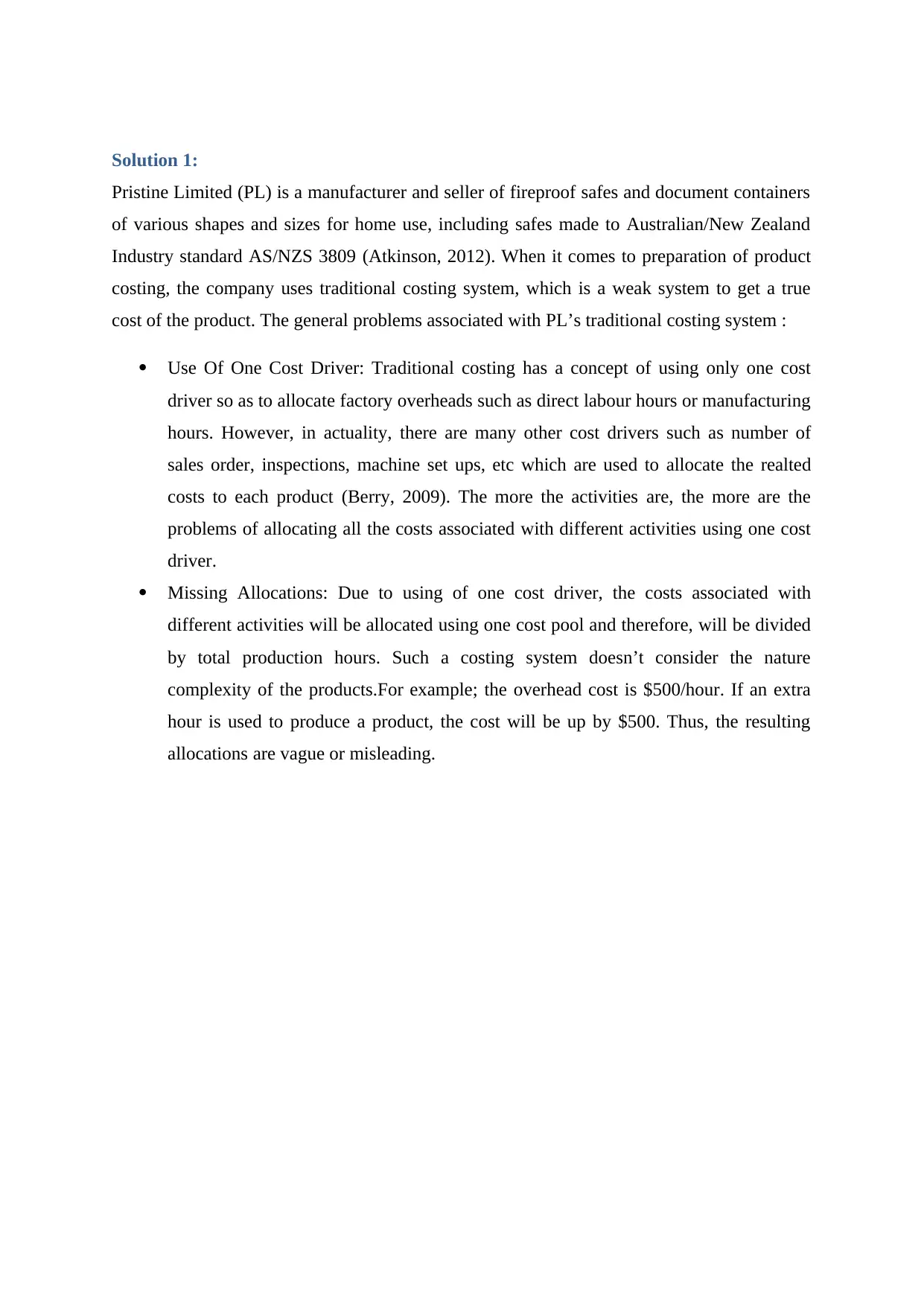
Pristine Limited (PL) is a manufacturer and seller of fireproof safes and document containers
of various shapes and sizes for home use, including safes made to Australian/New Zealand
Industry standard AS/NZS 3809 (Atkinson, 2012). When it comes to preparation of product
costing, the company uses traditional costing system, which is a weak system to get a true
cost of the product. The general problems associated with PL’s traditional costing system :
Use Of One Cost Driver: Traditional costing has a concept of using only one cost
driver so as to allocate factory overheads such as direct labour hours or manufacturing
hours. However, in actuality, there are many other cost drivers such as number of
sales order, inspections, machine set ups, etc which are used to allocate the realted
costs to each product (Berry, 2009). The more the activities are, the more are the
problems of allocating all the costs associated with different activities using one cost
driver.
Missing Allocations: Due to using of one cost driver, the costs associated with
different activities will be allocated using one cost pool and therefore, will be divided
by total production hours. Such a costing system doesn’t consider the nature
complexity of the products.For example; the overhead cost is $500/hour. If an extra
hour is used to produce a product, the cost will be up by $500. Thus, the resulting
allocations are vague or misleading.
Pristine Limited (PL) is a manufacturer and seller of fireproof safes and document containers
of various shapes and sizes for home use, including safes made to Australian/New Zealand
Industry standard AS/NZS 3809 (Atkinson, 2012). When it comes to preparation of product
costing, the company uses traditional costing system, which is a weak system to get a true
cost of the product. The general problems associated with PL’s traditional costing system :
Use Of One Cost Driver: Traditional costing has a concept of using only one cost
driver so as to allocate factory overheads such as direct labour hours or manufacturing
hours. However, in actuality, there are many other cost drivers such as number of
sales order, inspections, machine set ups, etc which are used to allocate the realted
costs to each product (Berry, 2009). The more the activities are, the more are the
problems of allocating all the costs associated with different activities using one cost
driver.
Missing Allocations: Due to using of one cost driver, the costs associated with
different activities will be allocated using one cost pool and therefore, will be divided
by total production hours. Such a costing system doesn’t consider the nature
complexity of the products.For example; the overhead cost is $500/hour. If an extra
hour is used to produce a product, the cost will be up by $500. Thus, the resulting
allocations are vague or misleading.
⊘ This is a preview!⊘
Do you want full access?
Subscribe today to unlock all pages.

Trusted by 1+ million students worldwide
Solution 2 :
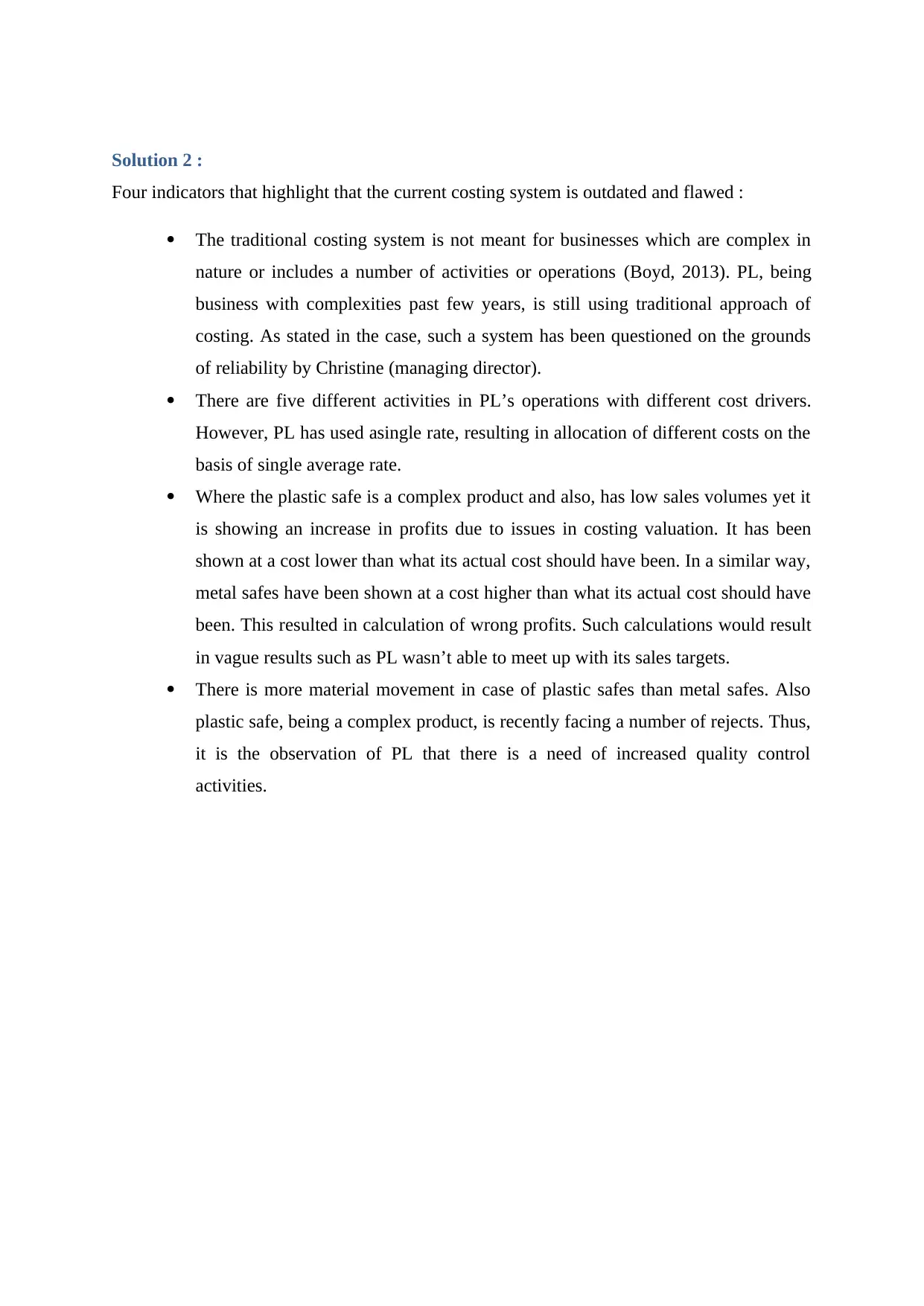
Four indicators that highlight that the current costing system is outdated and flawed :
The traditional costing system is not meant for businesses which are complex in
nature or includes a number of activities or operations (Boyd, 2013). PL, being
business with complexities past few years, is still using traditional approach of
costing. As stated in the case, such a system has been questioned on the grounds
of reliability by Christine (managing director).
There are five different activities in PL’s operations with different cost drivers.
However, PL has used asingle rate, resulting in allocation of different costs on the
basis of single average rate.
Where the plastic safe is a complex product and also, has low sales volumes yet it
is showing an increase in profits due to issues in costing valuation. It has been
shown at a cost lower than what its actual cost should have been. In a similar way,
metal safes have been shown at a cost higher than what its actual cost should have
been. This resulted in calculation of wrong profits. Such calculations would result
in vague results such as PL wasn’t able to meet up with its sales targets.
There is more material movement in case of plastic safes than metal safes. Also
plastic safe, being a complex product, is recently facing a number of rejects. Thus,
it is the observation of PL that there is a need of increased quality control
activities.
Four indicators that highlight that the current costing system is outdated and flawed :
The traditional costing system is not meant for businesses which are complex in
nature or includes a number of activities or operations (Boyd, 2013). PL, being
business with complexities past few years, is still using traditional approach of
costing. As stated in the case, such a system has been questioned on the grounds
of reliability by Christine (managing director).
There are five different activities in PL’s operations with different cost drivers.
However, PL has used asingle rate, resulting in allocation of different costs on the
basis of single average rate.
Where the plastic safe is a complex product and also, has low sales volumes yet it
is showing an increase in profits due to issues in costing valuation. It has been
shown at a cost lower than what its actual cost should have been. In a similar way,
metal safes have been shown at a cost higher than what its actual cost should have
been. This resulted in calculation of wrong profits. Such calculations would result
in vague results such as PL wasn’t able to meet up with its sales targets.
There is more material movement in case of plastic safes than metal safes. Also
plastic safe, being a complex product, is recently facing a number of rejects. Thus,
it is the observation of PL that there is a need of increased quality control
activities.
Paraphrase This Document
Need a fresh take? Get an instant paraphrase of this document with our AI Paraphraser
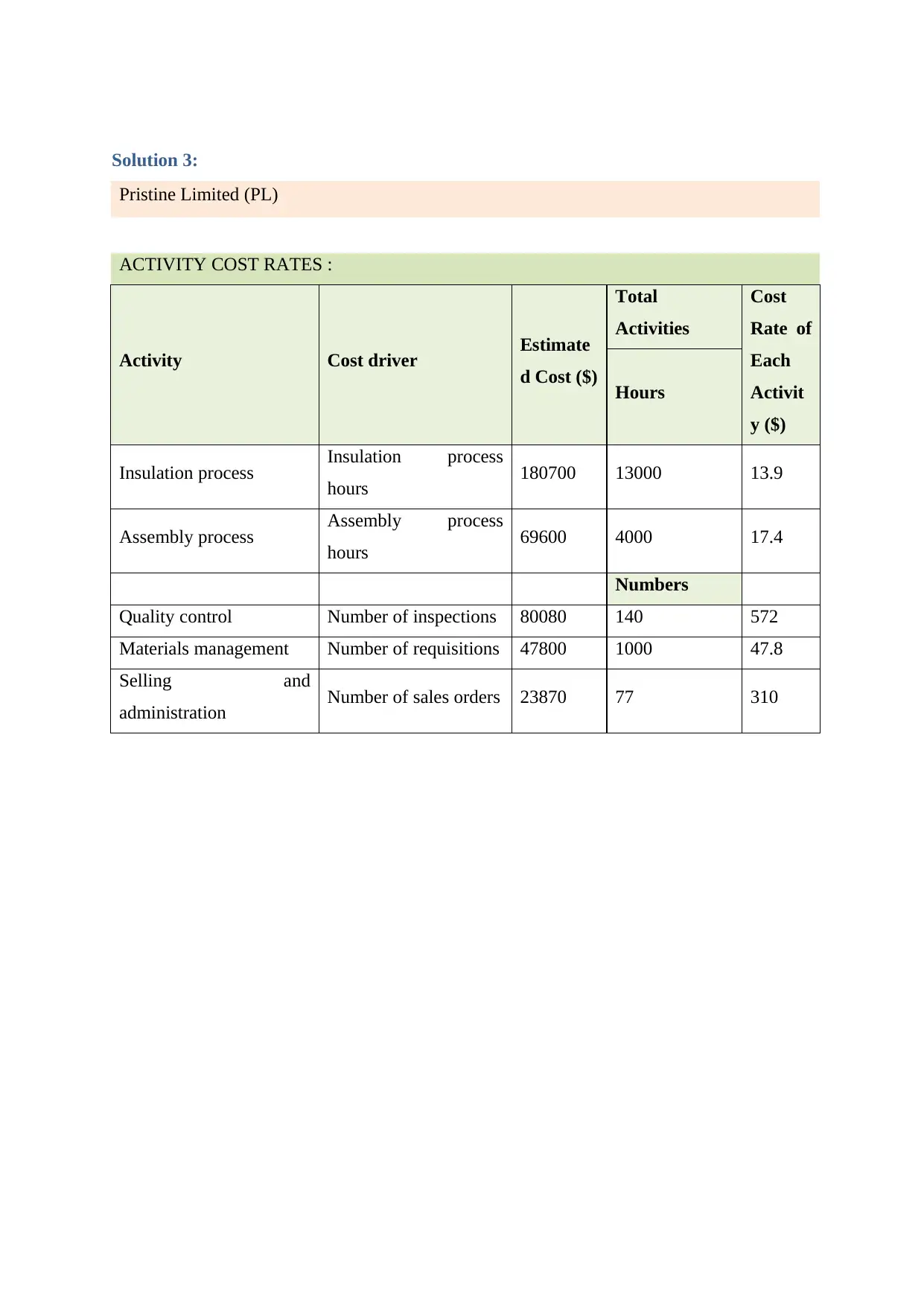
Solution 3:
Pristine Limited (PL)
ACTIVITY COST RATES :
Activity Cost driver Estimate
d Cost ($)
Total
Activities
Cost
Rate of
Each
Activit
y ($)
Hours
Insulation process Insulation process
hours 180700 13000 13.9
Assembly process Assembly process
hours 69600 4000 17.4
Numbers
Quality control Number of inspections 80080 140 572
Materials management Number of requisitions 47800 1000 47.8
Selling and
administration Number of sales orders 23870 77 310
Pristine Limited (PL)
ACTIVITY COST RATES :
Activity Cost driver Estimate
d Cost ($)
Total
Activities
Cost
Rate of
Each
Activit
y ($)
Hours
Insulation process Insulation process
hours 180700 13000 13.9
Assembly process Assembly process
hours 69600 4000 17.4
Numbers
Quality control Number of inspections 80080 140 572
Materials management Number of requisitions 47800 1000 47.8
Selling and
administration Number of sales orders 23870 77 310
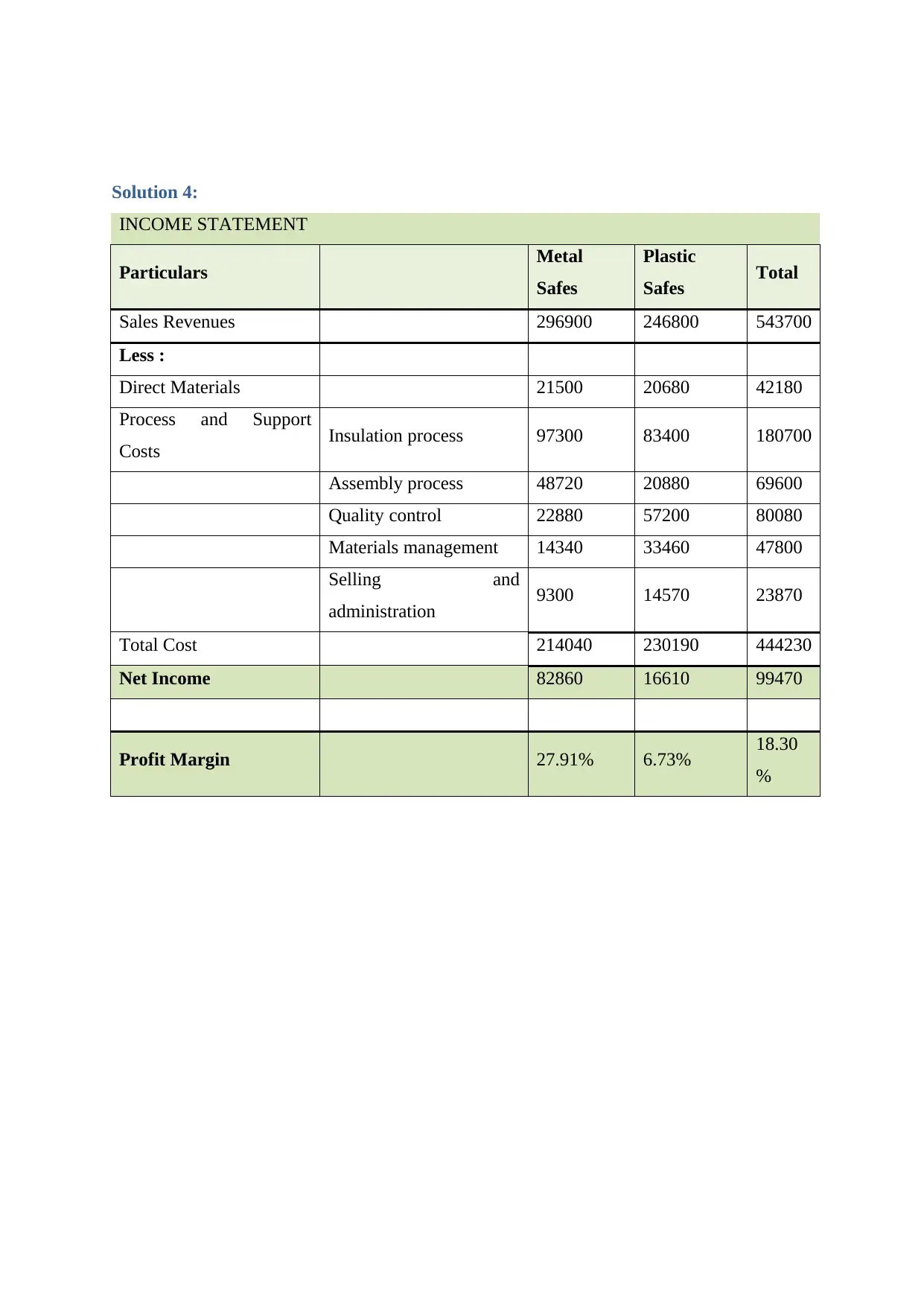
Solution 4:
INCOME STATEMENT
Particulars Metal
Safes
Plastic
Safes Total
Sales Revenues 296900 246800 543700
Less :
Direct Materials 21500 20680 42180
Process and Support
Costs Insulation process 97300 83400 180700
Assembly process 48720 20880 69600
Quality control 22880 57200 80080
Materials management 14340 33460 47800
Selling and
administration 9300 14570 23870
Total Cost 214040 230190 444230
Net Income 82860 16610 99470
Profit Margin 27.91% 6.73% 18.30
%
INCOME STATEMENT
Particulars Metal
Safes
Plastic
Safes Total
Sales Revenues 296900 246800 543700
Less :
Direct Materials 21500 20680 42180
Process and Support
Costs Insulation process 97300 83400 180700
Assembly process 48720 20880 69600
Quality control 22880 57200 80080
Materials management 14340 33460 47800
Selling and
administration 9300 14570 23870
Total Cost 214040 230190 444230
Net Income 82860 16610 99470
Profit Margin 27.91% 6.73% 18.30
%
⊘ This is a preview!⊘
Do you want full access?
Subscribe today to unlock all pages.
Trusted by 1+ million students worldwide
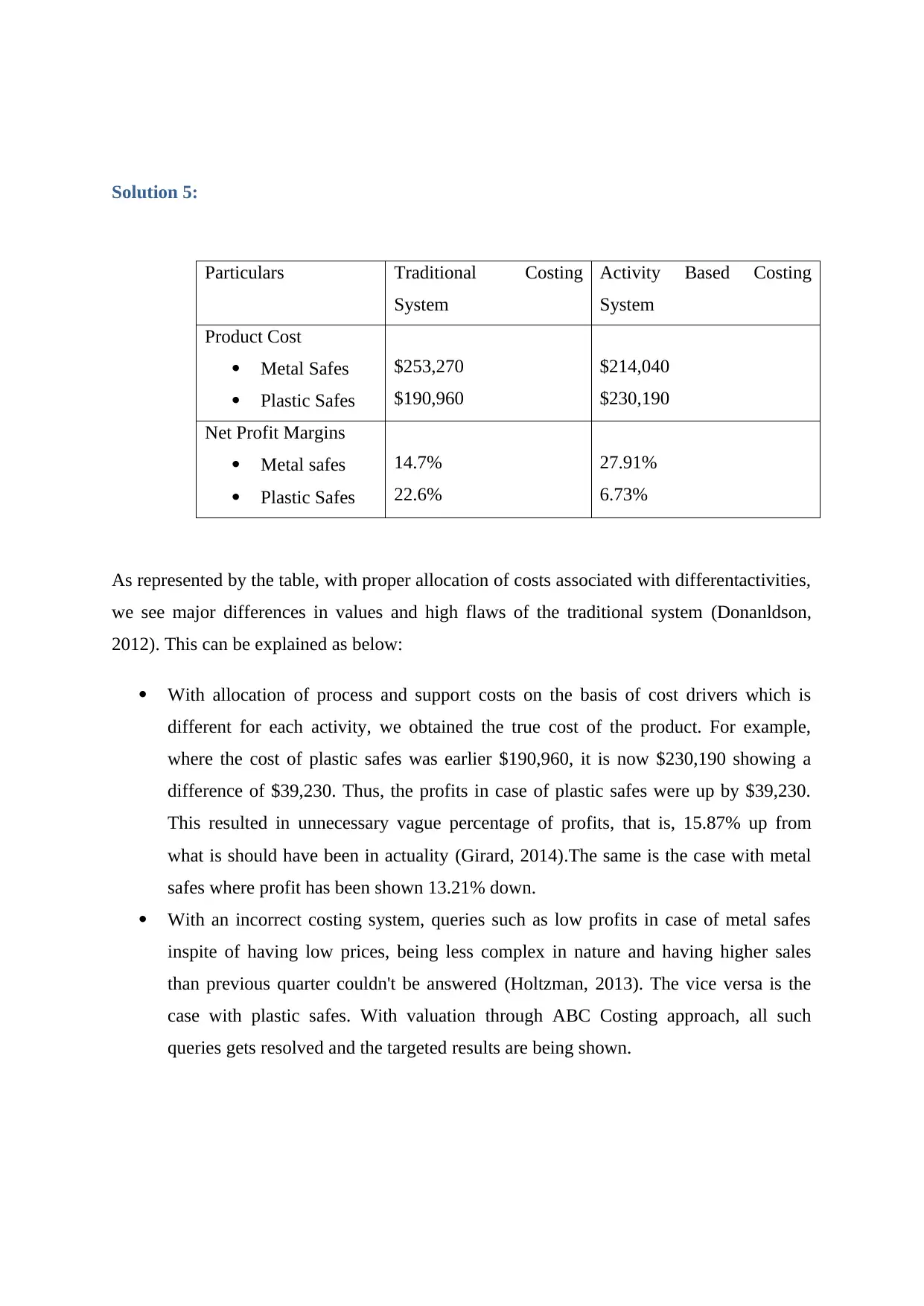
Solution 5:
Particulars Traditional Costing
System
Activity Based Costing
System
Product Cost
Metal Safes
Plastic Safes
$253,270
$190,960
$214,040
$230,190
Net Profit Margins
Metal safes
Plastic Safes
14.7%
22.6%
27.91%
6.73%
As represented by the table, with proper allocation of costs associated with differentactivities,
we see major differences in values and high flaws of the traditional system (Donanldson,
2012). This can be explained as below:
With allocation of process and support costs on the basis of cost drivers which is
different for each activity, we obtained the true cost of the product. For example,
where the cost of plastic safes was earlier $190,960, it is now $230,190 showing a
difference of $39,230. Thus, the profits in case of plastic safes were up by $39,230.
This resulted in unnecessary vague percentage of profits, that is, 15.87% up from
what is should have been in actuality (Girard, 2014).The same is the case with metal
safes where profit has been shown 13.21% down.
With an incorrect costing system, queries such as low profits in case of metal safes
inspite of having low prices, being less complex in nature and having higher sales
than previous quarter couldn't be answered (Holtzman, 2013). The vice versa is the
case with plastic safes. With valuation through ABC Costing approach, all such
queries gets resolved and the targeted results are being shown.
Particulars Traditional Costing
System
Activity Based Costing
System
Product Cost
Metal Safes
Plastic Safes
$253,270
$190,960
$214,040
$230,190
Net Profit Margins
Metal safes
Plastic Safes
14.7%
22.6%
27.91%
6.73%
As represented by the table, with proper allocation of costs associated with differentactivities,
we see major differences in values and high flaws of the traditional system (Donanldson,
2012). This can be explained as below:
With allocation of process and support costs on the basis of cost drivers which is
different for each activity, we obtained the true cost of the product. For example,
where the cost of plastic safes was earlier $190,960, it is now $230,190 showing a
difference of $39,230. Thus, the profits in case of plastic safes were up by $39,230.
This resulted in unnecessary vague percentage of profits, that is, 15.87% up from
what is should have been in actuality (Girard, 2014).The same is the case with metal
safes where profit has been shown 13.21% down.
With an incorrect costing system, queries such as low profits in case of metal safes
inspite of having low prices, being less complex in nature and having higher sales
than previous quarter couldn't be answered (Holtzman, 2013). The vice versa is the
case with plastic safes. With valuation through ABC Costing approach, all such
queries gets resolved and the targeted results are being shown.
Paraphrase This Document
Need a fresh take? Get an instant paraphrase of this document with our AI Paraphraser
Solution 6:
As discussed and represented above, we witnessed a lot of flaws in the traditional approach of
costing. The following report has been made to the managing director regarding changing the
costing approach for better results (Horngren, 2012). It is advisable that the company should
adopt activity based costing approach to prepare its books.
Activity based costing (ABC) is an approach of allocating overhead costs in a more practical
way to the products than the previous approach of allocating costs on an average rate
obtained on the basis of direct labour hours or production hours. It is a two way allocation,
that is, firstly assigning costs to the activities that together sums up the total overheads and
secondly, assigning the activities to only those products that has actually undertaken such
activities (Mattessich, 2016). The reason entities are approaching towards ABC analysis in
recent years are because (1) there is a significant increase in manufacturing overhead costs;
(2) there is no correlation between the overhead costs with the production hours; (3) entities
producing more than one products cannot use a single average rate for all its products as that
would give a false cost; (4) there is a growing diversification in products as well diversified
demands by customers. The benefits that can accrue due to activity based costing can be
explained as :
True Product Cost: It gives an accurate cost for each of the products the organization
is specializing in. This also helps in understanding the true nature of overheads.
Information about Cost Behaviour: With the correct understanding of overheads, an
entity can take into view the expenditure they are making and whether it is justifiable
or not. it helps in identification of activities that is no longer adding any value to the
product.
Control over Fixed Costs: with the correct cost information, management can
exercise control over activities that are real cause for occurrence of fixed costs. This
is possible as with proper allocation, one gets a clear picture of variable as well as
fixed costs.
Better Decision Making: The management can make decisions regarding cost
reduction or cost cutting as a more reliable product cost is available with them. This
also helps them in setting the selling prices of their products.
As discussed and represented above, we witnessed a lot of flaws in the traditional approach of
costing. The following report has been made to the managing director regarding changing the
costing approach for better results (Horngren, 2012). It is advisable that the company should
adopt activity based costing approach to prepare its books.
Activity based costing (ABC) is an approach of allocating overhead costs in a more practical
way to the products than the previous approach of allocating costs on an average rate
obtained on the basis of direct labour hours or production hours. It is a two way allocation,
that is, firstly assigning costs to the activities that together sums up the total overheads and
secondly, assigning the activities to only those products that has actually undertaken such
activities (Mattessich, 2016). The reason entities are approaching towards ABC analysis in
recent years are because (1) there is a significant increase in manufacturing overhead costs;
(2) there is no correlation between the overhead costs with the production hours; (3) entities
producing more than one products cannot use a single average rate for all its products as that
would give a false cost; (4) there is a growing diversification in products as well diversified
demands by customers. The benefits that can accrue due to activity based costing can be
explained as :
True Product Cost: It gives an accurate cost for each of the products the organization
is specializing in. This also helps in understanding the true nature of overheads.
Information about Cost Behaviour: With the correct understanding of overheads, an
entity can take into view the expenditure they are making and whether it is justifiable
or not. it helps in identification of activities that is no longer adding any value to the
product.
Control over Fixed Costs: with the correct cost information, management can
exercise control over activities that are real cause for occurrence of fixed costs. This
is possible as with proper allocation, one gets a clear picture of variable as well as
fixed costs.
Better Decision Making: The management can make decisions regarding cost
reduction or cost cutting as a more reliable product cost is available with them. This
also helps them in setting the selling prices of their products.
Adoption and implementation of ABC costing system is a costly process as it is a way
broader concept and includes a number of resources (Mattessich, 2016). The issues associated
with ABC costing can be stated below:
Complex in nature: Due to using of different cost drivers and cost pools, it is complex
in nature and this is why, it is a costly system .
Measurement Difficulties: ABC analysis requires determination of various cost
drivers and activities that can serve as the basis for cost allocation. Such
measurements require extreme expertise and therefore, are costly. In fact, a simple
ABC system also requires a lot of calculations for determining costs. Also, Activity
costing rates have to be updated regularly.
Other Difficulties : Such other difficulties that can be faced are selection of cost driver
for an activity, allocation of common costs, varying rates of cost drivers, less
knowledge of implementing ABC system properly (McLaney & Adril, 2016).
broader concept and includes a number of resources (Mattessich, 2016). The issues associated
with ABC costing can be stated below:
Complex in nature: Due to using of different cost drivers and cost pools, it is complex
in nature and this is why, it is a costly system .
Measurement Difficulties: ABC analysis requires determination of various cost
drivers and activities that can serve as the basis for cost allocation. Such
measurements require extreme expertise and therefore, are costly. In fact, a simple
ABC system also requires a lot of calculations for determining costs. Also, Activity
costing rates have to be updated regularly.
Other Difficulties : Such other difficulties that can be faced are selection of cost driver
for an activity, allocation of common costs, varying rates of cost drivers, less
knowledge of implementing ABC system properly (McLaney & Adril, 2016).
⊘ This is a preview!⊘
Do you want full access?
Subscribe today to unlock all pages.
Trusted by 1+ million students worldwide
Solution 7:
For a customer of PL who prefers to purchase low margin products and costly services, better
profits can be made if the company can consider the following suggestions:
Sets a competitive price of products: This means having an understanding of the
market price and setting the selling price accordingly. This would help in attracting
customers. A customer has an understanding of all the selling prices set by different
sellers in the market and accordingly, makes its decision of choosing the product.
Therefore, setting prices higher than the market price would penalize the company
and setting prices lower than the market price would raise questions on the quality of
the product.
Large volume sales of products: low margin products attract customers preferring
qualitative products with low margin. Also, low margin products have more number
of customers. With increase in number and size of transactions, the company can
minimize the effect of costs by having sufficient sales and therefore, profits. The
company should conduct practices such as advertising, sales promotion etc to increase
its sales (Seal, 2012).
Discounts from Suppliers: The Company should seek for discounts from suppliers.
Discount received would result in deduction of costs and therefore, lead to more sales
value and therefore, more profits.
Making an Analysis of cost of substitute services available in the market : The
company should analyze the costs of services of different market suppliers and make
a decision based on that regarding which supplier should be selected (Taillard, 2013).
Thus, using above methods and such other similar methods, profitability can be increased or
improved.
For a customer of PL who prefers to purchase low margin products and costly services, better
profits can be made if the company can consider the following suggestions:
Sets a competitive price of products: This means having an understanding of the
market price and setting the selling price accordingly. This would help in attracting
customers. A customer has an understanding of all the selling prices set by different
sellers in the market and accordingly, makes its decision of choosing the product.
Therefore, setting prices higher than the market price would penalize the company
and setting prices lower than the market price would raise questions on the quality of
the product.
Large volume sales of products: low margin products attract customers preferring
qualitative products with low margin. Also, low margin products have more number
of customers. With increase in number and size of transactions, the company can
minimize the effect of costs by having sufficient sales and therefore, profits. The
company should conduct practices such as advertising, sales promotion etc to increase
its sales (Seal, 2012).
Discounts from Suppliers: The Company should seek for discounts from suppliers.
Discount received would result in deduction of costs and therefore, lead to more sales
value and therefore, more profits.
Making an Analysis of cost of substitute services available in the market : The
company should analyze the costs of services of different market suppliers and make
a decision based on that regarding which supplier should be selected (Taillard, 2013).
Thus, using above methods and such other similar methods, profitability can be increased or
improved.
Paraphrase This Document
Need a fresh take? Get an instant paraphrase of this document with our AI Paraphraser
Bibliography
Atkinson, A. A. (2012). Management accounting. Upper Saddle River, N.J.: Paerson.
Berry, L. E. (2009). Management accounting demystified. New York: McGraw-Hill.
Boyd, W. K. (2013). Cost Accounting For Dummies. Hoboken: Wiley.
Donanldson, T. (2012). Ethical issues in business. New Jersey: Prentice Hall.
Girard, S. L. (2014). Business finance basics. Pompton Plains, NJ: Career Press.
Holtzman, M. (2013). Managerial Accounting For Dummies. Hoboken, NJ: Wiley.
Horngren, C. (2012). Cost accounting. Upper Saddle River, N.J.: Pearson/Prentice Hall.
Mattessich, R. (2016). Reality and accounting. [S.I.]: Routledge.
McLaney, E., & Adril, D. P. (2016). Accounting and Finance: An Introduction. United
Kingdom: Pearson.
Seal, W. (2012). Management accounting. Maidenhead: McGraw-Hill Higher Education.
Taillard, M. (2013). Corporate finance for dummies. Hoboken, N.J.: Wiley.
Atkinson, A. A. (2012). Management accounting. Upper Saddle River, N.J.: Paerson.
Berry, L. E. (2009). Management accounting demystified. New York: McGraw-Hill.
Boyd, W. K. (2013). Cost Accounting For Dummies. Hoboken: Wiley.
Donanldson, T. (2012). Ethical issues in business. New Jersey: Prentice Hall.
Girard, S. L. (2014). Business finance basics. Pompton Plains, NJ: Career Press.
Holtzman, M. (2013). Managerial Accounting For Dummies. Hoboken, NJ: Wiley.
Horngren, C. (2012). Cost accounting. Upper Saddle River, N.J.: Pearson/Prentice Hall.
Mattessich, R. (2016). Reality and accounting. [S.I.]: Routledge.
McLaney, E., & Adril, D. P. (2016). Accounting and Finance: An Introduction. United
Kingdom: Pearson.
Seal, W. (2012). Management accounting. Maidenhead: McGraw-Hill Higher Education.
Taillard, M. (2013). Corporate finance for dummies. Hoboken, N.J.: Wiley.

.
⊘ This is a preview!⊘
Do you want full access?
Subscribe today to unlock all pages.
Trusted by 1+ million students worldwide

1 out of 12


Related Documents


Your All-in-One AI-Powered Toolkit for Academic Success.
+13062052269
info@desklib.com
Available 24*7 on WhatsApp / Email
![[object Object]](/_next/static/media/star-bottom.7253800d.svg)
Unlock your academic potential
Copyright © 2020–2026 A2Z Services. All Rights Reserved. Developed and managed by ZUCOL.