COUNSELLING 19: Counseling Assessment Report on Valerie and Caiden
VerifiedAdded on 2021/04/17
|20
|3666
|144
Report
AI Summary
This report presents a thorough counseling assessment of two case studies: Valerie, a client with potential health and family issues, and Caiden, a client struggling with homosexuality, school reluctance, and suicidal ideation. The report is divided into two parts, the first focuses on gathering information, communication techniques, and applying Egan's model to Valerie's case, while the second part addresses risk identification and its impact on young clients, including Valerie. Furthermore, it explores the impact of risks in Valerie's case, considerations influencing decisions and actions, and relevant CareShore policies and procedures. The second case study on Caiden focuses on developing a counseling plan, including goal setting, trauma-informed care, and person-centered practice. The report outlines the client's needs, expectations, and commitment to counseling, as well as potential anxieties and a comprehensive counseling plan. This report provides a valuable resource for understanding the complexities of counseling assessment and intervention strategies.
Running head: COUNSELLING 1
MODULE 6 COUNSELLING ASSESSMET
Student’s Name
University Affiliation
Course
Date
MODULE 6 COUNSELLING ASSESSMET
Student’s Name
University Affiliation
Course
Date

Paraphrase This Document
Need a fresh take? Get an instant paraphrase of this document with our AI Paraphraser
COUNELLING 2
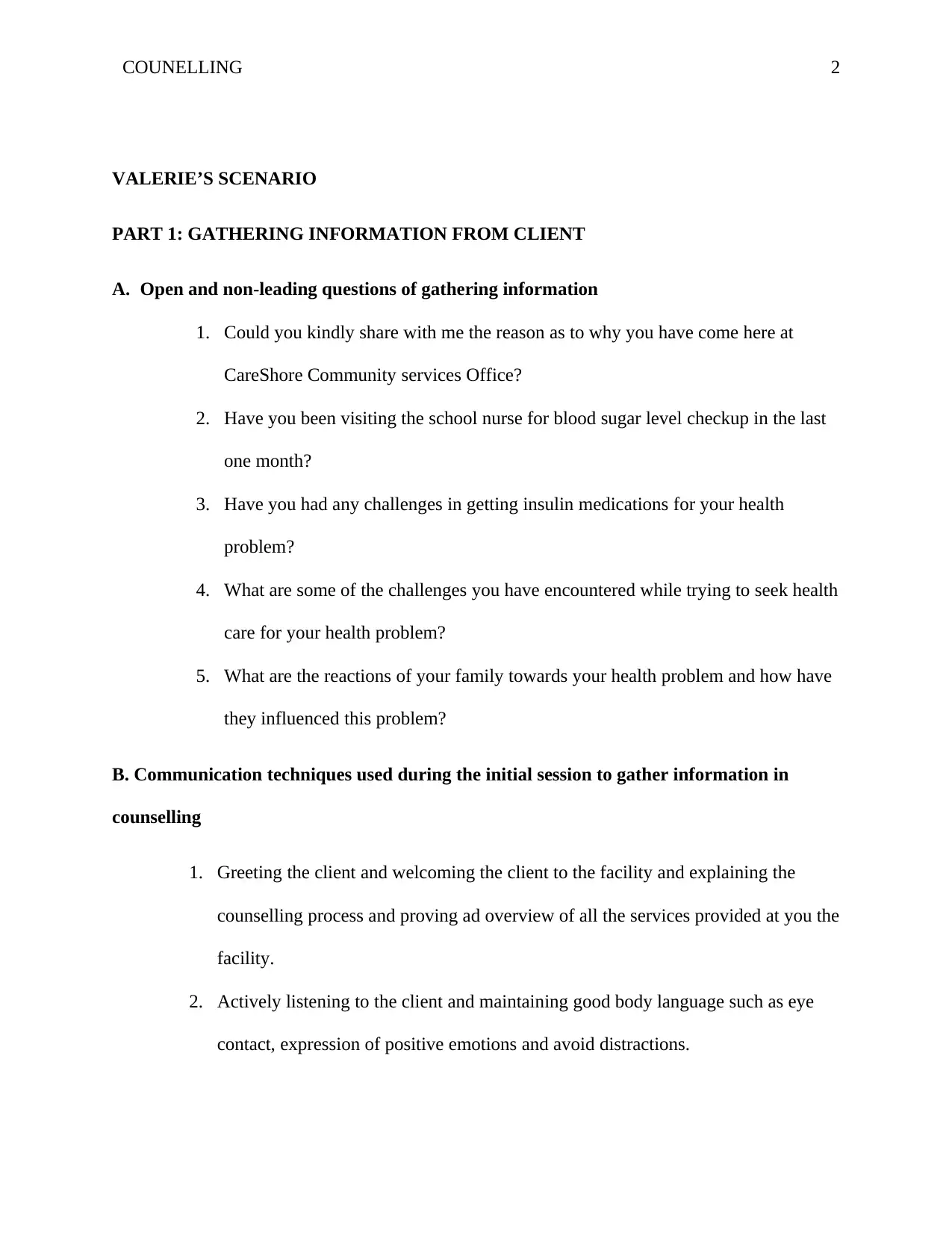
VALERIE’S SCENARIO
PART 1: GATHERING INFORMATION FROM CLIENT
A. Open and non-leading questions of gathering information
1. Could you kindly share with me the reason as to why you have come here at
CareShore Community services Office?
2. Have you been visiting the school nurse for blood sugar level checkup in the last
one month?
3. Have you had any challenges in getting insulin medications for your health
problem?
4. What are some of the challenges you have encountered while trying to seek health
care for your health problem?
5. What are the reactions of your family towards your health problem and how have
they influenced this problem?
B. Communication techniques used during the initial session to gather information in
counselling
1. Greeting the client and welcoming the client to the facility and explaining the
counselling process and proving ad overview of all the services provided at you the
facility.
2. Actively listening to the client and maintaining good body language such as eye
contact, expression of positive emotions and avoid distractions.
VALERIE’S SCENARIO
PART 1: GATHERING INFORMATION FROM CLIENT
A. Open and non-leading questions of gathering information
1. Could you kindly share with me the reason as to why you have come here at
CareShore Community services Office?
2. Have you been visiting the school nurse for blood sugar level checkup in the last
one month?
3. Have you had any challenges in getting insulin medications for your health
problem?
4. What are some of the challenges you have encountered while trying to seek health
care for your health problem?
5. What are the reactions of your family towards your health problem and how have
they influenced this problem?
B. Communication techniques used during the initial session to gather information in
counselling
1. Greeting the client and welcoming the client to the facility and explaining the
counselling process and proving ad overview of all the services provided at you the
facility.
2. Actively listening to the client and maintaining good body language such as eye
contact, expression of positive emotions and avoid distractions.
COUNELLING 3
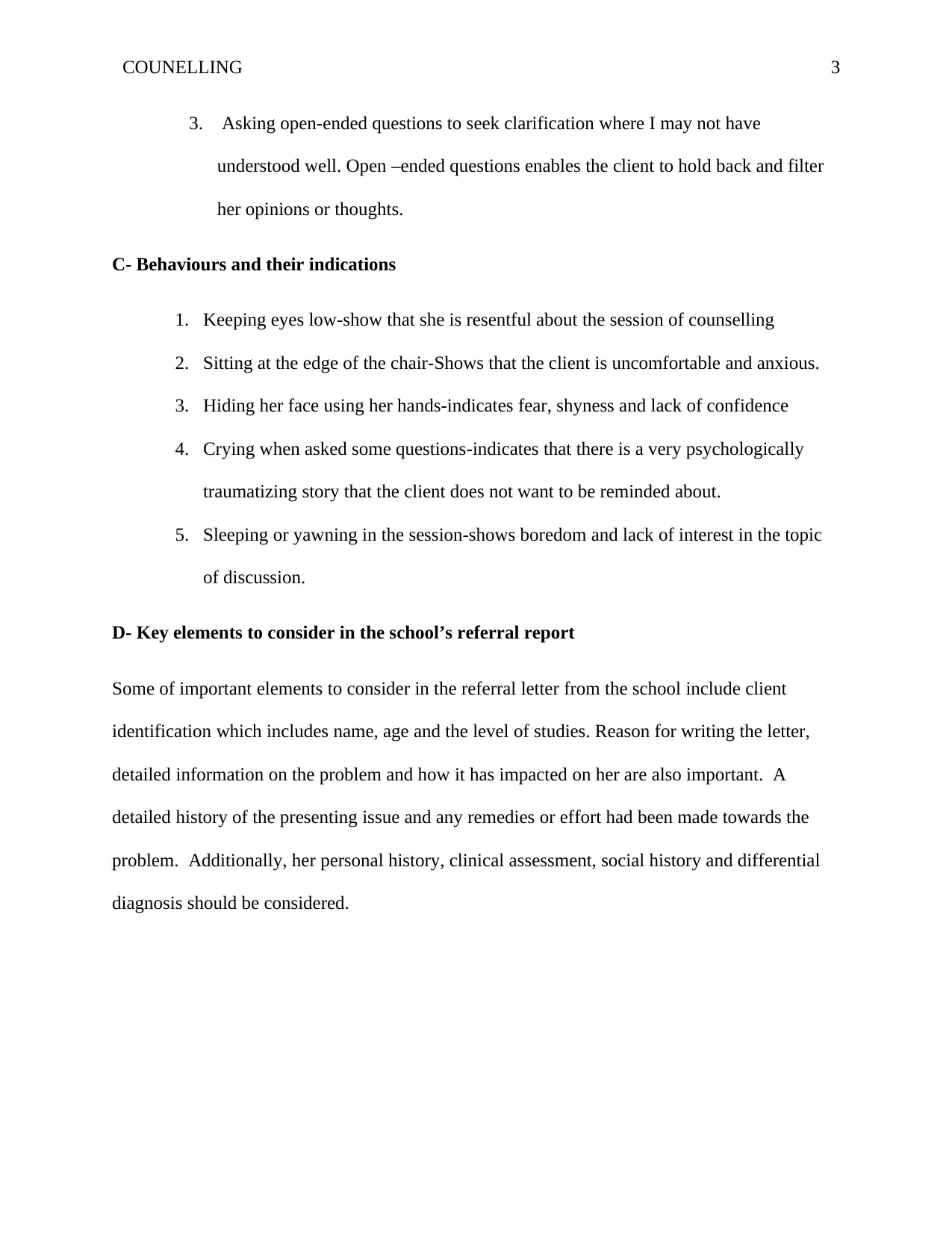
3. Asking open-ended questions to seek clarification where I may not have
understood well. Open –ended questions enables the client to hold back and filter
her opinions or thoughts.
C- Behaviours and their indications
1. Keeping eyes low-show that she is resentful about the session of counselling
2. Sitting at the edge of the chair-Shows that the client is uncomfortable and anxious.
3. Hiding her face using her hands-indicates fear, shyness and lack of confidence
4. Crying when asked some questions-indicates that there is a very psychologically
traumatizing story that the client does not want to be reminded about.
5. Sleeping or yawning in the session-shows boredom and lack of interest in the topic
of discussion.
D- Key elements to consider in the school’s referral report
Some of important elements to consider in the referral letter from the school include client
identification which includes name, age and the level of studies. Reason for writing the letter,
detailed information on the problem and how it has impacted on her are also important. A
detailed history of the presenting issue and any remedies or effort had been made towards the
problem. Additionally, her personal history, clinical assessment, social history and differential
diagnosis should be considered.
3. Asking open-ended questions to seek clarification where I may not have
understood well. Open –ended questions enables the client to hold back and filter
her opinions or thoughts.
C- Behaviours and their indications
1. Keeping eyes low-show that she is resentful about the session of counselling
2. Sitting at the edge of the chair-Shows that the client is uncomfortable and anxious.
3. Hiding her face using her hands-indicates fear, shyness and lack of confidence
4. Crying when asked some questions-indicates that there is a very psychologically
traumatizing story that the client does not want to be reminded about.
5. Sleeping or yawning in the session-shows boredom and lack of interest in the topic
of discussion.
D- Key elements to consider in the school’s referral report
Some of important elements to consider in the referral letter from the school include client
identification which includes name, age and the level of studies. Reason for writing the letter,
detailed information on the problem and how it has impacted on her are also important. A
detailed history of the presenting issue and any remedies or effort had been made towards the
problem. Additionally, her personal history, clinical assessment, social history and differential
diagnosis should be considered.
⊘ This is a preview!⊘
Do you want full access?
Subscribe today to unlock all pages.

Trusted by 1+ million students worldwide
COUNELLING 4
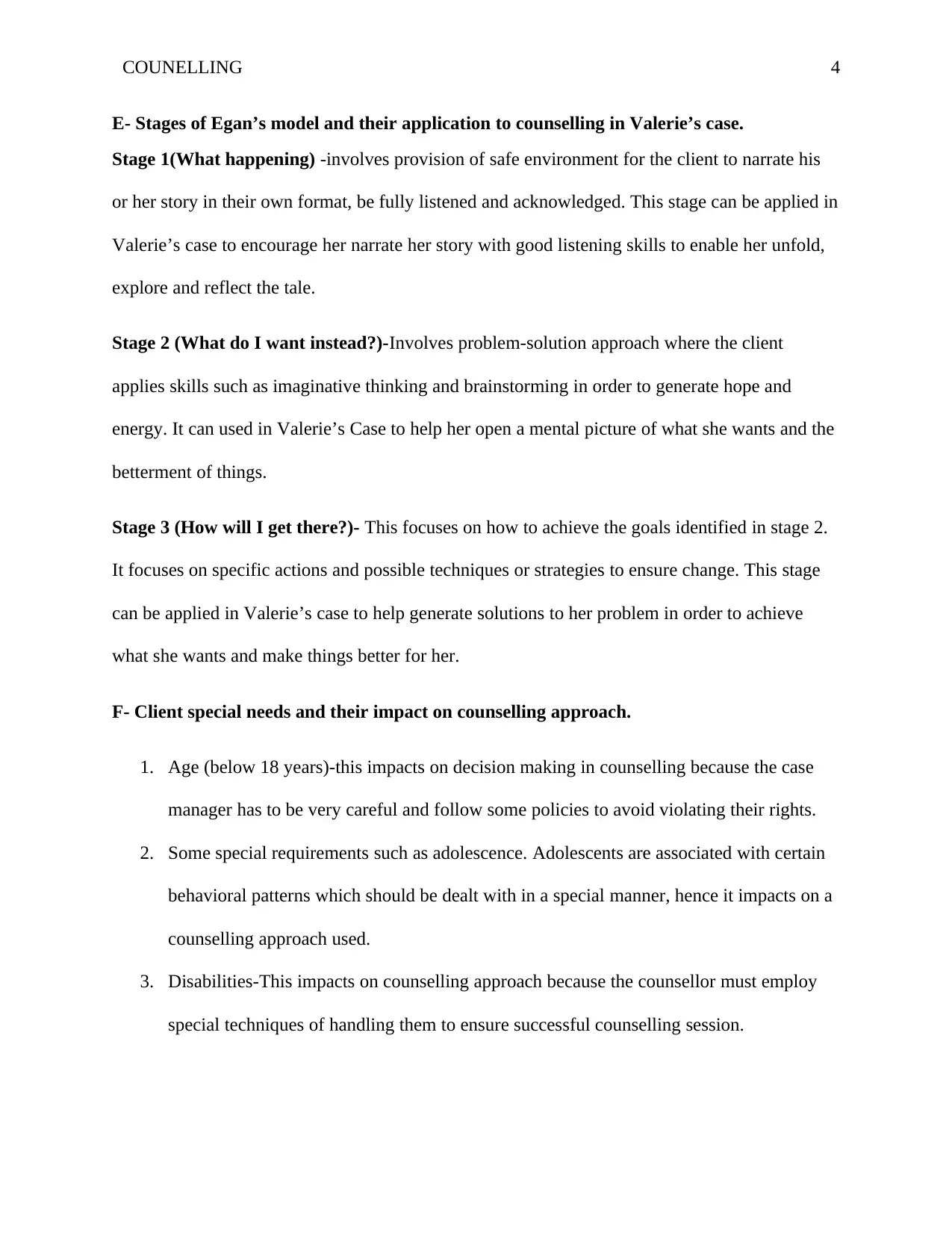
E- Stages of Egan’s model and their application to counselling in Valerie’s case.
Stage 1(What happening) -involves provision of safe environment for the client to narrate his
or her story in their own format, be fully listened and acknowledged. This stage can be applied in
Valerie’s case to encourage her narrate her story with good listening skills to enable her unfold,
explore and reflect the tale.
Stage 2 (What do I want instead?)-Involves problem-solution approach where the client
applies skills such as imaginative thinking and brainstorming in order to generate hope and
energy. It can used in Valerie’s Case to help her open a mental picture of what she wants and the
betterment of things.
Stage 3 (How will I get there?)- This focuses on how to achieve the goals identified in stage 2.
It focuses on specific actions and possible techniques or strategies to ensure change. This stage
can be applied in Valerie’s case to help generate solutions to her problem in order to achieve
what she wants and make things better for her.
F- Client special needs and their impact on counselling approach.
1. Age (below 18 years)-this impacts on decision making in counselling because the case
manager has to be very careful and follow some policies to avoid violating their rights.
2. Some special requirements such as adolescence. Adolescents are associated with certain
behavioral patterns which should be dealt with in a special manner, hence it impacts on a
counselling approach used.
3. Disabilities-This impacts on counselling approach because the counsellor must employ
special techniques of handling them to ensure successful counselling session.
E- Stages of Egan’s model and their application to counselling in Valerie’s case.
Stage 1(What happening) -involves provision of safe environment for the client to narrate his
or her story in their own format, be fully listened and acknowledged. This stage can be applied in
Valerie’s case to encourage her narrate her story with good listening skills to enable her unfold,
explore and reflect the tale.
Stage 2 (What do I want instead?)-Involves problem-solution approach where the client
applies skills such as imaginative thinking and brainstorming in order to generate hope and
energy. It can used in Valerie’s Case to help her open a mental picture of what she wants and the
betterment of things.
Stage 3 (How will I get there?)- This focuses on how to achieve the goals identified in stage 2.
It focuses on specific actions and possible techniques or strategies to ensure change. This stage
can be applied in Valerie’s case to help generate solutions to her problem in order to achieve
what she wants and make things better for her.
F- Client special needs and their impact on counselling approach.
1. Age (below 18 years)-this impacts on decision making in counselling because the case
manager has to be very careful and follow some policies to avoid violating their rights.
2. Some special requirements such as adolescence. Adolescents are associated with certain
behavioral patterns which should be dealt with in a special manner, hence it impacts on a
counselling approach used.
3. Disabilities-This impacts on counselling approach because the counsellor must employ
special techniques of handling them to ensure successful counselling session.
Paraphrase This Document
Need a fresh take? Get an instant paraphrase of this document with our AI Paraphraser
COUNELLING 5
PART TWO: RISK IDENTIFICATION
PART TWO: RISK IDENTIFICATION
COUNELLING 6
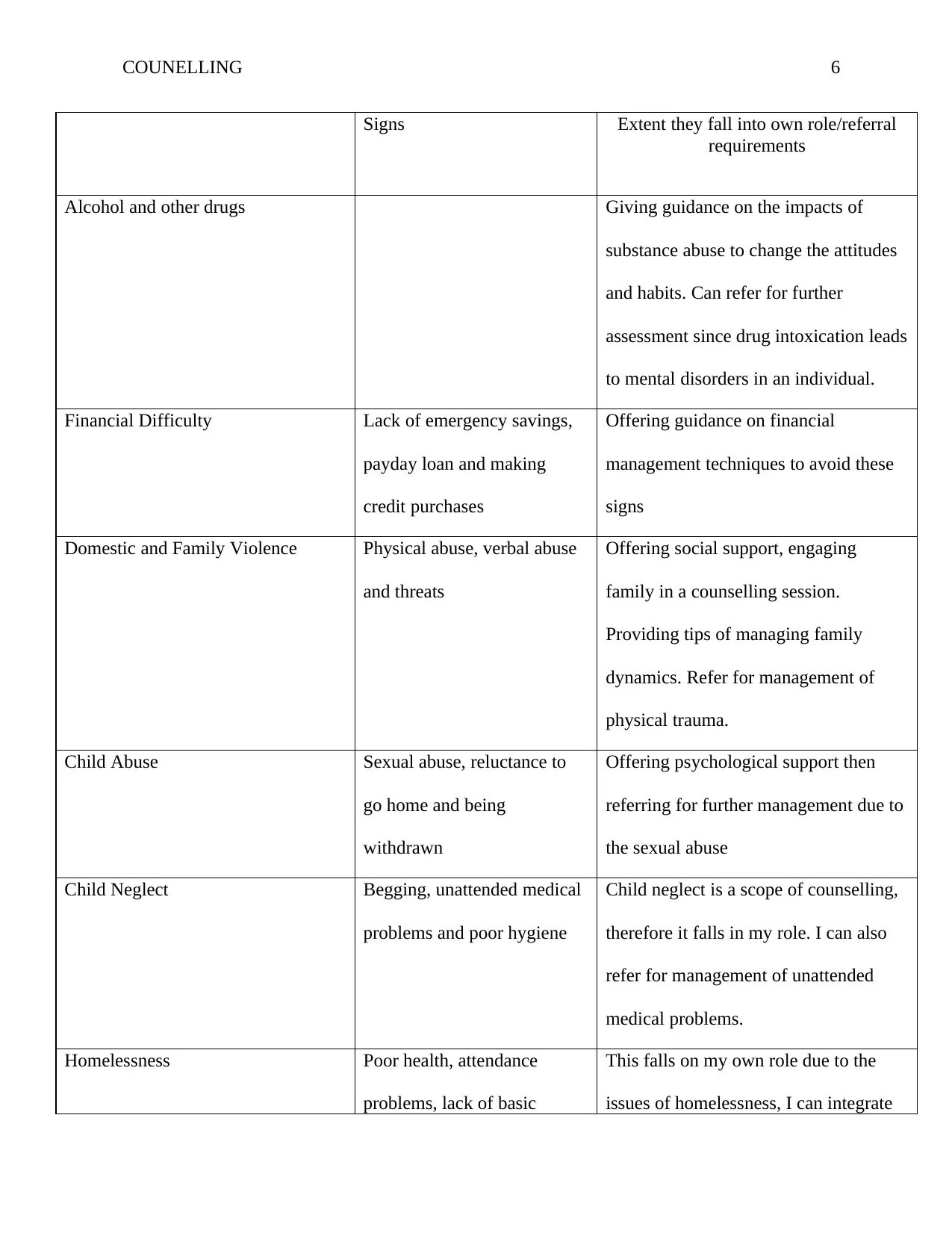
Signs Extent they fall into own role/referral
requirements
Alcohol and other drugs Giving guidance on the impacts of
substance abuse to change the attitudes
and habits. Can refer for further
assessment since drug intoxication leads
to mental disorders in an individual.
Financial Difficulty Lack of emergency savings,
payday loan and making
credit purchases
Offering guidance on financial
management techniques to avoid these
signs
Domestic and Family Violence Physical abuse, verbal abuse
and threats
Offering social support, engaging
family in a counselling session.
Providing tips of managing family
dynamics. Refer for management of
physical trauma.
Child Abuse Sexual abuse, reluctance to
go home and being
withdrawn
Offering psychological support then
referring for further management due to
the sexual abuse
Child Neglect Begging, unattended medical
problems and poor hygiene
Child neglect is a scope of counselling,
therefore it falls in my role. I can also
refer for management of unattended
medical problems.
Homelessness Poor health, attendance
problems, lack of basic
This falls on my own role due to the
issues of homelessness, I can integrate
Signs Extent they fall into own role/referral
requirements
Alcohol and other drugs Giving guidance on the impacts of
substance abuse to change the attitudes
and habits. Can refer for further
assessment since drug intoxication leads
to mental disorders in an individual.
Financial Difficulty Lack of emergency savings,
payday loan and making
credit purchases
Offering guidance on financial
management techniques to avoid these
signs
Domestic and Family Violence Physical abuse, verbal abuse
and threats
Offering social support, engaging
family in a counselling session.
Providing tips of managing family
dynamics. Refer for management of
physical trauma.
Child Abuse Sexual abuse, reluctance to
go home and being
withdrawn
Offering psychological support then
referring for further management due to
the sexual abuse
Child Neglect Begging, unattended medical
problems and poor hygiene
Child neglect is a scope of counselling,
therefore it falls in my role. I can also
refer for management of unattended
medical problems.
Homelessness Poor health, attendance
problems, lack of basic
This falls on my own role due to the
issues of homelessness, I can integrate
⊘ This is a preview!⊘
Do you want full access?
Subscribe today to unlock all pages.
Trusted by 1+ million students worldwide
COUNELLING 7
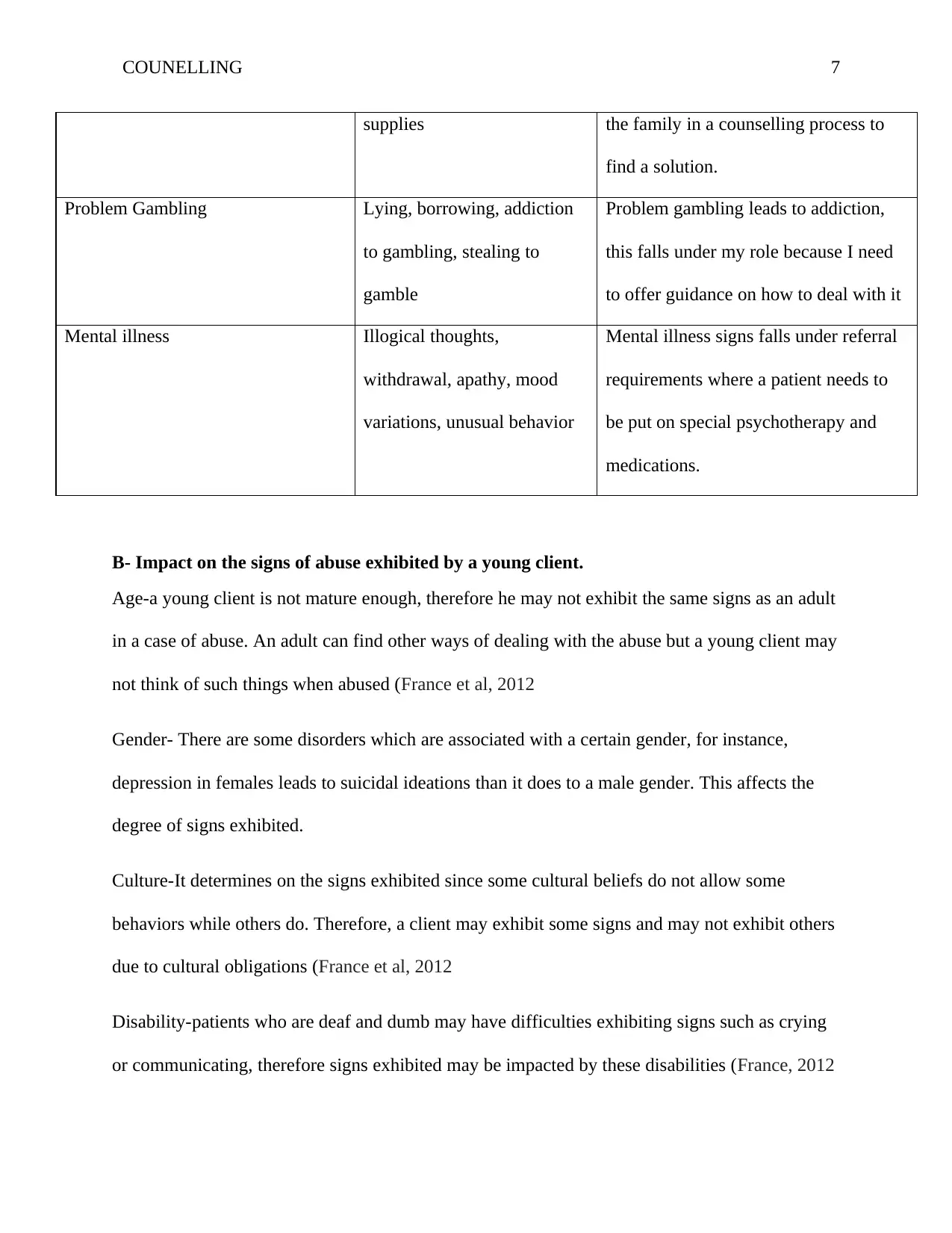
supplies the family in a counselling process to
find a solution.
Problem Gambling Lying, borrowing, addiction
to gambling, stealing to
gamble
Problem gambling leads to addiction,
this falls under my role because I need
to offer guidance on how to deal with it
Mental illness Illogical thoughts,
withdrawal, apathy, mood
variations, unusual behavior
Mental illness signs falls under referral
requirements where a patient needs to
be put on special psychotherapy and
medications.
B- Impact on the signs of abuse exhibited by a young client.
Age-a young client is not mature enough, therefore he may not exhibit the same signs as an adult
in a case of abuse. An adult can find other ways of dealing with the abuse but a young client may
not think of such things when abused (France et al, 2012
Gender- There are some disorders which are associated with a certain gender, for instance,
depression in females leads to suicidal ideations than it does to a male gender. This affects the
degree of signs exhibited.
Culture-It determines on the signs exhibited since some cultural beliefs do not allow some
behaviors while others do. Therefore, a client may exhibit some signs and may not exhibit others
due to cultural obligations (France et al, 2012
Disability-patients who are deaf and dumb may have difficulties exhibiting signs such as crying
or communicating, therefore signs exhibited may be impacted by these disabilities (France, 2012
supplies the family in a counselling process to
find a solution.
Problem Gambling Lying, borrowing, addiction
to gambling, stealing to
gamble
Problem gambling leads to addiction,
this falls under my role because I need
to offer guidance on how to deal with it
Mental illness Illogical thoughts,
withdrawal, apathy, mood
variations, unusual behavior
Mental illness signs falls under referral
requirements where a patient needs to
be put on special psychotherapy and
medications.
B- Impact on the signs of abuse exhibited by a young client.
Age-a young client is not mature enough, therefore he may not exhibit the same signs as an adult
in a case of abuse. An adult can find other ways of dealing with the abuse but a young client may
not think of such things when abused (France et al, 2012
Gender- There are some disorders which are associated with a certain gender, for instance,
depression in females leads to suicidal ideations than it does to a male gender. This affects the
degree of signs exhibited.
Culture-It determines on the signs exhibited since some cultural beliefs do not allow some
behaviors while others do. Therefore, a client may exhibit some signs and may not exhibit others
due to cultural obligations (France et al, 2012
Disability-patients who are deaf and dumb may have difficulties exhibiting signs such as crying
or communicating, therefore signs exhibited may be impacted by these disabilities (France, 2012
Paraphrase This Document
Need a fresh take? Get an instant paraphrase of this document with our AI Paraphraser
COUNELLING 8
Sexuality- this affects the signs exhibited since some clients opt for the same sex while others go
for the opposite sex. Like in homosexuality, the client is attracted to people of the same sex
(France et al, 2012
C-Impact of risks in Valerie’ Case: These risks may impact the life of Valerie in a negative
manner. Unattended health problem shows child neglect. Additionally, the family shows less
concern for her health problem. This may psychologically impact the client through depression,
dissociation, low self-esteem and academic challenges. Physically, she may be affected by the
complicated of diabetes if it goes untreated to elevated sugar levels since she has been having
challenges to get insulin medications.
D- Considerations that impact my decisions and actions in relation to this case
1. Age of the client since she is a child who has not yet attained 18 years hence cannot make
decisions for herself.
2. Social support of the client, the family seems not to cooperate with the school in the care
of the child
3. Gender, she is a female gender, so I have to make a decision or take an action that fits a
female gender.
E- CareShore policies and procedures I would access to assist me in making decisions
regarding this case?
1. Federal laws that deal with child welfare realm
2. Policies on provision of community services with respect and dignity irrespective of age
of the client.
Sexuality- this affects the signs exhibited since some clients opt for the same sex while others go
for the opposite sex. Like in homosexuality, the client is attracted to people of the same sex
(France et al, 2012
C-Impact of risks in Valerie’ Case: These risks may impact the life of Valerie in a negative
manner. Unattended health problem shows child neglect. Additionally, the family shows less
concern for her health problem. This may psychologically impact the client through depression,
dissociation, low self-esteem and academic challenges. Physically, she may be affected by the
complicated of diabetes if it goes untreated to elevated sugar levels since she has been having
challenges to get insulin medications.
D- Considerations that impact my decisions and actions in relation to this case
1. Age of the client since she is a child who has not yet attained 18 years hence cannot make
decisions for herself.
2. Social support of the client, the family seems not to cooperate with the school in the care
of the child
3. Gender, she is a female gender, so I have to make a decision or take an action that fits a
female gender.
E- CareShore policies and procedures I would access to assist me in making decisions
regarding this case?
1. Federal laws that deal with child welfare realm
2. Policies on provision of community services with respect and dignity irrespective of age
of the client.
COUNELLING 9
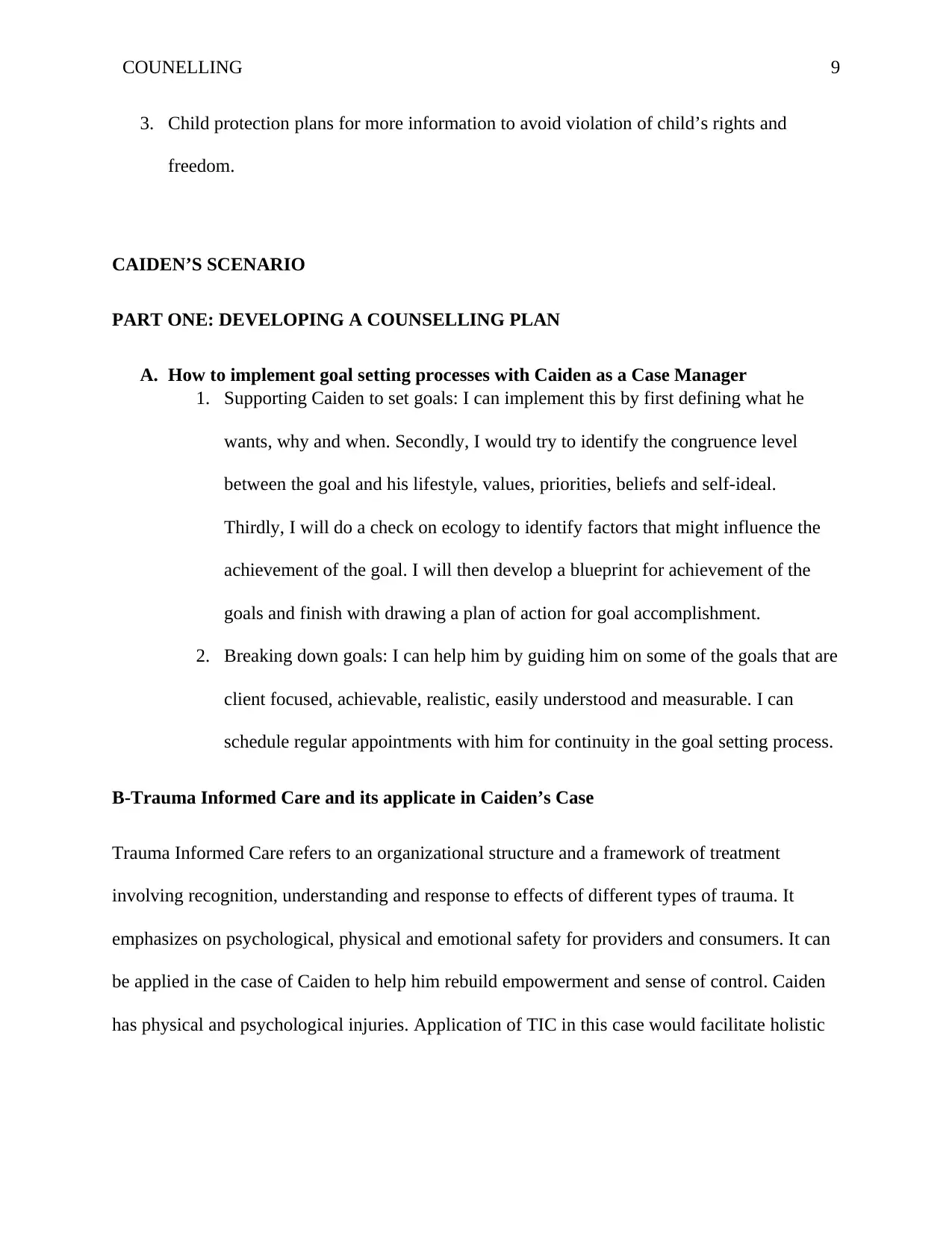
3. Child protection plans for more information to avoid violation of child’s rights and
freedom.
CAIDEN’S SCENARIO
PART ONE: DEVELOPING A COUNSELLING PLAN
A. How to implement goal setting processes with Caiden as a Case Manager
1. Supporting Caiden to set goals: I can implement this by first defining what he
wants, why and when. Secondly, I would try to identify the congruence level
between the goal and his lifestyle, values, priorities, beliefs and self-ideal.
Thirdly, I will do a check on ecology to identify factors that might influence the
achievement of the goal. I will then develop a blueprint for achievement of the
goals and finish with drawing a plan of action for goal accomplishment.
2. Breaking down goals: I can help him by guiding him on some of the goals that are
client focused, achievable, realistic, easily understood and measurable. I can
schedule regular appointments with him for continuity in the goal setting process.
B-Trauma Informed Care and its applicate in Caiden’s Case
Trauma Informed Care refers to an organizational structure and a framework of treatment
involving recognition, understanding and response to effects of different types of trauma. It
emphasizes on psychological, physical and emotional safety for providers and consumers. It can
be applied in the case of Caiden to help him rebuild empowerment and sense of control. Caiden
has physical and psychological injuries. Application of TIC in this case would facilitate holistic
3. Child protection plans for more information to avoid violation of child’s rights and
freedom.
CAIDEN’S SCENARIO
PART ONE: DEVELOPING A COUNSELLING PLAN
A. How to implement goal setting processes with Caiden as a Case Manager
1. Supporting Caiden to set goals: I can implement this by first defining what he
wants, why and when. Secondly, I would try to identify the congruence level
between the goal and his lifestyle, values, priorities, beliefs and self-ideal.
Thirdly, I will do a check on ecology to identify factors that might influence the
achievement of the goal. I will then develop a blueprint for achievement of the
goals and finish with drawing a plan of action for goal accomplishment.
2. Breaking down goals: I can help him by guiding him on some of the goals that are
client focused, achievable, realistic, easily understood and measurable. I can
schedule regular appointments with him for continuity in the goal setting process.
B-Trauma Informed Care and its applicate in Caiden’s Case
Trauma Informed Care refers to an organizational structure and a framework of treatment
involving recognition, understanding and response to effects of different types of trauma. It
emphasizes on psychological, physical and emotional safety for providers and consumers. It can
be applied in the case of Caiden to help him rebuild empowerment and sense of control. Caiden
has physical and psychological injuries. Application of TIC in this case would facilitate holistic
⊘ This is a preview!⊘
Do you want full access?
Subscribe today to unlock all pages.
Trusted by 1+ million students worldwide
COUNELLING 10
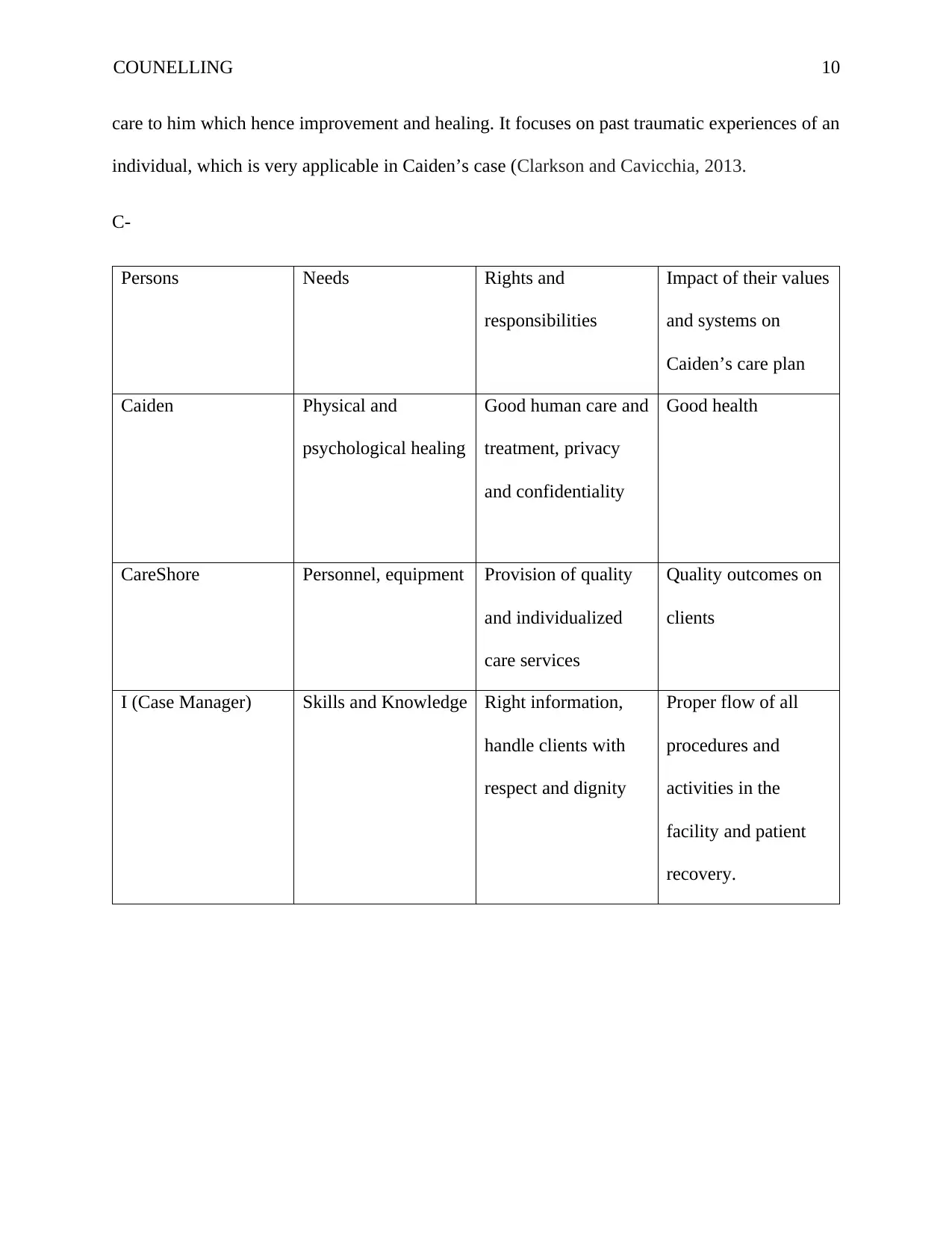
care to him which hence improvement and healing. It focuses on past traumatic experiences of an
individual, which is very applicable in Caiden’s case (Clarkson and Cavicchia, 2013.
C-
Persons Needs Rights and
responsibilities
Impact of their values
and systems on
Caiden’s care plan
Caiden Physical and
psychological healing
Good human care and
treatment, privacy
and confidentiality
Good health
CareShore Personnel, equipment Provision of quality
and individualized
care services
Quality outcomes on
clients
I (Case Manager) Skills and Knowledge Right information,
handle clients with
respect and dignity
Proper flow of all
procedures and
activities in the
facility and patient
recovery.
care to him which hence improvement and healing. It focuses on past traumatic experiences of an
individual, which is very applicable in Caiden’s case (Clarkson and Cavicchia, 2013.
C-
Persons Needs Rights and
responsibilities
Impact of their values
and systems on
Caiden’s care plan
Caiden Physical and
psychological healing
Good human care and
treatment, privacy
and confidentiality
Good health
CareShore Personnel, equipment Provision of quality
and individualized
care services
Quality outcomes on
clients
I (Case Manager) Skills and Knowledge Right information,
handle clients with
respect and dignity
Proper flow of all
procedures and
activities in the
facility and patient
recovery.
Paraphrase This Document
Need a fresh take? Get an instant paraphrase of this document with our AI Paraphraser
COUNELLING 11
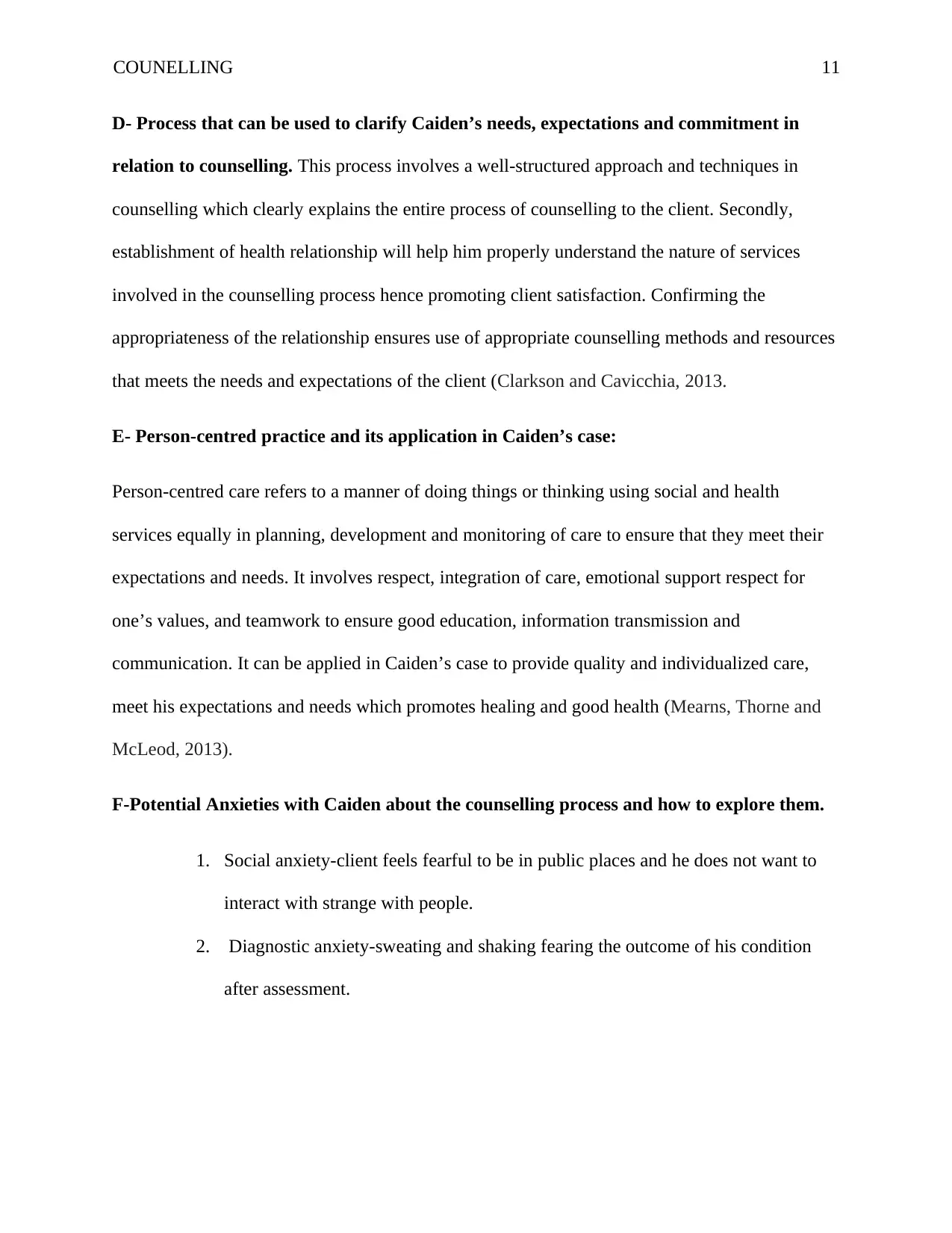
D- Process that can be used to clarify Caiden’s needs, expectations and commitment in
relation to counselling. This process involves a well-structured approach and techniques in
counselling which clearly explains the entire process of counselling to the client. Secondly,
establishment of health relationship will help him properly understand the nature of services
involved in the counselling process hence promoting client satisfaction. Confirming the
appropriateness of the relationship ensures use of appropriate counselling methods and resources
that meets the needs and expectations of the client (Clarkson and Cavicchia, 2013.
E- Person-centred practice and its application in Caiden’s case:
Person-centred care refers to a manner of doing things or thinking using social and health
services equally in planning, development and monitoring of care to ensure that they meet their
expectations and needs. It involves respect, integration of care, emotional support respect for
one’s values, and teamwork to ensure good education, information transmission and
communication. It can be applied in Caiden’s case to provide quality and individualized care,
meet his expectations and needs which promotes healing and good health (Mearns, Thorne and
McLeod, 2013).
F-Potential Anxieties with Caiden about the counselling process and how to explore them.
1. Social anxiety-client feels fearful to be in public places and he does not want to
interact with strange with people.
2. Diagnostic anxiety-sweating and shaking fearing the outcome of his condition
after assessment.
D- Process that can be used to clarify Caiden’s needs, expectations and commitment in
relation to counselling. This process involves a well-structured approach and techniques in
counselling which clearly explains the entire process of counselling to the client. Secondly,
establishment of health relationship will help him properly understand the nature of services
involved in the counselling process hence promoting client satisfaction. Confirming the
appropriateness of the relationship ensures use of appropriate counselling methods and resources
that meets the needs and expectations of the client (Clarkson and Cavicchia, 2013.
E- Person-centred practice and its application in Caiden’s case:
Person-centred care refers to a manner of doing things or thinking using social and health
services equally in planning, development and monitoring of care to ensure that they meet their
expectations and needs. It involves respect, integration of care, emotional support respect for
one’s values, and teamwork to ensure good education, information transmission and
communication. It can be applied in Caiden’s case to provide quality and individualized care,
meet his expectations and needs which promotes healing and good health (Mearns, Thorne and
McLeod, 2013).
F-Potential Anxieties with Caiden about the counselling process and how to explore them.
1. Social anxiety-client feels fearful to be in public places and he does not want to
interact with strange with people.
2. Diagnostic anxiety-sweating and shaking fearing the outcome of his condition
after assessment.
COUNELLING 12
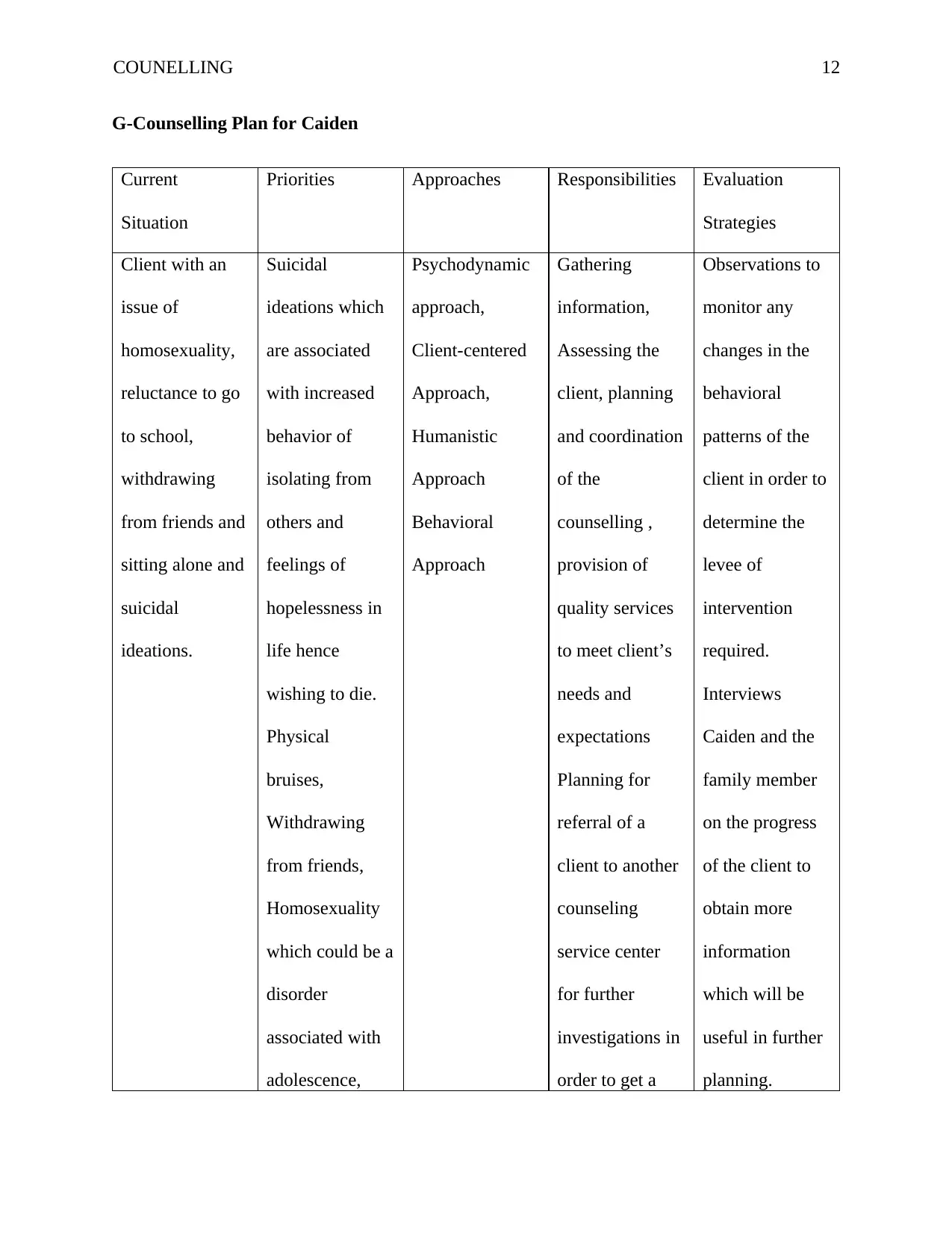
G-Counselling Plan for Caiden
Current
Situation
Priorities Approaches Responsibilities Evaluation
Strategies
Client with an
issue of
homosexuality,
reluctance to go
to school,
withdrawing
from friends and
sitting alone and
suicidal
ideations.
Suicidal
ideations which
are associated
with increased
behavior of
isolating from
others and
feelings of
hopelessness in
life hence
wishing to die.
Physical
bruises,
Withdrawing
from friends,
Homosexuality
which could be a
disorder
associated with
adolescence,
Psychodynamic
approach,
Client-centered
Approach,
Humanistic
Approach
Behavioral
Approach
Gathering
information,
Assessing the
client, planning
and coordination
of the
counselling ,
provision of
quality services
to meet client’s
needs and
expectations
Planning for
referral of a
client to another
counseling
service center
for further
investigations in
order to get a
Observations to
monitor any
changes in the
behavioral
patterns of the
client in order to
determine the
levee of
intervention
required.
Interviews
Caiden and the
family member
on the progress
of the client to
obtain more
information
which will be
useful in further
planning.
G-Counselling Plan for Caiden
Current
Situation
Priorities Approaches Responsibilities Evaluation
Strategies
Client with an
issue of
homosexuality,
reluctance to go
to school,
withdrawing
from friends and
sitting alone and
suicidal
ideations.
Suicidal
ideations which
are associated
with increased
behavior of
isolating from
others and
feelings of
hopelessness in
life hence
wishing to die.
Physical
bruises,
Withdrawing
from friends,
Homosexuality
which could be a
disorder
associated with
adolescence,
Psychodynamic
approach,
Client-centered
Approach,
Humanistic
Approach
Behavioral
Approach
Gathering
information,
Assessing the
client, planning
and coordination
of the
counselling ,
provision of
quality services
to meet client’s
needs and
expectations
Planning for
referral of a
client to another
counseling
service center
for further
investigations in
order to get a
Observations to
monitor any
changes in the
behavioral
patterns of the
client in order to
determine the
levee of
intervention
required.
Interviews
Caiden and the
family member
on the progress
of the client to
obtain more
information
which will be
useful in further
planning.
⊘ This is a preview!⊘
Do you want full access?
Subscribe today to unlock all pages.
Trusted by 1+ million students worldwide

1 out of 20


Related Documents


Your All-in-One AI-Powered Toolkit for Academic Success.
+13062052269
info@desklib.com
Available 24*7 on WhatsApp / Email
![[object Object]](/_next/static/media/star-bottom.7253800d.svg)
Unlock your academic potential
Copyright © 2020–2026 A2Z Services. All Rights Reserved. Developed and managed by ZUCOL.