Counseling 10: Classroom Behavior Problems and Academic Performance
VerifiedAdded on 2021/06/16
|12
|2974
|73
Essay
AI Summary
This essay explores the application of counseling and psychotherapy theories to address classroom behavior problems and improve student academic performance. It begins by defining counseling and psychotherapy, then identifies several behavioral issues exhibited by a student, including sensory processing disorder, aggression, inappropriate language, inattentiveness, and dishonesty. The essay then applies two key theories: Adlerian and psychoanalytic. Adlerian theory is used to address issues like inappropriate language and social interactions, focusing on the importance of social interest and belonging. The psychoanalytic theory is used to understand the root causes of the student's behavior, linking it to unresolved childhood issues and unconscious motivations. The essay highlights the counselor's role in interpreting the student's experiences, dreams, and transference to develop a more supportive relationship with peers and teachers. The essay provides insights into how these theories can be used to guide and support students in overcoming challenges and excelling academically.
Running head: COUNSELING 1
Counseling in Professional Contexts- Helping Groups and Individuals
Student Name
Institution Affiliation
Counseling in Professional Contexts- Helping Groups and Individuals
Student Name
Institution Affiliation

Paraphrase This Document
Need a fresh take? Get an instant paraphrase of this document with our AI Paraphraser
COUNSELING 2
Introduction
The terms Counseling and Psychotherapy are often used interchangeably. Also referred to
as talk therapy, counseling involves a series of conversations between the counselor and client
(Corey, 2017). Like counseling, psychotherapy involves a series of meeting between the
therapist and the client to understand an individual’s problems and recurrent feelings about an
aspect. Counseling and psychotherapy focus on specific problems that affect a group of people in
an attempt to resolve them (Capuzzi & Stauffer, 2016). The theory and practice of counseling
and psychotherapy concepts assist counselors in providing these students with the right support,
guidance, and advice on how to cope with the challenges and excel academically despite the
challenges (Truax & Carkhuff, 2008). As a counselor, I would like to help students excel
academically by offering them purposeful guidance and support to cope with their personal
experience problems while studying. The essay will specifically apply two counseling and
psychotherapy theories namely psychoanalytic theory and Adlerian theory in resolving
classroom behavior problems by children in order to boost their academic performance and
excellence.
Classroom behavior problems
Classroom behavior problems by students at school interfere with their lesson
concentration and disturb other students in the class. Behavior problems at school usually
overwhelm teachers, specifically novices, and some researchers consider these problems as the
most difficult experience that teachers face in their every day’s work. Students who exhibit
classroom behavior problems invariably need extra attention, which imposes a strain on teachers
and slows the pace at which lessons are administered and completed (Collins & Arthur, 2010).
Introduction
The terms Counseling and Psychotherapy are often used interchangeably. Also referred to
as talk therapy, counseling involves a series of conversations between the counselor and client
(Corey, 2017). Like counseling, psychotherapy involves a series of meeting between the
therapist and the client to understand an individual’s problems and recurrent feelings about an
aspect. Counseling and psychotherapy focus on specific problems that affect a group of people in
an attempt to resolve them (Capuzzi & Stauffer, 2016). The theory and practice of counseling
and psychotherapy concepts assist counselors in providing these students with the right support,
guidance, and advice on how to cope with the challenges and excel academically despite the
challenges (Truax & Carkhuff, 2008). As a counselor, I would like to help students excel
academically by offering them purposeful guidance and support to cope with their personal
experience problems while studying. The essay will specifically apply two counseling and
psychotherapy theories namely psychoanalytic theory and Adlerian theory in resolving
classroom behavior problems by children in order to boost their academic performance and
excellence.
Classroom behavior problems
Classroom behavior problems by students at school interfere with their lesson
concentration and disturb other students in the class. Behavior problems at school usually
overwhelm teachers, specifically novices, and some researchers consider these problems as the
most difficult experience that teachers face in their every day’s work. Students who exhibit
classroom behavior problems invariably need extra attention, which imposes a strain on teachers
and slows the pace at which lessons are administered and completed (Collins & Arthur, 2010).
COUNSELING 3
As a counselor, I met a student with different classroom behavior problems which I will explain
below before discussing how I used counseling and psychotherapy theories in assisting the
student (Corey, 2017). I carried a survey in a school from the teachers and classmates to
understand the behavior of a particular student before I advise him. The student's classroom
behavior problems include:
Sensory processing disorder
According to the student's teachers, the student had sensory processing disorder which
disrupted his ability to grasp even the simple concepts taught at the normal pace used while
teaching the other students. The student always walks around and talks at the wrong time while
teachers are in the classroom. The student had special needs and always diverted teachers’
attention from the set class program and syllabus. My understanding is that students with this
problem find it unfriendly to organize and make sense of the sensory information received by
their brains in the classroom. Even normal activities confuse and overwhelm them. Additionally,
such a student’s experience learning problems and prefer playing alone during recess.
Aggressive students
Aggressive student behavior poses a serious problem that is disruptive to a supportive
and safe learning environment in the classroom setting. The student has physical aggression
which makes him violent and easily tempted to hurt even young pupils. The aggression of the
student in the classroom disrupts all other coursework activities and adversely affects teachers
and the other classmates. The after-effects of physical fights by the student remains a sensitive
issue to the other students and teachers, and this is why I am called as a counselor to offer to
counsel to the student.
As a counselor, I met a student with different classroom behavior problems which I will explain
below before discussing how I used counseling and psychotherapy theories in assisting the
student (Corey, 2017). I carried a survey in a school from the teachers and classmates to
understand the behavior of a particular student before I advise him. The student's classroom
behavior problems include:
Sensory processing disorder
According to the student's teachers, the student had sensory processing disorder which
disrupted his ability to grasp even the simple concepts taught at the normal pace used while
teaching the other students. The student always walks around and talks at the wrong time while
teachers are in the classroom. The student had special needs and always diverted teachers’
attention from the set class program and syllabus. My understanding is that students with this
problem find it unfriendly to organize and make sense of the sensory information received by
their brains in the classroom. Even normal activities confuse and overwhelm them. Additionally,
such a student’s experience learning problems and prefer playing alone during recess.
Aggressive students
Aggressive student behavior poses a serious problem that is disruptive to a supportive
and safe learning environment in the classroom setting. The student has physical aggression
which makes him violent and easily tempted to hurt even young pupils. The aggression of the
student in the classroom disrupts all other coursework activities and adversely affects teachers
and the other classmates. The after-effects of physical fights by the student remains a sensitive
issue to the other students and teachers, and this is why I am called as a counselor to offer to
counsel to the student.
⊘ This is a preview!⊘
Do you want full access?
Subscribe today to unlock all pages.

Trusted by 1+ million students worldwide
COUNSELING 4
Inappropriate language
Inappropriate language is unexpected in a classroom setting. However, the student has been
using abusive language while addressing his classmates and teachers something which offends
them highly. The student uses foul language in impressing his classmates and seeking cheap
attention from the teachers. However, the management of the school does not allow this to
happen. Also, when angered; the student uses inappropriate words to express his displeasure and
frustration to the teachers and his classmates. In cases, the teacher says have been trying to
dissuade the student from swearing either in the classroom or on the playground since this
depicts immorality and danger to the rest of the students (Thomas et al., 2011). This is where the
role of a counselor is required. Abusing others with no fear creates anxiety in the classroom to an
extent that other students feel uncomfortable studying with him in the same class.
Inattentive students
Unless appropriate approaches are taken, inattentive students fall behind their classmates
and terribly fail in the exams. In certain cases, the student is believed to suffer from attention
deficit hyperactivity disorder which makes him face difficulties in controlling his overall
behavior (Sharf, 2015). Teachers and his parents claim that the student has a lot of difficulties
when organizing home and school work for he cannot sustain attention. When a new topic is
being introduced, the student struggles to comprehend and even the simplest assignments
overwhelm him. This student requires extra attention and advice from an external counselor, and
this is the reason why I am conducted. There is a high chance that once I counsel him, he will be
able to take school lessons important and employ all keenness required in order to grasp all
concepts and stop being bored and frustrated by the coursework.
Inappropriate language
Inappropriate language is unexpected in a classroom setting. However, the student has been
using abusive language while addressing his classmates and teachers something which offends
them highly. The student uses foul language in impressing his classmates and seeking cheap
attention from the teachers. However, the management of the school does not allow this to
happen. Also, when angered; the student uses inappropriate words to express his displeasure and
frustration to the teachers and his classmates. In cases, the teacher says have been trying to
dissuade the student from swearing either in the classroom or on the playground since this
depicts immorality and danger to the rest of the students (Thomas et al., 2011). This is where the
role of a counselor is required. Abusing others with no fear creates anxiety in the classroom to an
extent that other students feel uncomfortable studying with him in the same class.
Inattentive students
Unless appropriate approaches are taken, inattentive students fall behind their classmates
and terribly fail in the exams. In certain cases, the student is believed to suffer from attention
deficit hyperactivity disorder which makes him face difficulties in controlling his overall
behavior (Sharf, 2015). Teachers and his parents claim that the student has a lot of difficulties
when organizing home and school work for he cannot sustain attention. When a new topic is
being introduced, the student struggles to comprehend and even the simplest assignments
overwhelm him. This student requires extra attention and advice from an external counselor, and
this is the reason why I am conducted. There is a high chance that once I counsel him, he will be
able to take school lessons important and employ all keenness required in order to grasp all
concepts and stop being bored and frustrated by the coursework.
Paraphrase This Document
Need a fresh take? Get an instant paraphrase of this document with our AI Paraphraser
COUNSELING 5
Dishonesty
Dishonesty by students has increased in most schools. Students want to lie to teachers
and parents in order to entice them for nothing. According to the teachers, this student always
tells lies when asked why he is underperforming. Investigations show that he receives the best
parental care and that his background cannot have affected his ability to excel in his studies. The
student stretches the truth about on matters academics making it too hard for the teachers to
assist him (Manning & Bucher, 2013). The other students say that he comes and reports to class
late on regular basis. Once questioned by the teachers, he claims that he is never late to class.
The guy has been rude and always not ready to get assisted. Due to this teachers consider it
important to try out the services of an external counselor at least to counsel, guide, and advice
the student to change. It is possible for the student to change and improve from his negative to
positive classroom behavior if he is talked to privately by a counselor, a role which I believe will
be a success when administered by me.
Application of Counselling and Psychotherapy Theories in Solving this Problem
In my counseling prospects to the student, I will refer to Sigmund Freud’s psychoanalytic
theory together with Alfred Adler’s Adlerian theories of counseling and psychotherapy. Dealing
with a student with the above-explained classroom behavior problems require a proper
integration of counseling skills with the counseling and psychotherapy theories (Gibson,
Dollarhide, & Moss, 2010). The classroom behavior problems experienced and exhibited by the
student have been provided to me by the teachers, parents and his classmates as explained above.
As a counselor, I will deal with the student privately, not publicly to ensure that I transform him
into a responsible student in the school.
Dishonesty
Dishonesty by students has increased in most schools. Students want to lie to teachers
and parents in order to entice them for nothing. According to the teachers, this student always
tells lies when asked why he is underperforming. Investigations show that he receives the best
parental care and that his background cannot have affected his ability to excel in his studies. The
student stretches the truth about on matters academics making it too hard for the teachers to
assist him (Manning & Bucher, 2013). The other students say that he comes and reports to class
late on regular basis. Once questioned by the teachers, he claims that he is never late to class.
The guy has been rude and always not ready to get assisted. Due to this teachers consider it
important to try out the services of an external counselor at least to counsel, guide, and advice
the student to change. It is possible for the student to change and improve from his negative to
positive classroom behavior if he is talked to privately by a counselor, a role which I believe will
be a success when administered by me.
Application of Counselling and Psychotherapy Theories in Solving this Problem
In my counseling prospects to the student, I will refer to Sigmund Freud’s psychoanalytic
theory together with Alfred Adler’s Adlerian theories of counseling and psychotherapy. Dealing
with a student with the above-explained classroom behavior problems require a proper
integration of counseling skills with the counseling and psychotherapy theories (Gibson,
Dollarhide, & Moss, 2010). The classroom behavior problems experienced and exhibited by the
student have been provided to me by the teachers, parents and his classmates as explained above.
As a counselor, I will deal with the student privately, not publicly to ensure that I transform him
into a responsible student in the school.
COUNSELING 6
Adlerian Theory
Adlerian is a theory of counseling and psychotherapy whose application enables
counselors to solve irresponsible behavior exhibited by students in the classroom. According to
the theory, an educational setting can be viewed as teleological where some students feel
superior than others and consider them inferior (Adler, 1982). In this instance, the teachers are
dedicated to teaching the student but he is focused on dragging the coursework behind. I will
refer to Adlerian theory segment of personality when counseling the student on the right ways to
behave while in the classroom. This theory teaches us on the importance of being motivated by
social interests, loving to be viewed as unified beings, and the essence of belongingness to a
group. In addressing the problem of inappropriate language to other students, I will use Adlerian
concepts about life tasks and guide the student on the importance of friendship, love, and
understanding the individual self.
According to the Adlerian theory, successful adaptation to life depends on one's interest
to interact with the others (Corey, 2017). From what the classmates told me, the student is
aggressive in how he behaves in the classroom and also outside. He plays alone- this is funny. I
would advise the student on the importance of diversity and teamwork during studies. Goal
striving directly relates to a student's success in relating to the rest of students. As per Adlerian,
maybe the student started this behavior in his early educational ages where he formed fictional
concepts about the right lifestyles (Sharf, 2015). I would explain to the student that fictional
goals are unrealistic and cannot take him anywhere. In Adlerian’s theory of personality, there are
different types of people in any environment. In this context, I understand that being socially
useful, victimized, avoiding, ruling and a controlling student of his emotions may be difficult.
Every having his styles of life whose overall patterns affect their thinking, feelings, and
Adlerian Theory
Adlerian is a theory of counseling and psychotherapy whose application enables
counselors to solve irresponsible behavior exhibited by students in the classroom. According to
the theory, an educational setting can be viewed as teleological where some students feel
superior than others and consider them inferior (Adler, 1982). In this instance, the teachers are
dedicated to teaching the student but he is focused on dragging the coursework behind. I will
refer to Adlerian theory segment of personality when counseling the student on the right ways to
behave while in the classroom. This theory teaches us on the importance of being motivated by
social interests, loving to be viewed as unified beings, and the essence of belongingness to a
group. In addressing the problem of inappropriate language to other students, I will use Adlerian
concepts about life tasks and guide the student on the importance of friendship, love, and
understanding the individual self.
According to the Adlerian theory, successful adaptation to life depends on one's interest
to interact with the others (Corey, 2017). From what the classmates told me, the student is
aggressive in how he behaves in the classroom and also outside. He plays alone- this is funny. I
would advise the student on the importance of diversity and teamwork during studies. Goal
striving directly relates to a student's success in relating to the rest of students. As per Adlerian,
maybe the student started this behavior in his early educational ages where he formed fictional
concepts about the right lifestyles (Sharf, 2015). I would explain to the student that fictional
goals are unrealistic and cannot take him anywhere. In Adlerian’s theory of personality, there are
different types of people in any environment. In this context, I understand that being socially
useful, victimized, avoiding, ruling and a controlling student of his emotions may be difficult.
Every having his styles of life whose overall patterns affect their thinking, feelings, and
⊘ This is a preview!⊘
Do you want full access?
Subscribe today to unlock all pages.
Trusted by 1+ million students worldwide
COUNSELING 7
behavior. Therefore, using this concept in counseling student will be effective in encouraging
him to conform to the new environment and culture of the school for him to excel.
In Adlerian personality behavior, perceptions guide one's behavior. Most people engage
in abnormal behavior in an attempt to protect their opinions. In this context, the student has
become self-centered other than being other-centered and is believed to have no consciousness
on his behavior. From the analysis, the student has not been honest with students when they want
to support him. He always tells lies to protect his behavior. In Adlerian through, I will apply the
concepts of safeguarding, family constellation, and inferior complex in counseling him to
advance his negative behavior and embrace positive behavior (Hutchings et al., 2013). Through
this, I will be able to mediate the genetic and sensory processing disorders of the student from his
feedback hence use it in advising him appropriately.
Psychoanalytic Theory
In Sigmund Freud’s psychoanalytic theory, human motivation is guided by the drive to
seek pleasure (Freud, 1953). The basic tenets of Sigmund’s theory are defense mechanisms,
stages of development, and Id, Ego, and Superego. Personally, I am a practitioner of
psychoanalysis having undergone long training processes through which I am able to interpret
one’s intrapsychic conflicts and other self-defeating patterns that students face in their internal
struggles (Freud, 1953). The problems that student is exhibiting in the classroom are associated
with is past; this creates the current classroom behavior that stems from unresolved issues that
occurred in his early childhood. The sensory processing disorder exhibited by the student is
associated with unresolved issues that happened in his childhood.
behavior. Therefore, using this concept in counseling student will be effective in encouraging
him to conform to the new environment and culture of the school for him to excel.
In Adlerian personality behavior, perceptions guide one's behavior. Most people engage
in abnormal behavior in an attempt to protect their opinions. In this context, the student has
become self-centered other than being other-centered and is believed to have no consciousness
on his behavior. From the analysis, the student has not been honest with students when they want
to support him. He always tells lies to protect his behavior. In Adlerian through, I will apply the
concepts of safeguarding, family constellation, and inferior complex in counseling him to
advance his negative behavior and embrace positive behavior (Hutchings et al., 2013). Through
this, I will be able to mediate the genetic and sensory processing disorders of the student from his
feedback hence use it in advising him appropriately.
Psychoanalytic Theory
In Sigmund Freud’s psychoanalytic theory, human motivation is guided by the drive to
seek pleasure (Freud, 1953). The basic tenets of Sigmund’s theory are defense mechanisms,
stages of development, and Id, Ego, and Superego. Personally, I am a practitioner of
psychoanalysis having undergone long training processes through which I am able to interpret
one’s intrapsychic conflicts and other self-defeating patterns that students face in their internal
struggles (Freud, 1953). The problems that student is exhibiting in the classroom are associated
with is past; this creates the current classroom behavior that stems from unresolved issues that
occurred in his early childhood. The sensory processing disorder exhibited by the student is
associated with unresolved issues that happened in his childhood.
Paraphrase This Document
Need a fresh take? Get an instant paraphrase of this document with our AI Paraphraser
COUNSELING 8
Emotionally, the student has been ever disturbed. According to the psychoanalytic theory,
irresponsible emotional experience makes students behave irresponsibly in the classroom. The
student is less concerned about listening to the teachers and also unwilling to do assignments
(Garner & Waajid, 2012). He has a bad ego towards the other students and always wants to
fulfill his self-interests. As a counselor and a therapist, I will alter the students’ irresponsible
self-perceptions and behaviors in a way that he can become emotionally responsible in his
academics as well as helping the other students. By listening to the student talk, I will be able to
interpret, dreams analyze, and transference the root cause of his unconscious behavior while in
the classroom (EDUC7008, 2018). Eventually, I will make my projections as a therapist and
advise him appropriately.
The psychoanalytic theory has further been categorized into two contemporary theories;
self-psychology and object relations theories whose understanding helps me as a counselor in
advising my clients. In reference to the object relations theory, the student could be inattentive in
class due to past events that had a strong influence on his behavior when interacting with others
(McHenry, Sikorski, & McHenry, 2014). Eventually, I will succeed in assisting the student to
interpret the present and future hence creating a more emphatic and supportive relationship
between him and his parents, classmates, and teachers (Benner et al., 2012). In reference to the
self-psychology theory, I will interview the student and understand the source of his ego and
resilience drop when interacting with the other people. Once I receive the feedback from him, I
will focus on counseling him about academic goals in order to restrict his personality and attitude
in academic behavior.
Conclusion
Emotionally, the student has been ever disturbed. According to the psychoanalytic theory,
irresponsible emotional experience makes students behave irresponsibly in the classroom. The
student is less concerned about listening to the teachers and also unwilling to do assignments
(Garner & Waajid, 2012). He has a bad ego towards the other students and always wants to
fulfill his self-interests. As a counselor and a therapist, I will alter the students’ irresponsible
self-perceptions and behaviors in a way that he can become emotionally responsible in his
academics as well as helping the other students. By listening to the student talk, I will be able to
interpret, dreams analyze, and transference the root cause of his unconscious behavior while in
the classroom (EDUC7008, 2018). Eventually, I will make my projections as a therapist and
advise him appropriately.
The psychoanalytic theory has further been categorized into two contemporary theories;
self-psychology and object relations theories whose understanding helps me as a counselor in
advising my clients. In reference to the object relations theory, the student could be inattentive in
class due to past events that had a strong influence on his behavior when interacting with others
(McHenry, Sikorski, & McHenry, 2014). Eventually, I will succeed in assisting the student to
interpret the present and future hence creating a more emphatic and supportive relationship
between him and his parents, classmates, and teachers (Benner et al., 2012). In reference to the
self-psychology theory, I will interview the student and understand the source of his ego and
resilience drop when interacting with the other people. Once I receive the feedback from him, I
will focus on counseling him about academic goals in order to restrict his personality and attitude
in academic behavior.
Conclusion
COUNSELING 9
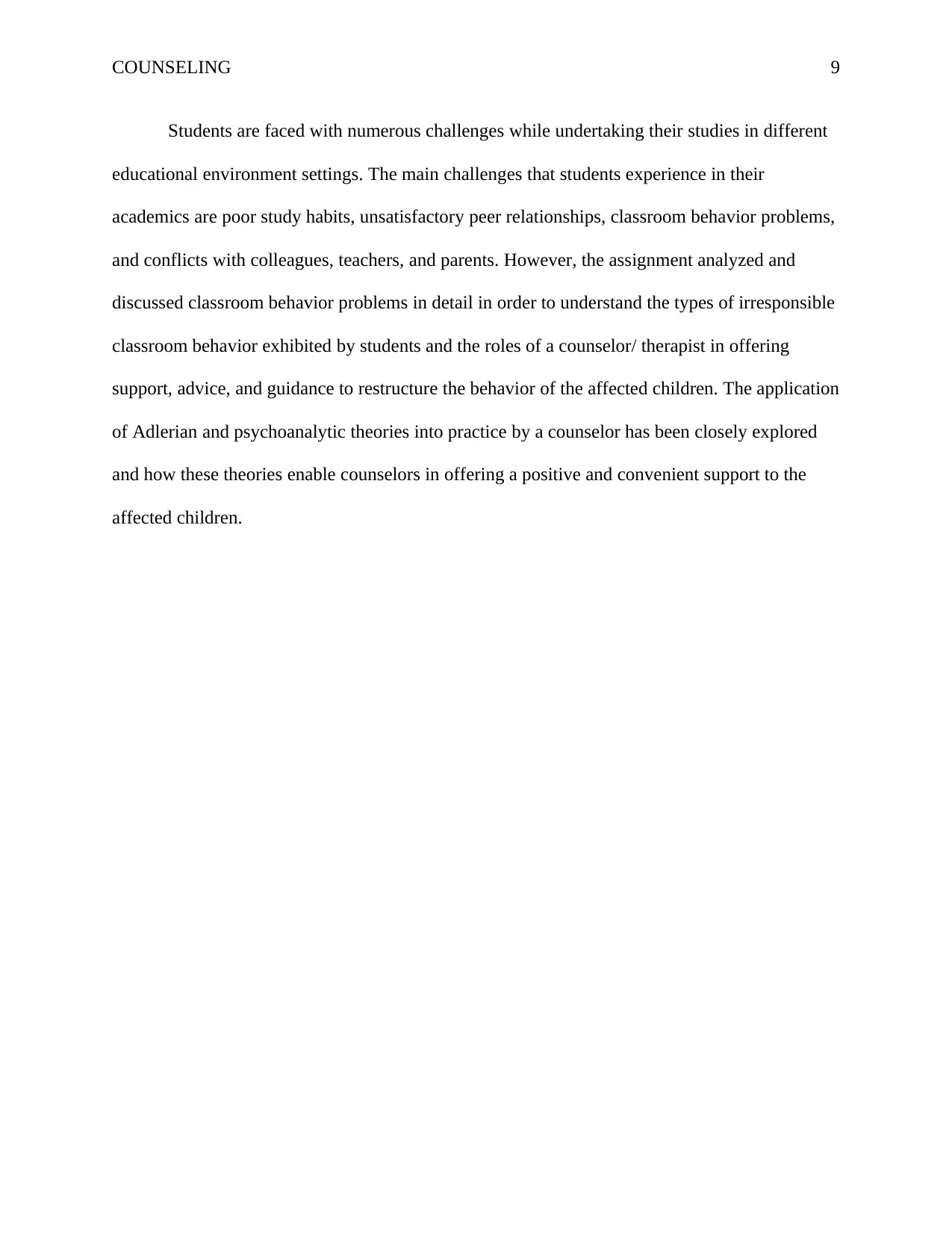
Students are faced with numerous challenges while undertaking their studies in different
educational environment settings. The main challenges that students experience in their
academics are poor study habits, unsatisfactory peer relationships, classroom behavior problems,
and conflicts with colleagues, teachers, and parents. However, the assignment analyzed and
discussed classroom behavior problems in detail in order to understand the types of irresponsible
classroom behavior exhibited by students and the roles of a counselor/ therapist in offering
support, advice, and guidance to restructure the behavior of the affected children. The application
of Adlerian and psychoanalytic theories into practice by a counselor has been closely explored
and how these theories enable counselors in offering a positive and convenient support to the
affected children.
Students are faced with numerous challenges while undertaking their studies in different
educational environment settings. The main challenges that students experience in their
academics are poor study habits, unsatisfactory peer relationships, classroom behavior problems,
and conflicts with colleagues, teachers, and parents. However, the assignment analyzed and
discussed classroom behavior problems in detail in order to understand the types of irresponsible
classroom behavior exhibited by students and the roles of a counselor/ therapist in offering
support, advice, and guidance to restructure the behavior of the affected children. The application
of Adlerian and psychoanalytic theories into practice by a counselor has been closely explored
and how these theories enable counselors in offering a positive and convenient support to the
affected children.
⊘ This is a preview!⊘
Do you want full access?
Subscribe today to unlock all pages.
Trusted by 1+ million students worldwide
COUNSELING 10
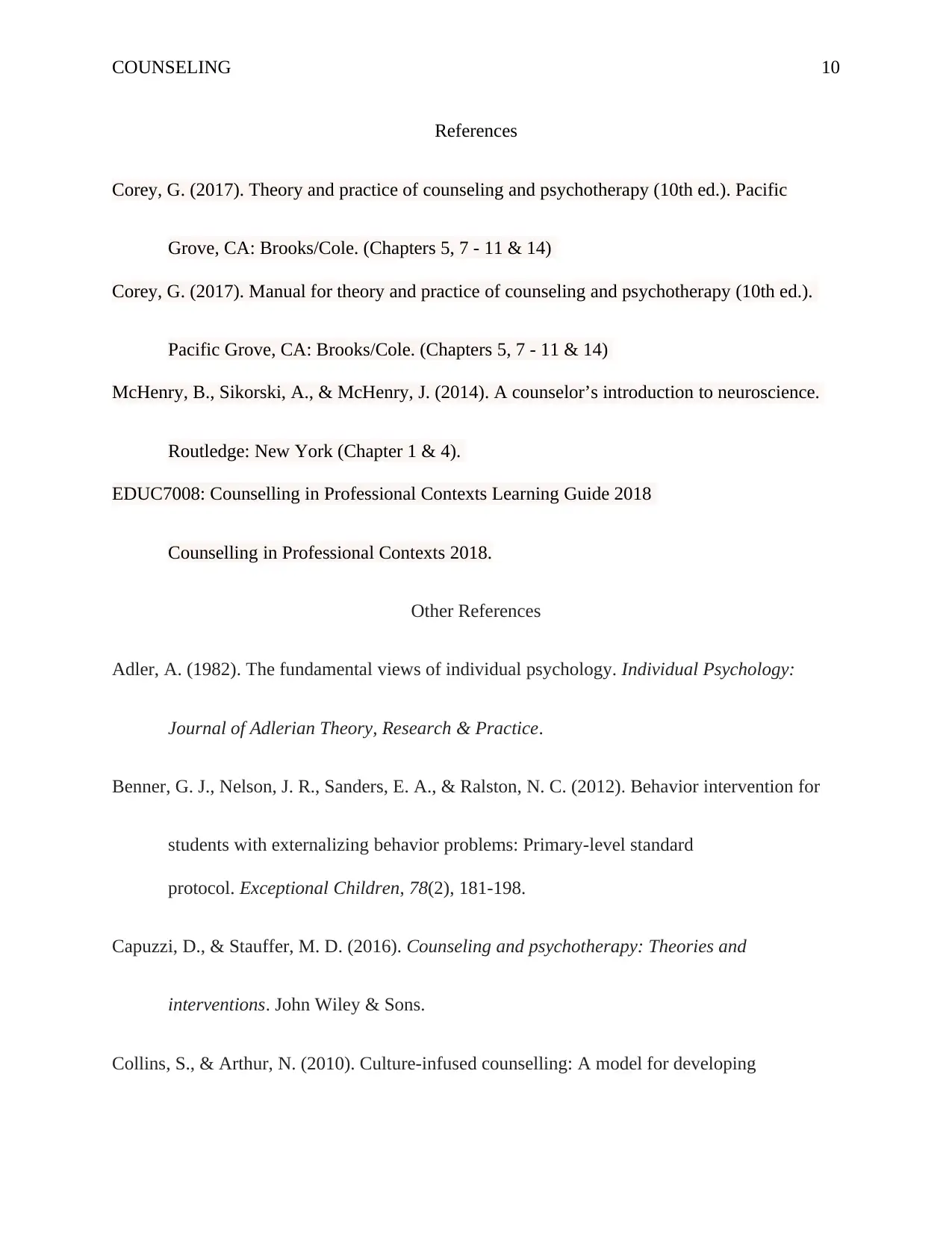
References
Corey, G. (2017). Theory and practice of counseling and psychotherapy (10th ed.). Pacific
Grove, CA: Brooks/Cole. (Chapters 5, 7 - 11 & 14)
Corey, G. (2017). Manual for theory and practice of counseling and psychotherapy (10th ed.).
Pacific Grove, CA: Brooks/Cole. (Chapters 5, 7 - 11 & 14)
McHenry, B., Sikorski, A., & McHenry, J. (2014). A counselor’s introduction to neuroscience.
Routledge: New York (Chapter 1 & 4).
EDUC7008: Counselling in Professional Contexts Learning Guide 2018
Counselling in Professional Contexts 2018.
Other References
Adler, A. (1982). The fundamental views of individual psychology. Individual Psychology:
Journal of Adlerian Theory, Research & Practice.
Benner, G. J., Nelson, J. R., Sanders, E. A., & Ralston, N. C. (2012). Behavior intervention for
students with externalizing behavior problems: Primary-level standard
protocol. Exceptional Children, 78(2), 181-198.
Capuzzi, D., & Stauffer, M. D. (2016). Counseling and psychotherapy: Theories and
interventions. John Wiley & Sons.
Collins, S., & Arthur, N. (2010). Culture-infused counselling: A model for developing
References
Corey, G. (2017). Theory and practice of counseling and psychotherapy (10th ed.). Pacific
Grove, CA: Brooks/Cole. (Chapters 5, 7 - 11 & 14)
Corey, G. (2017). Manual for theory and practice of counseling and psychotherapy (10th ed.).
Pacific Grove, CA: Brooks/Cole. (Chapters 5, 7 - 11 & 14)
McHenry, B., Sikorski, A., & McHenry, J. (2014). A counselor’s introduction to neuroscience.
Routledge: New York (Chapter 1 & 4).
EDUC7008: Counselling in Professional Contexts Learning Guide 2018
Counselling in Professional Contexts 2018.
Other References
Adler, A. (1982). The fundamental views of individual psychology. Individual Psychology:
Journal of Adlerian Theory, Research & Practice.
Benner, G. J., Nelson, J. R., Sanders, E. A., & Ralston, N. C. (2012). Behavior intervention for
students with externalizing behavior problems: Primary-level standard
protocol. Exceptional Children, 78(2), 181-198.
Capuzzi, D., & Stauffer, M. D. (2016). Counseling and psychotherapy: Theories and
interventions. John Wiley & Sons.
Collins, S., & Arthur, N. (2010). Culture-infused counselling: A model for developing
Paraphrase This Document
Need a fresh take? Get an instant paraphrase of this document with our AI Paraphraser
COUNSELING 11
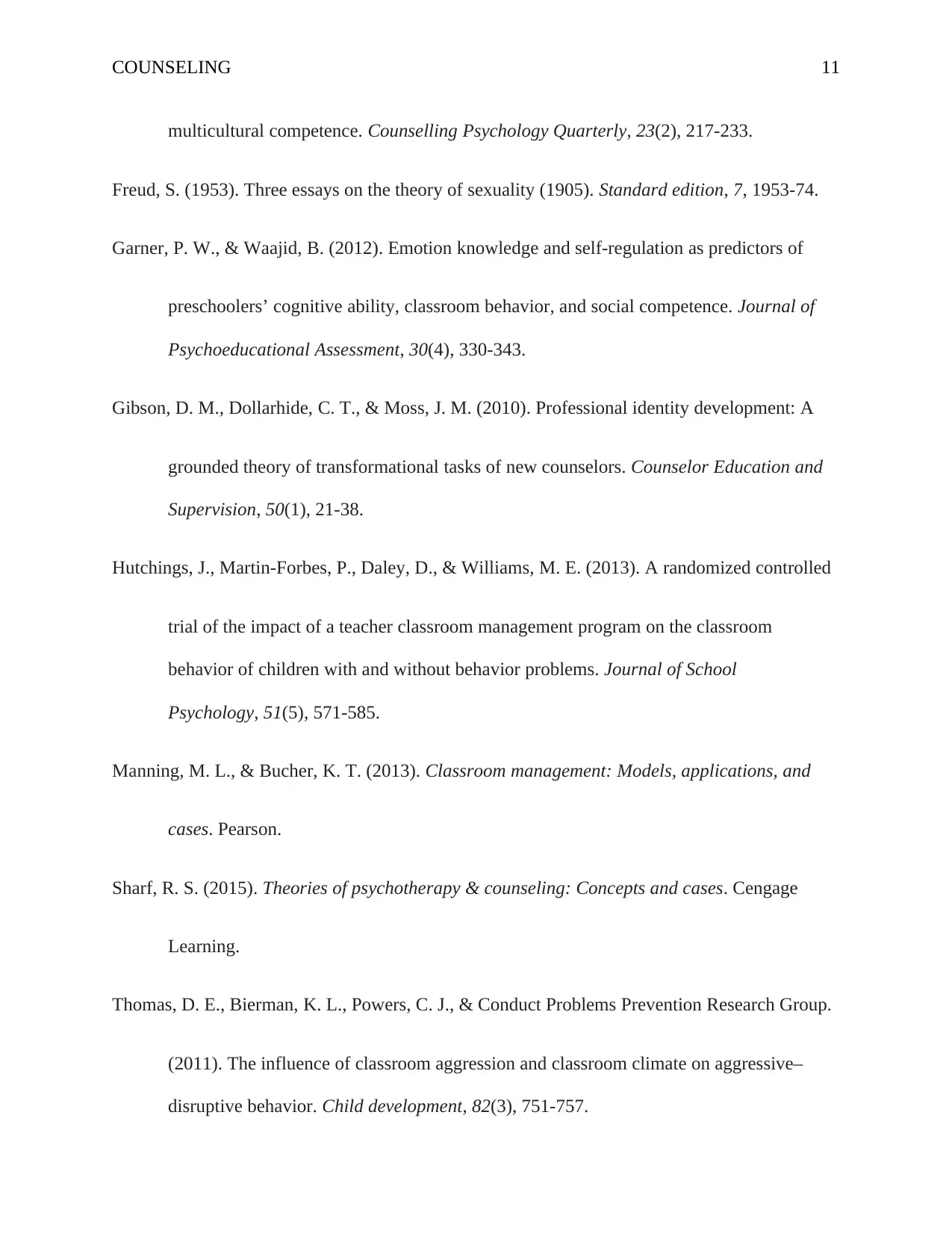
multicultural competence. Counselling Psychology Quarterly, 23(2), 217-233.
Freud, S. (1953). Three essays on the theory of sexuality (1905). Standard edition, 7, 1953-74.
Garner, P. W., & Waajid, B. (2012). Emotion knowledge and self-regulation as predictors of
preschoolers’ cognitive ability, classroom behavior, and social competence. Journal of
Psychoeducational Assessment, 30(4), 330-343.
Gibson, D. M., Dollarhide, C. T., & Moss, J. M. (2010). Professional identity development: A
grounded theory of transformational tasks of new counselors. Counselor Education and
Supervision, 50(1), 21-38.
Hutchings, J., Martin-Forbes, P., Daley, D., & Williams, M. E. (2013). A randomized controlled
trial of the impact of a teacher classroom management program on the classroom
behavior of children with and without behavior problems. Journal of School
Psychology, 51(5), 571-585.
Manning, M. L., & Bucher, K. T. (2013). Classroom management: Models, applications, and
cases. Pearson.
Sharf, R. S. (2015). Theories of psychotherapy & counseling: Concepts and cases. Cengage
Learning.
Thomas, D. E., Bierman, K. L., Powers, C. J., & Conduct Problems Prevention Research Group.
(2011). The influence of classroom aggression and classroom climate on aggressive–
disruptive behavior. Child development, 82(3), 751-757.
multicultural competence. Counselling Psychology Quarterly, 23(2), 217-233.
Freud, S. (1953). Three essays on the theory of sexuality (1905). Standard edition, 7, 1953-74.
Garner, P. W., & Waajid, B. (2012). Emotion knowledge and self-regulation as predictors of
preschoolers’ cognitive ability, classroom behavior, and social competence. Journal of
Psychoeducational Assessment, 30(4), 330-343.
Gibson, D. M., Dollarhide, C. T., & Moss, J. M. (2010). Professional identity development: A
grounded theory of transformational tasks of new counselors. Counselor Education and
Supervision, 50(1), 21-38.
Hutchings, J., Martin-Forbes, P., Daley, D., & Williams, M. E. (2013). A randomized controlled
trial of the impact of a teacher classroom management program on the classroom
behavior of children with and without behavior problems. Journal of School
Psychology, 51(5), 571-585.
Manning, M. L., & Bucher, K. T. (2013). Classroom management: Models, applications, and
cases. Pearson.
Sharf, R. S. (2015). Theories of psychotherapy & counseling: Concepts and cases. Cengage
Learning.
Thomas, D. E., Bierman, K. L., Powers, C. J., & Conduct Problems Prevention Research Group.
(2011). The influence of classroom aggression and classroom climate on aggressive–
disruptive behavior. Child development, 82(3), 751-757.
COUNSELING 12
Truax, C. B., & Carkhuff, R. (2008). Toward effective counseling and psychotherapy: Training
and practice. Transaction Publishers.
Truax, C. B., & Carkhuff, R. (2008). Toward effective counseling and psychotherapy: Training
and practice. Transaction Publishers.
⊘ This is a preview!⊘
Do you want full access?
Subscribe today to unlock all pages.
Trusted by 1+ million students worldwide

1 out of 12


Your All-in-One AI-Powered Toolkit for Academic Success.
+13062052269
info@desklib.com
Available 24*7 on WhatsApp / Email
![[object Object]](/_next/static/media/star-bottom.7253800d.svg)
Unlock your academic potential
Copyright © 2020–2026 A2Z Services. All Rights Reserved. Developed and managed by ZUCOL.