University Assignment: Counsellor's Role in Building Relationships
VerifiedAdded on 2021/06/17
|9
|2054
|73
Report
AI Summary
This report delves into the crucial role of a counsellor in building and maintaining effective relationships, exploring various facets of the concept. It emphasizes the significance of good communication and the application of Egan's skilled helper model, which is a three-stage framework focused on problem-solving and opportunity development. The report examines the stages of the model, the role of the helper, enabling and restraining factors, and the life cycle of helping mechanisms. It also discusses the advantages and disadvantages of the model, offering a reflection on its practical application. The analysis covers essential elements like trust, respect, and open communication, providing a comprehensive overview of relationship-building strategies within a counselling context. The report also includes the student's reflections on the application of the model.
Running head: ROLE OF COUNSELLOR IN BUILDING RELATIONSHIP
ROLE OF COUNSELLOR IN BUILDING RELATIONSHIP
Student Name
University name
Authors note
ROLE OF COUNSELLOR IN BUILDING RELATIONSHIP
Student Name
University name
Authors note

Paraphrase This Document
Need a fresh take? Get an instant paraphrase of this document with our AI Paraphraser
ROLE OF COUNSELLOR IN BUILDING RELATIONSHIP
Introduction
Human beings are considered to be a social creature and love to maintain a good
relationship in the society. Relationship can be identified in many ways. In fact, there
are several types of relationship such as relationship at workplace, in personal life as
well as with the counsellor as well1. In response to this, it can be ascribed that a
good relationship or communication can help a person to get more confidence and
learn the techniques of gaining attention2. In this regards, the skill helper model of
Egan is considered to be an effective way of bringing efficiency in the practice. The
model emphasises on the problem solving layout and help people to develop
opportunities to sort the issues out. Hence, the purpose of this report is to put more
focus on the effectiveness of Egan’s skilled helper model and make an
understanding of various facets of relationship building concept. The discussion is
going to widen up its discourse by taking a great deal of analysis on various stages,
role of helper and advantages and disadvantages of building relationship.
Discussion
Building relationship
Relationship building is a complex but easy task. There are some key elements
aligned with relationship building which are essentially helpful to make the
relationship better and stronger. Factors like trust, mutual respect, mindfulness, open
communication can be discussed in this context. It is also imperative to analyse the
perspective of the helpers and their efficiency as well. In order to do this, the skilled
helper model of Egan becomes significant. The model is a three stage framework in
which the helping process is being advocated. This model never deals with solving
problems, rather it emphasises the role of a counsellor in recognizing the problems
and suggests accordingly3. Besides this, it is also essential for a helper to build up a
sense of genuineness, respect and empathy.
1 Silverman, Jonathan, Suzanne Kurtz, and Juliet Draper.Skills for communicating with patients. CRC
Press, 2016.
2 Nelson-Jones, Richard. Basic counselling skills: a helper's manual. Sage, 2015.
3 Yang, Kimberly Fu-Jia. "From nonprofits to libraries: information-gathering, communication, and
relationship-building—skills that transcend fields." Skills to Make a Librarian. 2015. 35-48.
2
Student ID:
Introduction
Human beings are considered to be a social creature and love to maintain a good
relationship in the society. Relationship can be identified in many ways. In fact, there
are several types of relationship such as relationship at workplace, in personal life as
well as with the counsellor as well1. In response to this, it can be ascribed that a
good relationship or communication can help a person to get more confidence and
learn the techniques of gaining attention2. In this regards, the skill helper model of
Egan is considered to be an effective way of bringing efficiency in the practice. The
model emphasises on the problem solving layout and help people to develop
opportunities to sort the issues out. Hence, the purpose of this report is to put more
focus on the effectiveness of Egan’s skilled helper model and make an
understanding of various facets of relationship building concept. The discussion is
going to widen up its discourse by taking a great deal of analysis on various stages,
role of helper and advantages and disadvantages of building relationship.
Discussion
Building relationship
Relationship building is a complex but easy task. There are some key elements
aligned with relationship building which are essentially helpful to make the
relationship better and stronger. Factors like trust, mutual respect, mindfulness, open
communication can be discussed in this context. It is also imperative to analyse the
perspective of the helpers and their efficiency as well. In order to do this, the skilled
helper model of Egan becomes significant. The model is a three stage framework in
which the helping process is being advocated. This model never deals with solving
problems, rather it emphasises the role of a counsellor in recognizing the problems
and suggests accordingly3. Besides this, it is also essential for a helper to build up a
sense of genuineness, respect and empathy.
1 Silverman, Jonathan, Suzanne Kurtz, and Juliet Draper.Skills for communicating with patients. CRC
Press, 2016.
2 Nelson-Jones, Richard. Basic counselling skills: a helper's manual. Sage, 2015.
3 Yang, Kimberly Fu-Jia. "From nonprofits to libraries: information-gathering, communication, and
relationship-building—skills that transcend fields." Skills to Make a Librarian. 2015. 35-48.
2
Student ID:
ROLE OF COUNSELLOR IN BUILDING RELATIONSHIP
Stages
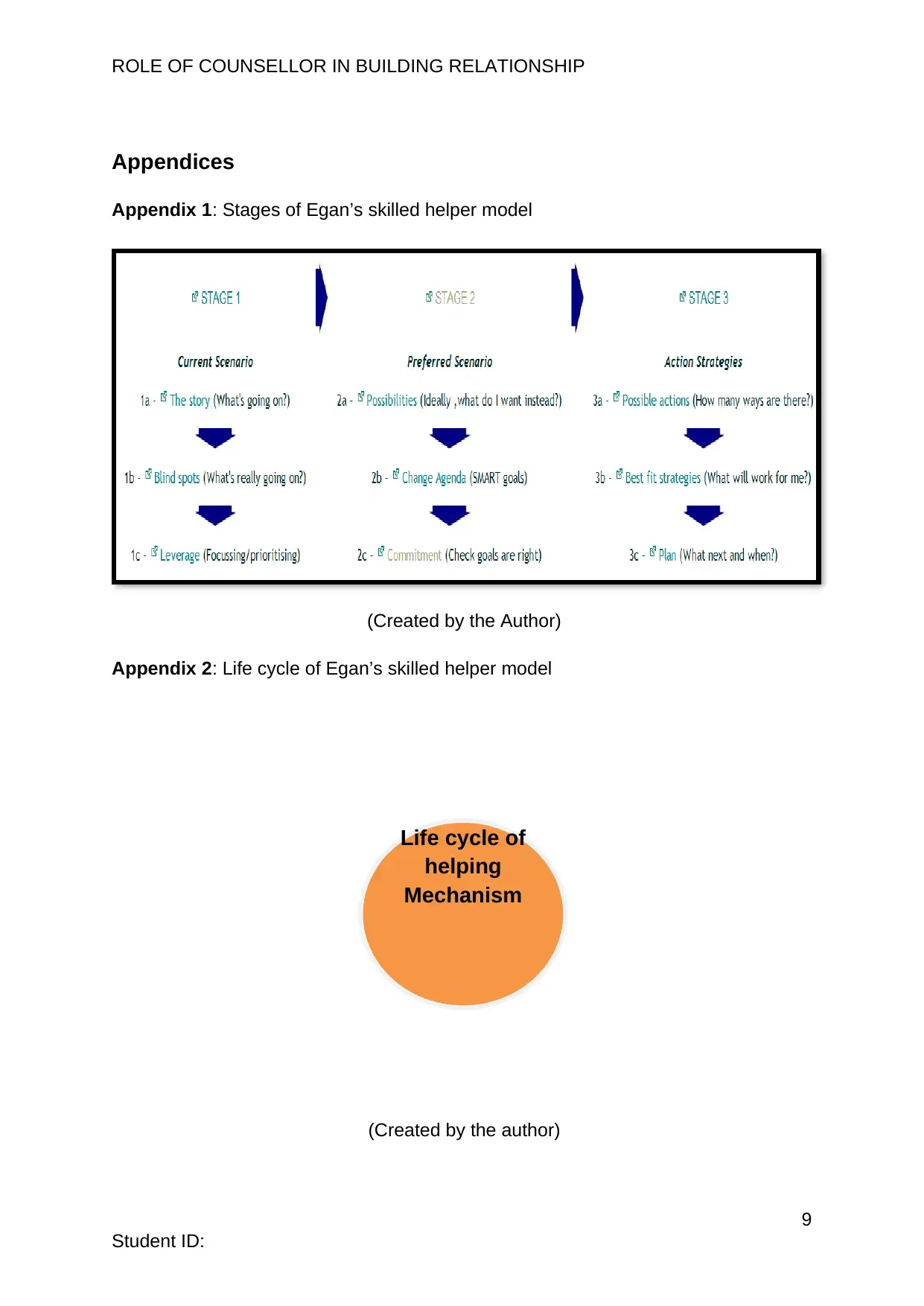
Based on Egan's skilled helper model (refer to Appendix 1), the stages are divided
into three sequential but unique steps. The first step is related to the current scenario
of the problem, the second step is to identify the preferred scenario and finally the
third step prescribes an action strategy.
The first stage is going to deal with the specific problems of the speaker. In
this phase, the helper will remain silent and try to acknowledge the problems.
Exploring the major issues and compartmentalise it is the primary concern of the
counsellor. In addition to this, open ended questions related to the issues are also
being asked. After that, the second stage in the name of preferred scenario needs to
be discussed. This part essentially reflects the mindset of the speaker in order to get
a clear picture about his or her expectation. The significance of the second stage is
that it clarifies the goals and ambition of the speaker to get rid of the emerging
problem. The final part will put a great deal of light into the set of plans which will
help the speaker to sort out the problems4. It is primarily a creative part where the
helper will envision a strategy related to the mentioned target and will provide an
estimated timeline for completing the plan.
Role of the helper
Professional helping relationship is manifested by both the participation of advisor
and receiver. Therefore, it is very essential to illustrate the role of helper in giving
suggestions. In this regards, the term helpers connotes a clear identification of those
people who are engaged with giving consultation and having helping skills. The
practise of helping becomes more restricted and significant when it is practised in a
professional way. Nonetheless, there are a number of way that helping in
professional basis can be delivered. It can be individual, group, couple or in family
counselling. In addition to this, the role of the helpers can also be differentiated with
the type of helping that they are performed. In general, the fundamental role of a
helper is to give proper advice to an individual in trouble5. In this context, the role of
an helper is slightly deviated from the action of a helper is slightly deviated from the
4 Riggall, Sally. "The sustainability of Egan’s Skilled Helper Model in students’ social work
practice." Journal of Social Work Practice 30.1 (2016): 81-93.
5 Carver, Christopher Loyd. Basic Counseling Techniques Training: The Differential Effects of Two
Models on Skill Development and Fully Functioning. University of Arkansas, 2015.
3
Student ID:
Stages
Based on Egan's skilled helper model (refer to Appendix 1), the stages are divided
into three sequential but unique steps. The first step is related to the current scenario
of the problem, the second step is to identify the preferred scenario and finally the
third step prescribes an action strategy.
The first stage is going to deal with the specific problems of the speaker. In
this phase, the helper will remain silent and try to acknowledge the problems.
Exploring the major issues and compartmentalise it is the primary concern of the
counsellor. In addition to this, open ended questions related to the issues are also
being asked. After that, the second stage in the name of preferred scenario needs to
be discussed. This part essentially reflects the mindset of the speaker in order to get
a clear picture about his or her expectation. The significance of the second stage is
that it clarifies the goals and ambition of the speaker to get rid of the emerging
problem. The final part will put a great deal of light into the set of plans which will
help the speaker to sort out the problems4. It is primarily a creative part where the
helper will envision a strategy related to the mentioned target and will provide an
estimated timeline for completing the plan.
Role of the helper
Professional helping relationship is manifested by both the participation of advisor
and receiver. Therefore, it is very essential to illustrate the role of helper in giving
suggestions. In this regards, the term helpers connotes a clear identification of those
people who are engaged with giving consultation and having helping skills. The
practise of helping becomes more restricted and significant when it is practised in a
professional way. Nonetheless, there are a number of way that helping in
professional basis can be delivered. It can be individual, group, couple or in family
counselling. In addition to this, the role of the helpers can also be differentiated with
the type of helping that they are performed. In general, the fundamental role of a
helper is to give proper advice to an individual in trouble5. In this context, the role of
an helper is slightly deviated from the action of a helper is slightly deviated from the
4 Riggall, Sally. "The sustainability of Egan’s Skilled Helper Model in students’ social work
practice." Journal of Social Work Practice 30.1 (2016): 81-93.
5 Carver, Christopher Loyd. Basic Counseling Techniques Training: The Differential Effects of Two
Models on Skill Development and Fully Functioning. University of Arkansas, 2015.
3
Student ID:
⊘ This is a preview!⊘
Do you want full access?
Subscribe today to unlock all pages.

Trusted by 1+ million students worldwide
ROLE OF COUNSELLOR IN BUILDING RELATIONSHIP
work of a counsellor or a psychotherapist. It can be argued that the primary target of
a helper is strictly focused on assist people to meet their goals, the psycho analysis
or the consultative nature is considered secondary in this matter. Hence, the role of a
helper is meant to be more significant and creative in nature.
Enabling factors
There are a number of influential factors that can help a counsellor or a helper to
become effective in practise. In that context, communication skills are considered to
be of very essential. As far as the entire conversation is based in positive
communication so that the helper must have possess the art of implementing a free
and open conversation with the speaker in order to understand specific problems6.
Besides this, building a good relation is supposed to be an effective strategy for the
helper. This rapport building skill fosters positivism for the client to express himself
freely. Another key factor in this regards is the skill of planning. A better planning
which is simple but effective can always get top preference from the client.
Therefore, keeping in mind about the excellence of the strategy the helper must
figure out the achievable way of effective planning.
Restraining elements
Subsequently the helper can also face obligations and obstructions in course of
counselling. Lack of understanding can lead towards a wrong advice which is
inadequate for the situation. It is important for the helper to provide enough time to
the speaker so that he or she can ventilate expression properly. However, it is also
essential for the helper to build up a good and open environment for the client which
will reflect a good sense of positivism. The client will get demoralized if he does not
get any positive response from the helper7.
Life cycle
The life cycle of helping mechanism is based on four stages in terms of
problems, identification, urge for a change and solution (refer to Appendix 2).The
6 Tamadoni, Mojtaba, et al. "A study to assess the effectiveness of training package and group
counseling with framework of skilled helper model on social, intellectual and occupational wellness of
the students." An International Peer Reviewed Open Access Journal For Rapid Publication (2017):
153.
7 Eryilmaz, Ali, and Tansu Mutlu. "Developing the four-stage supervision model for counselor
trainees." Kuram ve Uygulamada Egitim Bilimleri 17.2 (2017): 597.
4
Student ID:
work of a counsellor or a psychotherapist. It can be argued that the primary target of
a helper is strictly focused on assist people to meet their goals, the psycho analysis
or the consultative nature is considered secondary in this matter. Hence, the role of a
helper is meant to be more significant and creative in nature.
Enabling factors
There are a number of influential factors that can help a counsellor or a helper to
become effective in practise. In that context, communication skills are considered to
be of very essential. As far as the entire conversation is based in positive
communication so that the helper must have possess the art of implementing a free
and open conversation with the speaker in order to understand specific problems6.
Besides this, building a good relation is supposed to be an effective strategy for the
helper. This rapport building skill fosters positivism for the client to express himself
freely. Another key factor in this regards is the skill of planning. A better planning
which is simple but effective can always get top preference from the client.
Therefore, keeping in mind about the excellence of the strategy the helper must
figure out the achievable way of effective planning.
Restraining elements
Subsequently the helper can also face obligations and obstructions in course of
counselling. Lack of understanding can lead towards a wrong advice which is
inadequate for the situation. It is important for the helper to provide enough time to
the speaker so that he or she can ventilate expression properly. However, it is also
essential for the helper to build up a good and open environment for the client which
will reflect a good sense of positivism. The client will get demoralized if he does not
get any positive response from the helper7.
Life cycle
The life cycle of helping mechanism is based on four stages in terms of
problems, identification, urge for a change and solution (refer to Appendix 2).The
6 Tamadoni, Mojtaba, et al. "A study to assess the effectiveness of training package and group
counseling with framework of skilled helper model on social, intellectual and occupational wellness of
the students." An International Peer Reviewed Open Access Journal For Rapid Publication (2017):
153.
7 Eryilmaz, Ali, and Tansu Mutlu. "Developing the four-stage supervision model for counselor
trainees." Kuram ve Uygulamada Egitim Bilimleri 17.2 (2017): 597.
4
Student ID:
Paraphrase This Document
Need a fresh take? Get an instant paraphrase of this document with our AI Paraphraser
ROLE OF COUNSELLOR IN BUILDING RELATIONSHIP
problem phase reflects the issues regarding the client. In this phase the client will
express his problems and also share his view about the issues. The next step is
related to the helper. It focuses on identification of the problem. It is often happened
that clients have no idea about their actual problem or incapable to figure out the root
cause of the problem. Therefore, it is the responsibility of the helper to identify the
issues properly. After that, the helper must have the understanding about the client’s
perception on his problems. The reason behind this is that the helper wants to get a
clear idea about the intensity of client’s problem and how much it will affect his or her
life. Based on the intensity of the problem it is the duty of the helper to set proper
planning for the client which will lead towards success8.
Advantages
The skilled helper model developed by Gerard Egan is very helpful in
addressing specific issue. The model helps the clients to take responsibility for their
own decision making9. It can be asserted that the skill helper model dedicatedly
create an empathic relationship with the clients which encourages them to share
their issues10. The model never judge its clients in a preconceive manner which
facilitates to yield positive outcomes11.
Disadvantages
Lack of close ended question can perturbs the urgency of the planning. Often
the clients are telling several things which are not important for understanding the
problem and as a result it takes long time to formulate a plan12. The model is partially
depends upon the perception of the clients and it can be wrong to identify the
problem based on client’s perception13.
8 Riggall, Sally. "The sustainability of Egan’s Skilled Helper Model in students’ social work
practice." Journal of Social Work Practice 30.1 (2016): 81-93.
9 Furlonger, Brett, et al. "The Portrayal of Counselling on Television and YouTube: Implications for
Professional Counsellors." Journal of Behavioural Sciences 25.2 (2015).
10 Chandor, Anthony, Owen Hargie, and Valerie Crute.Professional interviewing. Routledge, 2017.
11 Adigwe, P., and E. Okoro. "Human communication and effective interpersonal relationships: An
analysis of client counseling and emotional stability." Int J Econ Manag Sci5.3 (2016): 336.
12 Midwinter, Rebecca, and Janie Dickson. Embedding counselling and communication skills: a
relational skills model. Routledge, 2015.
13 Eryilmaz, Ali, and Tansu Mutlu. "Developing the four-stage supervision model for counselor
trainees." Kuram ve Uygulamada Egitim Bilimleri 17.2 (2017): 597.
5
Student ID:
problem phase reflects the issues regarding the client. In this phase the client will
express his problems and also share his view about the issues. The next step is
related to the helper. It focuses on identification of the problem. It is often happened
that clients have no idea about their actual problem or incapable to figure out the root
cause of the problem. Therefore, it is the responsibility of the helper to identify the
issues properly. After that, the helper must have the understanding about the client’s
perception on his problems. The reason behind this is that the helper wants to get a
clear idea about the intensity of client’s problem and how much it will affect his or her
life. Based on the intensity of the problem it is the duty of the helper to set proper
planning for the client which will lead towards success8.
Advantages
The skilled helper model developed by Gerard Egan is very helpful in
addressing specific issue. The model helps the clients to take responsibility for their
own decision making9. It can be asserted that the skill helper model dedicatedly
create an empathic relationship with the clients which encourages them to share
their issues10. The model never judge its clients in a preconceive manner which
facilitates to yield positive outcomes11.
Disadvantages
Lack of close ended question can perturbs the urgency of the planning. Often
the clients are telling several things which are not important for understanding the
problem and as a result it takes long time to formulate a plan12. The model is partially
depends upon the perception of the clients and it can be wrong to identify the
problem based on client’s perception13.
8 Riggall, Sally. "The sustainability of Egan’s Skilled Helper Model in students’ social work
practice." Journal of Social Work Practice 30.1 (2016): 81-93.
9 Furlonger, Brett, et al. "The Portrayal of Counselling on Television and YouTube: Implications for
Professional Counsellors." Journal of Behavioural Sciences 25.2 (2015).
10 Chandor, Anthony, Owen Hargie, and Valerie Crute.Professional interviewing. Routledge, 2017.
11 Adigwe, P., and E. Okoro. "Human communication and effective interpersonal relationships: An
analysis of client counseling and emotional stability." Int J Econ Manag Sci5.3 (2016): 336.
12 Midwinter, Rebecca, and Janie Dickson. Embedding counselling and communication skills: a
relational skills model. Routledge, 2015.
13 Eryilmaz, Ali, and Tansu Mutlu. "Developing the four-stage supervision model for counselor
trainees." Kuram ve Uygulamada Egitim Bilimleri 17.2 (2017): 597.
5
Student ID:
ROLE OF COUNSELLOR IN BUILDING RELATIONSHIP
Reflection
Keeping in focus of the framework of Egan’s skilled helper model I conducted a
helping process in order to understand the effectiveness of the model in present
case scenario. In the first stage of the process it seemed so strenuous for a helper to
keep listing the speaker. It requires a great deal of concentration and expertise. As
this was my first experience so that I had done some mistakes and realized it later
on. The second stage was also a bit complex because it was based on the verdict of
the clients only. Nevertheless, the model is simple and useful for experimental
purposes.
Conclusion
Despite all the challenges a helper can face while practising the Egan’s skilled
helper model, it can be argued that the model is good and is able to provide a clear
picture of the client’s problem. At the same time it also retrieves the expectation of
the client in difficult situation. Therefore, it can be concluded that the scientific
process and patience has been generated through the Egan’s skilled helper model
which is beneficial for the helper to understand the problem of his client effectively.
6
Student ID:
Reflection
Keeping in focus of the framework of Egan’s skilled helper model I conducted a
helping process in order to understand the effectiveness of the model in present
case scenario. In the first stage of the process it seemed so strenuous for a helper to
keep listing the speaker. It requires a great deal of concentration and expertise. As
this was my first experience so that I had done some mistakes and realized it later
on. The second stage was also a bit complex because it was based on the verdict of
the clients only. Nevertheless, the model is simple and useful for experimental
purposes.
Conclusion
Despite all the challenges a helper can face while practising the Egan’s skilled
helper model, it can be argued that the model is good and is able to provide a clear
picture of the client’s problem. At the same time it also retrieves the expectation of
the client in difficult situation. Therefore, it can be concluded that the scientific
process and patience has been generated through the Egan’s skilled helper model
which is beneficial for the helper to understand the problem of his client effectively.
6
Student ID:
⊘ This is a preview!⊘
Do you want full access?
Subscribe today to unlock all pages.
Trusted by 1+ million students worldwide
ROLE OF COUNSELLOR IN BUILDING RELATIONSHIP
Reference
Adigwe, P., and E. Okoro. "Human communication and effective interpersonal
relationships: An analysis of client counseling and emotional stability." Int J Econ
Manag Sci5.3 (2016): 336.
Carver, Christopher Loyd. Basic Counseling Techniques Training: The Differential
Effects of Two Models on Skill Development and Fully Functioning. University of
Arkansas, 2015.
Chandor, Anthony, Owen Hargie, and Valerie Crute.Professional interviewing.
Routledge, 2017.
Eryilmaz, Ali, and Tansu Mutlu. "Developing the four-stage supervision model for
counselor trainees." Kuram ve Uygulamada Egitim Bilimleri 17.2 (2017): 597.
Eryilmaz, Ali, and Tansu Mutlu. "Developing the four-stage supervision model for
counselor trainees." Kuram ve Uygulamada Egitim Bilimleri 17.2 (2017): 597.
Furlonger, Brett, et al. "The Portrayal of Counselling on Television and YouTube:
Implications for Professional Counsellors." Journal of Behavioural Sciences 25.2
(2015).
Midwinter, Rebecca, and Janie Dickson. Embedding counselling and communication
skills: a relational skills model. Routledge, 2015.
Nelson-Jones, Richard. Basic counselling skills: a helper's manual. Sage, 2015.
Riggall, Sally. "The sustainability of Egan’s Skilled Helper Model in students’ social
work practice." Journal of Social Work Practice 30.1 (2016): 81-93.
Silverman, Jonathan, Suzanne Kurtz, and Juliet Draper.Skills for communicating with
patients. CRC Press, 2016.
Tamadoni, Mojtaba, et al. "A study to assess the effectiveness of training package
and group counseling with framework of skilled helper model on social, intellectual
and occupational wellness of the students." An International Peer Reviewed Open
Access Journal For Rapid Publication (2017): 153.
7
Student ID:
Reference
Adigwe, P., and E. Okoro. "Human communication and effective interpersonal
relationships: An analysis of client counseling and emotional stability." Int J Econ
Manag Sci5.3 (2016): 336.
Carver, Christopher Loyd. Basic Counseling Techniques Training: The Differential
Effects of Two Models on Skill Development and Fully Functioning. University of
Arkansas, 2015.
Chandor, Anthony, Owen Hargie, and Valerie Crute.Professional interviewing.
Routledge, 2017.
Eryilmaz, Ali, and Tansu Mutlu. "Developing the four-stage supervision model for
counselor trainees." Kuram ve Uygulamada Egitim Bilimleri 17.2 (2017): 597.
Eryilmaz, Ali, and Tansu Mutlu. "Developing the four-stage supervision model for
counselor trainees." Kuram ve Uygulamada Egitim Bilimleri 17.2 (2017): 597.
Furlonger, Brett, et al. "The Portrayal of Counselling on Television and YouTube:
Implications for Professional Counsellors." Journal of Behavioural Sciences 25.2
(2015).
Midwinter, Rebecca, and Janie Dickson. Embedding counselling and communication
skills: a relational skills model. Routledge, 2015.
Nelson-Jones, Richard. Basic counselling skills: a helper's manual. Sage, 2015.
Riggall, Sally. "The sustainability of Egan’s Skilled Helper Model in students’ social
work practice." Journal of Social Work Practice 30.1 (2016): 81-93.
Silverman, Jonathan, Suzanne Kurtz, and Juliet Draper.Skills for communicating with
patients. CRC Press, 2016.
Tamadoni, Mojtaba, et al. "A study to assess the effectiveness of training package
and group counseling with framework of skilled helper model on social, intellectual
and occupational wellness of the students." An International Peer Reviewed Open
Access Journal For Rapid Publication (2017): 153.
7
Student ID:
Paraphrase This Document
Need a fresh take? Get an instant paraphrase of this document with our AI Paraphraser
ROLE OF COUNSELLOR IN BUILDING RELATIONSHIP
Yang, Kimberly Fu-Jia. "From nonprofits to libraries: information-gathering,
communication, and relationship-building—skills that transcend fields." Skills to Make
a Librarian. 2015. 35-48.
8
Student ID:
Yang, Kimberly Fu-Jia. "From nonprofits to libraries: information-gathering,
communication, and relationship-building—skills that transcend fields." Skills to Make
a Librarian. 2015. 35-48.
8
Student ID:
ROLE OF COUNSELLOR IN BUILDING RELATIONSHIP
Appendices
Appendix 1: Stages of Egan’s skilled helper model
(Created by the Author)
Appendix 2: Life cycle of Egan’s skilled helper model
(Created by the author)
9
Student ID:
Life cycle of
helping
Mechanism
Appendices
Appendix 1: Stages of Egan’s skilled helper model
(Created by the Author)
Appendix 2: Life cycle of Egan’s skilled helper model
(Created by the author)
9
Student ID:
Life cycle of
helping
Mechanism
⊘ This is a preview!⊘
Do you want full access?
Subscribe today to unlock all pages.
Trusted by 1+ million students worldwide

1 out of 9


Related Documents


Your All-in-One AI-Powered Toolkit for Academic Success.
+13062052269
info@desklib.com
Available 24*7 on WhatsApp / Email
![[object Object]](/_next/static/media/star-bottom.7253800d.svg)
Unlock your academic potential
Copyright © 2020–2026 A2Z Services. All Rights Reserved. Developed and managed by ZUCOL.