Dissertation: Power in Courtroom Discourse – Questioning Analysis
VerifiedAdded on 2023/01/17
|43
|13259
|77
Thesis and Dissertation
AI Summary
This dissertation investigates the manifestation of power within courtroom discourse, specifically focusing on the language used in direct-examination and cross-examination questioning. The research examines how lawyers utilize different questioning techniques to assert power, influence witnesses, and shape the narrative of a case. The study delves into the nuances of language, including open-ended, closed-ended, and leading questions, as well as the impact of turn-taking and asymmetry in dialogue. The analysis draws upon discourse analysis principles to explore how lawyers manipulate sentences and witness responses to their advantage. The dissertation further examines the use of punctuation, specific words like 'so,' and other linguistic tools to convey power. It provides a detailed comparison between direct and cross-examination strategies, offering insights into the contrasting approaches employed by legal professionals. The ultimate aim is to determine how power is demonstrated through language and discourse in the courtroom setting.
Running head: DISSERTATION
English Language and Linguistics Dissertation
Topic: Power shown via courtroom discourse within
direct-examination and cross-examination questioning
Name of the Student:
Name of the University:
Author Note:
English Language and Linguistics Dissertation
Topic: Power shown via courtroom discourse within
direct-examination and cross-examination questioning
Name of the Student:
Name of the University:
Author Note:

Paraphrase This Document
Need a fresh take? Get an instant paraphrase of this document with our AI Paraphraser
DISSERTATION 1
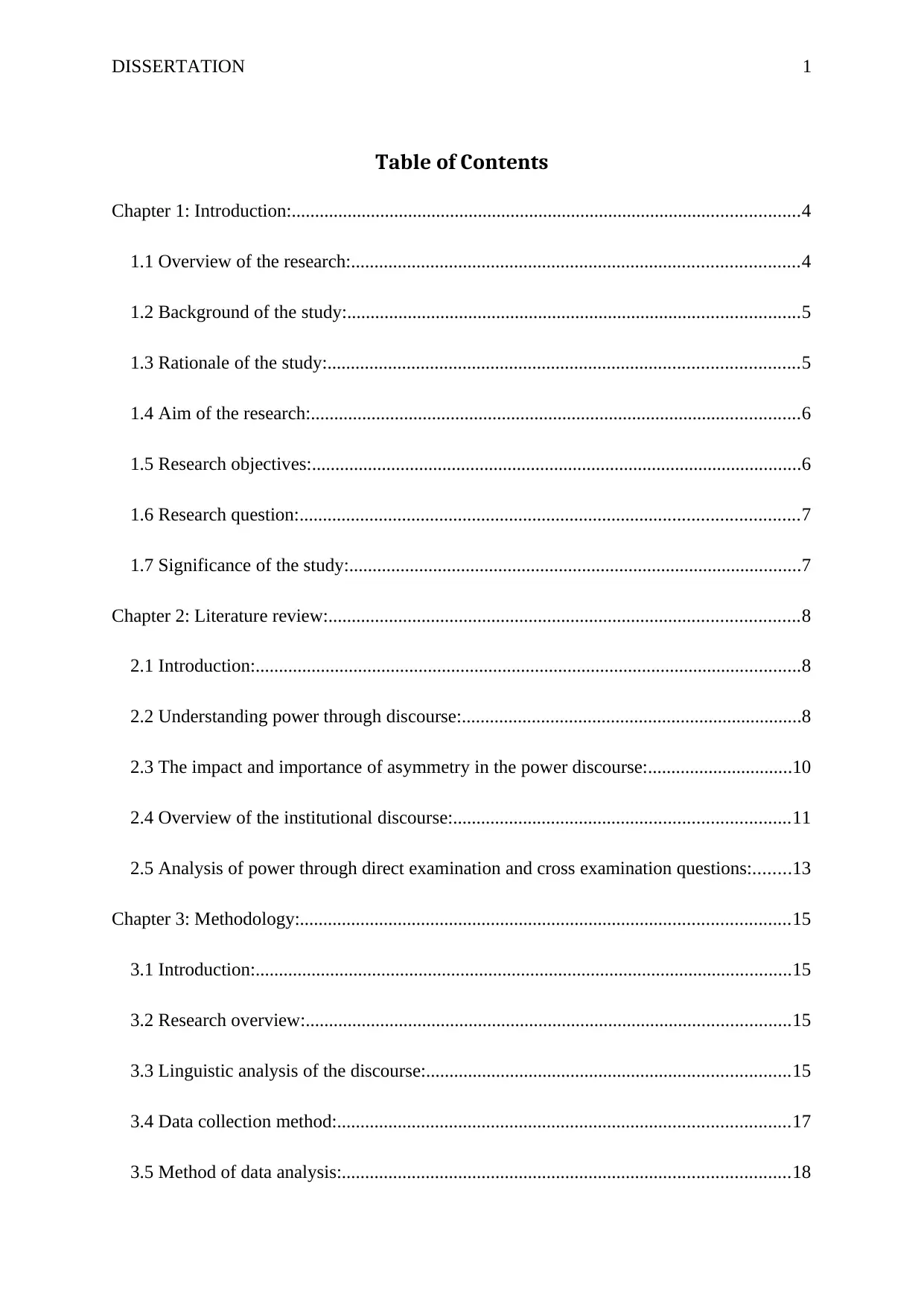
Table of Contents
Chapter 1: Introduction:.............................................................................................................4
1.1 Overview of the research:................................................................................................4
1.2 Background of the study:.................................................................................................5
1.3 Rationale of the study:.....................................................................................................5
1.4 Aim of the research:.........................................................................................................6
1.5 Research objectives:.........................................................................................................6
1.6 Research question:...........................................................................................................7
1.7 Significance of the study:.................................................................................................7
Chapter 2: Literature review:.....................................................................................................8
2.1 Introduction:.....................................................................................................................8
2.2 Understanding power through discourse:.........................................................................8
2.3 The impact and importance of asymmetry in the power discourse:...............................10
2.4 Overview of the institutional discourse:........................................................................11
2.5 Analysis of power through direct examination and cross examination questions:........13
Chapter 3: Methodology:.........................................................................................................15
3.1 Introduction:...................................................................................................................15
3.2 Research overview:........................................................................................................15
3.3 Linguistic analysis of the discourse:..............................................................................15
3.4 Data collection method:.................................................................................................17
3.5 Method of data analysis:................................................................................................18
Table of Contents
Chapter 1: Introduction:.............................................................................................................4
1.1 Overview of the research:................................................................................................4
1.2 Background of the study:.................................................................................................5
1.3 Rationale of the study:.....................................................................................................5
1.4 Aim of the research:.........................................................................................................6
1.5 Research objectives:.........................................................................................................6
1.6 Research question:...........................................................................................................7
1.7 Significance of the study:.................................................................................................7
Chapter 2: Literature review:.....................................................................................................8
2.1 Introduction:.....................................................................................................................8
2.2 Understanding power through discourse:.........................................................................8
2.3 The impact and importance of asymmetry in the power discourse:...............................10
2.4 Overview of the institutional discourse:........................................................................11
2.5 Analysis of power through direct examination and cross examination questions:........13
Chapter 3: Methodology:.........................................................................................................15
3.1 Introduction:...................................................................................................................15
3.2 Research overview:........................................................................................................15
3.3 Linguistic analysis of the discourse:..............................................................................15
3.4 Data collection method:.................................................................................................17
3.5 Method of data analysis:................................................................................................18
DISSERTATION 2
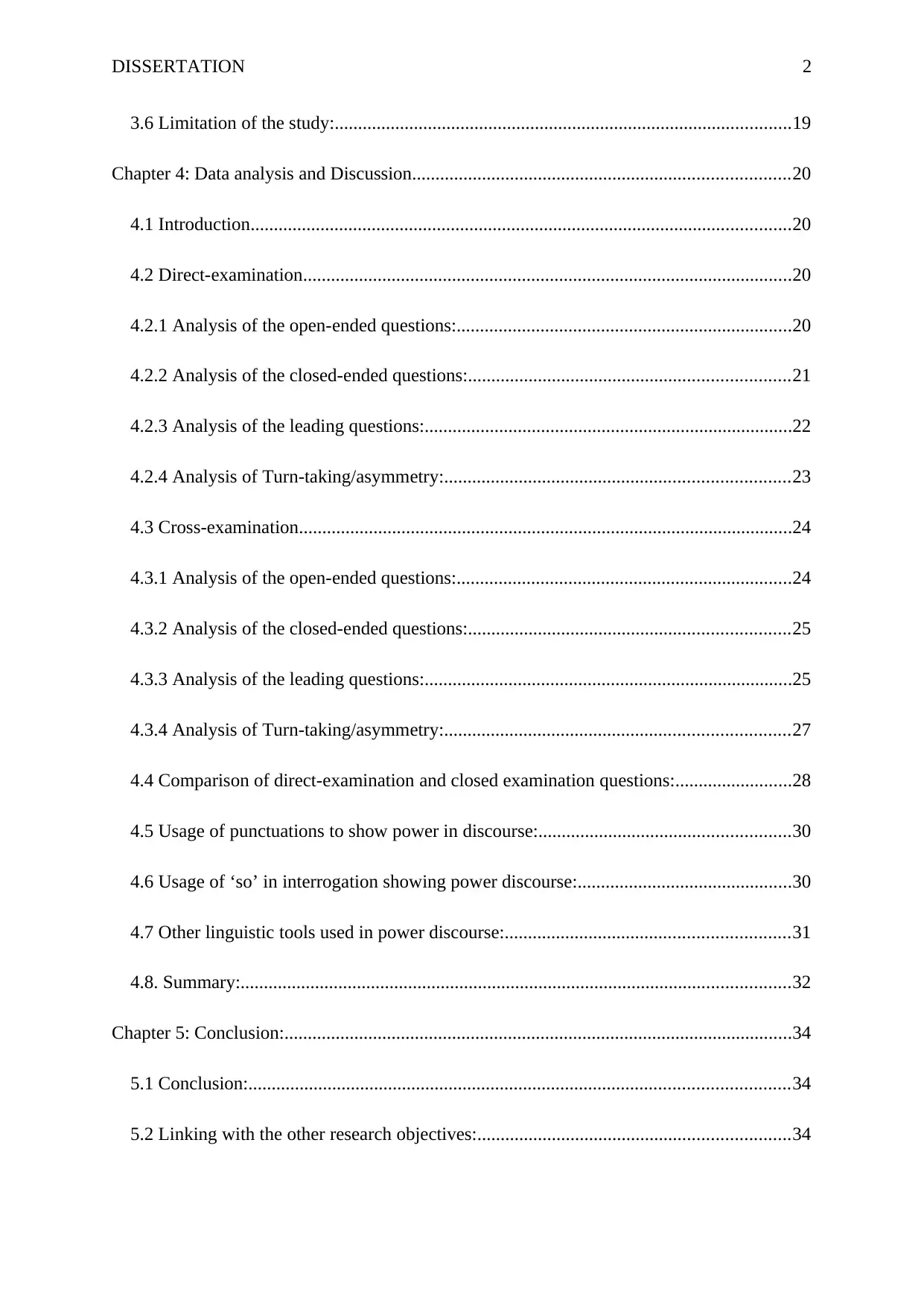
3.6 Limitation of the study:..................................................................................................19
Chapter 4: Data analysis and Discussion.................................................................................20
4.1 Introduction....................................................................................................................20
4.2 Direct-examination.........................................................................................................20
4.2.1 Analysis of the open-ended questions:........................................................................20
4.2.2 Analysis of the closed-ended questions:.....................................................................21
4.2.3 Analysis of the leading questions:...............................................................................22
4.2.4 Analysis of Turn-taking/asymmetry:..........................................................................23
4.3 Cross-examination..........................................................................................................24
4.3.1 Analysis of the open-ended questions:........................................................................24
4.3.2 Analysis of the closed-ended questions:.....................................................................25
4.3.3 Analysis of the leading questions:...............................................................................25
4.3.4 Analysis of Turn-taking/asymmetry:..........................................................................27
4.4 Comparison of direct-examination and closed examination questions:.........................28
4.5 Usage of punctuations to show power in discourse:......................................................30
4.6 Usage of ‘so’ in interrogation showing power discourse:..............................................30
4.7 Other linguistic tools used in power discourse:.............................................................31
4.8. Summary:......................................................................................................................32
Chapter 5: Conclusion:.............................................................................................................34
5.1 Conclusion:....................................................................................................................34
5.2 Linking with the other research objectives:...................................................................34
3.6 Limitation of the study:..................................................................................................19
Chapter 4: Data analysis and Discussion.................................................................................20
4.1 Introduction....................................................................................................................20
4.2 Direct-examination.........................................................................................................20
4.2.1 Analysis of the open-ended questions:........................................................................20
4.2.2 Analysis of the closed-ended questions:.....................................................................21
4.2.3 Analysis of the leading questions:...............................................................................22
4.2.4 Analysis of Turn-taking/asymmetry:..........................................................................23
4.3 Cross-examination..........................................................................................................24
4.3.1 Analysis of the open-ended questions:........................................................................24
4.3.2 Analysis of the closed-ended questions:.....................................................................25
4.3.3 Analysis of the leading questions:...............................................................................25
4.3.4 Analysis of Turn-taking/asymmetry:..........................................................................27
4.4 Comparison of direct-examination and closed examination questions:.........................28
4.5 Usage of punctuations to show power in discourse:......................................................30
4.6 Usage of ‘so’ in interrogation showing power discourse:..............................................30
4.7 Other linguistic tools used in power discourse:.............................................................31
4.8. Summary:......................................................................................................................32
Chapter 5: Conclusion:.............................................................................................................34
5.1 Conclusion:....................................................................................................................34
5.2 Linking with the other research objectives:...................................................................34
⊘ This is a preview!⊘
Do you want full access?
Subscribe today to unlock all pages.

Trusted by 1+ million students worldwide
DISSERTATION 3
5.3 Recommendations:.........................................................................................................35
5.4 Future scope of the study:..............................................................................................36
References:...............................................................................................................................37
5.3 Recommendations:.........................................................................................................35
5.4 Future scope of the study:..............................................................................................36
References:...............................................................................................................................37
Paraphrase This Document
Need a fresh take? Get an instant paraphrase of this document with our AI Paraphraser
DISSERTATION 4
Chapter 1: Introduction:
1.1 Overview of the research:
The title of my dissertation is ‘Courtroom discourse – Power in language within
direct-examination and cross-examination questioning’. By definition, Direct-examination
question is the first examination question asked by the party calling the witness and Cross-
examination question is the question raised by the opposing party to the same witness in
order to check or discredit the testimony of the same witness. This is how the knowledge,
testimony and credibility of the witness are tested and countered (Holmes and Stubbe, 2015).
Direct-examination questions question the witness who is in favour of the represented client.
On the other hand, cross-examination question is raised by the opposing lawyer questioning
the opposition’s witness in order to discredit their testimony in favour of his own client. This
is an interesting approach to power in language as solely knowing what these two types of
questioning are, we can readily assume that one may show evidence of greater power shown
due to the individual role it plays (Burman and Parker, 2016).
I wanted to explore this method of question deeper whilst looking to separate
similarities and differences between the two types of questioning as well as determining if
one type shows greater power via the language use within the questioning. This study is
focused on the dialogue in the courtroom discourse and several studies have been researched
that focused on the courtroom discourse. However, it should be noted that not all these
studies concentrated solely on the questioning but it also concentrated on the language used
within the opening and closing statements.
Chapter 1: Introduction:
1.1 Overview of the research:
The title of my dissertation is ‘Courtroom discourse – Power in language within
direct-examination and cross-examination questioning’. By definition, Direct-examination
question is the first examination question asked by the party calling the witness and Cross-
examination question is the question raised by the opposing party to the same witness in
order to check or discredit the testimony of the same witness. This is how the knowledge,
testimony and credibility of the witness are tested and countered (Holmes and Stubbe, 2015).
Direct-examination questions question the witness who is in favour of the represented client.
On the other hand, cross-examination question is raised by the opposing lawyer questioning
the opposition’s witness in order to discredit their testimony in favour of his own client. This
is an interesting approach to power in language as solely knowing what these two types of
questioning are, we can readily assume that one may show evidence of greater power shown
due to the individual role it plays (Burman and Parker, 2016).
I wanted to explore this method of question deeper whilst looking to separate
similarities and differences between the two types of questioning as well as determining if
one type shows greater power via the language use within the questioning. This study is
focused on the dialogue in the courtroom discourse and several studies have been researched
that focused on the courtroom discourse. However, it should be noted that not all these
studies concentrated solely on the questioning but it also concentrated on the language used
within the opening and closing statements.
DISSERTATION 5
1.2 Background of the study:
In the view point of Kang, Ji-Hae (2014), discourse analysis is the means of analysing
language beyond the sentences. This is indeed contradictory to the types of analysis done in
the modern day linguistics. Discourse analysis is mainly concerned with the study of
grammar, smaller bits of language, usage of phonetics and phonology, parts of speech and
also considering the order of the words in a sentence. It is important to study a chunk of
sentence in order to understand the discourse and the flow of language. The aim of the
discourse analysts is to understand how the usage of words and grammar is actually changing
the meaning of the conversation. In the discussion, Griscti, Odette et al. (2017) highlighted a
simple example with two sentences, “Please use the toilet, not the pool” and the other
sentence as “Pools are available for members only”. If these sentences are taken together, the
derived meaning would be completely something else. Thus, interpreting the meaning of the
sentences and the intensions behind such sentences is what discourse analysis for. However,
in contradictory to this, Harris, Sandra (2003) said that these assumptions are completely
depended on the on the person as how things are interpreted or signalled. Things can be
wrongly interpreted in case the person was not listening carefully or might have missed a
vital bodily signal like eye contact or response to the listener.
1.3 Rationale of the study:
Human beings are continuously engaged in various social activities and interaction
with people. People make all the possible approaches needed for interaction and convey their
messages. As pointed out by Zhang, Meifang (2015), it is completely dependent on a person
to deliver a word or a sentence that the person feels like but the interpretation completely
depends on the person who is listening and is at the receiving end. Human beings can be
involved in usual conversations, any kind of negotiation or even an argument. The
1.2 Background of the study:
In the view point of Kang, Ji-Hae (2014), discourse analysis is the means of analysing
language beyond the sentences. This is indeed contradictory to the types of analysis done in
the modern day linguistics. Discourse analysis is mainly concerned with the study of
grammar, smaller bits of language, usage of phonetics and phonology, parts of speech and
also considering the order of the words in a sentence. It is important to study a chunk of
sentence in order to understand the discourse and the flow of language. The aim of the
discourse analysts is to understand how the usage of words and grammar is actually changing
the meaning of the conversation. In the discussion, Griscti, Odette et al. (2017) highlighted a
simple example with two sentences, “Please use the toilet, not the pool” and the other
sentence as “Pools are available for members only”. If these sentences are taken together, the
derived meaning would be completely something else. Thus, interpreting the meaning of the
sentences and the intensions behind such sentences is what discourse analysis for. However,
in contradictory to this, Harris, Sandra (2003) said that these assumptions are completely
depended on the on the person as how things are interpreted or signalled. Things can be
wrongly interpreted in case the person was not listening carefully or might have missed a
vital bodily signal like eye contact or response to the listener.
1.3 Rationale of the study:
Human beings are continuously engaged in various social activities and interaction
with people. People make all the possible approaches needed for interaction and convey their
messages. As pointed out by Zhang, Meifang (2015), it is completely dependent on a person
to deliver a word or a sentence that the person feels like but the interpretation completely
depends on the person who is listening and is at the receiving end. Human beings can be
involved in usual conversations, any kind of negotiation or even an argument. The
⊘ This is a preview!⊘
Do you want full access?
Subscribe today to unlock all pages.
Trusted by 1+ million students worldwide
DISSERTATION 6
construction of the sentences and the meaning derived from the sentences are completely
unanimous to the sender as well as the receiver.
If the situation of a courtroom is considered, as per the topic of this dissertation, it can
be said that the final verdict of the court is depended on the entire conversation carried on at
the courtroom by the means of direct examination and cross examination questions. The
lawyers from both the parties always show the tendency of manipulating the sentences or the
sentences said by the witness or the one being questioned in a way that would satisfy their
point of view. In such cases, the winning party is definitely the one who will be able to show
more power via their conversation and sentences. Thus, studying discourse analysis of direct
examination and cross examination questions in the courtroom would provide another level
of analytical skills to the professionals.
1.4 Aim of the research:
The aim of the dissertation is to find out the ways in which lawyers show power in
their language within direct-examination and cross-examination questioning. The study will
not only focus on one of the questioning process but both direct-examination and cross-
examination questioning so that we can see the opposing sides of a court case and how each
side claims power.
1.5 Research objectives:
The objectives of the research are:
i. To find out how power is shown in the courtroom by discourse analysis in terms
of direct examination and cross examination questions.
ii. To analyse the variance in sentences while asking direct examination and cross
examination questions by the lawyers from both the parties
construction of the sentences and the meaning derived from the sentences are completely
unanimous to the sender as well as the receiver.
If the situation of a courtroom is considered, as per the topic of this dissertation, it can
be said that the final verdict of the court is depended on the entire conversation carried on at
the courtroom by the means of direct examination and cross examination questions. The
lawyers from both the parties always show the tendency of manipulating the sentences or the
sentences said by the witness or the one being questioned in a way that would satisfy their
point of view. In such cases, the winning party is definitely the one who will be able to show
more power via their conversation and sentences. Thus, studying discourse analysis of direct
examination and cross examination questions in the courtroom would provide another level
of analytical skills to the professionals.
1.4 Aim of the research:
The aim of the dissertation is to find out the ways in which lawyers show power in
their language within direct-examination and cross-examination questioning. The study will
not only focus on one of the questioning process but both direct-examination and cross-
examination questioning so that we can see the opposing sides of a court case and how each
side claims power.
1.5 Research objectives:
The objectives of the research are:
i. To find out how power is shown in the courtroom by discourse analysis in terms
of direct examination and cross examination questions.
ii. To analyse the variance in sentences while asking direct examination and cross
examination questions by the lawyers from both the parties
Paraphrase This Document
Need a fresh take? Get an instant paraphrase of this document with our AI Paraphraser
DISSERTATION 7
iii. To evaluate how the response of the witness is interpreted after asking a question
by the lawyer
1.6 Research question:
RQ: How power is shown via courtroom discourse within direct-examination and cross-
examination questioning?
1.7 Significance of the study:
This study will help to understand how a professional, for this research a lawyer can
use different set of sentences and words in order to meet the expected outcome of the entire
situation. The evaluation of the entire transcript of the courtroom scenario would give a clear
understanding on how direct examination and cross examination questions have helped the
lawyers from both the parties to take their own toll. Thus, this study would be further helpful
in analysing power discourse of sentences in a conversation.
iii. To evaluate how the response of the witness is interpreted after asking a question
by the lawyer
1.6 Research question:
RQ: How power is shown via courtroom discourse within direct-examination and cross-
examination questioning?
1.7 Significance of the study:
This study will help to understand how a professional, for this research a lawyer can
use different set of sentences and words in order to meet the expected outcome of the entire
situation. The evaluation of the entire transcript of the courtroom scenario would give a clear
understanding on how direct examination and cross examination questions have helped the
lawyers from both the parties to take their own toll. Thus, this study would be further helpful
in analysing power discourse of sentences in a conversation.
DISSERTATION 8
Chapter 2: Literature review:
2.1 Introduction:
In the section of the literature review, the discussion is based on the approaches to
power and what different theorists such as Foucault and Fairclough have to say about power
within discourse. Understanding the concept of power itself will help prepare one’s mind for
the basis of this dissertation. Moving forward, the discussion is about one of the key
components of power within talk, which is asymmetry within talk. This is often referred to as
‘turn-taking’ by conversation analysis scholars. The literature review will directly focus on
asymmetry within institutional settings which fulfils the focus of courtroom discourse making
the research less general and more specific to the topic. The research is based on
understanding the uneven distribution of talk within a courtroom setting and what researchers
such as Drew and Heritage (1992) have to say regarding power shown via asymmetry.
Furthermore, the research will focus on the institutional discourse and what researchers such
as Thornborrow (2002) and Drew and Heritage (1992) have to say regarding the topic, for
example, the restrictions within an institutional setting. Moving forward, the discussion will
be based on the main theme of theme dissertation, which is direct-examination and cross-
examination questioning.
2.2 Understanding power through discourse:
The understanding of power has been developing over large periods of time. The idea
and acknowledgment of power originates in Foucault’s theory of power (1977, 1980, as
quoted in Thornborrow 2002:77). Foucault suggests that power is activated through
interaction. Many critical linguists, who seemed to be inspired by Foucault, claim that rather
than being negotiable, power is pre-determined. ‘Discourse in Foucault’s sense is not simply
to talk itself, but also the way that something gets talked about’ (Yates, 2002). The way that
Chapter 2: Literature review:
2.1 Introduction:
In the section of the literature review, the discussion is based on the approaches to
power and what different theorists such as Foucault and Fairclough have to say about power
within discourse. Understanding the concept of power itself will help prepare one’s mind for
the basis of this dissertation. Moving forward, the discussion is about one of the key
components of power within talk, which is asymmetry within talk. This is often referred to as
‘turn-taking’ by conversation analysis scholars. The literature review will directly focus on
asymmetry within institutional settings which fulfils the focus of courtroom discourse making
the research less general and more specific to the topic. The research is based on
understanding the uneven distribution of talk within a courtroom setting and what researchers
such as Drew and Heritage (1992) have to say regarding power shown via asymmetry.
Furthermore, the research will focus on the institutional discourse and what researchers such
as Thornborrow (2002) and Drew and Heritage (1992) have to say regarding the topic, for
example, the restrictions within an institutional setting. Moving forward, the discussion will
be based on the main theme of theme dissertation, which is direct-examination and cross-
examination questioning.
2.2 Understanding power through discourse:
The understanding of power has been developing over large periods of time. The idea
and acknowledgment of power originates in Foucault’s theory of power (1977, 1980, as
quoted in Thornborrow 2002:77). Foucault suggests that power is activated through
interaction. Many critical linguists, who seemed to be inspired by Foucault, claim that rather
than being negotiable, power is pre-determined. ‘Discourse in Foucault’s sense is not simply
to talk itself, but also the way that something gets talked about’ (Yates, 2002). The way that
⊘ This is a preview!⊘
Do you want full access?
Subscribe today to unlock all pages.
Trusted by 1+ million students worldwide
DISSERTATION 9
people talk about an issue is in relation to the way they think about it and so act accordingly
suggesting that discourse is thus a ‘locus of power’ (Daldal, 2014). In the view point of Pitsoe
and Letseka, (2012), Discourse can be both an instrument and an effect of power but also a
hindrance, a stumbling block, a point of resistance and a starting point for an opposing
strategy.’ Contradicting this point, according to Foucault, power is omnipresent, not because
it embraces everything uniformly, but because it comes from everywhere. Reading
Tkacukova, (2010), it has been well observed that ‘power is attributed to the participants of
talk according to their institutional identity, social status or gender.’ It is definitely true that
power tends to be associated with competition, coercion and domination between two or
more persons. The words, sentences and the subjects that we use during the discourse are
largely influenced by the way we act. A multi-dimensional linguistic approach or the use of
words and phrases during a discourse plays a significant role in the power discourse. The
evidences of which are easily noticed in human history as well.
Fairclough (1989) took the main ideas of critical linguists and developed them into a
complex theory of ‘power in discourse’ and ‘power behind discourse.’ Fairclough believed
that ‘power is won, held and lost in social struggle’ (Tkacukova, 2010). In addition,
Thornborrow (2002: 16) states that this approach makes considering social relations (e.g.
turn-taking and politeness features) as well as social reality (e.g. lexical choices) necessary
when analysing power within texts. As commented by Macgilchrist, Felicitas (2013),
according to the basic discourse theory, there are various ways by which a subject can be
influenced and it completely reflects on the way we act with the subject. If the Western-
liberal societies are considered, their discourses are exclusively conflicting and adversary
when it comes to any negotiation of conflict resolution. In the recent time, power discourse
has been significantly getting highlighted by the feminist writers where the writers are
finding precise ways of discourse to show power. As pointed out by Etchanchu, Helen and
people talk about an issue is in relation to the way they think about it and so act accordingly
suggesting that discourse is thus a ‘locus of power’ (Daldal, 2014). In the view point of Pitsoe
and Letseka, (2012), Discourse can be both an instrument and an effect of power but also a
hindrance, a stumbling block, a point of resistance and a starting point for an opposing
strategy.’ Contradicting this point, according to Foucault, power is omnipresent, not because
it embraces everything uniformly, but because it comes from everywhere. Reading
Tkacukova, (2010), it has been well observed that ‘power is attributed to the participants of
talk according to their institutional identity, social status or gender.’ It is definitely true that
power tends to be associated with competition, coercion and domination between two or
more persons. The words, sentences and the subjects that we use during the discourse are
largely influenced by the way we act. A multi-dimensional linguistic approach or the use of
words and phrases during a discourse plays a significant role in the power discourse. The
evidences of which are easily noticed in human history as well.
Fairclough (1989) took the main ideas of critical linguists and developed them into a
complex theory of ‘power in discourse’ and ‘power behind discourse.’ Fairclough believed
that ‘power is won, held and lost in social struggle’ (Tkacukova, 2010). In addition,
Thornborrow (2002: 16) states that this approach makes considering social relations (e.g.
turn-taking and politeness features) as well as social reality (e.g. lexical choices) necessary
when analysing power within texts. As commented by Macgilchrist, Felicitas (2013),
according to the basic discourse theory, there are various ways by which a subject can be
influenced and it completely reflects on the way we act with the subject. If the Western-
liberal societies are considered, their discourses are exclusively conflicting and adversary
when it comes to any negotiation of conflict resolution. In the recent time, power discourse
has been significantly getting highlighted by the feminist writers where the writers are
finding precise ways of discourse to show power. As pointed out by Etchanchu, Helen and
Paraphrase This Document
Need a fresh take? Get an instant paraphrase of this document with our AI Paraphraser
DISSERTATION 10
Djelic, Marie-Laure (2016) , these discourses can be understood as an alternative power to
fight against the social injustice and to be precisely when talking about power.
2.3 The impact and importance of asymmetry in the power discourse:
A key idea that is of importance is the concept of ‘asymmetry’ within talk. As stated
by Sullivan, Jessica and Barner, David (2016), in an institutional communication, the role of
the participants can be determined by institutional frame and by the distribution of power
through asymmetrical discourse. Conversation analysis scholars have been studying the
question of power whilst using the preferred term ‘asymmetry’. This is often referred to as
‘turn-taking’ between each participant present in the conversation. The linguistic approach of
the role of asymmetry clearly defines the structural organisation and the sequences of the
usage of parts of speech (Pritchard, Madeleine et al. (2014). These words and phrases clearly
differentiate among interruption, enforcing a topic, formulating or controlling the topic in
discussion. The role of participants in the institutional communication is defined by the
various norms of the institution. These norms can vary from one person to another and also
according to the profession. For instance, the conversation between a doctor and patient and
that of a lawyer and witness can never be similar to the daily conversation that one does with
a family member or a friend (Zorčič, Sabina (2012)). Thus, the asymmetry completely
depends on the interaction between the people and also to show domination or power in
interaction with people.
Drew and Heritage (1992: 47) have described talk as being ‘characteristically
asymmetrical’ in an institutional setting. Within institutional settings, the participants have
certain set tasks to fulfil in accordance to the role they play. For example, in a courtroom, the
lawyer poses and asks the questions and the witness answers them. In this case, the lawyer
has control over which questions he poses and is able to choose which direction he would like
Djelic, Marie-Laure (2016) , these discourses can be understood as an alternative power to
fight against the social injustice and to be precisely when talking about power.
2.3 The impact and importance of asymmetry in the power discourse:
A key idea that is of importance is the concept of ‘asymmetry’ within talk. As stated
by Sullivan, Jessica and Barner, David (2016), in an institutional communication, the role of
the participants can be determined by institutional frame and by the distribution of power
through asymmetrical discourse. Conversation analysis scholars have been studying the
question of power whilst using the preferred term ‘asymmetry’. This is often referred to as
‘turn-taking’ between each participant present in the conversation. The linguistic approach of
the role of asymmetry clearly defines the structural organisation and the sequences of the
usage of parts of speech (Pritchard, Madeleine et al. (2014). These words and phrases clearly
differentiate among interruption, enforcing a topic, formulating or controlling the topic in
discussion. The role of participants in the institutional communication is defined by the
various norms of the institution. These norms can vary from one person to another and also
according to the profession. For instance, the conversation between a doctor and patient and
that of a lawyer and witness can never be similar to the daily conversation that one does with
a family member or a friend (Zorčič, Sabina (2012)). Thus, the asymmetry completely
depends on the interaction between the people and also to show domination or power in
interaction with people.
Drew and Heritage (1992: 47) have described talk as being ‘characteristically
asymmetrical’ in an institutional setting. Within institutional settings, the participants have
certain set tasks to fulfil in accordance to the role they play. For example, in a courtroom, the
lawyer poses and asks the questions and the witness answers them. In this case, the lawyer
has control over which questions he poses and is able to choose which direction he would like
DISSERTATION 11
to take the focus of the questioning. Drew and Heritage (1992: 47-51) talk about three
reasons which give a rise to asymmetries in institutional discourse: ‘a question-answer pattern
of interaction, different amount of knowledge shared by the participants, and the perception
of a client’s unique case as a routine situation’ (Tkacukova, 2010). Drew and Heritage
consider the interaction of question-answer patterns to be the most crucial reasoning behind
asymmetries (Drew and Heritage 1992: 47-51). Therefore, ‘asymmetry is viewed mainly in
terms of interactional space and turn-taking management’. (Thornborrow 2002: 21).
Considering the in depth study of the use of the language or talking about the social
community inseparably, there are cultural and anthropological factors that play crucial role
and develop the ethnography of communication.
2.4 Overview of the institutional discourse:
In various researches carried on to understand the variance in the power discourse, it
has been found that there is a specific distinction between institutional and non-institutional
settings via the use of three features: firstly, it is goal or task oriented; secondly, it involves
constraints on what counts as legitimate contributions to that goal or task and, thirdly, it
produces particular kinds of inferences in the way speakers interpret, or orient to, utterances.”
(Thornborrow, 2013: 2). The three features claim that, due to the preferred outcome of the
situation, institutional talk differs from non-institutional talk. Institutional talks where
specific audience is present will influence the way the speaker uses their language.
Furthermore, another key concept is that power can be seen as an ‘emergent feature’ of
orientated-to discourse practices in given settings (Hutchby 1996: 482). This can be seen via
the idea of participants being able to have control over the level of power that seems available
to them in an interaction through the ways in which they decide to design their talk. Adding
to this, Zimmermann, Camilla (2012) highlighted another typical feature of institutional
to take the focus of the questioning. Drew and Heritage (1992: 47-51) talk about three
reasons which give a rise to asymmetries in institutional discourse: ‘a question-answer pattern
of interaction, different amount of knowledge shared by the participants, and the perception
of a client’s unique case as a routine situation’ (Tkacukova, 2010). Drew and Heritage
consider the interaction of question-answer patterns to be the most crucial reasoning behind
asymmetries (Drew and Heritage 1992: 47-51). Therefore, ‘asymmetry is viewed mainly in
terms of interactional space and turn-taking management’. (Thornborrow 2002: 21).
Considering the in depth study of the use of the language or talking about the social
community inseparably, there are cultural and anthropological factors that play crucial role
and develop the ethnography of communication.
2.4 Overview of the institutional discourse:
In various researches carried on to understand the variance in the power discourse, it
has been found that there is a specific distinction between institutional and non-institutional
settings via the use of three features: firstly, it is goal or task oriented; secondly, it involves
constraints on what counts as legitimate contributions to that goal or task and, thirdly, it
produces particular kinds of inferences in the way speakers interpret, or orient to, utterances.”
(Thornborrow, 2013: 2). The three features claim that, due to the preferred outcome of the
situation, institutional talk differs from non-institutional talk. Institutional talks where
specific audience is present will influence the way the speaker uses their language.
Furthermore, another key concept is that power can be seen as an ‘emergent feature’ of
orientated-to discourse practices in given settings (Hutchby 1996: 482). This can be seen via
the idea of participants being able to have control over the level of power that seems available
to them in an interaction through the ways in which they decide to design their talk. Adding
to this, Zimmermann, Camilla (2012) highlighted another typical feature of institutional
⊘ This is a preview!⊘
Do you want full access?
Subscribe today to unlock all pages.
Trusted by 1+ million students worldwide

1 out of 43


Your All-in-One AI-Powered Toolkit for Academic Success.
+13062052269
info@desklib.com
Available 24*7 on WhatsApp / Email
![[object Object]](/_next/static/media/star-bottom.7253800d.svg)
Unlock your academic potential
Copyright © 2020–2026 A2Z Services. All Rights Reserved. Developed and managed by ZUCOL.