Unit 18 Research Project: COVID-19 Impact on Portugal Hotel Industry
VerifiedAdded on 2022/12/19
|9
|2063
|87
Project
AI Summary
This research project investigates the profound impact of COVID-19 on the hotel industry in Portugal. The study aims to analyze the challenges faced, the specific effects of the pandemic, and strategies for mitigating negative consequences. The research includes a literature review that examines the challenges related to cleanliness, technology, and financial losses, and the impact on tourism. The methodology employed combines both qualitative and quantitative research approaches, utilizing inductive and deductive reasoning. Data collection involves primary research through surveys of customers at Hotel Areias Do Seixo and secondary data from scholarly articles, and the data analysis uses thematic perception test techniques. The project also addresses research limitations, ethical considerations, and a detailed breakdown of activities and timelines. The project concludes with recommendations for the Portuguese hotel industry to navigate the ongoing effects of the COVID-19 pandemic.
Research Project
1
1

Paraphrase This Document
Need a fresh take? Get an instant paraphrase of this document with our AI Paraphraser
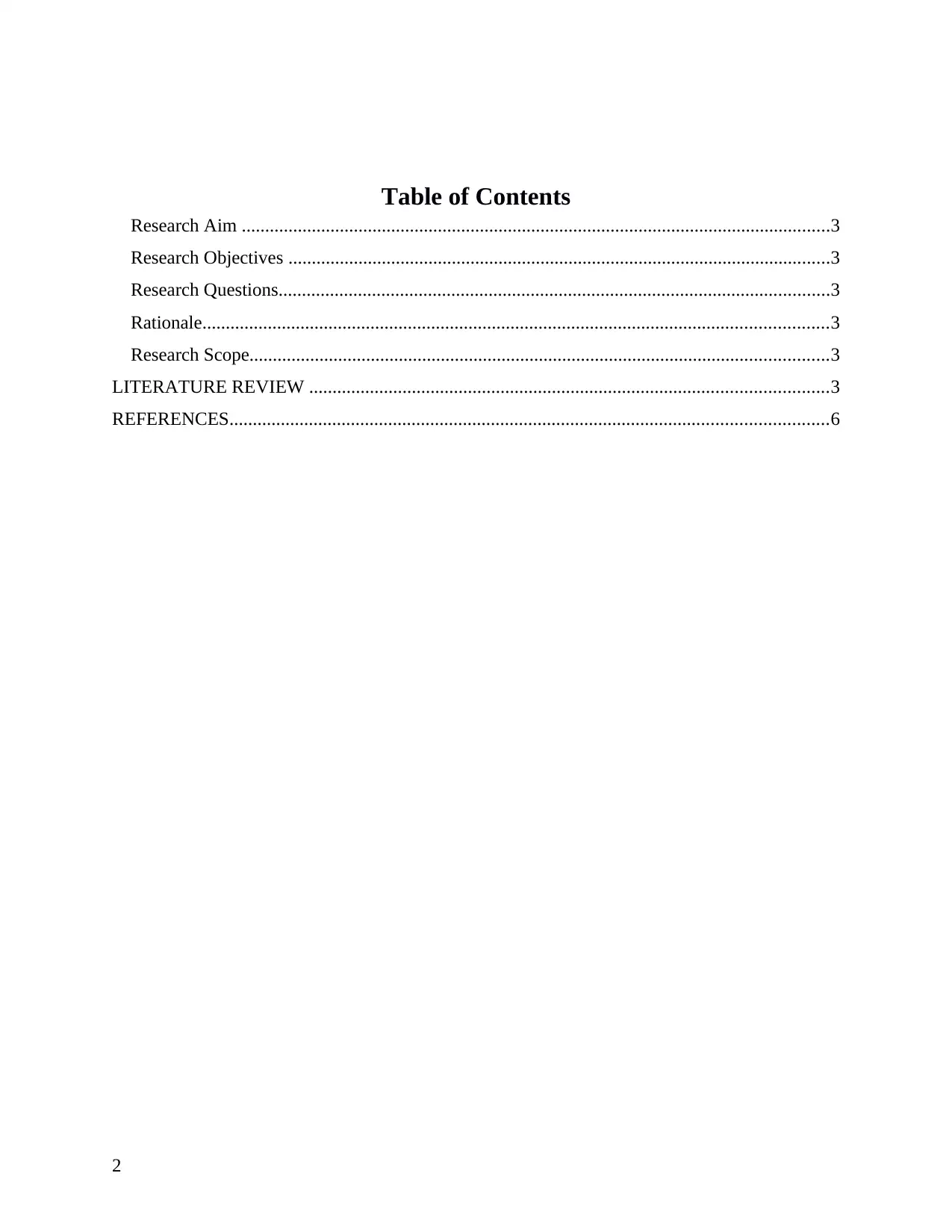
Table of Contents
Research Aim ..............................................................................................................................3
Research Objectives ....................................................................................................................3
Research Questions......................................................................................................................3
Rationale......................................................................................................................................3
Research Scope............................................................................................................................3
LITERATURE REVIEW ...............................................................................................................3
REFERENCES................................................................................................................................6
2
Research Aim ..............................................................................................................................3
Research Objectives ....................................................................................................................3
Research Questions......................................................................................................................3
Rationale......................................................................................................................................3
Research Scope............................................................................................................................3
LITERATURE REVIEW ...............................................................................................................3
REFERENCES................................................................................................................................6
2
Topic — The affect and impact of COVID -19 on hotel industry of Portugal
Research Aim
The aim of the current research is to analyse the affect and impact COVID — 19 has on
hotel industry of Portugal.
Research Objectives
By considering above aim following objectives have been drafted -
To analyse the challenges presented by COVID — 19 in hotel industry.
To analyse the affects and impact of COVID -19 on hotel industry of Portugal.
To recommend strategies for mitigating the negative impacts of COVID — 19 on hotel
industry in Portugal.
Research Questions
Q.1. What are the challenges faced by COVID — 19 in the Hotel Industry?
Q.2. What are the affect and impact of COVID -19 with regard to Hospitality Industry?
Rationale
The main reason for selecting this topic for research is to gain knowledge about the
affects and impacts of Covid — 19 has on hotel industry in Portugal. The gap which is identified
in the literature concerns that there are fewer studies done on Covid 19 and its impact on hotel
industry in Portugal. Practical benefits of the study are that it will help in acknowledging about
the ways through which Hotel industry can mitigate the negative effects of Covid- 19 pandemic.
Research Scope
The geographical area that has been covered is Portugal. And the organization which the
research is covered on is taken as Hotel Areias Do Seixo. The reason for choosing Hotel Areias
Do Seixo is as it is one of the famous Hotels in Portugal. The target group of the study will be
concerning the people related to the hotel industry of sector. Themes that will be involved in the
study will concentrate upon the impacts of Covid — 19 on hotel industry in Portugal.
3
Research Aim
The aim of the current research is to analyse the affect and impact COVID — 19 has on
hotel industry of Portugal.
Research Objectives
By considering above aim following objectives have been drafted -
To analyse the challenges presented by COVID — 19 in hotel industry.
To analyse the affects and impact of COVID -19 on hotel industry of Portugal.
To recommend strategies for mitigating the negative impacts of COVID — 19 on hotel
industry in Portugal.
Research Questions
Q.1. What are the challenges faced by COVID — 19 in the Hotel Industry?
Q.2. What are the affect and impact of COVID -19 with regard to Hospitality Industry?
Rationale
The main reason for selecting this topic for research is to gain knowledge about the
affects and impacts of Covid — 19 has on hotel industry in Portugal. The gap which is identified
in the literature concerns that there are fewer studies done on Covid 19 and its impact on hotel
industry in Portugal. Practical benefits of the study are that it will help in acknowledging about
the ways through which Hotel industry can mitigate the negative effects of Covid- 19 pandemic.
Research Scope
The geographical area that has been covered is Portugal. And the organization which the
research is covered on is taken as Hotel Areias Do Seixo. The reason for choosing Hotel Areias
Do Seixo is as it is one of the famous Hotels in Portugal. The target group of the study will be
concerning the people related to the hotel industry of sector. Themes that will be involved in the
study will concentrate upon the impacts of Covid — 19 on hotel industry in Portugal.
3
⊘ This is a preview!⊘
Do you want full access?
Subscribe today to unlock all pages.

Trusted by 1+ million students worldwide
LITERATURE REVIEW
Theme 1 — Challenges presented by COVID -19 in Hotel Industry
According to point of view of Kamruzzaman (2020), Due to Covid — 19, there are
various problems and challenges that are presented in Hotel Industry. The main challenge that
the Hotel Industry faces is the cleanliness issue. In the times of Covid -19, hotel industry finds it
difficult to deal with the safety measures that are to be taken in the tough times.
As specified by Hartley (2020), As this is the primary importance aspect for the industry
to cover up the ill effects. The second most major thing is the technology in the hotel industry.
This is also a major challenge as the Hotel industry has to create new technology measures such
as temperature checking equipment etc. Due to this pandemic, the hotel industries are the ones
which are in major loss as there is less travelling therefore hotel industries incur major financial
loss.
Theme 2 - Affects and impact of COVID -19 on hotel industry of Portugal
As stated by the Ribeiro (2021), There is no tourism in Portugal since few months as
Covid - 19 has largely impacted the tourism sector and the hotel industry on large scale. There
has been a major loss to the Hotel industries as the affects of Covid — 19 has questioned the
safety of customers acquiring services in the Hotels.
As per the Vrabie (2020), There are many cases due to Covid — 19 which have been
increasing day by day in Portugal. There are no jobs available in the Hotel industry due to Covid
- 19. Along with this, night clubs have been closed and there is capacity restraint on entry to
restaurants in the Hotels. Hotel industry has bearded the major loss as some Hotels in Portugal
has come to a situation of shut down.
Theme 3 — Recommending strategies for mitigating the negative impacts of COVID — 19
on hotel industry in Portugal
Khalid and et.al (2021) elucidates that, there are various recommendations which can be
taken care of while operating the hotel industry in the times of Covid — 19. Sanitization
facilities should be provided appropriately while serving the services to customers in the Hotel
Industry. Proper instructions in the hotel should be given to the employees for safety measures.
4
Theme 1 — Challenges presented by COVID -19 in Hotel Industry
According to point of view of Kamruzzaman (2020), Due to Covid — 19, there are
various problems and challenges that are presented in Hotel Industry. The main challenge that
the Hotel Industry faces is the cleanliness issue. In the times of Covid -19, hotel industry finds it
difficult to deal with the safety measures that are to be taken in the tough times.
As specified by Hartley (2020), As this is the primary importance aspect for the industry
to cover up the ill effects. The second most major thing is the technology in the hotel industry.
This is also a major challenge as the Hotel industry has to create new technology measures such
as temperature checking equipment etc. Due to this pandemic, the hotel industries are the ones
which are in major loss as there is less travelling therefore hotel industries incur major financial
loss.
Theme 2 - Affects and impact of COVID -19 on hotel industry of Portugal
As stated by the Ribeiro (2021), There is no tourism in Portugal since few months as
Covid - 19 has largely impacted the tourism sector and the hotel industry on large scale. There
has been a major loss to the Hotel industries as the affects of Covid — 19 has questioned the
safety of customers acquiring services in the Hotels.
As per the Vrabie (2020), There are many cases due to Covid — 19 which have been
increasing day by day in Portugal. There are no jobs available in the Hotel industry due to Covid
- 19. Along with this, night clubs have been closed and there is capacity restraint on entry to
restaurants in the Hotels. Hotel industry has bearded the major loss as some Hotels in Portugal
has come to a situation of shut down.
Theme 3 — Recommending strategies for mitigating the negative impacts of COVID — 19
on hotel industry in Portugal
Khalid and et.al (2021) elucidates that, there are various recommendations which can be
taken care of while operating the hotel industry in the times of Covid — 19. Sanitization
facilities should be provided appropriately while serving the services to customers in the Hotel
Industry. Proper instructions in the hotel should be given to the employees for safety measures.
4
Paraphrase This Document
Need a fresh take? Get an instant paraphrase of this document with our AI Paraphraser
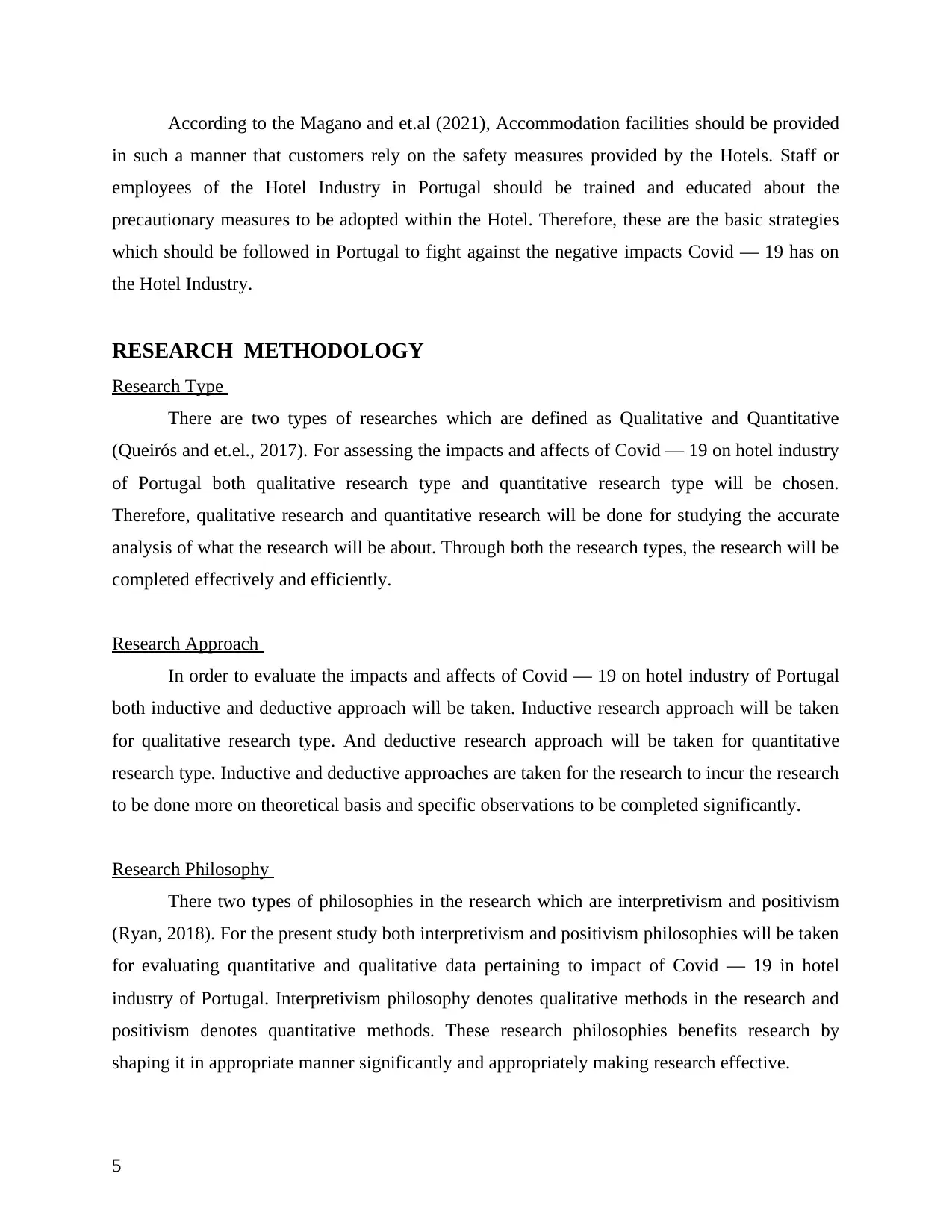
According to the Magano and et.al (2021), Accommodation facilities should be provided
in such a manner that customers rely on the safety measures provided by the Hotels. Staff or
employees of the Hotel Industry in Portugal should be trained and educated about the
precautionary measures to be adopted within the Hotel. Therefore, these are the basic strategies
which should be followed in Portugal to fight against the negative impacts Covid — 19 has on
the Hotel Industry.
RESEARCH METHODOLOGY
Research Type
There are two types of researches which are defined as Qualitative and Quantitative
(Queirós and et.el., 2017). For assessing the impacts and affects of Covid — 19 on hotel industry
of Portugal both qualitative research type and quantitative research type will be chosen.
Therefore, qualitative research and quantitative research will be done for studying the accurate
analysis of what the research will be about. Through both the research types, the research will be
completed effectively and efficiently.
Research Approach
In order to evaluate the impacts and affects of Covid — 19 on hotel industry of Portugal
both inductive and deductive approach will be taken. Inductive research approach will be taken
for qualitative research type. And deductive research approach will be taken for quantitative
research type. Inductive and deductive approaches are taken for the research to incur the research
to be done more on theoretical basis and specific observations to be completed significantly.
Research Philosophy
There two types of philosophies in the research which are interpretivism and positivism
(Ryan, 2018). For the present study both interpretivism and positivism philosophies will be taken
for evaluating quantitative and qualitative data pertaining to impact of Covid — 19 in hotel
industry of Portugal. Interpretivism philosophy denotes qualitative methods in the research and
positivism denotes quantitative methods. These research philosophies benefits research by
shaping it in appropriate manner significantly and appropriately making research effective.
5
in such a manner that customers rely on the safety measures provided by the Hotels. Staff or
employees of the Hotel Industry in Portugal should be trained and educated about the
precautionary measures to be adopted within the Hotel. Therefore, these are the basic strategies
which should be followed in Portugal to fight against the negative impacts Covid — 19 has on
the Hotel Industry.
RESEARCH METHODOLOGY
Research Type
There are two types of researches which are defined as Qualitative and Quantitative
(Queirós and et.el., 2017). For assessing the impacts and affects of Covid — 19 on hotel industry
of Portugal both qualitative research type and quantitative research type will be chosen.
Therefore, qualitative research and quantitative research will be done for studying the accurate
analysis of what the research will be about. Through both the research types, the research will be
completed effectively and efficiently.
Research Approach
In order to evaluate the impacts and affects of Covid — 19 on hotel industry of Portugal
both inductive and deductive approach will be taken. Inductive research approach will be taken
for qualitative research type. And deductive research approach will be taken for quantitative
research type. Inductive and deductive approaches are taken for the research to incur the research
to be done more on theoretical basis and specific observations to be completed significantly.
Research Philosophy
There two types of philosophies in the research which are interpretivism and positivism
(Ryan, 2018). For the present study both interpretivism and positivism philosophies will be taken
for evaluating quantitative and qualitative data pertaining to impact of Covid — 19 in hotel
industry of Portugal. Interpretivism philosophy denotes qualitative methods in the research and
positivism denotes quantitative methods. These research philosophies benefits research by
shaping it in appropriate manner significantly and appropriately making research effective.
5
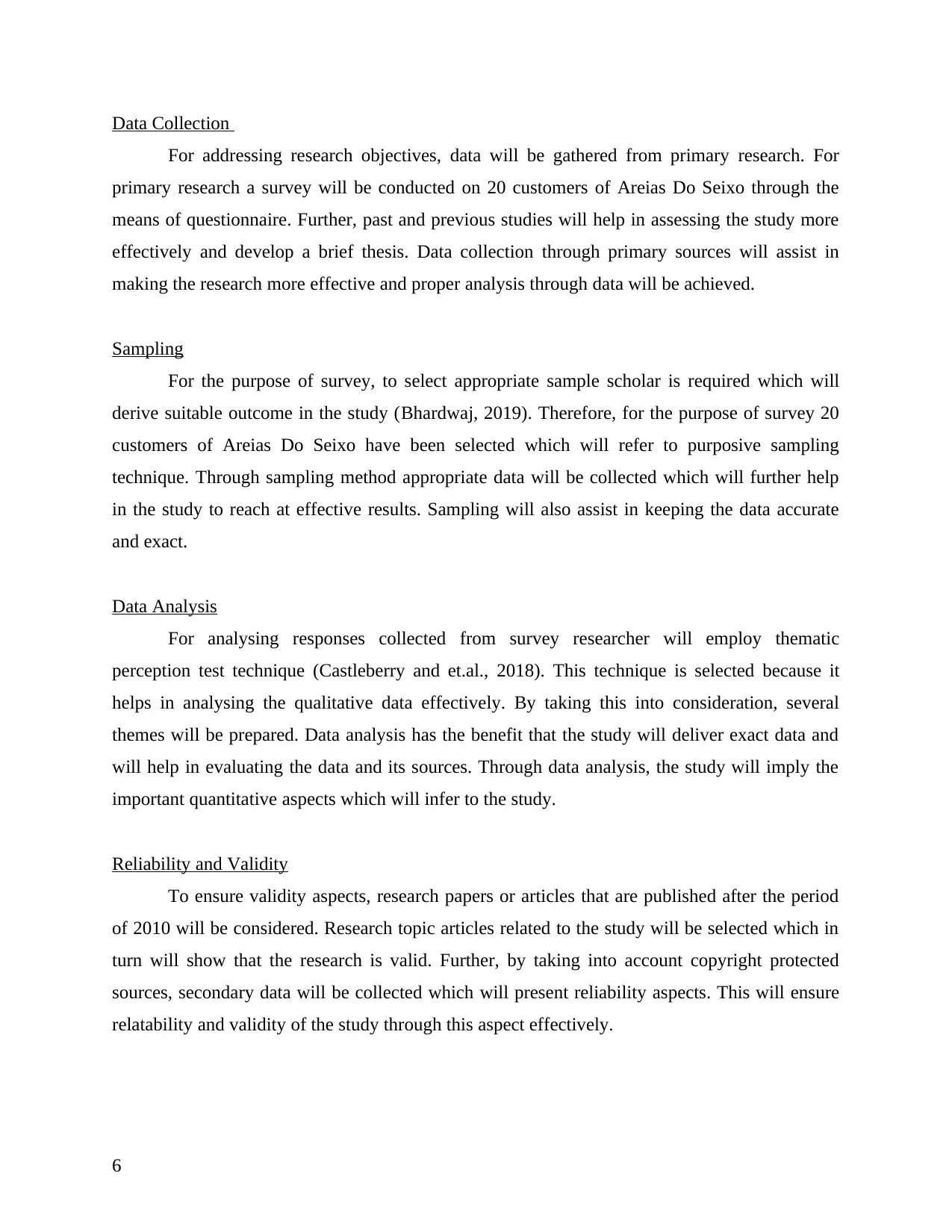
Data Collection
For addressing research objectives, data will be gathered from primary research. For
primary research a survey will be conducted on 20 customers of Areias Do Seixo through the
means of questionnaire. Further, past and previous studies will help in assessing the study more
effectively and develop a brief thesis. Data collection through primary sources will assist in
making the research more effective and proper analysis through data will be achieved.
Sampling
For the purpose of survey, to select appropriate sample scholar is required which will
derive suitable outcome in the study (Bhardwaj, 2019). Therefore, for the purpose of survey 20
customers of Areias Do Seixo have been selected which will refer to purposive sampling
technique. Through sampling method appropriate data will be collected which will further help
in the study to reach at effective results. Sampling will also assist in keeping the data accurate
and exact.
Data Analysis
For analysing responses collected from survey researcher will employ thematic
perception test technique (Castleberry and et.al., 2018). This technique is selected because it
helps in analysing the qualitative data effectively. By taking this into consideration, several
themes will be prepared. Data analysis has the benefit that the study will deliver exact data and
will help in evaluating the data and its sources. Through data analysis, the study will imply the
important quantitative aspects which will infer to the study.
Reliability and Validity
To ensure validity aspects, research papers or articles that are published after the period
of 2010 will be considered. Research topic articles related to the study will be selected which in
turn will show that the research is valid. Further, by taking into account copyright protected
sources, secondary data will be collected which will present reliability aspects. This will ensure
relatability and validity of the study through this aspect effectively.
6
For addressing research objectives, data will be gathered from primary research. For
primary research a survey will be conducted on 20 customers of Areias Do Seixo through the
means of questionnaire. Further, past and previous studies will help in assessing the study more
effectively and develop a brief thesis. Data collection through primary sources will assist in
making the research more effective and proper analysis through data will be achieved.
Sampling
For the purpose of survey, to select appropriate sample scholar is required which will
derive suitable outcome in the study (Bhardwaj, 2019). Therefore, for the purpose of survey 20
customers of Areias Do Seixo have been selected which will refer to purposive sampling
technique. Through sampling method appropriate data will be collected which will further help
in the study to reach at effective results. Sampling will also assist in keeping the data accurate
and exact.
Data Analysis
For analysing responses collected from survey researcher will employ thematic
perception test technique (Castleberry and et.al., 2018). This technique is selected because it
helps in analysing the qualitative data effectively. By taking this into consideration, several
themes will be prepared. Data analysis has the benefit that the study will deliver exact data and
will help in evaluating the data and its sources. Through data analysis, the study will imply the
important quantitative aspects which will infer to the study.
Reliability and Validity
To ensure validity aspects, research papers or articles that are published after the period
of 2010 will be considered. Research topic articles related to the study will be selected which in
turn will show that the research is valid. Further, by taking into account copyright protected
sources, secondary data will be collected which will present reliability aspects. This will ensure
relatability and validity of the study through this aspect effectively.
6
⊘ This is a preview!⊘
Do you want full access?
Subscribe today to unlock all pages.
Trusted by 1+ million students worldwide
Research Limitations
The main limitations which are recognized are unavailability of sources, time and money.
And these limitations are associated with the current study. Due to having limited time frame and
money quantitative tool such as SPSS has not been selected. Therefore, thematic analysis will be
done for avoiding the limitation. The current issue is related to both qualitative and quantitative
aspects to make the technique suitable for the study. Further, scholarly articles will be selected or
assessed using keywords which helps in resolving the issues which are related to unavailability
of resources.
Ethical Consideration
Consent forms will be sent to the respondents in order to imply with ethical aspects
which is selected for the purpose of survey been done. Through this, it will be concluded that
how participants are willing to respond to the survey being done for them. Further reference list
will be mentioned at the end of the research which will exhibit that work is not copied from
anywhere.
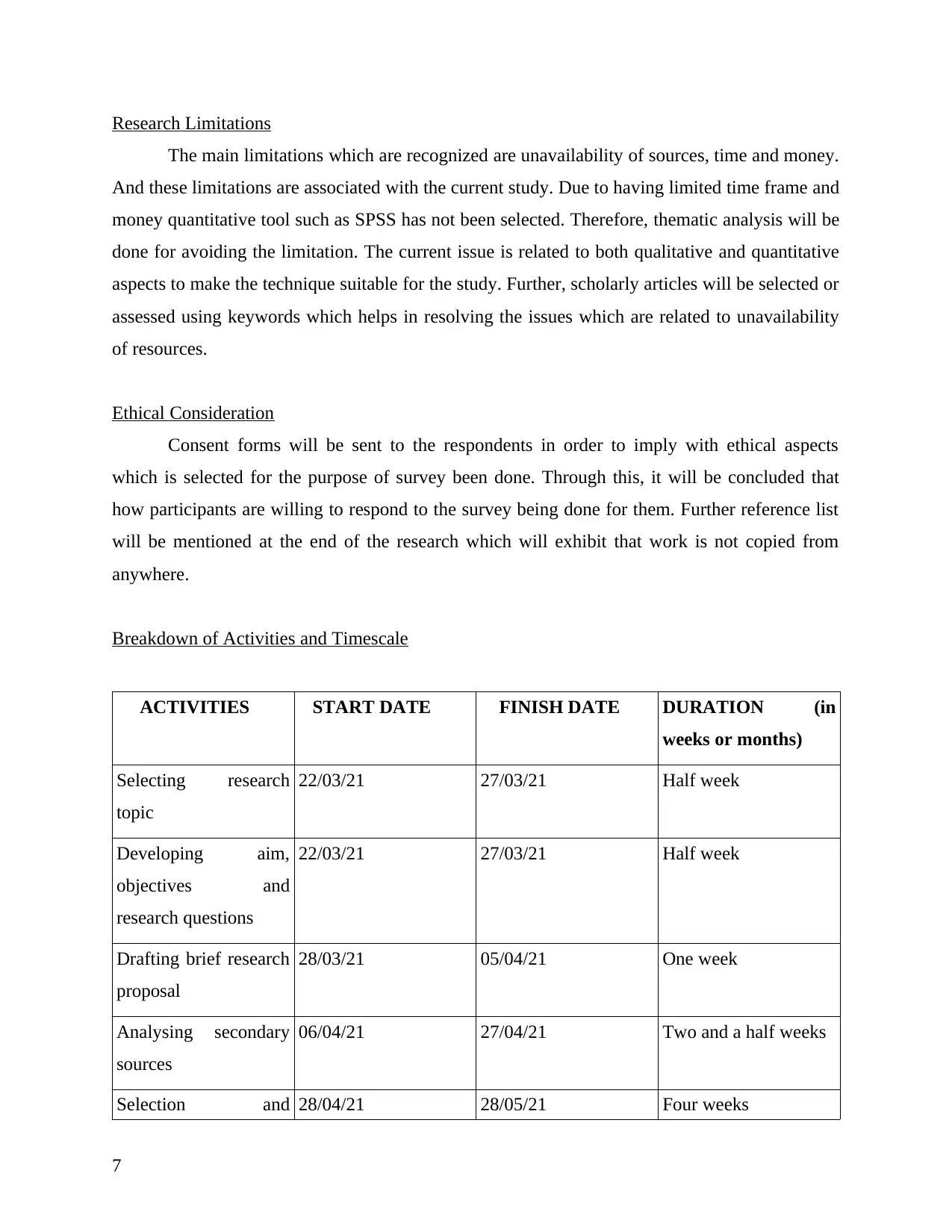
Breakdown of Activities and Timescale
ACTIVITIES START DATE FINISH DATE DURATION (in
weeks or months)
Selecting research
topic
22/03/21 27/03/21 Half week
Developing aim,
objectives and
research questions
22/03/21 27/03/21 Half week
Drafting brief research
proposal
28/03/21 05/04/21 One week
Analysing secondary
sources
06/04/21 27/04/21 Two and a half weeks
Selection and 28/04/21 28/05/21 Four weeks
7
The main limitations which are recognized are unavailability of sources, time and money.
And these limitations are associated with the current study. Due to having limited time frame and
money quantitative tool such as SPSS has not been selected. Therefore, thematic analysis will be
done for avoiding the limitation. The current issue is related to both qualitative and quantitative
aspects to make the technique suitable for the study. Further, scholarly articles will be selected or
assessed using keywords which helps in resolving the issues which are related to unavailability
of resources.
Ethical Consideration
Consent forms will be sent to the respondents in order to imply with ethical aspects
which is selected for the purpose of survey been done. Through this, it will be concluded that
how participants are willing to respond to the survey being done for them. Further reference list
will be mentioned at the end of the research which will exhibit that work is not copied from
anywhere.
Breakdown of Activities and Timescale
ACTIVITIES START DATE FINISH DATE DURATION (in
weeks or months)
Selecting research
topic
22/03/21 27/03/21 Half week
Developing aim,
objectives and
research questions
22/03/21 27/03/21 Half week
Drafting brief research
proposal
28/03/21 05/04/21 One week
Analysing secondary
sources
06/04/21 27/04/21 Two and a half weeks
Selection and 28/04/21 28/05/21 Four weeks
7
Paraphrase This Document
Need a fresh take? Get an instant paraphrase of this document with our AI Paraphraser
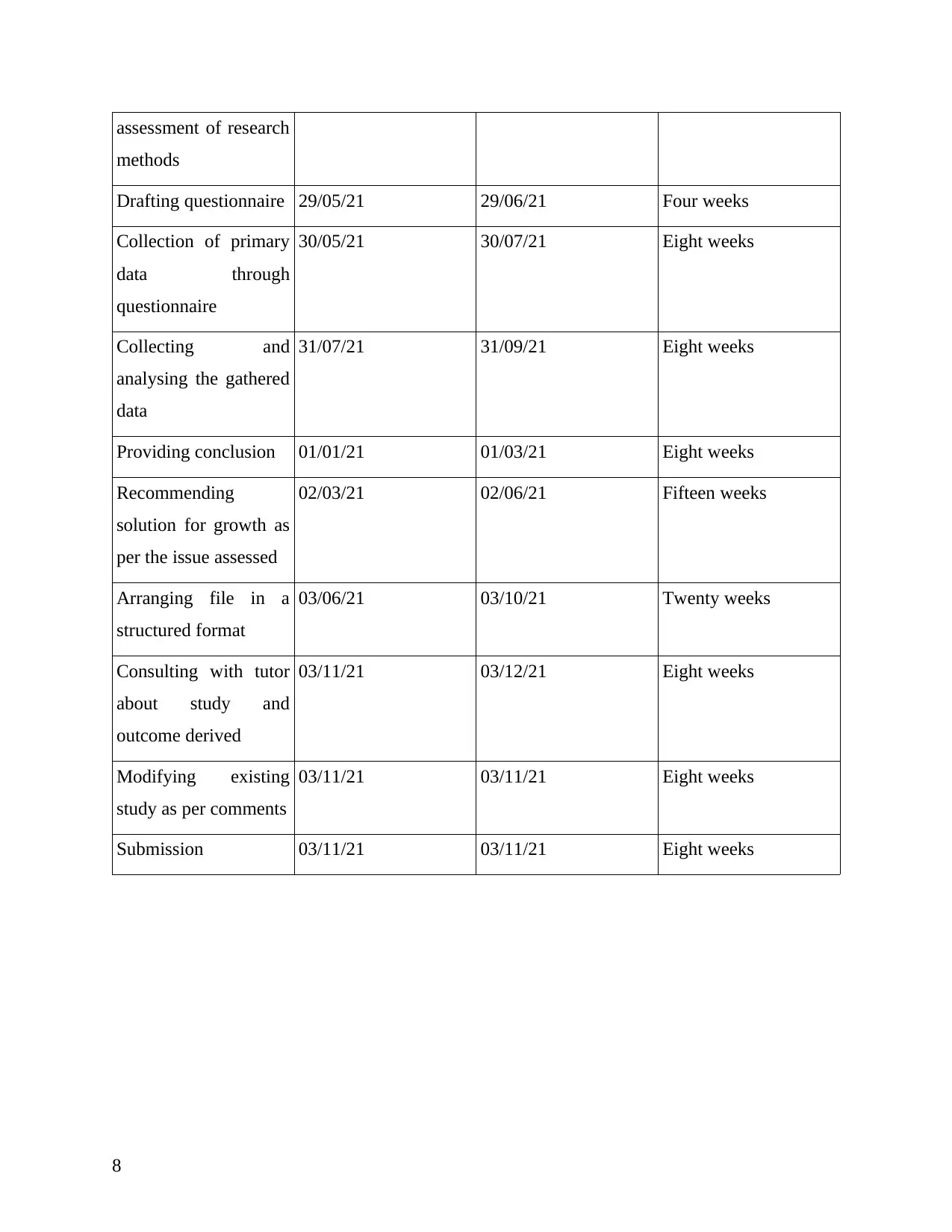
assessment of research
methods
Drafting questionnaire 29/05/21 29/06/21 Four weeks
Collection of primary
data through
questionnaire
30/05/21 30/07/21 Eight weeks
Collecting and
analysing the gathered
data
31/07/21 31/09/21 Eight weeks
Providing conclusion 01/01/21 01/03/21 Eight weeks
Recommending
solution for growth as
per the issue assessed
02/03/21 02/06/21 Fifteen weeks
Arranging file in a
structured format
03/06/21 03/10/21 Twenty weeks
Consulting with tutor
about study and
outcome derived
03/11/21 03/12/21 Eight weeks
Modifying existing
study as per comments
03/11/21 03/11/21 Eight weeks
Submission 03/11/21 03/11/21 Eight weeks
8
methods
Drafting questionnaire 29/05/21 29/06/21 Four weeks
Collection of primary
data through
questionnaire
30/05/21 30/07/21 Eight weeks
Collecting and
analysing the gathered
data
31/07/21 31/09/21 Eight weeks
Providing conclusion 01/01/21 01/03/21 Eight weeks
Recommending
solution for growth as
per the issue assessed
02/03/21 02/06/21 Fifteen weeks
Arranging file in a
structured format
03/06/21 03/10/21 Twenty weeks
Consulting with tutor
about study and
outcome derived
03/11/21 03/12/21 Eight weeks
Modifying existing
study as per comments
03/11/21 03/11/21 Eight weeks
Submission 03/11/21 03/11/21 Eight weeks
8
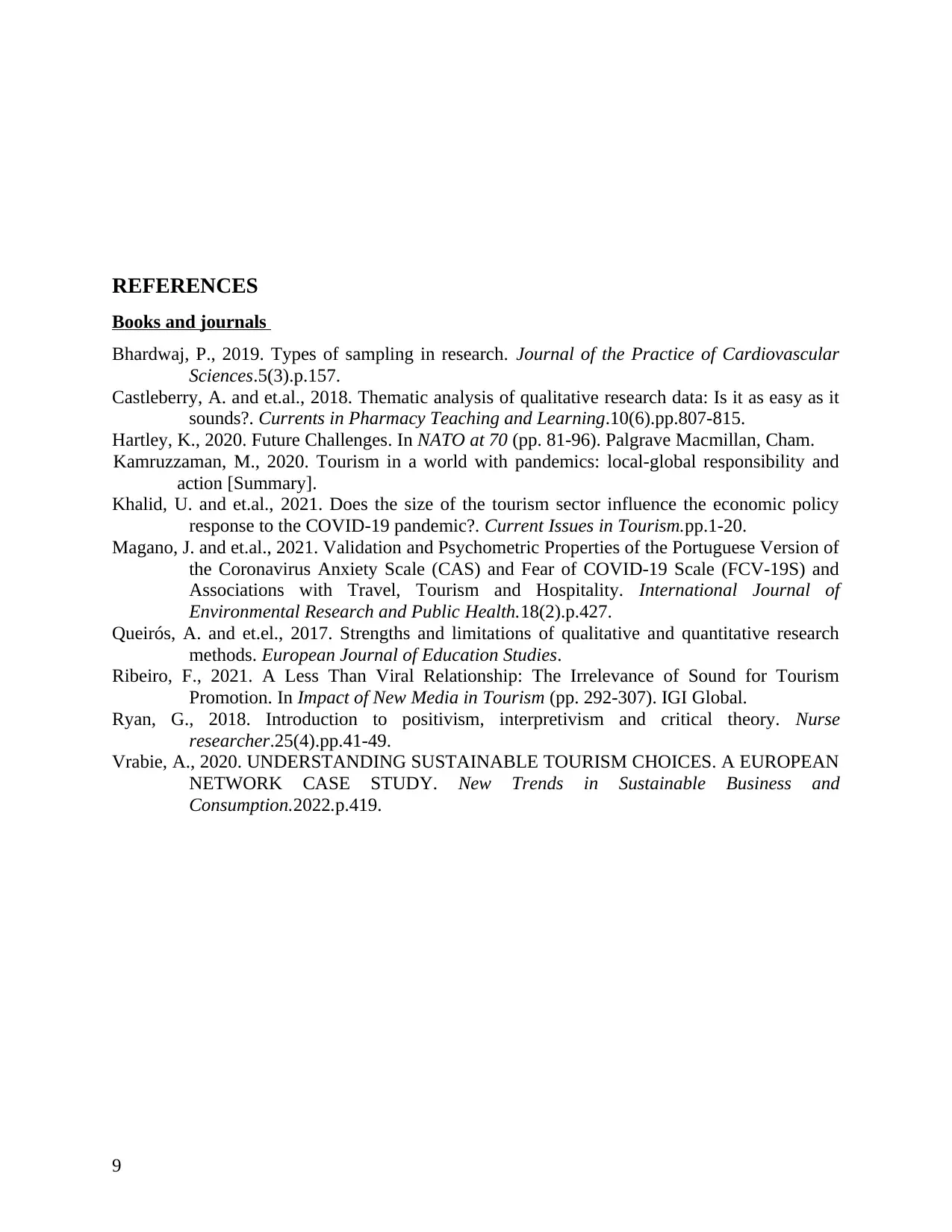
REFERENCES
Books and journals
Bhardwaj, P., 2019. Types of sampling in research. Journal of the Practice of Cardiovascular
Sciences.5(3).p.157.
Castleberry, A. and et.al., 2018. Thematic analysis of qualitative research data: Is it as easy as it
sounds?. Currents in Pharmacy Teaching and Learning.10(6).pp.807-815.
Hartley, K., 2020. Future Challenges. In NATO at 70 (pp. 81-96). Palgrave Macmillan, Cham.
Kamruzzaman, M., 2020. Tourism in a world with pandemics: local-global responsibility and
action [Summary].
Khalid, U. and et.al., 2021. Does the size of the tourism sector influence the economic policy
response to the COVID-19 pandemic?. Current Issues in Tourism.pp.1-20.
Magano, J. and et.al., 2021. Validation and Psychometric Properties of the Portuguese Version of
the Coronavirus Anxiety Scale (CAS) and Fear of COVID-19 Scale (FCV-19S) and
Associations with Travel, Tourism and Hospitality. International Journal of
Environmental Research and Public Health.18(2).p.427.
Queirós, A. and et.el., 2017. Strengths and limitations of qualitative and quantitative research
methods. European Journal of Education Studies.
Ribeiro, F., 2021. A Less Than Viral Relationship: The Irrelevance of Sound for Tourism
Promotion. In Impact of New Media in Tourism (pp. 292-307). IGI Global.
Ryan, G., 2018. Introduction to positivism, interpretivism and critical theory. Nurse
researcher.25(4).pp.41-49.
Vrabie, A., 2020. UNDERSTANDING SUSTAINABLE TOURISM CHOICES. A EUROPEAN
NETWORK CASE STUDY. New Trends in Sustainable Business and
Consumption.2022.p.419.
9
Books and journals
Bhardwaj, P., 2019. Types of sampling in research. Journal of the Practice of Cardiovascular
Sciences.5(3).p.157.
Castleberry, A. and et.al., 2018. Thematic analysis of qualitative research data: Is it as easy as it
sounds?. Currents in Pharmacy Teaching and Learning.10(6).pp.807-815.
Hartley, K., 2020. Future Challenges. In NATO at 70 (pp. 81-96). Palgrave Macmillan, Cham.
Kamruzzaman, M., 2020. Tourism in a world with pandemics: local-global responsibility and
action [Summary].
Khalid, U. and et.al., 2021. Does the size of the tourism sector influence the economic policy
response to the COVID-19 pandemic?. Current Issues in Tourism.pp.1-20.
Magano, J. and et.al., 2021. Validation and Psychometric Properties of the Portuguese Version of
the Coronavirus Anxiety Scale (CAS) and Fear of COVID-19 Scale (FCV-19S) and
Associations with Travel, Tourism and Hospitality. International Journal of
Environmental Research and Public Health.18(2).p.427.
Queirós, A. and et.el., 2017. Strengths and limitations of qualitative and quantitative research
methods. European Journal of Education Studies.
Ribeiro, F., 2021. A Less Than Viral Relationship: The Irrelevance of Sound for Tourism
Promotion. In Impact of New Media in Tourism (pp. 292-307). IGI Global.
Ryan, G., 2018. Introduction to positivism, interpretivism and critical theory. Nurse
researcher.25(4).pp.41-49.
Vrabie, A., 2020. UNDERSTANDING SUSTAINABLE TOURISM CHOICES. A EUROPEAN
NETWORK CASE STUDY. New Trends in Sustainable Business and
Consumption.2022.p.419.
9
⊘ This is a preview!⊘
Do you want full access?
Subscribe today to unlock all pages.
Trusted by 1+ million students worldwide

1 out of 9


Related Documents


Your All-in-One AI-Powered Toolkit for Academic Success.
+13062052269
info@desklib.com
Available 24*7 on WhatsApp / Email
![[object Object]](/_next/static/media/star-bottom.7253800d.svg)
Unlock your academic potential
Copyright © 2020–2026 A2Z Services. All Rights Reserved. Developed and managed by ZUCOL.