CPPDSM4056A: Managing Conflict and Disputes in Real Estate
VerifiedAdded on 2020/07/22
|38
|8160
|39
Homework Assignment
AI Summary
This document presents a completed assessment for the CPPDSM4056A unit, focusing on managing conflict and disputes within the property industry. The assignment explores the definition of conflict, reasons for high conflict levels in the property sector, and detailed explanations of conflict situations. It covers essential elements such as assessing conflict or dispute, negotiating resolutions, and evaluating responses, aligning with organizational and legislative requirements. The assessment includes analyzing conflict causes, identifying appropriate responses, and utilizing effective communication and negotiation techniques. It also addresses the importance of specialist advice, contingency measures, and the use of business equipment and technology for record-keeping. The document demonstrates an understanding of social, cultural differences, and the importance of maintaining confidentiality and safety throughout the conflict resolution process. The assessment emphasizes the application of range statements and performance criteria, including examples of conflict situations, organizational and legislative requirements, and communication and negotiation techniques.
CPPDSM4056A
Manage conflict and
disputes in the property
industry
Assessment
Real Estate Training
Solutions
Manage conflict and
disputes in the property
industry
Assessment
Real Estate Training
Solutions

Paraphrase This Document
Need a fresh take? Get an instant paraphrase of this document with our AI Paraphraser
CPPDSM4056A Manage conflict and disputes in the property industry
© Real Estate Training Solutions P/L
V4_1213 2
Copyright
The information in this booklet is copyright to Real Estate Training Solutions and may not
be used or reproduced in whole or in part without the prior written consent of Real
Estate Training Solutions.
Disclaimer
While every effort has been made to ensure that the information contained in this product
is free from errors and omissions and is not misleading in any way, Real Estate
Training Solutions makes no representations or warranties and is not liable for any loss
or damage or injury of any kind (however caused) under any theory of law including
negligence resulting from or in any way connected with the use of this product. RETS
does not assume any legal liability, whether direct or indirect, for the accuracy,
comprehensiveness or usefulness of any information, or the reliance on this
information.
© Real Estate Training Solutions P/L
V4_1213 2
Copyright
The information in this booklet is copyright to Real Estate Training Solutions and may not
be used or reproduced in whole or in part without the prior written consent of Real
Estate Training Solutions.
Disclaimer
While every effort has been made to ensure that the information contained in this product
is free from errors and omissions and is not misleading in any way, Real Estate
Training Solutions makes no representations or warranties and is not liable for any loss
or damage or injury of any kind (however caused) under any theory of law including
negligence resulting from or in any way connected with the use of this product. RETS
does not assume any legal liability, whether direct or indirect, for the accuracy,
comprehensiveness or usefulness of any information, or the reliance on this
information.
CPPDSM4056A Manage conflict and disputes in the property industry
Assessments
Completing your assessments
You will find as follows the assessments you will need to complete for this
unit of competence. You will need to complete all of the assessments.
To complete the assessments you can do either of the following:
1) Type your answers directly into the document and print off and sign
each page, then post to RETS
or
2) Print off and hand write the answers, sign each page, then post to
RETS
YOU MUST COMPLETE AND HAND IN THIS ENTIRE DOCUMENT.
If we do not receive the entire completed work book it will be sent
back unmarked.
YOU MUST WRITE YOUR NAME, SIGN AND DATE EACH PAGE OF
YOUR ASSESSMENT
Sending in Assessments
All written assessments and evidence must be legible. When you are
completing your assessments and collecting your evidence keep in mind
the elements and performance criteria– you will find these at the front of
the Learners Guide. Your assessor will be assessing you against all of these
things. If you need more information on assessment go to your ‘Student
Assessment Information Booklet’ which is in your traineeship kit,
alternatively speak to your assessor.
Ensure that all necessary parts of the Assessment Cover Sheet are signed.
You will see these are indicated with an ‘’. You will need to have your
workplace supervisor also sign the necessary sections.
Remember: if you are posting your assessments and evidence
always keep a copy or scan of all of your work. RETS is not
responsible for any material that is lost in the post or does not
reach our office.
Assessments
Completing your assessments
You will find as follows the assessments you will need to complete for this
unit of competence. You will need to complete all of the assessments.
To complete the assessments you can do either of the following:
1) Type your answers directly into the document and print off and sign
each page, then post to RETS
or
2) Print off and hand write the answers, sign each page, then post to
RETS
YOU MUST COMPLETE AND HAND IN THIS ENTIRE DOCUMENT.
If we do not receive the entire completed work book it will be sent
back unmarked.
YOU MUST WRITE YOUR NAME, SIGN AND DATE EACH PAGE OF
YOUR ASSESSMENT
Sending in Assessments
All written assessments and evidence must be legible. When you are
completing your assessments and collecting your evidence keep in mind
the elements and performance criteria– you will find these at the front of
the Learners Guide. Your assessor will be assessing you against all of these
things. If you need more information on assessment go to your ‘Student
Assessment Information Booklet’ which is in your traineeship kit,
alternatively speak to your assessor.
Ensure that all necessary parts of the Assessment Cover Sheet are signed.
You will see these are indicated with an ‘’. You will need to have your
workplace supervisor also sign the necessary sections.
Remember: if you are posting your assessments and evidence
always keep a copy or scan of all of your work. RETS is not
responsible for any material that is lost in the post or does not
reach our office.
⊘ This is a preview!⊘
Do you want full access?
Subscribe today to unlock all pages.

Trusted by 1+ million students worldwide

CPPDSM4056A Manage conflict and disputes in the property industry
Paraphrase This Document
Need a fresh take? Get an instant paraphrase of this document with our AI Paraphraser
CPPDSM4056A Manage conflict and disputes in the property industry
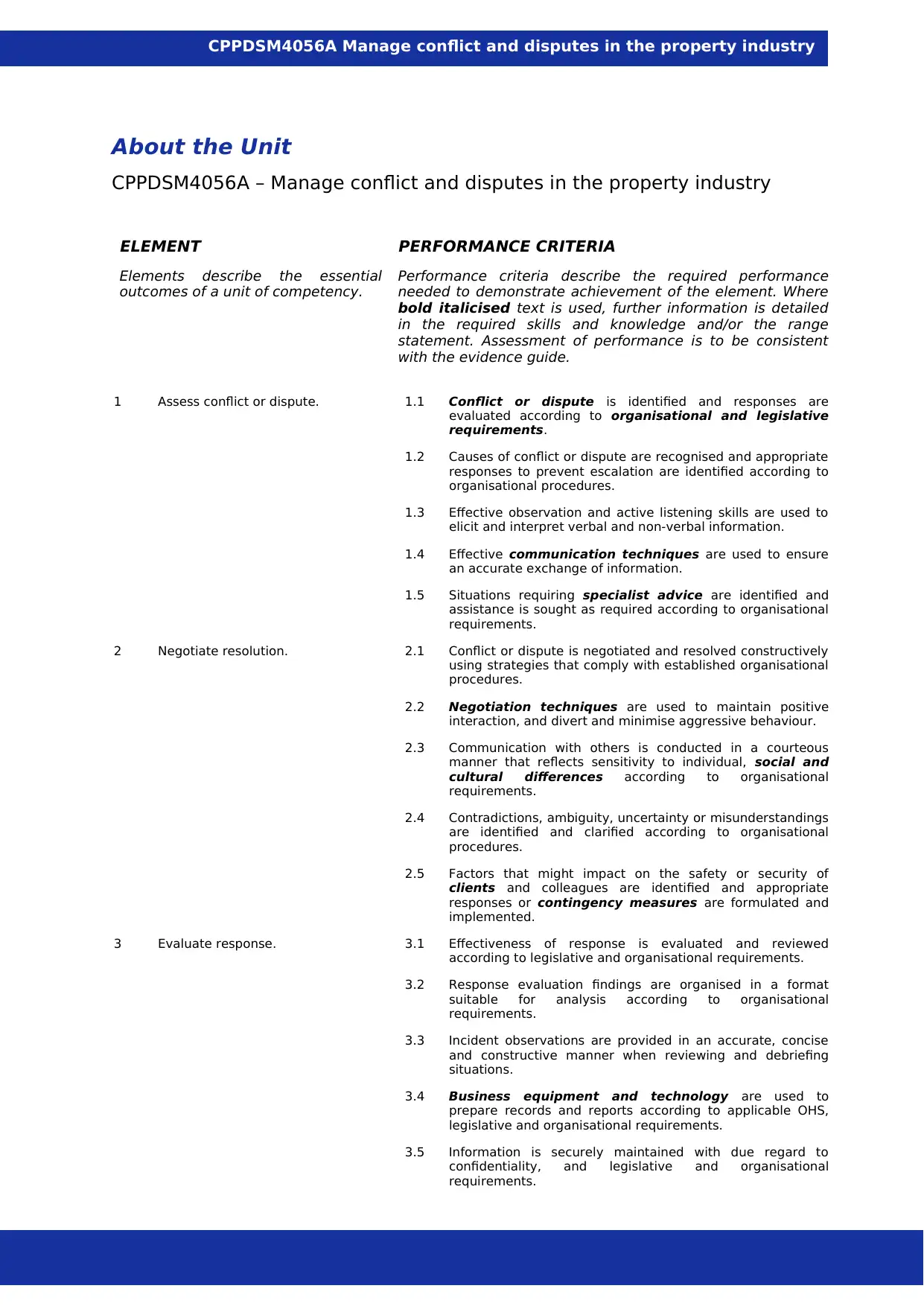
About the Unit
CPPDSM4056A – Manage conflict and disputes in the property industry
ELEMENT PERFORMANCE CRITERIA
Elements describe the essential
outcomes of a unit of competency.
Performance criteria describe the required performance
needed to demonstrate achievement of the element. Where
bold italicised text is used, further information is detailed
in the required skills and knowledge and/or the range
statement. Assessment of performance is to be consistent
with the evidence guide.
1 Assess conflict or dispute. 1.1 Conflict or dispute is identified and responses are
evaluated according to organisational and legislative
requirements.
1.2 Causes of conflict or dispute are recognised and appropriate
responses to prevent escalation are identified according to
organisational procedures.
1.3 Effective observation and active listening skills are used to
elicit and interpret verbal and non-verbal information.
1.4 Effective communication techniques are used to ensure
an accurate exchange of information.
1.5 Situations requiring specialist advice are identified and
assistance is sought as required according to organisational
requirements.
2 Negotiate resolution. 2.1 Conflict or dispute is negotiated and resolved constructively
using strategies that comply with established organisational
procedures.
2.2 Negotiation techniques are used to maintain positive
interaction, and divert and minimise aggressive behaviour.
2.3 Communication with others is conducted in a courteous
manner that reflects sensitivity to individual, social and
cultural differences according to organisational
requirements.
2.4 Contradictions, ambiguity, uncertainty or misunderstandings
are identified and clarified according to organisational
procedures.
2.5 Factors that might impact on the safety or security of
clients and colleagues are identified and appropriate
responses or contingency measures are formulated and
implemented.
3 Evaluate response. 3.1 Effectiveness of response is evaluated and reviewed
according to legislative and organisational requirements.
3.2 Response evaluation findings are organised in a format
suitable for analysis according to organisational
requirements.
3.3 Incident observations are provided in an accurate, concise
and constructive manner when reviewing and debriefing
situations.
3.4 Business equipment and technology are used to
prepare records and reports according to applicable OHS,
legislative and organisational requirements.
3.5 Information is securely maintained with due regard to
confidentiality, and legislative and organisational
requirements.
About the Unit
CPPDSM4056A – Manage conflict and disputes in the property industry
ELEMENT PERFORMANCE CRITERIA
Elements describe the essential
outcomes of a unit of competency.
Performance criteria describe the required performance
needed to demonstrate achievement of the element. Where
bold italicised text is used, further information is detailed
in the required skills and knowledge and/or the range
statement. Assessment of performance is to be consistent
with the evidence guide.
1 Assess conflict or dispute. 1.1 Conflict or dispute is identified and responses are
evaluated according to organisational and legislative
requirements.
1.2 Causes of conflict or dispute are recognised and appropriate
responses to prevent escalation are identified according to
organisational procedures.
1.3 Effective observation and active listening skills are used to
elicit and interpret verbal and non-verbal information.
1.4 Effective communication techniques are used to ensure
an accurate exchange of information.
1.5 Situations requiring specialist advice are identified and
assistance is sought as required according to organisational
requirements.
2 Negotiate resolution. 2.1 Conflict or dispute is negotiated and resolved constructively
using strategies that comply with established organisational
procedures.
2.2 Negotiation techniques are used to maintain positive
interaction, and divert and minimise aggressive behaviour.
2.3 Communication with others is conducted in a courteous
manner that reflects sensitivity to individual, social and
cultural differences according to organisational
requirements.
2.4 Contradictions, ambiguity, uncertainty or misunderstandings
are identified and clarified according to organisational
procedures.
2.5 Factors that might impact on the safety or security of
clients and colleagues are identified and appropriate
responses or contingency measures are formulated and
implemented.
3 Evaluate response. 3.1 Effectiveness of response is evaluated and reviewed
according to legislative and organisational requirements.
3.2 Response evaluation findings are organised in a format
suitable for analysis according to organisational
requirements.
3.3 Incident observations are provided in an accurate, concise
and constructive manner when reviewing and debriefing
situations.
3.4 Business equipment and technology are used to
prepare records and reports according to applicable OHS,
legislative and organisational requirements.
3.5 Information is securely maintained with due regard to
confidentiality, and legislative and organisational
requirements.
CPPDSM4056A Manage conflict and disputes in the property industry
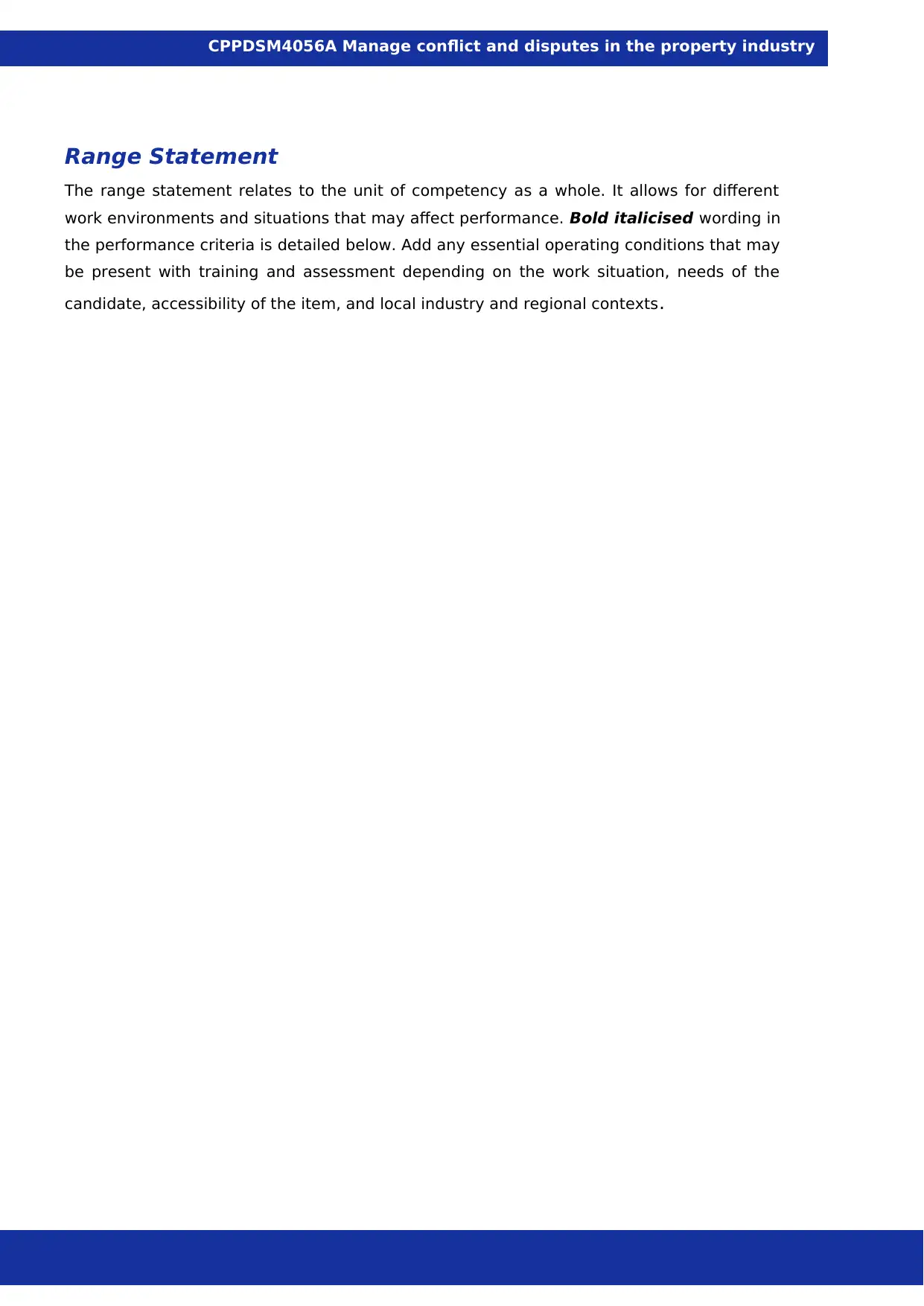
Range Statement
The range statement relates to the unit of competency as a whole. It allows for different
work environments and situations that may affect performance. Bold italicised wording in
the performance criteria is detailed below. Add any essential operating conditions that may
be present with training and assessment depending on the work situation, needs of the
candidate, accessibility of the item, and local industry and regional contexts.
Range Statement
The range statement relates to the unit of competency as a whole. It allows for different
work environments and situations that may affect performance. Bold italicised wording in
the performance criteria is detailed below. Add any essential operating conditions that may
be present with training and assessment depending on the work situation, needs of the
candidate, accessibility of the item, and local industry and regional contexts.
⊘ This is a preview!⊘
Do you want full access?
Subscribe today to unlock all pages.
Trusted by 1+ million students worldwide
CPPDSM4056A Manage conflict and disputes in the property industry
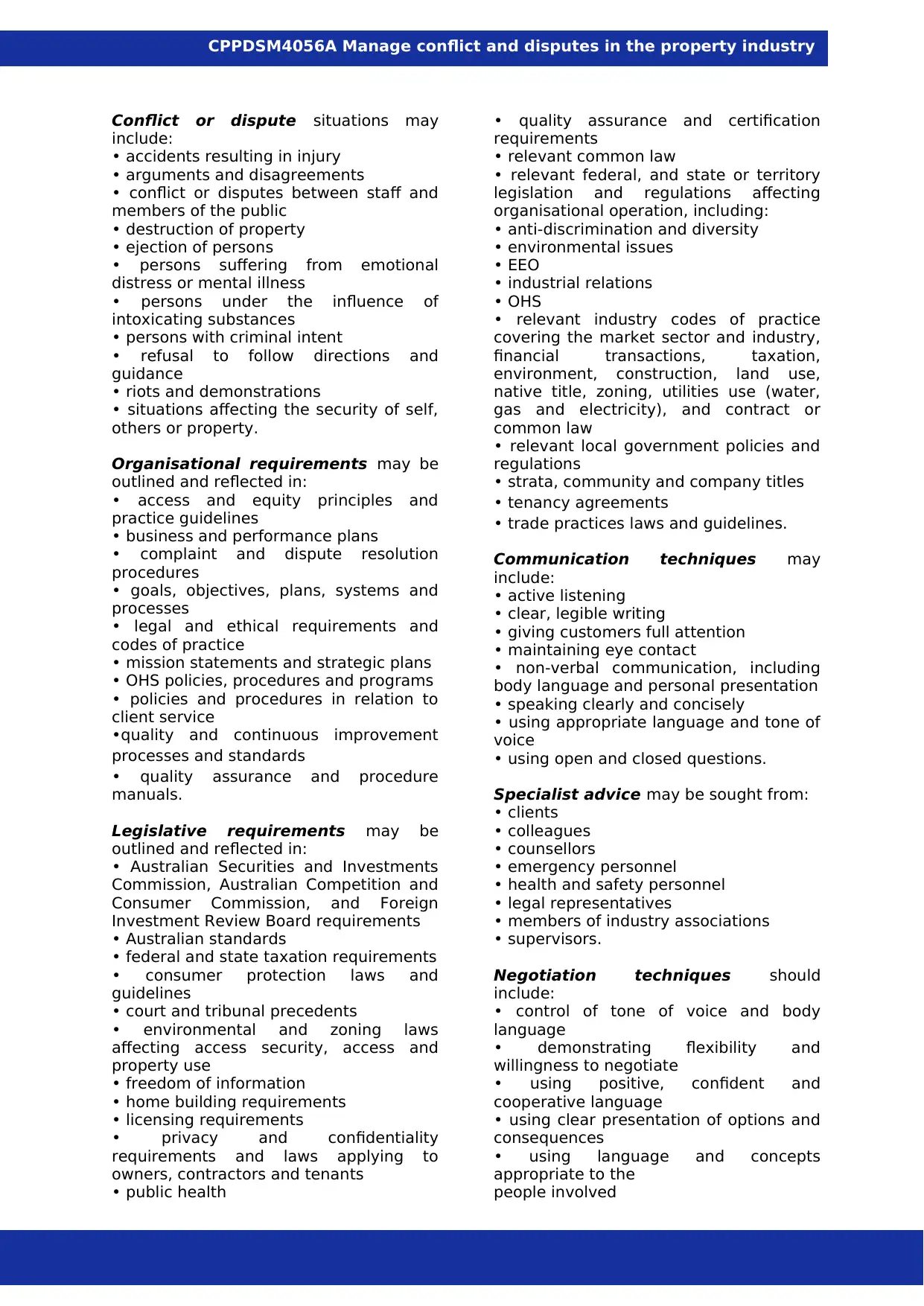
Conflict or dispute situations may
include:
• accidents resulting in injury
• arguments and disagreements
• conflict or disputes between staff and
members of the public
• destruction of property
• ejection of persons
• persons suffering from emotional
distress or mental illness
• persons under the influence of
intoxicating substances
• persons with criminal intent
• refusal to follow directions and
guidance
• riots and demonstrations
• situations affecting the security of self,
others or property.
Organisational requirements may be
outlined and reflected in:
• access and equity principles and
practice guidelines
• business and performance plans
• complaint and dispute resolution
procedures
• goals, objectives, plans, systems and
processes
• legal and ethical requirements and
codes of practice
• mission statements and strategic plans
• OHS policies, procedures and programs
• policies and procedures in relation to
client service
•quality and continuous improvement
processes and standards
• quality assurance and procedure
manuals.
Legislative requirements may be
outlined and reflected in:
• Australian Securities and Investments
Commission, Australian Competition and
Consumer Commission, and Foreign
Investment Review Board requirements
• Australian standards
• federal and state taxation requirements
• consumer protection laws and
guidelines
• court and tribunal precedents
• environmental and zoning laws
affecting access security, access and
property use
• freedom of information
• home building requirements
• licensing requirements
• privacy and confidentiality
requirements and laws applying to
owners, contractors and tenants
• public health
• quality assurance and certification
requirements
• relevant common law
• relevant federal, and state or territory
legislation and regulations affecting
organisational operation, including:
• anti-discrimination and diversity
• environmental issues
• EEO
• industrial relations
• OHS
• relevant industry codes of practice
covering the market sector and industry,
financial transactions, taxation,
environment, construction, land use,
native title, zoning, utilities use (water,
gas and electricity), and contract or
common law
• relevant local government policies and
regulations
• strata, community and company titles
• tenancy agreements
• trade practices laws and guidelines.
Communication techniques may
include:
• active listening
• clear, legible writing
• giving customers full attention
• maintaining eye contact
• non-verbal communication, including
body language and personal presentation
• speaking clearly and concisely
• using appropriate language and tone of
voice
• using open and closed questions.
Specialist advice may be sought from:
• clients
• colleagues
• counsellors
• emergency personnel
• health and safety personnel
• legal representatives
• members of industry associations
• supervisors.
Negotiation techniques should
include:
• control of tone of voice and body
language
• demonstrating flexibility and
willingness to negotiate
• using positive, confident and
cooperative language
• using clear presentation of options and
consequences
• using language and concepts
appropriate to the
people involved
Conflict or dispute situations may
include:
• accidents resulting in injury
• arguments and disagreements
• conflict or disputes between staff and
members of the public
• destruction of property
• ejection of persons
• persons suffering from emotional
distress or mental illness
• persons under the influence of
intoxicating substances
• persons with criminal intent
• refusal to follow directions and
guidance
• riots and demonstrations
• situations affecting the security of self,
others or property.
Organisational requirements may be
outlined and reflected in:
• access and equity principles and
practice guidelines
• business and performance plans
• complaint and dispute resolution
procedures
• goals, objectives, plans, systems and
processes
• legal and ethical requirements and
codes of practice
• mission statements and strategic plans
• OHS policies, procedures and programs
• policies and procedures in relation to
client service
•quality and continuous improvement
processes and standards
• quality assurance and procedure
manuals.
Legislative requirements may be
outlined and reflected in:
• Australian Securities and Investments
Commission, Australian Competition and
Consumer Commission, and Foreign
Investment Review Board requirements
• Australian standards
• federal and state taxation requirements
• consumer protection laws and
guidelines
• court and tribunal precedents
• environmental and zoning laws
affecting access security, access and
property use
• freedom of information
• home building requirements
• licensing requirements
• privacy and confidentiality
requirements and laws applying to
owners, contractors and tenants
• public health
• quality assurance and certification
requirements
• relevant common law
• relevant federal, and state or territory
legislation and regulations affecting
organisational operation, including:
• anti-discrimination and diversity
• environmental issues
• EEO
• industrial relations
• OHS
• relevant industry codes of practice
covering the market sector and industry,
financial transactions, taxation,
environment, construction, land use,
native title, zoning, utilities use (water,
gas and electricity), and contract or
common law
• relevant local government policies and
regulations
• strata, community and company titles
• tenancy agreements
• trade practices laws and guidelines.
Communication techniques may
include:
• active listening
• clear, legible writing
• giving customers full attention
• maintaining eye contact
• non-verbal communication, including
body language and personal presentation
• speaking clearly and concisely
• using appropriate language and tone of
voice
• using open and closed questions.
Specialist advice may be sought from:
• clients
• colleagues
• counsellors
• emergency personnel
• health and safety personnel
• legal representatives
• members of industry associations
• supervisors.
Negotiation techniques should
include:
• control of tone of voice and body
language
• demonstrating flexibility and
willingness to negotiate
• using positive, confident and
cooperative language
• using clear presentation of options and
consequences
• using language and concepts
appropriate to the
people involved
Paraphrase This Document
Need a fresh take? Get an instant paraphrase of this document with our AI Paraphraser
CPPDSM4056A Manage conflict and disputes in the property industry
• using strategic questioning and
listening to gather
information and direct the focus of
people involved
• using summarising of positions and
agreements to
move understanding.
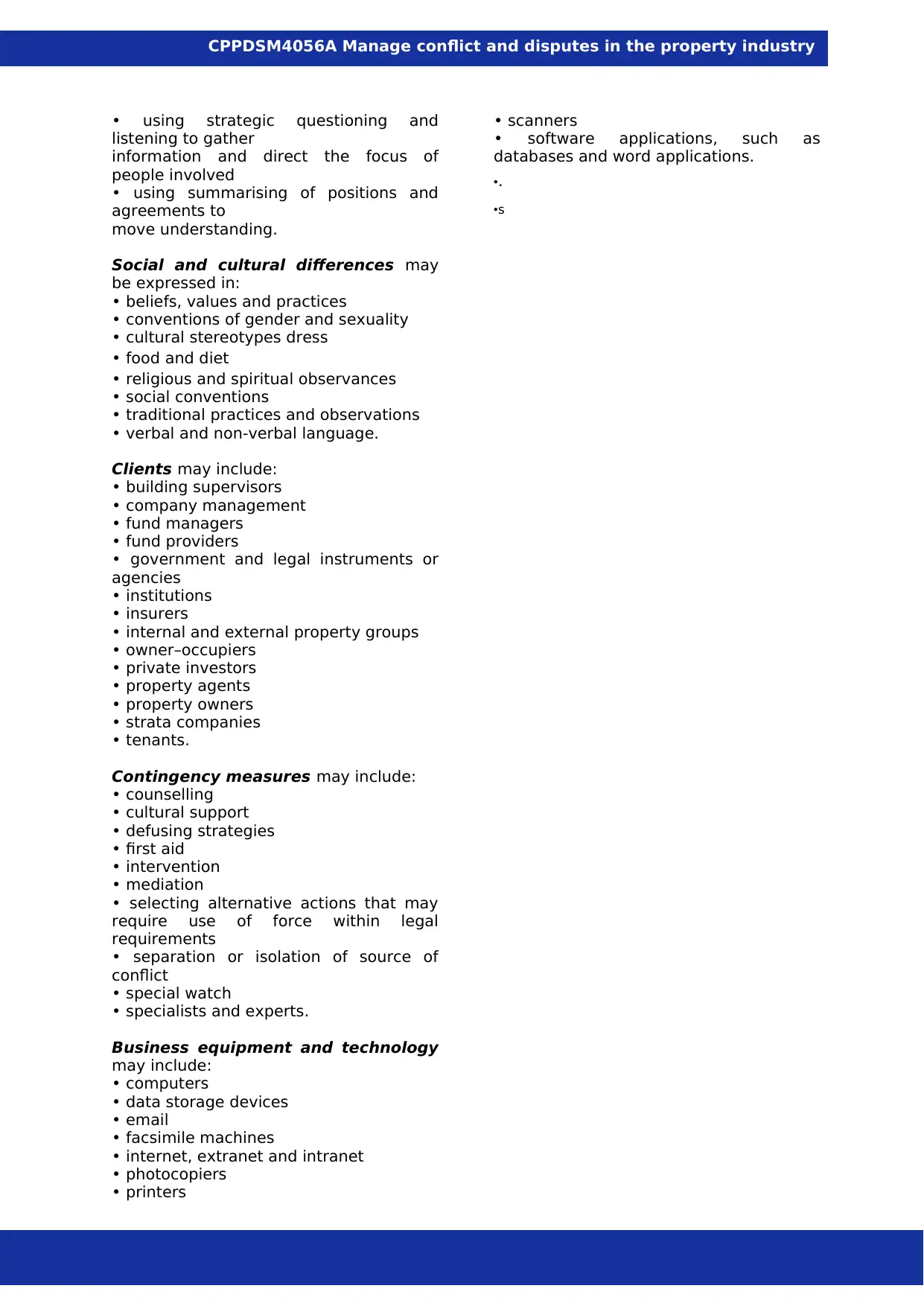
Social and cultural differences may
be expressed in:
• beliefs, values and practices
• conventions of gender and sexuality
• cultural stereotypes dress
• food and diet
• religious and spiritual observances
• social conventions
• traditional practices and observations
• verbal and non-verbal language.
Clients may include:
• building supervisors
• company management
• fund managers
• fund providers
• government and legal instruments or
agencies
• institutions
• insurers
• internal and external property groups
• owner–occupiers
• private investors
• property agents
• property owners
• strata companies
• tenants.
Contingency measures may include:
• counselling
• cultural support
• defusing strategies
• first aid
• intervention
• mediation
• selecting alternative actions that may
require use of force within legal
requirements
• separation or isolation of source of
conflict
• special watch
• specialists and experts.
Business equipment and technology
may include:
• computers
• data storage devices
• email
• facsimile machines
• internet, extranet and intranet
• photocopiers
• printers
• scanners
• software applications, such as
databases and word applications.
•.
•s
• using strategic questioning and
listening to gather
information and direct the focus of
people involved
• using summarising of positions and
agreements to
move understanding.
Social and cultural differences may
be expressed in:
• beliefs, values and practices
• conventions of gender and sexuality
• cultural stereotypes dress
• food and diet
• religious and spiritual observances
• social conventions
• traditional practices and observations
• verbal and non-verbal language.
Clients may include:
• building supervisors
• company management
• fund managers
• fund providers
• government and legal instruments or
agencies
• institutions
• insurers
• internal and external property groups
• owner–occupiers
• private investors
• property agents
• property owners
• strata companies
• tenants.
Contingency measures may include:
• counselling
• cultural support
• defusing strategies
• first aid
• intervention
• mediation
• selecting alternative actions that may
require use of force within legal
requirements
• separation or isolation of source of
conflict
• special watch
• specialists and experts.
Business equipment and technology
may include:
• computers
• data storage devices
• facsimile machines
• internet, extranet and intranet
• photocopiers
• printers
• scanners
• software applications, such as
databases and word applications.
•.
•s
CPPDSM4056A Manage conflict and dispute in the property industry
© Real Estate Training Solutions P/L
V4_1213 9
9
© Real Estate Training Solutions P/L
V4_1213 9
9
⊘ This is a preview!⊘
Do you want full access?
Subscribe today to unlock all pages.
Trusted by 1+ million students worldwide
CPPDSM4056A Manage conflict and dispute in the property industry
© Real Estate Training Solutions P/L
V4_1213
10
Name:
Date:
Signature
Questions
Question 1:
Explain what the term ‘conflict’ means to you.
Provide 3 reasons why working in the property sector might involve
high levels of conflict.
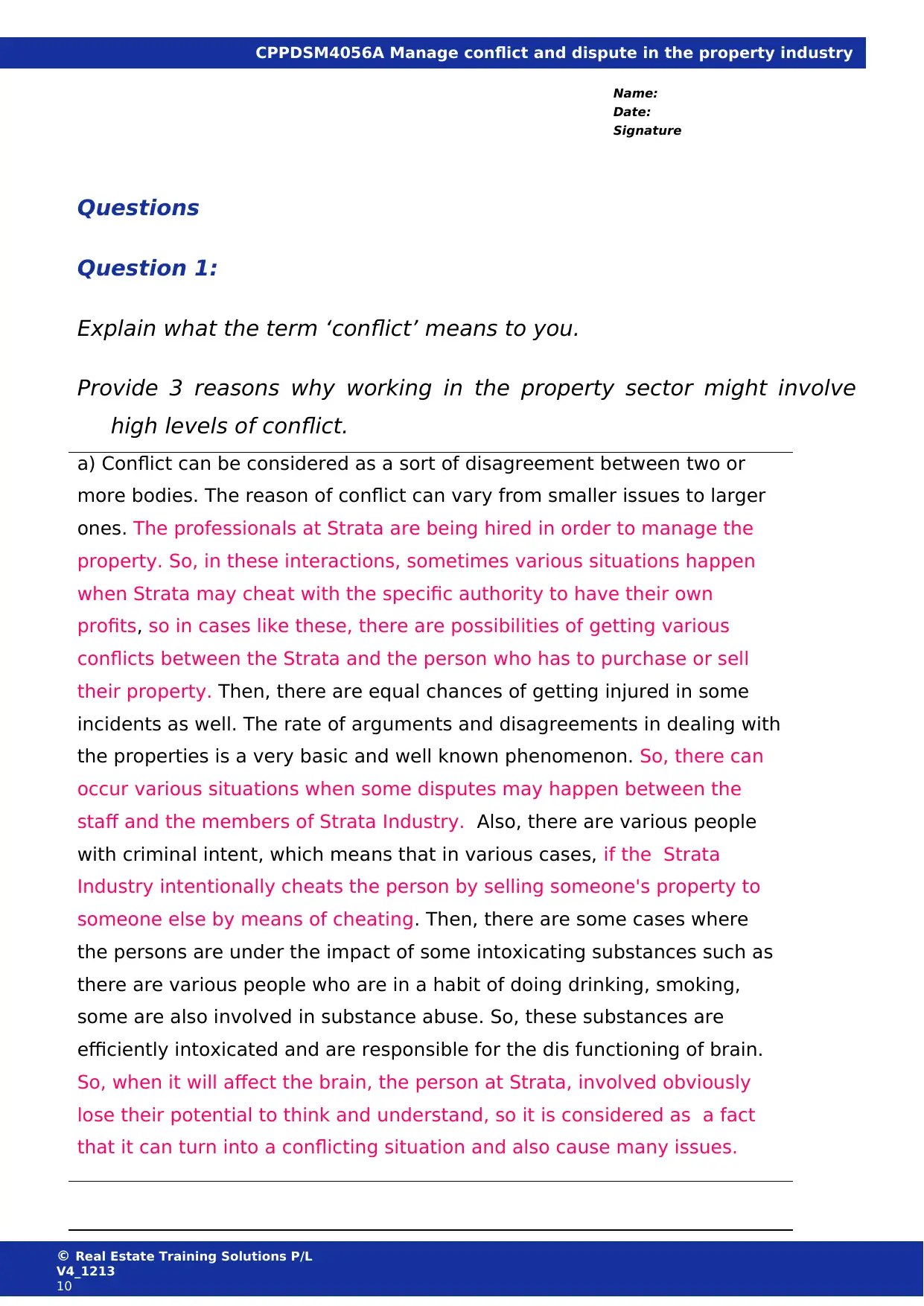
a) Conflict can be considered as a sort of disagreement between two or
more bodies. The reason of conflict can vary from smaller issues to larger
ones. The professionals at Strata are being hired in order to manage the
property. So, in these interactions, sometimes various situations happen
when Strata may cheat with the specific authority to have their own
profits, so in cases like these, there are possibilities of getting various
conflicts between the Strata and the person who has to purchase or sell
their property. Then, there are equal chances of getting injured in some
incidents as well. The rate of arguments and disagreements in dealing with
the properties is a very basic and well known phenomenon. So, there can
occur various situations when some disputes may happen between the
staff and the members of Strata Industry. Also, there are various people
with criminal intent, which means that in various cases, if the Strata
Industry intentionally cheats the person by selling someone's property to
someone else by means of cheating. Then, there are some cases where
the persons are under the impact of some intoxicating substances such as
there are various people who are in a habit of doing drinking, smoking,
some are also involved in substance abuse. So, these substances are
efficiently intoxicated and are responsible for the dis functioning of brain.
So, when it will affect the brain, the person at Strata, involved obviously
lose their potential to think and understand, so it is considered as a fact
that it can turn into a conflicting situation and also cause many issues.
© Real Estate Training Solutions P/L
V4_1213
10
Name:
Date:
Signature
Questions
Question 1:
Explain what the term ‘conflict’ means to you.
Provide 3 reasons why working in the property sector might involve
high levels of conflict.
a) Conflict can be considered as a sort of disagreement between two or
more bodies. The reason of conflict can vary from smaller issues to larger
ones. The professionals at Strata are being hired in order to manage the
property. So, in these interactions, sometimes various situations happen
when Strata may cheat with the specific authority to have their own
profits, so in cases like these, there are possibilities of getting various
conflicts between the Strata and the person who has to purchase or sell
their property. Then, there are equal chances of getting injured in some
incidents as well. The rate of arguments and disagreements in dealing with
the properties is a very basic and well known phenomenon. So, there can
occur various situations when some disputes may happen between the
staff and the members of Strata Industry. Also, there are various people
with criminal intent, which means that in various cases, if the Strata
Industry intentionally cheats the person by selling someone's property to
someone else by means of cheating. Then, there are some cases where
the persons are under the impact of some intoxicating substances such as
there are various people who are in a habit of doing drinking, smoking,
some are also involved in substance abuse. So, these substances are
efficiently intoxicated and are responsible for the dis functioning of brain.
So, when it will affect the brain, the person at Strata, involved obviously
lose their potential to think and understand, so it is considered as a fact
that it can turn into a conflicting situation and also cause many issues.
Paraphrase This Document
Need a fresh take? Get an instant paraphrase of this document with our AI Paraphraser
CPPDSM4056A Manage conflict and dispute in the property industry
© Real Estate Training Solutions P/L
V4_1213
11
Name:
Date:
Signature
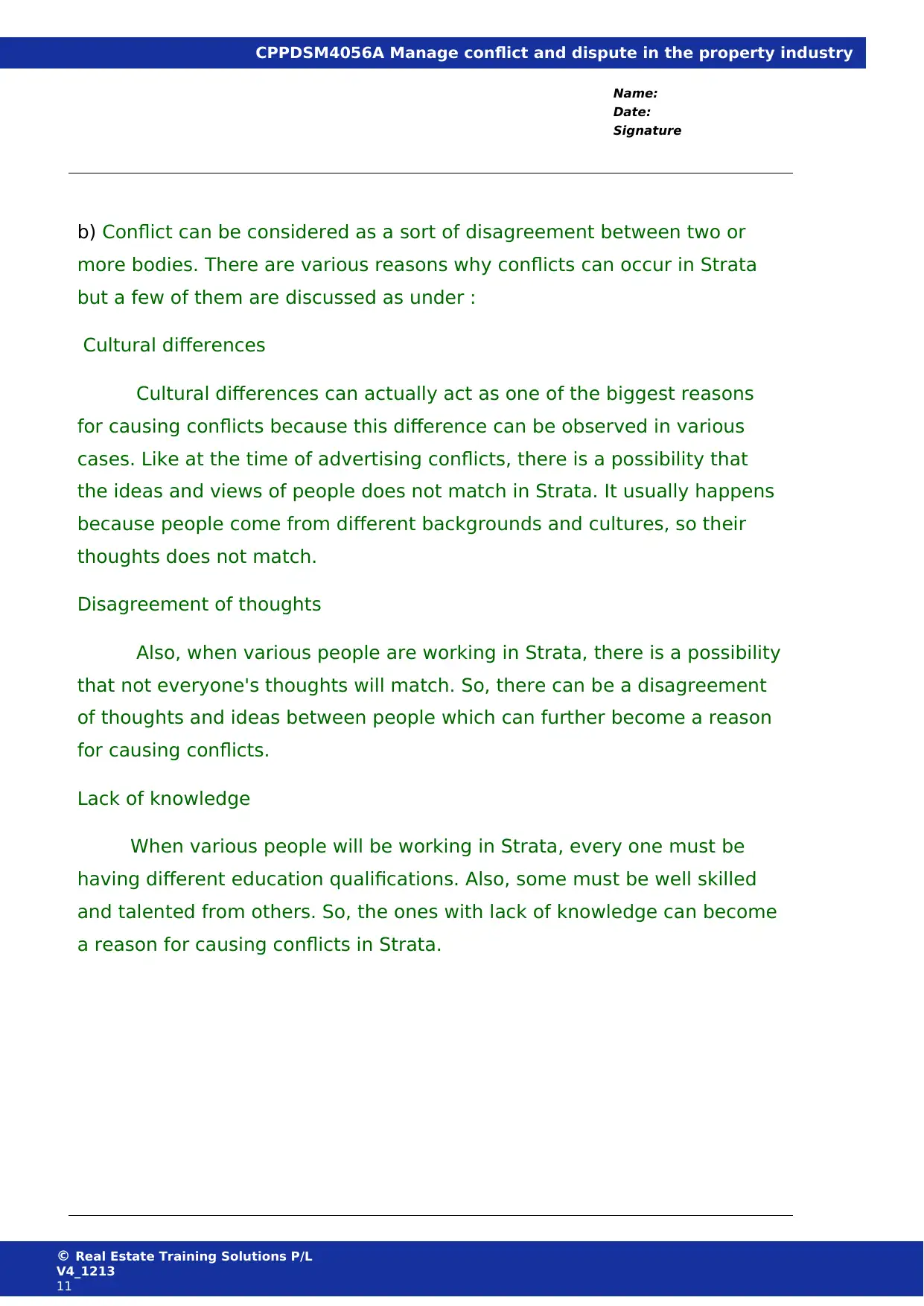
b) Conflict can be considered as a sort of disagreement between two or
more bodies. There are various reasons why conflicts can occur in Strata
but a few of them are discussed as under :
Cultural differences
Cultural differences can actually act as one of the biggest reasons
for causing conflicts because this difference can be observed in various
cases. Like at the time of advertising conflicts, there is a possibility that
the ideas and views of people does not match in Strata. It usually happens
because people come from different backgrounds and cultures, so their
thoughts does not match.
Disagreement of thoughts
Also, when various people are working in Strata, there is a possibility
that not everyone's thoughts will match. So, there can be a disagreement
of thoughts and ideas between people which can further become a reason
for causing conflicts.
Lack of knowledge
When various people will be working in Strata, every one must be
having different education qualifications. Also, some must be well skilled
and talented from others. So, the ones with lack of knowledge can become
a reason for causing conflicts in Strata.
© Real Estate Training Solutions P/L
V4_1213
11
Name:
Date:
Signature
b) Conflict can be considered as a sort of disagreement between two or
more bodies. There are various reasons why conflicts can occur in Strata
but a few of them are discussed as under :
Cultural differences
Cultural differences can actually act as one of the biggest reasons
for causing conflicts because this difference can be observed in various
cases. Like at the time of advertising conflicts, there is a possibility that
the ideas and views of people does not match in Strata. It usually happens
because people come from different backgrounds and cultures, so their
thoughts does not match.
Disagreement of thoughts
Also, when various people are working in Strata, there is a possibility
that not everyone's thoughts will match. So, there can be a disagreement
of thoughts and ideas between people which can further become a reason
for causing conflicts.
Lack of knowledge
When various people will be working in Strata, every one must be
having different education qualifications. Also, some must be well skilled
and talented from others. So, the ones with lack of knowledge can become
a reason for causing conflicts in Strata.
CPPDSM4056A Manage conflict and dispute in the property industry
© Real Estate Training Solutions P/L
V4_1213
12
Name:
Date:
Signature
Question 2:
List 3 examples of behaviour that might indicate that a
person is feeling uncomfortable about a situation.
A person can feel uncomfortable in any situation where the person in front,
is doing and involving a set of activities that they should not. Some very
common examples of it can be represented as under :
When any member at Strata who is dealing with the customer makes
a smaller talk about the deal and often with awkward silences, so this
can make the person quite uncomfortable.
Also, if the person who is dealing with the customer has a body
© Real Estate Training Solutions P/L
V4_1213
12
Name:
Date:
Signature
Question 2:
List 3 examples of behaviour that might indicate that a
person is feeling uncomfortable about a situation.
A person can feel uncomfortable in any situation where the person in front,
is doing and involving a set of activities that they should not. Some very
common examples of it can be represented as under :
When any member at Strata who is dealing with the customer makes
a smaller talk about the deal and often with awkward silences, so this
can make the person quite uncomfortable.
Also, if the person who is dealing with the customer has a body
⊘ This is a preview!⊘
Do you want full access?
Subscribe today to unlock all pages.
Trusted by 1+ million students worldwide

1 out of 38


Related Documents


Your All-in-One AI-Powered Toolkit for Academic Success.
+13062052269
info@desklib.com
Available 24*7 on WhatsApp / Email
![[object Object]](/_next/static/media/star-bottom.7253800d.svg)
Unlock your academic potential
Copyright © 2020–2026 A2Z Services. All Rights Reserved. Developed and managed by ZUCOL.