Creatine Supplementation and Physical Performance: 4-Week Cycle
VerifiedAdded on 2020/12/09
|50
|10918
|156
Dissertation
AI Summary
This dissertation investigates the effects of creatine supplementation on physical performance over a 4-week cycle. The study examines the rationale for creatine use, its benefits, and potential adverse effects. It explores the impact of creatine monohydrate with and without D-pinitol on resistance training adaptations, comparing different forms of creatine and their effects on strength and muscle mass. The research methodology includes a descriptive research design, qualitative and deductive approaches, and thematic data analysis. The literature review analyzes creatine's role in enhancing exercise performance, particularly for athletes in sports like rugby sevens, and discusses the influence of creatine and caffeine. The study aims to determine creatine's impact on physical performance, focusing on muscle strength and adaptations to exercise. It also addresses research questions about creatine supplementation's effects, including adverse effects and the effectiveness of different forms of creatine. The dissertation offers valuable insights into the use of creatine supplementation for enhancing physical performance.

DISSERTATION

Paraphrase This Document
Need a fresh take? Get an instant paraphrase of this document with our AI Paraphraser
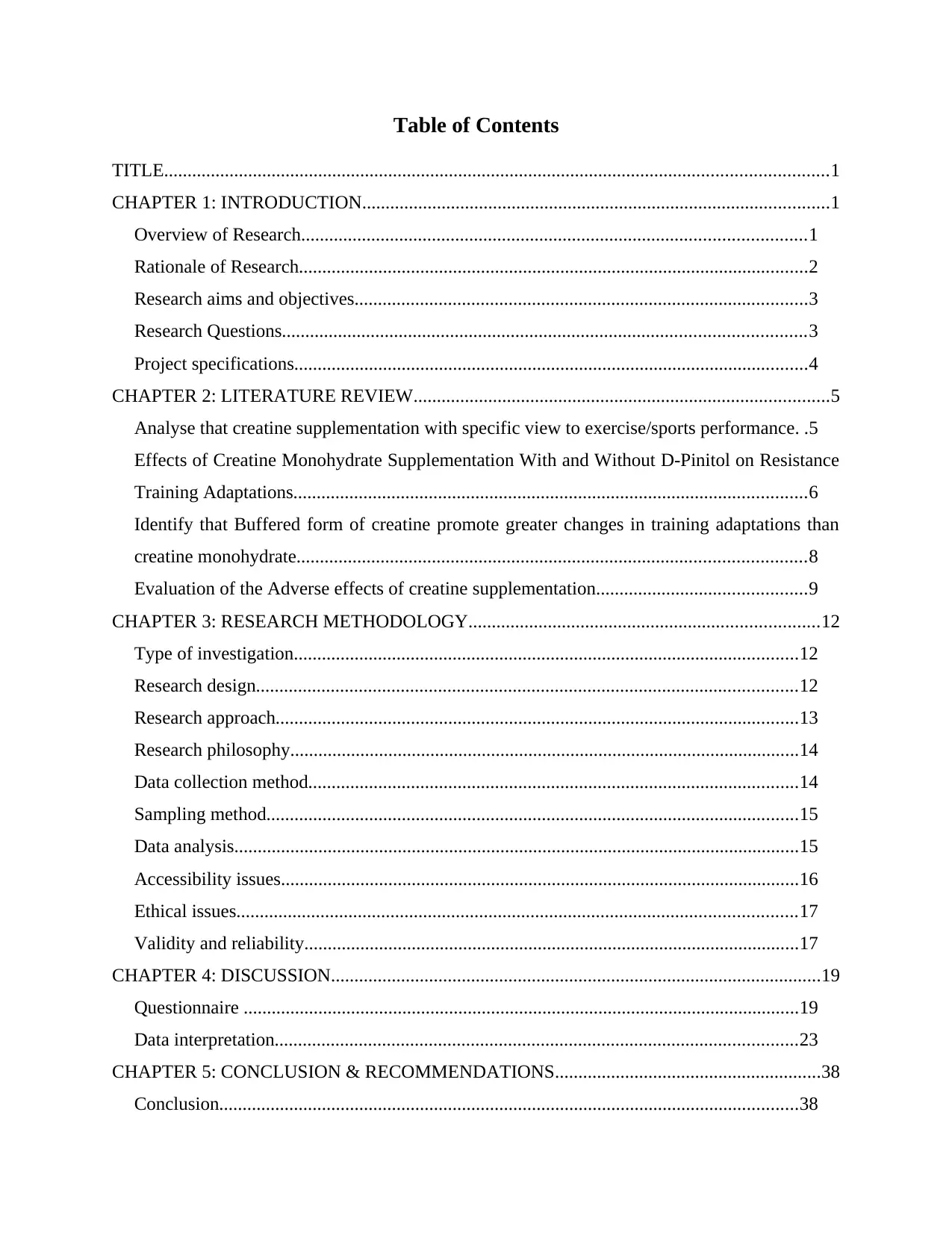
Table of Contents
TITLE..............................................................................................................................................1
CHAPTER 1: INTRODUCTION....................................................................................................1
Overview of Research............................................................................................................1
Rationale of Research.............................................................................................................2
Research aims and objectives.................................................................................................3
Research Questions................................................................................................................3
Project specifications..............................................................................................................4
CHAPTER 2: LITERATURE REVIEW.........................................................................................5
Analyse that creatine supplementation with specific view to exercise/sports performance. .5
Effects of Creatine Monohydrate Supplementation With and Without D-Pinitol on Resistance
Training Adaptations..............................................................................................................6
Identify that Buffered form of creatine promote greater changes in training adaptations than
creatine monohydrate.............................................................................................................8
Evaluation of the Adverse effects of creatine supplementation.............................................9
CHAPTER 3: RESEARCH METHODOLOGY...........................................................................12
Type of investigation............................................................................................................12
Research design....................................................................................................................12
Research approach................................................................................................................13
Research philosophy.............................................................................................................14
Data collection method.........................................................................................................14
Sampling method..................................................................................................................15
Data analysis.........................................................................................................................15
Accessibility issues...............................................................................................................16
Ethical issues........................................................................................................................17
Validity and reliability..........................................................................................................17
CHAPTER 4: DISCUSSION.........................................................................................................19
Questionnaire .......................................................................................................................19
Data interpretation................................................................................................................23
CHAPTER 5: CONCLUSION & RECOMMENDATIONS.........................................................38
Conclusion............................................................................................................................38
TITLE..............................................................................................................................................1
CHAPTER 1: INTRODUCTION....................................................................................................1
Overview of Research............................................................................................................1
Rationale of Research.............................................................................................................2
Research aims and objectives.................................................................................................3
Research Questions................................................................................................................3
Project specifications..............................................................................................................4
CHAPTER 2: LITERATURE REVIEW.........................................................................................5
Analyse that creatine supplementation with specific view to exercise/sports performance. .5
Effects of Creatine Monohydrate Supplementation With and Without D-Pinitol on Resistance
Training Adaptations..............................................................................................................6
Identify that Buffered form of creatine promote greater changes in training adaptations than
creatine monohydrate.............................................................................................................8
Evaluation of the Adverse effects of creatine supplementation.............................................9
CHAPTER 3: RESEARCH METHODOLOGY...........................................................................12
Type of investigation............................................................................................................12
Research design....................................................................................................................12
Research approach................................................................................................................13
Research philosophy.............................................................................................................14
Data collection method.........................................................................................................14
Sampling method..................................................................................................................15
Data analysis.........................................................................................................................15
Accessibility issues...............................................................................................................16
Ethical issues........................................................................................................................17
Validity and reliability..........................................................................................................17
CHAPTER 4: DISCUSSION.........................................................................................................19
Questionnaire .......................................................................................................................19
Data interpretation................................................................................................................23
CHAPTER 5: CONCLUSION & RECOMMENDATIONS.........................................................38
Conclusion............................................................................................................................38

Recommendations................................................................................................................38
REFLECTIVE STATEMENT.......................................................................................................39
REFERENCES..............................................................................................................................41
APPENDIX ...................................................................................................................................44
REFLECTIVE STATEMENT.......................................................................................................39
REFERENCES..............................................................................................................................41
APPENDIX ...................................................................................................................................44
⊘ This is a preview!⊘
Do you want full access?
Subscribe today to unlock all pages.

Trusted by 1+ million students worldwide

Paraphrase This Document
Need a fresh take? Get an instant paraphrase of this document with our AI Paraphraser
TITLE
“The effect of creatine supplementation on physical performance during a 4 week
cycle.”
CHAPTER 1: INTRODUCTION
Overview of Research
The creatine can be described as a chemical which is found especially in muscles and
brain which is helpful to increase physical performance. It is also found is red meat, sea food and
can be prepared at laboratory scale for use. However, creatine is generally utilise for boosting up
exercise performance as well as enhance muscle mass in athletes and older adults (Trexler and
Smith-Ryan, 2015). In addition to this, it is analysed that provide variety of health benefits in
terms of consisting neuro protective and cardio protective properties.
Meanwhile, creatine have a role to store high energy phosphate groups in form of
phosphocreatine which release energy in order to aid cellular function at the time of stress.
Moreover, this compound can be intake from several food items such as meat, egg and fish
which is commonly used by athletes and sport persons for increasing power output as well as
lean mass (Jones, 2014). Furthermore, creatine may create problem of stomach cramp if taken
without sufficient amount of water and diarrhoea & nausea can occur due to excess
supplementation of creatine takes place.
At the other hand, creatine products are available in market in form of tablets, powder,
energy bars and drinks which are taken by people through the prescription of doctors. It will
provide support to enhance muscle mass and helps athletes achieve burst of strengths (Momaya,
Fawal and Estes, 2015). However, creatine is helpful to boost up strength, increase lean muscle
mass and facilitate muscles to overcome more quickly at the time of exercise respectively. Apart
1
“The effect of creatine supplementation on physical performance during a 4 week
cycle.”
CHAPTER 1: INTRODUCTION
Overview of Research
The creatine can be described as a chemical which is found especially in muscles and
brain which is helpful to increase physical performance. It is also found is red meat, sea food and
can be prepared at laboratory scale for use. However, creatine is generally utilise for boosting up
exercise performance as well as enhance muscle mass in athletes and older adults (Trexler and
Smith-Ryan, 2015). In addition to this, it is analysed that provide variety of health benefits in
terms of consisting neuro protective and cardio protective properties.
Meanwhile, creatine have a role to store high energy phosphate groups in form of
phosphocreatine which release energy in order to aid cellular function at the time of stress.
Moreover, this compound can be intake from several food items such as meat, egg and fish
which is commonly used by athletes and sport persons for increasing power output as well as
lean mass (Jones, 2014). Furthermore, creatine may create problem of stomach cramp if taken
without sufficient amount of water and diarrhoea & nausea can occur due to excess
supplementation of creatine takes place.
At the other hand, creatine products are available in market in form of tablets, powder,
energy bars and drinks which are taken by people through the prescription of doctors. It will
provide support to enhance muscle mass and helps athletes achieve burst of strengths (Momaya,
Fawal and Estes, 2015). However, creatine is helpful to boost up strength, increase lean muscle
mass and facilitate muscles to overcome more quickly at the time of exercise respectively. Apart
1
from improving physical performance, creatine is also used in case of creatine deficiency
syndrome which impacts negatively on brain, ageing, bone density, chronic obstructive
pulmonary disease (COPD), congestive heart failure and so on (Lundberg, Vencovsky and
Alexanderson, 2014).
Background of the study – This present dissertation will focus on effect of creatine
supplementation in physical performance during the 4 week cycle. It involves the analysis of
levels of increase in exercise performance and muscle mass in respect of increasing energy of
body which is responsible for improving physical work. However, it include to evaluate the
impacts of intake creatine in terms of increasing energy of as an individual which boost up their
stamina for increasing their physical performance specially in context of sports persons and
athletes (Wax, Kavazis and Luckett, 2016). Moreover, creatine was made by 3 different amino
acids like L-arginine, glycine & L-methionine and it provide energy to different parts of body as
per requirement. In addition to this, Supplementing with creatine has been shown to improve
strength and explosiveness during a gradual time period. This study will also discuss about
effectiveness of supplementing creatine and better effect of different buffers in creatine in
physical performance. Meanwhile. It involves that high energy molecules known as ATP are
stored in cells and around 8-10 seconds ATP stores run out.
Rationale of Research
The study is important about effectiveness of creatine use within 4 week cycle to solve
various relevant issues occurred regarding its safety to use, range of benefits and level of
effectiveness. It is necessary to analyse about its applicability for its use so that people can utilise
the relevant products for their health (Naseeb and Volpe, 2017). However, it involves to study
that in what way creatine helps to boost up strength gains in the 1RM bench press, combined
2
syndrome which impacts negatively on brain, ageing, bone density, chronic obstructive
pulmonary disease (COPD), congestive heart failure and so on (Lundberg, Vencovsky and
Alexanderson, 2014).
Background of the study – This present dissertation will focus on effect of creatine
supplementation in physical performance during the 4 week cycle. It involves the analysis of
levels of increase in exercise performance and muscle mass in respect of increasing energy of
body which is responsible for improving physical work. However, it include to evaluate the
impacts of intake creatine in terms of increasing energy of as an individual which boost up their
stamina for increasing their physical performance specially in context of sports persons and
athletes (Wax, Kavazis and Luckett, 2016). Moreover, creatine was made by 3 different amino
acids like L-arginine, glycine & L-methionine and it provide energy to different parts of body as
per requirement. In addition to this, Supplementing with creatine has been shown to improve
strength and explosiveness during a gradual time period. This study will also discuss about
effectiveness of supplementing creatine and better effect of different buffers in creatine in
physical performance. Meanwhile. It involves that high energy molecules known as ATP are
stored in cells and around 8-10 seconds ATP stores run out.
Rationale of Research
The study is important about effectiveness of creatine use within 4 week cycle to solve
various relevant issues occurred regarding its safety to use, range of benefits and level of
effectiveness. It is necessary to analyse about its applicability for its use so that people can utilise
the relevant products for their health (Naseeb and Volpe, 2017). However, it involves to study
that in what way creatine helps to boost up strength gains in the 1RM bench press, combined
2
⊘ This is a preview!⊘
Do you want full access?
Subscribe today to unlock all pages.
Trusted by 1+ million students worldwide
with 1RM squat. In addition to this, it is significant to know about different forms of creatine
such as Creatine HCL, Creatine Nitrate and Creatine Monohydrate in order to evaluate their
effectiveness. Moreover, they all have their own impact on human body in context of increasing
strengths so that it is essential to analyse that which one is suitable for for specific situation
respectively. Meanwhile, it also essential to analyse that creatine products should be intake by
the proper prescription of specialist as its excess use may results into certain health problems
(Quinlivan, Martinuzzi and Schoser, 2014).
Research aims and objectives
Aims -
“To determine the effect of creatine supplementation on physical performance during
a 4 week cycle”
Objectives -
To analyse that creatine supplementation with specific view to exercise/sports
performance.
To determine the Effects of Creatine Monohydrate Supplementation With and Without
D-Pinitol on Resistance Training Adaptations.
To identify Buffered form of creatine promote greater changes in training adaptations
than creatine monohydrate.
To evaluate the Adverse effects of creatine supplementation.
Research Questions
How to analyse that creatine supplementation with specific view to exercise/sports
performance?
3
such as Creatine HCL, Creatine Nitrate and Creatine Monohydrate in order to evaluate their
effectiveness. Moreover, they all have their own impact on human body in context of increasing
strengths so that it is essential to analyse that which one is suitable for for specific situation
respectively. Meanwhile, it also essential to analyse that creatine products should be intake by
the proper prescription of specialist as its excess use may results into certain health problems
(Quinlivan, Martinuzzi and Schoser, 2014).
Research aims and objectives
Aims -
“To determine the effect of creatine supplementation on physical performance during
a 4 week cycle”
Objectives -
To analyse that creatine supplementation with specific view to exercise/sports
performance.
To determine the Effects of Creatine Monohydrate Supplementation With and Without
D-Pinitol on Resistance Training Adaptations.
To identify Buffered form of creatine promote greater changes in training adaptations
than creatine monohydrate.
To evaluate the Adverse effects of creatine supplementation.
Research Questions
How to analyse that creatine supplementation with specific view to exercise/sports
performance?
3
Paraphrase This Document
Need a fresh take? Get an instant paraphrase of this document with our AI Paraphraser
What are the effects of Creatine Monohydrate Supplementation With and Without D-
Pinitol on Resistance Training Adaptations?
How to identify Buffered form of creatine promote greater changes in training
adaptations than creatine monohydrate?
What are the ways to evaluate the Adverse effects of creatine supplementation?
Project specifications
Research methodology can be described as framework and analysis of collected
information which is utilised to conduct study about particular topic in order to conclude
appropriate results. The present dissertation will follow descriptive research design which consist
to gather large amount of data and make correct conclusions by description of selected
population (Andrade Kratz, Salles Painelli, Andrade Nemezio, Silva, Franchini, Zagatto,
Gualano and Artioli, 2017). However, research philosophy is helpful to collect information from
social constructed environment and interpretive is focussed in this study. Moreover, this
investigation types of qualitative and deductive approach will used to gather data in effective
manner. The primary and secondary sources of information are utilised to collect required
information to conduct appropriate investigation for attaining correct outcomes respectively.
Furthermore, data analysis will be carried out through implementing thematic analysis with
support of qualitative techniques and interpretation will be done by graphical representation.
4
Pinitol on Resistance Training Adaptations?
How to identify Buffered form of creatine promote greater changes in training
adaptations than creatine monohydrate?
What are the ways to evaluate the Adverse effects of creatine supplementation?
Project specifications
Research methodology can be described as framework and analysis of collected
information which is utilised to conduct study about particular topic in order to conclude
appropriate results. The present dissertation will follow descriptive research design which consist
to gather large amount of data and make correct conclusions by description of selected
population (Andrade Kratz, Salles Painelli, Andrade Nemezio, Silva, Franchini, Zagatto,
Gualano and Artioli, 2017). However, research philosophy is helpful to collect information from
social constructed environment and interpretive is focussed in this study. Moreover, this
investigation types of qualitative and deductive approach will used to gather data in effective
manner. The primary and secondary sources of information are utilised to collect required
information to conduct appropriate investigation for attaining correct outcomes respectively.
Furthermore, data analysis will be carried out through implementing thematic analysis with
support of qualitative techniques and interpretation will be done by graphical representation.
4
CHAPTER 2: LITERATURE REVIEW
Analyse that creatine supplementation with specific view to exercise/sports performance
Creatine supplementation is commonly responsible for several benefits such as boosting
up strength, improvement in lean muscle mass and facilitate to the recovering of muscles during
physical work out in quick manner (Zenith, Meena, Ramadi, Yavari, Harvey, Carbonneau, Ma,
Abraldes, Paterson, Haykowsky and Tandon, 2014). It is also considered as muscular boost
which provide support to athletes in respect of achieving bursts of energy, especially at the time
of short bouts of high intensity activities which can include weight lifting or sprinting. There are
various kinds of sports activities and physical games in which impacts of creatine
supplementation has been observed and few of them are given below.
According to the views of Christine E. Dziedzic (2014), Rugby sevens is known as an
abbreviated form of rugby union and international competitions are played in format of
tournaments. However, the demands of movements in rugby sevens per minute of match
duration is higher than rugby union which results into accentuated load on players which
repeated up-to in 2 to 3 days of competition duration. It has been analysed the the inadequate
carbohydrate, protein and fluid intake becomes greatest nutrition related concern for players
which is required to be overcome. Moreover, it needs several nutritional strategies to be followed
such as replenish substrate stores, improve recovery between matches and balance fluid in body
with help on ergogenic aids like creatine. It will provide support to increase intermittent,
executing motor abilities and high intensity activity which is helpful to maintain appropriate
performance by players in rugby sevens competition. This study will render an appropriate
practice for providing nutritional support to players which facilitate to maintain nutrients in
body and helps to enhance performance in international rugby sevens competition.
5
Analyse that creatine supplementation with specific view to exercise/sports performance
Creatine supplementation is commonly responsible for several benefits such as boosting
up strength, improvement in lean muscle mass and facilitate to the recovering of muscles during
physical work out in quick manner (Zenith, Meena, Ramadi, Yavari, Harvey, Carbonneau, Ma,
Abraldes, Paterson, Haykowsky and Tandon, 2014). It is also considered as muscular boost
which provide support to athletes in respect of achieving bursts of energy, especially at the time
of short bouts of high intensity activities which can include weight lifting or sprinting. There are
various kinds of sports activities and physical games in which impacts of creatine
supplementation has been observed and few of them are given below.
According to the views of Christine E. Dziedzic (2014), Rugby sevens is known as an
abbreviated form of rugby union and international competitions are played in format of
tournaments. However, the demands of movements in rugby sevens per minute of match
duration is higher than rugby union which results into accentuated load on players which
repeated up-to in 2 to 3 days of competition duration. It has been analysed the the inadequate
carbohydrate, protein and fluid intake becomes greatest nutrition related concern for players
which is required to be overcome. Moreover, it needs several nutritional strategies to be followed
such as replenish substrate stores, improve recovery between matches and balance fluid in body
with help on ergogenic aids like creatine. It will provide support to increase intermittent,
executing motor abilities and high intensity activity which is helpful to maintain appropriate
performance by players in rugby sevens competition. This study will render an appropriate
practice for providing nutritional support to players which facilitate to maintain nutrients in
body and helps to enhance performance in international rugby sevens competition.
5
⊘ This is a preview!⊘
Do you want full access?
Subscribe today to unlock all pages.
Trusted by 1+ million students worldwide
As explained by Eric T. Trexler (2015), it is analysed that nutritional supplementation
can be considered as common practice between athletes including creatine among ergogenic
acids. However, it has been determined from several studies that ergogenic potential of creatine
supplementation is responsible for consistent increase in strength and power which is reported in
context of exercise bouts of short period of time i.e., less than 30 seconds and great intensity as
well. In addition to this, it is evaluated that by independent mechanisms, creatine and caffeine
may increase sprint performance & strength that leads to preparation of multi- ingredients
supplements through consisting both components. Further, it is evaluated that caffeine ingestion
may blunt the ergogenic impacts on creatine and actual effects can be determined by opposing
affects on muscle relaxation time or gastrointestinal side effects from simultaneous consumption.
This review provide help to analyse the role of creatine in context of increasing strength but also
render information about its negative effects due to intake with caffeine simultaneously.
Effects of Creatine Monohydrate Supplementation With and Without D-Pinitol on Resistance
Training Adaptations
The Creatine supplementation is generally used by sports persons and competitive
athletes in order to boost yup their athletic performance (Benatti and Pedersen, 2015). However,
this supplementation provide support to improve intramuscular creatine which facilitate to
release more energy and increase physical performance of an individual. In addition to this, it has
been analysed that co-ingestion of D-pinitol with creatine is helpful for enhancing the creatine
uptake which impacts on training adaptations, body composition, whole body creatine retention
and blood safety markers.
As per views of Andrew Ryan (2016), it has been analysed that after using creatine with
D-pinitol (CRP) or creatine monohydrate (CR) in beginning of 4 week resistance training event
6
can be considered as common practice between athletes including creatine among ergogenic
acids. However, it has been determined from several studies that ergogenic potential of creatine
supplementation is responsible for consistent increase in strength and power which is reported in
context of exercise bouts of short period of time i.e., less than 30 seconds and great intensity as
well. In addition to this, it is evaluated that by independent mechanisms, creatine and caffeine
may increase sprint performance & strength that leads to preparation of multi- ingredients
supplements through consisting both components. Further, it is evaluated that caffeine ingestion
may blunt the ergogenic impacts on creatine and actual effects can be determined by opposing
affects on muscle relaxation time or gastrointestinal side effects from simultaneous consumption.
This review provide help to analyse the role of creatine in context of increasing strength but also
render information about its negative effects due to intake with caffeine simultaneously.
Effects of Creatine Monohydrate Supplementation With and Without D-Pinitol on Resistance
Training Adaptations
The Creatine supplementation is generally used by sports persons and competitive
athletes in order to boost yup their athletic performance (Benatti and Pedersen, 2015). However,
this supplementation provide support to improve intramuscular creatine which facilitate to
release more energy and increase physical performance of an individual. In addition to this, it has
been analysed that co-ingestion of D-pinitol with creatine is helpful for enhancing the creatine
uptake which impacts on training adaptations, body composition, whole body creatine retention
and blood safety markers.
As per views of Andrew Ryan (2016), it has been analysed that after using creatine with
D-pinitol (CRP) or creatine monohydrate (CR) in beginning of 4 week resistance training event
6
Paraphrase This Document
Need a fresh take? Get an instant paraphrase of this document with our AI Paraphraser
have favourable results for people in context of their performance. Meanwhile, creatine
monohydrate results into measurement of performance at baseline within 23 days including 1
repetition maximum (1RM) bench press, 1RM leg press, isokinetic knee extension and 30 second
Wingate anaerobic test. Moreover, it is observed that fasting blood and body composition
achieved by individuals due to utilisation of dual energy X-ray absorptiometry (DEXA) in week
1 and week 3. However, the effects of creatine mono-hydrate are evaluated in both cases
including its supplementation with and without D-pinitol on resistance training adaptations
which involves significant improvement in muscle strength of people. It has been analysed that
creatine with D-pinitol is responsible for increasing uptake of creatine in body which is
beneficial for an individual to improve their physical performance and muscle strength.
Meanwhile, creatine intake is itself favourable for improving strength of muscles but it will
become more effective while taking with D-pinitol. The creatine intake with D-Pinitol is much
better than without D-pinitol as this compound is helpful to boost up results of creatine in body.
In addition to this, it includes increase in strength which is analysed in upper & lower body and
body composition take place on both situations of intake creatine with and without D-pinitol
(Kasai, Mizuno, Ishimoto, Sakamoto, Maruta, Kurihara, Kurosawa and Goto, 2019). Similarly,
creatine has better impact on strength of body by taking with D-pinitol rather than without D-
pinitol. At the other hand, it is also evaluated that the creatine retention improved
supplementation with D-pinitol and without D-pinitol results into different low levels of
retaining creatine in human body. Furthermore, it is analysed about lean mass and fat free mass
that significantly increase in CR group which intake supplementation of creatine monohydrate as
compared to group of CRP that utilise creatine with D-pinitol. Finally, it is found that
supplementation of creatine render help to people for boosting up strength as well as body
7
monohydrate results into measurement of performance at baseline within 23 days including 1
repetition maximum (1RM) bench press, 1RM leg press, isokinetic knee extension and 30 second
Wingate anaerobic test. Moreover, it is observed that fasting blood and body composition
achieved by individuals due to utilisation of dual energy X-ray absorptiometry (DEXA) in week
1 and week 3. However, the effects of creatine mono-hydrate are evaluated in both cases
including its supplementation with and without D-pinitol on resistance training adaptations
which involves significant improvement in muscle strength of people. It has been analysed that
creatine with D-pinitol is responsible for increasing uptake of creatine in body which is
beneficial for an individual to improve their physical performance and muscle strength.
Meanwhile, creatine intake is itself favourable for improving strength of muscles but it will
become more effective while taking with D-pinitol. The creatine intake with D-Pinitol is much
better than without D-pinitol as this compound is helpful to boost up results of creatine in body.
In addition to this, it includes increase in strength which is analysed in upper & lower body and
body composition take place on both situations of intake creatine with and without D-pinitol
(Kasai, Mizuno, Ishimoto, Sakamoto, Maruta, Kurihara, Kurosawa and Goto, 2019). Similarly,
creatine has better impact on strength of body by taking with D-pinitol rather than without D-
pinitol. At the other hand, it is also evaluated that the creatine retention improved
supplementation with D-pinitol and without D-pinitol results into different low levels of
retaining creatine in human body. Furthermore, it is analysed about lean mass and fat free mass
that significantly increase in CR group which intake supplementation of creatine monohydrate as
compared to group of CRP that utilise creatine with D-pinitol. Finally, it is found that
supplementation of creatine render help to people for boosting up strength as well as body
7
composition at the time of resistance training whereas addition of D-pinitol with creatine plays
an important role to aid training adaptations to exercises for people as it increase creatine uptake
in body for better outcomes.
At the other hand, creatine supplementation provide support to increase ageing bone
health which is helpful to conduct physical work appropriately. After a certain age, bone and
muscle loss occur which impacts negatively on strength, agility & imbalance that may leads to
increasing risks of severe falls, injuries as well as fractures (Stang and Stotmeister, 2017).
However, the creatine supplementation with or without resistance training consists an effective
capability in influence the bone biology by improving health of the same which facilitate to
reduce risk of further problems respectively. Additionally, the addition of leucine to pre and post
exercise carbohydrate beverages to selected markers of mucsles damage is helpful to delay onset
muscle soreness and squat the performance for 72 hours after lower body resistance training
(Villanueva, He and Schroeder, 2014).
Identify that Buffered form of creatine promote greater changes in training adaptations than
creatine monohydrate
The buffered creatine can be described as patented product that prepares a combination of
creatine and magnesium. It can be considered as more effective as compared to creatine
monohydrate, tri-creatine malate and creatine ethyl ester. However, buffered creatine is most
appropriate for building muscle health which is also known as kre- alkalyn or chelated creatine
only consisting creatine & magnesium and this is called as secure health supplement respectively
(Hyldahl and Hubal, 2014). Moreover, the magnesium present in buffered creatine is helpful to
improve absorption of creatine by human body in better way. It has been analysed that adding
the ingredients like malic acid and magnesium render to help to users for digesting supplements
of creatine in proper manner. Meanwhile, proper processed and broken down creatine is capable
8
an important role to aid training adaptations to exercises for people as it increase creatine uptake
in body for better outcomes.
At the other hand, creatine supplementation provide support to increase ageing bone
health which is helpful to conduct physical work appropriately. After a certain age, bone and
muscle loss occur which impacts negatively on strength, agility & imbalance that may leads to
increasing risks of severe falls, injuries as well as fractures (Stang and Stotmeister, 2017).
However, the creatine supplementation with or without resistance training consists an effective
capability in influence the bone biology by improving health of the same which facilitate to
reduce risk of further problems respectively. Additionally, the addition of leucine to pre and post
exercise carbohydrate beverages to selected markers of mucsles damage is helpful to delay onset
muscle soreness and squat the performance for 72 hours after lower body resistance training
(Villanueva, He and Schroeder, 2014).
Identify that Buffered form of creatine promote greater changes in training adaptations than
creatine monohydrate
The buffered creatine can be described as patented product that prepares a combination of
creatine and magnesium. It can be considered as more effective as compared to creatine
monohydrate, tri-creatine malate and creatine ethyl ester. However, buffered creatine is most
appropriate for building muscle health which is also known as kre- alkalyn or chelated creatine
only consisting creatine & magnesium and this is called as secure health supplement respectively
(Hyldahl and Hubal, 2014). Moreover, the magnesium present in buffered creatine is helpful to
improve absorption of creatine by human body in better way. It has been analysed that adding
the ingredients like malic acid and magnesium render to help to users for digesting supplements
of creatine in proper manner. Meanwhile, proper processed and broken down creatine is capable
8
⊘ This is a preview!⊘
Do you want full access?
Subscribe today to unlock all pages.
Trusted by 1+ million students worldwide

1 out of 50


Related Documents


Your All-in-One AI-Powered Toolkit for Academic Success.
+13062052269
info@desklib.com
Available 24*7 on WhatsApp / Email
![[object Object]](/_next/static/media/star-bottom.7253800d.svg)
Unlock your academic potential
Copyright © 2020–2026 A2Z Services. All Rights Reserved. Developed and managed by ZUCOL.