Creative Coaching in Leadership: Methods and Differences
VerifiedAdded on 2022/08/22
|22
|5849
|16
Report
AI Summary
This report delves into the realm of creative coaching within leadership, examining its relationship with leadership principles and differentiating it from traditional training methodologies. The research identifies key objectives, including understanding the link between creative coaching and leadership, distinguishing between coaching and training, and exploring innovative coaching methods. The literature review covers various approaches, such as walking interactions, symbol usage, and multimedia integration, highlighting their effectiveness in leadership development. The report also discusses the importance of collaboration, communication, and motivation in coaching. Furthermore, it examines the GROW model and the significance of command and control in leadership. The report emphasizes the need for leaders to adapt to multigenerational workforces and foster a culture of creativity and self-assessment, ultimately providing insights into the evolution of leadership and coaching practices.

Running Head: EDUCATIONAL LEADERSHIP

Paraphrase This Document
Need a fresh take? Get an instant paraphrase of this document with our AI Paraphraser
1EDUCATIONAL LEADERSHIP
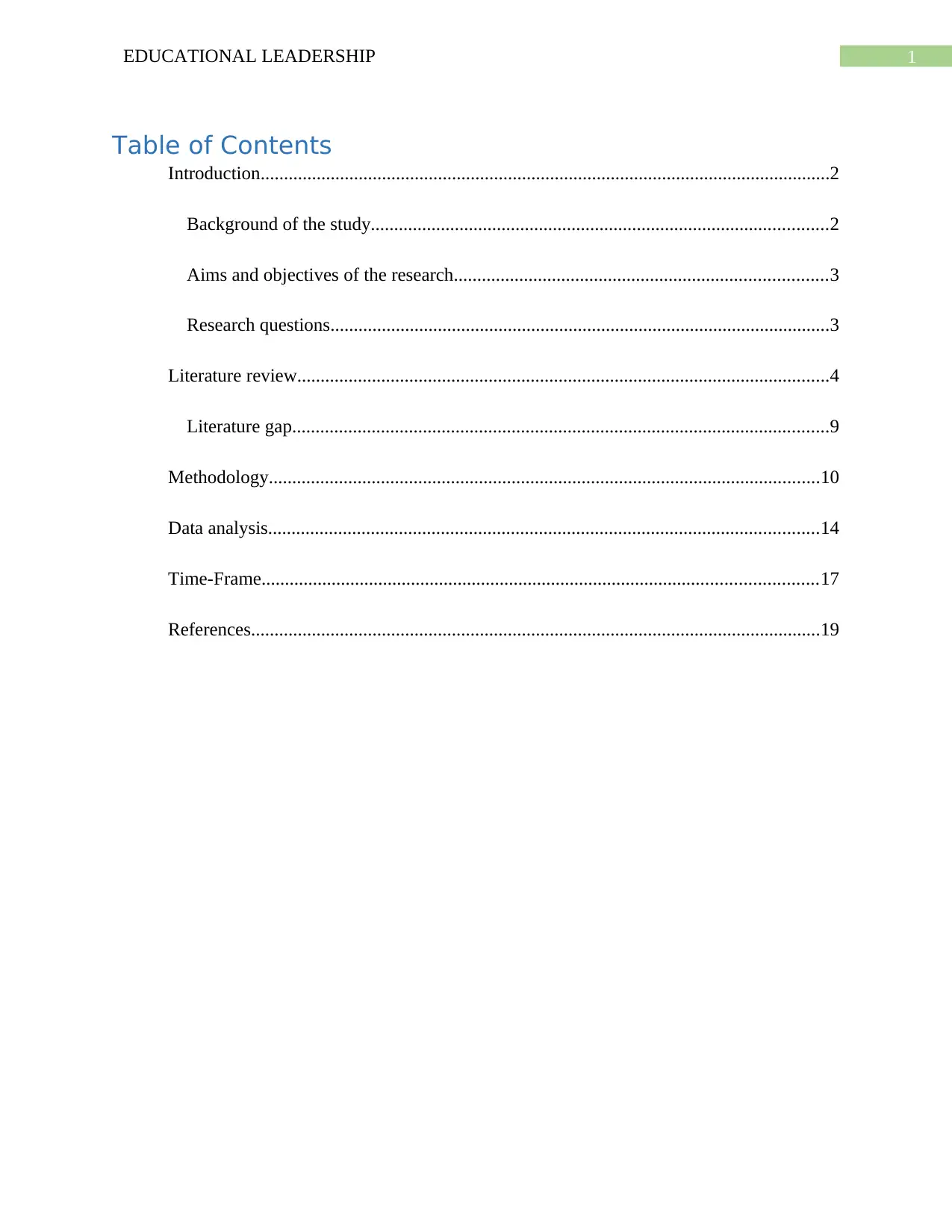
Table of Contents
Introduction..........................................................................................................................2
Background of the study..................................................................................................2
Aims and objectives of the research................................................................................3
Research questions...........................................................................................................3
Literature review..................................................................................................................4
Literature gap...................................................................................................................9
Methodology......................................................................................................................10
Data analysis......................................................................................................................14
Time-Frame.......................................................................................................................17
References..........................................................................................................................19
Table of Contents
Introduction..........................................................................................................................2
Background of the study..................................................................................................2
Aims and objectives of the research................................................................................3
Research questions...........................................................................................................3
Literature review..................................................................................................................4
Literature gap...................................................................................................................9
Methodology......................................................................................................................10
Data analysis......................................................................................................................14
Time-Frame.......................................................................................................................17
References..........................................................................................................................19
2EDUCATIONAL LEADERSHIP
Introduction
Background of the study
Coaching for business is turning into fundamental in nature. Both the organization and
leaders aware about their value. Hence, the domain of business also incorporating the ability to
coach or train and develop the employees. The aim is to make the managers efficient with the
ever-growing list of skills. According to the theoretical study, the aim of coaching for leaders
leads to more employee development with more efficiency. According to the empirical studies
the randomized and controlled design that can evaluate the entire procedure of coaching and its
due intervention.
Effective coaching for leadership and development helps to derivate procrastination and
ensures the procedure of goal attainment. Cochrane & Newton (2017) states that coaching can be
differentiated by the term training. Coaching is referred as a helpful relationship with proper
collaboration. It is a systematic process where the coach and the students engage in activities to
attain the pre-set goal. The aim of the facilitator was coach the persons to reach the goal with
self-directed learning procedure. The responsibility of the client or employee is to implement
those acquired knowledge for the sake of the growth and development of the organization. The
responsibilities of the coach as a facilitator include, defining the set agreement between the
organization and the employee.
On the other hand, training is a traditional procedure. It has contrasting characteristics
comparing the feature of coaching. It is a planned process to enhance the existing knowledge of
an employee. It involves several practices to enhance the employee’s innate skills in spite of
providing new knowledge to the employee. This is the main significant difference between the
Introduction
Background of the study
Coaching for business is turning into fundamental in nature. Both the organization and
leaders aware about their value. Hence, the domain of business also incorporating the ability to
coach or train and develop the employees. The aim is to make the managers efficient with the
ever-growing list of skills. According to the theoretical study, the aim of coaching for leaders
leads to more employee development with more efficiency. According to the empirical studies
the randomized and controlled design that can evaluate the entire procedure of coaching and its
due intervention.
Effective coaching for leadership and development helps to derivate procrastination and
ensures the procedure of goal attainment. Cochrane & Newton (2017) states that coaching can be
differentiated by the term training. Coaching is referred as a helpful relationship with proper
collaboration. It is a systematic process where the coach and the students engage in activities to
attain the pre-set goal. The aim of the facilitator was coach the persons to reach the goal with
self-directed learning procedure. The responsibility of the client or employee is to implement
those acquired knowledge for the sake of the growth and development of the organization. The
responsibilities of the coach as a facilitator include, defining the set agreement between the
organization and the employee.
On the other hand, training is a traditional procedure. It has contrasting characteristics
comparing the feature of coaching. It is a planned process to enhance the existing knowledge of
an employee. It involves several practices to enhance the employee’s innate skills in spite of
providing new knowledge to the employee. This is the main significant difference between the
⊘ This is a preview!⊘
Do you want full access?
Subscribe today to unlock all pages.

Trusted by 1+ million students worldwide
3EDUCATIONAL LEADERSHIP
two key concepts namely training and coaching. A trainer is a person who follows a set of
predetermined instructions to facilitate the activities for the suitable job and requirement of the
task. Contrarily, a coach is a follower of the employee’s agenda to provide solutions according to
the requirement of the trainee.
As per Turner’s (2019) statement, the relation between a coach and the pupils are
equivalent to the leader and employee. Both the coach and the leader performs the role of a
facilitator. Both the responsibilities can be considered as a process of interaction with the aim of
achievement of the desired goals. However, it cannot be denied that there is a minimal amount of
difference between the job role of a leader and a coach. In the leader and employee relationship,
the leader is a superior person by the organizational position. The leader leads the employees to
achieve the organizational goals. On the other hand, in the coaching relationship, the coach helps
the pupils to attain personal goals.
Aims and objectives of the research
The research aims to discuss about the relationship of creative coaching and leadership.
Some literary sources will be analyzed to serve the purpose of the research work. The main
objectives of this research work are mentioned below.
To identify the relationship between creative coaching and leadership.
To differentiate between the concepts of traditional training and leadership coaching.
To identify some alternative creative methods for coaching in leadership.
Research questions
What is the relationship between creative coaching and leadership?
two key concepts namely training and coaching. A trainer is a person who follows a set of
predetermined instructions to facilitate the activities for the suitable job and requirement of the
task. Contrarily, a coach is a follower of the employee’s agenda to provide solutions according to
the requirement of the trainee.
As per Turner’s (2019) statement, the relation between a coach and the pupils are
equivalent to the leader and employee. Both the coach and the leader performs the role of a
facilitator. Both the responsibilities can be considered as a process of interaction with the aim of
achievement of the desired goals. However, it cannot be denied that there is a minimal amount of
difference between the job role of a leader and a coach. In the leader and employee relationship,
the leader is a superior person by the organizational position. The leader leads the employees to
achieve the organizational goals. On the other hand, in the coaching relationship, the coach helps
the pupils to attain personal goals.
Aims and objectives of the research
The research aims to discuss about the relationship of creative coaching and leadership.
Some literary sources will be analyzed to serve the purpose of the research work. The main
objectives of this research work are mentioned below.
To identify the relationship between creative coaching and leadership.
To differentiate between the concepts of traditional training and leadership coaching.
To identify some alternative creative methods for coaching in leadership.
Research questions
What is the relationship between creative coaching and leadership?
Paraphrase This Document
Need a fresh take? Get an instant paraphrase of this document with our AI Paraphraser
4EDUCATIONAL LEADERSHIP
What is the difference between the two prevalent concepts of traditional training and
leadership coaching?
What are the alternative creative methods for coaching in leadership?
Literature review
The term leadership coaching can be considered as executive coaching. There are certain
models and approaches that dominates the concept of executive coaching. These approaches help
to understand the executive coaching as a process to enhance the performances of the executives.
The core skills attached with these approaches are communicative skill and listening skill
(Sheather, 2019). The qualified coaches acquire various means of disposals to identify the
challenges faced by different coachees. Creative approaches can be adopt by the leaders for self-
development and also for the development of the organization. A coaching leadership involves
some essential frameworks to develop the procedure of functioning. The ethical guidelines
proposed by David Clutterbuck published during the year 2018, reflects some essential agendas
of monitoring and coaching for leadership. These guidelines expose some essential happenings
of an essential coaching relationship. According to this, the creative approaches for leadership
coaching provide a sort of allowance to the coach to alter the available methods to support the
coachee’s venture for discovery (Cochrane & Newton, 2017). Some alternative methods that
belong to the domain of this creative approach are mentioned in the following section.
In spite of office-bound coaching session the leaders can apply walking interaction with
the employees. It provides an informal attitude while performing the formal responsibilities.
Walking along with the employees results into arousing more stimuli for interaction which is an
impossible thing in the formal or official sessions (Schaubroeck et al., 2016). Along with this,
using symbols are a way to focus on in-depth reality. Symbols makes the procedure of coaching
What is the difference between the two prevalent concepts of traditional training and
leadership coaching?
What are the alternative creative methods for coaching in leadership?
Literature review
The term leadership coaching can be considered as executive coaching. There are certain
models and approaches that dominates the concept of executive coaching. These approaches help
to understand the executive coaching as a process to enhance the performances of the executives.
The core skills attached with these approaches are communicative skill and listening skill
(Sheather, 2019). The qualified coaches acquire various means of disposals to identify the
challenges faced by different coachees. Creative approaches can be adopt by the leaders for self-
development and also for the development of the organization. A coaching leadership involves
some essential frameworks to develop the procedure of functioning. The ethical guidelines
proposed by David Clutterbuck published during the year 2018, reflects some essential agendas
of monitoring and coaching for leadership. These guidelines expose some essential happenings
of an essential coaching relationship. According to this, the creative approaches for leadership
coaching provide a sort of allowance to the coach to alter the available methods to support the
coachee’s venture for discovery (Cochrane & Newton, 2017). Some alternative methods that
belong to the domain of this creative approach are mentioned in the following section.
In spite of office-bound coaching session the leaders can apply walking interaction with
the employees. It provides an informal attitude while performing the formal responsibilities.
Walking along with the employees results into arousing more stimuli for interaction which is an
impossible thing in the formal or official sessions (Schaubroeck et al., 2016). Along with this,
using symbols are a way to focus on in-depth reality. Symbols makes the procedure of coaching
5EDUCATIONAL LEADERSHIP
easy as it takes the conversation to more complex stages instead of superficial stage. Metaphor
usage and exploration is also a creative approach followed in the executive coaching (Moffatt,
2014).. English language is enriched with metaphors and imagery (Brock, 2018). Language is a
playful way to communicate with much interest and that can easily strikes the brain of a coachee.
Another set of literary scholars argue that rather than interaction, a correctional way of
intervention performs greater in executive coaching. According to them, prosocial modelling and
reinforcement has an important role to communicate with the coaches from the end of the coach
(Jones et al., 2016). Professionalism of the employees determine the growth of the organization.
Organizational development demands employment skills, knowledge, and increasingly high
productive knowledge. International Coach Federation (ICF) has mentioned that overall twenty-
one hundred were operating globally as per the record of 1991 (Grant, 2017). From their point of
view, coaching is a procedure of collaborative relationship between coaches and coachees.
Contrarily, the training is a systematic process to bring the organizational goal into real.
Combining various references and articles it can be said that characteristics of creativity
is closely related with collaboration, communication, and motivation (Jones, Woods &
Guillaume, 2016). Executive coaching and collaboration is extremely connected with each other.
The leader or trainer or the coach needs to exhibit the collaborative skill that works as oil in the
machine. Collaboration includes showing respect from both ends (Currin, Brown & Schneider,
2019). The leader needs to adhere to the leadership guidelines along with exhibiting feeling and
concern for the employees also. Various researchers mentioned the use of multimedia or
photography during the course of executive coaching (Shepherd, 2014). The use of multimedia
as a means of coaching and training is more effective than the verbal orientation. The concept of
photography as a theory can be introduced in this regard. This therapy examines the use of
easy as it takes the conversation to more complex stages instead of superficial stage. Metaphor
usage and exploration is also a creative approach followed in the executive coaching (Moffatt,
2014).. English language is enriched with metaphors and imagery (Brock, 2018). Language is a
playful way to communicate with much interest and that can easily strikes the brain of a coachee.
Another set of literary scholars argue that rather than interaction, a correctional way of
intervention performs greater in executive coaching. According to them, prosocial modelling and
reinforcement has an important role to communicate with the coaches from the end of the coach
(Jones et al., 2016). Professionalism of the employees determine the growth of the organization.
Organizational development demands employment skills, knowledge, and increasingly high
productive knowledge. International Coach Federation (ICF) has mentioned that overall twenty-
one hundred were operating globally as per the record of 1991 (Grant, 2017). From their point of
view, coaching is a procedure of collaborative relationship between coaches and coachees.
Contrarily, the training is a systematic process to bring the organizational goal into real.
Combining various references and articles it can be said that characteristics of creativity
is closely related with collaboration, communication, and motivation (Jones, Woods &
Guillaume, 2016). Executive coaching and collaboration is extremely connected with each other.
The leader or trainer or the coach needs to exhibit the collaborative skill that works as oil in the
machine. Collaboration includes showing respect from both ends (Currin, Brown & Schneider,
2019). The leader needs to adhere to the leadership guidelines along with exhibiting feeling and
concern for the employees also. Various researchers mentioned the use of multimedia or
photography during the course of executive coaching (Shepherd, 2014). The use of multimedia
as a means of coaching and training is more effective than the verbal orientation. The concept of
photography as a theory can be introduced in this regard. This therapy examines the use of
⊘ This is a preview!⊘
Do you want full access?
Subscribe today to unlock all pages.
Trusted by 1+ million students worldwide
6EDUCATIONAL LEADERSHIP
photography as a powerful media to conceptualize the main agenda of the context (Thomas &
Akdere, 2013). This is a part of the therapy of art. It is used by the professionals of mental health
to discover the feeling and concerns of the clients. It helps the clients to become a socially active
individual. Employees can improve their orientation with the reality in a more positive way.
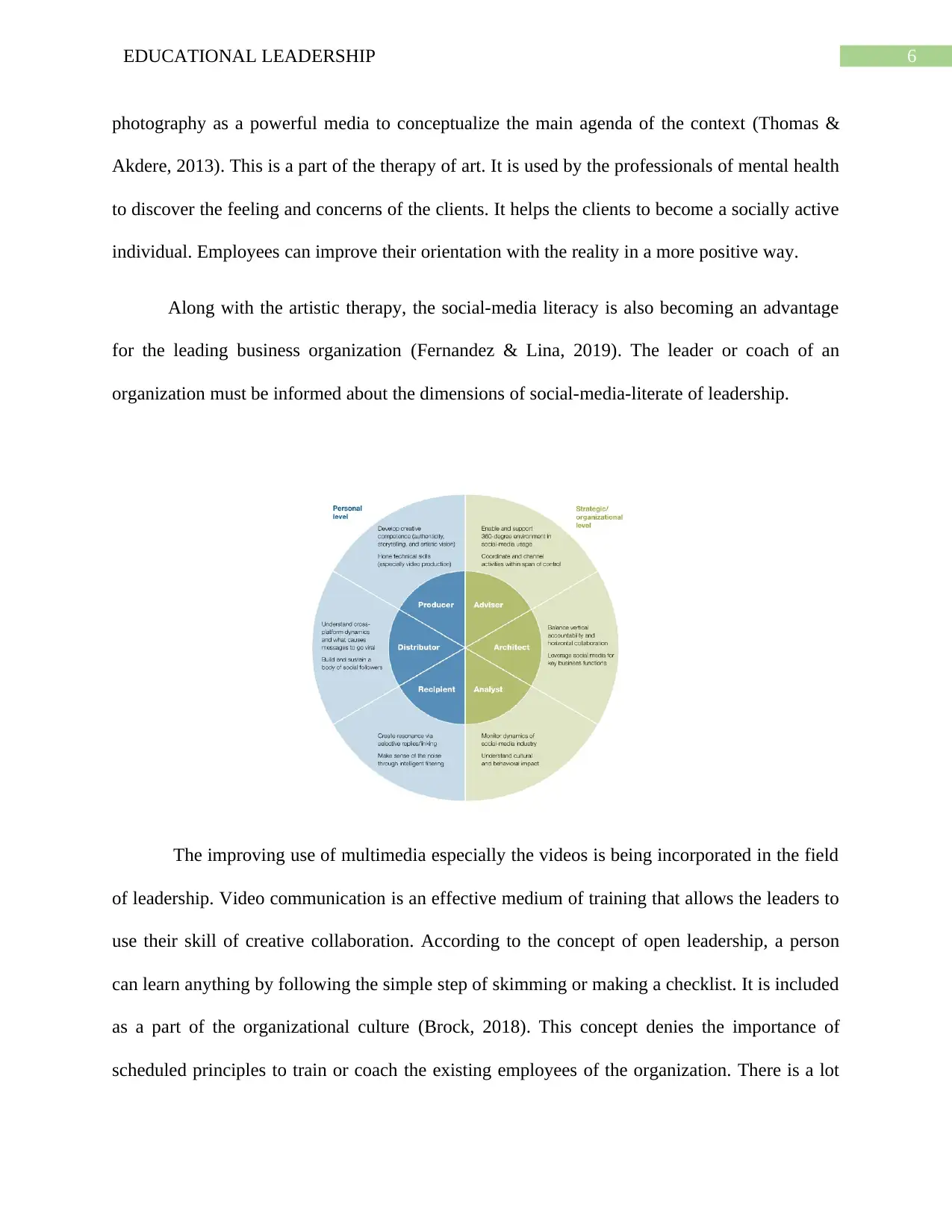
Along with the artistic therapy, the social-media literacy is also becoming an advantage
for the leading business organization (Fernandez & Lina, 2019). The leader or coach of an
organization must be informed about the dimensions of social-media-literate of leadership.
The improving use of multimedia especially the videos is being incorporated in the field
of leadership. Video communication is an effective medium of training that allows the leaders to
use their skill of creative collaboration. According to the concept of open leadership, a person
can learn anything by following the simple step of skimming or making a checklist. It is included
as a part of the organizational culture (Brock, 2018). This concept denies the importance of
scheduled principles to train or coach the existing employees of the organization. There is a lot
photography as a powerful media to conceptualize the main agenda of the context (Thomas &
Akdere, 2013). This is a part of the therapy of art. It is used by the professionals of mental health
to discover the feeling and concerns of the clients. It helps the clients to become a socially active
individual. Employees can improve their orientation with the reality in a more positive way.
Along with the artistic therapy, the social-media literacy is also becoming an advantage
for the leading business organization (Fernandez & Lina, 2019). The leader or coach of an
organization must be informed about the dimensions of social-media-literate of leadership.
The improving use of multimedia especially the videos is being incorporated in the field
of leadership. Video communication is an effective medium of training that allows the leaders to
use their skill of creative collaboration. According to the concept of open leadership, a person
can learn anything by following the simple step of skimming or making a checklist. It is included
as a part of the organizational culture (Brock, 2018). This concept denies the importance of
scheduled principles to train or coach the existing employees of the organization. There is a lot
Paraphrase This Document
Need a fresh take? Get an instant paraphrase of this document with our AI Paraphraser
7EDUCATIONAL LEADERSHIP
of opportunities for the leaders to show the creativity in the field of leadership and training
(Teck, 2006).
The literature review now moving for the discussion about the available methods of
creative coaching in leadership. According to the study, creativity is a type of rigid structure that
constructing one of the component of the characteristics of a potential leader. Creative leadership
provide a helping hand for the organizations to open a new growth strategy. Looking towards the
target from the creative point of view makes the way easier (Grant, 2017). Uniqueness always
leads to extraordinary look after to the organizational desire and motives. The growth strategies
applied by any particular organization is changing according to the course of time. The leader
should always brainstorm the existing employees of the organization for gathering suggestion
about organizational development. Self-assessment is a unique way that can be adopted by a
creative leader (Currin, Brown & Schneider, 2019). Thinking out of the box and applying the
thought process into the existing framework of the organization may or may not bring fruitful
result for the organization. Self-assessment or self-evaluation provides the leader an opportunity
to measure own capability. It provides a scope to the leader to evaluate the proposed strategy to
measure the efficiency level of the proposed strategy.
The study of leadership development program has a different section for the concept of
creativity. Following the GROW model of coaching, it can be said that it is a simplistic way to
manage the leadership in organizations. The abbreviations GROW stands for Goal, Current
reality, options, and will. Goal is the starting point of the coaching or the training program.
Defining the goal at the initial stage of the coaching procedure provides a direction for the
coachee. To incorporate creativity with this stage the leaders can guide the learners to follow the
SMART format of goal setting. It refers goal to be specific, measurable, attainable, realistic, and
of opportunities for the leaders to show the creativity in the field of leadership and training
(Teck, 2006).
The literature review now moving for the discussion about the available methods of
creative coaching in leadership. According to the study, creativity is a type of rigid structure that
constructing one of the component of the characteristics of a potential leader. Creative leadership
provide a helping hand for the organizations to open a new growth strategy. Looking towards the
target from the creative point of view makes the way easier (Grant, 2017). Uniqueness always
leads to extraordinary look after to the organizational desire and motives. The growth strategies
applied by any particular organization is changing according to the course of time. The leader
should always brainstorm the existing employees of the organization for gathering suggestion
about organizational development. Self-assessment is a unique way that can be adopted by a
creative leader (Currin, Brown & Schneider, 2019). Thinking out of the box and applying the
thought process into the existing framework of the organization may or may not bring fruitful
result for the organization. Self-assessment or self-evaluation provides the leader an opportunity
to measure own capability. It provides a scope to the leader to evaluate the proposed strategy to
measure the efficiency level of the proposed strategy.
The study of leadership development program has a different section for the concept of
creativity. Following the GROW model of coaching, it can be said that it is a simplistic way to
manage the leadership in organizations. The abbreviations GROW stands for Goal, Current
reality, options, and will. Goal is the starting point of the coaching or the training program.
Defining the goal at the initial stage of the coaching procedure provides a direction for the
coachee. To incorporate creativity with this stage the leaders can guide the learners to follow the
SMART format of goal setting. It refers goal to be specific, measurable, attainable, realistic, and
8EDUCATIONAL LEADERSHIP
timely (Cochrane & Newton, 2017). The next stage of the model is current reality. Knowing the
current position of the organization in the market place is an important fact for the learner. By
knowing the reality they can determine the amount of effort they have to put to develop the
business any further. After defining the clear goal and knowing the current situation, the next
step is identifying the probable options for expanding further the activities of creative coaching.
Finally, the will is the last step of the model. The coach determines the capability of the coachee
to make commitment for the organizational goal.
An effective leadership always combines the two concepts of command and control. In
this regard, the relation of coaching with command and control is worth mentioning. During the
initial stages, command and control are the two prevailing concepts commonly observed to be
attached with leadership. The classic concept of leadership always exhibits the superiority of the
leader (Cochrane & Newton, 2017). The command and control was posed only in the hands of
the leader or the trainer. Coaching is itself is an alternative method of leading the employees
within an organization. Coaching is the antidote type of leadership that requires striving, growing
and experimenting. This procedure includes interaction between the coach and the coachee.
However, the final decision still lies on the hands of the leader or the coach. The leaders have the
capabilities to determine the priorities according to the fulfillment of goal (Boyce, Jackson &
Neal, 2010).
An organization possesses employees from different generations. A leader must have the
quality to lead all the generation irrespective of gender, age and other determinants. An ideal
leader needs to understand the multigenerational issues and conflicts. Well-established
management does not hinge on time or stereotypes (Thomas & Akdere, 2013). The coaching
style leadership can only address these challenges. It can inspire the employees heading beyond
timely (Cochrane & Newton, 2017). The next stage of the model is current reality. Knowing the
current position of the organization in the market place is an important fact for the learner. By
knowing the reality they can determine the amount of effort they have to put to develop the
business any further. After defining the clear goal and knowing the current situation, the next
step is identifying the probable options for expanding further the activities of creative coaching.
Finally, the will is the last step of the model. The coach determines the capability of the coachee
to make commitment for the organizational goal.
An effective leadership always combines the two concepts of command and control. In
this regard, the relation of coaching with command and control is worth mentioning. During the
initial stages, command and control are the two prevailing concepts commonly observed to be
attached with leadership. The classic concept of leadership always exhibits the superiority of the
leader (Cochrane & Newton, 2017). The command and control was posed only in the hands of
the leader or the trainer. Coaching is itself is an alternative method of leading the employees
within an organization. Coaching is the antidote type of leadership that requires striving, growing
and experimenting. This procedure includes interaction between the coach and the coachee.
However, the final decision still lies on the hands of the leader or the coach. The leaders have the
capabilities to determine the priorities according to the fulfillment of goal (Boyce, Jackson &
Neal, 2010).
An organization possesses employees from different generations. A leader must have the
quality to lead all the generation irrespective of gender, age and other determinants. An ideal
leader needs to understand the multigenerational issues and conflicts. Well-established
management does not hinge on time or stereotypes (Thomas & Akdere, 2013). The coaching
style leadership can only address these challenges. It can inspire the employees heading beyond
⊘ This is a preview!⊘
Do you want full access?
Subscribe today to unlock all pages.
Trusted by 1+ million students worldwide
9EDUCATIONAL LEADERSHIP
the taboos and explore the innate stamina. Employees with growing mindset get more help from
the coaching style of leadership. An employee may contain some sort of fear or tension within
the mind for the service to provide for the organization. Proper coaching will help the employee
to overcome the conflict or fear and serve the company with better willpower (Jones, Woods &
Guillaume, 2016)..
Above all, it is worth mentioning that, effectiveness of coaching or training depends on
the environment of the organization. An ideal environment of the organization should possess
accountability. It means that individual employees must be aware about their own
responsibilities, roles, and the importance of their contribution for the organization. Openness is
another characteristic feature of an ideal organization (Stevens & Spears, 2009). It refers to the
habit of operating clear communication between the employees and the higher authority. Surface
level employees should not possess any hesitation to state their difficulties to the authoritative
members of the organization. The practice of sound decision-making is also another feature of
positive workplace environment (Sheather, 2019). An ideal should allocate the decision-making
power to the efficient employees of the organization. Hence, the larger corporate businesses
maintain proper hierarchy to systematically use the power of decision-making. Above all, the
organization must encourage the scope of personal development. The thought to acquire the best
of one self creates a positive impression in front of the employees for the organization (Turner,
2019). An effective leadership can contribute all the mentioned feature to the organization to
create a positive workplace environment.
Literature gap
All the literary sources contribute to develop knowledge about the concept of coaching
and training. The researcher also successfully demonstrated the difference between traditional
the taboos and explore the innate stamina. Employees with growing mindset get more help from
the coaching style of leadership. An employee may contain some sort of fear or tension within
the mind for the service to provide for the organization. Proper coaching will help the employee
to overcome the conflict or fear and serve the company with better willpower (Jones, Woods &
Guillaume, 2016)..
Above all, it is worth mentioning that, effectiveness of coaching or training depends on
the environment of the organization. An ideal environment of the organization should possess
accountability. It means that individual employees must be aware about their own
responsibilities, roles, and the importance of their contribution for the organization. Openness is
another characteristic feature of an ideal organization (Stevens & Spears, 2009). It refers to the
habit of operating clear communication between the employees and the higher authority. Surface
level employees should not possess any hesitation to state their difficulties to the authoritative
members of the organization. The practice of sound decision-making is also another feature of
positive workplace environment (Sheather, 2019). An ideal should allocate the decision-making
power to the efficient employees of the organization. Hence, the larger corporate businesses
maintain proper hierarchy to systematically use the power of decision-making. Above all, the
organization must encourage the scope of personal development. The thought to acquire the best
of one self creates a positive impression in front of the employees for the organization (Turner,
2019). An effective leadership can contribute all the mentioned feature to the organization to
create a positive workplace environment.
Literature gap
All the literary sources contribute to develop knowledge about the concept of coaching
and training. The researcher also successfully demonstrated the difference between traditional
Paraphrase This Document
Need a fresh take? Get an instant paraphrase of this document with our AI Paraphraser
10EDUCATIONAL LEADERSHIP
training and effective coaching. However, the literary sources lack to contribute for developing
knowledge about the available creative coaching methods for leadership. The main questions of
the research work are firstly to determine the relationship between creative coaching and
leadership, secondly, to understand the difference between traditional training and creative
coaching, and thirdly, the available methods of creative coaching in leadership. During the
course of literature review, the first two questions are answered. However, the study fails to
answer the third mentioned question of the research. Hence, this research will bridge this literary
gap and able to disclose some available methods of creative coaching in the field of leadership.
Methodology
The research can be defined in the form of an activity involving the finding out in a
systematic way about the aspects which were not known by others. The methodology is the
particular philosophical framework in which the research is actually conducted. It can rather be
called the foundation of the research. In the methodology chapter, the research methods, the
designs and the approaches are provided in a detailed form having highlighted throughout the
whole study. It justifies the choice through elaborating on the advantages and the drawbacks of
each of the approaches and designs having taken into account the practical applicability of the
research. It has been descried by O’ Leary that methodology is the framework that is connected
with a specific set of the paradigmatic assumptions which will be used for the conduction of
research. It is further insisted by Allan and Randy that during the conduction of research, the
methodology part must be meeting two of the following criteria: Firstly, the methodology must
be the most accurate in achieving objectives of the research. In the second place, It has to be
made completely possible for replicating the methodology that is used in other type of researches
of same concept and nature.
training and effective coaching. However, the literary sources lack to contribute for developing
knowledge about the available creative coaching methods for leadership. The main questions of
the research work are firstly to determine the relationship between creative coaching and
leadership, secondly, to understand the difference between traditional training and creative
coaching, and thirdly, the available methods of creative coaching in leadership. During the
course of literature review, the first two questions are answered. However, the study fails to
answer the third mentioned question of the research. Hence, this research will bridge this literary
gap and able to disclose some available methods of creative coaching in the field of leadership.
Methodology
The research can be defined in the form of an activity involving the finding out in a
systematic way about the aspects which were not known by others. The methodology is the
particular philosophical framework in which the research is actually conducted. It can rather be
called the foundation of the research. In the methodology chapter, the research methods, the
designs and the approaches are provided in a detailed form having highlighted throughout the
whole study. It justifies the choice through elaborating on the advantages and the drawbacks of
each of the approaches and designs having taken into account the practical applicability of the
research. It has been descried by O’ Leary that methodology is the framework that is connected
with a specific set of the paradigmatic assumptions which will be used for the conduction of
research. It is further insisted by Allan and Randy that during the conduction of research, the
methodology part must be meeting two of the following criteria: Firstly, the methodology must
be the most accurate in achieving objectives of the research. In the second place, It has to be
made completely possible for replicating the methodology that is used in other type of researches
of same concept and nature.
11EDUCATIONAL LEADERSHIP
Research Philosophy
The research philosophy is an extended topic dealing with the nature, the source and the
development of the knowledge. In the simple words, the research philosophy is a belief regarding
the ways through which data regarding a phenomenon must be gathered, analyzed and properly
used. In an essence, the addressing of the research philosophy consists of being aware of the
beliefs and formulation of some assumptions. It can be said that each stage of the research
process is founded on the assumptions regarding the source and the nature of the knowledge.
The research philosophy will further reflect the important assumptions of the author where these
types of assumptions serve in the form of a foundation of the strategy of research. The research
philosophy has many of the branches to a significantly wide range of the disciplines. There are
four main type of the research philosophies such as the pragmatism, realism, positivism and
interpretivism. The selection of the research philosophy is well impacted through the practical
implications. There are also some of the philosophical implications between the studies that are
focused on some facts and the numbers as analysis of influence of foreign direct investment on
standards of GDP growth level along with qualitative studies in the form of leadership style on
motivation of employees in certain organizations. The selection between interpretivist and
positivist philosophies of research or between the qualitative and quantitative methods of
research has represented a huge point of debate traditionally. Positivism as a research philosophy
helps in the development of in-depth analysis of a specific study. The interpretivism again works
with activities of management along with the functions. Realism is the mixed approach of all of
the philosophies. In this specific research, the interpretivism has been used since the research is
based on secondary data collection and analysis and this approach facilitates the understanding
of reasons and methods. It also has enabled to become alive in changes that occur and at the
Research Philosophy
The research philosophy is an extended topic dealing with the nature, the source and the
development of the knowledge. In the simple words, the research philosophy is a belief regarding
the ways through which data regarding a phenomenon must be gathered, analyzed and properly
used. In an essence, the addressing of the research philosophy consists of being aware of the
beliefs and formulation of some assumptions. It can be said that each stage of the research
process is founded on the assumptions regarding the source and the nature of the knowledge.
The research philosophy will further reflect the important assumptions of the author where these
types of assumptions serve in the form of a foundation of the strategy of research. The research
philosophy has many of the branches to a significantly wide range of the disciplines. There are
four main type of the research philosophies such as the pragmatism, realism, positivism and
interpretivism. The selection of the research philosophy is well impacted through the practical
implications. There are also some of the philosophical implications between the studies that are
focused on some facts and the numbers as analysis of influence of foreign direct investment on
standards of GDP growth level along with qualitative studies in the form of leadership style on
motivation of employees in certain organizations. The selection between interpretivist and
positivist philosophies of research or between the qualitative and quantitative methods of
research has represented a huge point of debate traditionally. Positivism as a research philosophy
helps in the development of in-depth analysis of a specific study. The interpretivism again works
with activities of management along with the functions. Realism is the mixed approach of all of
the philosophies. In this specific research, the interpretivism has been used since the research is
based on secondary data collection and analysis and this approach facilitates the understanding
of reasons and methods. It also has enabled to become alive in changes that occur and at the
⊘ This is a preview!⊘
Do you want full access?
Subscribe today to unlock all pages.
Trusted by 1+ million students worldwide

1 out of 22


Related Documents


Your All-in-One AI-Powered Toolkit for Academic Success.
+13062052269
info@desklib.com
Available 24*7 on WhatsApp / Email
![[object Object]](/_next/static/media/star-bottom.7253800d.svg)
Unlock your academic potential
Copyright © 2020–2026 A2Z Services. All Rights Reserved. Developed and managed by ZUCOL.