University Corporate Policy Report: Creative Thinkers Framework
VerifiedAdded on 2020/05/16
|12
|2593
|62
Report
AI Summary
This report provides a comprehensive analysis of the corporate policy of Creative Thinkers, a company focused on creativity and innovation. The policy outlines the purpose, scope, and effective date, as well as the legislative authority. It details the policy statement, covering aspects like creative activities, ethical considerations, approval processes, and risk management. The report also explores the procedures for content creation, including approvals, expenditure acquittal, and additional policies for content use and the Bring Your Own Device (BYOD) policy. The policy emphasizes the importance of originality, market suitability, and adherence to international standards. It also addresses content licensing, deployment, and usage, including guidelines for employees using personal devices for company purposes. The document concludes with a detailed overview of the steps for the adoption of content related to creativity and innovation, providing a complete framework for the company's operations.
Running head: CORPORATE POLICY 1
Corporate Policy
Student Name
University Affiliation
Corporate Policy
Student Name
University Affiliation

Paraphrase This Document
Need a fresh take? Get an instant paraphrase of this document with our AI Paraphraser
CORPORATE POLICY 2
Corporate Policy
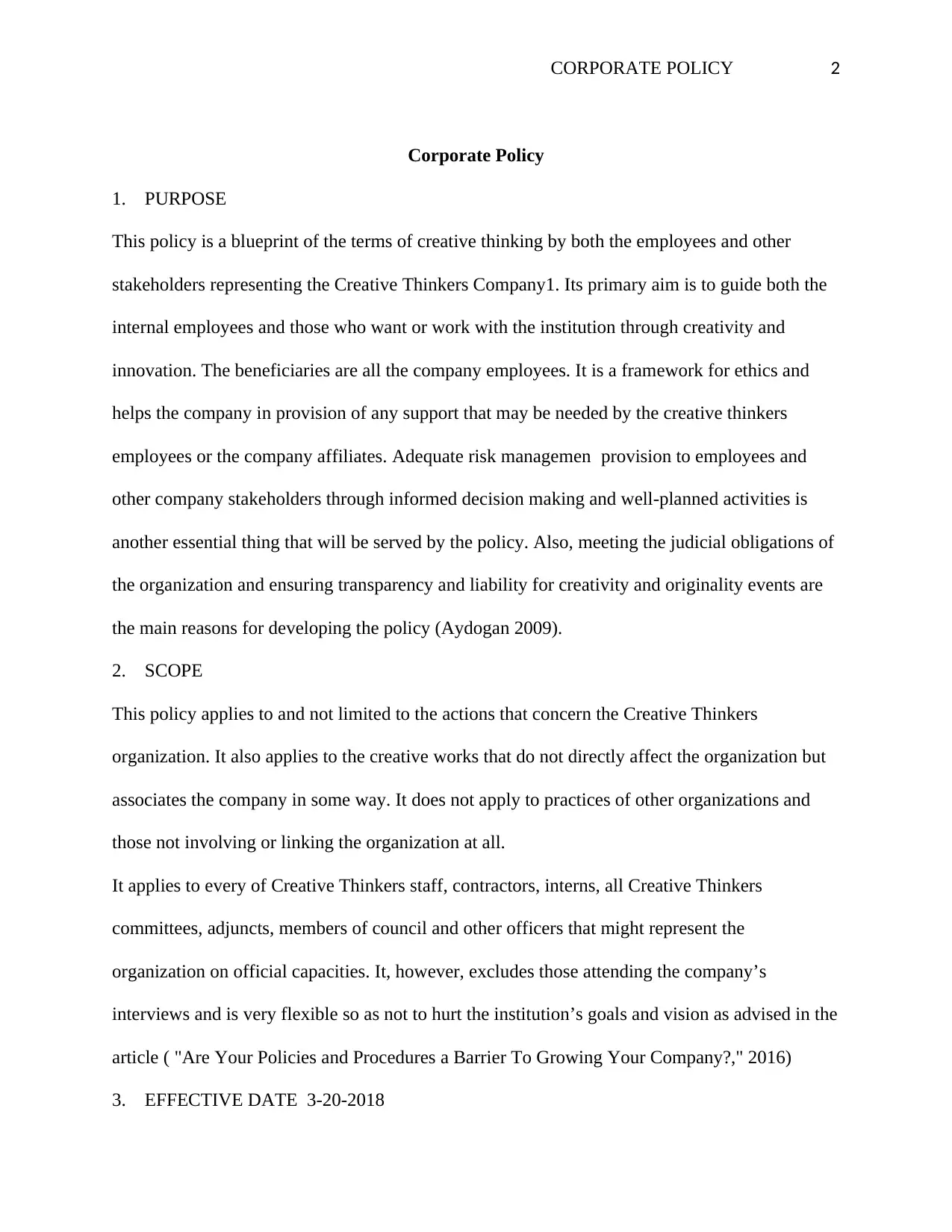
1. PURPOSE
This policy is a blueprint of the terms of creative thinking by both the employees and other
stakeholders representing the Creative Thinkers Company1. Its primary aim is to guide both the
internal employees and those who want or work with the institution through creativity and
innovation. The beneficiaries are all the company employees. It is a framework for ethics and
helps the company in provision of any support that may be needed by the creative thinkers
employees or the company affiliates. Adequate risk management provision to employees and
other company stakeholders through informed decision making and well-planned activities is
another essential thing that will be served by the policy. Also, meeting the judicial obligations of
the organization and ensuring transparency and liability for creativity and originality events are
the main reasons for developing the policy (Aydogan 2009).
2. SCOPE
This policy applies to and not limited to the actions that concern the Creative Thinkers
organization. It also applies to the creative works that do not directly affect the organization but
associates the company in some way. It does not apply to practices of other organizations and
those not involving or linking the organization at all.
It applies to every of Creative Thinkers staff, contractors, interns, all Creative Thinkers
committees, adjuncts, members of council and other officers that might represent the
organization on official capacities. It, however, excludes those attending the company’s
interviews and is very flexible so as not to hurt the institution’s goals and vision as advised in the
article ( "Are Your Policies and Procedures a Barrier To Growing Your Company?," 2016)
3. EFFECTIVE DATE 3-20-2018
Corporate Policy
1. PURPOSE
This policy is a blueprint of the terms of creative thinking by both the employees and other
stakeholders representing the Creative Thinkers Company1. Its primary aim is to guide both the
internal employees and those who want or work with the institution through creativity and
innovation. The beneficiaries are all the company employees. It is a framework for ethics and
helps the company in provision of any support that may be needed by the creative thinkers
employees or the company affiliates. Adequate risk management provision to employees and
other company stakeholders through informed decision making and well-planned activities is
another essential thing that will be served by the policy. Also, meeting the judicial obligations of
the organization and ensuring transparency and liability for creativity and originality events are
the main reasons for developing the policy (Aydogan 2009).
2. SCOPE
This policy applies to and not limited to the actions that concern the Creative Thinkers
organization. It also applies to the creative works that do not directly affect the organization but
associates the company in some way. It does not apply to practices of other organizations and
those not involving or linking the organization at all.
It applies to every of Creative Thinkers staff, contractors, interns, all Creative Thinkers
committees, adjuncts, members of council and other officers that might represent the
organization on official capacities. It, however, excludes those attending the company’s
interviews and is very flexible so as not to hurt the institution’s goals and vision as advised in the
article ( "Are Your Policies and Procedures a Barrier To Growing Your Company?," 2016)
3. EFFECTIVE DATE 3-20-2018
CORPORATE POLICY 3
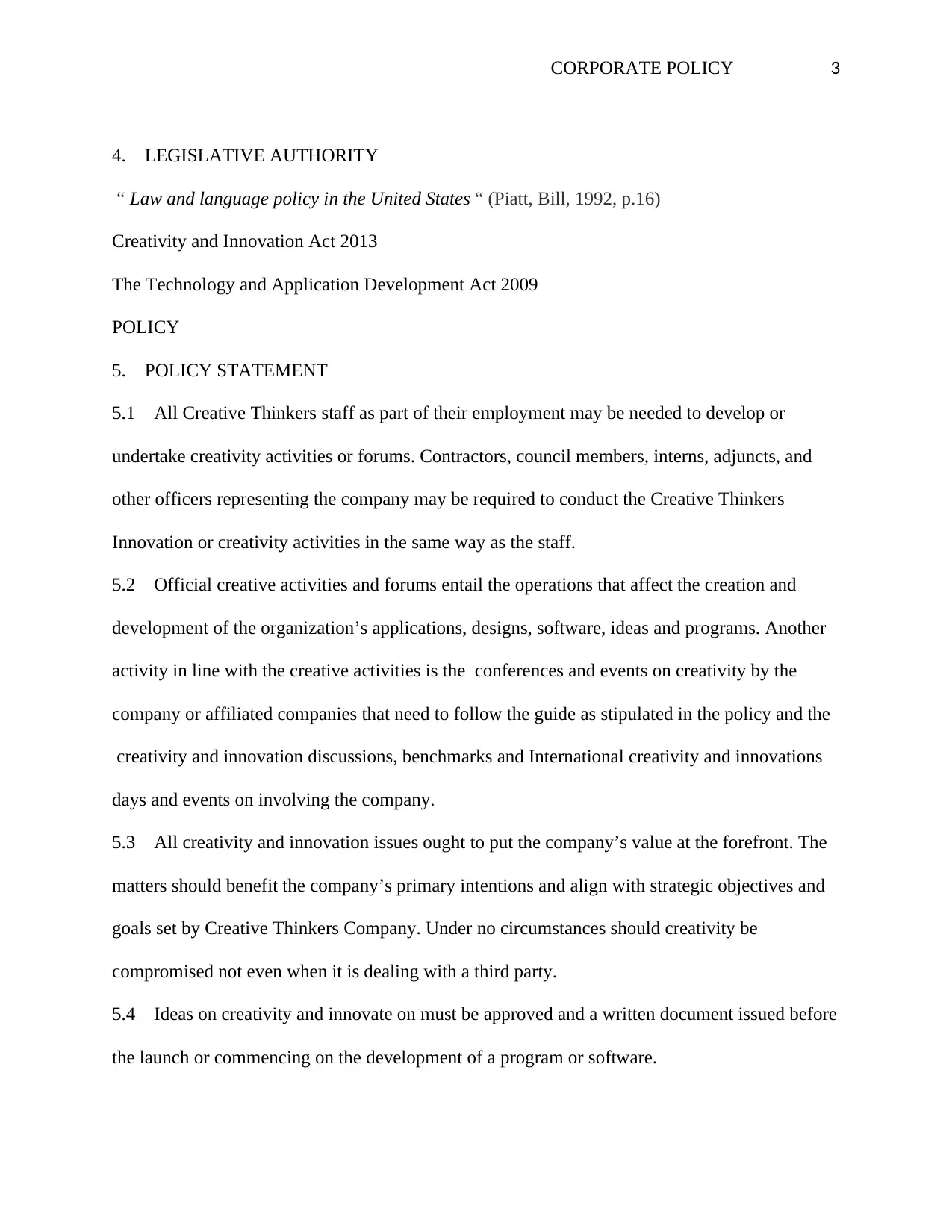
4. LEGISLATIVE AUTHORITY
“ Law and language policy in the United States “ (Piatt, Bill, 1992, p.16)
Creativity and Innovation Act 2013
The Technology and Application Development Act 2009
POLICY
5. POLICY STATEMENT
5.1 All Creative Thinkers staff as part of their employment may be needed to develop or
undertake creativity activities or forums. Contractors, council members, interns, adjuncts, and
other officers representing the company may be required to conduct the Creative Thinkers
Innovation or creativity activities in the same way as the staff.
5.2 Official creative activities and forums entail the operations that affect the creation and
development of the organization’s applications, designs, software, ideas and programs. Another
activity in line with the creative activities is the conferences and events on creativity by the
company or affiliated companies that need to follow the guide as stipulated in the policy and the
creativity and innovation discussions, benchmarks and International creativity and innovations
days and events on involving the company.
5.3 All creativity and innovation issues ought to put the company’s value at the forefront. The
matters should benefit the company’s primary intentions and align with strategic objectives and
goals set by Creative Thinkers Company. Under no circumstances should creativity be
compromised not even when it is dealing with a third party.
5.4 Ideas on creativity and innovate on must be approved and a written document issued before
the launch or commencing on the development of a program or software.
4. LEGISLATIVE AUTHORITY
“ Law and language policy in the United States “ (Piatt, Bill, 1992, p.16)
Creativity and Innovation Act 2013
The Technology and Application Development Act 2009
POLICY
5. POLICY STATEMENT
5.1 All Creative Thinkers staff as part of their employment may be needed to develop or
undertake creativity activities or forums. Contractors, council members, interns, adjuncts, and
other officers representing the company may be required to conduct the Creative Thinkers
Innovation or creativity activities in the same way as the staff.
5.2 Official creative activities and forums entail the operations that affect the creation and
development of the organization’s applications, designs, software, ideas and programs. Another
activity in line with the creative activities is the conferences and events on creativity by the
company or affiliated companies that need to follow the guide as stipulated in the policy and the
creativity and innovation discussions, benchmarks and International creativity and innovations
days and events on involving the company.
5.3 All creativity and innovation issues ought to put the company’s value at the forefront. The
matters should benefit the company’s primary intentions and align with strategic objectives and
goals set by Creative Thinkers Company. Under no circumstances should creativity be
compromised not even when it is dealing with a third party.
5.4 Ideas on creativity and innovate on must be approved and a written document issued before
the launch or commencing on the development of a program or software.
⊘ This is a preview!⊘
Do you want full access?
Subscribe today to unlock all pages.

Trusted by 1+ million students worldwide
CORPORATE POLICY 4
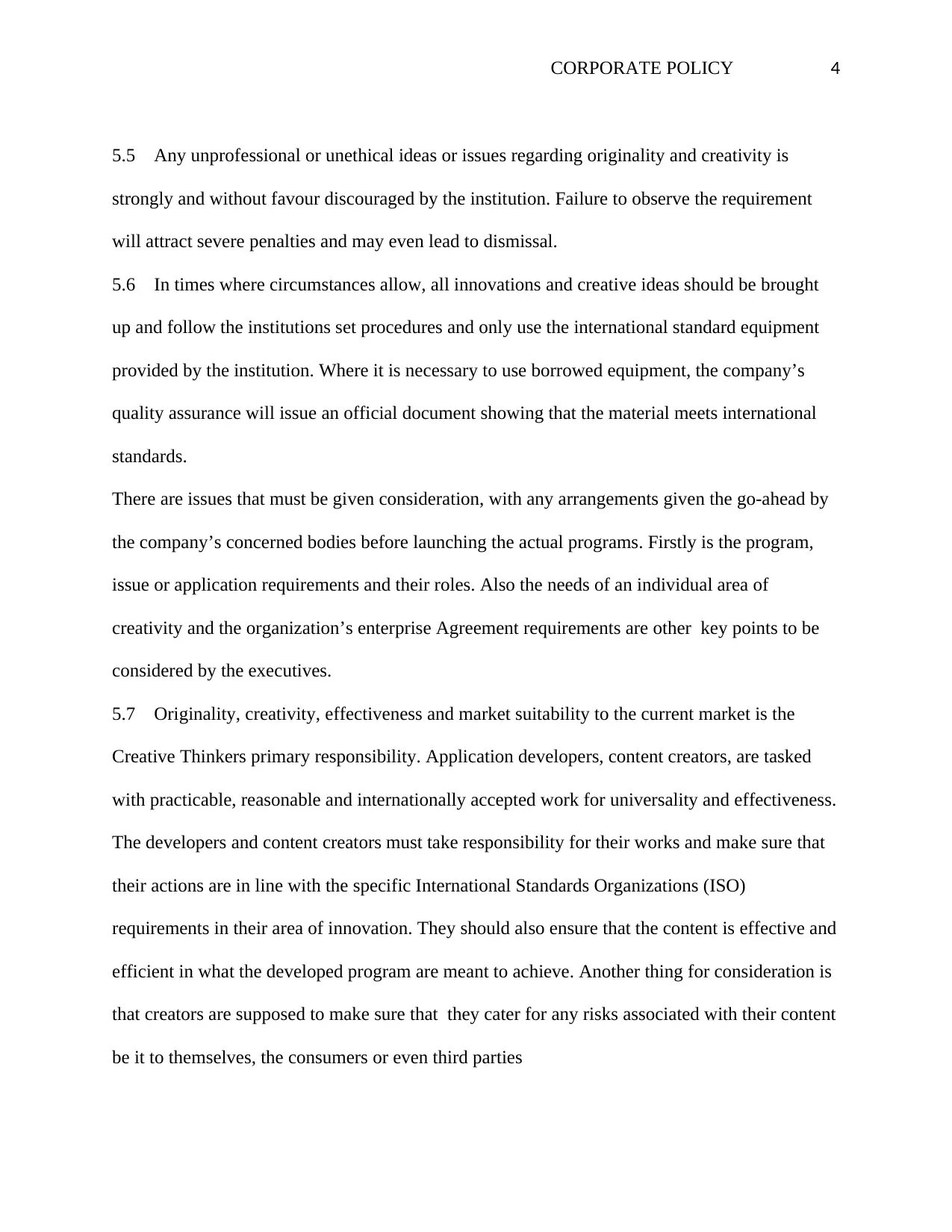
5.5 Any unprofessional or unethical ideas or issues regarding originality and creativity is
strongly and without favour discouraged by the institution. Failure to observe the requirement
will attract severe penalties and may even lead to dismissal.
5.6 In times where circumstances allow, all innovations and creative ideas should be brought
up and follow the institutions set procedures and only use the international standard equipment
provided by the institution. Where it is necessary to use borrowed equipment, the company’s
quality assurance will issue an official document showing that the material meets international
standards.
There are issues that must be given consideration, with any arrangements given the go-ahead by
the company’s concerned bodies before launching the actual programs. Firstly is the program,
issue or application requirements and their roles. Also the needs of an individual area of
creativity and the organization’s enterprise Agreement requirements are other key points to be
considered by the executives.
5.7 Originality, creativity, effectiveness and market suitability to the current market is the
Creative Thinkers primary responsibility. Application developers, content creators, are tasked
with practicable, reasonable and internationally accepted work for universality and effectiveness.
The developers and content creators must take responsibility for their works and make sure that
their actions are in line with the specific International Standards Organizations (ISO)
requirements in their area of innovation. They should also ensure that the content is effective and
efficient in what the developed program are meant to achieve. Another thing for consideration is
that creators are supposed to make sure that they cater for any risks associated with their content
be it to themselves, the consumers or even third parties
5.5 Any unprofessional or unethical ideas or issues regarding originality and creativity is
strongly and without favour discouraged by the institution. Failure to observe the requirement
will attract severe penalties and may even lead to dismissal.
5.6 In times where circumstances allow, all innovations and creative ideas should be brought
up and follow the institutions set procedures and only use the international standard equipment
provided by the institution. Where it is necessary to use borrowed equipment, the company’s
quality assurance will issue an official document showing that the material meets international
standards.
There are issues that must be given consideration, with any arrangements given the go-ahead by
the company’s concerned bodies before launching the actual programs. Firstly is the program,
issue or application requirements and their roles. Also the needs of an individual area of
creativity and the organization’s enterprise Agreement requirements are other key points to be
considered by the executives.
5.7 Originality, creativity, effectiveness and market suitability to the current market is the
Creative Thinkers primary responsibility. Application developers, content creators, are tasked
with practicable, reasonable and internationally accepted work for universality and effectiveness.
The developers and content creators must take responsibility for their works and make sure that
their actions are in line with the specific International Standards Organizations (ISO)
requirements in their area of innovation. They should also ensure that the content is effective and
efficient in what the developed program are meant to achieve. Another thing for consideration is
that creators are supposed to make sure that they cater for any risks associated with their content
be it to themselves, the consumers or even third parties
Paraphrase This Document
Need a fresh take? Get an instant paraphrase of this document with our AI Paraphraser
CORPORATE POLICY 5
5.8 Before developing and launching one’s content, the creators must put into consideration any
risks that may come up directly or indirectly because of their content. Risk assessment should be
carried out comprehensively. The risk assessment should be in partnership with the organization
safety department.
5.9 The Creative Thinkers strictly works by the international creativity and innovation program
and ISO in the provision of resources and direction on unclear issues. Newbies should at all
times refer to these guidelines.
5.10 The organization should reveal in its annual report all the details on new programs and all
the innovations. All details about the contents should be collected and submitted for record
keeping.
5.11 All content must be prepared via the company’s preferred regulators and other hardware
suppliers for natural follow-up and compensation in case of failures. In situations where the
preferred supplier cannot provide a needed item, the purchase can be made from another
organization-approved provider. The Director of sales marketing and procurement must sign the
approval.
5.12 Content creators are advised to purchase the resources needed for their content through
the organization’s corporate account or using the corporate cards to get offers and cost reduction
purposes. All Creative Thinkers’ affiliates are advised to get the corporate Credit Card for the
above reason.
5.13 Content creation and development is a management task and should be tracked through
exemption of Corporate Credit Card statement
5.8 Before developing and launching one’s content, the creators must put into consideration any
risks that may come up directly or indirectly because of their content. Risk assessment should be
carried out comprehensively. The risk assessment should be in partnership with the organization
safety department.
5.9 The Creative Thinkers strictly works by the international creativity and innovation program
and ISO in the provision of resources and direction on unclear issues. Newbies should at all
times refer to these guidelines.
5.10 The organization should reveal in its annual report all the details on new programs and all
the innovations. All details about the contents should be collected and submitted for record
keeping.
5.11 All content must be prepared via the company’s preferred regulators and other hardware
suppliers for natural follow-up and compensation in case of failures. In situations where the
preferred supplier cannot provide a needed item, the purchase can be made from another
organization-approved provider. The Director of sales marketing and procurement must sign the
approval.
5.12 Content creators are advised to purchase the resources needed for their content through
the organization’s corporate account or using the corporate cards to get offers and cost reduction
purposes. All Creative Thinkers’ affiliates are advised to get the corporate Credit Card for the
above reason.
5.13 Content creation and development is a management task and should be tracked through
exemption of Corporate Credit Card statement
CORPORATE POLICY 6
5.14 All content creation in violation of this policy and procedure is without discussion
considered a breach of the institutional policy. Those found to have been non-compliant may
face disciplinary action under the company’s code of ethics.
PROCEDURES
6 APPROVALS
6.1 Creative Thinkers applies the following steps for the adoption of contents of creativity and
innovations:
Step 1: Content development request. Innovators and content creators should fill submit content
creation detailing its development and launching to accompany the application will be the
estimated costs and budget.
Step 2: Risk assessment. Before undertaking any content creation and development, those
involved will be required to determine the risks that are associated with the whole ordeal. The
risk should be assessed regarding how they will impact the primary developers, the organization,
the consumers and other stakeholders.
Step 3: Approval for creation and development. Those involved in creation and development
must get approval from their supervisors, managers and the relevant executives where required.
Step 4: Approval for funds commissioning. On top of getting the creation and development
approval, the creators must obtain permission from the authorized and official personnel for the
estimated costs.
Step 5: Expenditure acquittal. The creators must acquit all the expenditure for approval by their
leaders or supervisors and authorized financial representative upon completion of their project.
Additional policies for creative content creation and development
Purchasing policy
5.14 All content creation in violation of this policy and procedure is without discussion
considered a breach of the institutional policy. Those found to have been non-compliant may
face disciplinary action under the company’s code of ethics.
PROCEDURES
6 APPROVALS
6.1 Creative Thinkers applies the following steps for the adoption of contents of creativity and
innovations:
Step 1: Content development request. Innovators and content creators should fill submit content
creation detailing its development and launching to accompany the application will be the
estimated costs and budget.
Step 2: Risk assessment. Before undertaking any content creation and development, those
involved will be required to determine the risks that are associated with the whole ordeal. The
risk should be assessed regarding how they will impact the primary developers, the organization,
the consumers and other stakeholders.
Step 3: Approval for creation and development. Those involved in creation and development
must get approval from their supervisors, managers and the relevant executives where required.
Step 4: Approval for funds commissioning. On top of getting the creation and development
approval, the creators must obtain permission from the authorized and official personnel for the
estimated costs.
Step 5: Expenditure acquittal. The creators must acquit all the expenditure for approval by their
leaders or supervisors and authorized financial representative upon completion of their project.
Additional policies for creative content creation and development
Purchasing policy
⊘ This is a preview!⊘
Do you want full access?
Subscribe today to unlock all pages.
Trusted by 1+ million students worldwide
CORPORATE POLICY 7
Use of content policy
6.2 Policy for the use of content
6.2.1 Policy Number: CCD032018
6.2.2 Policy Date: 02/02/2018
All staff, interns, stakeholders and company affiliates should read and operate as stipulated in the
policy
6.3 Scope of the plan
This policy gives direction on the use and the content created for all organization employees
within the company to ensure that all content is appropriate. The purpose of free and patent
content will be carried out under the same procedures outlined for commercial content.
6.4 Content/Program Licensing
• All content terms and copyright of all licenses will be adhered to by all employees and other
affiliates to the business.
• In cases where the licensing is specific on usage limit, for example, a particular department
only is allowed to use and get access to some content; then it is the duty of departmental heads
and executives to enforce this policy.
• The quality assurance and auditing delegate is responsible for auditing the content or
programs developed at least twice a year to ensure license and copyrights conformity
6.5 content/Program deployment
6.5.1. Where required, all content must officially be registered with the business supplying it.
6.5.2 Creative Thinkers is to be the official registered owner of all content or programs.
6.5.3 Only content created and developed aligning with content creation, and development policy
is to be allowed to be deployed for use by the institution.
Use of content policy
6.2 Policy for the use of content
6.2.1 Policy Number: CCD032018
6.2.2 Policy Date: 02/02/2018
All staff, interns, stakeholders and company affiliates should read and operate as stipulated in the
policy
6.3 Scope of the plan
This policy gives direction on the use and the content created for all organization employees
within the company to ensure that all content is appropriate. The purpose of free and patent
content will be carried out under the same procedures outlined for commercial content.
6.4 Content/Program Licensing
• All content terms and copyright of all licenses will be adhered to by all employees and other
affiliates to the business.
• In cases where the licensing is specific on usage limit, for example, a particular department
only is allowed to use and get access to some content; then it is the duty of departmental heads
and executives to enforce this policy.
• The quality assurance and auditing delegate is responsible for auditing the content or
programs developed at least twice a year to ensure license and copyrights conformity
6.5 content/Program deployment
6.5.1. Where required, all content must officially be registered with the business supplying it.
6.5.2 Creative Thinkers is to be the official registered owner of all content or programs.
6.5.3 Only content created and developed aligning with content creation, and development policy
is to be allowed to be deployed for use by the institution.
Paraphrase This Document
Need a fresh take? Get an instant paraphrase of this document with our AI Paraphraser
CORPORATE POLICY 8
6.6 Content usage
Material that complies with creativity and innovation policy is to be let to the customers only.
• Before the deployment of any content created or developed by Creative Thinkers, any user of
the program must receive instructions on any available licensing agreement.
• The users must receive training on all content/programs they are to use. This can be in the
form of the user manual for geographically distanced customers.
• The Creative Thinkers employees are discouraged from taking home with them the programs
or company contents unless stated otherwise.
• In situations where an employee has to use company content at home, written authorization
from his/her departmental head or relevant delegate executive is mandatory.
• Use of stolen solicited or cracked material is prohibited by the institution.
• Use of program copies or unauthorized duplication is discouraged. Any staff, adjuncts,
suppliers or any business affiliated persons who make or decides to use illegal content or
programs will be referred to the administrative policy representative for reprimands, further
consultation and any other disciplinary action deemed corrective by the delegate.
Additional Policies for content/program use
• Technology Hardware Policy
• Software Obtaining Policy
6.7 Bring your Device Policy
Policy Number: BYOD032018
Policy Date: 03/03/2018
At Creative Thinkers, the use of mobile technologies for improved productivity and institution
communication is acknowledged .in wake of increased use mobile devices and the employees
6.6 Content usage
Material that complies with creativity and innovation policy is to be let to the customers only.
• Before the deployment of any content created or developed by Creative Thinkers, any user of
the program must receive instructions on any available licensing agreement.
• The users must receive training on all content/programs they are to use. This can be in the
form of the user manual for geographically distanced customers.
• The Creative Thinkers employees are discouraged from taking home with them the programs
or company contents unless stated otherwise.
• In situations where an employee has to use company content at home, written authorization
from his/her departmental head or relevant delegate executive is mandatory.
• Use of stolen solicited or cracked material is prohibited by the institution.
• Use of program copies or unauthorized duplication is discouraged. Any staff, adjuncts,
suppliers or any business affiliated persons who make or decides to use illegal content or
programs will be referred to the administrative policy representative for reprimands, further
consultation and any other disciplinary action deemed corrective by the delegate.
Additional Policies for content/program use
• Technology Hardware Policy
• Software Obtaining Policy
6.7 Bring your Device Policy
Policy Number: BYOD032018
Policy Date: 03/03/2018
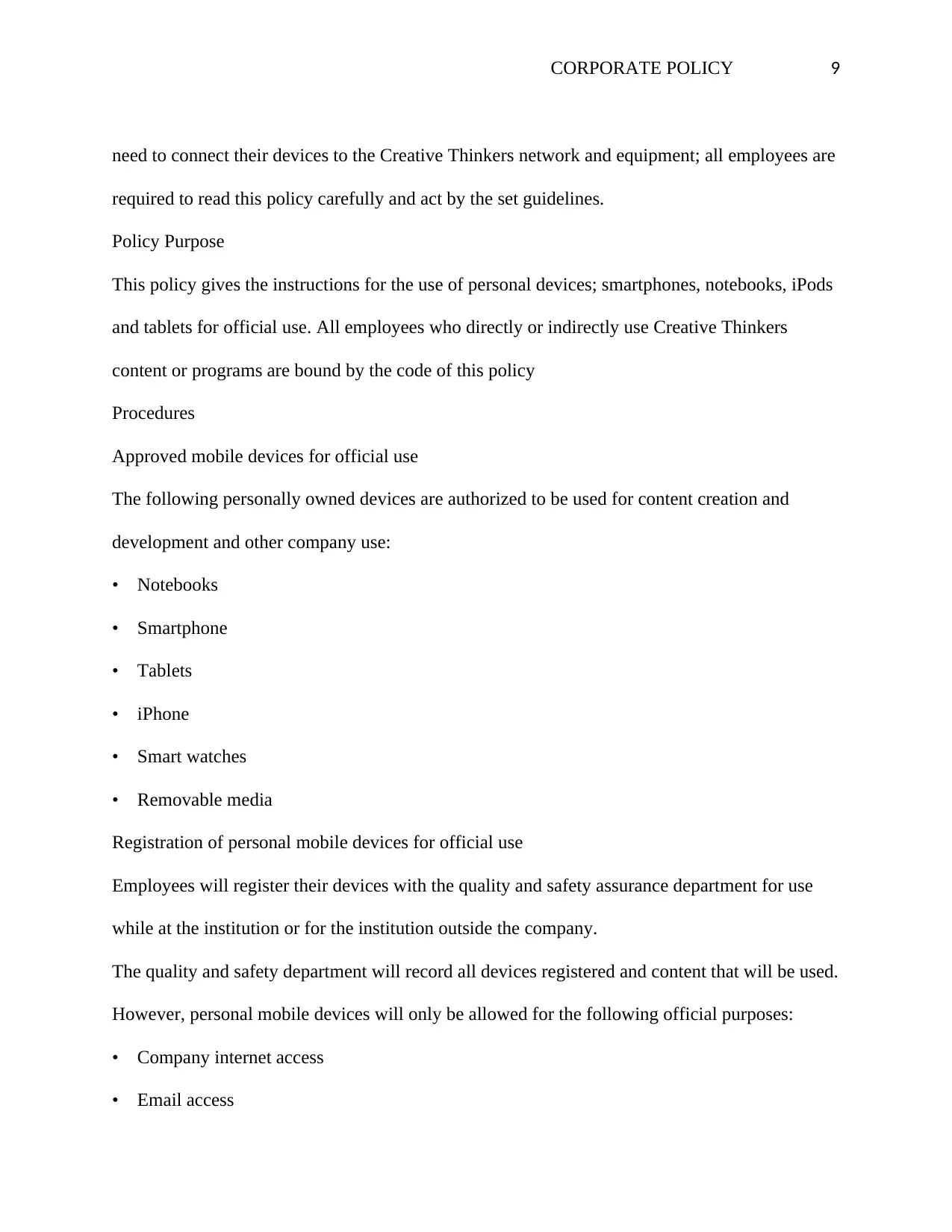
At Creative Thinkers, the use of mobile technologies for improved productivity and institution
communication is acknowledged .in wake of increased use mobile devices and the employees
CORPORATE POLICY 9
need to connect their devices to the Creative Thinkers network and equipment; all employees are
required to read this policy carefully and act by the set guidelines.
Policy Purpose
This policy gives the instructions for the use of personal devices; smartphones, notebooks, iPods
and tablets for official use. All employees who directly or indirectly use Creative Thinkers
content or programs are bound by the code of this policy
Procedures
Approved mobile devices for official use
The following personally owned devices are authorized to be used for content creation and
development and other company use:
• Notebooks
• Smartphone
• Tablets
• iPhone
• Smart watches
• Removable media
Registration of personal mobile devices for official use
Employees will register their devices with the quality and safety assurance department for use
while at the institution or for the institution outside the company.
The quality and safety department will record all devices registered and content that will be used.
However, personal mobile devices will only be allowed for the following official purposes:
• Company internet access
• Email access
need to connect their devices to the Creative Thinkers network and equipment; all employees are
required to read this policy carefully and act by the set guidelines.
Policy Purpose
This policy gives the instructions for the use of personal devices; smartphones, notebooks, iPods
and tablets for official use. All employees who directly or indirectly use Creative Thinkers
content or programs are bound by the code of this policy
Procedures
Approved mobile devices for official use
The following personally owned devices are authorized to be used for content creation and
development and other company use:
• Notebooks
• Smartphone
• Tablets
• iPhone
• Smart watches
• Removable media
Registration of personal mobile devices for official use
Employees will register their devices with the quality and safety assurance department for use
while at the institution or for the institution outside the company.
The quality and safety department will record all devices registered and content that will be used.
However, personal mobile devices will only be allowed for the following official purposes:
• Company internet access
• Email access
⊘ This is a preview!⊘
Do you want full access?
Subscribe today to unlock all pages.
Trusted by 1+ million students worldwide
CORPORATE POLICY 10
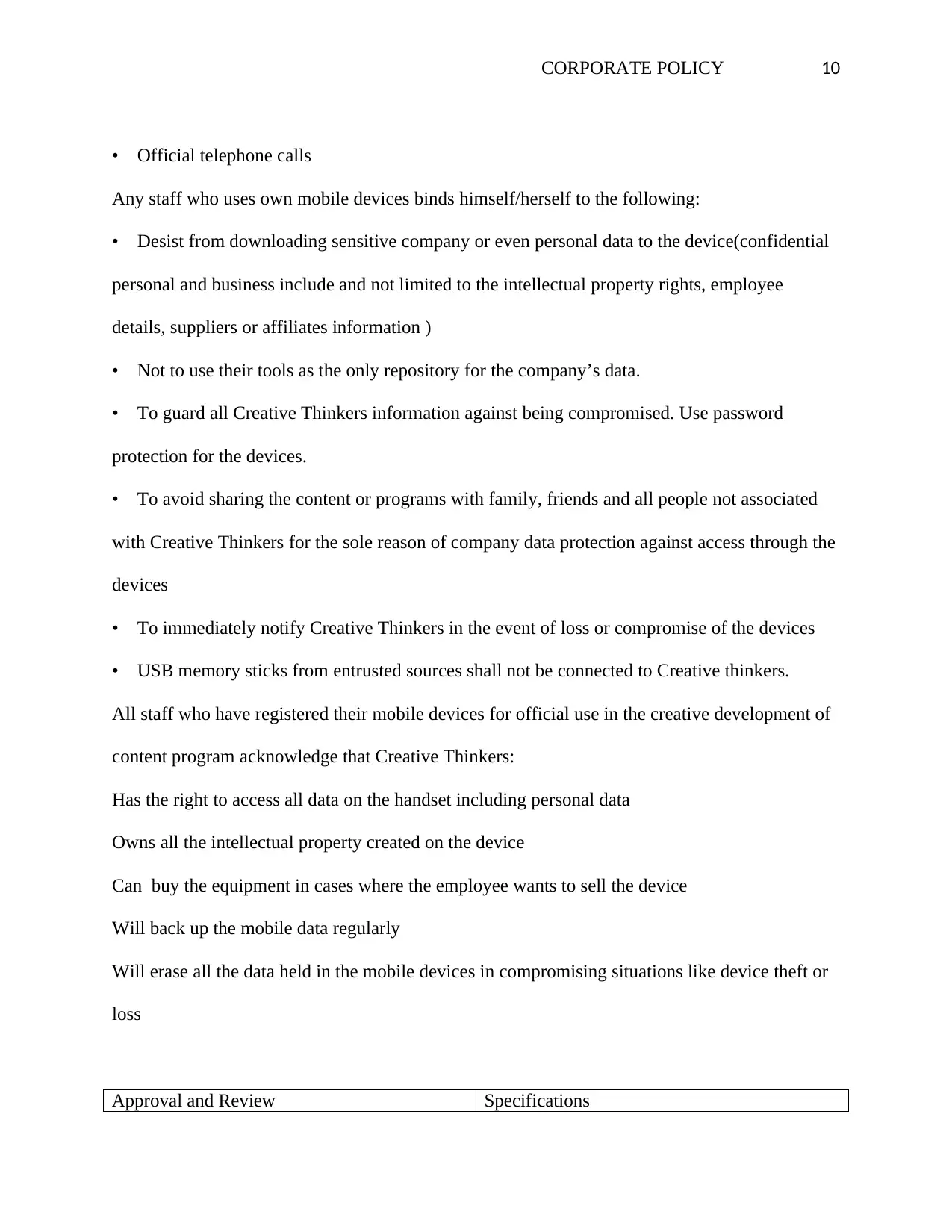
• Official telephone calls
Any staff who uses own mobile devices binds himself/herself to the following:
• Desist from downloading sensitive company or even personal data to the device(confidential
personal and business include and not limited to the intellectual property rights, employee
details, suppliers or affiliates information )
• Not to use their tools as the only repository for the company’s data.
• To guard all Creative Thinkers information against being compromised. Use password
protection for the devices.
• To avoid sharing the content or programs with family, friends and all people not associated
with Creative Thinkers for the sole reason of company data protection against access through the
devices
• To immediately notify Creative Thinkers in the event of loss or compromise of the devices
• USB memory sticks from entrusted sources shall not be connected to Creative thinkers.
All staff who have registered their mobile devices for official use in the creative development of
content program acknowledge that Creative Thinkers:
Has the right to access all data on the handset including personal data
Owns all the intellectual property created on the device
Can buy the equipment in cases where the employee wants to sell the device
Will back up the mobile data regularly
Will erase all the data held in the mobile devices in compromising situations like device theft or
loss
Approval and Review Specifications
• Official telephone calls
Any staff who uses own mobile devices binds himself/herself to the following:
• Desist from downloading sensitive company or even personal data to the device(confidential
personal and business include and not limited to the intellectual property rights, employee
details, suppliers or affiliates information )
• Not to use their tools as the only repository for the company’s data.
• To guard all Creative Thinkers information against being compromised. Use password
protection for the devices.
• To avoid sharing the content or programs with family, friends and all people not associated
with Creative Thinkers for the sole reason of company data protection against access through the
devices
• To immediately notify Creative Thinkers in the event of loss or compromise of the devices
• USB memory sticks from entrusted sources shall not be connected to Creative thinkers.
All staff who have registered their mobile devices for official use in the creative development of
content program acknowledge that Creative Thinkers:
Has the right to access all data on the handset including personal data
Owns all the intellectual property created on the device
Can buy the equipment in cases where the employee wants to sell the device
Will back up the mobile data regularly
Will erase all the data held in the mobile devices in compromising situations like device theft or
loss
Approval and Review Specifications
Paraphrase This Document
Need a fresh take? Get an instant paraphrase of this document with our AI Paraphraser
CORPORATE POLICY 11
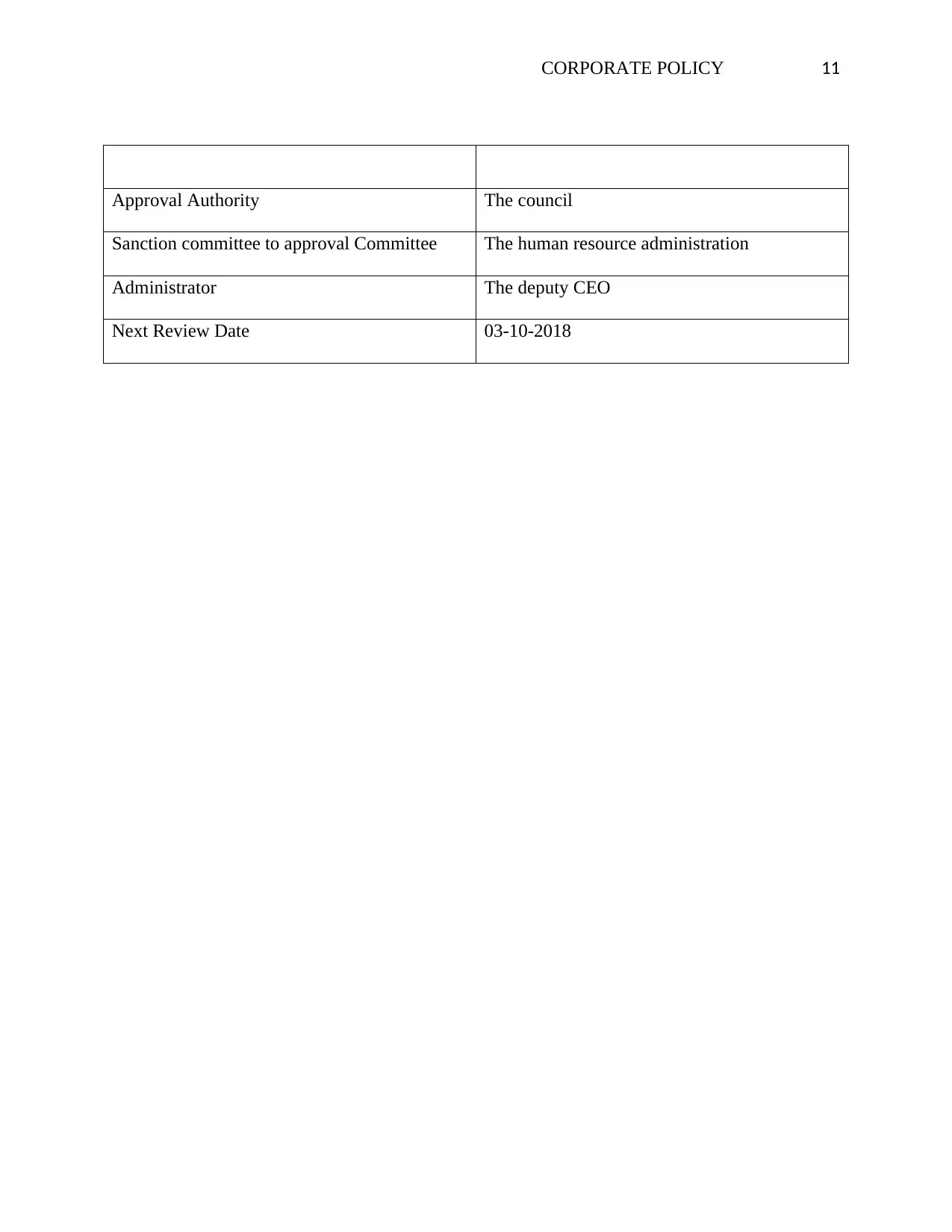
Approval Authority The council
Sanction committee to approval Committee The human resource administration
Administrator The deputy CEO
Next Review Date 03-10-2018
Approval Authority The council
Sanction committee to approval Committee The human resource administration
Administrator The deputy CEO
Next Review Date 03-10-2018
CORPORATE POLICY 12
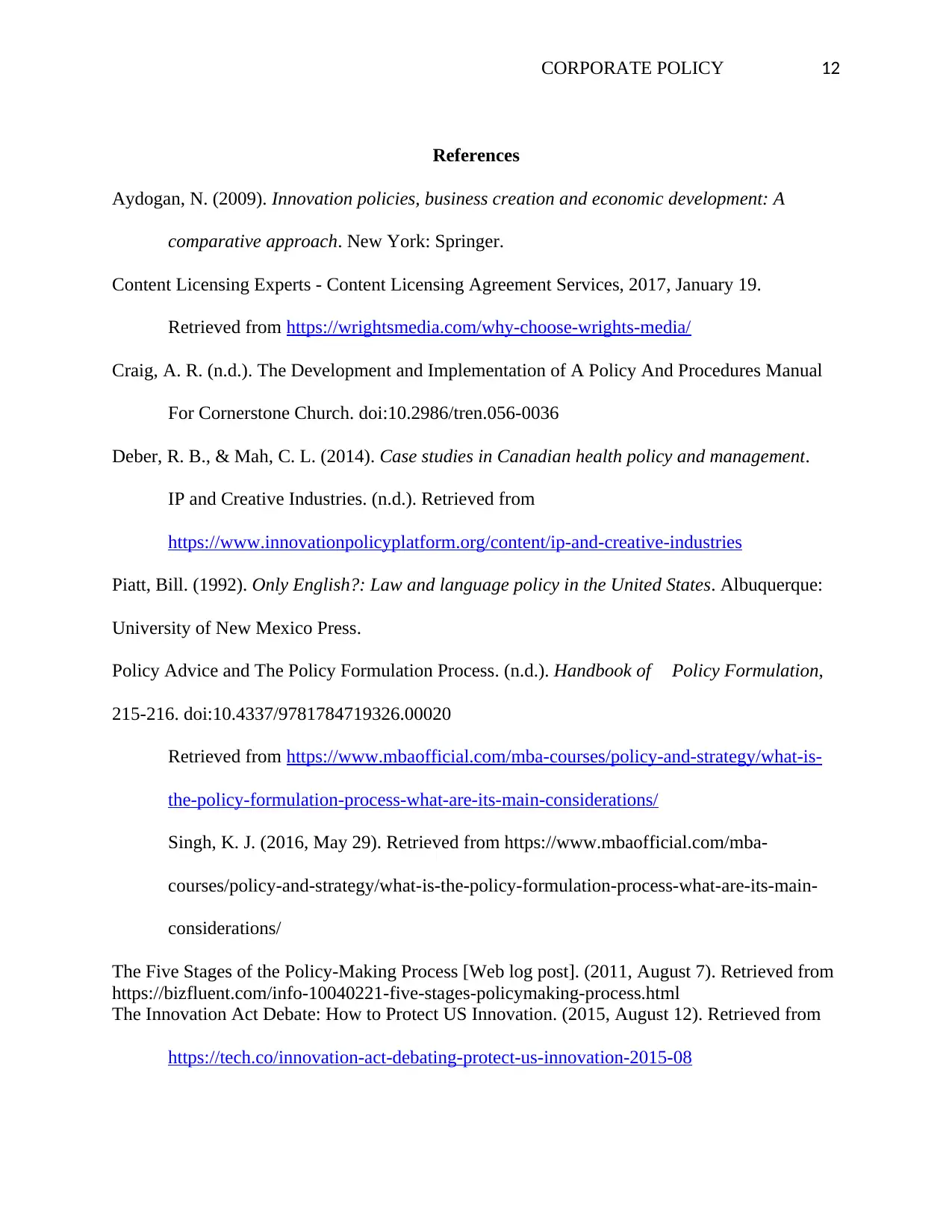
References
Aydogan, N. (2009). Innovation policies, business creation and economic development: A
comparative approach. New York: Springer.
Content Licensing Experts - Content Licensing Agreement Services, 2017, January 19.
Retrieved from https://wrightsmedia.com/why-choose-wrights-media/
Craig, A. R. (n.d.). The Development and Implementation of A Policy And Procedures Manual
For Cornerstone Church. doi:10.2986/tren.056-0036
Deber, R. B., & Mah, C. L. (2014). Case studies in Canadian health policy and management.
IP and Creative Industries. (n.d.). Retrieved from
https://www.innovationpolicyplatform.org/content/ip-and-creative-industries
Piatt, Bill. (1992). Only English?: Law and language policy in the United States. Albuquerque:
University of New Mexico Press.
Policy Advice and The Policy Formulation Process. (n.d.). Handbook of Policy Formulation,
215-216. doi:10.4337/9781784719326.00020
Retrieved from https://www.mbaofficial.com/mba-courses/policy-and-strategy/what-is-
the-policy-formulation-process-what-are-its-main-considerations/
Singh, K. J. (2016, May 29). Retrieved from https://www.mbaofficial.com/mba-
courses/policy-and-strategy/what-is-the-policy-formulation-process-what-are-its-main-
considerations/
The Five Stages of the Policy-Making Process [Web log post]. (2011, August 7). Retrieved from
https://bizfluent.com/info-10040221-five-stages-policymaking-process.html
The Innovation Act Debate: How to Protect US Innovation. (2015, August 12). Retrieved from
https://tech.co/innovation-act-debating-protect-us-innovation-2015-08
References
Aydogan, N. (2009). Innovation policies, business creation and economic development: A
comparative approach. New York: Springer.
Content Licensing Experts - Content Licensing Agreement Services, 2017, January 19.
Retrieved from https://wrightsmedia.com/why-choose-wrights-media/
Craig, A. R. (n.d.). The Development and Implementation of A Policy And Procedures Manual
For Cornerstone Church. doi:10.2986/tren.056-0036
Deber, R. B., & Mah, C. L. (2014). Case studies in Canadian health policy and management.
IP and Creative Industries. (n.d.). Retrieved from
https://www.innovationpolicyplatform.org/content/ip-and-creative-industries
Piatt, Bill. (1992). Only English?: Law and language policy in the United States. Albuquerque:
University of New Mexico Press.
Policy Advice and The Policy Formulation Process. (n.d.). Handbook of Policy Formulation,
215-216. doi:10.4337/9781784719326.00020
Retrieved from https://www.mbaofficial.com/mba-courses/policy-and-strategy/what-is-
the-policy-formulation-process-what-are-its-main-considerations/
Singh, K. J. (2016, May 29). Retrieved from https://www.mbaofficial.com/mba-
courses/policy-and-strategy/what-is-the-policy-formulation-process-what-are-its-main-
considerations/
The Five Stages of the Policy-Making Process [Web log post]. (2011, August 7). Retrieved from
https://bizfluent.com/info-10040221-five-stages-policymaking-process.html
The Innovation Act Debate: How to Protect US Innovation. (2015, August 12). Retrieved from
https://tech.co/innovation-act-debating-protect-us-innovation-2015-08
⊘ This is a preview!⊘
Do you want full access?
Subscribe today to unlock all pages.
Trusted by 1+ million students worldwide

1 out of 12


Related Documents


Your All-in-One AI-Powered Toolkit for Academic Success.
+13062052269
info@desklib.com
Available 24*7 on WhatsApp / Email
![[object Object]](/_next/static/media/star-bottom.7253800d.svg)
Unlock your academic potential
Copyright © 2020–2026 A2Z Services. All Rights Reserved. Developed and managed by ZUCOL.