Creativity and Business Wealth: Innovation and Social Need
VerifiedAdded on 2023/01/10
|11
|2902
|34
Essay
AI Summary
This essay explores the crucial role of innovation in addressing social needs, particularly focusing on the 'bottom of the pyramid' (BOP) market and its potential for business wealth creation. The paper begins by defining the BOP and highlighting the factors that contribute to the needs of people below the poverty line. It then delves into the strategies organizations employ to meet consumer needs, emphasizing the importance of innovative approaches. The essay uses Coca-Cola as a case study to illustrate how a company can successfully target the BOP market by developing innovative products and distribution strategies. Key principles of BOP innovation, such as value-driven pricing, innovation in product design, efficient resource utilization, and consumer education, are discussed. The Coca-Cola case study details the company's successful entry into the Indian rural market, highlighting its marketing and advertising strategies. The essay concludes by emphasizing the value creation mechanisms and the importance of innovation for driving growth and fulfilling the needs of BOP consumers. The essay demonstrates critical understanding of how innovation addresses social needs according to literature and what are the key value-creation mechanisms to be found in examples.
CREATIVITY AND BUSINESS WEALTH 1
STUDENT NAME:
STUDENT ID:
TOPIC: CREATIVITY AND BUSINESS WEALTH
DATE: 5-04-2019
STUDENT NAME:
STUDENT ID:
TOPIC: CREATIVITY AND BUSINESS WEALTH
DATE: 5-04-2019

Paraphrase This Document
Need a fresh take? Get an instant paraphrase of this document with our AI Paraphraser
CREATIVITY AND BUSINESS WEALTH 2
Contents
Introduction.................................................................................................................................................3
Innovation addresses a social need.............................................................................................................3
Bottom of the pyramid................................................................................................................................4
Principles of BOP innovation...................................................................................................................6
CASE STUDY: COCA-COLA........................................................................................................................7
Value creation.............................................................................................................................................8
Conclusion...................................................................................................................................................9
References.................................................................................................................................................10
Contents
Introduction.................................................................................................................................................3
Innovation addresses a social need.............................................................................................................3
Bottom of the pyramid................................................................................................................................4
Principles of BOP innovation...................................................................................................................6
CASE STUDY: COCA-COLA........................................................................................................................7
Value creation.............................................................................................................................................8
Conclusion...................................................................................................................................................9
References.................................................................................................................................................10
CREATIVITY AND BUSINESS WEALTH 3
Introduction
The bottom of the pyramid is the poorest group which is reflected in the society. There are
contributing factors that enhance the need of the people below the poverty line. This paper
provides detailed knowledge of the Bottom of Pyramid and innovative measures taken for
fulfilling the needs of the consumers. To curtail poverty and to ensure the standard of living of
the people, there are several strategies taken by several organizations to fulfill the need of the
consumers. There are examples and the case study of Coca-cola that is described in the paper.
Innovation addresses a social need
Companies should develop new strategies in order to enter the market and accomplish business
model breakthroughs. It is important to identify the gap that the company needs to fill and find
consecutive ways that turn the business into a profitable condition (George, Anita & Jaideep
2012). Innovative ideas lead to attracting consumers while promoting and producing distributive
measures that burst the market and interest of people in buying the product. There are several
ways that are applied to unfold the business and ensure economic growth in the market. Strategic
innovations and research lead to the success of the business. The dynamics of growth is
measured with the economic pyramid that is understood as it provides opportunities in the
market. Strategic innovation addresses social needs and helps to establish the business while
enhancing the distribution channels and working on customer needs from the ground up (Zhou &
Li 2011).
Innovation is a major condition that is involved in the Bottom of Pyramid markets (BOP). It is
known that that innovation helps to reduce the cost of the product, while on the other hand the
social needs of the BOP customers are fulfilled. Innovation is thereby important and tends to
reduce the cost while using managerial tools and several business techniques. The market
creation concept is really different from the market entry system (Peter & Krishnakumar 2010).
The BOP perspective has a mutual value creation that is comparatively greater and meets the
demand and needs of the poor population. The partnership goal is important and is involved in
the business in order to measure corporate objective and fulfill the needs of the customer. Profit
is not only the goal that is measured in this case, the but social needs of poor people are also
fulfilled at a lower rate. Business encourages profit marking and tends to create a society that
ensures business success and societal needs to be fulfilled equally. Bottom of the pyramid is a
Introduction
The bottom of the pyramid is the poorest group which is reflected in the society. There are
contributing factors that enhance the need of the people below the poverty line. This paper
provides detailed knowledge of the Bottom of Pyramid and innovative measures taken for
fulfilling the needs of the consumers. To curtail poverty and to ensure the standard of living of
the people, there are several strategies taken by several organizations to fulfill the need of the
consumers. There are examples and the case study of Coca-cola that is described in the paper.
Innovation addresses a social need
Companies should develop new strategies in order to enter the market and accomplish business
model breakthroughs. It is important to identify the gap that the company needs to fill and find
consecutive ways that turn the business into a profitable condition (George, Anita & Jaideep
2012). Innovative ideas lead to attracting consumers while promoting and producing distributive
measures that burst the market and interest of people in buying the product. There are several
ways that are applied to unfold the business and ensure economic growth in the market. Strategic
innovations and research lead to the success of the business. The dynamics of growth is
measured with the economic pyramid that is understood as it provides opportunities in the
market. Strategic innovation addresses social needs and helps to establish the business while
enhancing the distribution channels and working on customer needs from the ground up (Zhou &
Li 2011).
Innovation is a major condition that is involved in the Bottom of Pyramid markets (BOP). It is
known that that innovation helps to reduce the cost of the product, while on the other hand the
social needs of the BOP customers are fulfilled. Innovation is thereby important and tends to
reduce the cost while using managerial tools and several business techniques. The market
creation concept is really different from the market entry system (Peter & Krishnakumar 2010).
The BOP perspective has a mutual value creation that is comparatively greater and meets the
demand and needs of the poor population. The partnership goal is important and is involved in
the business in order to measure corporate objective and fulfill the needs of the customer. Profit
is not only the goal that is measured in this case, the but social needs of poor people are also
fulfilled at a lower rate. Business encourages profit marking and tends to create a society that
ensures business success and societal needs to be fulfilled equally. Bottom of the pyramid is a
⊘ This is a preview!⊘
Do you want full access?
Subscribe today to unlock all pages.

Trusted by 1+ million students worldwide
CREATIVITY AND BUSINESS WEALTH 4
revenue-generating goal that the company should focus on selling the product to the consumer
from BOP producers for a lower base of the pyramid.
There is an innovation space that is measured along with the product and service engagement
while offering the products to poor people. Improving the standard of living of bottom line
people and encouraging them to buy the products that offer value satisfaction is the goal of many
companies that ensure social responsibility as of the objective of the company. There are several
companies that ensure innovation and provide products to BOP consumers (Kotler 2011). The
one that is discussed in the paper is Coca-cola company which had great marketing and
advertising strategies that attracted the consumers to opt for a product at a lower price than
expected. The rural segment in India was targeted by Coca-cola. This appears to be the major
case study that has made a difference in the minds of the people and has encouraged the concept
of innovation and providing products to the bottom of pyramid consumers.
Bottom of the pyramid
To introduce new services and products in the market, it is important that an organization should
maintain a specific position in the market. A vast difference is studied with empirical nature
between developed countries and BOP (Barki & Parente 2010). There is an emphasis on the
triple bottom line perspectives that an organization focuses to achieve profit and sustainable
position in the market. there are several ways in which the company can work to attain
sustainable success while adding disruptive innovations, creativity, and other elements.
revenue-generating goal that the company should focus on selling the product to the consumer
from BOP producers for a lower base of the pyramid.
There is an innovation space that is measured along with the product and service engagement
while offering the products to poor people. Improving the standard of living of bottom line
people and encouraging them to buy the products that offer value satisfaction is the goal of many
companies that ensure social responsibility as of the objective of the company. There are several
companies that ensure innovation and provide products to BOP consumers (Kotler 2011). The
one that is discussed in the paper is Coca-cola company which had great marketing and
advertising strategies that attracted the consumers to opt for a product at a lower price than
expected. The rural segment in India was targeted by Coca-cola. This appears to be the major
case study that has made a difference in the minds of the people and has encouraged the concept
of innovation and providing products to the bottom of pyramid consumers.
Bottom of the pyramid
To introduce new services and products in the market, it is important that an organization should
maintain a specific position in the market. A vast difference is studied with empirical nature
between developed countries and BOP (Barki & Parente 2010). There is an emphasis on the
triple bottom line perspectives that an organization focuses to achieve profit and sustainable
position in the market. there are several ways in which the company can work to attain
sustainable success while adding disruptive innovations, creativity, and other elements.
Paraphrase This Document
Need a fresh take? Get an instant paraphrase of this document with our AI Paraphraser
CREATIVITY AND BUSINESS WEALTH 5
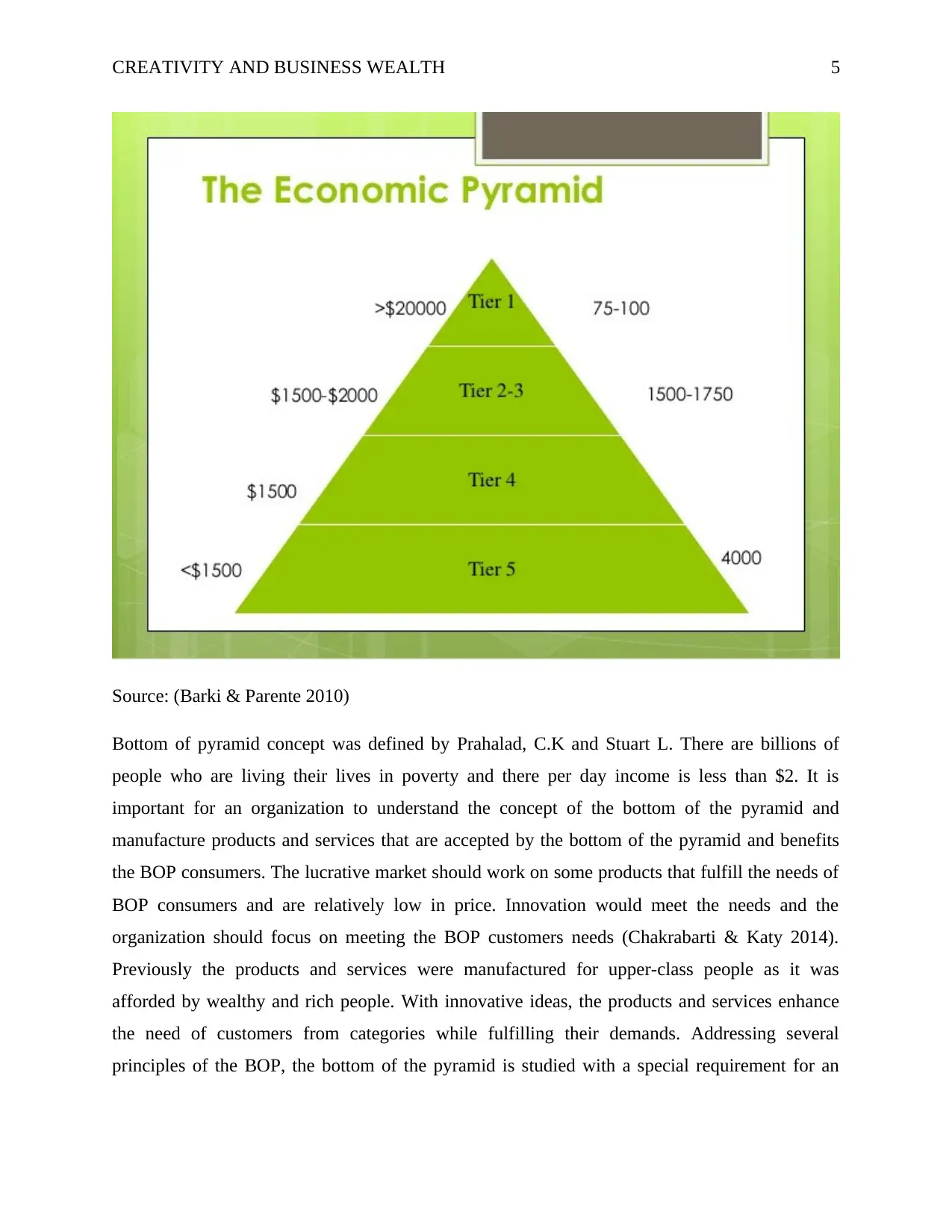
Source: (Barki & Parente 2010)
Bottom of pyramid concept was defined by Prahalad, C.K and Stuart L. There are billions of
people who are living their lives in poverty and there per day income is less than $2. It is
important for an organization to understand the concept of the bottom of the pyramid and
manufacture products and services that are accepted by the bottom of the pyramid and benefits
the BOP consumers. The lucrative market should work on some products that fulfill the needs of
BOP consumers and are relatively low in price. Innovation would meet the needs and the
organization should focus on meeting the BOP customers needs (Chakrabarti & Katy 2014).
Previously the products and services were manufactured for upper-class people as it was
afforded by wealthy and rich people. With innovative ideas, the products and services enhance
the need of customers from categories while fulfilling their demands. Addressing several
principles of the BOP, the bottom of the pyramid is studied with a special requirement for an
Source: (Barki & Parente 2010)
Bottom of pyramid concept was defined by Prahalad, C.K and Stuart L. There are billions of
people who are living their lives in poverty and there per day income is less than $2. It is
important for an organization to understand the concept of the bottom of the pyramid and
manufacture products and services that are accepted by the bottom of the pyramid and benefits
the BOP consumers. The lucrative market should work on some products that fulfill the needs of
BOP consumers and are relatively low in price. Innovation would meet the needs and the
organization should focus on meeting the BOP customers needs (Chakrabarti & Katy 2014).
Previously the products and services were manufactured for upper-class people as it was
afforded by wealthy and rich people. With innovative ideas, the products and services enhance
the need of customers from categories while fulfilling their demands. Addressing several
principles of the BOP, the bottom of the pyramid is studied with a special requirement for an
CREATIVITY AND BUSINESS WEALTH 6
organization to consider the importance of products and services for BOP consumers (Weidner,
José & Madhu 2010).
Principles of BOP innovation
Addressing the principles of BOP innovation, the bottom of the pyramid is explained in detail.
Focusing on the value and performance of the price
The BOP consumer tends to focus on value and expects a price that is not necessarily low but is
profitable in a sense of achieving the product or service (Elaydi & Harrison 2010). The greatest
performance is delivered by the supplier while working on the price category and reducing the
price for the rural market consumers. The seller at this end is organized and works on delivering
effective services.
Innovation
It is impossible to solve and work on the needs of BOP consumers while focusing on old and
traditional techniques. The products are aimed to reach to the BOP consumer with a simple
version while using modern techniques and tools (Singh 2012). It is thereby important that the
seller or the manufacturer should address certain products with a lower cost and higher price
value. The new features of the products are added with encapsulation technology that enhances
the need of the people. Unilever is an example that helped to develop products to prevent iodized
salt from iodine. The use of radioactive tracing helped to enhance the demand of the consumers.
Optimum utilization of the resources
BOP producer cannot afford to waste the resources, thereby BOP consumers buy products that
enhance the system and work on a compared level of acceptance of the product. Using optimum
resources would tend to build a high standard of living for consumers and producers while
fulfilling the demand of consumers. Innovation in utilizing the resources should be carried on as
creating products from waste and using as an environmentally sustainable product is the success
of the company (Bell 2011).
Educate BOP consumers to use the products
organization to consider the importance of products and services for BOP consumers (Weidner,
José & Madhu 2010).
Principles of BOP innovation
Addressing the principles of BOP innovation, the bottom of the pyramid is explained in detail.
Focusing on the value and performance of the price
The BOP consumer tends to focus on value and expects a price that is not necessarily low but is
profitable in a sense of achieving the product or service (Elaydi & Harrison 2010). The greatest
performance is delivered by the supplier while working on the price category and reducing the
price for the rural market consumers. The seller at this end is organized and works on delivering
effective services.
Innovation
It is impossible to solve and work on the needs of BOP consumers while focusing on old and
traditional techniques. The products are aimed to reach to the BOP consumer with a simple
version while using modern techniques and tools (Singh 2012). It is thereby important that the
seller or the manufacturer should address certain products with a lower cost and higher price
value. The new features of the products are added with encapsulation technology that enhances
the need of the people. Unilever is an example that helped to develop products to prevent iodized
salt from iodine. The use of radioactive tracing helped to enhance the demand of the consumers.
Optimum utilization of the resources
BOP producer cannot afford to waste the resources, thereby BOP consumers buy products that
enhance the system and work on a compared level of acceptance of the product. Using optimum
resources would tend to build a high standard of living for consumers and producers while
fulfilling the demand of consumers. Innovation in utilizing the resources should be carried on as
creating products from waste and using as an environmentally sustainable product is the success
of the company (Bell 2011).
Educate BOP consumers to use the products
⊘ This is a preview!⊘
Do you want full access?
Subscribe today to unlock all pages.
Trusted by 1+ million students worldwide
CREATIVITY AND BUSINESS WEALTH 7
The principle of providing education to consumers is the basic need that should be created while
advertising and publicity would encourage a consumer to opt for a product that satisfies the need
of the company (Chiweche & Fletcher 2010). The NGOs that are non-governmental
organizations should work on a program that encourages people to buy the product as per the
needs.
CASE STUDY: COCA-COLA
In the year, 2001, Coca-Cola slowly and gradually gained importance in the form of leadership.
This was possible because it focused on the Indian market especially the rural market in India. In
the rural market, the soft drinks and beverages categories products were not observed as the
market was undeveloped.
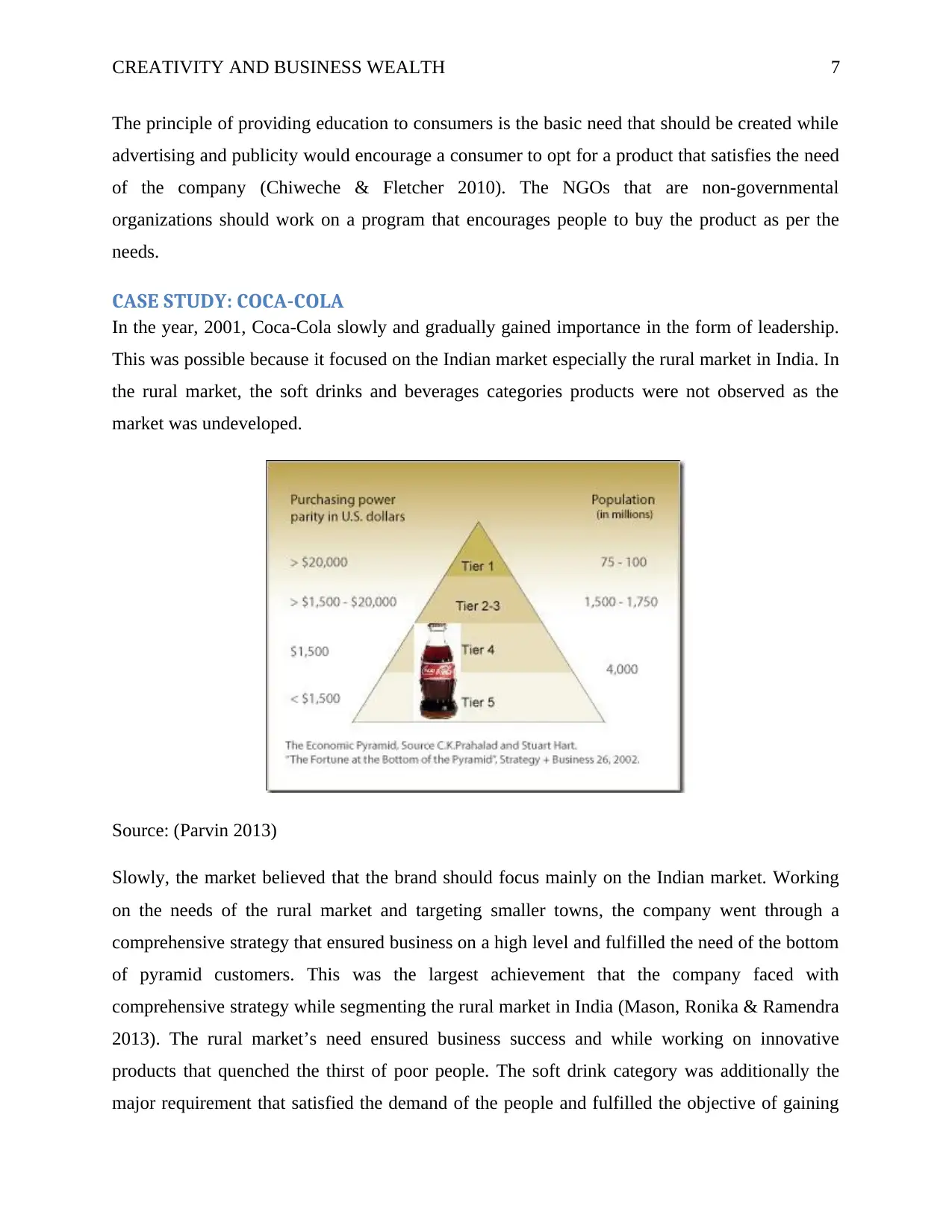
Source: (Parvin 2013)
Slowly, the market believed that the brand should focus mainly on the Indian market. Working
on the needs of the rural market and targeting smaller towns, the company went through a
comprehensive strategy that ensured business on a high level and fulfilled the need of the bottom
of pyramid customers. This was the largest achievement that the company faced with
comprehensive strategy while segmenting the rural market in India (Mason, Ronika & Ramendra
2013). The rural market’s need ensured business success and while working on innovative
products that quenched the thirst of poor people. The soft drink category was additionally the
major requirement that satisfied the demand of the people and fulfilled the objective of gaining
The principle of providing education to consumers is the basic need that should be created while
advertising and publicity would encourage a consumer to opt for a product that satisfies the need
of the company (Chiweche & Fletcher 2010). The NGOs that are non-governmental
organizations should work on a program that encourages people to buy the product as per the
needs.
CASE STUDY: COCA-COLA
In the year, 2001, Coca-Cola slowly and gradually gained importance in the form of leadership.
This was possible because it focused on the Indian market especially the rural market in India. In
the rural market, the soft drinks and beverages categories products were not observed as the
market was undeveloped.
Source: (Parvin 2013)
Slowly, the market believed that the brand should focus mainly on the Indian market. Working
on the needs of the rural market and targeting smaller towns, the company went through a
comprehensive strategy that ensured business on a high level and fulfilled the need of the bottom
of pyramid customers. This was the largest achievement that the company faced with
comprehensive strategy while segmenting the rural market in India (Mason, Ronika & Ramendra
2013). The rural market’s need ensured business success and while working on innovative
products that quenched the thirst of poor people. The soft drink category was additionally the
major requirement that satisfied the demand of the people and fulfilled the objective of gaining
Paraphrase This Document
Need a fresh take? Get an instant paraphrase of this document with our AI Paraphraser
CREATIVITY AND BUSINESS WEALTH 8
profit for an organization with innovative products. The primary need of the rural segment was
fulfilled and this undifferentiated the rural and urban market in India. The average cost ranges to
Rs. 10 for a coke and the average daily wage was calculated as Rs. 100. Coke was a luxury but
still fulfilled the demand of the customers.
Gradually, Coca-Cola launched a high-potential market that introduced traditional and urban
market demand. The accessibility campaign gained importance while introducing Coca-Cola in a
200ml bottle which was comparatively smaller than 300ml in the urban market. With the demand
enhancement, the price cutting product was half the price, Rs. 5. The pricing strategy was very
applied by Coca-cola and ensured success in the business while basic refreshment needs were
fulfilled like several soft drinks, tea, lemonade for a low price. Coke invested in innovation and
distribution network that affected the population reach and increased the stores that provide
Coca-cola products to the rural market. The increased outlets of Coca-Cola spread a message that
innovative products led to social needs while the increasing market penetration was observed in
the beverage market.
With the emphasizes of promotion and advertising strategy, the marketing plan pulled the
situation and gathered customers who are in need of the product and plan to buy the product at
the given price (London & Stuart 2011). The advertising and promotional strategies of Coca-cola
ensured that the marketing plan enhanced the local language of people living in rural areas and
targeted the brand with idiomatic expressions. Due to these innovative strategies, the company
was awarded for the advertising market (Viswanathan, Sridharan & Ritche 2010). This was the
largest step that was taken to promote the product in the rural market and reach to the bottom of
the pyramid customer with innovative steps. Coca-cola than doubles the spend on the expenses
related to government channels. The increase in the price was observed to 50 percent and thereby
it reduced the cost of the product. The results that were observed were intrinsic to the market
demand and enhanced the sales volume while attracting rural customers and fulfilling the needs
of the customers (Parvin 2013).
Value creation
Coca-cola presents the case in which the company ensures productivity and provides products to
the customers. A value creation mechanism is created and thereby the progressive and short term
profit for an organization with innovative products. The primary need of the rural segment was
fulfilled and this undifferentiated the rural and urban market in India. The average cost ranges to
Rs. 10 for a coke and the average daily wage was calculated as Rs. 100. Coke was a luxury but
still fulfilled the demand of the customers.
Gradually, Coca-Cola launched a high-potential market that introduced traditional and urban
market demand. The accessibility campaign gained importance while introducing Coca-Cola in a
200ml bottle which was comparatively smaller than 300ml in the urban market. With the demand
enhancement, the price cutting product was half the price, Rs. 5. The pricing strategy was very
applied by Coca-cola and ensured success in the business while basic refreshment needs were
fulfilled like several soft drinks, tea, lemonade for a low price. Coke invested in innovation and
distribution network that affected the population reach and increased the stores that provide
Coca-cola products to the rural market. The increased outlets of Coca-Cola spread a message that
innovative products led to social needs while the increasing market penetration was observed in
the beverage market.
With the emphasizes of promotion and advertising strategy, the marketing plan pulled the
situation and gathered customers who are in need of the product and plan to buy the product at
the given price (London & Stuart 2011). The advertising and promotional strategies of Coca-cola
ensured that the marketing plan enhanced the local language of people living in rural areas and
targeted the brand with idiomatic expressions. Due to these innovative strategies, the company
was awarded for the advertising market (Viswanathan, Sridharan & Ritche 2010). This was the
largest step that was taken to promote the product in the rural market and reach to the bottom of
the pyramid customer with innovative steps. Coca-cola than doubles the spend on the expenses
related to government channels. The increase in the price was observed to 50 percent and thereby
it reduced the cost of the product. The results that were observed were intrinsic to the market
demand and enhanced the sales volume while attracting rural customers and fulfilling the needs
of the customers (Parvin 2013).
Value creation
Coca-cola presents the case in which the company ensures productivity and provides products to
the customers. A value creation mechanism is created and thereby the progressive and short term
CREATIVITY AND BUSINESS WEALTH 9
value fulfilled the demand of people (Nakata & Weidner 2012). The innovative strategy ensures
the growth of the company and fires the imagination. The innovation process tends to work on a
continuous basis by Coca-cola and provides a stimulated growth to the company with driving
factors. For achieving the growth of the company and fulfilling the demand of BOP consumers,
the company created a pricing strategy that benefited the BOP consumers and producers.
Innovation evolves around the company while there are certain strategies that tend to believe that
an advertising and promotion strategy created the major change. The local language and
immediate expressions are taken in order to ensure innovation and creation.
Conclusion
The bottom of the pyramid is the group that is the poorest group in the society, whereby the
needs of the society are not fulfilled. The majority of the population in India are below the
poverty line and cannot fulfill their needs. It is important that a value creation strategy should be
adopted by organizations in order to fulfill the need of the people. There are several selected
products that are provided to BOP consumers which are mentioned in the paper. The principles
of BOP are even mentioned while working on the needs and of BOP consumer and attaining
innovative strategies. innovation addresses the source of need.
value fulfilled the demand of people (Nakata & Weidner 2012). The innovative strategy ensures
the growth of the company and fires the imagination. The innovation process tends to work on a
continuous basis by Coca-cola and provides a stimulated growth to the company with driving
factors. For achieving the growth of the company and fulfilling the demand of BOP consumers,
the company created a pricing strategy that benefited the BOP consumers and producers.
Innovation evolves around the company while there are certain strategies that tend to believe that
an advertising and promotion strategy created the major change. The local language and
immediate expressions are taken in order to ensure innovation and creation.
Conclusion
The bottom of the pyramid is the group that is the poorest group in the society, whereby the
needs of the society are not fulfilled. The majority of the population in India are below the
poverty line and cannot fulfill their needs. It is important that a value creation strategy should be
adopted by organizations in order to fulfill the need of the people. There are several selected
products that are provided to BOP consumers which are mentioned in the paper. The principles
of BOP are even mentioned while working on the needs and of BOP consumer and attaining
innovative strategies. innovation addresses the source of need.
⊘ This is a preview!⊘
Do you want full access?
Subscribe today to unlock all pages.
Trusted by 1+ million students worldwide
CREATIVITY AND BUSINESS WEALTH 10
References
Barki E, & Parente J, 2010, Consumer Behaviour of the Base of the Pyramid in Brazil; Greenleaf
Publishing; pp. 11-23.
Bell, H A, 2011, A Contemporary Framework for Emotions in Consumer DecisionMaking:
Moving Beyond Traditional Models; International Journal of Business and Social Science; Vol.
2 No. 17; p 11-16
Chiweche, T, & Fletcher R, 2010, Understanding factors that influence purchases in subsistence
markets; Journal of Business Research, vol. 63, p.643-650
Chakrabarti, R & Katy M, 2014, "Designing better markets for people at the bottom of the
pyramid: bottom-up market design." Pp. 153-77 in Concerned markets: economic ordering for
multiple values, edited by Susi Geiger, Debbie Harrison, Hans Kjellberg, and Alexandre Mallard.
Cheltenham, UK; Massachusetts, USA: Edward Elgar Publishing Inc.
Elaydi, R & Harrison C, 2010, Strategic motivations and Choice in subsistence markets; Journal
of Business Research; vol. 63, p. 651-655.
George, G, Anita M. M, and Jaideep P, 2012, "Innovation for Inclusive Growth: Towards a
Theoretical Framework and a Research Agenda." Journal of Management Studies vol. 49, no. 4,
pp. 661-83.
Nakata C & Weidner K, 2012, Enhancing New Product Adoption at the Base of the Pyramid: A
Contextualized Model; Journal of Product and Innovation Management; Vol.29; No. 1) p. 21-
32.
Kotler, Philip. 2011. "Reinventing Marketing to Manage the Environmental Imperative." Journal
of Marketing, vol. 75, no. 4, pp. 132-35.
London, T, & Stuart H, 2011, Next Generation Business Strategies for the Base of the Pyramid:
New Approaches for Building Mutual Value. Upper Saddle River, New Jersey: Pearson
Education Ltd
Mason, K, Ronika C, & Ramendra S, 2013, "What are bottom of the pyramid markets and why
do they matter?" Marketing Theory vol. 13, no. 3, pp. 401-04.
References
Barki E, & Parente J, 2010, Consumer Behaviour of the Base of the Pyramid in Brazil; Greenleaf
Publishing; pp. 11-23.
Bell, H A, 2011, A Contemporary Framework for Emotions in Consumer DecisionMaking:
Moving Beyond Traditional Models; International Journal of Business and Social Science; Vol.
2 No. 17; p 11-16
Chiweche, T, & Fletcher R, 2010, Understanding factors that influence purchases in subsistence
markets; Journal of Business Research, vol. 63, p.643-650
Chakrabarti, R & Katy M, 2014, "Designing better markets for people at the bottom of the
pyramid: bottom-up market design." Pp. 153-77 in Concerned markets: economic ordering for
multiple values, edited by Susi Geiger, Debbie Harrison, Hans Kjellberg, and Alexandre Mallard.
Cheltenham, UK; Massachusetts, USA: Edward Elgar Publishing Inc.
Elaydi, R & Harrison C, 2010, Strategic motivations and Choice in subsistence markets; Journal
of Business Research; vol. 63, p. 651-655.
George, G, Anita M. M, and Jaideep P, 2012, "Innovation for Inclusive Growth: Towards a
Theoretical Framework and a Research Agenda." Journal of Management Studies vol. 49, no. 4,
pp. 661-83.
Nakata C & Weidner K, 2012, Enhancing New Product Adoption at the Base of the Pyramid: A
Contextualized Model; Journal of Product and Innovation Management; Vol.29; No. 1) p. 21-
32.
Kotler, Philip. 2011. "Reinventing Marketing to Manage the Environmental Imperative." Journal
of Marketing, vol. 75, no. 4, pp. 132-35.
London, T, & Stuart H, 2011, Next Generation Business Strategies for the Base of the Pyramid:
New Approaches for Building Mutual Value. Upper Saddle River, New Jersey: Pearson
Education Ltd
Mason, K, Ronika C, & Ramendra S, 2013, "What are bottom of the pyramid markets and why
do they matter?" Marketing Theory vol. 13, no. 3, pp. 401-04.
Paraphrase This Document
Need a fresh take? Get an instant paraphrase of this document with our AI Paraphraser
CREATIVITY AND BUSINESS WEALTH 11
Parvin, S, 2013. "Conceptual Framework For Exploration of brand equity Perception from
bottom of the Pyramid (BOP) Market Perspective." International Journal of Research 1(5):1- 10.
Peter, P., & Krishnakumar, S. 2010, Emotional intelligence, impulse buying, and self-esteem:
The predictive validity of two ability measures of emotional intelligence. Advances in Consumer
Research-North American Conference Proceedings, vol. 37, pp. 877-878.
Singh, H.S, 2012, Indian Shopkeepers Protest Government Plan For Retail Reforms, CNN
website.
Viswanathan M, Sridharan S, Ritche R, 2010, Understanding Consumption and Entrepreneurship
in subsistence market places; Journal of Business Research; vol. 63, no. 2010, pp. 570-581.
Weidner, K L., José Antonio R, & Madhu V. 2010, "Marketing to subsistence consumers:
Lessons from practice." Journal of Business Research vol. 63, no. 6, pp. 559-69.
Zhou, J., T, Y, & Li, J, 2011, Disruptive Innovation in China's BOP market, IEEE, Technology
management in the Energy Smart World, 2011, pp. 1-7.
Parvin, S, 2013. "Conceptual Framework For Exploration of brand equity Perception from
bottom of the Pyramid (BOP) Market Perspective." International Journal of Research 1(5):1- 10.
Peter, P., & Krishnakumar, S. 2010, Emotional intelligence, impulse buying, and self-esteem:
The predictive validity of two ability measures of emotional intelligence. Advances in Consumer
Research-North American Conference Proceedings, vol. 37, pp. 877-878.
Singh, H.S, 2012, Indian Shopkeepers Protest Government Plan For Retail Reforms, CNN
website.
Viswanathan M, Sridharan S, Ritche R, 2010, Understanding Consumption and Entrepreneurship
in subsistence market places; Journal of Business Research; vol. 63, no. 2010, pp. 570-581.
Weidner, K L., José Antonio R, & Madhu V. 2010, "Marketing to subsistence consumers:
Lessons from practice." Journal of Business Research vol. 63, no. 6, pp. 559-69.
Zhou, J., T, Y, & Li, J, 2011, Disruptive Innovation in China's BOP market, IEEE, Technology
management in the Energy Smart World, 2011, pp. 1-7.

1 out of 11


Related Documents


Your All-in-One AI-Powered Toolkit for Academic Success.
+13062052269
info@desklib.com
Available 24*7 on WhatsApp / Email
![[object Object]](/_next/static/media/star-bottom.7253800d.svg)
Unlock your academic potential
Copyright © 2020–2026 A2Z Services. All Rights Reserved. Developed and managed by ZUCOL.