A Report on the Challenges of Internal Risk Rating Systems in Banking
VerifiedAdded on 2022/08/24
|13
|2768
|29
Report
AI Summary
This report provides an analysis of the challenges faced by internal risk rating systems within banks, focusing on credit and lending practices. It examines the credit risk management process, highlighting issues related to the Basel Committee of Banking Supervision regulations and the difficulties banks encounter in adapting to evolving credit-risk profiles. The report identifies challenges such as data requirements, regulatory compliance, and the need for robust risk assessment methodologies. It recommends that banks prioritize long-term strategic planning, improve data acquisition and maintenance, and enhance their techniques for managing credit risk. The report suggests that banks should use tools such as FICO scores and debt-to-income ratios to assess customer creditworthiness. The analysis covers the components of credit risk, the risk rating system, and the importance of internal risk-rating systems in controlling credit risks. The report concludes that banks should focus on enhancing their techniques and adapting to the changing credit risk environment to effectively manage and mitigate risks.
Running Head: CREDIT AND LENDING
CREDIT AND LENDING
Name of the Student
Name of the University
Author Note
CREDIT AND LENDING
Name of the Student
Name of the University
Author Note

Paraphrase This Document
Need a fresh take? Get an instant paraphrase of this document with our AI Paraphraser
1
CREDIT AND LENDING
Executive Summary
The primary purpose of this report is to analyse the various issues faced by the
internal risk rating systems of a bank. The study is supported by studying the credit risk
management process through an internal rating system. It is found that the developed bank
faces various challenges in implementing the various difficulties in following the regulations
of Basel Committee of Banking Supervision. The banks should focus on improving the
techniques more meeting with the various changes related to credit- risk profiles. Bank can
also use FICO score, and debt-to-income ratio to estimate credit extend of the customers.
CREDIT AND LENDING
Executive Summary
The primary purpose of this report is to analyse the various issues faced by the
internal risk rating systems of a bank. The study is supported by studying the credit risk
management process through an internal rating system. It is found that the developed bank
faces various challenges in implementing the various difficulties in following the regulations
of Basel Committee of Banking Supervision. The banks should focus on improving the
techniques more meeting with the various changes related to credit- risk profiles. Bank can
also use FICO score, and debt-to-income ratio to estimate credit extend of the customers.

2
CREDIT AND LENDING
Table of Contents
Introduction................................................................................................................................3
Discussions.................................................................................................................................3
Conclusion..................................................................................................................................9
References................................................................................................................................10
CREDIT AND LENDING
Table of Contents
Introduction................................................................................................................................3
Discussions.................................................................................................................................3
Conclusion..................................................................................................................................9
References................................................................................................................................10
⊘ This is a preview!⊘
Do you want full access?
Subscribe today to unlock all pages.

Trusted by 1+ million students worldwide
3
CREDIT AND LENDING
Introduction
Internal Risk Rating System is a system that helps the financial institutions and other
banks, to control the risks that have incurred during the lending process. It also helps to
manage the creditworthiness of the borrower. The first part has discussed on the Credit Risk-
rating management process and the Risk-rating system. The next part has addressed the
various issues related to internal rating systems of the bank, and the last section has provided
specific recommendations to banks on how to execute the risk rating system. The intense of
this paper is to analyze the various issues, that bank has faces in implementing the internal
risk rating systems.
Discussions
Credit Risk Management
Credit Risk management is the process of quantifying the various risks associated
with the bank's capital reserves. Credit risks is that probability of bank loss due to the failure
in making payments to any type of debts. Credit Risk management process will help the bank
to mitigate against these type of bank losses at the given period (Bulbul, Hakenes and
Lambert 2019). Banks and other financial institutions have to follow specific steps to lend
credibility to the borrower. The following are the steps for credit risks management:
1. Adequately understand the overall credit risks by viewing the credit risks of the
customers or individual or to a company portfolio.
2. Implement an appropriate method of quantitative credit solution in the risk assessment
process.
3. A proper model should be implemented for monitoring and controlling the entire
management process.
CREDIT AND LENDING
Introduction
Internal Risk Rating System is a system that helps the financial institutions and other
banks, to control the risks that have incurred during the lending process. It also helps to
manage the creditworthiness of the borrower. The first part has discussed on the Credit Risk-
rating management process and the Risk-rating system. The next part has addressed the
various issues related to internal rating systems of the bank, and the last section has provided
specific recommendations to banks on how to execute the risk rating system. The intense of
this paper is to analyze the various issues, that bank has faces in implementing the internal
risk rating systems.
Discussions
Credit Risk Management
Credit Risk management is the process of quantifying the various risks associated
with the bank's capital reserves. Credit risks is that probability of bank loss due to the failure
in making payments to any type of debts. Credit Risk management process will help the bank
to mitigate against these type of bank losses at the given period (Bulbul, Hakenes and
Lambert 2019). Banks and other financial institutions have to follow specific steps to lend
credibility to the borrower. The following are the steps for credit risks management:
1. Adequately understand the overall credit risks by viewing the credit risks of the
customers or individual or to a company portfolio.
2. Implement an appropriate method of quantitative credit solution in the risk assessment
process.
3. A proper model should be implemented for monitoring and controlling the entire
management process.
Paraphrase This Document
Need a fresh take? Get an instant paraphrase of this document with our AI Paraphraser
4
CREDIT AND LENDING
4. Use of various business intelligence tools to collect essential data for the risk
management process.
The credit risks of a borrower are calculated by identifying their ability to pay the
loan with respect to its original amount. The banks look at the borrower's capacity, capital,
loan conditions and other associated collateral to repay the loans.
Components of Credit Risks Analysis
The various components of credit risks are determined by five C’s:
Capacity- The bank assesses the borrower's capability to pay back the loan. The
lender looks into the monthly income of the borrower in the form of salary or any
profit from the business (Belas et al. 2017). It also looks after other sources of
payment like home, gold and many more.
Capital- The bank also investigates if the borrower has any source of capital to invest
in purchasing the assets. In this case, the bank especially looks after a company or
business capital.
Collateral- Collateral is an asset in the form of mortgage, car or property, the
borrower pledges for the repayment of the loan to the banks.
Conditions- Different loans have different conditions for the loan applicants before
the loan has been approved. Both the lender and the borrower must full fill these
conditions.
Risk rating system
There is various credit risk rating system that is used to identify the credit risk rating
related to a loan. This risk rating system helps the banks and other credit unions to assess the
quality of the credit, identify the various problems associated with the loans, examine &
CREDIT AND LENDING
4. Use of various business intelligence tools to collect essential data for the risk
management process.
The credit risks of a borrower are calculated by identifying their ability to pay the
loan with respect to its original amount. The banks look at the borrower's capacity, capital,
loan conditions and other associated collateral to repay the loans.
Components of Credit Risks Analysis
The various components of credit risks are determined by five C’s:
Capacity- The bank assesses the borrower's capability to pay back the loan. The
lender looks into the monthly income of the borrower in the form of salary or any
profit from the business (Belas et al. 2017). It also looks after other sources of
payment like home, gold and many more.
Capital- The bank also investigates if the borrower has any source of capital to invest
in purchasing the assets. In this case, the bank especially looks after a company or
business capital.
Collateral- Collateral is an asset in the form of mortgage, car or property, the
borrower pledges for the repayment of the loan to the banks.
Conditions- Different loans have different conditions for the loan applicants before
the loan has been approved. Both the lender and the borrower must full fill these
conditions.
Risk rating system
There is various credit risk rating system that is used to identify the credit risk rating
related to a loan. This risk rating system helps the banks and other credit unions to assess the
quality of the credit, identify the various problems associated with the loans, examine &
5
CREDIT AND LENDING
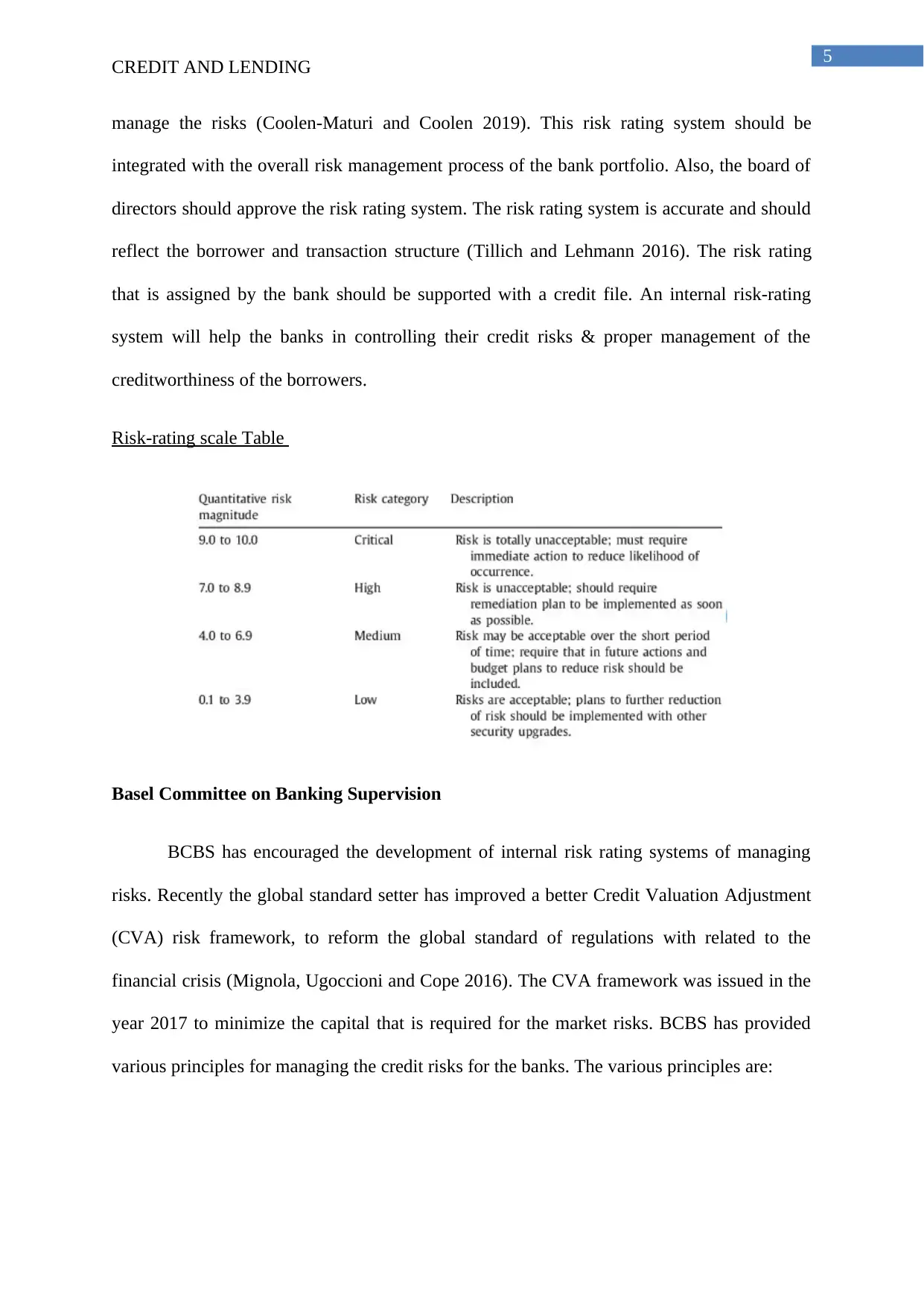
manage the risks (Coolen‐Maturi and Coolen 2019). This risk rating system should be
integrated with the overall risk management process of the bank portfolio. Also, the board of
directors should approve the risk rating system. The risk rating system is accurate and should
reflect the borrower and transaction structure (Tillich and Lehmann 2016). The risk rating
that is assigned by the bank should be supported with a credit file. An internal risk-rating
system will help the banks in controlling their credit risks & proper management of the
creditworthiness of the borrowers.
Risk-rating scale Table
Basel Committee on Banking Supervision
BCBS has encouraged the development of internal risk rating systems of managing
risks. Recently the global standard setter has improved a better Credit Valuation Adjustment
(CVA) risk framework, to reform the global standard of regulations with related to the
financial crisis (Mignola, Ugoccioni and Cope 2016). The CVA framework was issued in the
year 2017 to minimize the capital that is required for the market risks. BCBS has provided
various principles for managing the credit risks for the banks. The various principles are:
CREDIT AND LENDING
manage the risks (Coolen‐Maturi and Coolen 2019). This risk rating system should be
integrated with the overall risk management process of the bank portfolio. Also, the board of
directors should approve the risk rating system. The risk rating system is accurate and should
reflect the borrower and transaction structure (Tillich and Lehmann 2016). The risk rating
that is assigned by the bank should be supported with a credit file. An internal risk-rating
system will help the banks in controlling their credit risks & proper management of the
creditworthiness of the borrowers.
Risk-rating scale Table
Basel Committee on Banking Supervision
BCBS has encouraged the development of internal risk rating systems of managing
risks. Recently the global standard setter has improved a better Credit Valuation Adjustment
(CVA) risk framework, to reform the global standard of regulations with related to the
financial crisis (Mignola, Ugoccioni and Cope 2016). The CVA framework was issued in the
year 2017 to minimize the capital that is required for the market risks. BCBS has provided
various principles for managing the credit risks for the banks. The various principles are:
⊘ This is a preview!⊘
Do you want full access?
Subscribe today to unlock all pages.
Trusted by 1+ million students worldwide
6
CREDIT AND LENDING
To establish a proper credit risk environment in the business. The board of directors
are responsible for revising the credit risks policies and strategy of the banks. The
management is responsible for implementing the risks according to the policies.
Operating a sound credit process-Banks should have proper criteria for establishing
the credit limits for the borrowers and the other groups. They should have a clear
business process for allowing a new credit in the banks.
Should have a proper monitoring process in the bank for examining the on-going
credit risk-bearing portfolios. A proper internal risk rating system should be
developed to manage credit risks. The monitoring process should have a proper
analytical technique and information system to measure their inherent credit portfolios
and identify the concentration of risk (Alber and Ramadan 2017). Banks should also
consider future economic changes while assessing credit portfolios.
The banks must ensure adequate control over the bank risks. They should implement a
system that can easily communicate the results of credit risk assessment to their board
of directors. Banks should guarantee that the credit exposures are within the internal
limits and standards of the banks. The banks must have a system of managing the
problems related to credits during the process.
The supervisors of the bank should consider the bank policies, strategies, procedures
and practices to properly conduct the credit risk management process.
Banks internal risk-rating systems
The banks are permitted to use their risk parameters for estimating their capital
requirements for credit risks. Bank uses the risk-rating system to rate their customers based
on their creditworthiness. Risk-rating systems provide greater support to the top management
in managing their credit risks. Therefore, establishing an efficient internal risk-rating
framework is very much important for maintaining the losses from loans. This process
CREDIT AND LENDING
To establish a proper credit risk environment in the business. The board of directors
are responsible for revising the credit risks policies and strategy of the banks. The
management is responsible for implementing the risks according to the policies.
Operating a sound credit process-Banks should have proper criteria for establishing
the credit limits for the borrowers and the other groups. They should have a clear
business process for allowing a new credit in the banks.
Should have a proper monitoring process in the bank for examining the on-going
credit risk-bearing portfolios. A proper internal risk rating system should be
developed to manage credit risks. The monitoring process should have a proper
analytical technique and information system to measure their inherent credit portfolios
and identify the concentration of risk (Alber and Ramadan 2017). Banks should also
consider future economic changes while assessing credit portfolios.
The banks must ensure adequate control over the bank risks. They should implement a
system that can easily communicate the results of credit risk assessment to their board
of directors. Banks should guarantee that the credit exposures are within the internal
limits and standards of the banks. The banks must have a system of managing the
problems related to credits during the process.
The supervisors of the bank should consider the bank policies, strategies, procedures
and practices to properly conduct the credit risk management process.
Banks internal risk-rating systems
The banks are permitted to use their risk parameters for estimating their capital
requirements for credit risks. Bank uses the risk-rating system to rate their customers based
on their creditworthiness. Risk-rating systems provide greater support to the top management
in managing their credit risks. Therefore, establishing an efficient internal risk-rating
framework is very much important for maintaining the losses from loans. This process
Paraphrase This Document
Need a fresh take? Get an instant paraphrase of this document with our AI Paraphraser
7
CREDIT AND LENDING
involves the initiation of the loan applications to classification of the transactions into various
credit-risks (Yaacob, Markom and Hakimah 2018). The regulators want the banks to improve
their risk-management practices to ensure safety in the entire banking system. However, the
internal risk-rating systems of developed banks face various issues during the improvement
of their internal risk rating systems. The different issues are:
Challenges due to the Basel Committee on Banking Supervision (BCBS)
The auditors dealing with the internal risk-reporting system have to monitor the entire
process continuously. They face various challenges while dealing with the risk-rating system.
The internal auditors are involved in dealing with the risk-reporting systems of the company,
are involved in a material misstatement in the company’s balance sheet. This can create an
issue in the development of a banks internal risk-rating system (Kumar and Kaur 2019).
1. The bank faces various challenges to compliance their changes with the regulatory
principles of the Basel Committee on Banking Supervisions. Implementation of these
regulations influences the finance, management, risks and regulatory reporting
practices of the banks.
2. The banks had to assess the data, upgrade the current process with new functionality.
During the data collection process, they have to face huge challenges in maintaining
cost and time.
3. The Basel standards include an enterprise-standards related to business processes. The
banks find difficulties to collect information’s related to the customers and other
organizations.
4. The banks were not able to manage the diverse range of data from multiple business
lines. They find difficulties in calculating the key risk indicators. Basel guidelines
enforce the banks to make extensive data for doing their credit-risks (Zainudin et al.
CREDIT AND LENDING
involves the initiation of the loan applications to classification of the transactions into various
credit-risks (Yaacob, Markom and Hakimah 2018). The regulators want the banks to improve
their risk-management practices to ensure safety in the entire banking system. However, the
internal risk-rating systems of developed banks face various issues during the improvement
of their internal risk rating systems. The different issues are:
Challenges due to the Basel Committee on Banking Supervision (BCBS)
The auditors dealing with the internal risk-reporting system have to monitor the entire
process continuously. They face various challenges while dealing with the risk-rating system.
The internal auditors are involved in dealing with the risk-reporting systems of the company,
are involved in a material misstatement in the company’s balance sheet. This can create an
issue in the development of a banks internal risk-rating system (Kumar and Kaur 2019).
1. The bank faces various challenges to compliance their changes with the regulatory
principles of the Basel Committee on Banking Supervisions. Implementation of these
regulations influences the finance, management, risks and regulatory reporting
practices of the banks.
2. The banks had to assess the data, upgrade the current process with new functionality.
During the data collection process, they have to face huge challenges in maintaining
cost and time.
3. The Basel standards include an enterprise-standards related to business processes. The
banks find difficulties to collect information’s related to the customers and other
organizations.
4. The banks were not able to manage the diverse range of data from multiple business
lines. They find difficulties in calculating the key risk indicators. Basel guidelines
enforce the banks to make extensive data for doing their credit-risks (Zainudin et al.
8
CREDIT AND LENDING
2019). This has led to the exposure of some sensitive exposure of credit data of the
business units.
5. The banking sector faced various complexities in following this regulatory
framework; due to continuous change of the regulatory guidelines. They are unable to
manage the uncertainties that require a strong communication system, a proper
mechanism to manage the change-management and resolve the issues and conflicts.
6. The banks had to adopt a hybrid model, which is a combination of global and
individual country initiatives (Edwards 2016).
Other challenges faced by the banks in internal-risk rating systems
The internal-risk rating system allows the credit risks to be measured on the basis of
quantitative and qualitative factors (Rahim et al., 2017). The different credit scores on
different credit intervals are arranged with a credit grade. This type of risk-rating system is
not applicable in all banking conditions. The large banks require an internal rating system,
which can allow multiple grading account procedures, according to the complex level of the
credits exposed. They require a statistical system to measure the credit risks, based on the
different credit exposures with the growth of internal risk-rating systems (Wang 2020). For
doing this, the banks will have to continuously monitor the level of creditworthiness for
measuring the credit risks. It was found that, due to converging pressure on the banks, the
banks are disclosing poor disclosure of the internal data to face credit risk management
issues. The Basel Committee did not provide any map of showing how to achieve the plans.
The main problems are:
1. Data requirements for measuring the credit risks- Internal risk rating system allows
two approaches; foundation and methodologies. These approaches allow the banks to
use their data to determine the risk (Al-Shawabkeh and Kanungo 2017). These
CREDIT AND LENDING
2019). This has led to the exposure of some sensitive exposure of credit data of the
business units.
5. The banking sector faced various complexities in following this regulatory
framework; due to continuous change of the regulatory guidelines. They are unable to
manage the uncertainties that require a strong communication system, a proper
mechanism to manage the change-management and resolve the issues and conflicts.
6. The banks had to adopt a hybrid model, which is a combination of global and
individual country initiatives (Edwards 2016).
Other challenges faced by the banks in internal-risk rating systems
The internal-risk rating system allows the credit risks to be measured on the basis of
quantitative and qualitative factors (Rahim et al., 2017). The different credit scores on
different credit intervals are arranged with a credit grade. This type of risk-rating system is
not applicable in all banking conditions. The large banks require an internal rating system,
which can allow multiple grading account procedures, according to the complex level of the
credits exposed. They require a statistical system to measure the credit risks, based on the
different credit exposures with the growth of internal risk-rating systems (Wang 2020). For
doing this, the banks will have to continuously monitor the level of creditworthiness for
measuring the credit risks. It was found that, due to converging pressure on the banks, the
banks are disclosing poor disclosure of the internal data to face credit risk management
issues. The Basel Committee did not provide any map of showing how to achieve the plans.
The main problems are:
1. Data requirements for measuring the credit risks- Internal risk rating system allows
two approaches; foundation and methodologies. These approaches allow the banks to
use their data to determine the risk (Al-Shawabkeh and Kanungo 2017). These
⊘ This is a preview!⊘
Do you want full access?
Subscribe today to unlock all pages.
Trusted by 1+ million students worldwide
9
CREDIT AND LENDING
requirements are quite complex. Banks should collect more data through the risk
assessment process. But, they are collecting information on the basis of loan structure
and terms.
2. Proposed practice for meeting the new standards- The banks had to develop a long-
term strategy to solve their issues related to credit risk management (Lim et al., 2017).
The strategy includes acquisition and maintenance strategy. Banks faced challenges in
getting accurate and complete information.
Recommendations
The banks should focus on making a broad term planning, of the entire program in a
long-term perspective. A single rating system cannot solve the problems. The banks should
consider a potential solution and know how to balance the risk data. The banks should
include sound data acquisition and maintenance procedures in their rating system. This will
help the developed banks to store multiple data of the customers (Adrian 2018). Banks should
also determine the regulatory functions; they are aiming and accordingly develop their
business requirements. To advance the credit risk management process with the internal
rating systems, the banks should focus on improving the techniques, on accommodating with
the changes of the credit-risk profiles. They should adequately estimate the credit risk
components. Banks can calculate the FICO score of the customer, which was created by the
Fair Isaac Corporation (Francis 2019). FICO scores will help the bank to determine the credit
extend of customers. Banks can also calculate their debt-to-income ratio for identify their
credit risks.
Conclusion
Therefore, it can be deferred that, the developed bank faces various challenges in
implementing the various challenges in following the regulations of Basel Committee of
CREDIT AND LENDING
requirements are quite complex. Banks should collect more data through the risk
assessment process. But, they are collecting information on the basis of loan structure
and terms.
2. Proposed practice for meeting the new standards- The banks had to develop a long-
term strategy to solve their issues related to credit risk management (Lim et al., 2017).
The strategy includes acquisition and maintenance strategy. Banks faced challenges in
getting accurate and complete information.
Recommendations
The banks should focus on making a broad term planning, of the entire program in a
long-term perspective. A single rating system cannot solve the problems. The banks should
consider a potential solution and know how to balance the risk data. The banks should
include sound data acquisition and maintenance procedures in their rating system. This will
help the developed banks to store multiple data of the customers (Adrian 2018). Banks should
also determine the regulatory functions; they are aiming and accordingly develop their
business requirements. To advance the credit risk management process with the internal
rating systems, the banks should focus on improving the techniques, on accommodating with
the changes of the credit-risk profiles. They should adequately estimate the credit risk
components. Banks can calculate the FICO score of the customer, which was created by the
Fair Isaac Corporation (Francis 2019). FICO scores will help the bank to determine the credit
extend of customers. Banks can also calculate their debt-to-income ratio for identify their
credit risks.
Conclusion
Therefore, it can be deferred that, the developed bank faces various challenges in
implementing the various challenges in following the regulations of Basel Committee of
Paraphrase This Document
Need a fresh take? Get an instant paraphrase of this document with our AI Paraphraser
10
CREDIT AND LENDING
Banking Supervision. It is recommended that the banks should focus on improving the
techniques more meeting with the various changes related to credit- risk profiles. Bank can
also use FICO score, and debt-to-income ratio to estimate credit extend of the customers.
References
Adrian, T., 2018. Risk management and regulation. International Monetary Fund.
Alber, N. and Ramadan, H., 2017. The Impact of Applying Basel Committee Norms on Asset
Quality of Egyptian Banks. Available at SSRN 2995456.
Al-Shawabkeh, A. and Kanungo, R., 2017. Credit risk estimate using internal explicit
knowledge. Investment Management & Financial Innovations, 14(1), p.55.
Belás, J., Mišanková, M., Schönfeld, J. and Gavurová, B., 2017. CREDIT RISK
MANAGEMENT: FINANCIAL SAFETY AND SUSTAINABILITY ASPECTS. Journal of
Security & Sustainability Issues, 7(1).
Bülbül, D., Hakenes, H. and Lambert, C., 2019. What influences banks’ choice of credit risk
management practices? Theory and evidence. Journal of Financial Stability, 40, pp.1-14.
Coolen‐Maturi, T. and Coolen, F.P.A., 2019. Non‐parametric predictive inference for the
validation of credit rating systems. Journal of the Royal Statistical Society: Series A
(Statistics in Society), 182(4), pp.1189-1204.
Edwards, G.A., 2016. Supervisors’ key roles as banks implement expected credit loss
provisioning. SEACEN Financial Stability Journal, 7(1), pp.1-25.
Francis, G., 2019. Enterprise Risk Management (ERM): Key Risks, Responses and
Applications.
CREDIT AND LENDING
Banking Supervision. It is recommended that the banks should focus on improving the
techniques more meeting with the various changes related to credit- risk profiles. Bank can
also use FICO score, and debt-to-income ratio to estimate credit extend of the customers.
References
Adrian, T., 2018. Risk management and regulation. International Monetary Fund.
Alber, N. and Ramadan, H., 2017. The Impact of Applying Basel Committee Norms on Asset
Quality of Egyptian Banks. Available at SSRN 2995456.
Al-Shawabkeh, A. and Kanungo, R., 2017. Credit risk estimate using internal explicit
knowledge. Investment Management & Financial Innovations, 14(1), p.55.
Belás, J., Mišanková, M., Schönfeld, J. and Gavurová, B., 2017. CREDIT RISK
MANAGEMENT: FINANCIAL SAFETY AND SUSTAINABILITY ASPECTS. Journal of
Security & Sustainability Issues, 7(1).
Bülbül, D., Hakenes, H. and Lambert, C., 2019. What influences banks’ choice of credit risk
management practices? Theory and evidence. Journal of Financial Stability, 40, pp.1-14.
Coolen‐Maturi, T. and Coolen, F.P.A., 2019. Non‐parametric predictive inference for the
validation of credit rating systems. Journal of the Royal Statistical Society: Series A
(Statistics in Society), 182(4), pp.1189-1204.
Edwards, G.A., 2016. Supervisors’ key roles as banks implement expected credit loss
provisioning. SEACEN Financial Stability Journal, 7(1), pp.1-25.
Francis, G., 2019. Enterprise Risk Management (ERM): Key Risks, Responses and
Applications.
11
CREDIT AND LENDING
Kumar, S. and Kaur, M., 2019. CORPORATE GOVERNANCE OF BANKS. CORPORATE
GOVERNANCE, 7(02).
Lim, C.Y., Woods, M., Humphrey, C. and Seow, J.L., 2017. The paradoxes of risk
management in the banking sector. The British Accounting Review, 49(1), pp.75-90.
Mignola, G., Ugoccioni, R. and Cope, E., 2016. Comments on the Basel Committee on
Banking Supervision proposal for a new standardized approach for operational risk. Journal
of Operational Risk, 11(3).
Rahim, N.F.A., Jaafar, A.R., Syamsuddin, J. and Sarkawi, M.N., 2017. Internal Control
System and Hazard Identification of Operational Risk in Malaysian Conventional Banking.
Int. J Sup. Chain. Mgt Vol, 6(2), p.215.
Tillich, D. and Lehmann, C., 2016. Estimation in discontinuous Bernoulli mixture models
applicable in credit rating systems with dependent data. Technische Universität, Fakultät
Wirtschaftswissenschaften.
Wang, B. and Wang, X., 2020, January. Study on the Current Development, Problems, and
Countermeasures of Shadow Banking in China. In 5th International Conference on
Economics, Management, Law and Education (EMLE 2019) (pp. 383-386). Atlantis Press.
Yaacob, H., Markom, R. and Hakimah, A., 2018. COPING WITH THE INTERNATIONAL
STANDARDS OF BASEL COMMITTEE ON CORE PRINCIPLES ON EFFECTIVE
BANKING SUPERVISION (BCBS): ANALYSIS AND REFORM FOR ISLAMIC
BANKING.
Zainudin, S.M., Rasid, A., Zaleha, S., Omar, R. and Hassan, R., 2019. The Good and Bad
News about the New Liquidity Rules of Basel III in Islamic Banking of Malaysia. Journal of
Risk and Financial Management, 12(3), p.120.
CREDIT AND LENDING
Kumar, S. and Kaur, M., 2019. CORPORATE GOVERNANCE OF BANKS. CORPORATE
GOVERNANCE, 7(02).
Lim, C.Y., Woods, M., Humphrey, C. and Seow, J.L., 2017. The paradoxes of risk
management in the banking sector. The British Accounting Review, 49(1), pp.75-90.
Mignola, G., Ugoccioni, R. and Cope, E., 2016. Comments on the Basel Committee on
Banking Supervision proposal for a new standardized approach for operational risk. Journal
of Operational Risk, 11(3).
Rahim, N.F.A., Jaafar, A.R., Syamsuddin, J. and Sarkawi, M.N., 2017. Internal Control
System and Hazard Identification of Operational Risk in Malaysian Conventional Banking.
Int. J Sup. Chain. Mgt Vol, 6(2), p.215.
Tillich, D. and Lehmann, C., 2016. Estimation in discontinuous Bernoulli mixture models
applicable in credit rating systems with dependent data. Technische Universität, Fakultät
Wirtschaftswissenschaften.
Wang, B. and Wang, X., 2020, January. Study on the Current Development, Problems, and
Countermeasures of Shadow Banking in China. In 5th International Conference on
Economics, Management, Law and Education (EMLE 2019) (pp. 383-386). Atlantis Press.
Yaacob, H., Markom, R. and Hakimah, A., 2018. COPING WITH THE INTERNATIONAL
STANDARDS OF BASEL COMMITTEE ON CORE PRINCIPLES ON EFFECTIVE
BANKING SUPERVISION (BCBS): ANALYSIS AND REFORM FOR ISLAMIC
BANKING.
Zainudin, S.M., Rasid, A., Zaleha, S., Omar, R. and Hassan, R., 2019. The Good and Bad
News about the New Liquidity Rules of Basel III in Islamic Banking of Malaysia. Journal of
Risk and Financial Management, 12(3), p.120.
⊘ This is a preview!⊘
Do you want full access?
Subscribe today to unlock all pages.
Trusted by 1+ million students worldwide

1 out of 13


Related Documents


Your All-in-One AI-Powered Toolkit for Academic Success.
+13062052269
info@desklib.com
Available 24*7 on WhatsApp / Email
![[object Object]](/_next/static/media/star-bottom.7253800d.svg)
Unlock your academic potential
Copyright © 2020–2026 A2Z Services. All Rights Reserved. Developed and managed by ZUCOL.