Essay on Crime Causation: Societal Factors and Gender Dynamics

Verified

Added on  2022/12/29

|4
|874
|21
Essay
AI Summary
This essay explores the multifaceted issue of crime causation, with a particular emphasis on the disproportionate involvement of men in violent crimes. It examines both biological and societal factors, highlighting that societal influences play a more significant role. The essay delves into the impact of societal norms, gender roles, and the freedom afforded to men, as well as the limitations placed on women, contributing to crime rates. Furthermore, the essay discusses key theoretical perspectives such as the Feminist Perspective Theory, which addresses behavioral differences between men and women and concepts like hegemonic masculinity; the Rational Choice Theory, which focuses on individual decision-making in committing crimes; and the Strain Theory, which links crime to stress and strain experienced by individuals. The essay uses real-world examples and academic references to support its arguments, offering a comprehensive analysis of crime causation.
Document Page
Running Head: Crime Causation
Crime Causation
Essay
System04104
6/9/2019
tabler-icon-diamond-filled.svg

Paraphrase This Document

Need a fresh take? Get an instant paraphrase of this document with our AI Paraphraser
Document Page
Crime Causation
1
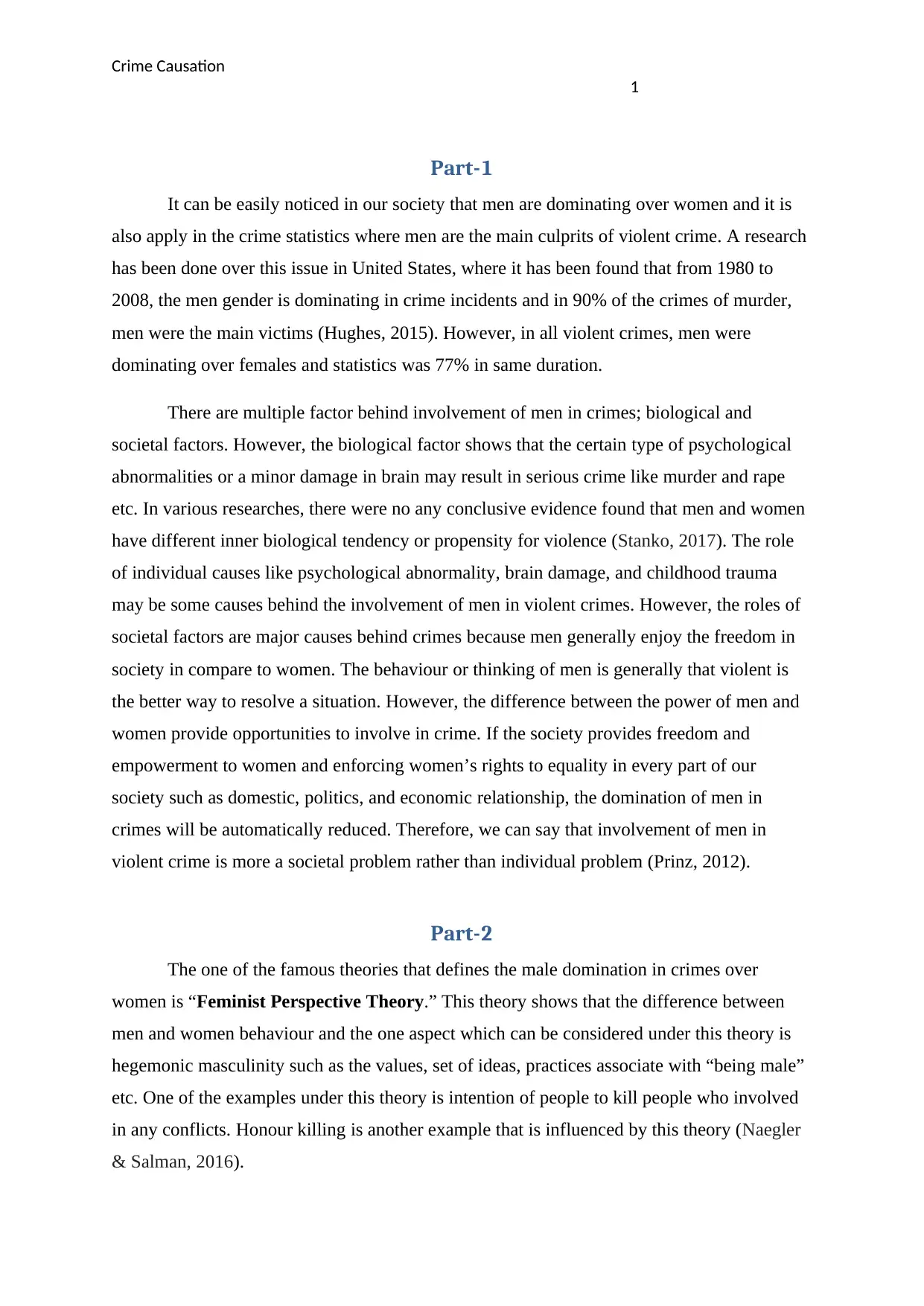
Part-1
It can be easily noticed in our society that men are dominating over women and it is
also apply in the crime statistics where men are the main culprits of violent crime. A research
has been done over this issue in United States, where it has been found that from 1980 to
2008, the men gender is dominating in crime incidents and in 90% of the crimes of murder,
men were the main victims (Hughes, 2015). However, in all violent crimes, men were
dominating over females and statistics was 77% in same duration.
There are multiple factor behind involvement of men in crimes; biological and
societal factors. However, the biological factor shows that the certain type of psychological
abnormalities or a minor damage in brain may result in serious crime like murder and rape
etc. In various researches, there were no any conclusive evidence found that men and women
have different inner biological tendency or propensity for violence (Stanko, 2017). The role
of individual causes like psychological abnormality, brain damage, and childhood trauma
may be some causes behind the involvement of men in violent crimes. However, the roles of
societal factors are major causes behind crimes because men generally enjoy the freedom in
society in compare to women. The behaviour or thinking of men is generally that violent is
the better way to resolve a situation. However, the difference between the power of men and
women provide opportunities to involve in crime. If the society provides freedom and
empowerment to women and enforcing women’s rights to equality in every part of our
society such as domestic, politics, and economic relationship, the domination of men in
crimes will be automatically reduced. Therefore, we can say that involvement of men in
violent crime is more a societal problem rather than individual problem (Prinz, 2012).
Part-2
The one of the famous theories that defines the male domination in crimes over
women is “Feminist Perspective Theory.” This theory shows that the difference between
men and women behaviour and the one aspect which can be considered under this theory is
hegemonic masculinity such as the values, set of ideas, practices associate with “being male”
etc. One of the examples under this theory is intention of people to kill people who involved
in any conflicts. Honour killing is another example that is influenced by this theory (Naegler
& Salman, 2016).
Document Page
Crime Causation
2
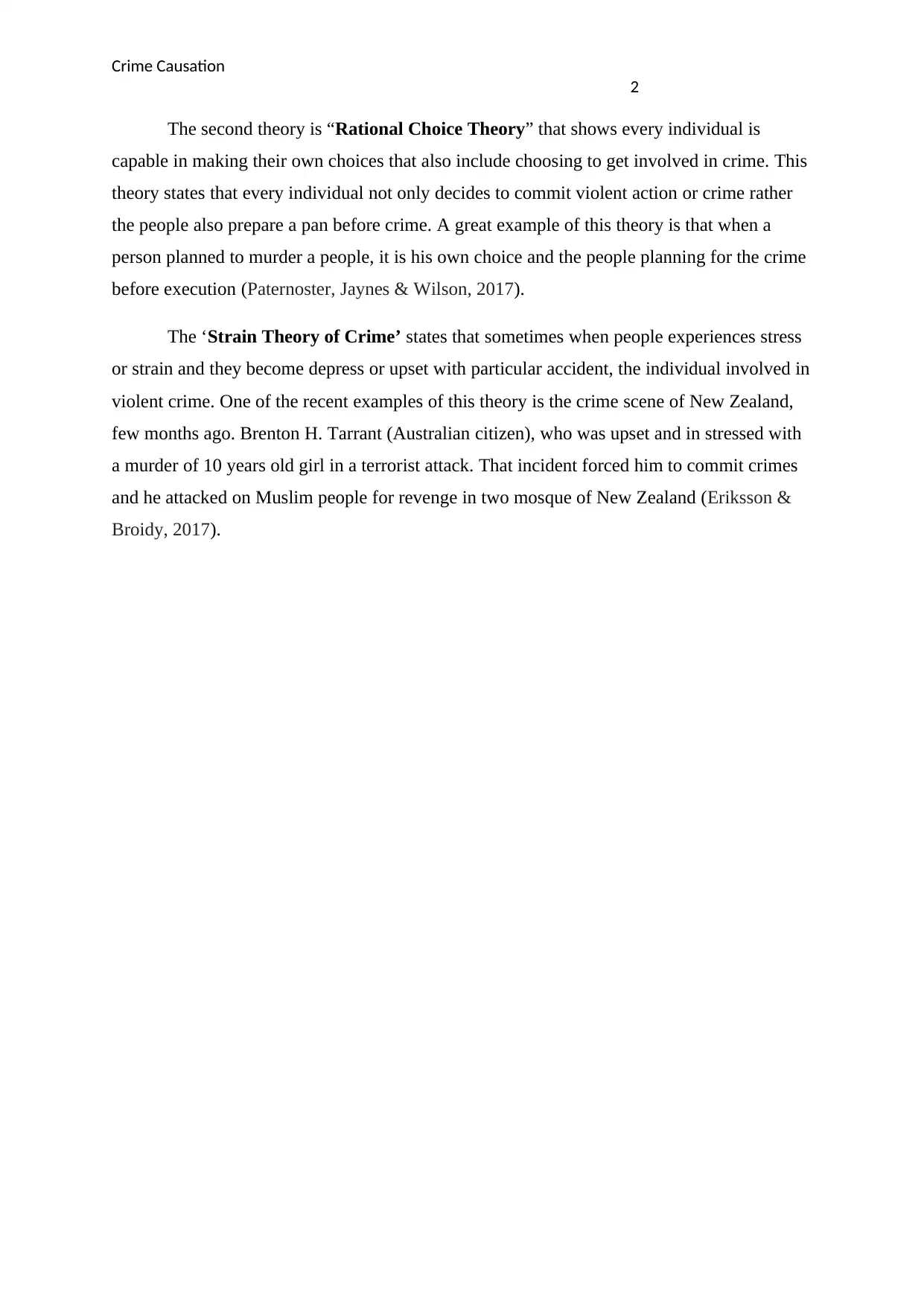
The second theory is “Rational Choice Theory” that shows every individual is
capable in making their own choices that also include choosing to get involved in crime. This
theory states that every individual not only decides to commit violent action or crime rather
the people also prepare a pan before crime. A great example of this theory is that when a
person planned to murder a people, it is his own choice and the people planning for the crime
before execution (Paternoster, Jaynes & Wilson, 2017).
The ‘Strain Theory of Crime’ states that sometimes when people experiences stress
or strain and they become depress or upset with particular accident, the individual involved in
violent crime. One of the recent examples of this theory is the crime scene of New Zealand,
few months ago. Brenton H. Tarrant (Australian citizen), who was upset and in stressed with
a murder of 10 years old girl in a terrorist attack. That incident forced him to commit crimes
and he attacked on Muslim people for revenge in two mosque of New Zealand (Eriksson &
Broidy, 2017).
Document Page
Crime Causation
3
References
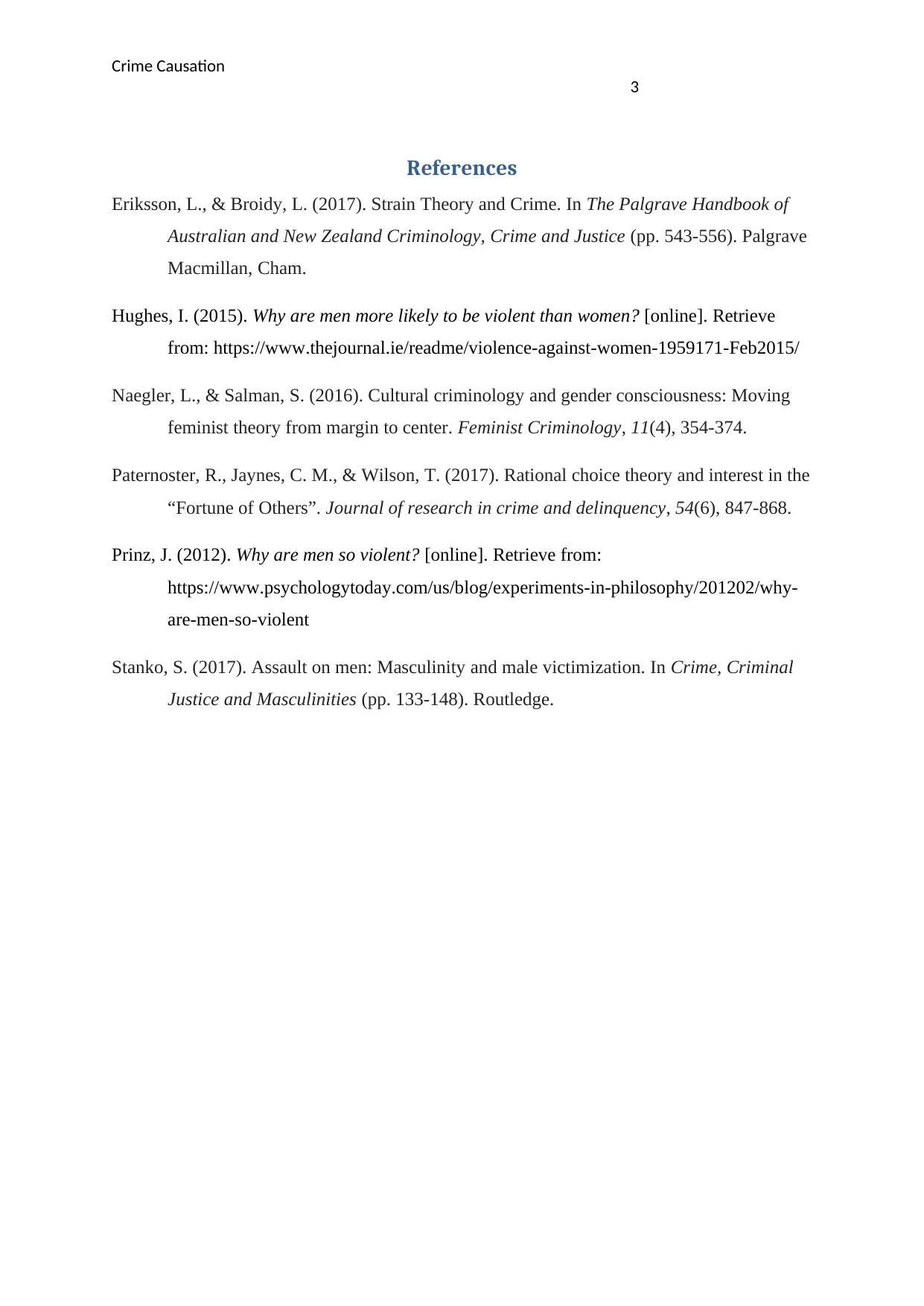
Eriksson, L., & Broidy, L. (2017). Strain Theory and Crime. In The Palgrave Handbook of
Australian and New Zealand Criminology, Crime and Justice (pp. 543-556). Palgrave
Macmillan, Cham.
Hughes, I. (2015). Why are men more likely to be violent than women? [online]. Retrieve
from: https://www.thejournal.ie/readme/violence-against-women-1959171-Feb2015/
Naegler, L., & Salman, S. (2016). Cultural criminology and gender consciousness: Moving
feminist theory from margin to center. Feminist Criminology, 11(4), 354-374.
Paternoster, R., Jaynes, C. M., & Wilson, T. (2017). Rational choice theory and interest in the
“Fortune of Others”. Journal of research in crime and delinquency, 54(6), 847-868.
Prinz, J. (2012). Why are men so violent? [online]. Retrieve from:
https://www.psychologytoday.com/us/blog/experiments-in-philosophy/201202/why-
are-men-so-violent
Stanko, S. (2017). Assault on men: Masculinity and male victimization. In Crime, Criminal
Justice and Masculinities (pp. 133-148). Routledge.
chevron_up_icon
1 out of 4
circle_padding
hide_on_mobile
zoom_out_icon
[object Object]