Crime Prevention: Illicit Drug Use and Licensed Venues Analysis
VerifiedAdded on 2022/08/23
|9
|2066
|17
Report
AI Summary
This report delves into the issue of illicit drug use within and around licensed venues, focusing on the Australian National Drug Strategy (NDS) and the application of pragmatism in complex situations. It examines research evidence, including studies on ecstasy, GHB, and cocaine consumption by young people in dance clubs and festivals, and current drug policy indicators. The report explores the risks associated with drug consumption, the role of harm reduction strategies like pill testing, and the impact of drug policies on public health. It discusses the failures of previous approaches and advocates for alternative strategies to address drug-related harm, drawing on international research and evidence. The conclusion emphasizes the need for a pragmatic approach to crime prevention and the potential of pill testing to reduce drug use and related harms.
Topic 3. Illicit drug use in and around licensed venues
Crime Prevention and Security
Summative Task 1
STUDENT’S DETAILS
RUNNING HEAD: CRIME PREVENTION 0
Crime Prevention and Security
Summative Task 1
STUDENT’S DETAILS
RUNNING HEAD: CRIME PREVENTION 0

Paraphrase This Document
Need a fresh take? Get an instant paraphrase of this document with our AI Paraphraser
CRIME PREVENTION 1
Introduction
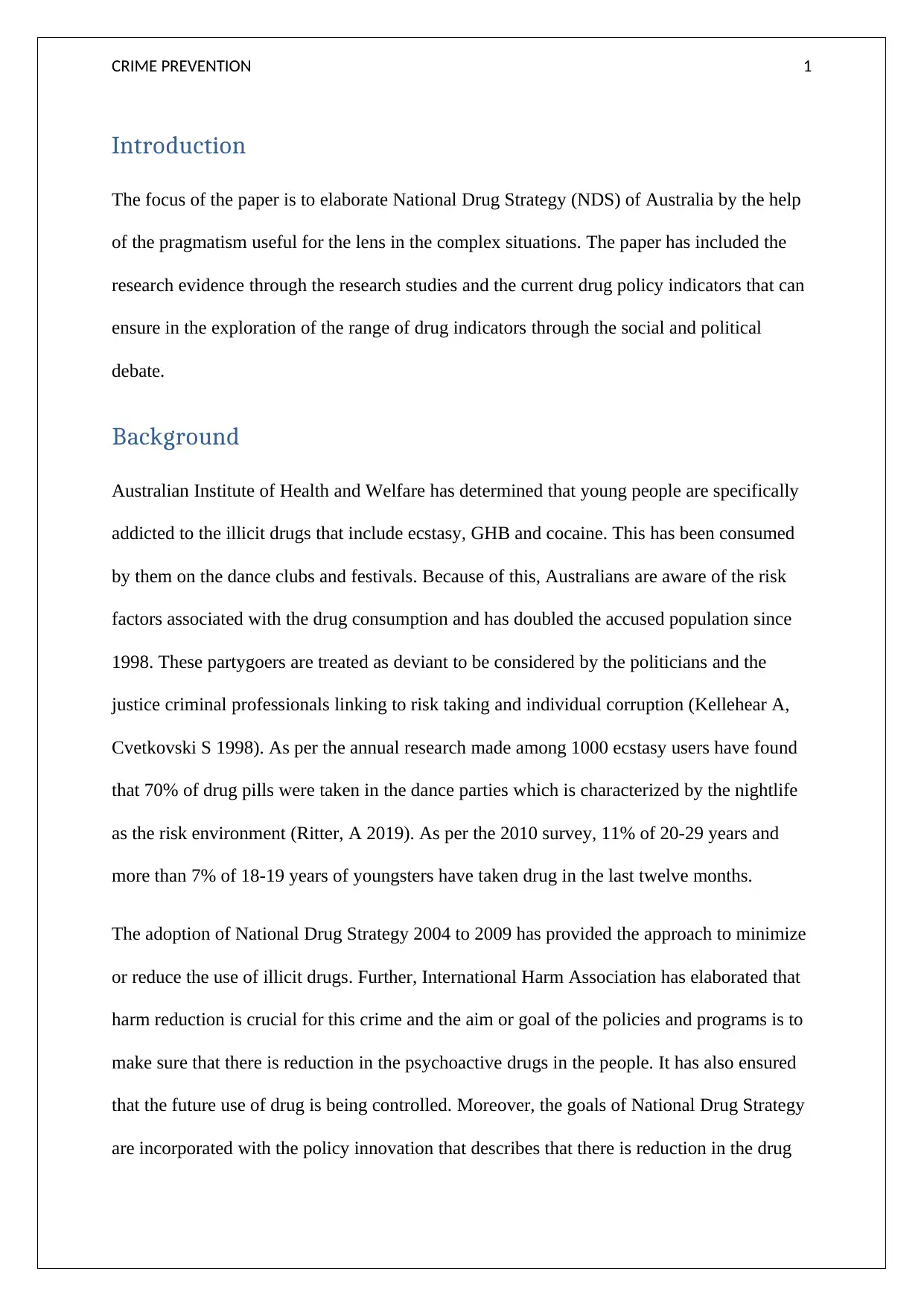
The focus of the paper is to elaborate National Drug Strategy (NDS) of Australia by the help
of the pragmatism useful for the lens in the complex situations. The paper has included the
research evidence through the research studies and the current drug policy indicators that can
ensure in the exploration of the range of drug indicators through the social and political
debate.
Background
Australian Institute of Health and Welfare has determined that young people are specifically
addicted to the illicit drugs that include ecstasy, GHB and cocaine. This has been consumed
by them on the dance clubs and festivals. Because of this, Australians are aware of the risk
factors associated with the drug consumption and has doubled the accused population since
1998. These partygoers are treated as deviant to be considered by the politicians and the
justice criminal professionals linking to risk taking and individual corruption (Kellehear A,
Cvetkovski S 1998). As per the annual research made among 1000 ecstasy users have found
that 70% of drug pills were taken in the dance parties which is characterized by the nightlife
as the risk environment (Ritter, A 2019). As per the 2010 survey, 11% of 20-29 years and
more than 7% of 18-19 years of youngsters have taken drug in the last twelve months.
The adoption of National Drug Strategy 2004 to 2009 has provided the approach to minimize
or reduce the use of illicit drugs. Further, International Harm Association has elaborated that
harm reduction is crucial for this crime and the aim or goal of the policies and programs is to
make sure that there is reduction in the psychoactive drugs in the people. It has also ensured
that the future use of drug is being controlled. Moreover, the goals of National Drug Strategy
are incorporated with the policy innovation that describes that there is reduction in the drug
Introduction
The focus of the paper is to elaborate National Drug Strategy (NDS) of Australia by the help
of the pragmatism useful for the lens in the complex situations. The paper has included the
research evidence through the research studies and the current drug policy indicators that can
ensure in the exploration of the range of drug indicators through the social and political
debate.
Background
Australian Institute of Health and Welfare has determined that young people are specifically
addicted to the illicit drugs that include ecstasy, GHB and cocaine. This has been consumed
by them on the dance clubs and festivals. Because of this, Australians are aware of the risk
factors associated with the drug consumption and has doubled the accused population since
1998. These partygoers are treated as deviant to be considered by the politicians and the
justice criminal professionals linking to risk taking and individual corruption (Kellehear A,
Cvetkovski S 1998). As per the annual research made among 1000 ecstasy users have found
that 70% of drug pills were taken in the dance parties which is characterized by the nightlife
as the risk environment (Ritter, A 2019). As per the 2010 survey, 11% of 20-29 years and
more than 7% of 18-19 years of youngsters have taken drug in the last twelve months.
The adoption of National Drug Strategy 2004 to 2009 has provided the approach to minimize
or reduce the use of illicit drugs. Further, International Harm Association has elaborated that
harm reduction is crucial for this crime and the aim or goal of the policies and programs is to
make sure that there is reduction in the psychoactive drugs in the people. It has also ensured
that the future use of drug is being controlled. Moreover, the goals of National Drug Strategy
are incorporated with the policy innovation that describes that there is reduction in the drug
CRIME PREVENTION 2
users and potential harm is declined through the application of pill testing. Moreover, the
drug policies are sparked with the recent death of drug addict to be found in the Australian
music festival due to the overdoses of drugs which has embarked the social and political
agendas (McClellan B and Fyfe-Yeomans J 2015).
It is observed that amoral drug policy and practice has reduced the loss of young lives due to
the fatal overdoses and has made the pragmatic and policies and practices (Crouch B 2016).
This can be overcome by fringe policy debates which is an alternative approach to be adopted
by the punitive praxis and reticent government practices (Kyriacou K and McCormack M
2017).
Pill Testing
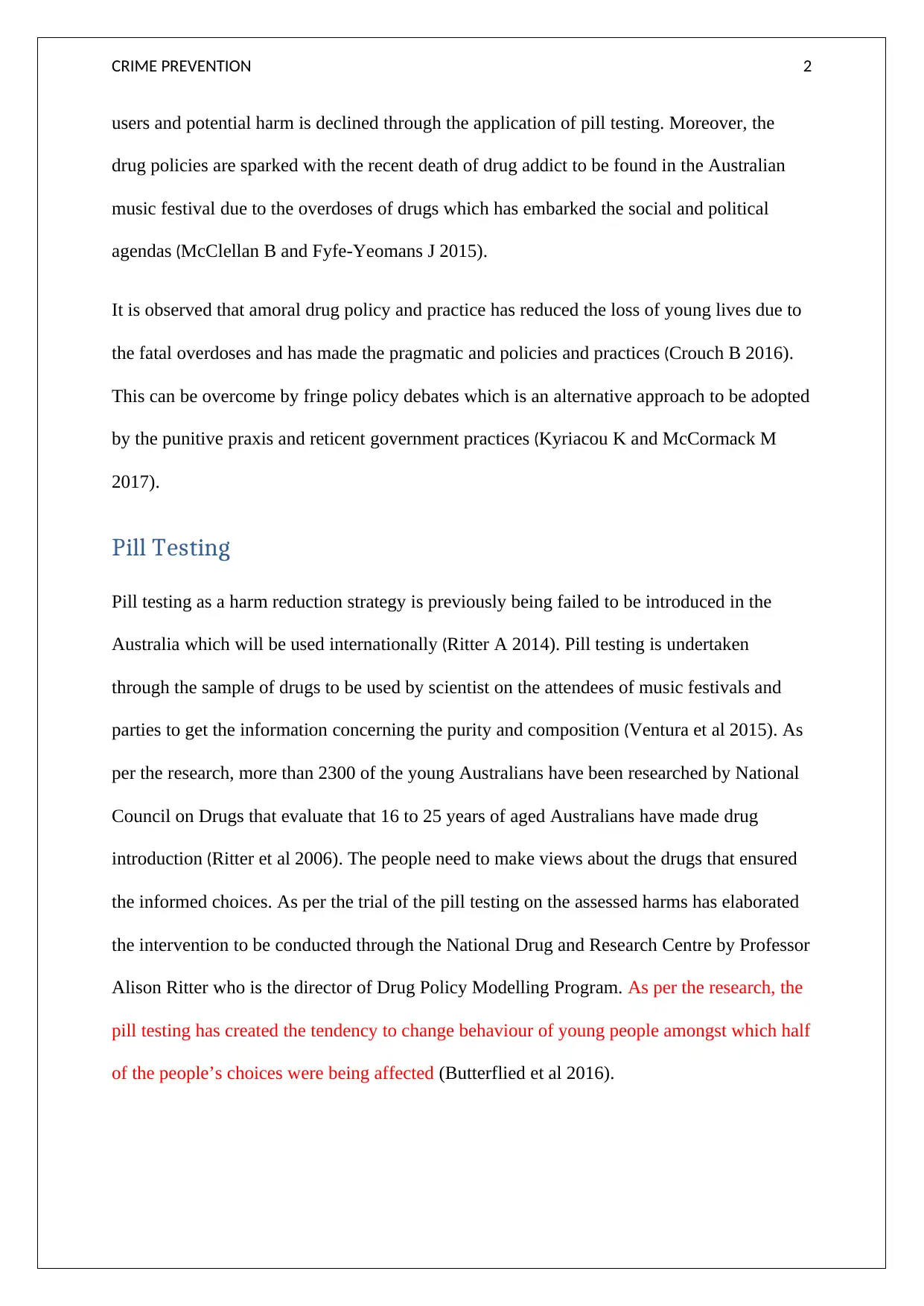
Pill testing as a harm reduction strategy is previously being failed to be introduced in the
Australia which will be used internationally (Ritter A 2014). Pill testing is undertaken
through the sample of drugs to be used by scientist on the attendees of music festivals and
parties to get the information concerning the purity and composition (Ventura et al 2015). As
per the research, more than 2300 of the young Australians have been researched by National
Council on Drugs that evaluate that 16 to 25 years of aged Australians have made drug
introduction (Ritter et al 2006). The people need to make views about the drugs that ensured
the informed choices. As per the trial of the pill testing on the assessed harms has elaborated
the intervention to be conducted through the National Drug and Research Centre by Professor
Alison Ritter who is the director of Drug Policy Modelling Program. As per the research, the
pill testing has created the tendency to change behaviour of young people amongst which half
of the people’s choices were being affected (Butterflied et al 2016).
users and potential harm is declined through the application of pill testing. Moreover, the
drug policies are sparked with the recent death of drug addict to be found in the Australian
music festival due to the overdoses of drugs which has embarked the social and political
agendas (McClellan B and Fyfe-Yeomans J 2015).
It is observed that amoral drug policy and practice has reduced the loss of young lives due to
the fatal overdoses and has made the pragmatic and policies and practices (Crouch B 2016).
This can be overcome by fringe policy debates which is an alternative approach to be adopted
by the punitive praxis and reticent government practices (Kyriacou K and McCormack M
2017).
Pill Testing
Pill testing as a harm reduction strategy is previously being failed to be introduced in the
Australia which will be used internationally (Ritter A 2014). Pill testing is undertaken
through the sample of drugs to be used by scientist on the attendees of music festivals and
parties to get the information concerning the purity and composition (Ventura et al 2015). As
per the research, more than 2300 of the young Australians have been researched by National
Council on Drugs that evaluate that 16 to 25 years of aged Australians have made drug
introduction (Ritter et al 2006). The people need to make views about the drugs that ensured
the informed choices. As per the trial of the pill testing on the assessed harms has elaborated
the intervention to be conducted through the National Drug and Research Centre by Professor
Alison Ritter who is the director of Drug Policy Modelling Program. As per the research, the
pill testing has created the tendency to change behaviour of young people amongst which half
of the people’s choices were being affected (Butterflied et al 2016).
⊘ This is a preview!⊘
Do you want full access?
Subscribe today to unlock all pages.

Trusted by 1+ million students worldwide
CRIME PREVENTION 3
Discussion
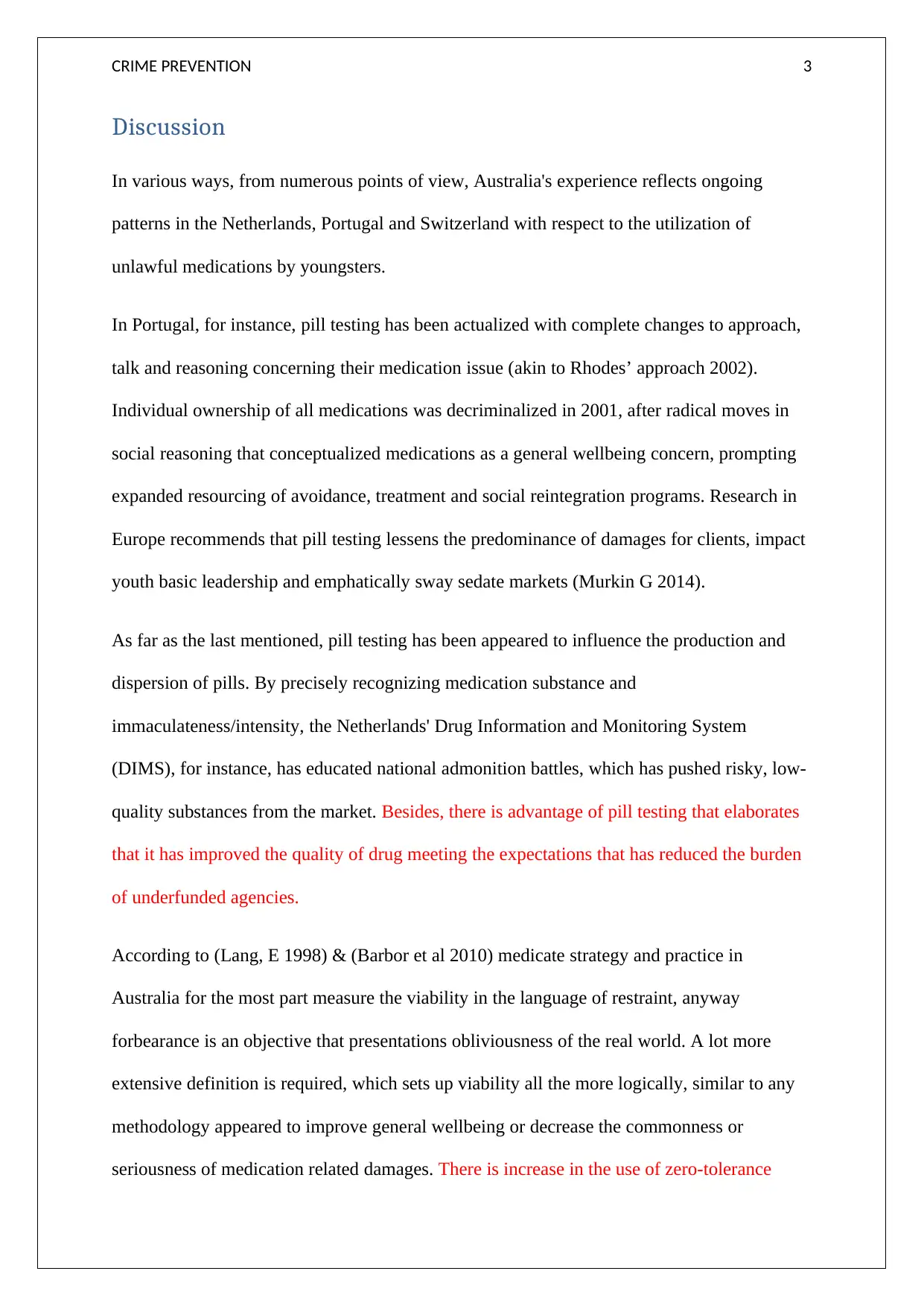
In various ways, from numerous points of view, Australia's experience reflects ongoing
patterns in the Netherlands, Portugal and Switzerland with respect to the utilization of
unlawful medications by youngsters.
In Portugal, for instance, pill testing has been actualized with complete changes to approach,
talk and reasoning concerning their medication issue (akin to Rhodes’ approach 2002).
Individual ownership of all medications was decriminalized in 2001, after radical moves in
social reasoning that conceptualized medications as a general wellbeing concern, prompting
expanded resourcing of avoidance, treatment and social reintegration programs. Research in
Europe recommends that pill testing lessens the predominance of damages for clients, impact
youth basic leadership and emphatically sway sedate markets (Murkin G 2014).
As far as the last mentioned, pill testing has been appeared to influence the production and
dispersion of pills. By precisely recognizing medication substance and
immaculateness/intensity, the Netherlands' Drug Information and Monitoring System
(DIMS), for instance, has educated national admonition battles, which has pushed risky, low-
quality substances from the market. Besides, there is advantage of pill testing that elaborates
that it has improved the quality of drug meeting the expectations that has reduced the burden
of underfunded agencies.
According to (Lang, E 1998) & (Barbor et al 2010) medicate strategy and practice in
Australia for the most part measure the viability in the language of restraint, anyway
forbearance is an objective that presentations obliviousness of the real world. A lot more
extensive definition is required, which sets up viability all the more logically, similar to any
methodology appeared to improve general wellbeing or decrease the commonness or
seriousness of medication related damages. There is increase in the use of zero-tolerance
Discussion
In various ways, from numerous points of view, Australia's experience reflects ongoing
patterns in the Netherlands, Portugal and Switzerland with respect to the utilization of
unlawful medications by youngsters.
In Portugal, for instance, pill testing has been actualized with complete changes to approach,
talk and reasoning concerning their medication issue (akin to Rhodes’ approach 2002).
Individual ownership of all medications was decriminalized in 2001, after radical moves in
social reasoning that conceptualized medications as a general wellbeing concern, prompting
expanded resourcing of avoidance, treatment and social reintegration programs. Research in
Europe recommends that pill testing lessens the predominance of damages for clients, impact
youth basic leadership and emphatically sway sedate markets (Murkin G 2014).
As far as the last mentioned, pill testing has been appeared to influence the production and
dispersion of pills. By precisely recognizing medication substance and
immaculateness/intensity, the Netherlands' Drug Information and Monitoring System
(DIMS), for instance, has educated national admonition battles, which has pushed risky, low-
quality substances from the market. Besides, there is advantage of pill testing that elaborates
that it has improved the quality of drug meeting the expectations that has reduced the burden
of underfunded agencies.
According to (Lang, E 1998) & (Barbor et al 2010) medicate strategy and practice in
Australia for the most part measure the viability in the language of restraint, anyway
forbearance is an objective that presentations obliviousness of the real world. A lot more
extensive definition is required, which sets up viability all the more logically, similar to any
methodology appeared to improve general wellbeing or decrease the commonness or
seriousness of medication related damages. There is increase in the use of zero-tolerance
Paraphrase This Document
Need a fresh take? Get an instant paraphrase of this document with our AI Paraphraser
CRIME PREVENTION 4
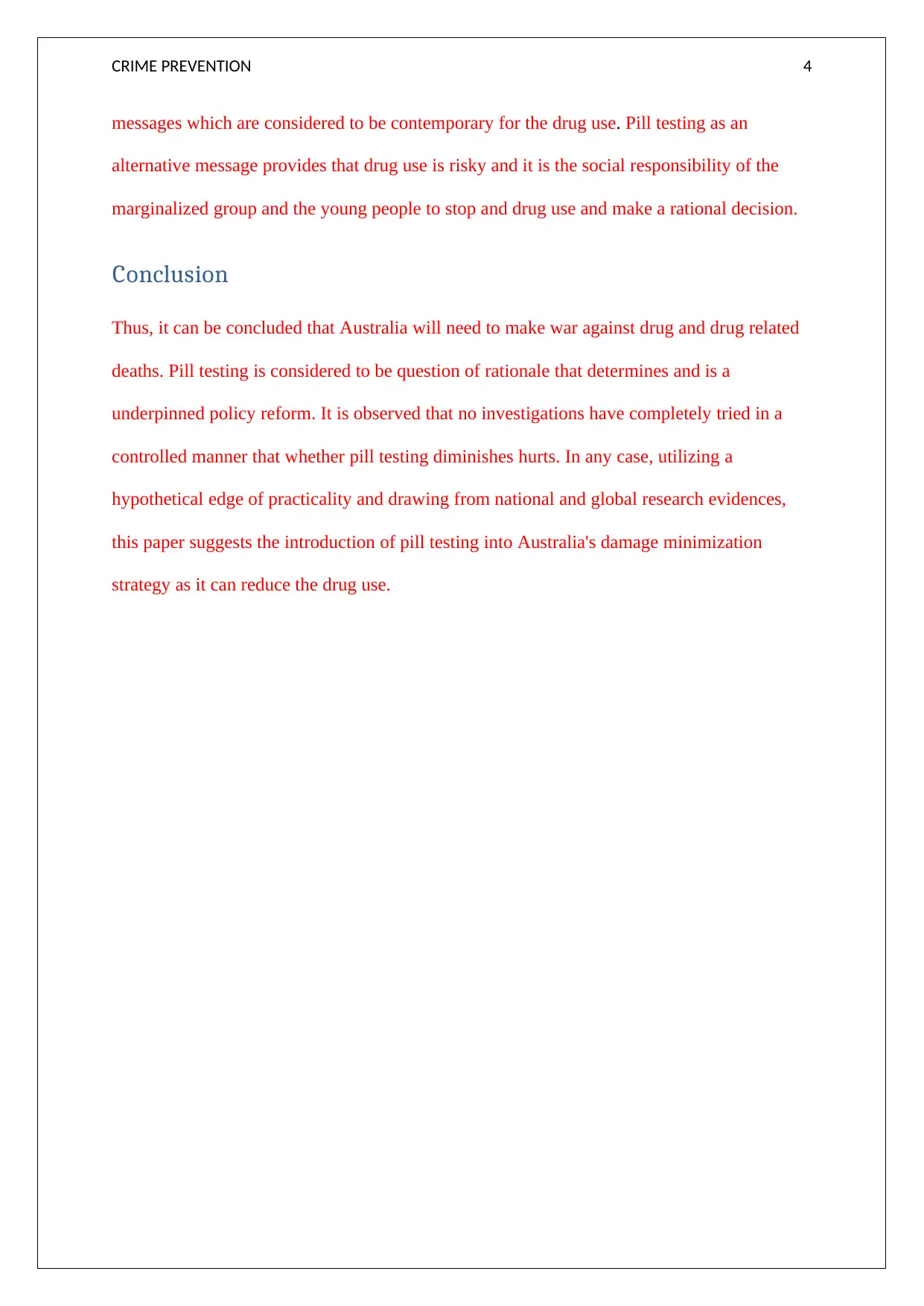
messages which are considered to be contemporary for the drug use. Pill testing as an
alternative message provides that drug use is risky and it is the social responsibility of the
marginalized group and the young people to stop and drug use and make a rational decision.
Conclusion
Thus, it can be concluded that Australia will need to make war against drug and drug related
deaths. Pill testing is considered to be question of rationale that determines and is a
underpinned policy reform. It is observed that no investigations have completely tried in a
controlled manner that whether pill testing diminishes hurts. In any case, utilizing a
hypothetical edge of practicality and drawing from national and global research evidences,
this paper suggests the introduction of pill testing into Australia's damage minimization
strategy as it can reduce the drug use.
messages which are considered to be contemporary for the drug use. Pill testing as an
alternative message provides that drug use is risky and it is the social responsibility of the
marginalized group and the young people to stop and drug use and make a rational decision.
Conclusion
Thus, it can be concluded that Australia will need to make war against drug and drug related
deaths. Pill testing is considered to be question of rationale that determines and is a
underpinned policy reform. It is observed that no investigations have completely tried in a
controlled manner that whether pill testing diminishes hurts. In any case, utilizing a
hypothetical edge of practicality and drawing from national and global research evidences,
this paper suggests the introduction of pill testing into Australia's damage minimization
strategy as it can reduce the drug use.
CRIME PREVENTION 5
References
Australian Institute of Health and Welfare. Young Australians: their health and wellbeing. (Cat.
No. PHE 140) Canberra: AIHW; 2011
Babor T, Caulkins J, Edwards G, Fischer B, Foxcroft D, Humphreys K, et al. Drug policy and
the public good. Oxford: Oxford University Press; 2010.
Benschop, A., Rabes, M. and Korf, D.J., 2002. Pill testing, ecstasy & prevention. Eine wis.
Boys, A., Marsden, J. and Strang, J., 2001. Understanding reasons for drug use amongst young
people: a functional perspective. Health education research, 16(4), pp.457-469.
Butterfield R, Barratt M, Ezard N, Day R. Drug checking to improve monitoring of new
psychoactive substances in Australia. Med J Aust. 2016;204(4):144–146. doi:
10.5694/mja15.01058
Camilleri, A.M. and Caldicott, D., 2005. Underground pill testing, down under. Forensic
Science International, 151(1), pp.53-58.
Crouch B. Stereosonic drug deaths: should we be testing illegal drugs to see if they’re safe? The
Advertiser. [Internet] 6 Dec 2015. Available from: http://www.adelaidenow.com.au/news/south-
australia/stereosonic-deaths-call-for-inquest-into-deaths-at-music-festival/news-story/
40bbeb4339e0f3af7c5f9fcb195baca4.
Day N, Criss J, Griffiths B, Gujral S, John-Leader F, Johnston J, Pit S. Music festival attendees’
illicit drug use, knowledge and practices regarding drug content and purity: a cross-sectional
survey. Harm Red J. 2018;15:1–8. doi: 10.1186/s12954-017-0205-7.
Holt, M., 2005. Young people and illicit drug use in Australia. National Centre in HIV Social
Research.
References
Australian Institute of Health and Welfare. Young Australians: their health and wellbeing. (Cat.
No. PHE 140) Canberra: AIHW; 2011
Babor T, Caulkins J, Edwards G, Fischer B, Foxcroft D, Humphreys K, et al. Drug policy and
the public good. Oxford: Oxford University Press; 2010.
Benschop, A., Rabes, M. and Korf, D.J., 2002. Pill testing, ecstasy & prevention. Eine wis.
Boys, A., Marsden, J. and Strang, J., 2001. Understanding reasons for drug use amongst young
people: a functional perspective. Health education research, 16(4), pp.457-469.
Butterfield R, Barratt M, Ezard N, Day R. Drug checking to improve monitoring of new
psychoactive substances in Australia. Med J Aust. 2016;204(4):144–146. doi:
10.5694/mja15.01058
Camilleri, A.M. and Caldicott, D., 2005. Underground pill testing, down under. Forensic
Science International, 151(1), pp.53-58.
Crouch B. Stereosonic drug deaths: should we be testing illegal drugs to see if they’re safe? The
Advertiser. [Internet] 6 Dec 2015. Available from: http://www.adelaidenow.com.au/news/south-
australia/stereosonic-deaths-call-for-inquest-into-deaths-at-music-festival/news-story/
40bbeb4339e0f3af7c5f9fcb195baca4.
Day N, Criss J, Griffiths B, Gujral S, John-Leader F, Johnston J, Pit S. Music festival attendees’
illicit drug use, knowledge and practices regarding drug content and purity: a cross-sectional
survey. Harm Red J. 2018;15:1–8. doi: 10.1186/s12954-017-0205-7.
Holt, M., 2005. Young people and illicit drug use in Australia. National Centre in HIV Social
Research.
⊘ This is a preview!⊘
Do you want full access?
Subscribe today to unlock all pages.
Trusted by 1+ million students worldwide
CRIME PREVENTION 6
Kelly, B.C., Wells, B.E., Pawson, M., LeClair, A. and Parsons, J.T., 2014. Combinations of
prescription drug misuse and illicit drugs among young adults. Addictive behaviors, 39(5),
pp.941-944.
Kyriacou K, McCormack M. Mount Lindesay New Year’s party turns deadly. Courier Mail.
[Internet] 2 Jan 2017. Available from: http://www.couriermail.com.au/news/queensland/mount-
lindesay-new-years-party-turns-deadly/news-story/4d3f9d4f1058cd834cbe8741964acc45.
Lang E. Drugs in society: a social history. In: Hamilton M, Kellehear A, Rumbold G,
editors. Drug use in Australia: a harm minimisation approach. Melbourne: Oxford University
Press; 1998. pp. 1–13.
McClellan B, Fyfe-Yeomans J. Stereosonic music festival: police despair as Sylvia Choi, 25,
dies after taking ecstasy. The Daily Telegraph. [Internet] 30 Nov 2015. Available
from: https://www.dailytelegraph.com.au/news/nsw/stereosonic-music-festival-police-despair-
as-sylvia-choi-25-dies-after-taking-ecstasy/news-story/2392528f4ed8d68497ffe337fff05f9e.
Miller, P., Curtis, A., Jenkinson, R., Droste, N., Bowe, S.J. and Pennay, A., 2015. Drug use in
Australian nightlife settings: estimation of prevalence and validity of self‐
report. Addiction, 110(11), pp.1803-1810.
Ministerial Council on Drug Strategy (MCDS) National Drug Strategy 2010–2015: a
framework for action on alcohol, tobacco and other drugs. Canberra: MCDS; 2011.
Murkin G. Drug decriminalisation in Portugal: setting the record straight. Bristol: Transform,
Getting drugs under control; 2014.
Obot, I.S., 2007. Limits of substance-use interventions in developing countries. The
Lancet, 369(9570), pp.1323-1325.
Kelly, B.C., Wells, B.E., Pawson, M., LeClair, A. and Parsons, J.T., 2014. Combinations of
prescription drug misuse and illicit drugs among young adults. Addictive behaviors, 39(5),
pp.941-944.
Kyriacou K, McCormack M. Mount Lindesay New Year’s party turns deadly. Courier Mail.
[Internet] 2 Jan 2017. Available from: http://www.couriermail.com.au/news/queensland/mount-
lindesay-new-years-party-turns-deadly/news-story/4d3f9d4f1058cd834cbe8741964acc45.
Lang E. Drugs in society: a social history. In: Hamilton M, Kellehear A, Rumbold G,
editors. Drug use in Australia: a harm minimisation approach. Melbourne: Oxford University
Press; 1998. pp. 1–13.
McClellan B, Fyfe-Yeomans J. Stereosonic music festival: police despair as Sylvia Choi, 25,
dies after taking ecstasy. The Daily Telegraph. [Internet] 30 Nov 2015. Available
from: https://www.dailytelegraph.com.au/news/nsw/stereosonic-music-festival-police-despair-
as-sylvia-choi-25-dies-after-taking-ecstasy/news-story/2392528f4ed8d68497ffe337fff05f9e.
Miller, P., Curtis, A., Jenkinson, R., Droste, N., Bowe, S.J. and Pennay, A., 2015. Drug use in
Australian nightlife settings: estimation of prevalence and validity of self‐
report. Addiction, 110(11), pp.1803-1810.
Ministerial Council on Drug Strategy (MCDS) National Drug Strategy 2010–2015: a
framework for action on alcohol, tobacco and other drugs. Canberra: MCDS; 2011.
Murkin G. Drug decriminalisation in Portugal: setting the record straight. Bristol: Transform,
Getting drugs under control; 2014.
Obot, I.S., 2007. Limits of substance-use interventions in developing countries. The
Lancet, 369(9570), pp.1323-1325.
Paraphrase This Document
Need a fresh take? Get an instant paraphrase of this document with our AI Paraphraser
CRIME PREVENTION 7
Ritter A 2019 ‘six reasons for pill testing’ Drug Policy Australia.
https://www.drugpolicy.org.au/pill_testing?
gclid=CjwKCAiAsIDxBRAsEiwAV76N88CPGI80SIYOxxqWyikIbX_JaUJ28X6KbhfLUlhcly
_SDAgZaR5NHxoCJJAQAvD_BwE
Ritter A. Six reasons Australia should pilot ‘pill testing’ party drugs. The Conversation.
[Internet] 12 Nov 2014. Available from: https://theconversation.com/six-reasons-australia-
should-pilot-pill-testing-party-drugs-34073.
Ritter, A., Ritter, A., Cameron, J., Ritter, A. and Cameron, J., 2006. A review of the efficacy and
effectiveness of harm reduction strategies for alcohol, tobacco and illicit drugs. Drug and
alcohol review, 25(6), pp.611-624
Rhodes T. The ‘risk environment’: a framework for understanding and reducing drug-related
harm. Int J Drug Policy. 2002;13:85–94. doi: 10.1016/S0955-3959(02)00007-5.
Shildrick, T., 2002. Young people, illicit drug use and the question of normalization. Journal of
youth studies, 5(1), pp.35-48.
Ventura M, Noijen J, Bucheli A, Isvy A, van Huyck C, Martins D, Nagy C, Schipper V, Ugarte
M, Valente H. Drug checking service: good practice standards. Europe: Nightlife
Empowerment & Well-being Implementation Project (NEWIP); 2015.
Winstock, A.R., Wolff, K. and Ramsey, J., 2001. Ecstasy pill testing: harm minimization gone
too far?. Addiction, 96(8), pp.1139-1148.
Wright, J.D. and Pearl, L., 2000. Experience and knowledge of young people regarding illicit
drug use, 1969–99. Addiction, 95(8), pp.1225-1235.
Ritter A 2019 ‘six reasons for pill testing’ Drug Policy Australia.
https://www.drugpolicy.org.au/pill_testing?
gclid=CjwKCAiAsIDxBRAsEiwAV76N88CPGI80SIYOxxqWyikIbX_JaUJ28X6KbhfLUlhcly
_SDAgZaR5NHxoCJJAQAvD_BwE
Ritter A. Six reasons Australia should pilot ‘pill testing’ party drugs. The Conversation.
[Internet] 12 Nov 2014. Available from: https://theconversation.com/six-reasons-australia-
should-pilot-pill-testing-party-drugs-34073.
Ritter, A., Ritter, A., Cameron, J., Ritter, A. and Cameron, J., 2006. A review of the efficacy and
effectiveness of harm reduction strategies for alcohol, tobacco and illicit drugs. Drug and
alcohol review, 25(6), pp.611-624
Rhodes T. The ‘risk environment’: a framework for understanding and reducing drug-related
harm. Int J Drug Policy. 2002;13:85–94. doi: 10.1016/S0955-3959(02)00007-5.
Shildrick, T., 2002. Young people, illicit drug use and the question of normalization. Journal of
youth studies, 5(1), pp.35-48.
Ventura M, Noijen J, Bucheli A, Isvy A, van Huyck C, Martins D, Nagy C, Schipper V, Ugarte
M, Valente H. Drug checking service: good practice standards. Europe: Nightlife
Empowerment & Well-being Implementation Project (NEWIP); 2015.
Winstock, A.R., Wolff, K. and Ramsey, J., 2001. Ecstasy pill testing: harm minimization gone
too far?. Addiction, 96(8), pp.1139-1148.
Wright, J.D. and Pearl, L., 2000. Experience and knowledge of young people regarding illicit
drug use, 1969–99. Addiction, 95(8), pp.1225-1235.
CRIME PREVENTION 8
⊘ This is a preview!⊘
Do you want full access?
Subscribe today to unlock all pages.
Trusted by 1+ million students worldwide

1 out of 9


Your All-in-One AI-Powered Toolkit for Academic Success.
+13062052269
info@desklib.com
Available 24*7 on WhatsApp / Email
![[object Object]](/_next/static/media/star-bottom.7253800d.svg)
Unlock your academic potential
Copyright © 2020–2026 A2Z Services. All Rights Reserved. Developed and managed by ZUCOL.