Comprehensive Analysis of Crime Rates in England and Wales
VerifiedAdded on 2022/12/12
|12
|2806
|2
Report
AI Summary
This report provides an in-depth analysis of crime rates in England and Wales, examining various aspects of crime research. It begins with an introduction to crime rate concepts and historical data, highlighting a decrease in recorded crimes in 2020. The methodology section details the research type (primary), approach (quantitative), and sampling strategy (cluster sampling), along with data collection methods using questionnaires. The report then addresses ethical considerations, including informed consent, confidentiality, anonymity, and voluntary participation, crucial for sensitive crime-related research. Data analysis techniques, such as descriptive statistics and correlation tests, are outlined, alongside an interpretation of CSEW crime data across different age groups and genders, revealing that individuals aged 16-24 are most vulnerable to victimization. Finally, the report explores alternative research methods, contrasting the quantitative approach with a qualitative approach involving interviews, which could provide deeper insights into the reasons behind victimization.
Introduction to Researching
Crime Rates in England and
Wales
Crime Rates in England and
Wales

Paraphrase This Document
Need a fresh take? Get an instant paraphrase of this document with our AI Paraphraser
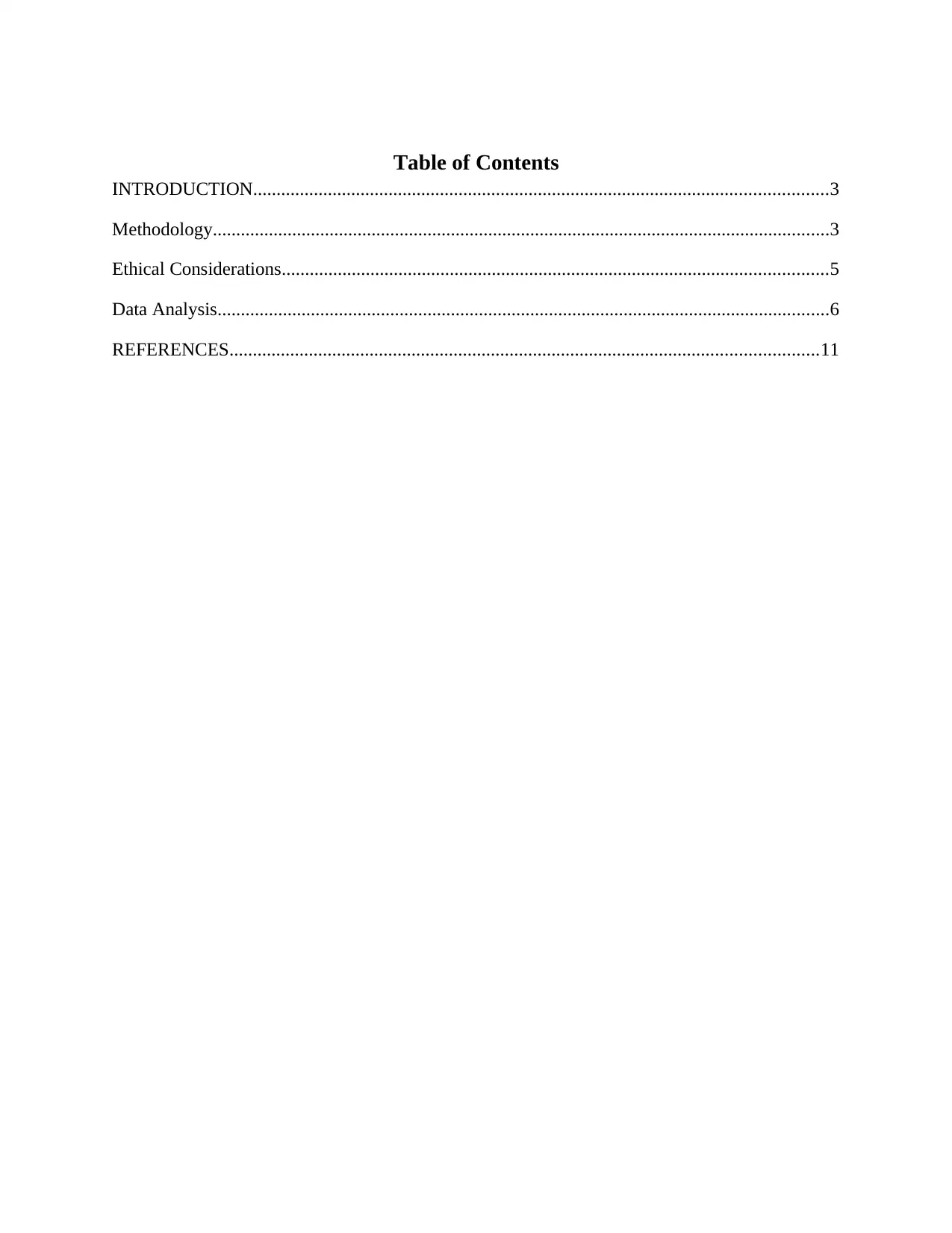
Table of Contents
INTRODUCTION...........................................................................................................................3
Methodology....................................................................................................................................3
Ethical Considerations.....................................................................................................................5
Data Analysis...................................................................................................................................6
REFERENCES..............................................................................................................................11
INTRODUCTION...........................................................................................................................3
Methodology....................................................................................................................................3
Ethical Considerations.....................................................................................................................5
Data Analysis...................................................................................................................................6
REFERENCES..............................................................................................................................11
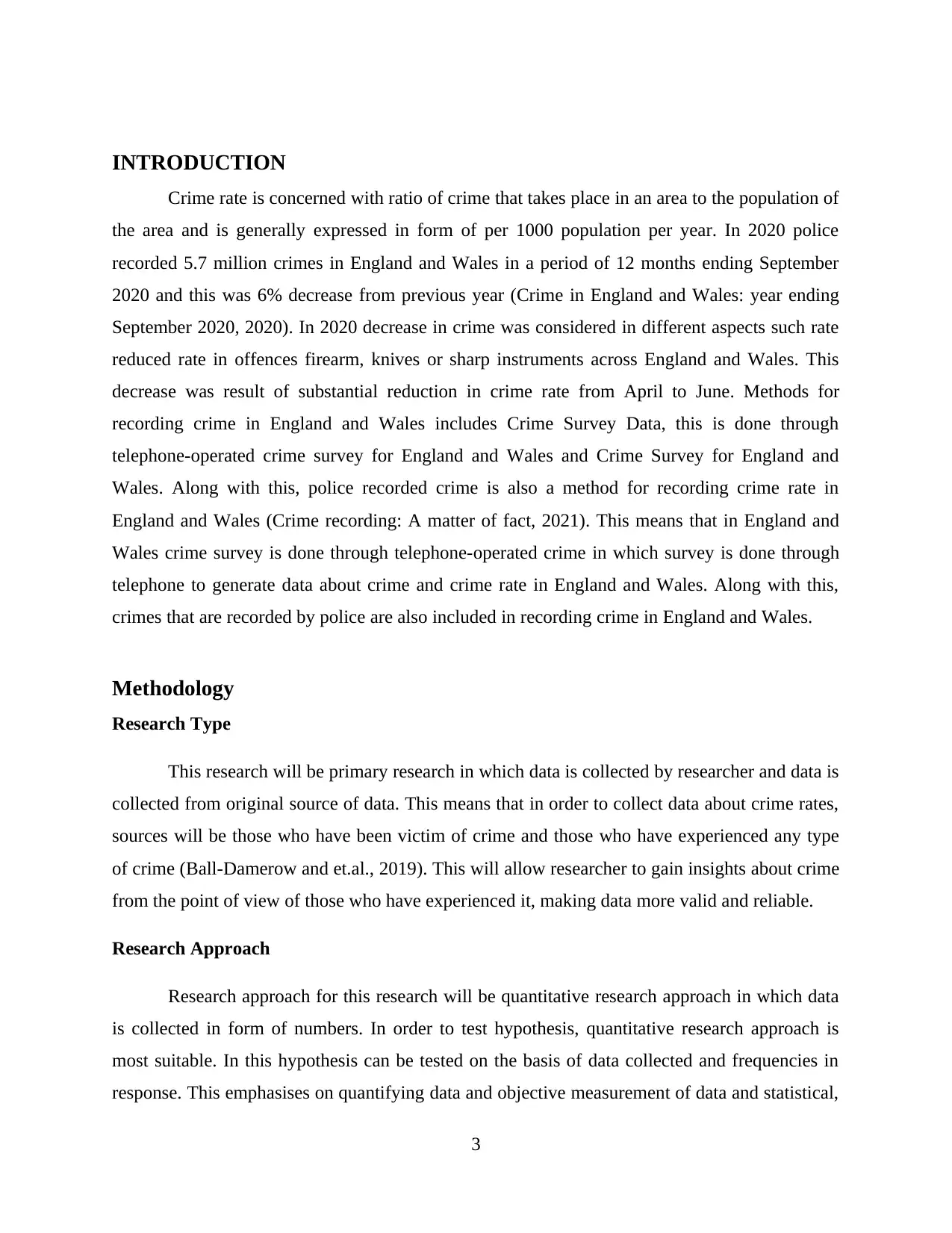
INTRODUCTION
Crime rate is concerned with ratio of crime that takes place in an area to the population of
the area and is generally expressed in form of per 1000 population per year. In 2020 police
recorded 5.7 million crimes in England and Wales in a period of 12 months ending September
2020 and this was 6% decrease from previous year (Crime in England and Wales: year ending
September 2020, 2020). In 2020 decrease in crime was considered in different aspects such rate
reduced rate in offences firearm, knives or sharp instruments across England and Wales. This
decrease was result of substantial reduction in crime rate from April to June. Methods for
recording crime in England and Wales includes Crime Survey Data, this is done through
telephone-operated crime survey for England and Wales and Crime Survey for England and
Wales. Along with this, police recorded crime is also a method for recording crime rate in
England and Wales (Crime recording: A matter of fact, 2021). This means that in England and
Wales crime survey is done through telephone-operated crime in which survey is done through
telephone to generate data about crime and crime rate in England and Wales. Along with this,
crimes that are recorded by police are also included in recording crime in England and Wales.
Methodology
Research Type
This research will be primary research in which data is collected by researcher and data is
collected from original source of data. This means that in order to collect data about crime rates,
sources will be those who have been victim of crime and those who have experienced any type
of crime (Ball-Damerow and et.al., 2019). This will allow researcher to gain insights about crime
from the point of view of those who have experienced it, making data more valid and reliable.
Research Approach
Research approach for this research will be quantitative research approach in which data
is collected in form of numbers. In order to test hypothesis, quantitative research approach is
most suitable. In this hypothesis can be tested on the basis of data collected and frequencies in
response. This emphasises on quantifying data and objective measurement of data and statistical,
3
Crime rate is concerned with ratio of crime that takes place in an area to the population of
the area and is generally expressed in form of per 1000 population per year. In 2020 police
recorded 5.7 million crimes in England and Wales in a period of 12 months ending September
2020 and this was 6% decrease from previous year (Crime in England and Wales: year ending
September 2020, 2020). In 2020 decrease in crime was considered in different aspects such rate
reduced rate in offences firearm, knives or sharp instruments across England and Wales. This
decrease was result of substantial reduction in crime rate from April to June. Methods for
recording crime in England and Wales includes Crime Survey Data, this is done through
telephone-operated crime survey for England and Wales and Crime Survey for England and
Wales. Along with this, police recorded crime is also a method for recording crime rate in
England and Wales (Crime recording: A matter of fact, 2021). This means that in England and
Wales crime survey is done through telephone-operated crime in which survey is done through
telephone to generate data about crime and crime rate in England and Wales. Along with this,
crimes that are recorded by police are also included in recording crime in England and Wales.
Methodology
Research Type
This research will be primary research in which data is collected by researcher and data is
collected from original source of data. This means that in order to collect data about crime rates,
sources will be those who have been victim of crime and those who have experienced any type
of crime (Ball-Damerow and et.al., 2019). This will allow researcher to gain insights about crime
from the point of view of those who have experienced it, making data more valid and reliable.
Research Approach
Research approach for this research will be quantitative research approach in which data
is collected in form of numbers. In order to test hypothesis, quantitative research approach is
most suitable. In this hypothesis can be tested on the basis of data collected and frequencies in
response. This emphasises on quantifying data and objective measurement of data and statistical,
3
⊘ This is a preview!⊘
Do you want full access?
Subscribe today to unlock all pages.

Trusted by 1+ million students worldwide
mathematical data collected through survey and questionnaire (Grant and et.al., 2017). In this
research closed-ended questionnaire will be used for collecting data which will enable to
quantify data being collected.
Sampling
Sampling strategy for this research will be cluster sampling strategy. In this overall
population is divided into different clusters. Cluster to be created for this research are based on
age and gender and ethnic group of population. On the basis of these clusters individuals among
population will be randomly selected, creating equal possibility for everyone to participate in
research. On the basis of gender 2 clusters will be included, on the basis of age 7 clusters will be
developed and on the basis of ethnicity 5 clusters will be developed, European, Black, Asian,
minority ethnic, and others (Humm and et.al., 2017). From each other of these clusters 100
participants will be included in research.
Data Collection
This is a primary research and this is why data in this research will be collected through
Questionnaire. For all type of population similar questionnaire will be developed. Participants in
this research will be given questionnaire that will not involve any question that require sharing
their identity because, data will be collected anonymously. However, data is being collected from
different clusters and this is why information regarding cluster in which they belong will be
included in questionnaire (Casati and et.al., 2017). This includes their age, gender, and ethnicity
which will enable researcher to collect valid and reliable data and will also avoid
misrepresentation of data.
Data Analysis
Data analysis will be done through different statistical analysis methods. Data analysis
through this will be done because it is quantitative research and data is collected in form of
numbers and statistical analysis facilitate proper presentation of data and make it easy to be
understood by others. Statistical methods for data analysis that is to be used for analysing data
includes descriptive statistics, reliability tests, and correlation tests (Casati and et.al., 2017).
Along with this, chi-square tests will also be done for analysis of data collected through research.
4
research closed-ended questionnaire will be used for collecting data which will enable to
quantify data being collected.
Sampling
Sampling strategy for this research will be cluster sampling strategy. In this overall
population is divided into different clusters. Cluster to be created for this research are based on
age and gender and ethnic group of population. On the basis of these clusters individuals among
population will be randomly selected, creating equal possibility for everyone to participate in
research. On the basis of gender 2 clusters will be included, on the basis of age 7 clusters will be
developed and on the basis of ethnicity 5 clusters will be developed, European, Black, Asian,
minority ethnic, and others (Humm and et.al., 2017). From each other of these clusters 100
participants will be included in research.
Data Collection
This is a primary research and this is why data in this research will be collected through
Questionnaire. For all type of population similar questionnaire will be developed. Participants in
this research will be given questionnaire that will not involve any question that require sharing
their identity because, data will be collected anonymously. However, data is being collected from
different clusters and this is why information regarding cluster in which they belong will be
included in questionnaire (Casati and et.al., 2017). This includes their age, gender, and ethnicity
which will enable researcher to collect valid and reliable data and will also avoid
misrepresentation of data.
Data Analysis
Data analysis will be done through different statistical analysis methods. Data analysis
through this will be done because it is quantitative research and data is collected in form of
numbers and statistical analysis facilitate proper presentation of data and make it easy to be
understood by others. Statistical methods for data analysis that is to be used for analysing data
includes descriptive statistics, reliability tests, and correlation tests (Casati and et.al., 2017).
Along with this, chi-square tests will also be done for analysis of data collected through research.
4
Paraphrase This Document
Need a fresh take? Get an instant paraphrase of this document with our AI Paraphraser
Ethical Considerations
This research is based on crime rates and when data is collected about crime and crime
rate, this is a very sensitive topic. This is why it is very important that all ethical issues are
considered in order to avoid potential risk for participants. This is because those who have been
victims of crime are involved have threat and their participation can create difficulties for them.
Ethical consideration for this research includes-
Informed consent- This is first ethical consideration in which informed consent is obtained from
individuals (Thomas and et.al., 2017). Informed consent is one in which participants in research
are informed about research and are given all required information. Consent is obtained from
participants when they have adequate knowledge about research in which they are participating.
This is first important ethical consideration in which on the basis of knowledge of research
participants can determine whether they wish to participate in research or not.
Confidentiality- This is also one of the very important ethical consideration for research on
crime rate in which identity of participants is kept confidential. In this research, researcher is
aware about link between participants of their responses, however this information is kept
confidential by researcher. However, in this research confidentiality will not be required because
participants’ identity will be anonymous.
Anonymity- Anonymity is concerned with ensuring that link between participants and research
cannot be found and this is possible through anonymity. This means that participants’ identity is
completely anonymous. In crime research, this can play very important role in avoiding any
potential risk that participants have because of participation in research (Adams and et.al., 2017).
This is because crime research involves several sensitive issues and this is why participants may
not wish to participate because they pose threat.
Communicating results- This is also very important ethical consideration regarding crime
research. In this it is required that results being communicated are true and transparent, it is very
important that original data of research is not manipulated. Results are fairly communicated
considering that no important part of research is left to be communicated which can affect
quality of overall research and results.
5
This research is based on crime rates and when data is collected about crime and crime
rate, this is a very sensitive topic. This is why it is very important that all ethical issues are
considered in order to avoid potential risk for participants. This is because those who have been
victims of crime are involved have threat and their participation can create difficulties for them.
Ethical consideration for this research includes-
Informed consent- This is first ethical consideration in which informed consent is obtained from
individuals (Thomas and et.al., 2017). Informed consent is one in which participants in research
are informed about research and are given all required information. Consent is obtained from
participants when they have adequate knowledge about research in which they are participating.
This is first important ethical consideration in which on the basis of knowledge of research
participants can determine whether they wish to participate in research or not.
Confidentiality- This is also one of the very important ethical consideration for research on
crime rate in which identity of participants is kept confidential. In this research, researcher is
aware about link between participants of their responses, however this information is kept
confidential by researcher. However, in this research confidentiality will not be required because
participants’ identity will be anonymous.
Anonymity- Anonymity is concerned with ensuring that link between participants and research
cannot be found and this is possible through anonymity. This means that participants’ identity is
completely anonymous. In crime research, this can play very important role in avoiding any
potential risk that participants have because of participation in research (Adams and et.al., 2017).
This is because crime research involves several sensitive issues and this is why participants may
not wish to participate because they pose threat.
Communicating results- This is also very important ethical consideration regarding crime
research. In this it is required that results being communicated are true and transparent, it is very
important that original data of research is not manipulated. Results are fairly communicated
considering that no important part of research is left to be communicated which can affect
quality of overall research and results.
5
Voluntary participation- This is also an ethical consideration according to which it is required
that participants participate voluntarily in research. Participants should not be involves in
research through means of coercion and deception as it is unethical. Voluntary participation is
one in which participants willingly participate in research and provide their required contribution
in carrying out research.
Potential for harm- This is very important ethical consideration to be followed for crime
research in which researcher is required to identify potential harm of any type for participants
(Brown, 2018). On the basis of identified potential harm such as physical, psychological,
emotional and embarrassment, social harm, adequate actions are required to be taken by
researcher to mitigate such harm for participants.
Respecting Privacy- This is another important ethical consideration in which privacy of those
participating in research should be given utmost respect. This means that any question that
causes threat to their privacy should be avoided by researcher.
All these ethical consideration will be considered for this research.
Data Analysis
Personal characteristic
All CSEW crime
(including fraud and
computer misuse)
Personal crime
(including fraud and
computer misuse)
Unweighted base -
number of adults
ALL ADULTS 19.3 11.0 33,735
16-24 23.7 14.7 2,103
25-34 22.3 12.8 4,836
35-44 21.5 11.7 5,451
45-54 21.1 11.4 5,535
55-64 19.2 10.8 5,605
65-74 13.8 8.1 5,373
75+ 9.2 5.8 4,832
6
that participants participate voluntarily in research. Participants should not be involves in
research through means of coercion and deception as it is unethical. Voluntary participation is
one in which participants willingly participate in research and provide their required contribution
in carrying out research.
Potential for harm- This is very important ethical consideration to be followed for crime
research in which researcher is required to identify potential harm of any type for participants
(Brown, 2018). On the basis of identified potential harm such as physical, psychological,
emotional and embarrassment, social harm, adequate actions are required to be taken by
researcher to mitigate such harm for participants.
Respecting Privacy- This is another important ethical consideration in which privacy of those
participating in research should be given utmost respect. This means that any question that
causes threat to their privacy should be avoided by researcher.
All these ethical consideration will be considered for this research.
Data Analysis
Personal characteristic
All CSEW crime
(including fraud and
computer misuse)
Personal crime
(including fraud and
computer misuse)
Unweighted base -
number of adults
ALL ADULTS 19.3 11.0 33,735
16-24 23.7 14.7 2,103
25-34 22.3 12.8 4,836
35-44 21.5 11.7 5,451
45-54 21.1 11.4 5,535
55-64 19.2 10.8 5,605
65-74 13.8 8.1 5,373
75+ 9.2 5.8 4,832
6
⊘ This is a preview!⊘
Do you want full access?
Subscribe today to unlock all pages.
Trusted by 1+ million students worldwide
ALL
ADULTS 16-24 25-34 35-44 45-54 55-64 65-74 75+
19.28911369432
39
23.73998999798
7422.25300850210
6221.45152033388
4521.11576817728
2319.20939255866
91
13.84233505490
47
9.184303547272
05
11.01208421757
64
14.65016560903
2512.78719020972
9811.66056635244
3611.36861402975
8110.78315835144
478.136447341362
565.785556035315
13
Series1 Series2
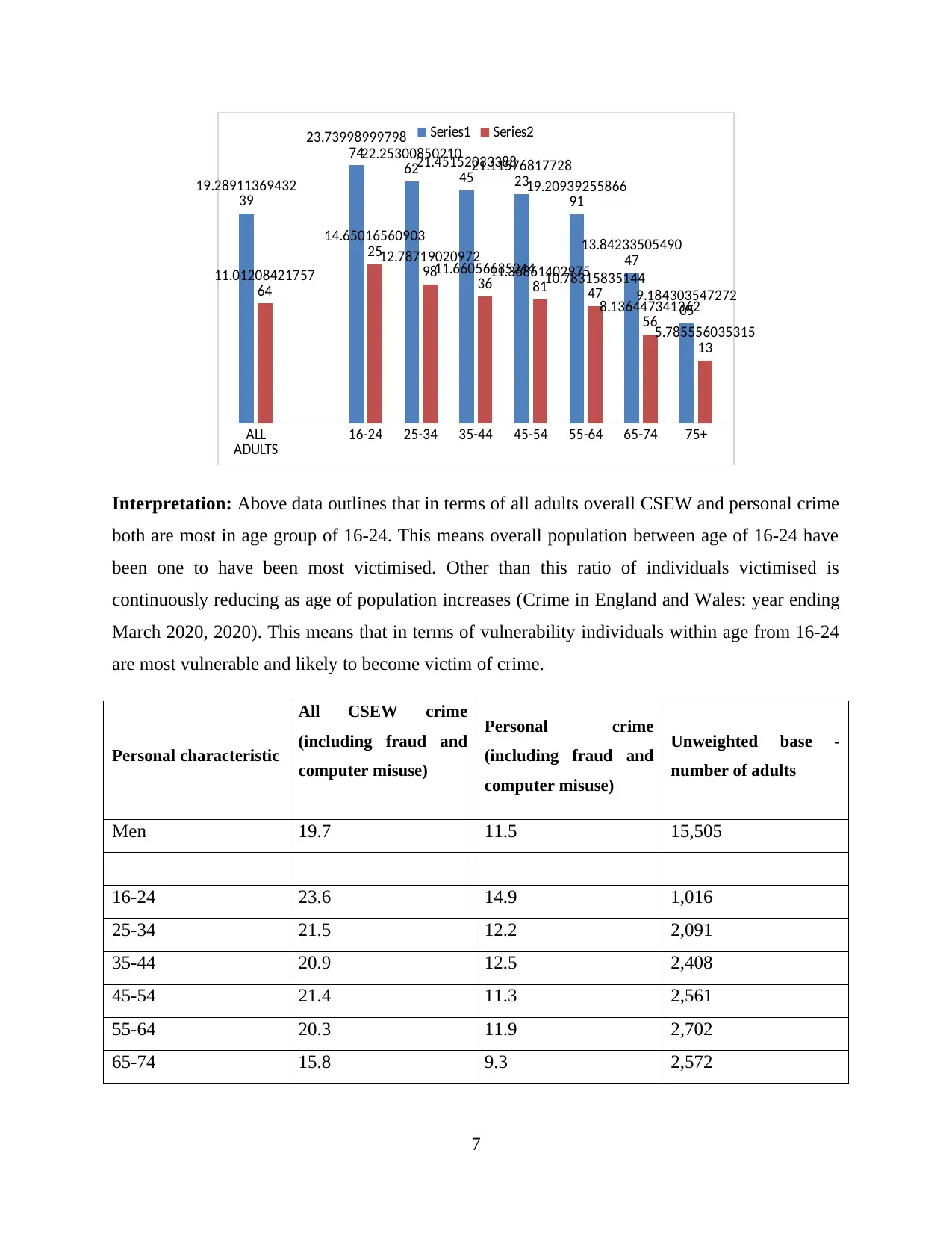
Interpretation: Above data outlines that in terms of all adults overall CSEW and personal crime
both are most in age group of 16-24. This means overall population between age of 16-24 have
been one to have been most victimised. Other than this ratio of individuals victimised is
continuously reducing as age of population increases (Crime in England and Wales: year ending
March 2020, 2020). This means that in terms of vulnerability individuals within age from 16-24
are most vulnerable and likely to become victim of crime.
Personal characteristic
All CSEW crime
(including fraud and
computer misuse)
Personal crime
(including fraud and
computer misuse)
Unweighted base -
number of adults
Men 19.7 11.5 15,505
16-24 23.6 14.9 1,016
25-34 21.5 12.2 2,091
35-44 20.9 12.5 2,408
45-54 21.4 11.3 2,561
55-64 20.3 11.9 2,702
65-74 15.8 9.3 2,572
7
ADULTS 16-24 25-34 35-44 45-54 55-64 65-74 75+
19.28911369432
39
23.73998999798
7422.25300850210
6221.45152033388
4521.11576817728
2319.20939255866
91
13.84233505490
47
9.184303547272
05
11.01208421757
64
14.65016560903
2512.78719020972
9811.66056635244
3611.36861402975
8110.78315835144
478.136447341362
565.785556035315
13
Series1 Series2
Interpretation: Above data outlines that in terms of all adults overall CSEW and personal crime
both are most in age group of 16-24. This means overall population between age of 16-24 have
been one to have been most victimised. Other than this ratio of individuals victimised is
continuously reducing as age of population increases (Crime in England and Wales: year ending
March 2020, 2020). This means that in terms of vulnerability individuals within age from 16-24
are most vulnerable and likely to become victim of crime.
Personal characteristic
All CSEW crime
(including fraud and
computer misuse)
Personal crime
(including fraud and
computer misuse)
Unweighted base -
number of adults
Men 19.7 11.5 15,505
16-24 23.6 14.9 1,016
25-34 21.5 12.2 2,091
35-44 20.9 12.5 2,408
45-54 21.4 11.3 2,561
55-64 20.3 11.9 2,702
65-74 15.8 9.3 2,572
7
Paraphrase This Document
Need a fresh take? Get an instant paraphrase of this document with our AI Paraphraser
Men 16-24 25-34 35-44 45-54 55-64 65-74
19.7
23.6
21.5 20.9 21.4 20.3
15.8
11.5
14.9
12.2 12.5 11.3 11.9
9.3
Series1 Series2
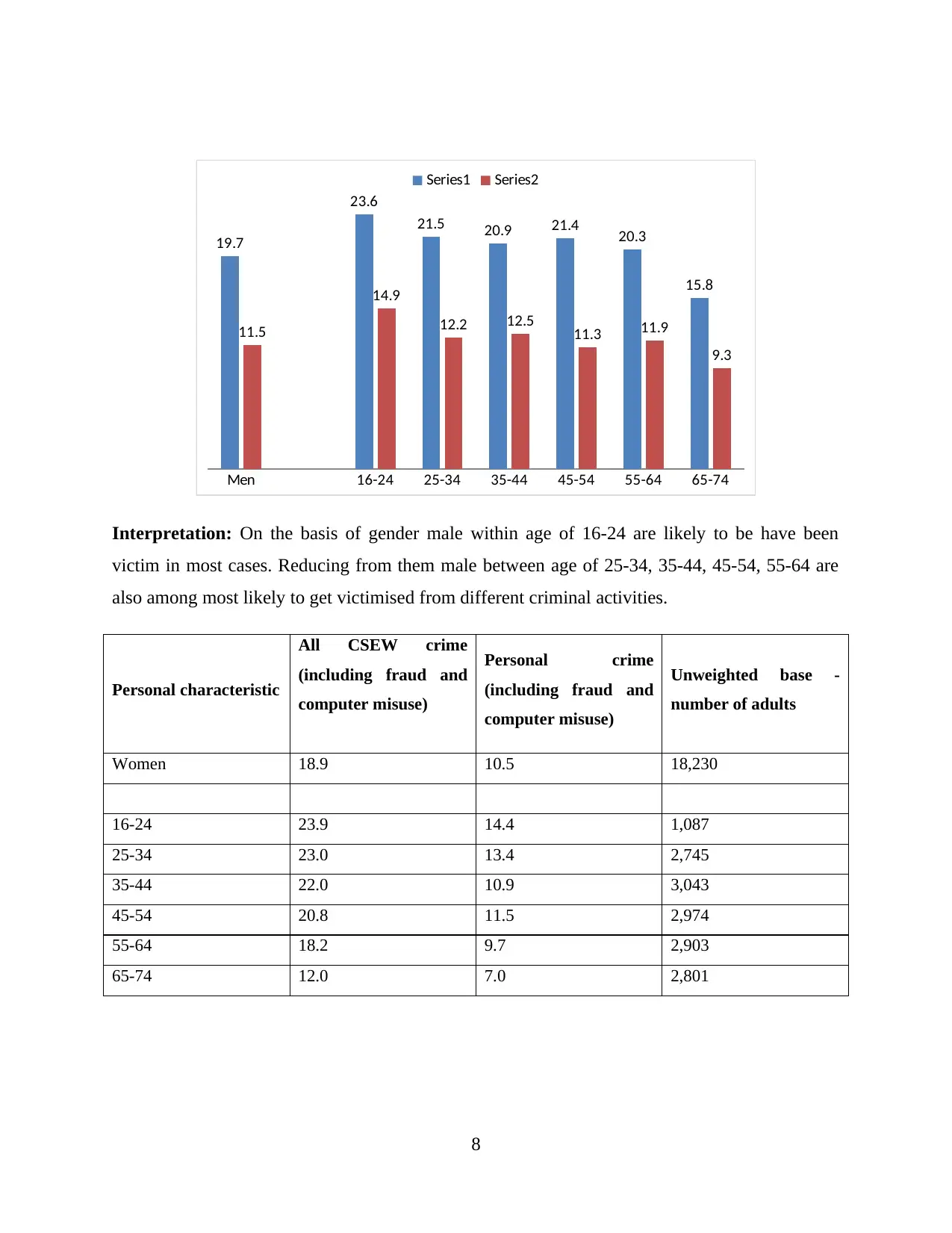
Interpretation: On the basis of gender male within age of 16-24 are likely to be have been
victim in most cases. Reducing from them male between age of 25-34, 35-44, 45-54, 55-64 are
also among most likely to get victimised from different criminal activities.
Personal characteristic
All CSEW crime
(including fraud and
computer misuse)
Personal crime
(including fraud and
computer misuse)
Unweighted base -
number of adults
Women 18.9 10.5 18,230
16-24 23.9 14.4 1,087
25-34 23.0 13.4 2,745
35-44 22.0 10.9 3,043
45-54 20.8 11.5 2,974
55-64 18.2 9.7 2,903
65-74 12.0 7.0 2,801
8
19.7
23.6
21.5 20.9 21.4 20.3
15.8
11.5
14.9
12.2 12.5 11.3 11.9
9.3
Series1 Series2
Interpretation: On the basis of gender male within age of 16-24 are likely to be have been
victim in most cases. Reducing from them male between age of 25-34, 35-44, 45-54, 55-64 are
also among most likely to get victimised from different criminal activities.
Personal characteristic
All CSEW crime
(including fraud and
computer misuse)
Personal crime
(including fraud and
computer misuse)
Unweighted base -
number of adults
Women 18.9 10.5 18,230
16-24 23.9 14.4 1,087
25-34 23.0 13.4 2,745
35-44 22.0 10.9 3,043
45-54 20.8 11.5 2,974
55-64 18.2 9.7 2,903
65-74 12.0 7.0 2,801
8
Women 16-24 25-34 35-44 45-54 55-64 65-74
18.9
23.9 23 22 20.8
18.2
12
10.5
14.4 13.4
10.9 11.5
9.7
7
Series1 Series2
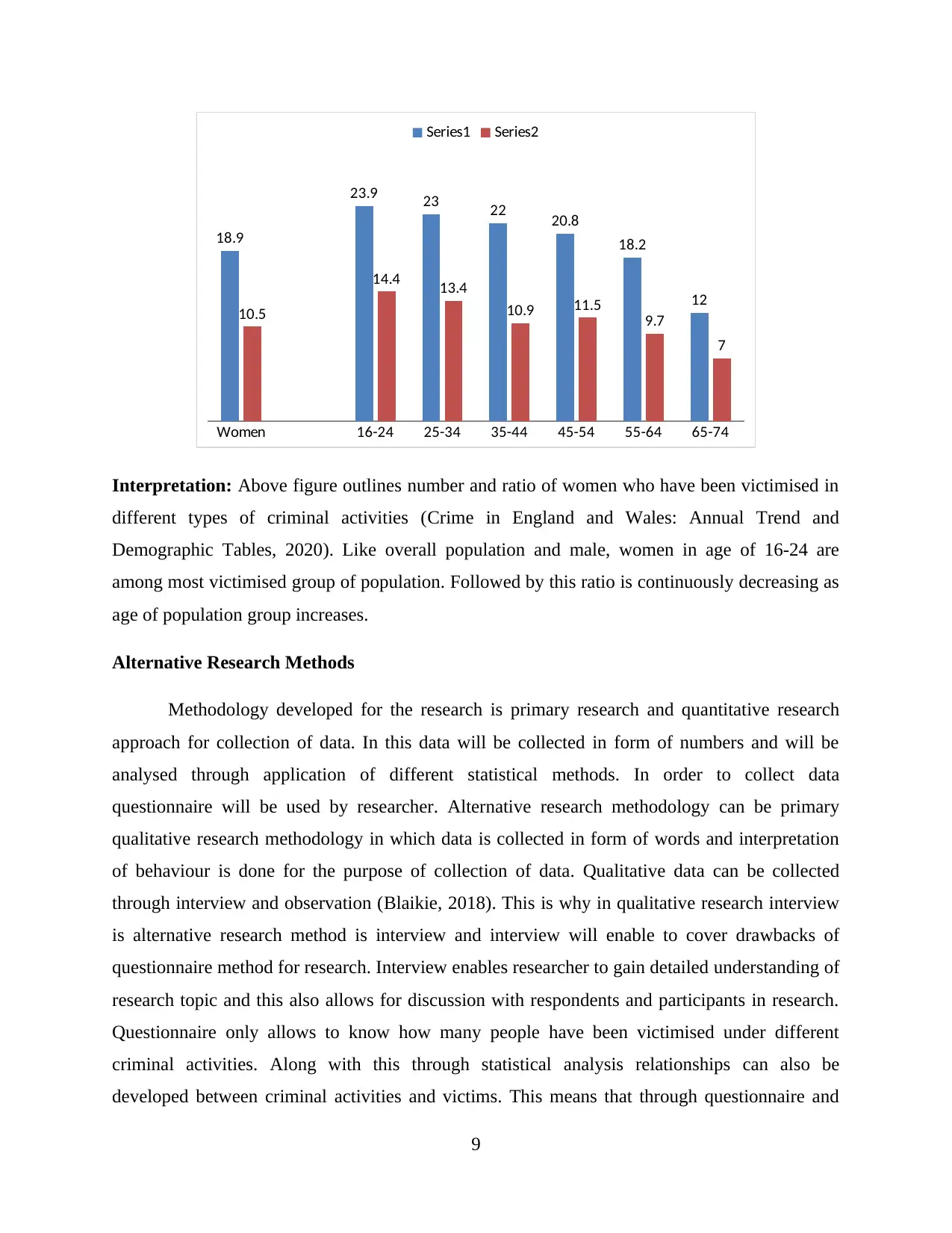
Interpretation: Above figure outlines number and ratio of women who have been victimised in
different types of criminal activities (Crime in England and Wales: Annual Trend and
Demographic Tables, 2020). Like overall population and male, women in age of 16-24 are
among most victimised group of population. Followed by this ratio is continuously decreasing as
age of population group increases.
Alternative Research Methods
Methodology developed for the research is primary research and quantitative research
approach for collection of data. In this data will be collected in form of numbers and will be
analysed through application of different statistical methods. In order to collect data
questionnaire will be used by researcher. Alternative research methodology can be primary
qualitative research methodology in which data is collected in form of words and interpretation
of behaviour is done for the purpose of collection of data. Qualitative data can be collected
through interview and observation (Blaikie, 2018). This is why in qualitative research interview
is alternative research method is interview and interview will enable to cover drawbacks of
questionnaire method for research. Interview enables researcher to gain detailed understanding of
research topic and this also allows for discussion with respondents and participants in research.
Questionnaire only allows to know how many people have been victimised under different
criminal activities. Along with this through statistical analysis relationships can also be
developed between criminal activities and victims. This means that through questionnaire and
9
18.9
23.9 23 22 20.8
18.2
12
10.5
14.4 13.4
10.9 11.5
9.7
7
Series1 Series2
Interpretation: Above figure outlines number and ratio of women who have been victimised in
different types of criminal activities (Crime in England and Wales: Annual Trend and
Demographic Tables, 2020). Like overall population and male, women in age of 16-24 are
among most victimised group of population. Followed by this ratio is continuously decreasing as
age of population group increases.
Alternative Research Methods
Methodology developed for the research is primary research and quantitative research
approach for collection of data. In this data will be collected in form of numbers and will be
analysed through application of different statistical methods. In order to collect data
questionnaire will be used by researcher. Alternative research methodology can be primary
qualitative research methodology in which data is collected in form of words and interpretation
of behaviour is done for the purpose of collection of data. Qualitative data can be collected
through interview and observation (Blaikie, 2018). This is why in qualitative research interview
is alternative research method is interview and interview will enable to cover drawbacks of
questionnaire method for research. Interview enables researcher to gain detailed understanding of
research topic and this also allows for discussion with respondents and participants in research.
Questionnaire only allows to know how many people have been victimised under different
criminal activities. Along with this through statistical analysis relationships can also be
developed between criminal activities and victims. This means that through questionnaire and
9
⊘ This is a preview!⊘
Do you want full access?
Subscribe today to unlock all pages.
Trusted by 1+ million students worldwide
different types of statistical analysis it can be found by researcher that females or male
population of any particular group is being more victimised than others. However, this will not
inform about the reasons and causes of why they are being victimised of different crimes and
criminal events. This is a major drawback that can be covered by qualitative method and
interview (Whitley and Massey, 2018). Interview allows researcher to identity potential reasons
because of which particular group of population experience more victimisation than other
groups. Researcher will be able to gain this information and data through interview in which
researcher can understand perception of different victims regarding reasons because of which
they have been victimised. This means that whether they have been victimised because of
personal reason and hate crime or because of discrimination. Regarding interview from different
clusters 5 individuals can be selected randomly for interview. However, interviews are very
time-consuming and in this researcher also cannot maintain anonymity which is possible in
collecting data through questionnaire. Regarding questionnaire one of the drawback of this is that
in this respondents might avoid responding to questions and in interview because researcher
directly ask them all questions, it becomes less possible and also difficult to avoid answering
question (Kesseba, Awolowo and Clark, 2018). This is the reason that interview can be an
alternative method for collection of data in primary research and this is also suitable when
research being carried out is qualitative approach of research. However, interviews are time
consuming and participants involved in this are also limited. This is the reason that to undertake
research about crime in England and Wales questionnaire is most appropriate method because
this allows for collecting data from large population which enables more valid and reliable data.
10
population of any particular group is being more victimised than others. However, this will not
inform about the reasons and causes of why they are being victimised of different crimes and
criminal events. This is a major drawback that can be covered by qualitative method and
interview (Whitley and Massey, 2018). Interview allows researcher to identity potential reasons
because of which particular group of population experience more victimisation than other
groups. Researcher will be able to gain this information and data through interview in which
researcher can understand perception of different victims regarding reasons because of which
they have been victimised. This means that whether they have been victimised because of
personal reason and hate crime or because of discrimination. Regarding interview from different
clusters 5 individuals can be selected randomly for interview. However, interviews are very
time-consuming and in this researcher also cannot maintain anonymity which is possible in
collecting data through questionnaire. Regarding questionnaire one of the drawback of this is that
in this respondents might avoid responding to questions and in interview because researcher
directly ask them all questions, it becomes less possible and also difficult to avoid answering
question (Kesseba, Awolowo and Clark, 2018). This is the reason that interview can be an
alternative method for collection of data in primary research and this is also suitable when
research being carried out is qualitative approach of research. However, interviews are time
consuming and participants involved in this are also limited. This is the reason that to undertake
research about crime in England and Wales questionnaire is most appropriate method because
this allows for collecting data from large population which enables more valid and reliable data.
10
Paraphrase This Document
Need a fresh take? Get an instant paraphrase of this document with our AI Paraphraser
REFERENCES
Books and Journals
Ball-Damerow, J.E and et.al., 2019. Research applications of primary biodiversity databases in
the digital age. PloS one. 14(9). p.e0215794.
Grant, T and et.al., 2017. Quantitative research methods for linguists: A questions and answers
approach for students. Taylor & Francis.
Humm, J.M and et.al., 2017. Spatially explicit population estimates for black bears based on
cluster sampling. The Journal of Wildlife Management. 81(7). pp.1187-1201.
Casati, N and et.al., 2017. Exploring charge density analysis in crystals at high pressure: data
collection, data analysis and advanced modelling. Acta Crystallographica Section B:
Structural Science, Crystal Engineering and Materials. 73(4). pp.584-597.
Thomas, D.R and et.al., 2017, November. Ethical issues in research using datasets of illicit
origin. In Proceedings of the 2017 Internet Measurement Conference (pp. 445-462).
Adams, N and et.al., 2017. Guidance and ethical considerations for undertaking transgender
health research and institutional review boards adjudicating this research. Transgender
health. 2(1). pp.165-175.
Brown, P., 2018. Ethical challenges to research in the criminal justice system.
Blaikie, N., 2018. Confounding issues related to determining sample size in qualitative
research. International Journal of Social Research Methodology. 21(5). pp.635-641.
Whitley, M.A. and Massey, W.V., 2018. Navigating tensions in qualitative research:
methodology, geography, personality and beyond. Qualitative Research in Sport,
Exercise and Health. 10(5). pp.543-554.
Kesseba, K., Awolowo, I. and Clark, M., 2018. Qualitative research methodology: a neo-
empiricist perspective. Driving productivity in uncertain and challenging times.
Online
Crime in England and Wales: Annual Trend and Demographic Tables. 2020. [Online]. Available
Through: <https://www.ons.gov.uk/peoplepopulationandcommunity/crimeandjustice/
datasets/crimeinenglandandwalesannualtrendanddemographictables>.
Crime in England and Wales: year ending March 2020. 2020. [Online]. Available Through:
<https://www.ons.gov.uk/peoplepopulationandcommunity/crimeandjustice/bulletins/
crimeinenglandandwales/yearendingmarch2020>.
Crime in England and Wales: year ending September 2020. 2020. [Online]. Available Through:
<https://www.ons.gov.uk/peoplepopulationandcommunity/crimeandjustice/bulletins/
11
Books and Journals
Ball-Damerow, J.E and et.al., 2019. Research applications of primary biodiversity databases in
the digital age. PloS one. 14(9). p.e0215794.
Grant, T and et.al., 2017. Quantitative research methods for linguists: A questions and answers
approach for students. Taylor & Francis.
Humm, J.M and et.al., 2017. Spatially explicit population estimates for black bears based on
cluster sampling. The Journal of Wildlife Management. 81(7). pp.1187-1201.
Casati, N and et.al., 2017. Exploring charge density analysis in crystals at high pressure: data
collection, data analysis and advanced modelling. Acta Crystallographica Section B:
Structural Science, Crystal Engineering and Materials. 73(4). pp.584-597.
Thomas, D.R and et.al., 2017, November. Ethical issues in research using datasets of illicit
origin. In Proceedings of the 2017 Internet Measurement Conference (pp. 445-462).
Adams, N and et.al., 2017. Guidance and ethical considerations for undertaking transgender
health research and institutional review boards adjudicating this research. Transgender
health. 2(1). pp.165-175.
Brown, P., 2018. Ethical challenges to research in the criminal justice system.
Blaikie, N., 2018. Confounding issues related to determining sample size in qualitative
research. International Journal of Social Research Methodology. 21(5). pp.635-641.
Whitley, M.A. and Massey, W.V., 2018. Navigating tensions in qualitative research:
methodology, geography, personality and beyond. Qualitative Research in Sport,
Exercise and Health. 10(5). pp.543-554.
Kesseba, K., Awolowo, I. and Clark, M., 2018. Qualitative research methodology: a neo-
empiricist perspective. Driving productivity in uncertain and challenging times.
Online
Crime in England and Wales: Annual Trend and Demographic Tables. 2020. [Online]. Available
Through: <https://www.ons.gov.uk/peoplepopulationandcommunity/crimeandjustice/
datasets/crimeinenglandandwalesannualtrendanddemographictables>.
Crime in England and Wales: year ending March 2020. 2020. [Online]. Available Through:
<https://www.ons.gov.uk/peoplepopulationandcommunity/crimeandjustice/bulletins/
crimeinenglandandwales/yearendingmarch2020>.
Crime in England and Wales: year ending September 2020. 2020. [Online]. Available Through:
<https://www.ons.gov.uk/peoplepopulationandcommunity/crimeandjustice/bulletins/
11

crimeinenglandandwales/yearendingseptember2020#:~:text=The%20police
%20recorded%205.7%20million,decrease%20from%20the%20previous%20year>.
Crime recording: A matter of fact. 2021. [Online]. Available Through:
<https://www.ons.gov.uk/peoplepopulationandcommunity/crimeandjustice/
methodologies/crimeinenglandandwalesqmi>.
12
%20recorded%205.7%20million,decrease%20from%20the%20previous%20year>.
Crime recording: A matter of fact. 2021. [Online]. Available Through:
<https://www.ons.gov.uk/peoplepopulationandcommunity/crimeandjustice/
methodologies/crimeinenglandandwalesqmi>.
12
⊘ This is a preview!⊘
Do you want full access?
Subscribe today to unlock all pages.
Trusted by 1+ million students worldwide

1 out of 12


Related Documents


Your All-in-One AI-Powered Toolkit for Academic Success.
+13062052269
info@desklib.com
Available 24*7 on WhatsApp / Email
![[object Object]](/_next/static/media/star-bottom.7253800d.svg)
Unlock your academic potential
Copyright © 2020–2026 A2Z Services. All Rights Reserved. Developed and managed by ZUCOL.