Criminology Week 3: Crime Triangle, Neutralization & Prevention

Verified

Added on  2023/04/23

|5
|1078
|378
Discussion Board Post
AI Summary
This criminology discussion explores the application of the crime triangle and neutralization theory in a practical scenario involving an underground parking garage. The analysis focuses on using the crime triangle's elements of desire (offenders), target (shoppers), and opportunity (interaction and motivation) to implement preventive measures. It also delves into the neutralization theory, examining potential causes of criminal activities such as depression and employing techniques like denial of responsibility and injury to understand offender behavior. The discussion identifies opportunities for intervention, including using social and psychological skills to deter offenders. Furthermore, it considers the biological and psychological insights into offender personality, suggesting the involvement of health professionals to reshape offenders' mindsets towards actions that benefit society rather than cause harm. The goal is to prevent crime, protect shoppers and guardians, and ultimately catch offenders through a combination of immediate and long-term strategies.

Document Page
1Criminology Week 3 Discussion
Running head: CRIMINOLOGY WEEK 3 DISCUSSION
Criminology Week 3 Discussion
Author’s Name
Institution
Instructor’s Name
Course
tabler-icon-diamond-filled.svg

Paraphrase This Document

Need a fresh take? Get an instant paraphrase of this document with our AI Paraphraser
Document Page
2Criminology Week 3 Discussion
Criminology Week 3 Discussion
Applying the Crime Triangle
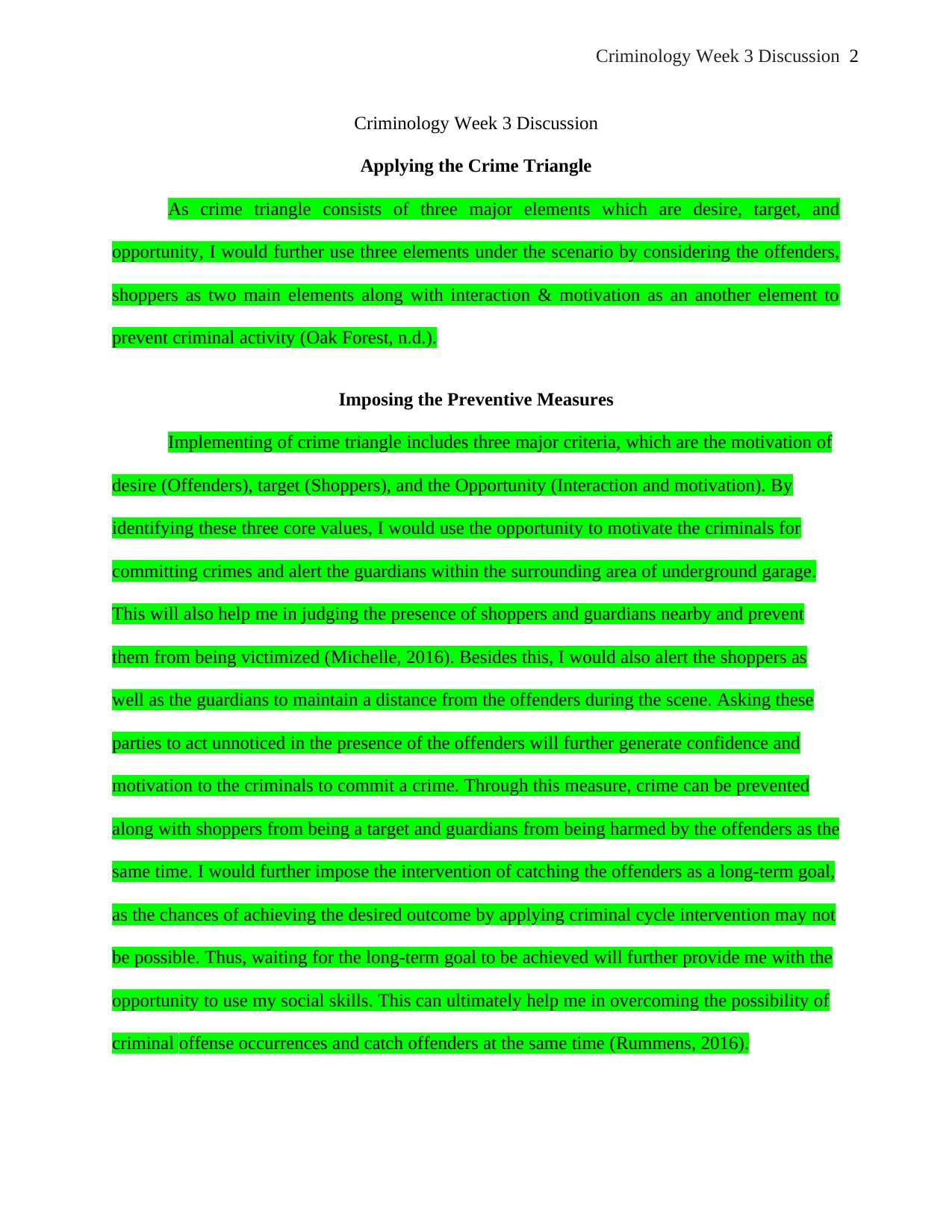
As crime triangle consists of three major elements which are desire, target, and
opportunity, I would further use three elements under the scenario by considering the offenders,
shoppers as two main elements along with interaction & motivation as an another element to
prevent criminal activity (Oak Forest, n.d.).
Imposing the Preventive Measures
Implementing of crime triangle includes three major criteria, which are the motivation of
desire (Offenders), target (Shoppers), and the Opportunity (Interaction and motivation). By
identifying these three core values, I would use the opportunity to motivate the criminals for
committing crimes and alert the guardians within the surrounding area of underground garage.
This will also help me in judging the presence of shoppers and guardians nearby and prevent
them from being victimized (Michelle, 2016). Besides this, I would also alert the shoppers as
well as the guardians to maintain a distance from the offenders during the scene. Asking these
parties to act unnoticed in the presence of the offenders will further generate confidence and
motivation to the criminals to commit a crime. Through this measure, crime can be prevented
along with shoppers from being a target and guardians from being harmed by the offenders as the
same time. I would further impose the intervention of catching the offenders as a long-term goal,
as the chances of achieving the desired outcome by applying criminal cycle intervention may not
be possible. Thus, waiting for the long-term goal to be achieved will further provide me with the
opportunity to use my social skills. This can ultimately help me in overcoming the possibility of
criminal offense occurrences and catch offenders at the same time (Rummens, 2016).
Document Page
3Criminology Week 3 Discussion
Use of Neutralization Theory
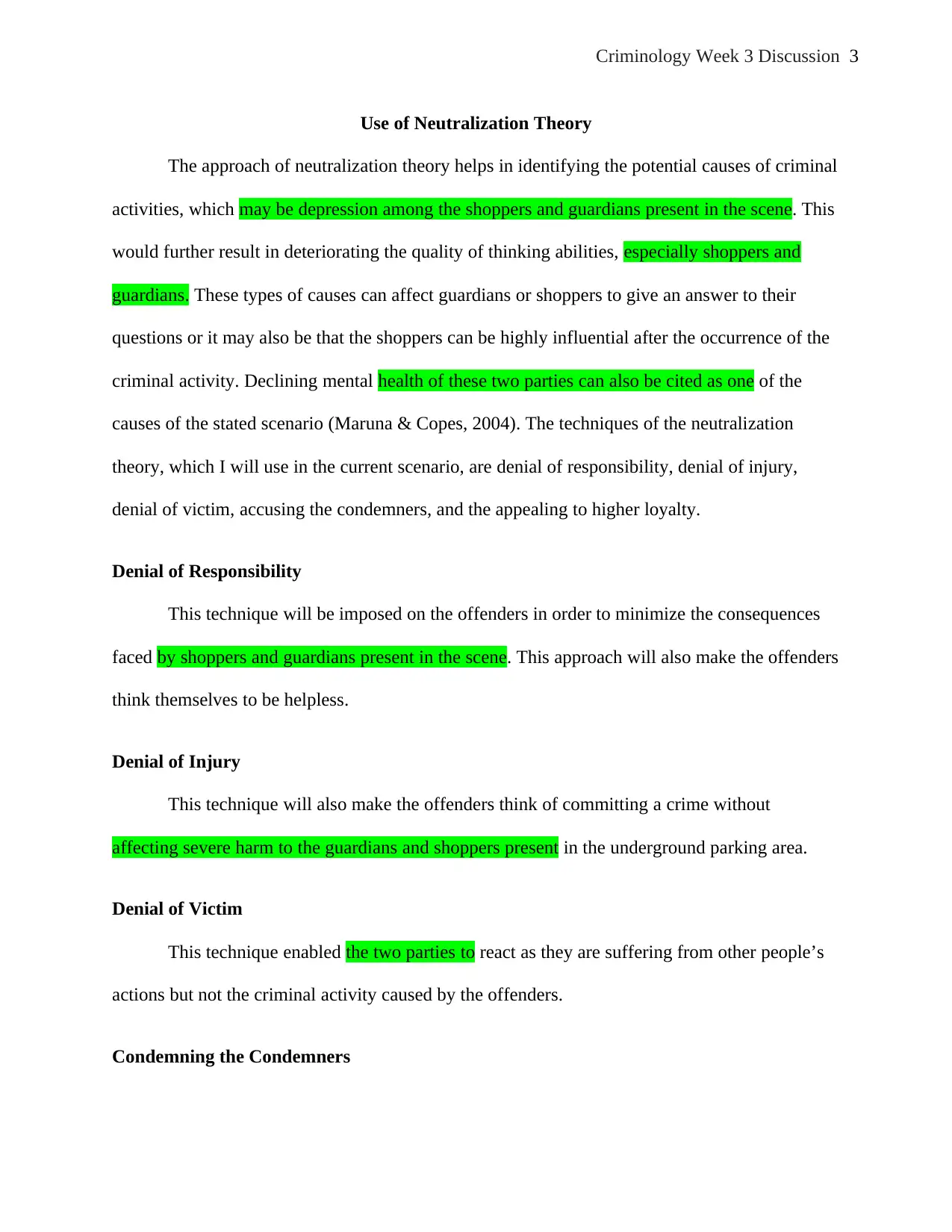
The approach of neutralization theory helps in identifying the potential causes of criminal
activities, which may be depression among the shoppers and guardians present in the scene. This
would further result in deteriorating the quality of thinking abilities, especially shoppers and
guardians. These types of causes can affect guardians or shoppers to give an answer to their
questions or it may also be that the shoppers can be highly influential after the occurrence of the
criminal activity. Declining mental health of these two parties can also be cited as one of the
causes of the stated scenario (Maruna & Copes, 2004). The techniques of the neutralization
theory, which I will use in the current scenario, are denial of responsibility, denial of injury,
denial of victim, accusing the condemners, and the appealing to higher loyalty.
Denial of Responsibility
This technique will be imposed on the offenders in order to minimize the consequences
faced by shoppers and guardians present in the scene. This approach will also make the offenders
think themselves to be helpless.
Denial of Injury
This technique will also make the offenders think of committing a crime without
affecting severe harm to the guardians and shoppers present in the underground parking area.
Denial of Victim
This technique enabled the two parties to react as they are suffering from other people’s
actions but not the criminal activity caused by the offenders.
Condemning the Condemners
Document Page
4Criminology Week 3 Discussion
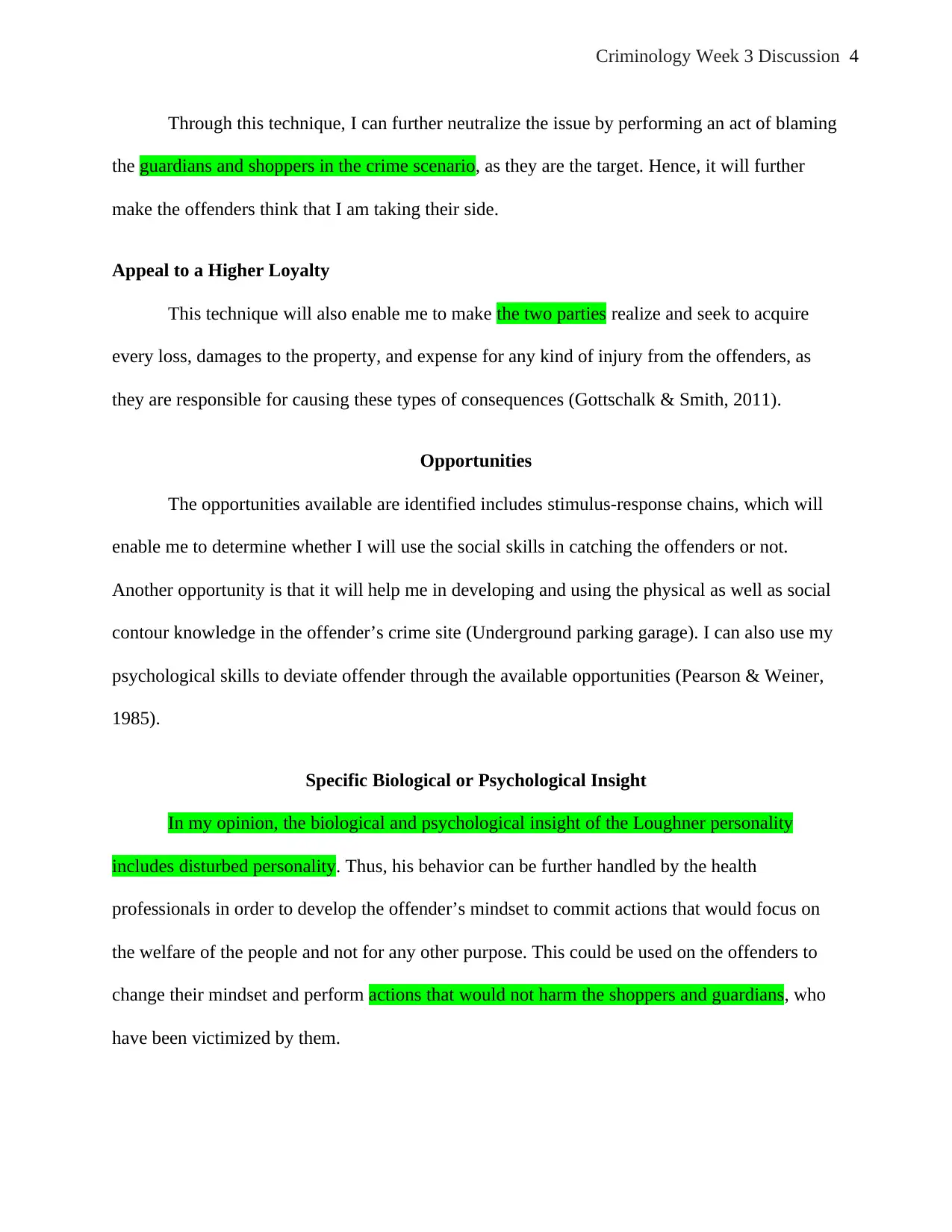
Through this technique, I can further neutralize the issue by performing an act of blaming
the guardians and shoppers in the crime scenario, as they are the target. Hence, it will further
make the offenders think that I am taking their side.
Appeal to a Higher Loyalty
This technique will also enable me to make the two parties realize and seek to acquire
every loss, damages to the property, and expense for any kind of injury from the offenders, as
they are responsible for causing these types of consequences (Gottschalk & Smith, 2011).
Opportunities
The opportunities available are identified includes stimulus-response chains, which will
enable me to determine whether I will use the social skills in catching the offenders or not.
Another opportunity is that it will help me in developing and using the physical as well as social
contour knowledge in the offender’s crime site (Underground parking garage). I can also use my
psychological skills to deviate offender through the available opportunities (Pearson & Weiner,
1985).
Specific Biological or Psychological Insight
In my opinion, the biological and psychological insight of the Loughner personality
includes disturbed personality. Thus, his behavior can be further handled by the health
professionals in order to develop the offender’s mindset to commit actions that would focus on
the welfare of the people and not for any other purpose. This could be used on the offenders to
change their mindset and perform actions that would not harm the shoppers and guardians, who
have been victimized by them.
tabler-icon-diamond-filled.svg

Paraphrase This Document

Need a fresh take? Get an instant paraphrase of this document with our AI Paraphraser
Document Page
5Criminology Week 3 Discussion
References
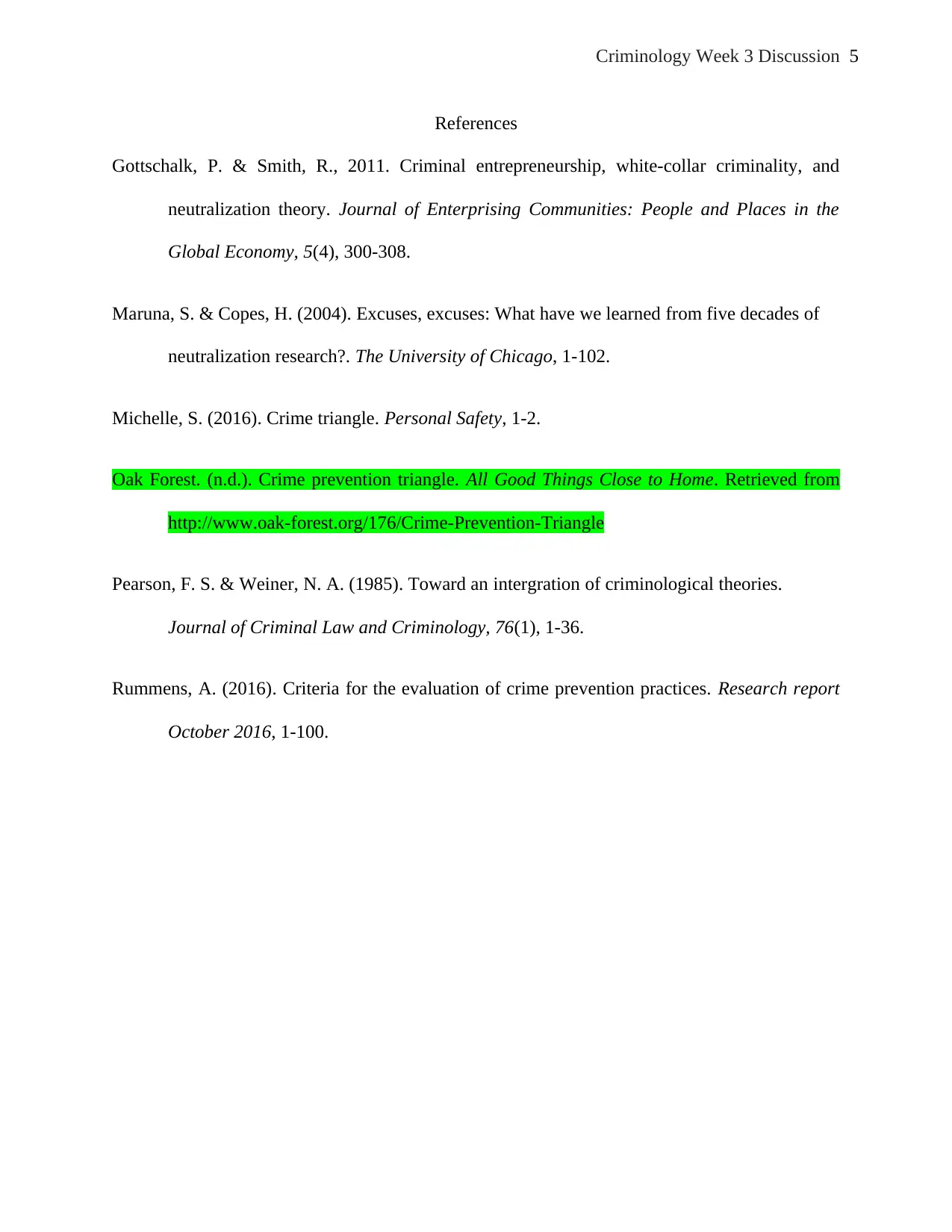
Gottschalk, P. & Smith, R., 2011. Criminal entrepreneurship, white-collar criminality, and
neutralization theory. Journal of Enterprising Communities: People and Places in the
Global Economy, 5(4), 300-308.
Maruna, S. & Copes, H. (2004). Excuses, excuses: What have we learned from five decades of
neutralization research?. The University of Chicago, 1-102.
Michelle, S. (2016). Crime triangle. Personal Safety, 1-2.
Oak Forest. (n.d.). Crime prevention triangle. All Good Things Close to Home. Retrieved from
http://www.oak-forest.org/176/Crime-Prevention-Triangle
Pearson, F. S. & Weiner, N. A. (1985). Toward an intergration of criminological theories.
Journal of Criminal Law and Criminology, 76(1), 1-36.
Rummens, A. (2016). Criteria for the evaluation of crime prevention practices. Research report
October 2016, 1-100.
chevron_up_icon
1 out of 5
circle_padding
hide_on_mobile
zoom_out_icon
[object Object]