CJ-230 Module 2 Journal: Integrity, Authority, Discretion Analysis

Verified

Added on  2022/08/20

|4
|691
|13
Journal and Reflective Writing
AI Summary
This journal entry analyzes the roles of integrity, authority, and discretionary power within the criminal justice system, contrasting their application in cases involving adult and juvenile defendants. The assignment begins by defining and comparing these key concepts, highlighting their similarities and differences. It then explores how integrity, authority, and discretionary power function in the context of adult defendants, emphasizing the importance of integrity in ensuring a fair and transparent legal process. The discussion then shifts to juvenile defendants, examining how these principles are adapted within the juvenile justice system, considering the unique challenges posed by the mental immaturity of juvenile offenders. The analysis references relevant legal precedents and scholarly sources to support the arguments. The journal also highlights the changes in how these concepts are applied when dealing with juveniles versus adults, emphasizing that the juvenile justice system should consider the developmental stage of the defendant. The overall aim is to provide a comprehensive understanding of the ethical and practical considerations that shape the administration of justice for both adult and juvenile offenders.
Document Page
Running head: CRIMINAL JUSTICE 1
Criminal Justice
Student Name
Institutional Affiliation
tabler-icon-diamond-filled.svg

Paraphrase This Document

Need a fresh take? Get an instant paraphrase of this document with our AI Paraphraser
Document Page
CRIMINAL JUSTICE 2
Criminal Justice
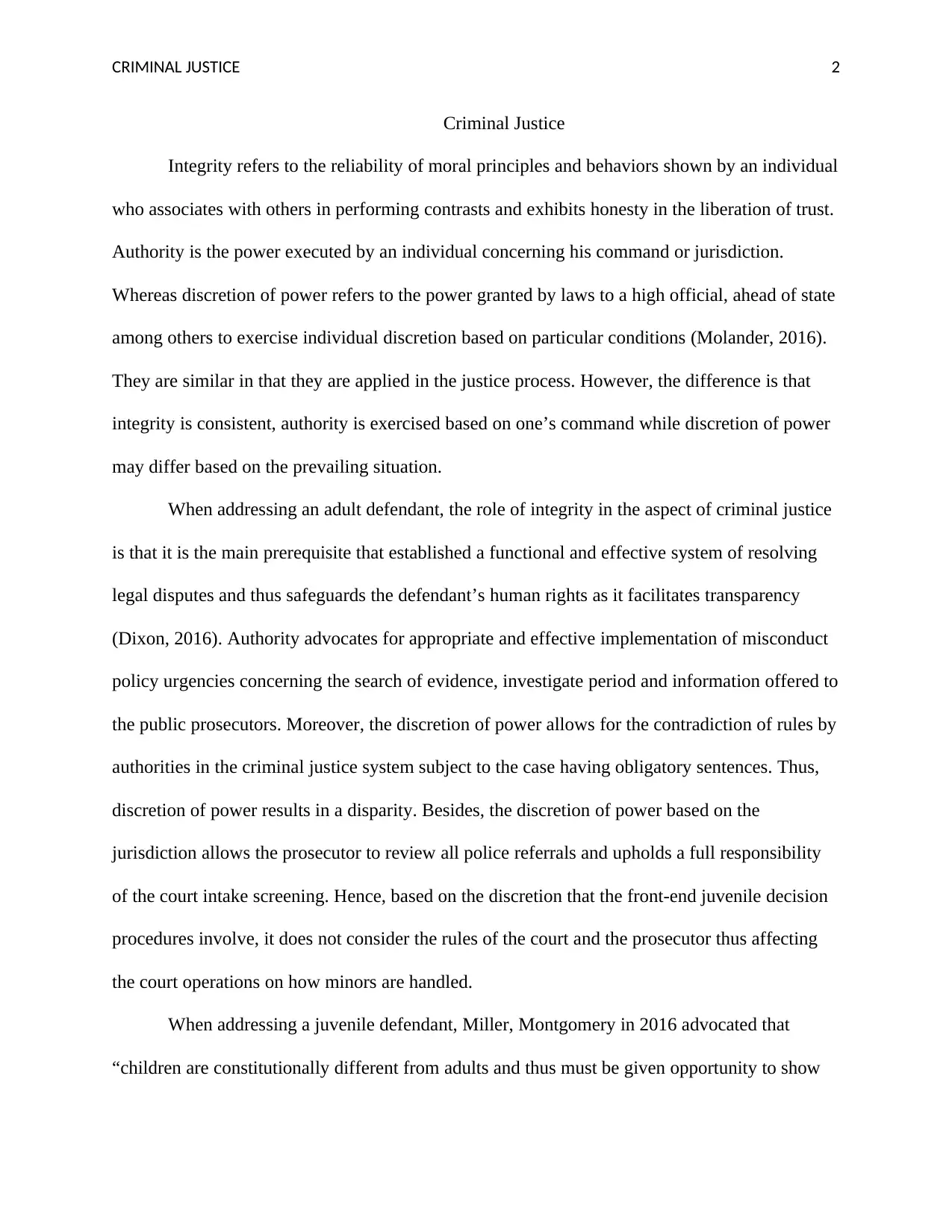
Integrity refers to the reliability of moral principles and behaviors shown by an individual
who associates with others in performing contrasts and exhibits honesty in the liberation of trust.
Authority is the power executed by an individual concerning his command or jurisdiction.
Whereas discretion of power refers to the power granted by laws to a high official, ahead of state
among others to exercise individual discretion based on particular conditions (Molander, 2016).
They are similar in that they are applied in the justice process. However, the difference is that
integrity is consistent, authority is exercised based on one’s command while discretion of power
may differ based on the prevailing situation.
When addressing an adult defendant, the role of integrity in the aspect of criminal justice
is that it is the main prerequisite that established a functional and effective system of resolving
legal disputes and thus safeguards the defendant’s human rights as it facilitates transparency
(Dixon, 2016). Authority advocates for appropriate and effective implementation of misconduct
policy urgencies concerning the search of evidence, investigate period and information offered to
the public prosecutors. Moreover, the discretion of power allows for the contradiction of rules by
authorities in the criminal justice system subject to the case having obligatory sentences. Thus,
discretion of power results in a disparity. Besides, the discretion of power based on the
jurisdiction allows the prosecutor to review all police referrals and upholds a full responsibility
of the court intake screening. Hence, based on the discretion that the front-end juvenile decision
procedures involve, it does not consider the rules of the court and the prosecutor thus affecting
the court operations on how minors are handled.
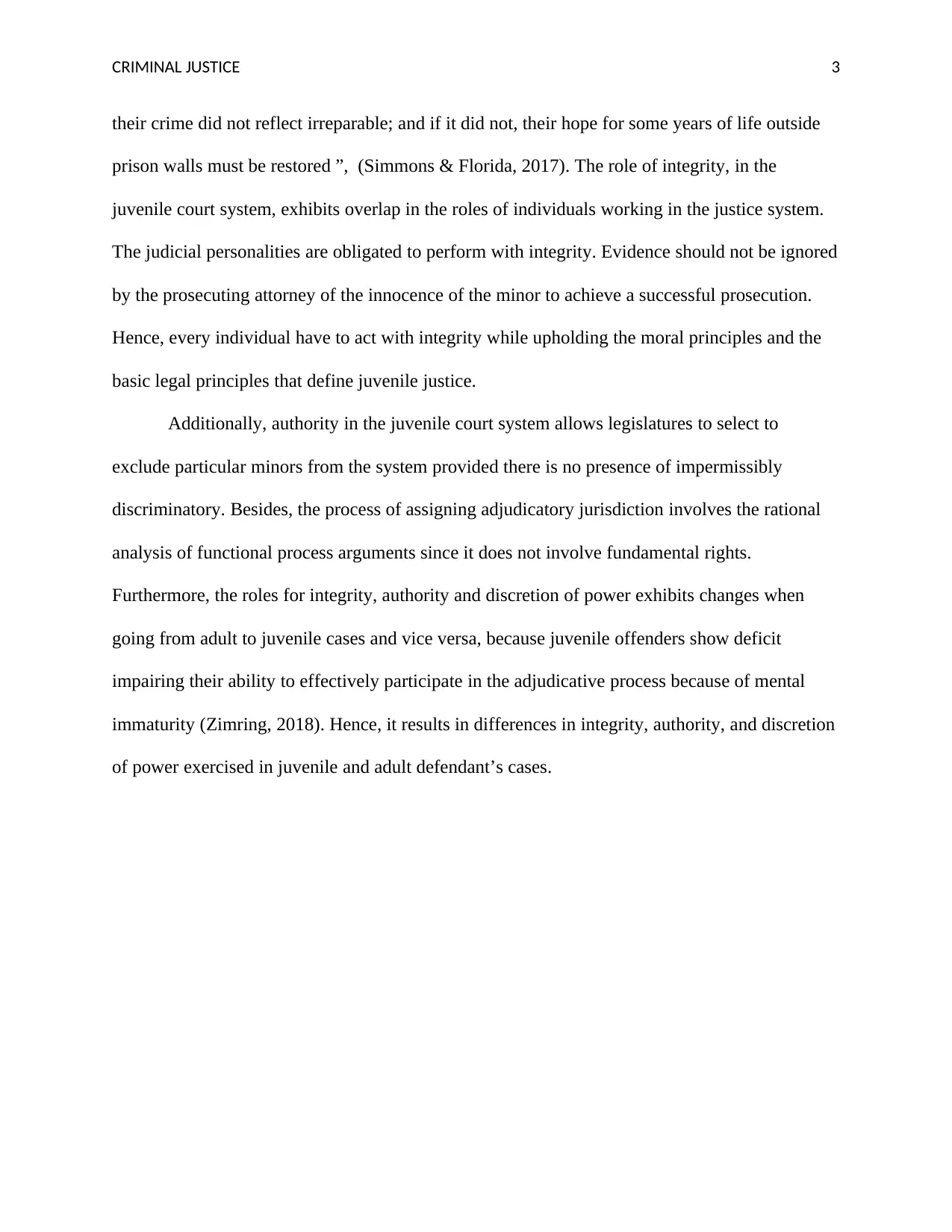
When addressing a juvenile defendant, Miller, Montgomery in 2016 advocated that
“children are constitutionally different from adults and thus must be given opportunity to show
Document Page
CRIMINAL JUSTICE 3
their crime did not reflect irreparable; and if it did not, their hope for some years of life outside
prison walls must be restored ”, (Simmons & Florida, 2017). The role of integrity, in the
juvenile court system, exhibits overlap in the roles of individuals working in the justice system.
The judicial personalities are obligated to perform with integrity. Evidence should not be ignored
by the prosecuting attorney of the innocence of the minor to achieve a successful prosecution.
Hence, every individual have to act with integrity while upholding the moral principles and the
basic legal principles that define juvenile justice.
Additionally, authority in the juvenile court system allows legislatures to select to
exclude particular minors from the system provided there is no presence of impermissibly
discriminatory. Besides, the process of assigning adjudicatory jurisdiction involves the rational
analysis of functional process arguments since it does not involve fundamental rights.
Furthermore, the roles for integrity, authority and discretion of power exhibits changes when
going from adult to juvenile cases and vice versa, because juvenile offenders show deficit
impairing their ability to effectively participate in the adjudicative process because of mental
immaturity (Zimring, 2018). Hence, it results in differences in integrity, authority, and discretion
of power exercised in juvenile and adult defendant’s cases.
Document Page
CRIMINAL JUSTICE 4
References
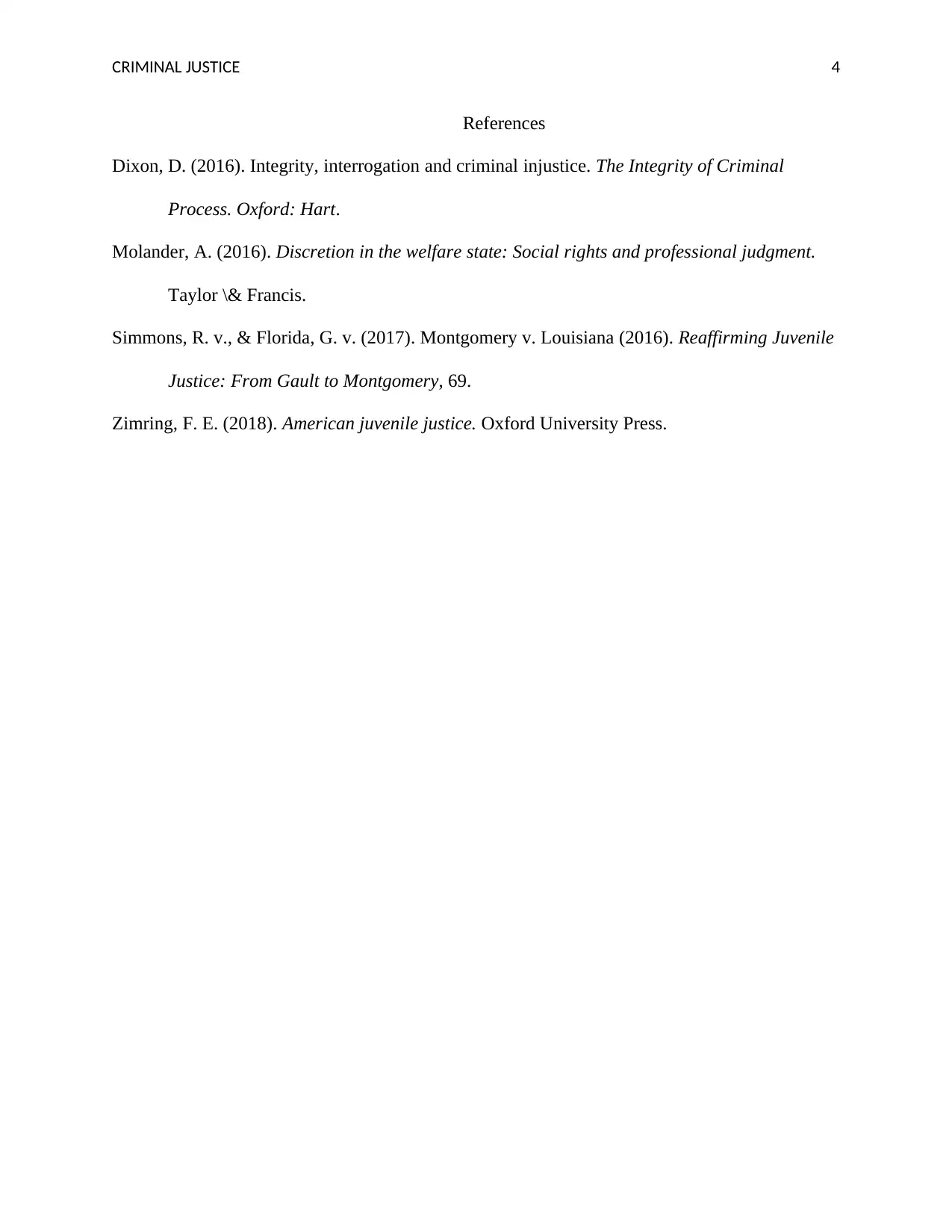
Dixon, D. (2016). Integrity, interrogation and criminal injustice. The Integrity of Criminal
Process. Oxford: Hart.
Molander, A. (2016). Discretion in the welfare state: Social rights and professional judgment.
Taylor \& Francis.
Simmons, R. v., & Florida, G. v. (2017). Montgomery v. Louisiana (2016). Reaffirming Juvenile
Justice: From Gault to Montgomery, 69.
Zimring, F. E. (2018). American juvenile justice. Oxford University Press.
chevron_up_icon
1 out of 4
circle_padding
hide_on_mobile
zoom_out_icon
[object Object]