Criminal Law Assignment: Ignorance and Mistake in Criminal Law Context

Verified

Added on  2022/12/28

|4
|1224
|23
Essay
AI Summary
This essay delves into the intricacies of ignorance and mistake within the framework of South African criminal law. It critically examines the maxim 'ignorantia legis neminem excusat,' exploring its implications for fairness and justice. The essay analyzes the distinction between mistake and ignorance, and investigates the mens rea concept and its relevance in determining criminal liability. It explores the principle's application in cases like Coetzee v Steenkamp and S v De Blom, evaluating whether the principle adopted in De Blom unjustifiably favors the wrongdoer. The essay concludes by analyzing the extent to which a mistake of law should be considered a valid ground for negating mens rea and its impact on the criminal justice system. The essay is well-structured and supported by relevant legal sources, including case law and academic literature. The essay adheres to the specified formatting guidelines of Times New Roman, 12-point font, 1.15 line spacing, and the specified margins. The assignment is properly referenced in accordance with the South African Law Journal (SALJ) or the South African Journal on Human Rights (SAJHR) house-style.
Document Page
Running Head: CRIMINAL LAW 0
TOPIC ON IGNORANCE AND MISTAKE IN CRIMINAL LAW
South Africa
tabler-icon-diamond-filled.svg

Paraphrase This Document

Need a fresh take? Get an instant paraphrase of this document with our AI Paraphraser
Document Page
CRIMINAL LAW 1
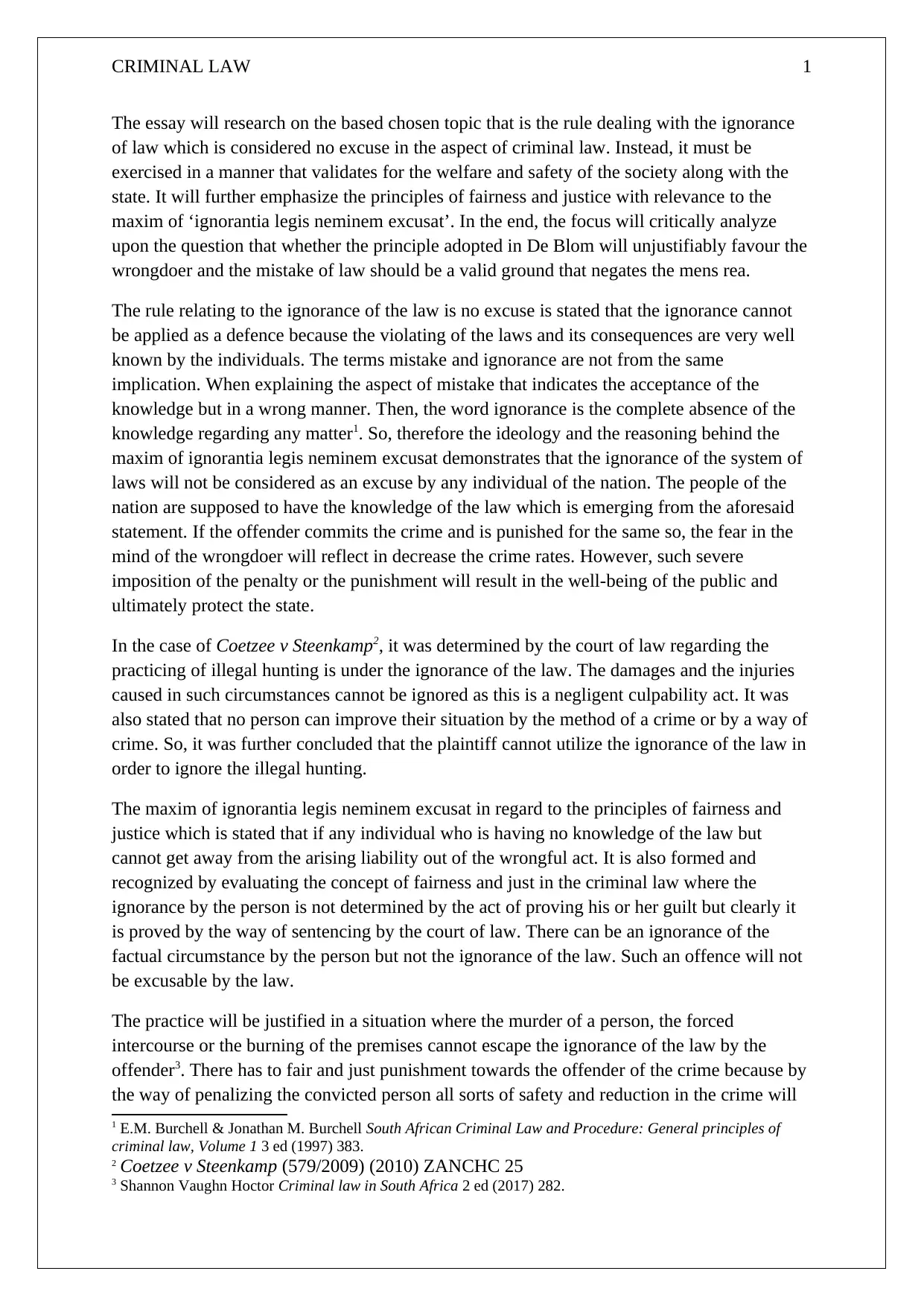
The essay will research on the based chosen topic that is the rule dealing with the ignorance
of law which is considered no excuse in the aspect of criminal law. Instead, it must be
exercised in a manner that validates for the welfare and safety of the society along with the
state. It will further emphasize the principles of fairness and justice with relevance to the
maxim of ‘ignorantia legis neminem excusat’. In the end, the focus will critically analyze
upon the question that whether the principle adopted in De Blom will unjustifiably favour the
wrongdoer and the mistake of law should be a valid ground that negates the mens rea.
The rule relating to the ignorance of the law is no excuse is stated that the ignorance cannot
be applied as a defence because the violating of the laws and its consequences are very well
known by the individuals. The terms mistake and ignorance are not from the same
implication. When explaining the aspect of mistake that indicates the acceptance of the
knowledge but in a wrong manner. Then, the word ignorance is the complete absence of the
knowledge regarding any matter1. So, therefore the ideology and the reasoning behind the
maxim of ignorantia legis neminem excusat demonstrates that the ignorance of the system of
laws will not be considered as an excuse by any individual of the nation. The people of the
nation are supposed to have the knowledge of the law which is emerging from the aforesaid
statement. If the offender commits the crime and is punished for the same so, the fear in the
mind of the wrongdoer will reflect in decrease the crime rates. However, such severe
imposition of the penalty or the punishment will result in the well-being of the public and
ultimately protect the state.
In the case of Coetzee v Steenkamp2, it was determined by the court of law regarding the
practicing of illegal hunting is under the ignorance of the law. The damages and the injuries
caused in such circumstances cannot be ignored as this is a negligent culpability act. It was
also stated that no person can improve their situation by the method of a crime or by a way of
crime. So, it was further concluded that the plaintiff cannot utilize the ignorance of the law in
order to ignore the illegal hunting.
The maxim of ignorantia legis neminem excusat in regard to the principles of fairness and
justice which is stated that if any individual who is having no knowledge of the law but
cannot get away from the arising liability out of the wrongful act. It is also formed and
recognized by evaluating the concept of fairness and just in the criminal law where the
ignorance by the person is not determined by the act of proving his or her guilt but clearly it
is proved by the way of sentencing by the court of law. There can be an ignorance of the
factual circumstance by the person but not the ignorance of the law. Such an offence will not
be excusable by the law.
The practice will be justified in a situation where the murder of a person, the forced
intercourse or the burning of the premises cannot escape the ignorance of the law by the
offender3. There has to fair and just punishment towards the offender of the crime because by
the way of penalizing the convicted person all sorts of safety and reduction in the crime will
1 E.M. Burchell & Jonathan M. Burchell South African Criminal Law and Procedure: General principles of
criminal law, Volume 1 3 ed (1997) 383.
2 Coetzee v Steenkamp (579/2009) (2010) ZANCHC 25
3 Shannon Vaughn Hoctor Criminal law in South Africa 2 ed (2017) 282.
Document Page
CRIMINAL LAW 2
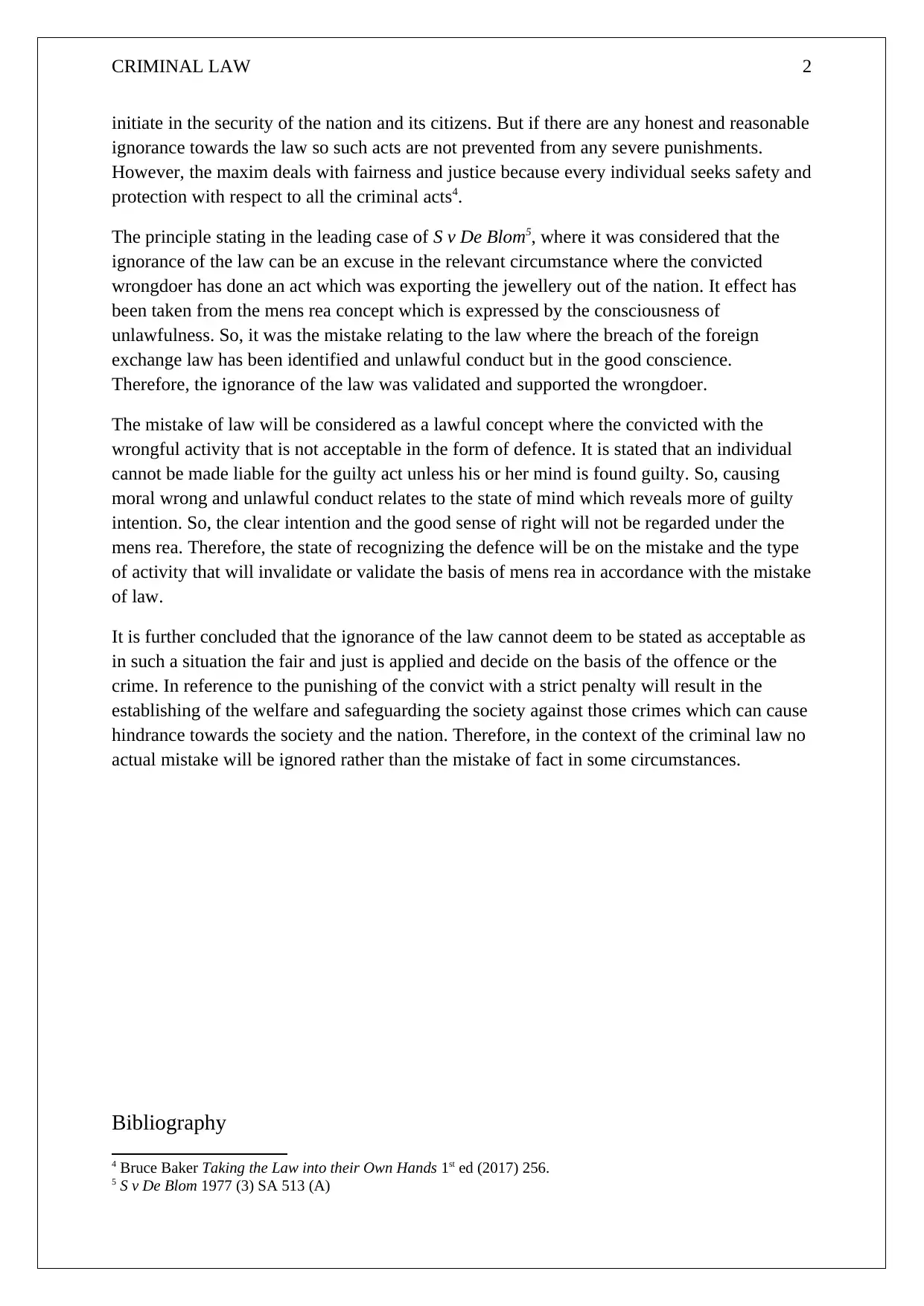
initiate in the security of the nation and its citizens. But if there are any honest and reasonable
ignorance towards the law so such acts are not prevented from any severe punishments.
However, the maxim deals with fairness and justice because every individual seeks safety and
protection with respect to all the criminal acts4.
The principle stating in the leading case of S v De Blom5, where it was considered that the
ignorance of the law can be an excuse in the relevant circumstance where the convicted
wrongdoer has done an act which was exporting the jewellery out of the nation. It effect has
been taken from the mens rea concept which is expressed by the consciousness of
unlawfulness. So, it was the mistake relating to the law where the breach of the foreign
exchange law has been identified and unlawful conduct but in the good conscience.
Therefore, the ignorance of the law was validated and supported the wrongdoer.
The mistake of law will be considered as a lawful concept where the convicted with the
wrongful activity that is not acceptable in the form of defence. It is stated that an individual
cannot be made liable for the guilty act unless his or her mind is found guilty. So, causing
moral wrong and unlawful conduct relates to the state of mind which reveals more of guilty
intention. So, the clear intention and the good sense of right will not be regarded under the
mens rea. Therefore, the state of recognizing the defence will be on the mistake and the type
of activity that will invalidate or validate the basis of mens rea in accordance with the mistake
of law.
It is further concluded that the ignorance of the law cannot deem to be stated as acceptable as
in such a situation the fair and just is applied and decide on the basis of the offence or the
crime. In reference to the punishing of the convict with a strict penalty will result in the
establishing of the welfare and safeguarding the society against those crimes which can cause
hindrance towards the society and the nation. Therefore, in the context of the criminal law no
actual mistake will be ignored rather than the mistake of fact in some circumstances.
Bibliography
4 Bruce Baker Taking the Law into their Own Hands 1st ed (2017) 256.
5 S v De Blom 1977 (3) SA 513 (A)
Document Page
CRIMINAL LAW 3
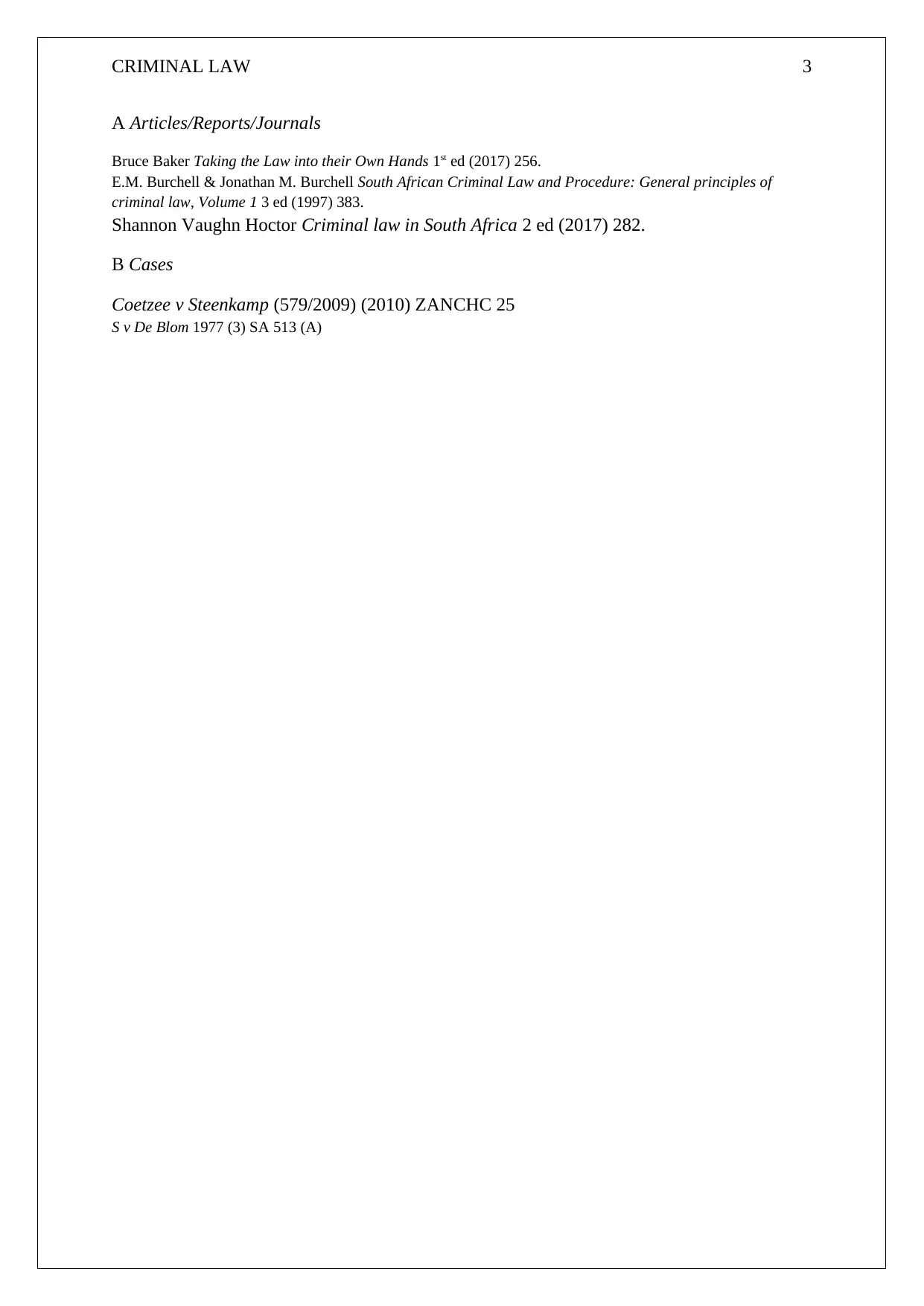
A Articles/Reports/Journals
Bruce Baker Taking the Law into their Own Hands 1st ed (2017) 256.
E.M. Burchell & Jonathan M. Burchell South African Criminal Law and Procedure: General principles of
criminal law, Volume 1 3 ed (1997) 383.
Shannon Vaughn Hoctor Criminal law in South Africa 2 ed (2017) 282.
B Cases
Coetzee v Steenkamp (579/2009) (2010) ZANCHC 25
S v De Blom 1977 (3) SA 513 (A)
chevron_up_icon
1 out of 4
circle_padding
hide_on_mobile
zoom_out_icon
[object Object]