LAW1112 Criminal Law: Pre-Trial Publicity and Murder Cases
VerifiedAdded on 2022/11/17
|7
|1417
|375
Report
AI Summary
This report delves into the intricacies of criminal law, specifically examining the impact of pre-trial publicity on murder cases. It defines murder under the Queensland Criminal Code, outlining the necessary elements of intention and jurisdiction of the Supreme Court of Australia. The report explores various methods to mitigate the effects of pre-trial publicity, including contempt by publication, suppression orders, and judge-alone trials, referencing relevant legislative provisions. Furthermore, it analyzes Australian and Queensland case laws involving murder and manslaughter, where the accused and victims were in marital or de facto relationships, such as R v Mills and R v Katie Anne Castel. By applying these legal principles to hypothetical scenarios, the report discusses potential outcomes and sentencing considerations. The report concludes by examining the court's approach to prejudicial pre-trial publicity, emphasizing the importance of a fair trial, freedom of speech, and community interests, while considering options for addressing such publicity.

CRIMINAL LAW
CRIMINAL LAW
Name of Student
Name of University
Author Note
CRIMINAL LAW
Name of Student
Name of University
Author Note
Paraphrase This Document
Need a fresh take? Get an instant paraphrase of this document with our AI Paraphraser

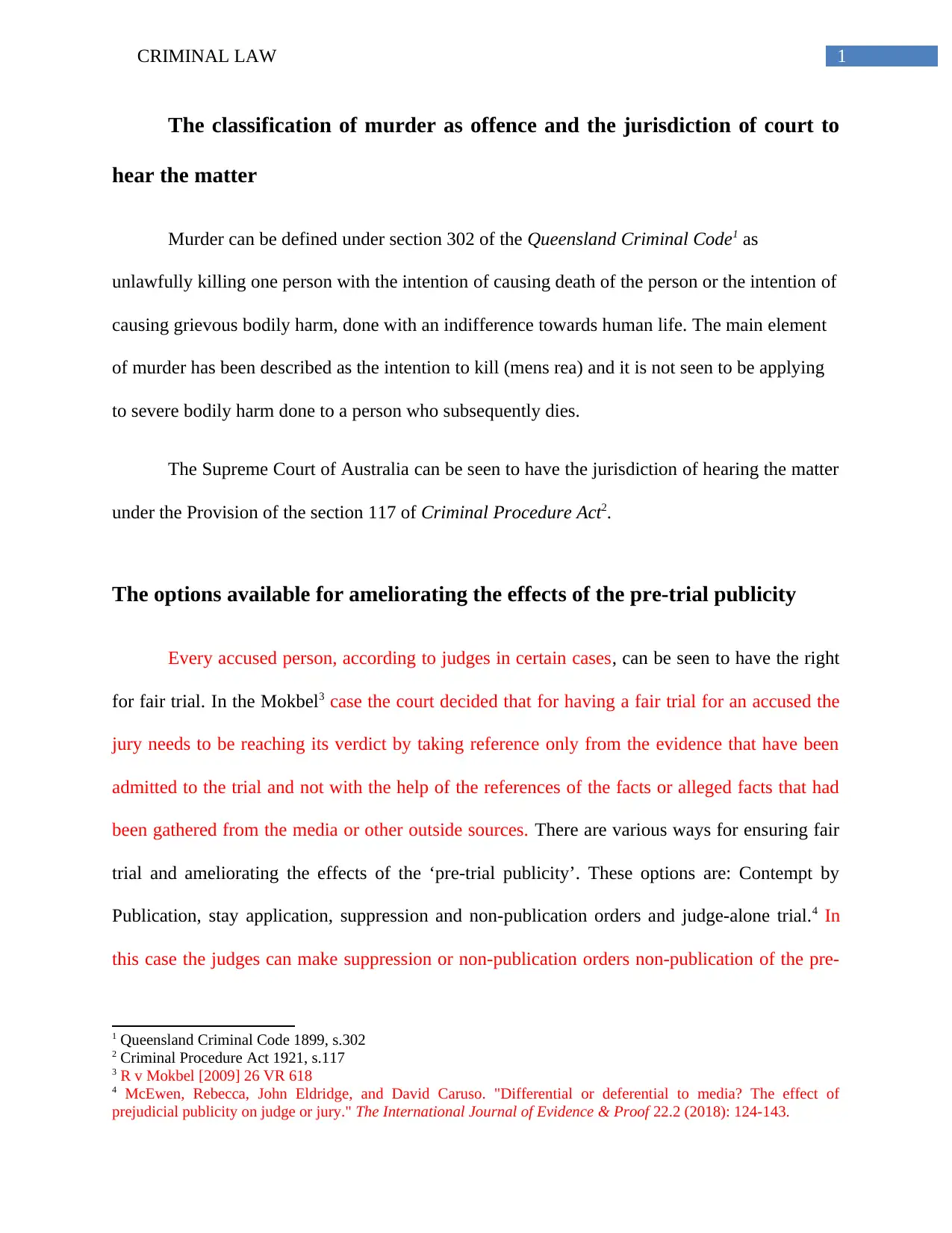
1CRIMINAL LAW
The classification of murder as offence and the jurisdiction of court to
hear the matter
Murder can be defined under section 302 of the Queensland Criminal Code1 as
unlawfully killing one person with the intention of causing death of the person or the intention of
causing grievous bodily harm, done with an indifference towards human life. The main element
of murder has been described as the intention to kill (mens rea) and it is not seen to be applying
to severe bodily harm done to a person who subsequently dies.
The Supreme Court of Australia can be seen to have the jurisdiction of hearing the matter
under the Provision of the section 117 of Criminal Procedure Act2.
The options available for ameliorating the effects of the pre-trial publicity
Every accused person, according to judges in certain cases, can be seen to have the right
for fair trial. In the Mokbel3 case the court decided that for having a fair trial for an accused the
jury needs to be reaching its verdict by taking reference only from the evidence that have been
admitted to the trial and not with the help of the references of the facts or alleged facts that had
been gathered from the media or other outside sources. There are various ways for ensuring fair
trial and ameliorating the effects of the ‘pre-trial publicity’. These options are: Contempt by
Publication, stay application, suppression and non-publication orders and judge-alone trial.4 In
this case the judges can make suppression or non-publication orders non-publication of the pre-
1 Queensland Criminal Code 1899, s.302
2 Criminal Procedure Act 1921, s.117
3 R v Mokbel [2009] 26 VR 618
4 McEwen, Rebecca, John Eldridge, and David Caruso. "Differential or deferential to media? The effect of
prejudicial publicity on judge or jury." The International Journal of Evidence & Proof 22.2 (2018): 124-143.
The classification of murder as offence and the jurisdiction of court to
hear the matter
Murder can be defined under section 302 of the Queensland Criminal Code1 as
unlawfully killing one person with the intention of causing death of the person or the intention of
causing grievous bodily harm, done with an indifference towards human life. The main element
of murder has been described as the intention to kill (mens rea) and it is not seen to be applying
to severe bodily harm done to a person who subsequently dies.
The Supreme Court of Australia can be seen to have the jurisdiction of hearing the matter
under the Provision of the section 117 of Criminal Procedure Act2.
The options available for ameliorating the effects of the pre-trial publicity
Every accused person, according to judges in certain cases, can be seen to have the right
for fair trial. In the Mokbel3 case the court decided that for having a fair trial for an accused the
jury needs to be reaching its verdict by taking reference only from the evidence that have been
admitted to the trial and not with the help of the references of the facts or alleged facts that had
been gathered from the media or other outside sources. There are various ways for ensuring fair
trial and ameliorating the effects of the ‘pre-trial publicity’. These options are: Contempt by
Publication, stay application, suppression and non-publication orders and judge-alone trial.4 In
this case the judges can make suppression or non-publication orders non-publication of the pre-
1 Queensland Criminal Code 1899, s.302
2 Criminal Procedure Act 1921, s.117
3 R v Mokbel [2009] 26 VR 618
4 McEwen, Rebecca, John Eldridge, and David Caruso. "Differential or deferential to media? The effect of
prejudicial publicity on judge or jury." The International Journal of Evidence & Proof 22.2 (2018): 124-143.

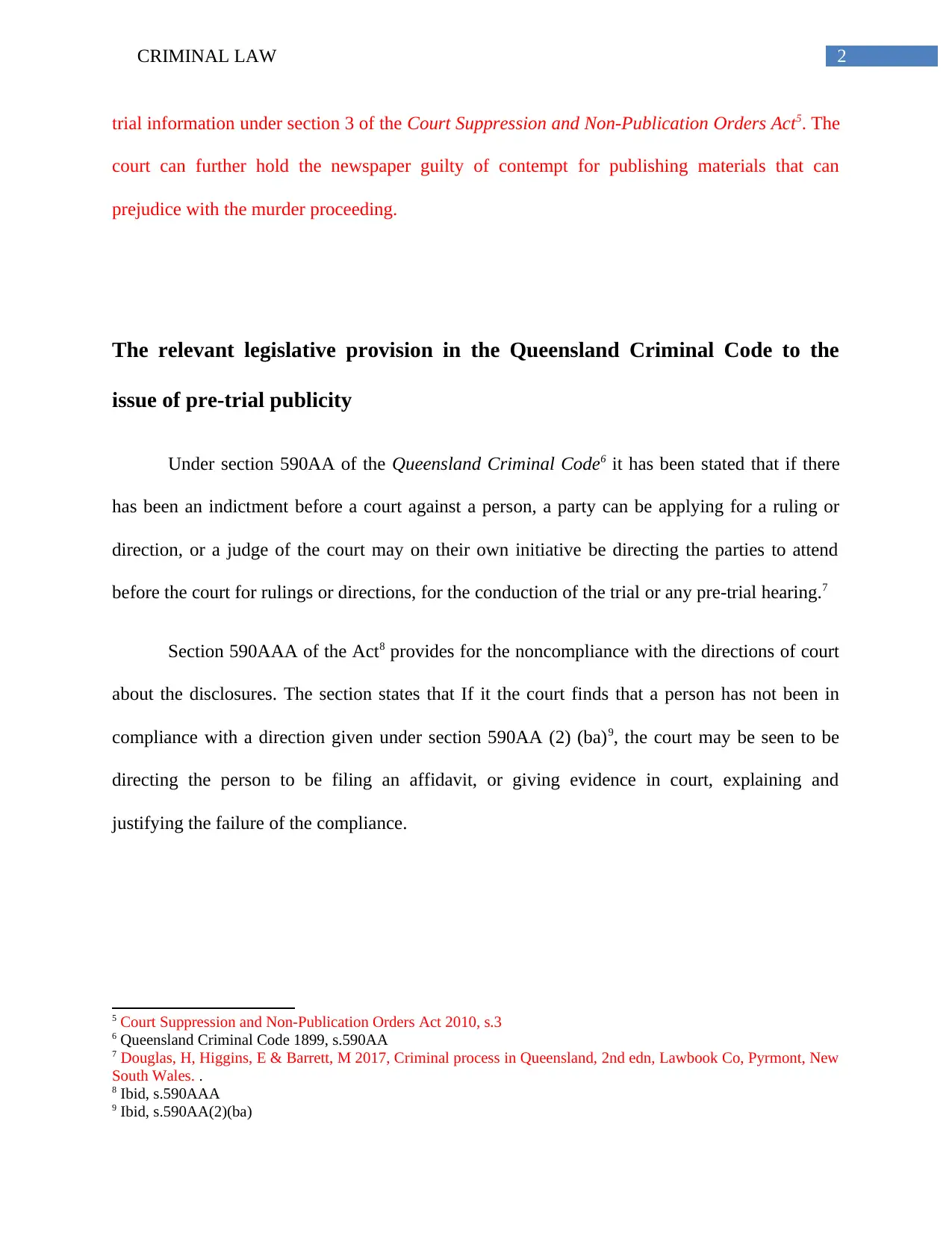
2CRIMINAL LAW
trial information under section 3 of the Court Suppression and Non-Publication Orders Act5. The
court can further hold the newspaper guilty of contempt for publishing materials that can
prejudice with the murder proceeding.
The relevant legislative provision in the Queensland Criminal Code to the
issue of pre-trial publicity
Under section 590AA of the Queensland Criminal Code6 it has been stated that if there
has been an indictment before a court against a person, a party can be applying for a ruling or
direction, or a judge of the court may on their own initiative be directing the parties to attend
before the court for rulings or directions, for the conduction of the trial or any pre-trial hearing.7
Section 590AAA of the Act8 provides for the noncompliance with the directions of court
about the disclosures. The section states that If it the court finds that a person has not been in
compliance with a direction given under section 590AA (2) (ba)9, the court may be seen to be
directing the person to be filing an affidavit, or giving evidence in court, explaining and
justifying the failure of the compliance.
5 Court Suppression and Non-Publication Orders Act 2010, s.3
6 Queensland Criminal Code 1899, s.590AA
7 Douglas, H, Higgins, E & Barrett, M 2017, Criminal process in Queensland, 2nd edn, Lawbook Co, Pyrmont, New
South Wales. .
8 Ibid, s.590AAA
9 Ibid, s.590AA(2)(ba)
trial information under section 3 of the Court Suppression and Non-Publication Orders Act5. The
court can further hold the newspaper guilty of contempt for publishing materials that can
prejudice with the murder proceeding.
The relevant legislative provision in the Queensland Criminal Code to the
issue of pre-trial publicity
Under section 590AA of the Queensland Criminal Code6 it has been stated that if there
has been an indictment before a court against a person, a party can be applying for a ruling or
direction, or a judge of the court may on their own initiative be directing the parties to attend
before the court for rulings or directions, for the conduction of the trial or any pre-trial hearing.7
Section 590AAA of the Act8 provides for the noncompliance with the directions of court
about the disclosures. The section states that If it the court finds that a person has not been in
compliance with a direction given under section 590AA (2) (ba)9, the court may be seen to be
directing the person to be filing an affidavit, or giving evidence in court, explaining and
justifying the failure of the compliance.
5 Court Suppression and Non-Publication Orders Act 2010, s.3
6 Queensland Criminal Code 1899, s.590AA
7 Douglas, H, Higgins, E & Barrett, M 2017, Criminal process in Queensland, 2nd edn, Lawbook Co, Pyrmont, New
South Wales. .
8 Ibid, s.590AAA
9 Ibid, s.590AA(2)(ba)
⊘ This is a preview!⊘
Do you want full access?
Subscribe today to unlock all pages.

Trusted by 1+ million students worldwide

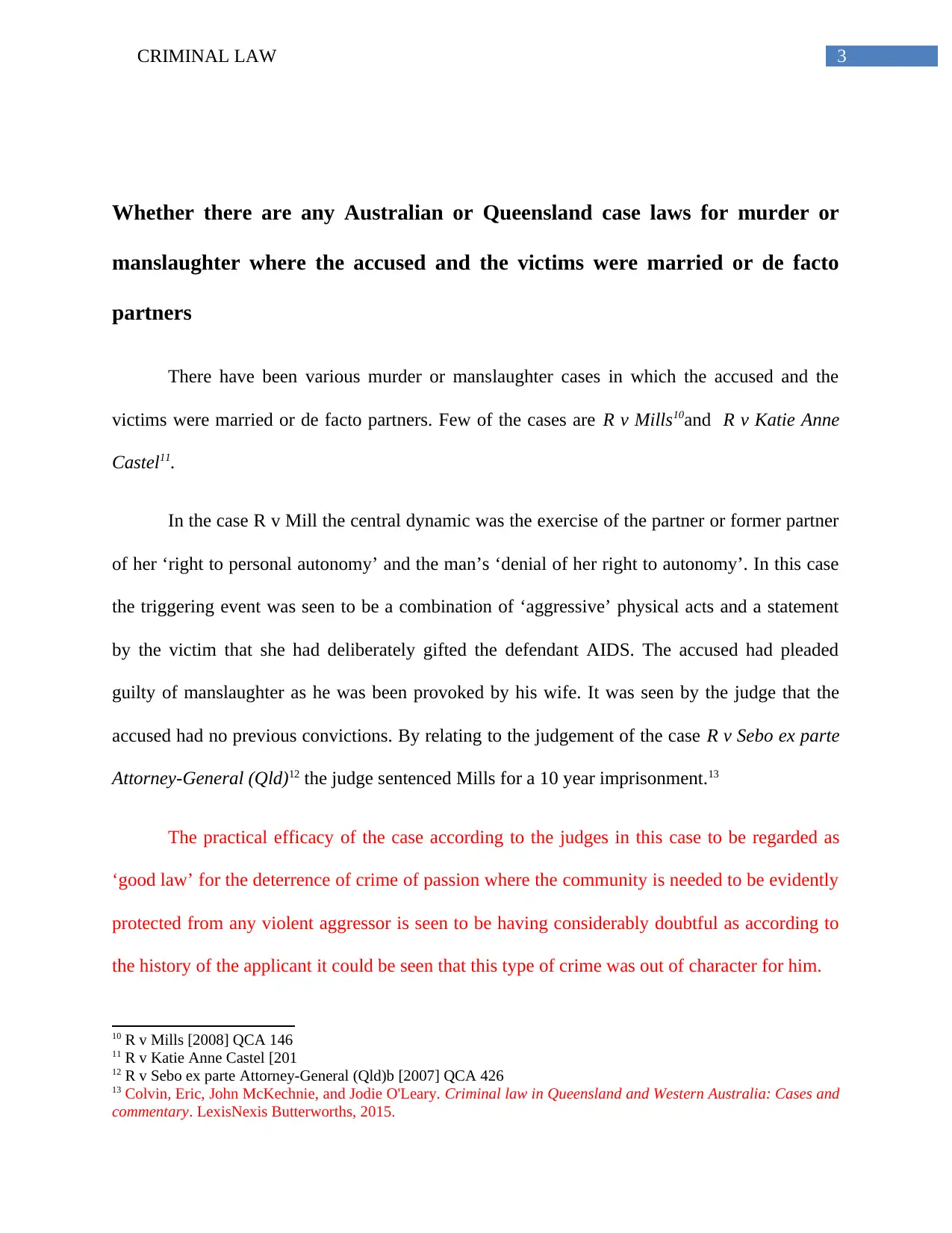
3CRIMINAL LAW
Whether there are any Australian or Queensland case laws for murder or
manslaughter where the accused and the victims were married or de facto
partners
There have been various murder or manslaughter cases in which the accused and the
victims were married or de facto partners. Few of the cases are R v Mills10and R v Katie Anne
Castel11.
In the case R v Mill the central dynamic was the exercise of the partner or former partner
of her ‘right to personal autonomy’ and the man’s ‘denial of her right to autonomy’. In this case
the triggering event was seen to be a combination of ‘aggressive’ physical acts and a statement
by the victim that she had deliberately gifted the defendant AIDS. The accused had pleaded
guilty of manslaughter as he was been provoked by his wife. It was seen by the judge that the
accused had no previous convictions. By relating to the judgement of the case R v Sebo ex parte
Attorney-General (Qld)12 the judge sentenced Mills for a 10 year imprisonment.13
The practical efficacy of the case according to the judges in this case to be regarded as
‘good law’ for the deterrence of crime of passion where the community is needed to be evidently
protected from any violent aggressor is seen to be having considerably doubtful as according to
the history of the applicant it could be seen that this type of crime was out of character for him.
10 R v Mills [2008] QCA 146
11 R v Katie Anne Castel [201
12 R v Sebo ex parte Attorney-General (Qld)b [2007] QCA 426
13 Colvin, Eric, John McKechnie, and Jodie O'Leary. Criminal law in Queensland and Western Australia: Cases and
commentary. LexisNexis Butterworths, 2015.
Whether there are any Australian or Queensland case laws for murder or
manslaughter where the accused and the victims were married or de facto
partners
There have been various murder or manslaughter cases in which the accused and the
victims were married or de facto partners. Few of the cases are R v Mills10and R v Katie Anne
Castel11.
In the case R v Mill the central dynamic was the exercise of the partner or former partner
of her ‘right to personal autonomy’ and the man’s ‘denial of her right to autonomy’. In this case
the triggering event was seen to be a combination of ‘aggressive’ physical acts and a statement
by the victim that she had deliberately gifted the defendant AIDS. The accused had pleaded
guilty of manslaughter as he was been provoked by his wife. It was seen by the judge that the
accused had no previous convictions. By relating to the judgement of the case R v Sebo ex parte
Attorney-General (Qld)12 the judge sentenced Mills for a 10 year imprisonment.13
The practical efficacy of the case according to the judges in this case to be regarded as
‘good law’ for the deterrence of crime of passion where the community is needed to be evidently
protected from any violent aggressor is seen to be having considerably doubtful as according to
the history of the applicant it could be seen that this type of crime was out of character for him.
10 R v Mills [2008] QCA 146
11 R v Katie Anne Castel [201
12 R v Sebo ex parte Attorney-General (Qld)b [2007] QCA 426
13 Colvin, Eric, John McKechnie, and Jodie O'Leary. Criminal law in Queensland and Western Australia: Cases and
commentary. LexisNexis Butterworths, 2015.
Paraphrase This Document
Need a fresh take? Get an instant paraphrase of this document with our AI Paraphraser

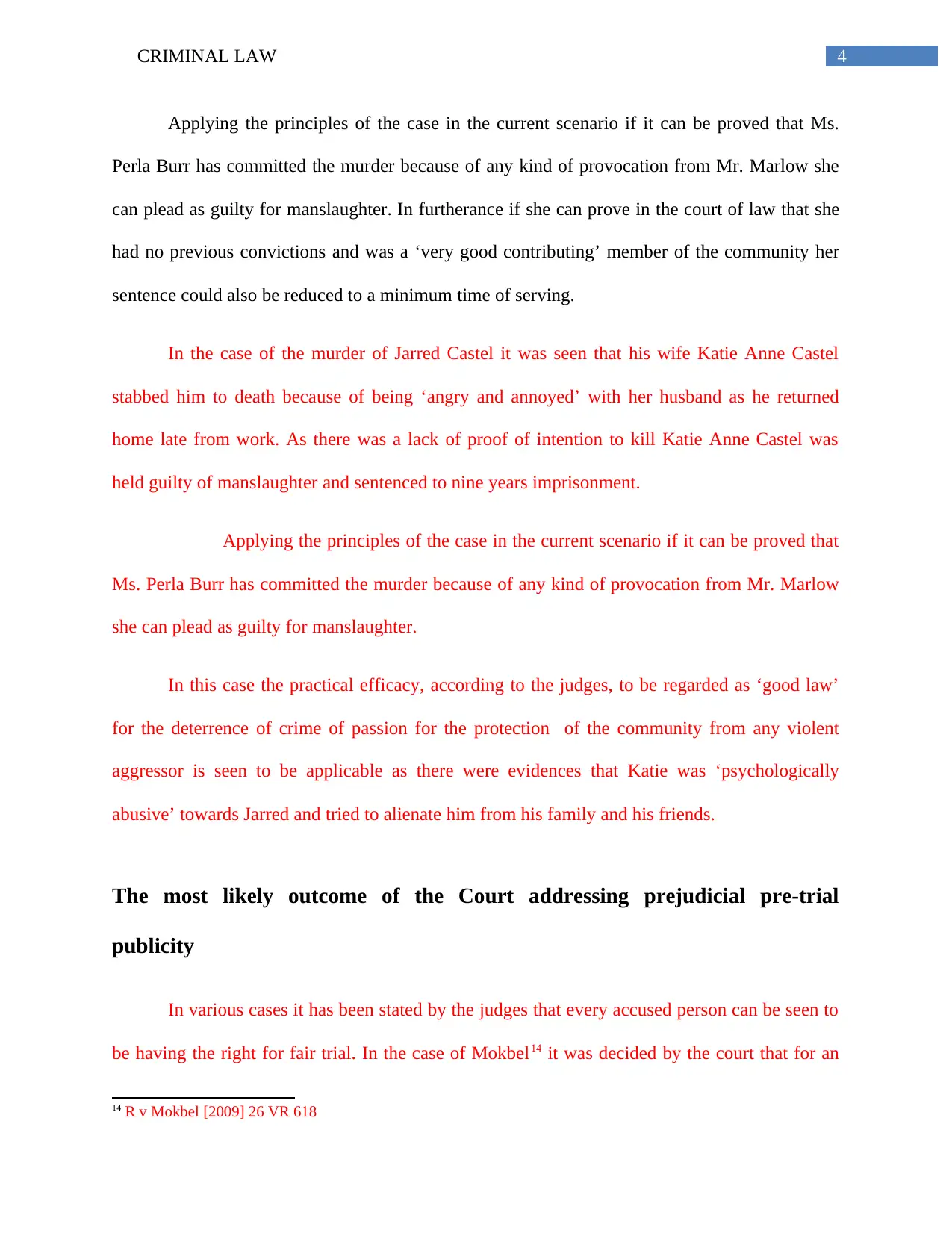
4CRIMINAL LAW
Applying the principles of the case in the current scenario if it can be proved that Ms.
Perla Burr has committed the murder because of any kind of provocation from Mr. Marlow she
can plead as guilty for manslaughter. In furtherance if she can prove in the court of law that she
had no previous convictions and was a ‘very good contributing’ member of the community her
sentence could also be reduced to a minimum time of serving.
In the case of the murder of Jarred Castel it was seen that his wife Katie Anne Castel
stabbed him to death because of being ‘angry and annoyed’ with her husband as he returned
home late from work. As there was a lack of proof of intention to kill Katie Anne Castel was
held guilty of manslaughter and sentenced to nine years imprisonment.
Applying the principles of the case in the current scenario if it can be proved that
Ms. Perla Burr has committed the murder because of any kind of provocation from Mr. Marlow
she can plead as guilty for manslaughter.
In this case the practical efficacy, according to the judges, to be regarded as ‘good law’
for the deterrence of crime of passion for the protection of the community from any violent
aggressor is seen to be applicable as there were evidences that Katie was ‘psychologically
abusive’ towards Jarred and tried to alienate him from his family and his friends.
The most likely outcome of the Court addressing prejudicial pre-trial
publicity
In various cases it has been stated by the judges that every accused person can be seen to
be having the right for fair trial. In the case of Mokbel14 it was decided by the court that for an
14 R v Mokbel [2009] 26 VR 618
Applying the principles of the case in the current scenario if it can be proved that Ms.
Perla Burr has committed the murder because of any kind of provocation from Mr. Marlow she
can plead as guilty for manslaughter. In furtherance if she can prove in the court of law that she
had no previous convictions and was a ‘very good contributing’ member of the community her
sentence could also be reduced to a minimum time of serving.
In the case of the murder of Jarred Castel it was seen that his wife Katie Anne Castel
stabbed him to death because of being ‘angry and annoyed’ with her husband as he returned
home late from work. As there was a lack of proof of intention to kill Katie Anne Castel was
held guilty of manslaughter and sentenced to nine years imprisonment.
Applying the principles of the case in the current scenario if it can be proved that
Ms. Perla Burr has committed the murder because of any kind of provocation from Mr. Marlow
she can plead as guilty for manslaughter.
In this case the practical efficacy, according to the judges, to be regarded as ‘good law’
for the deterrence of crime of passion for the protection of the community from any violent
aggressor is seen to be applicable as there were evidences that Katie was ‘psychologically
abusive’ towards Jarred and tried to alienate him from his family and his friends.
The most likely outcome of the Court addressing prejudicial pre-trial
publicity
In various cases it has been stated by the judges that every accused person can be seen to
be having the right for fair trial. In the case of Mokbel14 it was decided by the court that for an
14 R v Mokbel [2009] 26 VR 618

5CRIMINAL LAW
accused person to be having fair trial the jury should be reaching its verdict by taking reference
only from the evidence that had been admitted to the trial and not with the help of the references
of the facts or alleged facts gathered from the media or other outside sources. It has been seen in
the case R v Glennon15 that the high court decision after the publication of inadmissible and
prejudicial material before the trial stood in the way of the accused right for getting fair trial. In
Australia principle of open justice is seen to be foundational to the criminal justice system.
However in practice it can be seen that the courts have been reluctant towards allowing pre-
judicial publicity for prevention of trials to be held in open court before juries. For fair trial,
freedom of speech, and the community interest the court can consider certain options for
addressing prejudicial pretrial publicity.16 The first option is to hold any person guilty of
contempt for publishing materials which can prejudice or interfere with a particular proceeding.
Secondly, In the case Hogan v Hinch17 under the common law the powers implied towards a
superior court can be used for the restriction of reporting of the proceedings where it can be seen
to be necessary for the interest of the administration of the justice. The Local, District or
Supreme Courts are authorized to make suppression or non-publication orders for the prohibition
or non-publication of information under section 3 of the Court Suppression and Non-Publication
Orders Act18. Another option that the court can consider for the avoidance of the impact of the
prejudicial publicity is conducting judge-alone trials. An accused may also apply for a judge-
alone trial as per section 132 of the Criminal Procedure Act19.
15 R v Glennon [1992] HCA 16; [1992] 173 CLR
16 McEwen, Rebecca, and John Eldridge. "Judges, juries and prejudicial publicity: Lessons from empirical legal
scholarship." Alternative Law Journal 41.2 (2016): 110-114.
17 Hogan v Hinch (2011) 243 CLR 506 at [26]
18 Court Suppression and Non-Publication Orders Act 2010, s.3
19 Criminal Procedure Act 1986, s.132
accused person to be having fair trial the jury should be reaching its verdict by taking reference
only from the evidence that had been admitted to the trial and not with the help of the references
of the facts or alleged facts gathered from the media or other outside sources. It has been seen in
the case R v Glennon15 that the high court decision after the publication of inadmissible and
prejudicial material before the trial stood in the way of the accused right for getting fair trial. In
Australia principle of open justice is seen to be foundational to the criminal justice system.
However in practice it can be seen that the courts have been reluctant towards allowing pre-
judicial publicity for prevention of trials to be held in open court before juries. For fair trial,
freedom of speech, and the community interest the court can consider certain options for
addressing prejudicial pretrial publicity.16 The first option is to hold any person guilty of
contempt for publishing materials which can prejudice or interfere with a particular proceeding.
Secondly, In the case Hogan v Hinch17 under the common law the powers implied towards a
superior court can be used for the restriction of reporting of the proceedings where it can be seen
to be necessary for the interest of the administration of the justice. The Local, District or
Supreme Courts are authorized to make suppression or non-publication orders for the prohibition
or non-publication of information under section 3 of the Court Suppression and Non-Publication
Orders Act18. Another option that the court can consider for the avoidance of the impact of the
prejudicial publicity is conducting judge-alone trials. An accused may also apply for a judge-
alone trial as per section 132 of the Criminal Procedure Act19.
15 R v Glennon [1992] HCA 16; [1992] 173 CLR
16 McEwen, Rebecca, and John Eldridge. "Judges, juries and prejudicial publicity: Lessons from empirical legal
scholarship." Alternative Law Journal 41.2 (2016): 110-114.
17 Hogan v Hinch (2011) 243 CLR 506 at [26]
18 Court Suppression and Non-Publication Orders Act 2010, s.3
19 Criminal Procedure Act 1986, s.132
⊘ This is a preview!⊘
Do you want full access?
Subscribe today to unlock all pages.

Trusted by 1+ million students worldwide

6CRIMINAL LAW
Where the trial would be taking place
Under the Provision of the section 117 of Criminal Procedure Act20 the Supreme Court of
Australia can be seen to have the jurisdiction of hearing the matter and hence the trial would
likely be held in the Supreme Court of Australia.
20 Criminal Procedure Act 1921, s.117
Where the trial would be taking place
Under the Provision of the section 117 of Criminal Procedure Act20 the Supreme Court of
Australia can be seen to have the jurisdiction of hearing the matter and hence the trial would
likely be held in the Supreme Court of Australia.
20 Criminal Procedure Act 1921, s.117
1 out of 7
Related Documents
Your All-in-One AI-Powered Toolkit for Academic Success.
+13062052269
info@desklib.com
Available 24*7 on WhatsApp / Email
Unlock your academic potential
Copyright © 2020–2026 A2Z Services. All Rights Reserved. Developed and managed by ZUCOL.