Criminal Law & Justice: Individual Autonomy, Welfare, Responsibility

Verified

Added on  2023/06/14

|4
|703
|56
Homework Assignment
AI Summary
This assignment delves into the principles of individual autonomy and community welfare within the context of criminal law. It examines how criminal law balances the protection of individual freedoms with the need to ensure societal well-being. The assignment further identifies elements of complicity, conspiracy, and attempt that broaden the scope of criminal responsibility, while also considering the restraints designed to prevent overextension. It explores whether these restraints should be tightened or removed, using contemporary examples from Australia to support the arguments. The assignment concludes by emphasizing the importance of strict measures to reduce criminal responsibility and crime rates.
Document Page
Running head: CRIME AND CRIMINAL JUSTICE
Crime and Criminal Justice
Name of the Student
Name of the University
Author note
tabler-icon-diamond-filled.svg

Paraphrase This Document

Need a fresh take? Get an instant paraphrase of this document with our AI Paraphraser
Document Page
1CRIME AND CRIMINAL JUSTICE
Question 1
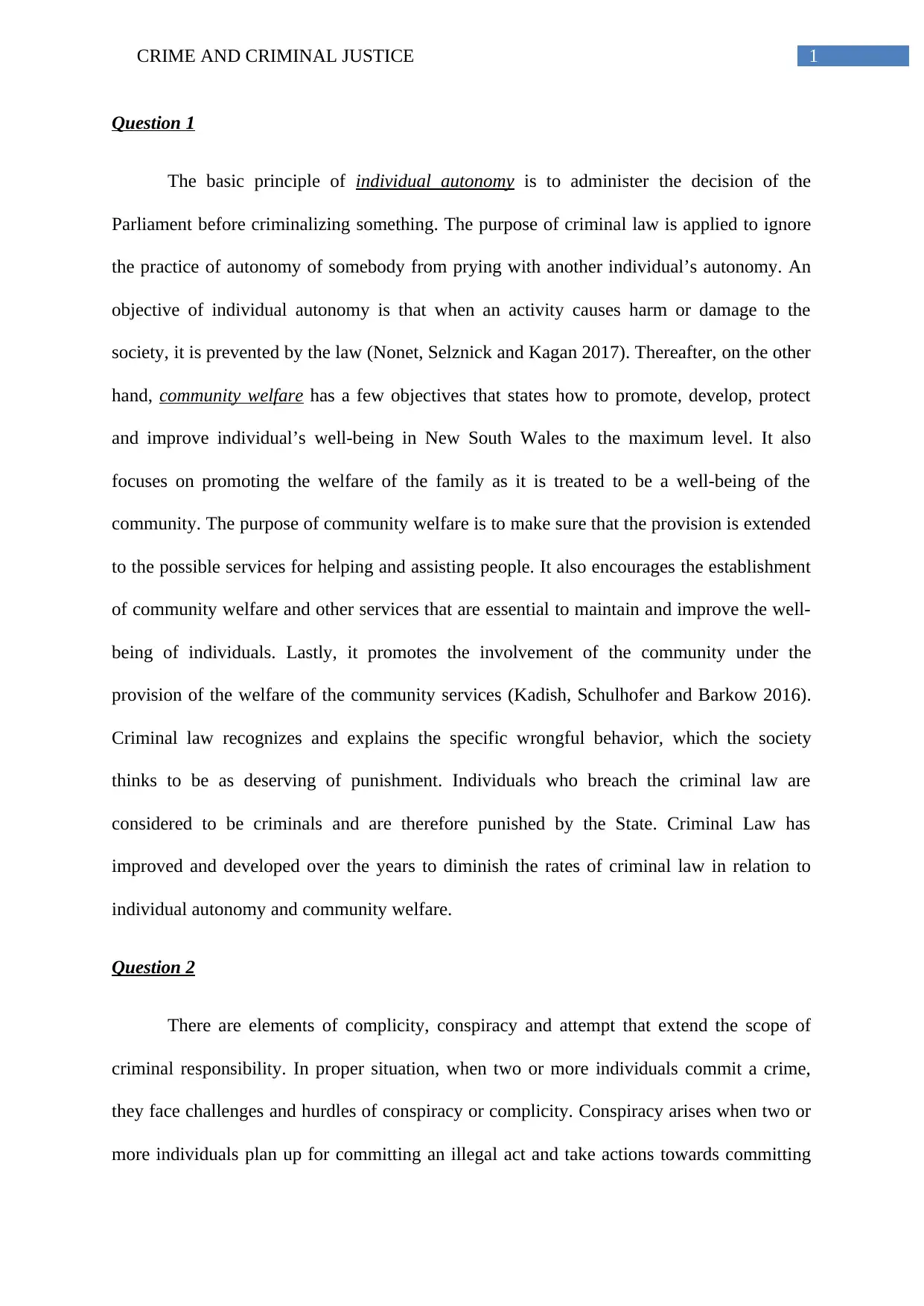
The basic principle of individual autonomy is to administer the decision of the
Parliament before criminalizing something. The purpose of criminal law is applied to ignore
the practice of autonomy of somebody from prying with another individual’s autonomy. An
objective of individual autonomy is that when an activity causes harm or damage to the
society, it is prevented by the law (Nonet, Selznick and Kagan 2017). Thereafter, on the other
hand, community welfare has a few objectives that states how to promote, develop, protect
and improve individual’s well-being in New South Wales to the maximum level. It also
focuses on promoting the welfare of the family as it is treated to be a well-being of the
community. The purpose of community welfare is to make sure that the provision is extended
to the possible services for helping and assisting people. It also encourages the establishment
of community welfare and other services that are essential to maintain and improve the well-
being of individuals. Lastly, it promotes the involvement of the community under the
provision of the welfare of the community services (Kadish, Schulhofer and Barkow 2016).
Criminal law recognizes and explains the specific wrongful behavior, which the society
thinks to be as deserving of punishment. Individuals who breach the criminal law are
considered to be criminals and are therefore punished by the State. Criminal Law has
improved and developed over the years to diminish the rates of criminal law in relation to
individual autonomy and community welfare.
Question 2
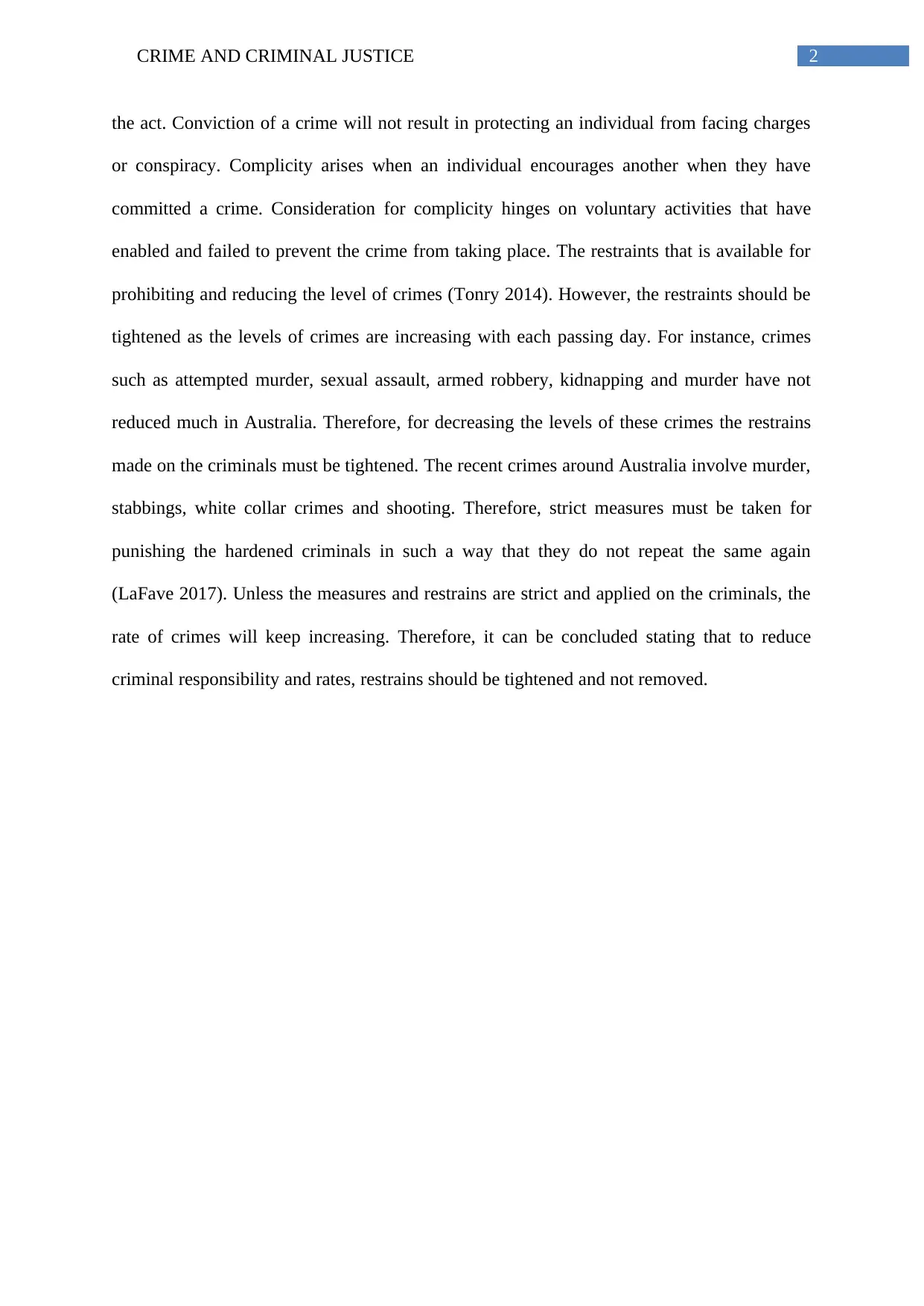
There are elements of complicity, conspiracy and attempt that extend the scope of
criminal responsibility. In proper situation, when two or more individuals commit a crime,
they face challenges and hurdles of conspiracy or complicity. Conspiracy arises when two or
more individuals plan up for committing an illegal act and take actions towards committing
Document Page
2CRIME AND CRIMINAL JUSTICE
the act. Conviction of a crime will not result in protecting an individual from facing charges
or conspiracy. Complicity arises when an individual encourages another when they have
committed a crime. Consideration for complicity hinges on voluntary activities that have
enabled and failed to prevent the crime from taking place. The restraints that is available for
prohibiting and reducing the level of crimes (Tonry 2014). However, the restraints should be
tightened as the levels of crimes are increasing with each passing day. For instance, crimes
such as attempted murder, sexual assault, armed robbery, kidnapping and murder have not
reduced much in Australia. Therefore, for decreasing the levels of these crimes the restrains
made on the criminals must be tightened. The recent crimes around Australia involve murder,
stabbings, white collar crimes and shooting. Therefore, strict measures must be taken for
punishing the hardened criminals in such a way that they do not repeat the same again
(LaFave 2017). Unless the measures and restrains are strict and applied on the criminals, the
rate of crimes will keep increasing. Therefore, it can be concluded stating that to reduce
criminal responsibility and rates, restrains should be tightened and not removed.
Document Page
3CRIME AND CRIMINAL JUSTICE
References:
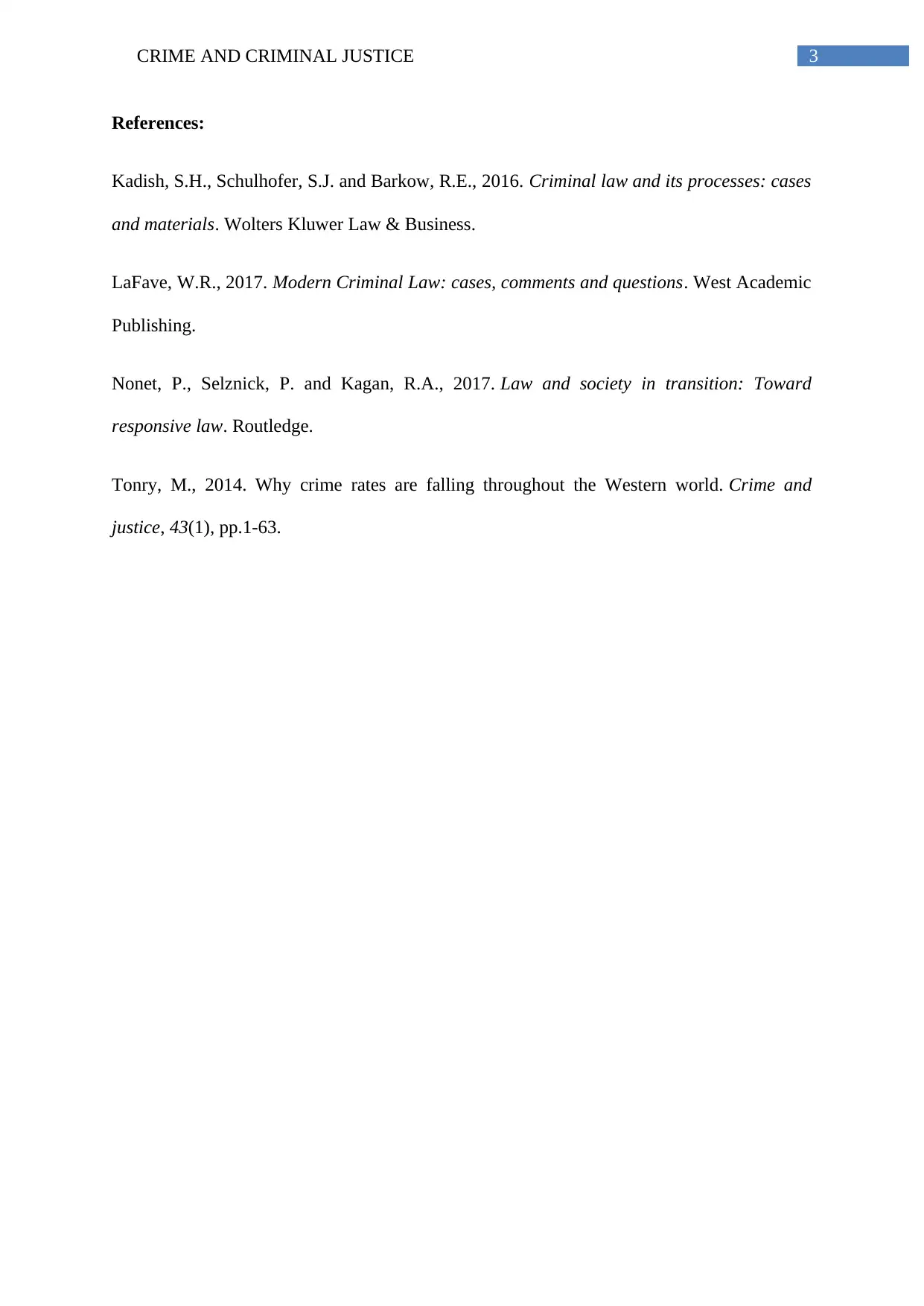
Kadish, S.H., Schulhofer, S.J. and Barkow, R.E., 2016. Criminal law and its processes: cases
and materials. Wolters Kluwer Law & Business.
LaFave, W.R., 2017. Modern Criminal Law: cases, comments and questions. West Academic
Publishing.
Nonet, P., Selznick, P. and Kagan, R.A., 2017. Law and society in transition: Toward
responsive law. Routledge.
Tonry, M., 2014. Why crime rates are falling throughout the Western world. Crime and
justice, 43(1), pp.1-63.
chevron_up_icon
1 out of 4
circle_padding
hide_on_mobile
zoom_out_icon
[object Object]