An Analysis of Crime Code and Criminal Procedure Principles
VerifiedAdded on 2020/05/04
|6
|1108
|119
Homework Assignment
AI Summary
This assignment delves into the intricacies of criminal procedure and the crime code, providing a detailed analysis of various legal principles. It explores the concept of solicitor-client privilege, examining its exceptions and the underlying fiduciary relationship between lawyers and their clients, referencing the case of Descôteaux v. Mierzwinski. The assignment also covers spousal privilege, outlining its fundamental principles and the types of communications protected, with reference to R. v. Schell. Furthermore, it investigates informer privilege, including its origins in Marks v Beyfus, and the protection afforded to police informers, referencing R. v. Named Person B. The assignment also discusses how the Crown Prosecutor can invoke informer privilege and the exceptions to this privilege, such as the "Innocence at Stake" exception. The assignment utilizes relevant case law and legal principles to support its arguments, providing a comprehensive overview of these important aspects of criminal procedure. The assignment is well-structured and provides clear explanations of complex legal concepts.

Running head: Crime Code
Criminal Procedure
Criminal Procedure
Paraphrase This Document
Need a fresh take? Get an instant paraphrase of this document with our AI Paraphraser

Crime Code 1
Contents
Answer 1.................................................................................................................................................................... 2
Answer 2.................................................................................................................................................................... 2
Answer 3 (a)...............................................................................................................................................................2
Answer 3 (b)...............................................................................................................................................................2
Answer 3 (c)...............................................................................................................................................................3
Answer 4 (a)...............................................................................................................................................................3
Answer 4 (b)...............................................................................................................................................................3
Answer 4 (d)...............................................................................................................................................................4
Answer 4 (e)...............................................................................................................................................................4
References..................................................................................................................................................................5
Contents
Answer 1.................................................................................................................................................................... 2
Answer 2.................................................................................................................................................................... 2
Answer 3 (a)...............................................................................................................................................................2
Answer 3 (b)...............................................................................................................................................................2
Answer 3 (c)...............................................................................................................................................................3
Answer 4 (a)...............................................................................................................................................................3
Answer 4 (b)...............................................................................................................................................................3
Answer 4 (d)...............................................................................................................................................................4
Answer 4 (e)...............................................................................................................................................................4
References..................................................................................................................................................................5

Crime Code 2
Answer 1
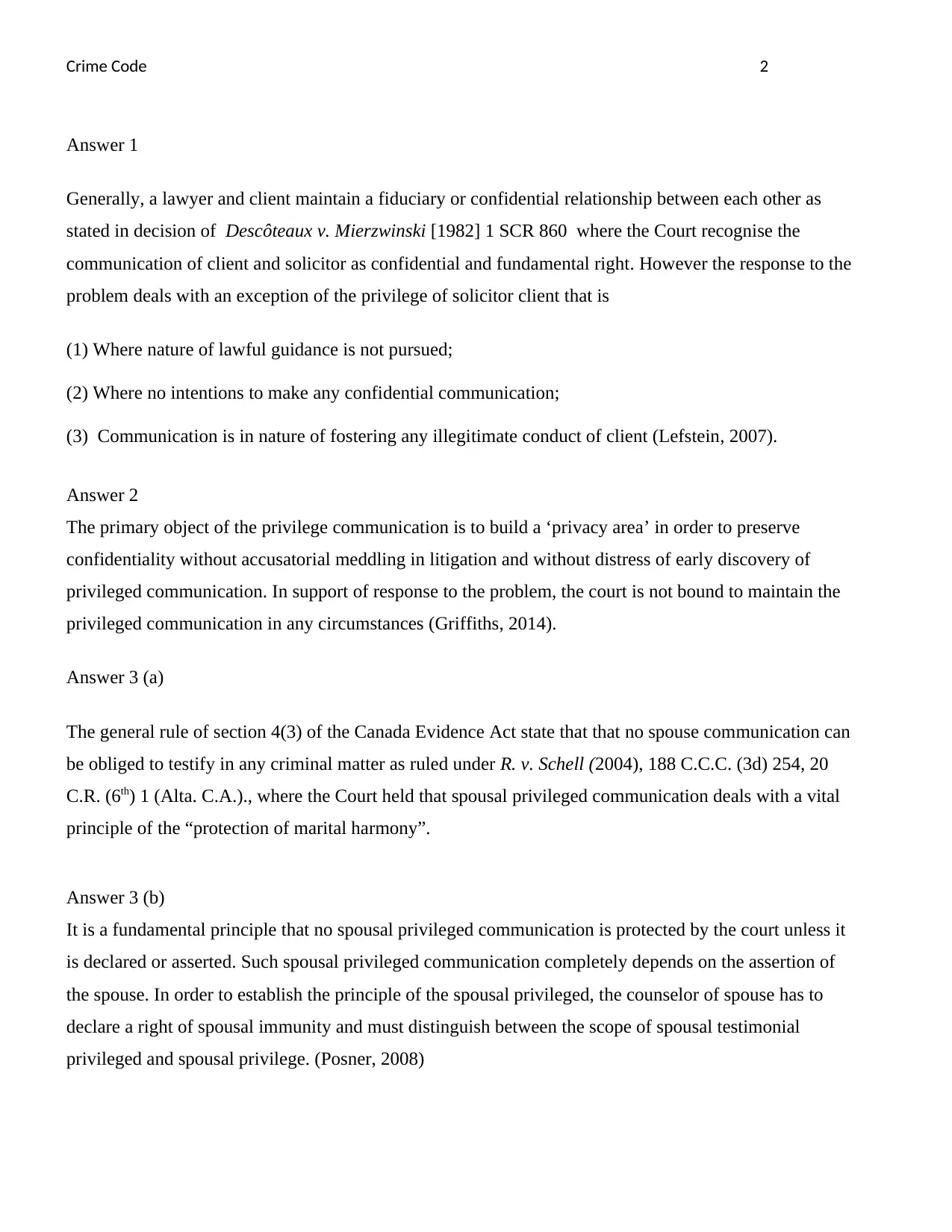
Generally, a lawyer and client maintain a fiduciary or confidential relationship between each other as
stated in decision of Descôteaux v. Mierzwinski [1982] 1 SCR 860 where the Court recognise the
communication of client and solicitor as confidential and fundamental right. However the response to the
problem deals with an exception of the privilege of solicitor client that is
(1) Where nature of lawful guidance is not pursued;
(2) Where no intentions to make any confidential communication;
(3) Communication is in nature of fostering any illegitimate conduct of client (Lefstein, 2007).
Answer 2
The primary object of the privilege communication is to build a ‘privacy area’ in order to preserve
confidentiality without accusatorial meddling in litigation and without distress of early discovery of
privileged communication. In support of response to the problem, the court is not bound to maintain the
privileged communication in any circumstances (Griffiths, 2014).
Answer 3 (a)
The general rule of section 4(3) of the Canada Evidence Act state that that no spouse communication can
be obliged to testify in any criminal matter as ruled under R. v. Schell (2004), 188 C.C.C. (3d) 254, 20
C.R. (6th) 1 (Alta. C.A.)., where the Court held that spousal privileged communication deals with a vital
principle of the “protection of marital harmony”.
Answer 3 (b)
It is a fundamental principle that no spousal privileged communication is protected by the court unless it
is declared or asserted. Such spousal privileged communication completely depends on the assertion of
the spouse. In order to establish the principle of the spousal privileged, the counselor of spouse has to
declare a right of spousal immunity and must distinguish between the scope of spousal testimonial
privileged and spousal privilege. (Posner, 2008)
Answer 1
Generally, a lawyer and client maintain a fiduciary or confidential relationship between each other as
stated in decision of Descôteaux v. Mierzwinski [1982] 1 SCR 860 where the Court recognise the
communication of client and solicitor as confidential and fundamental right. However the response to the
problem deals with an exception of the privilege of solicitor client that is
(1) Where nature of lawful guidance is not pursued;
(2) Where no intentions to make any confidential communication;
(3) Communication is in nature of fostering any illegitimate conduct of client (Lefstein, 2007).
Answer 2
The primary object of the privilege communication is to build a ‘privacy area’ in order to preserve
confidentiality without accusatorial meddling in litigation and without distress of early discovery of
privileged communication. In support of response to the problem, the court is not bound to maintain the
privileged communication in any circumstances (Griffiths, 2014).
Answer 3 (a)
The general rule of section 4(3) of the Canada Evidence Act state that that no spouse communication can
be obliged to testify in any criminal matter as ruled under R. v. Schell (2004), 188 C.C.C. (3d) 254, 20
C.R. (6th) 1 (Alta. C.A.)., where the Court held that spousal privileged communication deals with a vital
principle of the “protection of marital harmony”.
Answer 3 (b)
It is a fundamental principle that no spousal privileged communication is protected by the court unless it
is declared or asserted. Such spousal privileged communication completely depends on the assertion of
the spouse. In order to establish the principle of the spousal privileged, the counselor of spouse has to
declare a right of spousal immunity and must distinguish between the scope of spousal testimonial
privileged and spousal privilege. (Posner, 2008)
⊘ This is a preview!⊘
Do you want full access?
Subscribe today to unlock all pages.

Trusted by 1+ million students worldwide

Crime Code 3
Answer 3 (c)
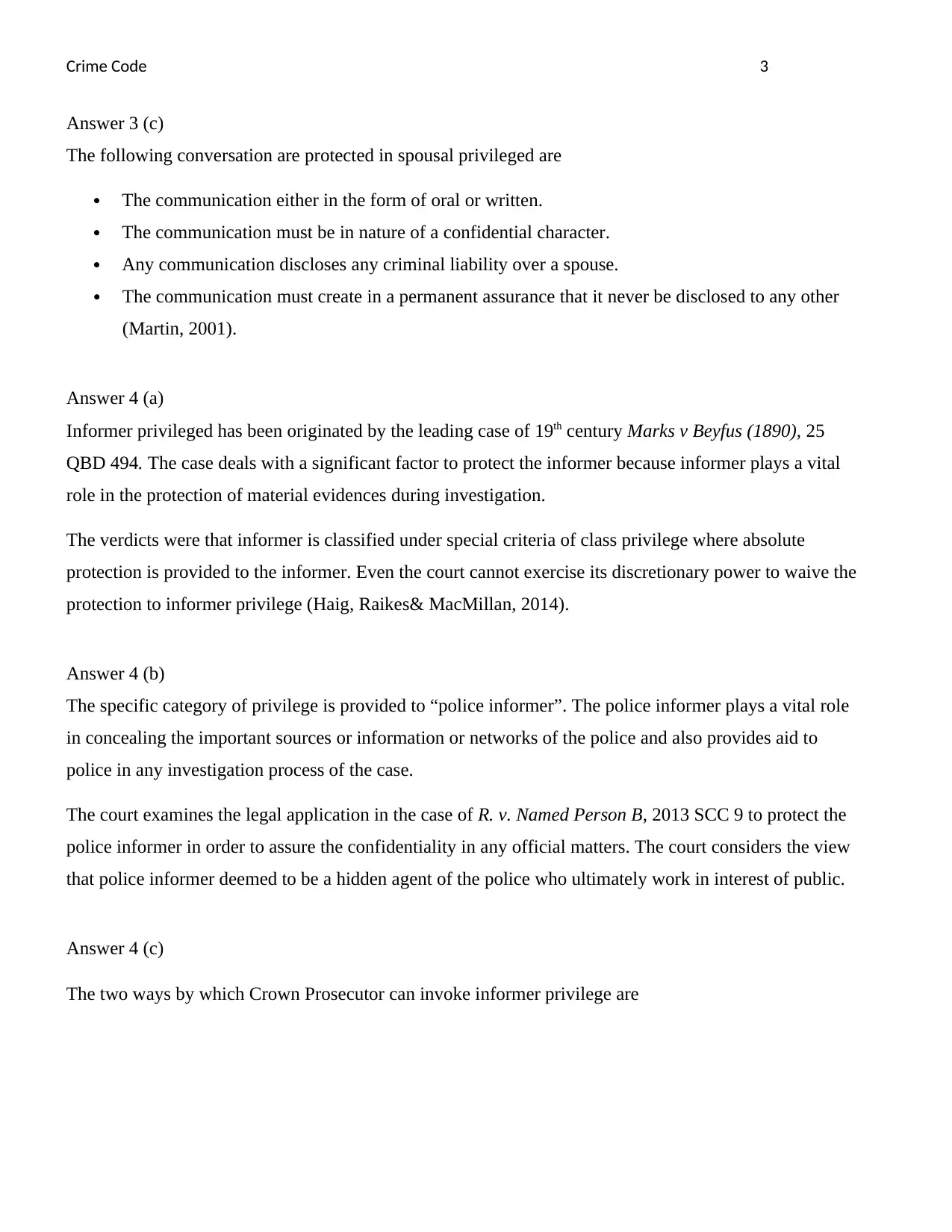
The following conversation are protected in spousal privileged are
The communication either in the form of oral or written.
The communication must be in nature of a confidential character.
Any communication discloses any criminal liability over a spouse.
The communication must create in a permanent assurance that it never be disclosed to any other
(Martin, 2001).
Answer 4 (a)
Informer privileged has been originated by the leading case of 19th century Marks v Beyfus (1890), 25
QBD 494. The case deals with a significant factor to protect the informer because informer plays a vital
role in the protection of material evidences during investigation.
The verdicts were that informer is classified under special criteria of class privilege where absolute
protection is provided to the informer. Even the court cannot exercise its discretionary power to waive the
protection to informer privilege (Haig, Raikes& MacMillan, 2014).
Answer 4 (b)
The specific category of privilege is provided to “police informer”. The police informer plays a vital role
in concealing the important sources or information or networks of the police and also provides aid to
police in any investigation process of the case.
The court examines the legal application in the case of R. v. Named Person B, 2013 SCC 9 to protect the
police informer in order to assure the confidentiality in any official matters. The court considers the view
that police informer deemed to be a hidden agent of the police who ultimately work in interest of public.
Answer 4 (c)
The two ways by which Crown Prosecutor can invoke informer privilege are
Answer 3 (c)
The following conversation are protected in spousal privileged are
The communication either in the form of oral or written.
The communication must be in nature of a confidential character.
Any communication discloses any criminal liability over a spouse.
The communication must create in a permanent assurance that it never be disclosed to any other
(Martin, 2001).
Answer 4 (a)
Informer privileged has been originated by the leading case of 19th century Marks v Beyfus (1890), 25
QBD 494. The case deals with a significant factor to protect the informer because informer plays a vital
role in the protection of material evidences during investigation.
The verdicts were that informer is classified under special criteria of class privilege where absolute
protection is provided to the informer. Even the court cannot exercise its discretionary power to waive the
protection to informer privilege (Haig, Raikes& MacMillan, 2014).
Answer 4 (b)
The specific category of privilege is provided to “police informer”. The police informer plays a vital role
in concealing the important sources or information or networks of the police and also provides aid to
police in any investigation process of the case.
The court examines the legal application in the case of R. v. Named Person B, 2013 SCC 9 to protect the
police informer in order to assure the confidentiality in any official matters. The court considers the view
that police informer deemed to be a hidden agent of the police who ultimately work in interest of public.
Answer 4 (c)
The two ways by which Crown Prosecutor can invoke informer privilege are
Paraphrase This Document
Need a fresh take? Get an instant paraphrase of this document with our AI Paraphraser

Crime Code 4
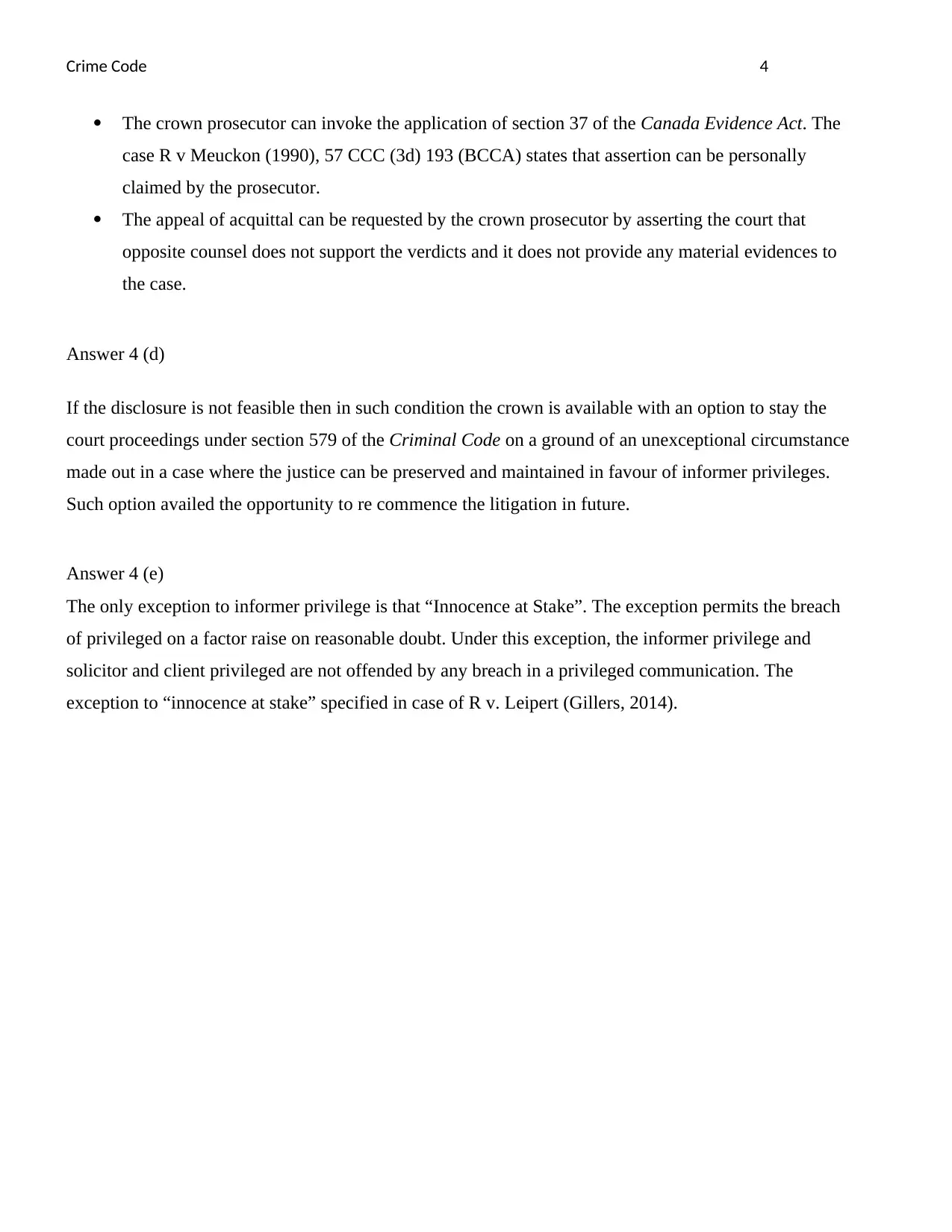
The crown prosecutor can invoke the application of section 37 of the Canada Evidence Act. The
case R v Meuckon (1990), 57 CCC (3d) 193 (BCCA) states that assertion can be personally
claimed by the prosecutor.
The appeal of acquittal can be requested by the crown prosecutor by asserting the court that
opposite counsel does not support the verdicts and it does not provide any material evidences to
the case.
Answer 4 (d)
If the disclosure is not feasible then in such condition the crown is available with an option to stay the
court proceedings under section 579 of the Criminal Code on a ground of an unexceptional circumstance
made out in a case where the justice can be preserved and maintained in favour of informer privileges.
Such option availed the opportunity to re commence the litigation in future.
Answer 4 (e)
The only exception to informer privilege is that “Innocence at Stake”. The exception permits the breach
of privileged on a factor raise on reasonable doubt. Under this exception, the informer privilege and
solicitor and client privileged are not offended by any breach in a privileged communication. The
exception to “innocence at stake” specified in case of R v. Leipert (Gillers, 2014).
The crown prosecutor can invoke the application of section 37 of the Canada Evidence Act. The
case R v Meuckon (1990), 57 CCC (3d) 193 (BCCA) states that assertion can be personally
claimed by the prosecutor.
The appeal of acquittal can be requested by the crown prosecutor by asserting the court that
opposite counsel does not support the verdicts and it does not provide any material evidences to
the case.
Answer 4 (d)
If the disclosure is not feasible then in such condition the crown is available with an option to stay the
court proceedings under section 579 of the Criminal Code on a ground of an unexceptional circumstance
made out in a case where the justice can be preserved and maintained in favour of informer privileges.
Such option availed the opportunity to re commence the litigation in future.
Answer 4 (e)
The only exception to informer privilege is that “Innocence at Stake”. The exception permits the breach
of privileged on a factor raise on reasonable doubt. Under this exception, the informer privilege and
solicitor and client privileged are not offended by any breach in a privileged communication. The
exception to “innocence at stake” specified in case of R v. Leipert (Gillers, 2014).

Crime Code 5
References
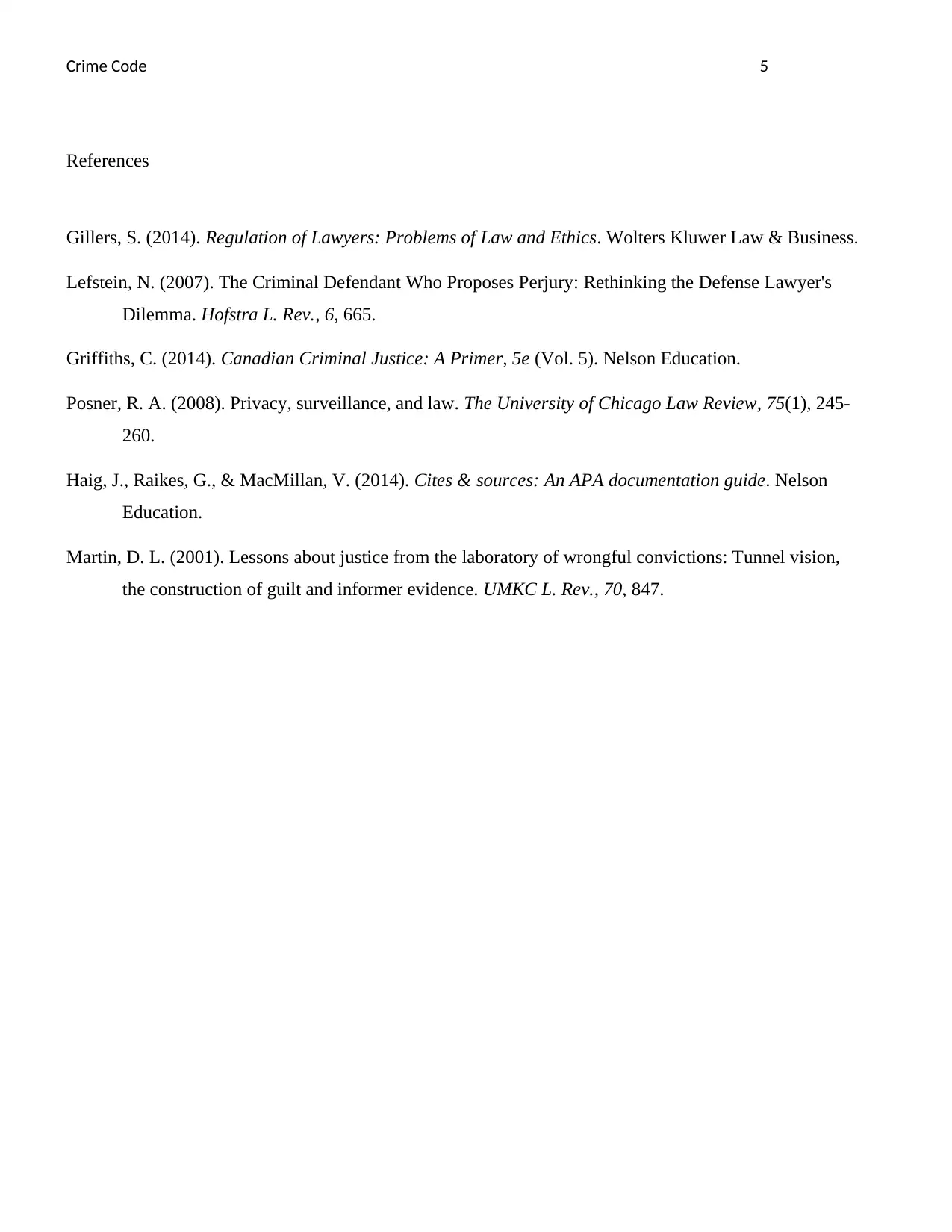
Gillers, S. (2014). Regulation of Lawyers: Problems of Law and Ethics. Wolters Kluwer Law & Business.
Lefstein, N. (2007). The Criminal Defendant Who Proposes Perjury: Rethinking the Defense Lawyer's
Dilemma. Hofstra L. Rev., 6, 665.
Griffiths, C. (2014). Canadian Criminal Justice: A Primer, 5e (Vol. 5). Nelson Education.
Posner, R. A. (2008). Privacy, surveillance, and law. The University of Chicago Law Review, 75(1), 245-
260.
Haig, J., Raikes, G., & MacMillan, V. (2014). Cites & sources: An APA documentation guide. Nelson
Education.
Martin, D. L. (2001). Lessons about justice from the laboratory of wrongful convictions: Tunnel vision,
the construction of guilt and informer evidence. UMKC L. Rev., 70, 847.
References
Gillers, S. (2014). Regulation of Lawyers: Problems of Law and Ethics. Wolters Kluwer Law & Business.
Lefstein, N. (2007). The Criminal Defendant Who Proposes Perjury: Rethinking the Defense Lawyer's
Dilemma. Hofstra L. Rev., 6, 665.
Griffiths, C. (2014). Canadian Criminal Justice: A Primer, 5e (Vol. 5). Nelson Education.
Posner, R. A. (2008). Privacy, surveillance, and law. The University of Chicago Law Review, 75(1), 245-
260.
Haig, J., Raikes, G., & MacMillan, V. (2014). Cites & sources: An APA documentation guide. Nelson
Education.
Martin, D. L. (2001). Lessons about justice from the laboratory of wrongful convictions: Tunnel vision,
the construction of guilt and informer evidence. UMKC L. Rev., 70, 847.
⊘ This is a preview!⊘
Do you want full access?
Subscribe today to unlock all pages.

Trusted by 1+ million students worldwide
1 out of 6
Related Documents
Your All-in-One AI-Powered Toolkit for Academic Success.
+13062052269
info@desklib.com
Available 24*7 on WhatsApp / Email
Unlock your academic potential
Copyright © 2020–2025 A2Z Services. All Rights Reserved. Developed and managed by ZUCOL.