Crisis Management Impact on Global Hospitality and Tourism Industry
VerifiedAdded on 2023/01/13
|14
|4553
|78
Report
AI Summary
This report delves into the critical aspects of crisis management within the global hospitality and tourism industry, using Premier Inn as a case study. It examines communication tools and techniques employed by tourist organizations to effectively manage crises, emphasizing real-time communication, accessibility of information, and the use of mobile apps and satellite phones. The report explores various theoretical approaches to crisis management in the hospitality sector, including the structural functional systems theory, diffusion of innovation theory, and the role of apologies and social media. It also provides a detailed analysis of the four phases of disaster management: mitigation, preparedness, response, and recovery. Furthermore, the report evaluates proactive and reactive management strategies, discusses the consequences of effective and ineffective crisis management, and highlights the importance of online reputation management. The report emphasizes the significance of training, crisis management teams, and competency certifications in ensuring effective crisis response and overall brand resilience.
CRISIS MANAGEMENT
AND THE IMPACT ON THE
GLOBAL HOSPITALITY
AND TOURISM INDUSTRY
AND THE IMPACT ON THE
GLOBAL HOSPITALITY
AND TOURISM INDUSTRY

Paraphrase This Document
Need a fresh take? Get an instant paraphrase of this document with our AI Paraphraser
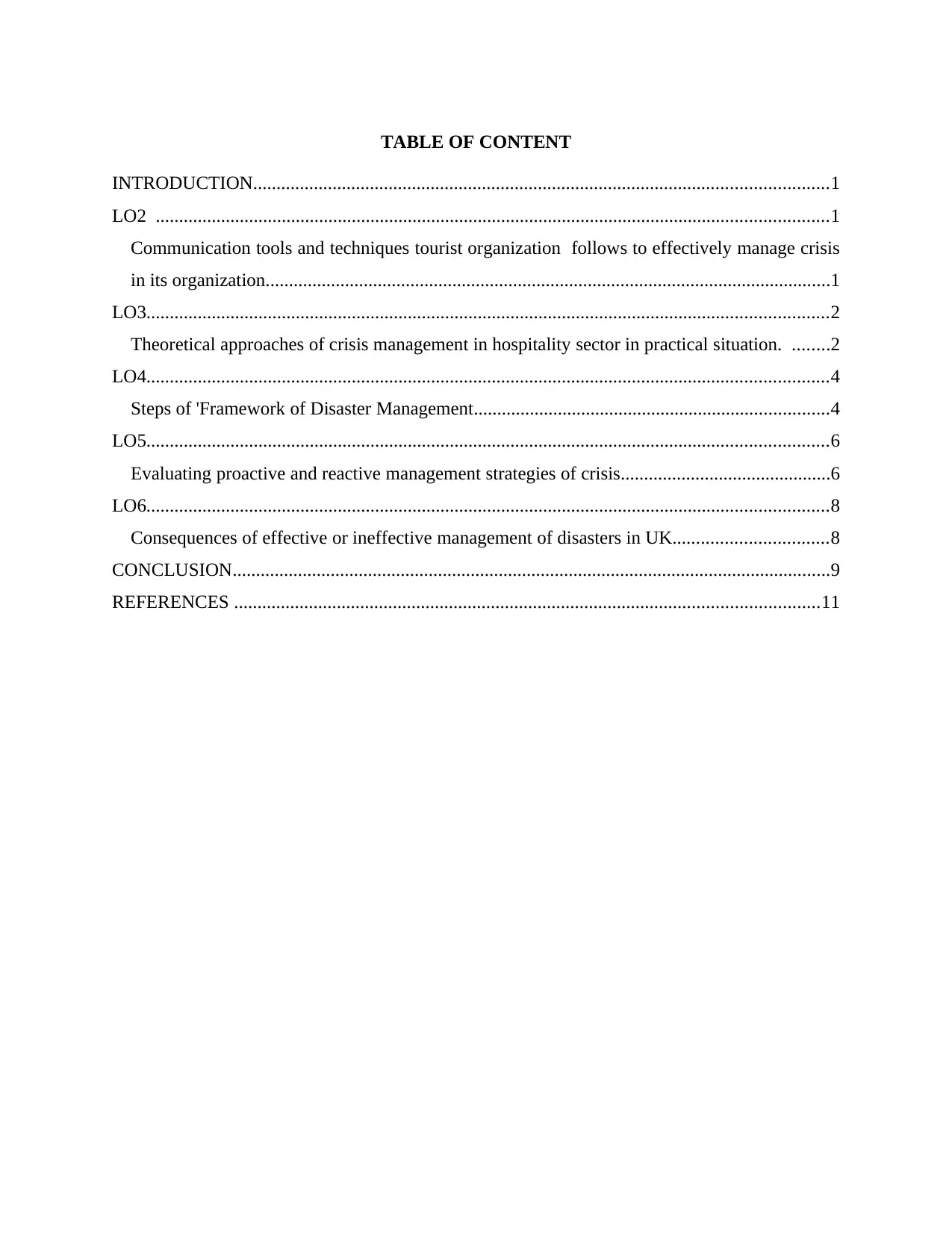
TABLE OF CONTENT
INTRODUCTION...........................................................................................................................1
LO2 ................................................................................................................................................1
Communication tools and techniques tourist organization follows to effectively manage crisis
in its organization.........................................................................................................................1
LO3..................................................................................................................................................2
Theoretical approaches of crisis management in hospitality sector in practical situation. ........2
LO4..................................................................................................................................................4
Steps of 'Framework of Disaster Management............................................................................4
LO5..................................................................................................................................................6
Evaluating proactive and reactive management strategies of crisis.............................................6
LO6..................................................................................................................................................8
Consequences of effective or ineffective management of disasters in UK.................................8
CONCLUSION................................................................................................................................9
REFERENCES .............................................................................................................................11
INTRODUCTION...........................................................................................................................1
LO2 ................................................................................................................................................1
Communication tools and techniques tourist organization follows to effectively manage crisis
in its organization.........................................................................................................................1
LO3..................................................................................................................................................2
Theoretical approaches of crisis management in hospitality sector in practical situation. ........2
LO4..................................................................................................................................................4
Steps of 'Framework of Disaster Management............................................................................4
LO5..................................................................................................................................................6
Evaluating proactive and reactive management strategies of crisis.............................................6
LO6..................................................................................................................................................8
Consequences of effective or ineffective management of disasters in UK.................................8
CONCLUSION................................................................................................................................9
REFERENCES .............................................................................................................................11
INTRODUCTION
Crisis management in general describes measures of all types which allow a business to
cope with suddenly occurring danger or risk situation to return to normal business schedule. It
includes activities and processes which help the managers and employees to analyse and
understand different crisis situation that could occur in the organization and the best way can be
figured to deal with such situation and respond accordingly. Premier Inn is one among the
biggest hotel chain in United Kingdom (UK). It is owned by British hospitality group
Whitebread. In the case study various strategies and tools are discussed which can help the
organization communicate better to people staying in it (Aliperti,2019). The study explain how
new technologies can worktop the effects of crisis on tourism industry in the contemporary
world. Various approaches of crisis management in hospitality sector are put into conversation.
The management strategies discussion also have context to global tourism.
Crisis communication team of the hotel is diverse enough to gather and understand wide
variety of information. Tourist at hotel can be of varied types some will require in-depth
information regarding technical details while others need only high level executive summaries.
The training is accordingly given to employees of Premier Inn. Most executive focus is given to
communication and public relations by it. The study explains about consequences the company
could face when crisis management are not effective.
LO2
Communication tools and techniques tourist organization follows to effectively manage crisis in
its organization.
Crisis communication refers to the technologies, systems and procedures that allows the
firm to effectively communicate during an emergency situation (Moutinho and Vargas-
Sanchez,2018). An effective communication ensures that all the tourists can quickly let know
each other about crisis and share the same information to the organization which rectifies the
situation sooner and protects the assets and employees and maintains continuity of work in the
firm. The ideal approach of crisis communication may include :
Communication should be in real time. Everyone in the organization should know about
trouble as soon as the emergency unfolds. Information should be accessible anywhere.
Employees should inform the tourist on their mobile phones instead of emails or manual phones
as the individual can be away from landline or in case of calamity there may be electricity cut.
1
Crisis management in general describes measures of all types which allow a business to
cope with suddenly occurring danger or risk situation to return to normal business schedule. It
includes activities and processes which help the managers and employees to analyse and
understand different crisis situation that could occur in the organization and the best way can be
figured to deal with such situation and respond accordingly. Premier Inn is one among the
biggest hotel chain in United Kingdom (UK). It is owned by British hospitality group
Whitebread. In the case study various strategies and tools are discussed which can help the
organization communicate better to people staying in it (Aliperti,2019). The study explain how
new technologies can worktop the effects of crisis on tourism industry in the contemporary
world. Various approaches of crisis management in hospitality sector are put into conversation.
The management strategies discussion also have context to global tourism.
Crisis communication team of the hotel is diverse enough to gather and understand wide
variety of information. Tourist at hotel can be of varied types some will require in-depth
information regarding technical details while others need only high level executive summaries.
The training is accordingly given to employees of Premier Inn. Most executive focus is given to
communication and public relations by it. The study explains about consequences the company
could face when crisis management are not effective.
LO2
Communication tools and techniques tourist organization follows to effectively manage crisis in
its organization.
Crisis communication refers to the technologies, systems and procedures that allows the
firm to effectively communicate during an emergency situation (Moutinho and Vargas-
Sanchez,2018). An effective communication ensures that all the tourists can quickly let know
each other about crisis and share the same information to the organization which rectifies the
situation sooner and protects the assets and employees and maintains continuity of work in the
firm. The ideal approach of crisis communication may include :
Communication should be in real time. Everyone in the organization should know about
trouble as soon as the emergency unfolds. Information should be accessible anywhere.
Employees should inform the tourist on their mobile phones instead of emails or manual phones
as the individual can be away from landline or in case of calamity there may be electricity cut.
1
⊘ This is a preview!⊘
Do you want full access?
Subscribe today to unlock all pages.

Trusted by 1+ million students worldwide
There are some mobile apps like Life360, FEMA app which can help to communicate better
(Smith,2017).
There are remote areas where internet is not accessible, Satellite phone (Satphones)
proves beneficial in these special condition. Some phones even have coverage in all parts of the
world. Radio are considered to be items of past but when at same frequency a modification of it,
Two-Way radio also known as walkies-talkies can connect people within a certain distance in the
campus of Premier Inn.
After it is successfully communicated, the tourist destination follows certain techniques for
better management crisis so that tourist staying here faces problem of no kind. Some techniques
followed includes :
Hospitality organization like Premier Inn always have a per-prepared plan that helps to
identify and avoid absolute risks that could end in crisis. The preparation aids in managing the
situation. The more one waits in crisis situation, more damage can be done. People at Premier
Inn are efficient enough to respond quickly to the situation. They stand hand in hand with the
people and take them out the crisis in the smartest way. Victims of the calamity are expressed
with empathy and concern by the hotel (Vignal Lambret and Barki 2018). The workers make sure
no bad news is buried as its coming out later can affect its brand name negatively.
Continuous assessment of action plan are carried out to identify gaps and redesign it for
better proficiency. Hotel management also have proposed training and demo test for various
calamities so that employee become intensely aware of performing when emergency situation
occurs in real. Skills and experience at every level of crisis response are crucial. On the basis of
response shown by employee in demo test, crisis management team are made by organization.
This team of Premier Inn is responsible to communicating media about the exact situation of
crisis in the hotel. Corporation is now introducing crisis management competency certification
for management and staff to ensure right skills are placed at right place.
LO3
Theoretical approaches of crisis management in hospitality sector in practical situation.
A theoretical crisis management model proposed identified three different stages of crisis
management. The three stages includes :
Diagnosis of Crisis : Detecting early indicators of crisis is what initial stage involves. Leaders
and managers of the hospitality organization must sense warning signals of crisis and prepares
2
(Smith,2017).
There are remote areas where internet is not accessible, Satellite phone (Satphones)
proves beneficial in these special condition. Some phones even have coverage in all parts of the
world. Radio are considered to be items of past but when at same frequency a modification of it,
Two-Way radio also known as walkies-talkies can connect people within a certain distance in the
campus of Premier Inn.
After it is successfully communicated, the tourist destination follows certain techniques for
better management crisis so that tourist staying here faces problem of no kind. Some techniques
followed includes :
Hospitality organization like Premier Inn always have a per-prepared plan that helps to
identify and avoid absolute risks that could end in crisis. The preparation aids in managing the
situation. The more one waits in crisis situation, more damage can be done. People at Premier
Inn are efficient enough to respond quickly to the situation. They stand hand in hand with the
people and take them out the crisis in the smartest way. Victims of the calamity are expressed
with empathy and concern by the hotel (Vignal Lambret and Barki 2018). The workers make sure
no bad news is buried as its coming out later can affect its brand name negatively.
Continuous assessment of action plan are carried out to identify gaps and redesign it for
better proficiency. Hotel management also have proposed training and demo test for various
calamities so that employee become intensely aware of performing when emergency situation
occurs in real. Skills and experience at every level of crisis response are crucial. On the basis of
response shown by employee in demo test, crisis management team are made by organization.
This team of Premier Inn is responsible to communicating media about the exact situation of
crisis in the hotel. Corporation is now introducing crisis management competency certification
for management and staff to ensure right skills are placed at right place.
LO3
Theoretical approaches of crisis management in hospitality sector in practical situation.
A theoretical crisis management model proposed identified three different stages of crisis
management. The three stages includes :
Diagnosis of Crisis : Detecting early indicators of crisis is what initial stage involves. Leaders
and managers of the hospitality organization must sense warning signals of crisis and prepares
2
Paraphrase This Document
Need a fresh take? Get an instant paraphrase of this document with our AI Paraphraser
employee of firm to face the same with courage and determination. No alarming signals are
ignored by the company and every necessary actions are taken against it.
Planning : An appropriate turnaround strategy must be chosen. Ask the employee not to panic.
Don't rely on mere guess works and assumptions, consider correct facts and figures.
Adjusting to changes : The hotel make sure that employee adjusts well to new situations and
changes for effective working of organization. Mistakes shouldn't be repeated and new plans
must be incorporated in the system.
Structural Functional Systems Theory : Providing information to an organization in a time of
crisis is important to better crisis management. The theory addresses complexion of information
networks and levels of command increasing communication in the organization.
Diffusion of innovation theory : It describes how innovation is spread and communicated
through certain channels over a period. This theory is applied to sharing of information and the
process involves an innovation, an individual that has knowledge to use innovation, another
individual that doesn't have the same and communication channel connecting the two units. For
instance ;Johnson and Johnson a pharmaceutical company which produced Tylenol capsules
found that a murderer added cyanide to some of Tylenol capsules which led to death of some
people. Company recalled all the capsules from the market and destroyed it and beard up with
the loss. As soon as the manager came to about crisis, in a minute it was communicated to the
whole nation which prevented people from taking medicine further. After that temper-resistant
packaging was introduced and Tylenol easily got back to near pre-crisis level of sales again
(Lachlan,2016).
Unequal human capital theory : An organizational crisis can be result from discrimination
lawsuits. It happens when minority employee receives fewer rewards than those with access to
executive management.
Role of apologies : When an organization takes responsibility for the crisis it shapes peoples
perception towards it. Giving compensation and showing sympathy are effective ways that
focuses on the victim's needs. Sympathy response express concern and compensation offers
victims something to subside suffering from it. For e.g.; Odewalla's apple juice was thought to be
reason of E.coli infection and due to same company lost a third of its market value. Within a day
company scheduled briefings for daily press, sent press release to recall the product from
market.. It also expressed remorse, concern and apologized for the crisis and took the
3
ignored by the company and every necessary actions are taken against it.
Planning : An appropriate turnaround strategy must be chosen. Ask the employee not to panic.
Don't rely on mere guess works and assumptions, consider correct facts and figures.
Adjusting to changes : The hotel make sure that employee adjusts well to new situations and
changes for effective working of organization. Mistakes shouldn't be repeated and new plans
must be incorporated in the system.
Structural Functional Systems Theory : Providing information to an organization in a time of
crisis is important to better crisis management. The theory addresses complexion of information
networks and levels of command increasing communication in the organization.
Diffusion of innovation theory : It describes how innovation is spread and communicated
through certain channels over a period. This theory is applied to sharing of information and the
process involves an innovation, an individual that has knowledge to use innovation, another
individual that doesn't have the same and communication channel connecting the two units. For
instance ;Johnson and Johnson a pharmaceutical company which produced Tylenol capsules
found that a murderer added cyanide to some of Tylenol capsules which led to death of some
people. Company recalled all the capsules from the market and destroyed it and beard up with
the loss. As soon as the manager came to about crisis, in a minute it was communicated to the
whole nation which prevented people from taking medicine further. After that temper-resistant
packaging was introduced and Tylenol easily got back to near pre-crisis level of sales again
(Lachlan,2016).
Unequal human capital theory : An organizational crisis can be result from discrimination
lawsuits. It happens when minority employee receives fewer rewards than those with access to
executive management.
Role of apologies : When an organization takes responsibility for the crisis it shapes peoples
perception towards it. Giving compensation and showing sympathy are effective ways that
focuses on the victim's needs. Sympathy response express concern and compensation offers
victims something to subside suffering from it. For e.g.; Odewalla's apple juice was thought to be
reason of E.coli infection and due to same company lost a third of its market value. Within a day
company scheduled briefings for daily press, sent press release to recall the product from
market.. It also expressed remorse, concern and apologized for the crisis and took the
3
responsibility of same. It also took several steps which restrains further repeat of the event and
openly aired it in media through full paper newspaper ads.
Social media and crisis management : Social method has accelerated the speed by which a crisis
can spread. The viral effect of it break news faster than traditional media making crisis
managmemnt harder. Social media creates a platform for two ways equal communication
between organization and the public provided that it have an internet connection.
Organization should have planned techniques to release information to media in the crisis
situation. Hotel should impart this work to crisis management team and a way to deal has to be
pre-explained. For eg: An emergency unfolded in Pepsi which claimed that there were syringes
in the can of drink. Organization immediately stopped the retailers from removing can from the
shelves and got the situation investigated. With the help of social media only firm released first
video showing how and where the can has been manufactured which shows syringe
incorporation is not possible at factory (Jiang,Scott and Ritchie,2018). Second video release
showed arresting of a man. Lastly a CCTV camera footage of a general store was aired in which
woman was inserting syringe in the can. The company along with the public and FDA worked
during the crisis. Effective communication in public did not affect brand name of firm. After the
crisis has been resolved, corporation released thank you video from time to time thank public for
abiding by the corporation. Coupons for further compensation were also issued and thus effective
crisis management was done.
The final step of crisis management is recovery of the loss occurred to the brand name. It
includes use of online reputation management to repair digital image (Heath,2018). The digital
footprint can be expanded and strengthen by investing in SEO-driven online reputation
management services. Every crisis is an opportunity to showcase institution's character, its
commitment to brand promise and its institutional values. The online tattered search results
should also be fixed by expertise.
LO4
Steps of 'Framework of Disaster Management
Disaster management is the process through which an organisation curtails the impact,
reacts to and recovers from a natural or man made disaster. There are mainly four phases of
disaster management that Premier Inn chain can make use of, in order to curtail the impact of
natural or man made disasters. Proper implementation of this disaster management cycle can
4
openly aired it in media through full paper newspaper ads.
Social media and crisis management : Social method has accelerated the speed by which a crisis
can spread. The viral effect of it break news faster than traditional media making crisis
managmemnt harder. Social media creates a platform for two ways equal communication
between organization and the public provided that it have an internet connection.
Organization should have planned techniques to release information to media in the crisis
situation. Hotel should impart this work to crisis management team and a way to deal has to be
pre-explained. For eg: An emergency unfolded in Pepsi which claimed that there were syringes
in the can of drink. Organization immediately stopped the retailers from removing can from the
shelves and got the situation investigated. With the help of social media only firm released first
video showing how and where the can has been manufactured which shows syringe
incorporation is not possible at factory (Jiang,Scott and Ritchie,2018). Second video release
showed arresting of a man. Lastly a CCTV camera footage of a general store was aired in which
woman was inserting syringe in the can. The company along with the public and FDA worked
during the crisis. Effective communication in public did not affect brand name of firm. After the
crisis has been resolved, corporation released thank you video from time to time thank public for
abiding by the corporation. Coupons for further compensation were also issued and thus effective
crisis management was done.
The final step of crisis management is recovery of the loss occurred to the brand name. It
includes use of online reputation management to repair digital image (Heath,2018). The digital
footprint can be expanded and strengthen by investing in SEO-driven online reputation
management services. Every crisis is an opportunity to showcase institution's character, its
commitment to brand promise and its institutional values. The online tattered search results
should also be fixed by expertise.
LO4
Steps of 'Framework of Disaster Management
Disaster management is the process through which an organisation curtails the impact,
reacts to and recovers from a natural or man made disaster. There are mainly four phases of
disaster management that Premier Inn chain can make use of, in order to curtail the impact of
natural or man made disasters. Proper implementation of this disaster management cycle can
4
⊘ This is a preview!⊘
Do you want full access?
Subscribe today to unlock all pages.
Trusted by 1+ million students worldwide
provide Premier Inns with earlier warnings, reduced vulnerability, better preparedness and
greater chances to minimise property and human losses. These four steps include mitigation,
preparedness, response and recovery (Kirschenbaum, 2019). Mitigation and preparedness are
pre-disaster strategies focusing on reducing human and property losses due to disasters, while
response and recovery are post-disaster strategies taken in response to particular disaster with the
primary objective being recovery and rehabilitation of all people who are affected.
MITIGATION:
Mitigation strategies focus on or reducing or eliminating the impact of unavoidable
disasters such as injuries, loss of life and property, loss of ecosystem etc. or on decreasing the
probability of disaster occurrence altogether. These are implemented through various legal,
administrative, political, infrastructural measures as well as educating communities about
preventative measures in the event of a disaster. Some examples of mitigation strategies include
government implementing regulations and laws to curb deforestation in mudslide prone areas,
elevating or relocating buildings to minimise impact of floods in risky areas, engineering bridges
and buildings able to withstand earthquakes in constantly affected areas etc. Mitigation strategy
depends upon implementation of strategies in local and national development planning.
Effectiveness of mitigation strategies also depends on the public knowledge of these hazards and
how countermeasures are taken up by the government (Ray, Mukherjee and Shu, 2017). Premier
Inn can try to mitigate damages by educating its employees and customers of impending threats
and how best to avoid them.
PREPAREDNESS:
The primary objective of preparedness programs is to implement an adequate system that
can respond to any emergency situation in order to minimise incurring human and property
losses. Preparedness programs include strategies in how to deal with disasters, having dedicated
response procedures and mechanisms and short term or long term strategies. Educating public
and building warning systems are also preparedness strategies. These strategies can also mandate
maintaining strategic reserves of water, food, medicines and first aid kits in the event of national
or local catastrophes. Just as with mitigation, preparedness strategies depend upon the
implementation of appropriate strategies in local and national development planning. Its
effectiveness is also based on the quality of public emergency training, imminent emergency
5
greater chances to minimise property and human losses. These four steps include mitigation,
preparedness, response and recovery (Kirschenbaum, 2019). Mitigation and preparedness are
pre-disaster strategies focusing on reducing human and property losses due to disasters, while
response and recovery are post-disaster strategies taken in response to particular disaster with the
primary objective being recovery and rehabilitation of all people who are affected.
MITIGATION:
Mitigation strategies focus on or reducing or eliminating the impact of unavoidable
disasters such as injuries, loss of life and property, loss of ecosystem etc. or on decreasing the
probability of disaster occurrence altogether. These are implemented through various legal,
administrative, political, infrastructural measures as well as educating communities about
preventative measures in the event of a disaster. Some examples of mitigation strategies include
government implementing regulations and laws to curb deforestation in mudslide prone areas,
elevating or relocating buildings to minimise impact of floods in risky areas, engineering bridges
and buildings able to withstand earthquakes in constantly affected areas etc. Mitigation strategy
depends upon implementation of strategies in local and national development planning.
Effectiveness of mitigation strategies also depends on the public knowledge of these hazards and
how countermeasures are taken up by the government (Ray, Mukherjee and Shu, 2017). Premier
Inn can try to mitigate damages by educating its employees and customers of impending threats
and how best to avoid them.
PREPAREDNESS:
The primary objective of preparedness programs is to implement an adequate system that
can respond to any emergency situation in order to minimise incurring human and property
losses. Preparedness programs include strategies in how to deal with disasters, having dedicated
response procedures and mechanisms and short term or long term strategies. Educating public
and building warning systems are also preparedness strategies. These strategies can also mandate
maintaining strategic reserves of water, food, medicines and first aid kits in the event of national
or local catastrophes. Just as with mitigation, preparedness strategies depend upon the
implementation of appropriate strategies in local and national development planning. Its
effectiveness is also based on the quality of public emergency training, imminent emergency
5
Paraphrase This Document
Need a fresh take? Get an instant paraphrase of this document with our AI Paraphraser
warning alarms, stored resource inventories and quality of affected area's communication
systems. Premier Inn can prepare its employees by enforcing regular safety drills.
RESPONSE:
Response is the phase implemented after a disaster has occurred with its primary
objective being to provide immediate urgent relief support to affected areas in order to save lives,
reduce infrastructural damage, improve living conditions and support the morale of devastated
communities. This support may range from providing limited specific aid such as food, water,
medicines, or providing temporary shelters to affected communities (Alazawi, 2019,). Response
strategies generally include search and rescue operations, triage, providing basic medical care to
injured population, combating fire and other resulting phenomenon, providing temporary shelters
to recently homeless people. The main focus of response strategies is on taking care of basic
needs of people after a disaster has occurred until a more sustainable and permanent solution can
be found. Humanitarian organisations prove themselves extremely helpful during this phase of
disaster management cycle, providing volunteers for search and rescue of survivors, collecting
necessary resources such as food, water, clothes and medicines for survivors and assisting
government's disaster response team with their operations. Premier Inn should reserve necessary
resources for responding in the event of a disaster.
RECOVERY:
With the emergency situation beginning to get under control, the survivors of the disaster
are now capable of performing various activities in order to restore their livelihood and the
buildings and infrastructure need to support their functioning. Recovery strategies include both
short term and long term measures such as building houses, repairing buildings, improving
infrastructure, hospitals, educating public about health and safety procedures, creating
counselling programs for heavily affected communities, conducting economic and social impact
studies and analysing how similar disasters occurring in the future can be better handled to
maximise public safety and health. Premier Inn should analyse the damages suffered during
occurred disaster and find ways to improve their response for future mishaps.
LO5
Evaluating proactive and reactive management strategies of crisis
Crisis management is the process through which Premier Inn chain can deal with sudden
disruptive changes or events that threaten to harm its operations and functioning such as human
6
systems. Premier Inn can prepare its employees by enforcing regular safety drills.
RESPONSE:
Response is the phase implemented after a disaster has occurred with its primary
objective being to provide immediate urgent relief support to affected areas in order to save lives,
reduce infrastructural damage, improve living conditions and support the morale of devastated
communities. This support may range from providing limited specific aid such as food, water,
medicines, or providing temporary shelters to affected communities (Alazawi, 2019,). Response
strategies generally include search and rescue operations, triage, providing basic medical care to
injured population, combating fire and other resulting phenomenon, providing temporary shelters
to recently homeless people. The main focus of response strategies is on taking care of basic
needs of people after a disaster has occurred until a more sustainable and permanent solution can
be found. Humanitarian organisations prove themselves extremely helpful during this phase of
disaster management cycle, providing volunteers for search and rescue of survivors, collecting
necessary resources such as food, water, clothes and medicines for survivors and assisting
government's disaster response team with their operations. Premier Inn should reserve necessary
resources for responding in the event of a disaster.
RECOVERY:
With the emergency situation beginning to get under control, the survivors of the disaster
are now capable of performing various activities in order to restore their livelihood and the
buildings and infrastructure need to support their functioning. Recovery strategies include both
short term and long term measures such as building houses, repairing buildings, improving
infrastructure, hospitals, educating public about health and safety procedures, creating
counselling programs for heavily affected communities, conducting economic and social impact
studies and analysing how similar disasters occurring in the future can be better handled to
maximise public safety and health. Premier Inn should analyse the damages suffered during
occurred disaster and find ways to improve their response for future mishaps.
LO5
Evaluating proactive and reactive management strategies of crisis
Crisis management is the process through which Premier Inn chain can deal with sudden
disruptive changes or events that threaten to harm its operations and functioning such as human
6
mistakes, accidents or any natural disasters. The strategy to minimise impact of such events and
mitigate their effects is know as crisis management. Crisis management can be performed by
following two different approaches called proactive and reactive crisis management strategies.
The main difference between proactive and reactive strategies is that while proactive strategies
are adaptive, feedback control approaches that rely upon observation and measurement, reactive
strategies are responsive in nature dependent on disaster evaluation and investigative findings
(Wang and Ye, 2018).
Proactive Crisis Management: This approach tries to identify all possible risks and potential
hazards that could happen before they take place. As Premier Inn have to deal with numerous
functional changes caused by technological innovation, increased competition and rising public
concerns, proactive management approach doesn't rely on past disruptive incidents for guidance.
The primary objectives of proactive crisis management approach is to first identify behaviours
that can potentially lead to the occurrence of a disaster or hazard and stop it before it occurs, to
analyse root cause for hazard occurrence before they happen and figure out safety inputs of
program. To perform proactive crisis management one Premier Inns would require huge safety
data sets, ability yo monitor various safety metrics and an adaptable safety culture. Proactive
crisis management approach is best suited to situations that require understanding of underlying
attributes, actions and behaviours which can directly be correlated to and influence an Premier
Inn's safety performance. It is also suited to situations when relationship between various base
causes and hazard occurrence needs to be created (Bundy and et.al., 2017). Accidental analysis is
also a part of the proactive crisis management approach where accidental scenarios are created
and employees who may initiate these accidents are identified and educated to offer the
organisation better chances at crisis management.
Premier Inn can offer better safety standards to its customers through implementation of
proactive crisis management approach in their hotels by installing fire extinguishers in all
lobbies, creating emergency staircases and exits in case of sudden accidental fire and training
their staffs with regular safety drills.
Reactive Crisis Management: This approach records every accident occurred in the past and
documents them in order to determine the factors that lead to that hazard. Measures to prevent
occurrence of potential hazards and how these measures are implemented are provided through
the use of reactive crisis management approach (Coombs and Laufer, 2018). This approach was
7
mitigate their effects is know as crisis management. Crisis management can be performed by
following two different approaches called proactive and reactive crisis management strategies.
The main difference between proactive and reactive strategies is that while proactive strategies
are adaptive, feedback control approaches that rely upon observation and measurement, reactive
strategies are responsive in nature dependent on disaster evaluation and investigative findings
(Wang and Ye, 2018).
Proactive Crisis Management: This approach tries to identify all possible risks and potential
hazards that could happen before they take place. As Premier Inn have to deal with numerous
functional changes caused by technological innovation, increased competition and rising public
concerns, proactive management approach doesn't rely on past disruptive incidents for guidance.
The primary objectives of proactive crisis management approach is to first identify behaviours
that can potentially lead to the occurrence of a disaster or hazard and stop it before it occurs, to
analyse root cause for hazard occurrence before they happen and figure out safety inputs of
program. To perform proactive crisis management one Premier Inns would require huge safety
data sets, ability yo monitor various safety metrics and an adaptable safety culture. Proactive
crisis management approach is best suited to situations that require understanding of underlying
attributes, actions and behaviours which can directly be correlated to and influence an Premier
Inn's safety performance. It is also suited to situations when relationship between various base
causes and hazard occurrence needs to be created (Bundy and et.al., 2017). Accidental analysis is
also a part of the proactive crisis management approach where accidental scenarios are created
and employees who may initiate these accidents are identified and educated to offer the
organisation better chances at crisis management.
Premier Inn can offer better safety standards to its customers through implementation of
proactive crisis management approach in their hotels by installing fire extinguishers in all
lobbies, creating emergency staircases and exits in case of sudden accidental fire and training
their staffs with regular safety drills.
Reactive Crisis Management: This approach records every accident occurred in the past and
documents them in order to determine the factors that lead to that hazard. Measures to prevent
occurrence of potential hazards and how these measures are implemented are provided through
the use of reactive crisis management approach (Coombs and Laufer, 2018). This approach was
7
⊘ This is a preview!⊘
Do you want full access?
Subscribe today to unlock all pages.
Trusted by 1+ million students worldwide
used in earlier models of crisis management as it has a tendency to cause major delays at
workplace due to the model's unpreparedness for new accidents. This prevailing unpreparedness
makes crisis management process complex as the root cause of accident needs to be investigated
and solutions can be of high cost, often involving extensive modification of the workplace.
Reactive crisis management's objectives are implementing safety procedures after hazard has
occurred, minimising losses from hazardous incidents, acting efficiently and quickly in response
to the undesired hazards and making high quality decisions in reaction to safety threats. High
quality decision making is essential to reactive approach as the management will have to deal
with additional safety events as they understand what risks they are prone to. This can be
achieved by risk management training, strong bureaucracy related to safety behaviour and
gaining experience with identifying and analysing safety events (Williams and et.al., 2017).
Reactive approach is best suited to situations where required safety data to implement proactive
approach is unavailable and in situations where threats suddenly arise in the workplace.
Premier Inn can implement reactive crisis management approach to its hotels which
operate in earthquake prone areas, by analysing the frequency and magnitude of previous
earthquakes and building infrastructure and facilities that can withstand most earthquakes that
occur in that location, increasing safety of its employees and customers.
LO6
Consequences of effective or ineffective management of disasters in UK
Natural or man made disasters have a colossal impact on humans and their surrounding
environment. Disaster management enables us to prepare against and minimise damages inflicted
after inevitable disasters. Integration of new tools and processes such as current technological
advancement, communication innovations and improved environmental knowledge with disaster
management strategies results in its effective implementation which is key to saving lives and
mitigating losses (St Pierre, Hofinger and Simon, 2016). Although its ineffective implementation
can result in excessive human and property loss. Following are the major consequences of
effective or ineffective management of disasters by Premier Inn in UK.
Impact on Life: In the event of a disaster, effective implementation of disaster management can
help Premier Inn save lives of numerous employees and customers, while its ineffective
implementation will surely result in drastic loss of life of employees and customers alike.
8
workplace due to the model's unpreparedness for new accidents. This prevailing unpreparedness
makes crisis management process complex as the root cause of accident needs to be investigated
and solutions can be of high cost, often involving extensive modification of the workplace.
Reactive crisis management's objectives are implementing safety procedures after hazard has
occurred, minimising losses from hazardous incidents, acting efficiently and quickly in response
to the undesired hazards and making high quality decisions in reaction to safety threats. High
quality decision making is essential to reactive approach as the management will have to deal
with additional safety events as they understand what risks they are prone to. This can be
achieved by risk management training, strong bureaucracy related to safety behaviour and
gaining experience with identifying and analysing safety events (Williams and et.al., 2017).
Reactive approach is best suited to situations where required safety data to implement proactive
approach is unavailable and in situations where threats suddenly arise in the workplace.
Premier Inn can implement reactive crisis management approach to its hotels which
operate in earthquake prone areas, by analysing the frequency and magnitude of previous
earthquakes and building infrastructure and facilities that can withstand most earthquakes that
occur in that location, increasing safety of its employees and customers.
LO6
Consequences of effective or ineffective management of disasters in UK
Natural or man made disasters have a colossal impact on humans and their surrounding
environment. Disaster management enables us to prepare against and minimise damages inflicted
after inevitable disasters. Integration of new tools and processes such as current technological
advancement, communication innovations and improved environmental knowledge with disaster
management strategies results in its effective implementation which is key to saving lives and
mitigating losses (St Pierre, Hofinger and Simon, 2016). Although its ineffective implementation
can result in excessive human and property loss. Following are the major consequences of
effective or ineffective management of disasters by Premier Inn in UK.
Impact on Life: In the event of a disaster, effective implementation of disaster management can
help Premier Inn save lives of numerous employees and customers, while its ineffective
implementation will surely result in drastic loss of life of employees and customers alike.
8
Paraphrase This Document
Need a fresh take? Get an instant paraphrase of this document with our AI Paraphraser
Impact on Property: Effective implementation of disaster management can reduce the damages
inflicted to Premier Inn properties and safeguard lives of everyone inside them. On the contrary,
its ineffective implementation will result in partial or complete destruction of properties and
personnel within.
Impact on Operations & Productivity: Effective implementation of disaster management will
lessen a disaster's impact on Premier Inn's operations and productivity and keep their businesses
viable in the event of a disaster, while its ineffective implementation of disaster management will
put a stop to most if not all of Premier Inn's operations and productivity.
Impact on Brand Image & Reputation: Effective implementation of disaster management will
surely increase Premier Inn's reputation and brand image in the market, leading to better business
opportunities (Liu, Shankar and Yun, 2017). On the contrary, ineffective implementation of
disaster management will highlight Premier Inn in a negative light in the public's eye and
decrease their brand reputation and name, resulting in meagre business opportunities.
Impact on Profitability: Effective implementation of disaster management can help in hugely
mitigating both human and property losses and its ineffective implementation can result in
drastic human and property losses. This has an enormous effect on Premier Inn's profitability as
effective implementation of disaster management can potentially save huge costs to Premier Inn
in the long run, while ineffective implementation can result in a total shutdown of operations and
Premier Inn having to completely reconstruct its infrastructure and rehire most employees.
Ethical Implications: Effective implementation of disaster management is a moral duty of
Premier Inn as their employees and customers expect some assurances and safeguards in the
event of a disaster or accident. Ineffective implementation of disaster management would betray
this trust that employees and customers have shown in Premier Inn chain and would leave lasting
memories in the minds of public deterring future employees and customers.
Legal Implications: While the governing bodies don't reward effective implementation of
disaster management, certain laws and regulations exist in order to punish organisations that
choose to ignore this aspect (Kapucu and Boin, 2017). Especially in some disaster prone areas,
failure to adhere to these laws and regulations can result in cancellation of licences, permits and
imposition of heavy monetary fines. Premier Inn should also implement disaster management
system to avoid getting into legal trouble with the state.
9
inflicted to Premier Inn properties and safeguard lives of everyone inside them. On the contrary,
its ineffective implementation will result in partial or complete destruction of properties and
personnel within.
Impact on Operations & Productivity: Effective implementation of disaster management will
lessen a disaster's impact on Premier Inn's operations and productivity and keep their businesses
viable in the event of a disaster, while its ineffective implementation of disaster management will
put a stop to most if not all of Premier Inn's operations and productivity.
Impact on Brand Image & Reputation: Effective implementation of disaster management will
surely increase Premier Inn's reputation and brand image in the market, leading to better business
opportunities (Liu, Shankar and Yun, 2017). On the contrary, ineffective implementation of
disaster management will highlight Premier Inn in a negative light in the public's eye and
decrease their brand reputation and name, resulting in meagre business opportunities.
Impact on Profitability: Effective implementation of disaster management can help in hugely
mitigating both human and property losses and its ineffective implementation can result in
drastic human and property losses. This has an enormous effect on Premier Inn's profitability as
effective implementation of disaster management can potentially save huge costs to Premier Inn
in the long run, while ineffective implementation can result in a total shutdown of operations and
Premier Inn having to completely reconstruct its infrastructure and rehire most employees.
Ethical Implications: Effective implementation of disaster management is a moral duty of
Premier Inn as their employees and customers expect some assurances and safeguards in the
event of a disaster or accident. Ineffective implementation of disaster management would betray
this trust that employees and customers have shown in Premier Inn chain and would leave lasting
memories in the minds of public deterring future employees and customers.
Legal Implications: While the governing bodies don't reward effective implementation of
disaster management, certain laws and regulations exist in order to punish organisations that
choose to ignore this aspect (Kapucu and Boin, 2017). Especially in some disaster prone areas,
failure to adhere to these laws and regulations can result in cancellation of licences, permits and
imposition of heavy monetary fines. Premier Inn should also implement disaster management
system to avoid getting into legal trouble with the state.
9
CONCLUSION
In conclusion, this report analyses the tools and strategies used by the tourism
organisation 'Premier Inn' based in UK to effectively identify, manage and recover from crises by
applying theoretical approaches of crisis management to real life situations. This report also
examines the various frameworks through which Premier Inn can implement disaster
management, evaluates proactive and reactive strategies of crises management with examples on
how their implementation would benefit Premier Inn. The report also assesses the various
consequences of Premier Inn's effective or ineffective implementation of disaster management.
10
In conclusion, this report analyses the tools and strategies used by the tourism
organisation 'Premier Inn' based in UK to effectively identify, manage and recover from crises by
applying theoretical approaches of crisis management to real life situations. This report also
examines the various frameworks through which Premier Inn can implement disaster
management, evaluates proactive and reactive strategies of crises management with examples on
how their implementation would benefit Premier Inn. The report also assesses the various
consequences of Premier Inn's effective or ineffective implementation of disaster management.
10
⊘ This is a preview!⊘
Do you want full access?
Subscribe today to unlock all pages.
Trusted by 1+ million students worldwide

1 out of 14


Related Documents


Your All-in-One AI-Powered Toolkit for Academic Success.
+13062052269
info@desklib.com
Available 24*7 on WhatsApp / Email
![[object Object]](/_next/static/media/star-bottom.7253800d.svg)
Unlock your academic potential
Copyright © 2020–2026 A2Z Services. All Rights Reserved. Developed and managed by ZUCOL.