TOU9171M MCs International Hospitality: Crisis Management Report
VerifiedAdded on 2020/11/02
|21
|6156
|69
Report
AI Summary
This report presents a comprehensive analysis of the crisis management strategies employed by Le Petit Gourmet Catering in response to a food poisoning incident. The report delves into the background of the organization, the nature of the crisis, and the phases through which it unfolded. It identifies the turning point of the crisis and examines the stakeholders affected, including the business owner, staff, and clients. The analysis encompasses internal and external communication strategies, the role of the spokesperson, and the timeline of events. The report also evaluates perceived threats and resolutions, providing insights into the effectiveness of the management's response. The findings are based on academic journals, online resources, and literature references. The report concludes with recommendations for future research and management of crises in the hospitality sector.
25011414 Trung Chanh Tran TOU9171M
MCs International Hospitality Management with Professional Practice
TOU9171M – Crisis Management for Hospitality Enterprises
Report of Crisis Management: The Case Study of Le Petit Gourmet
Student: Trung Chanh Tran
Martin Knight
Natascha McVeigh Word Count – 2199
MCs International Hospitality Management with Professional Practice
TOU9171M – Crisis Management for Hospitality Enterprises
Report of Crisis Management: The Case Study of Le Petit Gourmet
Student: Trung Chanh Tran
Martin Knight
Natascha McVeigh Word Count – 2199

Paraphrase This Document
Need a fresh take? Get an instant paraphrase of this document with our AI Paraphraser
25011414 Trung Chanh Tran TOU9171M
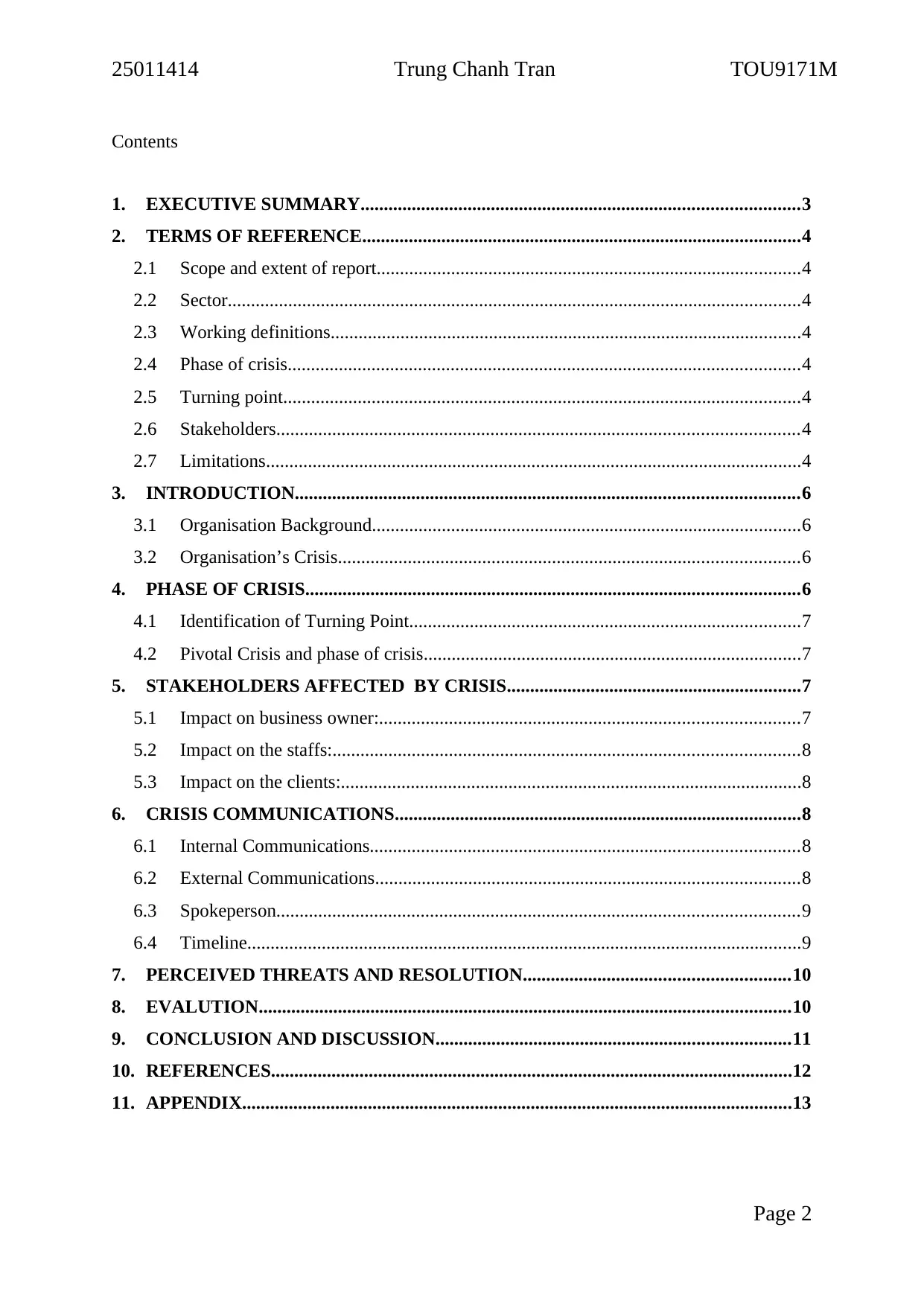
Contents
1. EXECUTIVE SUMMARY..............................................................................................3
2. TERMS OF REFERENCE..............................................................................................4
2.1 Scope and extent of report...........................................................................................4
2.2 Sector...........................................................................................................................4
2.3 Working definitions.....................................................................................................4
2.4 Phase of crisis..............................................................................................................4
2.5 Turning point...............................................................................................................4
2.6 Stakeholders................................................................................................................4
2.7 Limitations...................................................................................................................4
3. INTRODUCTION............................................................................................................6
3.1 Organisation Background............................................................................................6
3.2 Organisation’s Crisis...................................................................................................6
4. PHASE OF CRISIS..........................................................................................................6
4.1 Identification of Turning Point....................................................................................7
4.2 Pivotal Crisis and phase of crisis.................................................................................7
5. STAKEHOLDERS AFFECTED BY CRISIS...............................................................7
5.1 Impact on business owner:..........................................................................................7
5.2 Impact on the staffs:....................................................................................................8
5.3 Impact on the clients:...................................................................................................8
6. CRISIS COMMUNICATIONS.......................................................................................8
6.1 Internal Communications............................................................................................8
6.2 External Communications...........................................................................................8
6.3 Spokeperson................................................................................................................9
6.4 Timeline.......................................................................................................................9
7. PERCEIVED THREATS AND RESOLUTION.........................................................10
8. EVALUTION..................................................................................................................10
9. CONCLUSION AND DISCUSSION............................................................................11
10. REFERENCES................................................................................................................12
11. APPENDIX......................................................................................................................13
Page 2
Contents
1. EXECUTIVE SUMMARY..............................................................................................3
2. TERMS OF REFERENCE..............................................................................................4
2.1 Scope and extent of report...........................................................................................4
2.2 Sector...........................................................................................................................4
2.3 Working definitions.....................................................................................................4
2.4 Phase of crisis..............................................................................................................4
2.5 Turning point...............................................................................................................4
2.6 Stakeholders................................................................................................................4
2.7 Limitations...................................................................................................................4
3. INTRODUCTION............................................................................................................6
3.1 Organisation Background............................................................................................6
3.2 Organisation’s Crisis...................................................................................................6
4. PHASE OF CRISIS..........................................................................................................6
4.1 Identification of Turning Point....................................................................................7
4.2 Pivotal Crisis and phase of crisis.................................................................................7
5. STAKEHOLDERS AFFECTED BY CRISIS...............................................................7
5.1 Impact on business owner:..........................................................................................7
5.2 Impact on the staffs:....................................................................................................8
5.3 Impact on the clients:...................................................................................................8
6. CRISIS COMMUNICATIONS.......................................................................................8
6.1 Internal Communications............................................................................................8
6.2 External Communications...........................................................................................8
6.3 Spokeperson................................................................................................................9
6.4 Timeline.......................................................................................................................9
7. PERCEIVED THREATS AND RESOLUTION.........................................................10
8. EVALUTION..................................................................................................................10
9. CONCLUSION AND DISCUSSION............................................................................11
10. REFERENCES................................................................................................................12
11. APPENDIX......................................................................................................................13
Page 2
25011414 Trung Chanh Tran TOU9171M
1. EXECUTIVE SUMMARY
As the amount of crises affecting the national economy in general and the hospitality
sector particularly, it is becoming necessary to understand the nature of these crises and how
to limit the impacts of such incidents. This report examines hospitality crisis management
practices within the context of the Le Petit Gourmet – a family catering located in central
Denver, Colorado, USA. The paper also focused on examining the occurrence of food
poisoning incident which has been traced to the organisation. The report is conducted with
some crisis communications frameworks that evaluate the importance and imperiousness of
crisis management in the hospitality industry. The findings illustrate which practices
hospitality managers should consider as crucial and which practices they actually use during
the crisis. The report also concludes with some recommendations for future research and
management of crises. All of the analysis and evaluations are made using facts and
information gathered from academic journals, online resources and literature references.
Page 3
1. EXECUTIVE SUMMARY
As the amount of crises affecting the national economy in general and the hospitality
sector particularly, it is becoming necessary to understand the nature of these crises and how
to limit the impacts of such incidents. This report examines hospitality crisis management
practices within the context of the Le Petit Gourmet – a family catering located in central
Denver, Colorado, USA. The paper also focused on examining the occurrence of food
poisoning incident which has been traced to the organisation. The report is conducted with
some crisis communications frameworks that evaluate the importance and imperiousness of
crisis management in the hospitality industry. The findings illustrate which practices
hospitality managers should consider as crucial and which practices they actually use during
the crisis. The report also concludes with some recommendations for future research and
management of crises. All of the analysis and evaluations are made using facts and
information gathered from academic journals, online resources and literature references.
Page 3
⊘ This is a preview!⊘
Do you want full access?
Subscribe today to unlock all pages.

Trusted by 1+ million students worldwide
25011414 Trung Chanh Tran TOU9171M
2. TERMS OF REFERENCE
This Terms of Reference will guide the development of Le Petit Gourmet Catering: A Crisis
Management Report. This report forms part of the comprehensive strategic assessment of Le
Petit Gourmet Catering in Denver, Colorado, USA. Key issues raised in this report related to:
2.1 Scope and extent of report
This report is aimed to evaluate crisis communication process of Le Petit Gourmet
Catering in Denver, USA. The report will concentrate in analysing the response strategy of
business owner during their food poisoning incident. The time period is 1-year length which
is from December 1992 to December 1993.
2.2 Sector
This report will discuss the crisis management strategy of a local hospitality
organisation, with its influence in a national dimension as the incident had affected a wide
range of internal and external stakeholders.
2.3 Working definitions
Pauchant and Mitroff (1992) defined crisis as a “disruption that physically affects a
system as a whole and threatens its basis assumptions, its subjective sense of self, its
existential core”. This statement could be adopted as a working definition of crisis for the
case of Le Petit Gourmet Catering since the incident has severely affected the organisation’s
reputation and outcomes, also its target audiences and the core stakeholders.
2.4 Phase of crisis
The report will analyse and evaluate the reactive and recovery phase of the crisis, or
chronic crisis stage and crisis resolution stage.
2.5 Turning point
The turning point here refers to the point of time when the crisis marked an escalation
in intensity. The turning point of Le Petit Gourmet Catering was right after the food
poisoning incident which had been traced to the organisation in December, 1992.
2.6 Stakeholders
There are three predominant stakeholders that had been directly impacted by the
crisis: the business owner, the staffs and the customers.
2.7 Limitations
It is undeniable that this study has limitations, mostly due to the limited access and
ability to examine the reliability of statistics released by the company in 1992. Moreover,
most of the information and statistics displayed in this report was gathered through online
Page 4
2. TERMS OF REFERENCE
This Terms of Reference will guide the development of Le Petit Gourmet Catering: A Crisis
Management Report. This report forms part of the comprehensive strategic assessment of Le
Petit Gourmet Catering in Denver, Colorado, USA. Key issues raised in this report related to:
2.1 Scope and extent of report
This report is aimed to evaluate crisis communication process of Le Petit Gourmet
Catering in Denver, USA. The report will concentrate in analysing the response strategy of
business owner during their food poisoning incident. The time period is 1-year length which
is from December 1992 to December 1993.
2.2 Sector
This report will discuss the crisis management strategy of a local hospitality
organisation, with its influence in a national dimension as the incident had affected a wide
range of internal and external stakeholders.
2.3 Working definitions
Pauchant and Mitroff (1992) defined crisis as a “disruption that physically affects a
system as a whole and threatens its basis assumptions, its subjective sense of self, its
existential core”. This statement could be adopted as a working definition of crisis for the
case of Le Petit Gourmet Catering since the incident has severely affected the organisation’s
reputation and outcomes, also its target audiences and the core stakeholders.
2.4 Phase of crisis
The report will analyse and evaluate the reactive and recovery phase of the crisis, or
chronic crisis stage and crisis resolution stage.
2.5 Turning point
The turning point here refers to the point of time when the crisis marked an escalation
in intensity. The turning point of Le Petit Gourmet Catering was right after the food
poisoning incident which had been traced to the organisation in December, 1992.
2.6 Stakeholders
There are three predominant stakeholders that had been directly impacted by the
crisis: the business owner, the staffs and the customers.
2.7 Limitations
It is undeniable that this study has limitations, mostly due to the limited access and
ability to examine the reliability of statistics released by the company in 1992. Moreover,
most of the information and statistics displayed in this report was gathered through online
Page 4
Paraphrase This Document
Need a fresh take? Get an instant paraphrase of this document with our AI Paraphraser
25011414 Trung Chanh Tran TOU9171M
research from academic journal and virtual newspaper which may contain subjective opinion
of the journalists or information bias.
Page 5
research from academic journal and virtual newspaper which may contain subjective opinion
of the journalists or information bias.
Page 5
25011414 Trung Chanh Tran TOU9171M
3. INTRODUCTION
The spectrum of recent crises impacting on the tourism and hospitality industry is
large, ranging from terrorism attacks in Madrid in 2004 and the “September 11 attack”,
natural epidemics such as the Boxing Day Tsunami affecting large parts of coastal South East
Asia in 2004 (Sharpley, 2005), bush fires in Australia’s capital Canberra in 2002 as well as
the Asian pandemic crisis in 1997 to health-related threats such as the SARS outbreak and
bird flu epidemic in 2003, also the food and mouth outbreak in England in 2001 (Leslie,
2006). These issues resulted in an increase of studies assessing about crisis management,
especially within the context of hospitality industry. The purpose of this report is to evaluate
which approaches had been adopted when dealing with a crisis through a case study of Le
Petit Gourmet in Denver, USA.
3.1 Organisation Background
Le Petit Gourmet was founded in 1960 as a family catering business. The company
was located in a 15,000 square foot facility in Glendale, Colorado, in the Denver metro area.
Le Petit had a number of employees ranging from 150 and 220 people, but only one-third of
them were full-time staffs. The founder O'Connor also operated the Sweet Soiree bakery
shop, which is a subsidiary venture in the same building as he wanted to expand his business
and helped the customers having more options. Although having achieved many success in
his ambition with Le Petit Gourmet and being recognised as the most biggest caterer in
Denver, O'Connor, however, had the desire to make his business become prominent on every
sectors, from desserts to main dishes, and said that Le Petit had to cope with the fact that
coming forward to appeal a larger segmentation on the market is the only way to survive.
3.2 Organisation’s Crisis
On December 30, 1992, while on a vacation in California, Jim O’Connor, president
and owner of Le Petit Gourmet, a high-society catering firm in Glendale, Colorado received a
phone call notifying him that a food poisoning incident of potentially epidemic proportion
(hepatitis-A) had been traced to his organization. The health department was shutting his
business down indefinitely. At first, O’Connor’s feelings was shock and defensive, however,
he managed to overcome his personal concern and tried the best to find a solution.
4. PHASE OF CRISIS
Similar to most human events, crises can be described in terms of stages, or relatively
identifiable sequences of events and reactions. Stages enable planners to monitor risks,
progress, target stakeholders and take strategic action appropriate to the stage.
Page 6
3. INTRODUCTION
The spectrum of recent crises impacting on the tourism and hospitality industry is
large, ranging from terrorism attacks in Madrid in 2004 and the “September 11 attack”,
natural epidemics such as the Boxing Day Tsunami affecting large parts of coastal South East
Asia in 2004 (Sharpley, 2005), bush fires in Australia’s capital Canberra in 2002 as well as
the Asian pandemic crisis in 1997 to health-related threats such as the SARS outbreak and
bird flu epidemic in 2003, also the food and mouth outbreak in England in 2001 (Leslie,
2006). These issues resulted in an increase of studies assessing about crisis management,
especially within the context of hospitality industry. The purpose of this report is to evaluate
which approaches had been adopted when dealing with a crisis through a case study of Le
Petit Gourmet in Denver, USA.
3.1 Organisation Background
Le Petit Gourmet was founded in 1960 as a family catering business. The company
was located in a 15,000 square foot facility in Glendale, Colorado, in the Denver metro area.
Le Petit had a number of employees ranging from 150 and 220 people, but only one-third of
them were full-time staffs. The founder O'Connor also operated the Sweet Soiree bakery
shop, which is a subsidiary venture in the same building as he wanted to expand his business
and helped the customers having more options. Although having achieved many success in
his ambition with Le Petit Gourmet and being recognised as the most biggest caterer in
Denver, O'Connor, however, had the desire to make his business become prominent on every
sectors, from desserts to main dishes, and said that Le Petit had to cope with the fact that
coming forward to appeal a larger segmentation on the market is the only way to survive.
3.2 Organisation’s Crisis
On December 30, 1992, while on a vacation in California, Jim O’Connor, president
and owner of Le Petit Gourmet, a high-society catering firm in Glendale, Colorado received a
phone call notifying him that a food poisoning incident of potentially epidemic proportion
(hepatitis-A) had been traced to his organization. The health department was shutting his
business down indefinitely. At first, O’Connor’s feelings was shock and defensive, however,
he managed to overcome his personal concern and tried the best to find a solution.
4. PHASE OF CRISIS
Similar to most human events, crises can be described in terms of stages, or relatively
identifiable sequences of events and reactions. Stages enable planners to monitor risks,
progress, target stakeholders and take strategic action appropriate to the stage.
Page 6
⊘ This is a preview!⊘
Do you want full access?
Subscribe today to unlock all pages.
Trusted by 1+ million students worldwide
25011414 Trung Chanh Tran TOU9171M
Fink (2002) had concluded that crisis management is defined by four consecutive
stages:
Prodromal crisis stage – the warning signs
There was no warning sign for the incident at Le Petit Gourmet to happen.
Acute crisis stage – sudden onset
A food poisoning incident of potentially epidemic proportion (hepatitis-A) had been traced to
Le Petit Gourmet.
Chronic crisis stage – organisation mopping up the damage
The CEO personally called the patients and apologised for what happened, knowing that he
could not be afraid to speak up discussing the crisis incident with the community and the
press.
Crisis resolution stage – returning to pre-crisis existence
In an effort to regain the reputation, the CEO stated that he and his co-workers were working
diligently with health officials to get through the crisis.
4.1 Identification of Turning Point
Epidemics, industrial accidents and other crises can disrupt an organisation’s
functioning and survival (Caponigro, 2000). This is particularly true to the hospitality
industry, which is often a prominent victim in crises (Faulkner, 2001). In the case of Le Petit
Gourmet Catering, the turning point here refers to the point of time when the crisis marked an
escalation in intensity. The turning point of Le Petit Gourmet Catering was right after the
food poisoning incident which had been traced to the organisation in December, 1992.
4.2 Pivotal Crisis and phase of crisis
According to Pearson and Mitroff (1993), four major issues should be analysed as a
part of every crisis management strategy, namely (1) types of crisis, (2) phases through which
the crisis moves, (3) systems and factors that cause or prevent a crisis, and (4) stakeholders
involved. Building on this stream of research, Faulkner (2001) developed the first
comprehensive model for crisis management in the hospitality industry. An important facet of
this model was to integrate hospitality and tourism organisations and the local communities
into the crisis management process. Since the hospitality industry is deeply embedded in local
communities, both the industry and its community need to be coordinated in crisis situations.
5. STAKEHOLDERS AFFECTED BY CRISIS
There are three predominant stakeholders that had been directly influenced by the
incident: the business owner, the staffs and the clients.
Page 7
Fink (2002) had concluded that crisis management is defined by four consecutive
stages:
Prodromal crisis stage – the warning signs
There was no warning sign for the incident at Le Petit Gourmet to happen.
Acute crisis stage – sudden onset
A food poisoning incident of potentially epidemic proportion (hepatitis-A) had been traced to
Le Petit Gourmet.
Chronic crisis stage – organisation mopping up the damage
The CEO personally called the patients and apologised for what happened, knowing that he
could not be afraid to speak up discussing the crisis incident with the community and the
press.
Crisis resolution stage – returning to pre-crisis existence
In an effort to regain the reputation, the CEO stated that he and his co-workers were working
diligently with health officials to get through the crisis.
4.1 Identification of Turning Point
Epidemics, industrial accidents and other crises can disrupt an organisation’s
functioning and survival (Caponigro, 2000). This is particularly true to the hospitality
industry, which is often a prominent victim in crises (Faulkner, 2001). In the case of Le Petit
Gourmet Catering, the turning point here refers to the point of time when the crisis marked an
escalation in intensity. The turning point of Le Petit Gourmet Catering was right after the
food poisoning incident which had been traced to the organisation in December, 1992.
4.2 Pivotal Crisis and phase of crisis
According to Pearson and Mitroff (1993), four major issues should be analysed as a
part of every crisis management strategy, namely (1) types of crisis, (2) phases through which
the crisis moves, (3) systems and factors that cause or prevent a crisis, and (4) stakeholders
involved. Building on this stream of research, Faulkner (2001) developed the first
comprehensive model for crisis management in the hospitality industry. An important facet of
this model was to integrate hospitality and tourism organisations and the local communities
into the crisis management process. Since the hospitality industry is deeply embedded in local
communities, both the industry and its community need to be coordinated in crisis situations.
5. STAKEHOLDERS AFFECTED BY CRISIS
There are three predominant stakeholders that had been directly influenced by the
incident: the business owner, the staffs and the clients.
Page 7
Paraphrase This Document
Need a fresh take? Get an instant paraphrase of this document with our AI Paraphraser
25011414 Trung Chanh Tran TOU9171M
5.1 Impact on business owner:
According to Xiao (2012), the business owner has played a vital role towards the
operation and financial performance of the organisation. Hence, the organisation’s crisis will
result in the loss of owner’s reputation and brand’s image, also many other forfeiture such as
financial gains, trust of out-source suppliers and relationship with local administration.
5.2 Impact on the staffs:
For the perspective of employee, it is clearly that incident has a bad influence on their
task-performing ability. In this case, the fact that health department had shut down the
business made them feel worried about their working position. Not only the crisis affected
employee’s current vacancies, it could lead to much more further destruction in terms of their
career path since they could not work in food service sector for an undetermined amount of
time.
5.3 Impact on the clients:
It is clearly that the customers were the most vulnerable people in this crisis, due to
the fact that their health safe and well-being had been injured by the hepatitis-A outbreak,
also they had to rely on medical assistance to prevent or inhibit the consequences of this
crisis. According to Morgan (1994), relationship and loyalty between business ventures and
customers is only constructed on the foundation of trust and commitment. Otherwise,
conflicts and stresses may occur if there is lack of conviction or appearance of uncertainty.
Only through commitment and reputation to its stakeholders, the organisation can secure the
stabilization of the relationship with customers, also gain more respects and reliance in
customer’s perspective.
6. CRISIS COMMUNICATIONS
6.1 Internal Communications
In a recent study, Kim (2005) has concluded the importance of establishing an
effective channel of internal and external communication and an emergency communication
network Shortly after the happened incident, the CEO of Le Petit Gourmet Catering –
O’Connor organised a meeting and received advice from many stakeholders about how to
handle the situation. The first decision was to clear all the outsiders from his business office
and facility. O’Connor and the management team consolidated all the information and
consult from the lawyers, insurance company, staffs and the most important internal
stakeholders – his family. They decided the press have to wait and no press release had been
made until final investigation was conducted.
Page 8
5.1 Impact on business owner:
According to Xiao (2012), the business owner has played a vital role towards the
operation and financial performance of the organisation. Hence, the organisation’s crisis will
result in the loss of owner’s reputation and brand’s image, also many other forfeiture such as
financial gains, trust of out-source suppliers and relationship with local administration.
5.2 Impact on the staffs:
For the perspective of employee, it is clearly that incident has a bad influence on their
task-performing ability. In this case, the fact that health department had shut down the
business made them feel worried about their working position. Not only the crisis affected
employee’s current vacancies, it could lead to much more further destruction in terms of their
career path since they could not work in food service sector for an undetermined amount of
time.
5.3 Impact on the clients:
It is clearly that the customers were the most vulnerable people in this crisis, due to
the fact that their health safe and well-being had been injured by the hepatitis-A outbreak,
also they had to rely on medical assistance to prevent or inhibit the consequences of this
crisis. According to Morgan (1994), relationship and loyalty between business ventures and
customers is only constructed on the foundation of trust and commitment. Otherwise,
conflicts and stresses may occur if there is lack of conviction or appearance of uncertainty.
Only through commitment and reputation to its stakeholders, the organisation can secure the
stabilization of the relationship with customers, also gain more respects and reliance in
customer’s perspective.
6. CRISIS COMMUNICATIONS
6.1 Internal Communications
In a recent study, Kim (2005) has concluded the importance of establishing an
effective channel of internal and external communication and an emergency communication
network Shortly after the happened incident, the CEO of Le Petit Gourmet Catering –
O’Connor organised a meeting and received advice from many stakeholders about how to
handle the situation. The first decision was to clear all the outsiders from his business office
and facility. O’Connor and the management team consolidated all the information and
consult from the lawyers, insurance company, staffs and the most important internal
stakeholders – his family. They decided the press have to wait and no press release had been
made until final investigation was conducted.
Page 8
25011414 Trung Chanh Tran TOU9171M
6.2 External Communications
The first priorities were the wellbeing of people including staffs, customers and victims of
hepatitis-A outbreak. O’Connor planned to meet the victims in person and apologised for
what happened. A lot of meetings inside the company were organised to calm the staffs’ fears
and to commit about the safety of their jobs. O’Connor discussed what need to be done in the
next stage and highlighted three main areas of concern in this crisis: mudslinging and
pointing the finger, trust in people and control of emotions. Initially, O'Connor hired a public
relations firm to assist him, at a cost of approximately $15,000, but he decided that he needed
to take a more active role to save his business. This action is supported by a study of Herrero
(1999) when he discussed about the significance of building a communication system in the
hospitality industry, with the purpose of managing and reducing the negative impact of crisis
situations.
6.3 Spokesperson
As the business owner played an important part in controlling every aspects of a
venture, it is necessary to assign him as the key spokesperson when appearing in front of the
crowd. O’Connor made the decision that he personally needed to be the public relations
spokesperson for Le Petit Gourmet, knowing that he could not be afraid to speak up when
discussing crisis issues with attorneys, insurance agents, and media representatives. His first
priorities were people, victims of the outbreak and his employees. Even more, he managed to
contact the patients of hepatitis-A and personally expressed his deeply regret for what had
happened. Being aware of Le Petit Gourmet success was mostly based on his family
reputation, O’Connor knew his interaction with clients – the core stakeholders could be the
key to pull the whole business out of the catastrophe.
6.4 Timeline
22 November, 1992, Tri-County health department officials notified O’Connor that
they had traced a hepatitis-A outbreak to a Le Petit Gourmet kitchen manager, who
had served at least two holiday parties.
30 November, 1992, the first hepatitis-A case was reported when a doctor, who
treated a Le Petit employee on 22 November had laboratory confirmation that the
patient had hepatitis-A virus.
Early December 1992, health department officials investigated the case and suggested
that all the employees of Le Petit Gourmet should be given a gamma globulin shot as
a preventive measure.
Page 9
6.2 External Communications
The first priorities were the wellbeing of people including staffs, customers and victims of
hepatitis-A outbreak. O’Connor planned to meet the victims in person and apologised for
what happened. A lot of meetings inside the company were organised to calm the staffs’ fears
and to commit about the safety of their jobs. O’Connor discussed what need to be done in the
next stage and highlighted three main areas of concern in this crisis: mudslinging and
pointing the finger, trust in people and control of emotions. Initially, O'Connor hired a public
relations firm to assist him, at a cost of approximately $15,000, but he decided that he needed
to take a more active role to save his business. This action is supported by a study of Herrero
(1999) when he discussed about the significance of building a communication system in the
hospitality industry, with the purpose of managing and reducing the negative impact of crisis
situations.
6.3 Spokesperson
As the business owner played an important part in controlling every aspects of a
venture, it is necessary to assign him as the key spokesperson when appearing in front of the
crowd. O’Connor made the decision that he personally needed to be the public relations
spokesperson for Le Petit Gourmet, knowing that he could not be afraid to speak up when
discussing crisis issues with attorneys, insurance agents, and media representatives. His first
priorities were people, victims of the outbreak and his employees. Even more, he managed to
contact the patients of hepatitis-A and personally expressed his deeply regret for what had
happened. Being aware of Le Petit Gourmet success was mostly based on his family
reputation, O’Connor knew his interaction with clients – the core stakeholders could be the
key to pull the whole business out of the catastrophe.
6.4 Timeline
22 November, 1992, Tri-County health department officials notified O’Connor that
they had traced a hepatitis-A outbreak to a Le Petit Gourmet kitchen manager, who
had served at least two holiday parties.
30 November, 1992, the first hepatitis-A case was reported when a doctor, who
treated a Le Petit employee on 22 November had laboratory confirmation that the
patient had hepatitis-A virus.
Early December 1992, health department officials investigated the case and suggested
that all the employees of Le Petit Gourmet should be given a gamma globulin shot as
a preventive measure.
Page 9
⊘ This is a preview!⊘
Do you want full access?
Subscribe today to unlock all pages.
Trusted by 1+ million students worldwide
25011414 Trung Chanh Tran TOU9171M
5 December, 1992, O’Connor informed all the staffs about the recommendation and
urged them to immediately comply. However, only 50 employees had received their
immunizations.
17 December, 1992, health department officials confirmed that four additional Le
Petit Gourmet employees had developed hepatitis-A symptoms.
30 December, 1992, all Le Petit Gourmet employees had been inoculated.
31 December, 1992, state and other health department agencies ordered food service
workers in metro Denver, US to use gloves or utensils when serving foods.
By 4 January, 1993, thousands of guests who attended parties catered by Le Petit
Gourmet lined up at hospital areas for gamma globulin shots. Le Petit Gourmet
employees were forbidden to work anywhere else as food handlers until 31 January,
1993.
7. PERCEIVED THREATS AND RESOLUTION
Although suffering from a big loss in financial performance due to the food poisoning
crisis, O'Connor recognised that public observation was more significant than income at this
point of time. In an effort to gain the trust from community, he and his staff dumped $45,000
worth of food products into the trash. Many of these items were unopened and frozen
products, not part of the infected food, but he felt that as a good faith gesture he needed to
discard all products.
Also, since the employees were perceived as the most emergency issue, he met with
his staff, telling them that pay cuts were forthcoming in the immediate future and their long-
term status as employees might be gloomy. However, he decided to stand by the staff and
help in any way that was possible so they might also stand by him. O'Connor did not
terminate anyone due to the outbreak. However, he was able to tell people that the individual
to whom the initial outbreak was traced had already left Le Petit Gourmet. Some employees
were wary of the situation and questioned the handling of the incident. O'Connor presented
the information honestly and quickly to relieve any fears that they had.
8. EVALUTION
The real challenge in handling with crises is to recognise them in an appropriate
manner and implement coping strategies to reduce their destruction (Darling et al., 1996).
Moreover, pre-planning in crisis management will enable more availability make decisions
when a crisis which could be beneficial for business ventures, rather than organisations being
managed by the crisis which leads to rushed and ineffective decisions (Burnett, 1998)
Page 10
5 December, 1992, O’Connor informed all the staffs about the recommendation and
urged them to immediately comply. However, only 50 employees had received their
immunizations.
17 December, 1992, health department officials confirmed that four additional Le
Petit Gourmet employees had developed hepatitis-A symptoms.
30 December, 1992, all Le Petit Gourmet employees had been inoculated.
31 December, 1992, state and other health department agencies ordered food service
workers in metro Denver, US to use gloves or utensils when serving foods.
By 4 January, 1993, thousands of guests who attended parties catered by Le Petit
Gourmet lined up at hospital areas for gamma globulin shots. Le Petit Gourmet
employees were forbidden to work anywhere else as food handlers until 31 January,
1993.
7. PERCEIVED THREATS AND RESOLUTION
Although suffering from a big loss in financial performance due to the food poisoning
crisis, O'Connor recognised that public observation was more significant than income at this
point of time. In an effort to gain the trust from community, he and his staff dumped $45,000
worth of food products into the trash. Many of these items were unopened and frozen
products, not part of the infected food, but he felt that as a good faith gesture he needed to
discard all products.
Also, since the employees were perceived as the most emergency issue, he met with
his staff, telling them that pay cuts were forthcoming in the immediate future and their long-
term status as employees might be gloomy. However, he decided to stand by the staff and
help in any way that was possible so they might also stand by him. O'Connor did not
terminate anyone due to the outbreak. However, he was able to tell people that the individual
to whom the initial outbreak was traced had already left Le Petit Gourmet. Some employees
were wary of the situation and questioned the handling of the incident. O'Connor presented
the information honestly and quickly to relieve any fears that they had.
8. EVALUTION
The real challenge in handling with crises is to recognise them in an appropriate
manner and implement coping strategies to reduce their destruction (Darling et al., 1996).
Moreover, pre-planning in crisis management will enable more availability make decisions
when a crisis which could be beneficial for business ventures, rather than organisations being
managed by the crisis which leads to rushed and ineffective decisions (Burnett, 1998)
Page 10
Paraphrase This Document
Need a fresh take? Get an instant paraphrase of this document with our AI Paraphraser
25011414 Trung Chanh Tran TOU9171M
As for Le Petit Gourmet, the actions and decisions by O’Connor are demonstrative of
strategies for small business survival, thus indicating the entrepreneurial implications of the
case. The CEO has shown his influence when considering all the scenarios and delivering
suitable actions to untie the knot and pull the business away from sinking down into the
catastrophe. Finally, an important part of this issue has been the business survival and
strategies concerning the management and marketing aspects of Le Petit Gourmet. Those
activities will lay a solid foundation for the management team to help the organisation
overcome the difficulty and develop even stronger in the upcoming future.
9. CONCLUSION AND DISCUSSION
Crisis management in hospitality sector is extremely complex, mostly because of the
services, which can include many different operations organised in the facility, or through
outsourcing. On the other hand, unlike any other industry, the hospitality sector is vulnerable
as it is uncovered to internal and external influences. These issues need to be predicted, and
crisis management needs to be in place for them. In such complex circumstances, hospitality
managers are required to be more entrepreneurially oriented, more imaginative, penetrative,
persistent, and patient in order to meet the needs of global customers from all generations.
The characteristics of hospitality services, the organisational structure of the venture, the role
of human resources, the importance of standards and the specifics of maintaining a hospitality
business are the most crucial aspects that every manager must pay special attention to.
This report provides an opportunity to assess managers’ perceptions and actions of
crisis management through a case study of Le Petit Gourmet Catering. The common theme
suggests that communication is considered as a crucial element when dealing with a crisis.
This is particularly exact in cases where crisis is prompted by external factors. It is suggested
that hospitality managers should prepare an action plan for effectively dealing with future
crisis situations.
Page 11
As for Le Petit Gourmet, the actions and decisions by O’Connor are demonstrative of
strategies for small business survival, thus indicating the entrepreneurial implications of the
case. The CEO has shown his influence when considering all the scenarios and delivering
suitable actions to untie the knot and pull the business away from sinking down into the
catastrophe. Finally, an important part of this issue has been the business survival and
strategies concerning the management and marketing aspects of Le Petit Gourmet. Those
activities will lay a solid foundation for the management team to help the organisation
overcome the difficulty and develop even stronger in the upcoming future.
9. CONCLUSION AND DISCUSSION
Crisis management in hospitality sector is extremely complex, mostly because of the
services, which can include many different operations organised in the facility, or through
outsourcing. On the other hand, unlike any other industry, the hospitality sector is vulnerable
as it is uncovered to internal and external influences. These issues need to be predicted, and
crisis management needs to be in place for them. In such complex circumstances, hospitality
managers are required to be more entrepreneurially oriented, more imaginative, penetrative,
persistent, and patient in order to meet the needs of global customers from all generations.
The characteristics of hospitality services, the organisational structure of the venture, the role
of human resources, the importance of standards and the specifics of maintaining a hospitality
business are the most crucial aspects that every manager must pay special attention to.
This report provides an opportunity to assess managers’ perceptions and actions of
crisis management through a case study of Le Petit Gourmet Catering. The common theme
suggests that communication is considered as a crucial element when dealing with a crisis.
This is particularly exact in cases where crisis is prompted by external factors. It is suggested
that hospitality managers should prepare an action plan for effectively dealing with future
crisis situations.
Page 11
25011414 Trung Chanh Tran TOU9171M
10. REFERENCES
11.
Burnett, J. (1998). A strategic approach to managing a crisis. Public Relations
Review, 24 (4):, 475-488.
Caponigro, J. R. (2000). The crisis counselor: A step-by-step guide to managing a
business crisis. Chicago: Contemporary Books.
Darling, J. H. (1996). Crisis management in international business: A case situation in
decision making concerning trade with Russia. The Finnish Journal of Business Economics,
Vol. 4, np.
Faulkner, B. (2001). Towards a framework for tourism disaster management. Tourism
Management., 135-147.
Fink, S. (2002). Crisis Management - Planning for the Inevitable (2nd ed.). Lincoln:
backinprint.com.
Freeman, R. E. (1984). Strategic Management - a Stakeholder Approach. Cambrigde:
Cambrigde University Press.
Herrero, A. G. (1999). Product commercialization and crisis planning in the tourist
sector: Corporative image and consumercentred marketing. Papers de Turisme, 24, 6.
Kim, S. S. (2005). The effects of SARS on the Korean hotel industry and measures to
overcome the crisis: A case study of six Korean five-star hotels. Asia Pacific Journal of
Tourism Research, 10 (4), 369-377.
Leslie, D. &. (2006). Tourism and the impact of the foot and mouth epidemic in the
UK. Journal of Travel and Tourism Marketing, 35-46.
McEuen, M. B. (2011). The Game Has Changed: A New Paradigm for Stakeholder
Engagement. Cornell Hospitality Perspectives.
Morgan, R. M. (1994). "The commitment-trust theory of relationship marketing".
Journal of Marketing, Vol. 58, 20-38.
Pauchant, T. &. (1992). Transforming the Crisis Prone Organization. San Francisco,
CA: Jossey-Bass Publishers.
Pearson, C. M. (1993). From crisis prone to crisis prepared: A framework for crisis
management. . Academy of Management Executive, 48-59.
Sharpley, R. (2005). The tsunami and tourism: A comment,. Current Issues in
Tourism, 344-349.
Xiao, Q. O. (2012). "The role of hotel owners: the influence of corporate strategies on
hotel performance". International Journal of Contemporary Hospitality Management, Vol.
24,, 122-139.
Page 12
10. REFERENCES
11.
Burnett, J. (1998). A strategic approach to managing a crisis. Public Relations
Review, 24 (4):, 475-488.
Caponigro, J. R. (2000). The crisis counselor: A step-by-step guide to managing a
business crisis. Chicago: Contemporary Books.
Darling, J. H. (1996). Crisis management in international business: A case situation in
decision making concerning trade with Russia. The Finnish Journal of Business Economics,
Vol. 4, np.
Faulkner, B. (2001). Towards a framework for tourism disaster management. Tourism
Management., 135-147.
Fink, S. (2002). Crisis Management - Planning for the Inevitable (2nd ed.). Lincoln:
backinprint.com.
Freeman, R. E. (1984). Strategic Management - a Stakeholder Approach. Cambrigde:
Cambrigde University Press.
Herrero, A. G. (1999). Product commercialization and crisis planning in the tourist
sector: Corporative image and consumercentred marketing. Papers de Turisme, 24, 6.
Kim, S. S. (2005). The effects of SARS on the Korean hotel industry and measures to
overcome the crisis: A case study of six Korean five-star hotels. Asia Pacific Journal of
Tourism Research, 10 (4), 369-377.
Leslie, D. &. (2006). Tourism and the impact of the foot and mouth epidemic in the
UK. Journal of Travel and Tourism Marketing, 35-46.
McEuen, M. B. (2011). The Game Has Changed: A New Paradigm for Stakeholder
Engagement. Cornell Hospitality Perspectives.
Morgan, R. M. (1994). "The commitment-trust theory of relationship marketing".
Journal of Marketing, Vol. 58, 20-38.
Pauchant, T. &. (1992). Transforming the Crisis Prone Organization. San Francisco,
CA: Jossey-Bass Publishers.
Pearson, C. M. (1993). From crisis prone to crisis prepared: A framework for crisis
management. . Academy of Management Executive, 48-59.
Sharpley, R. (2005). The tsunami and tourism: A comment,. Current Issues in
Tourism, 344-349.
Xiao, Q. O. (2012). "The role of hotel owners: the influence of corporate strategies on
hotel performance". International Journal of Contemporary Hospitality Management, Vol.
24,, 122-139.
Page 12
⊘ This is a preview!⊘
Do you want full access?
Subscribe today to unlock all pages.
Trusted by 1+ million students worldwide

1 out of 21


Your All-in-One AI-Powered Toolkit for Academic Success.
+13062052269
info@desklib.com
Available 24*7 on WhatsApp / Email
![[object Object]](/_next/static/media/star-bottom.7253800d.svg)
Unlock your academic potential
Copyright © 2020–2026 A2Z Services. All Rights Reserved. Developed and managed by ZUCOL.