Implications of RNA Editing Using CRISPR-Cas13 in Mice for ASD
VerifiedAdded on 2020/12/24
|31
|9859
|217
Report
AI Summary
This report investigates the potential of CRISPR-Cas13 and RNA editing as a therapeutic approach for Autism Spectrum Disorder (ASD) using mouse models. The study focuses on the SHANK3 gene, a critical component in glutamatergic synapses, and its disruption in ASD. The research explores the methodology of creating mouse models with SHANK3 irregularities and evaluating improvements in ASD symptoms. The literature review covers human disease models in mice, the CRISPR-Cas13 system for RNA manipulation, and the role of SHANK3 mutations in autism. The report also examines the process of RNA editing, including the use of CRISPR-Cas13 to target RNA and induce changes in protein expression. The aim is to evaluate the implications of RNA editing in mice for curing ASD, with objectives to identify suitable disease models, assess the efficacy of SHANK3 modifications, and determine the impact of CRISPR-Cas13 on RNA and protein. The methodology involves qualitative experimental research, aiming to gather accurate information to achieve desired research outcomes. Ethical concerns are addressed, and the study concludes with references and an appendix. The overall goal is to determine the feasibility and efficacy of RNA editing as a potential treatment for ASD.
Is it possible to delver
CRISPR-cas13/ADAR2 (with
gold nanoparticles) to edit
RNA in mice carrying
CRISPR-cas13/ADAR2 (with
gold nanoparticles) to edit
RNA in mice carrying

Paraphrase This Document
Need a fresh take? Get an instant paraphrase of this document with our AI Paraphraser
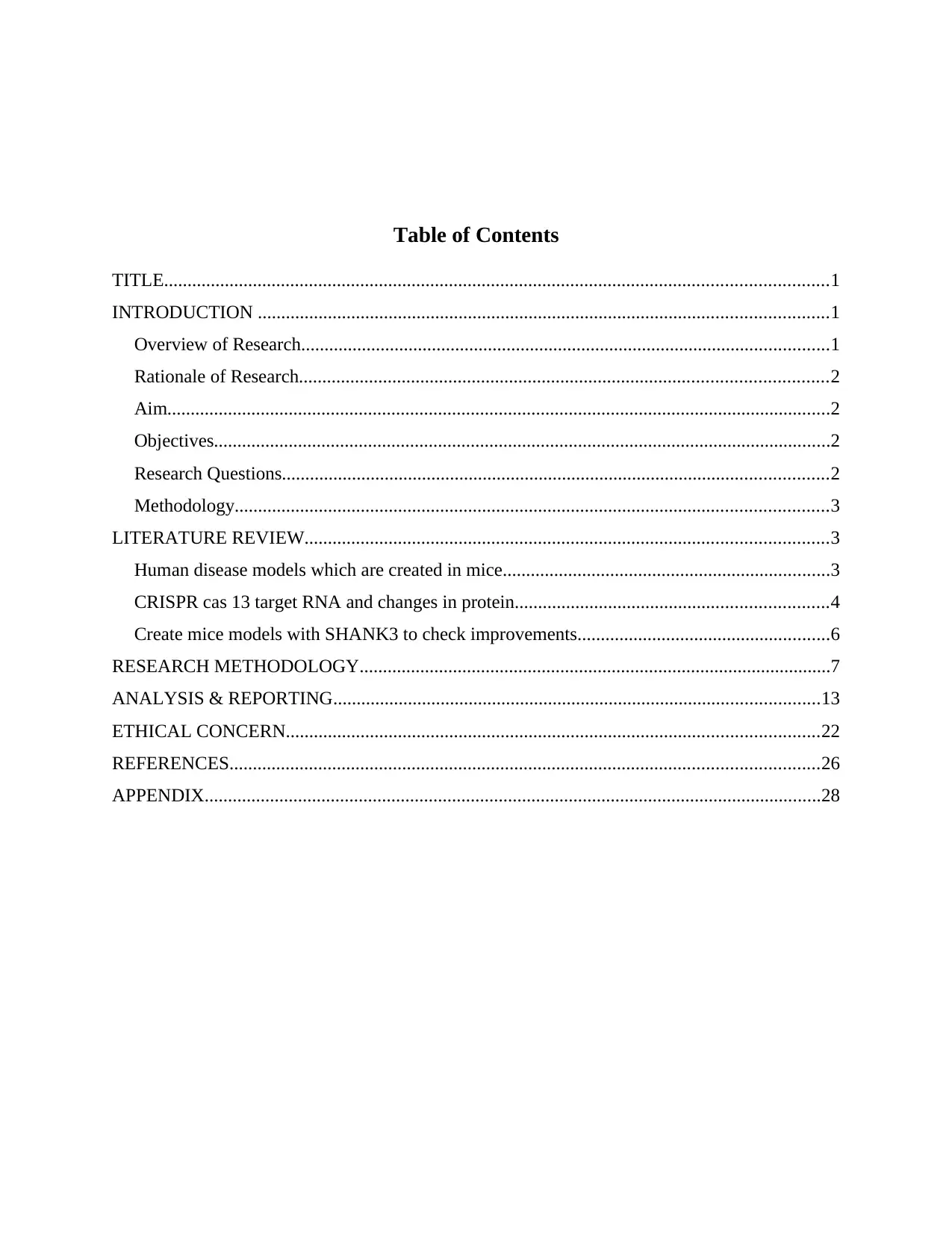
Table of Contents
TITLE..............................................................................................................................................1
INTRODUCTION ..........................................................................................................................1
Overview of Research.................................................................................................................1
Rationale of Research.................................................................................................................2
Aim..............................................................................................................................................2
Objectives....................................................................................................................................2
Research Questions.....................................................................................................................2
Methodology...............................................................................................................................3
LITERATURE REVIEW................................................................................................................3
Human disease models which are created in mice......................................................................3
CRISPR cas 13 target RNA and changes in protein...................................................................4
Create mice models with SHANK3 to check improvements......................................................6
RESEARCH METHODOLOGY.....................................................................................................7
ANALYSIS & REPORTING........................................................................................................13
ETHICAL CONCERN..................................................................................................................22
REFERENCES..............................................................................................................................26
APPENDIX....................................................................................................................................28
TITLE..............................................................................................................................................1
INTRODUCTION ..........................................................................................................................1
Overview of Research.................................................................................................................1
Rationale of Research.................................................................................................................2
Aim..............................................................................................................................................2
Objectives....................................................................................................................................2
Research Questions.....................................................................................................................2
Methodology...............................................................................................................................3
LITERATURE REVIEW................................................................................................................3
Human disease models which are created in mice......................................................................3
CRISPR cas 13 target RNA and changes in protein...................................................................4
Create mice models with SHANK3 to check improvements......................................................6
RESEARCH METHODOLOGY.....................................................................................................7
ANALYSIS & REPORTING........................................................................................................13
ETHICAL CONCERN..................................................................................................................22
REFERENCES..............................................................................................................................26
APPENDIX....................................................................................................................................28
TITLE
“To evaluate implications of editing RNA in mice for curing Autism Spectrum Disorder.”
INTRODUCTION
Overview of Research
Autism Spectrum Disorder is a kind problem which impacts negatively on
communication and behavior of an individual. The bacterial CRISPR-Cas13 is a system, which
is utilized to facilitate RNA manipulation in eukaryotes along with plants. It include basically the
criteria of RNA editing which is known as RNA interference (RNAi). Moreover, it is considered
as a biological procedure of inhibiting gene expression or translation of RNA molecules through
neutralization of targeted mRNA. Previously, RNA interference was known as co- suppression,
post transcriptional gene silencing and quelling (Barry and Mattick, 2012). Additionally, RNA
stands for ribo- nucleic acid having two subunits of genetics in which genetic material get edited
to treat any relevant disease that is particularly of RNA level. Meanwhile, it is a beneficial
techniques in order to develop hybrid plants or animals and desired medications which are
helpful to solve problem of severe health problems of people. all molecules such as microRNA
(miRNA) and small interfering RNA (siRNA) which are considered as central for RNA
interference. However, RNA editing is very useful in present era as it is utilized for research
purposes, therapeutics and biotechnology. This overall process of part of genetics in which
genetic material get edited to treat any relevant disease that is particularly of RNA level.
Meanwhile, it is a beneficial techniques in order to develop hybrid plants or animals and desired
medications which are helpful to solve problem of severe health problems of people.
The post synaptic scaffolding protein SH3 and multiple ankyrin repeat domains 3 known
as SHANK3 as critical for development as well as function of glutamatergic synapses. It is
analyzed that disruption of SHANK3- encoding gene has been strongly applied as a monogenic
situation called as autism. There are various kinds of human diseases which are removed by
utilizing technique of RNA interference successfully (Crunkhorn, 2012). Furthermore, it is
evaluated that SHANK proteins are considered as major scaffold of post synaptic density and
then mutations in human SHANK3 gene were connected with autism spectrum disorders. It has
function of effecting N- terminal part of protein through the expression of wold type and mutant
shank 3 in cultured neutrons which care binding essays in heterologous cells. Now, autism
1
“To evaluate implications of editing RNA in mice for curing Autism Spectrum Disorder.”
INTRODUCTION
Overview of Research
Autism Spectrum Disorder is a kind problem which impacts negatively on
communication and behavior of an individual. The bacterial CRISPR-Cas13 is a system, which
is utilized to facilitate RNA manipulation in eukaryotes along with plants. It include basically the
criteria of RNA editing which is known as RNA interference (RNAi). Moreover, it is considered
as a biological procedure of inhibiting gene expression or translation of RNA molecules through
neutralization of targeted mRNA. Previously, RNA interference was known as co- suppression,
post transcriptional gene silencing and quelling (Barry and Mattick, 2012). Additionally, RNA
stands for ribo- nucleic acid having two subunits of genetics in which genetic material get edited
to treat any relevant disease that is particularly of RNA level. Meanwhile, it is a beneficial
techniques in order to develop hybrid plants or animals and desired medications which are
helpful to solve problem of severe health problems of people. all molecules such as microRNA
(miRNA) and small interfering RNA (siRNA) which are considered as central for RNA
interference. However, RNA editing is very useful in present era as it is utilized for research
purposes, therapeutics and biotechnology. This overall process of part of genetics in which
genetic material get edited to treat any relevant disease that is particularly of RNA level.
Meanwhile, it is a beneficial techniques in order to develop hybrid plants or animals and desired
medications which are helpful to solve problem of severe health problems of people.
The post synaptic scaffolding protein SH3 and multiple ankyrin repeat domains 3 known
as SHANK3 as critical for development as well as function of glutamatergic synapses. It is
analyzed that disruption of SHANK3- encoding gene has been strongly applied as a monogenic
situation called as autism. There are various kinds of human diseases which are removed by
utilizing technique of RNA interference successfully (Crunkhorn, 2012). Furthermore, it is
evaluated that SHANK proteins are considered as major scaffold of post synaptic density and
then mutations in human SHANK3 gene were connected with autism spectrum disorders. It has
function of effecting N- terminal part of protein through the expression of wold type and mutant
shank 3 in cultured neutrons which care binding essays in heterologous cells. Now, autism
1
⊘ This is a preview!⊘
Do you want full access?
Subscribe today to unlock all pages.

Trusted by 1+ million students worldwide
spectrum disorder can be characterized by delayed acquisition of speech, deficits on social
communication and stereotypic behaviors. It include that mutated genes involve such coding for
synaptic adhesion molecules known as Neurexin and Neuroligin. Consequently, genomic
alterations observed in people having loss of function for one copy of gene whereas rare
missense mutations have been d determined in autistic patients which may contains strong risk
factors (Davis and Broadie, 2017).
Rationale of Research
The main purpose of this research to utilize CRISPR-Cas13 for mutation in SHANK3
gene to analyze about function recovery in mice in case of autism spectrum disorder. RNA
editing platform interference is widely used techniques in genetics or biotechnology to fulfill
actual needs of people in order to make them disease free as well as provide high vitamin or
mineral food products through hybridization. The present report will focus on various kinds of
human disease models which are created in mice along with implementation on SHANK3 gene
for improves ASD symptoms. It include discussion about CRISPR cas 13 targeted RNA and
changes of protein instruction altering by RNA coding which can be reversed. The creation of
mice models with SHANK3 irregularities and evaluate improvements in obvious symptoms
(Dockendorff and Labrador, 2018).
Aim
To evaluate implications of editing RNA in mice for curing Autism Spectrum Disorder.
Objectives
To identify the Human disease models which are created in mice
To evaluate ways by which mice models created with SHANK3 to check improvements
To determine how CRISPR cas 13 target RNA and changes in protein
Research Questions
How to identify the Human disease models which are created in mice
What are the ways to evaluate mice models created with SHANK3 to check
improvements
How to determine how CRISPR cas 13 target RNA and changes in protein
2
communication and stereotypic behaviors. It include that mutated genes involve such coding for
synaptic adhesion molecules known as Neurexin and Neuroligin. Consequently, genomic
alterations observed in people having loss of function for one copy of gene whereas rare
missense mutations have been d determined in autistic patients which may contains strong risk
factors (Davis and Broadie, 2017).
Rationale of Research
The main purpose of this research to utilize CRISPR-Cas13 for mutation in SHANK3
gene to analyze about function recovery in mice in case of autism spectrum disorder. RNA
editing platform interference is widely used techniques in genetics or biotechnology to fulfill
actual needs of people in order to make them disease free as well as provide high vitamin or
mineral food products through hybridization. The present report will focus on various kinds of
human disease models which are created in mice along with implementation on SHANK3 gene
for improves ASD symptoms. It include discussion about CRISPR cas 13 targeted RNA and
changes of protein instruction altering by RNA coding which can be reversed. The creation of
mice models with SHANK3 irregularities and evaluate improvements in obvious symptoms
(Dockendorff and Labrador, 2018).
Aim
To evaluate implications of editing RNA in mice for curing Autism Spectrum Disorder.
Objectives
To identify the Human disease models which are created in mice
To evaluate ways by which mice models created with SHANK3 to check improvements
To determine how CRISPR cas 13 target RNA and changes in protein
Research Questions
How to identify the Human disease models which are created in mice
What are the ways to evaluate mice models created with SHANK3 to check
improvements
How to determine how CRISPR cas 13 target RNA and changes in protein
2
Paraphrase This Document
Need a fresh take? Get an instant paraphrase of this document with our AI Paraphraser
Methodology
This is a kind of experimental research in which qualitative method will be used to
identify several features of functional recovery in autism spectrum disorder. In this procedure, a
researcher select most appropriate methods for the data collection approaches that assist to
enhance their knowledge criteria effectively. Moreover, it is essential to gather an accurate
information about particular issue which provide support to gain desired results of research in an
appropriate manner (Eran Kohane and Kunkel, 2014).
LITERATURE REVIEW
The literature review can be described as an evaluative report of data found in particular
research related to specified area of study. It include description, summary, evaluation and
clarification of content of literature. It is necessary to used evidence, remain selective and utilize
caution for paraphrasing while writing literature review. The main purpose of literature review is
to demonstrate author's opinions about specific field involving vocabulary, theories, key
variables, phenomena, methods and previous information. Moreover, it involves various
description about desired topic including related facts which helps to gather information about
the same (Ergaz, Weinstein-Fudim and Ornoy, 2016).
Human disease models which are created in mice
The mouse model can be described as mammalian model which is used to study about
human health problems for making more effective medication for their welfare. The mice based
research contribute to better therapies and care for human beings through solving several crucial
health issues. It includes gene therapy which provide support for conduct effective treatment of
childhood diseases such as muscular dystrophy, cystic fibrosis and sickle cell anemia is
dependent on type of mouse model. In context of research, scientist has proper information about
physiology, anatomy, genes of mice and hence, working with this small animal from around 110
years. As per views of Danielle Simmons (2014), mice is used due to having biological similarity
with humans and it is considered as cost effective as well as efficient research tool as one year
mouse is equal to 30 years old human being. Moreover, mice is used as a model organism for
conducting research to study about human biology including genetic and physiological
similarities between species (Simmons, 2014). Additionally, there are different types of
3
This is a kind of experimental research in which qualitative method will be used to
identify several features of functional recovery in autism spectrum disorder. In this procedure, a
researcher select most appropriate methods for the data collection approaches that assist to
enhance their knowledge criteria effectively. Moreover, it is essential to gather an accurate
information about particular issue which provide support to gain desired results of research in an
appropriate manner (Eran Kohane and Kunkel, 2014).
LITERATURE REVIEW
The literature review can be described as an evaluative report of data found in particular
research related to specified area of study. It include description, summary, evaluation and
clarification of content of literature. It is necessary to used evidence, remain selective and utilize
caution for paraphrasing while writing literature review. The main purpose of literature review is
to demonstrate author's opinions about specific field involving vocabulary, theories, key
variables, phenomena, methods and previous information. Moreover, it involves various
description about desired topic including related facts which helps to gather information about
the same (Ergaz, Weinstein-Fudim and Ornoy, 2016).
Human disease models which are created in mice
The mouse model can be described as mammalian model which is used to study about
human health problems for making more effective medication for their welfare. The mice based
research contribute to better therapies and care for human beings through solving several crucial
health issues. It includes gene therapy which provide support for conduct effective treatment of
childhood diseases such as muscular dystrophy, cystic fibrosis and sickle cell anemia is
dependent on type of mouse model. In context of research, scientist has proper information about
physiology, anatomy, genes of mice and hence, working with this small animal from around 110
years. As per views of Danielle Simmons (2014), mice is used due to having biological similarity
with humans and it is considered as cost effective as well as efficient research tool as one year
mouse is equal to 30 years old human being. Moreover, mice is used as a model organism for
conducting research to study about human biology including genetic and physiological
similarities between species (Simmons, 2014). Additionally, there are different types of
3
experiments are carried out on mice in order to evaluate success or accuracy of particular
developed medications for solving human diseases.
There are different types of mouse models for better understand about several human
disease that such as Down Syndrome, Cystic Fibrosis, cancer, Glaucoma, Type 1 & 2 Diabetes,
Epilepsy, Heart disease, Muscular Dystrophy and Ovarian Tumors. The scientist mostly prefer
two species of moues such as Mus musculus (house moues) and Rattus norvegicus (brown rat) to
study about genetic principles as well as human disease. Additionally, there are several methods
of inducing human disease in other organisms including large scale mutations screens, trans
genesis, single gene knock outs & knock ins, conditional gene modifications and chromosomal
rearrangement (Faial, 2015). It is also analyzed that genetic problems affect various tissues
which results into numerous kinds of mutations.
CRISPR cas9 has been applied on shank3 gene
The Clustered Regularly Interspaced Short Palindromic Repeats (CRISPR) cas9 can be
used as a enzyme by a genomic platform to develop a double stranded break at a specific
location in genome as per direction of guide RNA. Shank2 gene is known for providing
instructions to for manufacturing protein which is found in many tissues in human body but is
most available in brain. According to the opinion of Chun-xue Liu (2018), this protein plays an
essential role of synapses which is links among nerve cells to make cell- to- cell conversation.
Moreover, CRISPR cas9 is utilized to cut RNA strands at given genome to induce infected
genetic material of autism spectrum disorder (ASD) to identify actual analyze symptoms. It also
provide help to understand relationship between ASD and molecular defects in Shank3 gene
(Liu, 2018). Furthermore, CRISPR cas9 can be applied to generate shank3 loss- of – function
mutation and then conduct a series of morphological, behavioral and molecular analysis in a
systematic manner.
CRISPR cas 13 target RNA and changes in protein
The RNA editing can be described as a molecular procedure in which few of cells make
several changes to particular nucleotide sequences within RNA molecule. It will results into
RNA polymerase but it has a an appropriate process that involves splicing, 5'- capping and 3'-
polyadenylation which collectively called as editing of RNA. Meanwhile, it is analyzed that a
large number of de novo single mutations and chromosomal deletions are associated with autism
spectrum disorders. At the other hand, there are several editing events such as insertion, deletion
4
developed medications for solving human diseases.
There are different types of mouse models for better understand about several human
disease that such as Down Syndrome, Cystic Fibrosis, cancer, Glaucoma, Type 1 & 2 Diabetes,
Epilepsy, Heart disease, Muscular Dystrophy and Ovarian Tumors. The scientist mostly prefer
two species of moues such as Mus musculus (house moues) and Rattus norvegicus (brown rat) to
study about genetic principles as well as human disease. Additionally, there are several methods
of inducing human disease in other organisms including large scale mutations screens, trans
genesis, single gene knock outs & knock ins, conditional gene modifications and chromosomal
rearrangement (Faial, 2015). It is also analyzed that genetic problems affect various tissues
which results into numerous kinds of mutations.
CRISPR cas9 has been applied on shank3 gene
The Clustered Regularly Interspaced Short Palindromic Repeats (CRISPR) cas9 can be
used as a enzyme by a genomic platform to develop a double stranded break at a specific
location in genome as per direction of guide RNA. Shank2 gene is known for providing
instructions to for manufacturing protein which is found in many tissues in human body but is
most available in brain. According to the opinion of Chun-xue Liu (2018), this protein plays an
essential role of synapses which is links among nerve cells to make cell- to- cell conversation.
Moreover, CRISPR cas9 is utilized to cut RNA strands at given genome to induce infected
genetic material of autism spectrum disorder (ASD) to identify actual analyze symptoms. It also
provide help to understand relationship between ASD and molecular defects in Shank3 gene
(Liu, 2018). Furthermore, CRISPR cas9 can be applied to generate shank3 loss- of – function
mutation and then conduct a series of morphological, behavioral and molecular analysis in a
systematic manner.
CRISPR cas 13 target RNA and changes in protein
The RNA editing can be described as a molecular procedure in which few of cells make
several changes to particular nucleotide sequences within RNA molecule. It will results into
RNA polymerase but it has a an appropriate process that involves splicing, 5'- capping and 3'-
polyadenylation which collectively called as editing of RNA. Meanwhile, it is analyzed that a
large number of de novo single mutations and chromosomal deletions are associated with autism
spectrum disorders. At the other hand, there are several editing events such as insertion, deletion
4
⊘ This is a preview!⊘
Do you want full access?
Subscribe today to unlock all pages.
Trusted by 1+ million students worldwide
and base substitution of nucleotides in modified RNA molecule. It include several molecules in
which editing is observed such as tRNA, rRNA, mRNA and miRNA in eukaryotes along with
their viruses, archae & prokaryotes. However, the process of RNA editing take places in nucleus
of cell and cytosol as well as within mitochondria & plastids. RNA splicing is considered as
process in which newly developed precursor messenger RNA transcript is transformed into
mature mRNA. Moreover, introns are removed and exons get joined after splicing. Capping
refers to attachment of 5'cap to mRNA with help of capping enzyme (CE). At last,
polyadenylation is a process in which addition of poly (A) tail occurs to mRNA through
containing multiple adenosine mono phosphates (Guennewig and Cooper, 2014).
There are various kinds of genetically modified organisms which are developed through
carrying out editing in genetic material to gain better features in them. It include different GMOs
on context of food such as Soy, Corn, Canola oil, Cotton, Milk, Sugar, Aspartame, Zucchini,
Yellow Squash Papaya, purple tomatoes, golden rice, onions do not make cry, abiotic stress,
arctic apple, and many more for welfare of human beings. Additionally, some of genetically
modified organisms are mule, hinni etc, and scientist has safely genetically engineered cattle,
pigs, chickens, goats, sheep, dogs,cats, fish, rats and mice with help of RNA editing technique.
The first GMO was GloFish and a Zebra Fish with fluorescent gene addition through UV light
(Guennewig and Cooper, 2014).
The novel RNA targeting CRISPR effect-or protein which is known as Cas13. As per
knowledge of Javier T. Granados (2018), it is analyzed that case 13 binds and cleaves RNA
rather then DNA substrates in eukaryotic RNA Interference system. Moreover, it has capability
to cleave complementary single stranded RNAs in an efficient way which is considered as
potentially secure alternative to deoxyribonuclease cas9. Meanwhile, it induces loss- of- function
phenotypes through avoiding genomic loss of targeted gene. Furthermore, RNA editing can be
explained as form of transcript process which involve enzymatic regulations of nucleotide
substitutions (Granados, 2018). In this, several enzymes are utilized that are called as adenosine
deaminases which acts on RNA and convert adenosine into inosine which is consider equal to
guanosine then creation of fusion of protein takes place. Additionally, RNA editing is preferred
to in condition of changes of short period of time in a gene expression.
The experiment was carried out on mice through injecting nonsense mutation in
SHANK3 gene at single point implicated on autism spectrum disorder. It is thoroughly observe,
5
which editing is observed such as tRNA, rRNA, mRNA and miRNA in eukaryotes along with
their viruses, archae & prokaryotes. However, the process of RNA editing take places in nucleus
of cell and cytosol as well as within mitochondria & plastids. RNA splicing is considered as
process in which newly developed precursor messenger RNA transcript is transformed into
mature mRNA. Moreover, introns are removed and exons get joined after splicing. Capping
refers to attachment of 5'cap to mRNA with help of capping enzyme (CE). At last,
polyadenylation is a process in which addition of poly (A) tail occurs to mRNA through
containing multiple adenosine mono phosphates (Guennewig and Cooper, 2014).
There are various kinds of genetically modified organisms which are developed through
carrying out editing in genetic material to gain better features in them. It include different GMOs
on context of food such as Soy, Corn, Canola oil, Cotton, Milk, Sugar, Aspartame, Zucchini,
Yellow Squash Papaya, purple tomatoes, golden rice, onions do not make cry, abiotic stress,
arctic apple, and many more for welfare of human beings. Additionally, some of genetically
modified organisms are mule, hinni etc, and scientist has safely genetically engineered cattle,
pigs, chickens, goats, sheep, dogs,cats, fish, rats and mice with help of RNA editing technique.
The first GMO was GloFish and a Zebra Fish with fluorescent gene addition through UV light
(Guennewig and Cooper, 2014).
The novel RNA targeting CRISPR effect-or protein which is known as Cas13. As per
knowledge of Javier T. Granados (2018), it is analyzed that case 13 binds and cleaves RNA
rather then DNA substrates in eukaryotic RNA Interference system. Moreover, it has capability
to cleave complementary single stranded RNAs in an efficient way which is considered as
potentially secure alternative to deoxyribonuclease cas9. Meanwhile, it induces loss- of- function
phenotypes through avoiding genomic loss of targeted gene. Furthermore, RNA editing can be
explained as form of transcript process which involve enzymatic regulations of nucleotide
substitutions (Granados, 2018). In this, several enzymes are utilized that are called as adenosine
deaminases which acts on RNA and convert adenosine into inosine which is consider equal to
guanosine then creation of fusion of protein takes place. Additionally, RNA editing is preferred
to in condition of changes of short period of time in a gene expression.
The experiment was carried out on mice through injecting nonsense mutation in
SHANK3 gene at single point implicated on autism spectrum disorder. It is thoroughly observe,
5
Paraphrase This Document
Need a fresh take? Get an instant paraphrase of this document with our AI Paraphraser
analyze and evaluate after symptoms of mice through conducting several activities. However, the
prepared mouse model to study autism get examined from variety of perspectives including
certain changes at different level. Initially, it includes regulation and biochemical properties as
well as observe changes on morphology and distribution of neurotransmitter receptors in neurons
brought on by disrupting SHANK3. Moreover, it is essential to record overall electrical currents
from neurons of mouse, calculate their functions and investigate their neural communication
which is abnormal in mice. Furthermore, most important part is to analyze about abnormalities of
mice in terms of learning and behavior of interacting socially (Hamilton and et. al., 2018).
The study of prepared mouse model helps to evaluate about reduced expression of
glutamate receptors and deficiency in synaptic elasticity which is considered as link among
neurons to change in strength. Additionally, connection between neutrons is helpful to underline
procedure of learning and memory of an individual. Besides of this, deficits in plasticity results
into several abnormalities in terms of electro- physiology and structure. At last, these overall
findings conclude about possibility of glutamate receptors to be represent therapeutic targets in
autism. Additionally, edition of RNA in mice with nonsense mutation in SHNAK3 gene creates
several abnormalities in results into problems in brain regarding connection between neurons
which results into autism spectrum disorder (Imoto and et. al., 2017).
Create mice models with SHANK3 to check improvements
There are different types of mice models which are created by carrying out an experiment
through editing RNA to conduct a nonsense mutation in particular gene to analyze actual
changes or abnormalities. It provide support to invent new and more efficient treatment for
different kinds of diseases of human beings so that appropriate diagnosis can be provided to
patients in order to make them healthy. Moreover, it is observed that, several health problems are
really critical which are not easily curable so that certain techniques are generated by applying
biotechnology and modify gene to make a individual healthy. For example, bone marrow
transplant, insulin, Xenotransplantation, vaccines, skimmed milk, antibiotics etc. Additionally,
newly invented technique is primarily get tried on prepared mice models of particular disease to
evaluate actual beneficial impacts of the same.
As per views of Kaijie Ma (2018), mice models are considered as primary tools for
investigating causal role of genetic mutations and environmental factors. However, the autism is
neuro- developmental disorder characterized by social deficits and repetitive behaviors.
6
prepared mouse model to study autism get examined from variety of perspectives including
certain changes at different level. Initially, it includes regulation and biochemical properties as
well as observe changes on morphology and distribution of neurotransmitter receptors in neurons
brought on by disrupting SHANK3. Moreover, it is essential to record overall electrical currents
from neurons of mouse, calculate their functions and investigate their neural communication
which is abnormal in mice. Furthermore, most important part is to analyze about abnormalities of
mice in terms of learning and behavior of interacting socially (Hamilton and et. al., 2018).
The study of prepared mouse model helps to evaluate about reduced expression of
glutamate receptors and deficiency in synaptic elasticity which is considered as link among
neurons to change in strength. Additionally, connection between neutrons is helpful to underline
procedure of learning and memory of an individual. Besides of this, deficits in plasticity results
into several abnormalities in terms of electro- physiology and structure. At last, these overall
findings conclude about possibility of glutamate receptors to be represent therapeutic targets in
autism. Additionally, edition of RNA in mice with nonsense mutation in SHNAK3 gene creates
several abnormalities in results into problems in brain regarding connection between neurons
which results into autism spectrum disorder (Imoto and et. al., 2017).
Create mice models with SHANK3 to check improvements
There are different types of mice models which are created by carrying out an experiment
through editing RNA to conduct a nonsense mutation in particular gene to analyze actual
changes or abnormalities. It provide support to invent new and more efficient treatment for
different kinds of diseases of human beings so that appropriate diagnosis can be provided to
patients in order to make them healthy. Moreover, it is observed that, several health problems are
really critical which are not easily curable so that certain techniques are generated by applying
biotechnology and modify gene to make a individual healthy. For example, bone marrow
transplant, insulin, Xenotransplantation, vaccines, skimmed milk, antibiotics etc. Additionally,
newly invented technique is primarily get tried on prepared mice models of particular disease to
evaluate actual beneficial impacts of the same.
As per views of Kaijie Ma (2018), mice models are considered as primary tools for
investigating causal role of genetic mutations and environmental factors. However, the autism is
neuro- developmental disorder characterized by social deficits and repetitive behaviors.
6
Moreover, it is observed in a novel SHANK3 conditional knock out model that in case of re-
expression of sane gene in adult mice results into several improvements (Ma, 2018). Meanwhile,
these are relevant to synaptic protein composition, spine density and neural function in stria-tum.
At the other hand, certain abnormalities can be improved such as anxiety- like behaviors and
motor coordination deficits which are irreversible and they can be boost up through early
postnatal intervention. Furthermore, it is analyzed that improvement can gained up to certain
degree in patients suffered from autism spectrum disorders even after early developmental
milestones are completed. At last, several improvements are can be achieved in case of having
ASDs in people which ensured by thoroughly evaluating prepared mice models by carrying
mutations in SHANK3 gene (Kishimoto and et. al., 2015).
On the basis of opinion of Haley E. Speed (2018), it is thoroughly evaluated by
collaborating different approaches that mutation of CHD8 cause changes in brain which
facilitates development of the same and results into desired brain anatomy, function as well as
behavior. Moreover, the positive impacts of mutation of CHD8 packages RNA in neural cells
which identify specific early brain development and synaptic function (Speed, 2018). At the
other hand, when serotonergic activity get boost up in brain at time of initial development then it
facilitate to balanced the same in proper manner as well as improve abnormal sociability in mice.
Furthermore, utilization of Selective serotonin re uptake inhibitors (SSRIs) for treating sensory
neurons in mice indicates normal inhibitory responses which provide support to boost up
excitatory or inhibitory balance. Additionally, it also improves social behavior and
communication which helps to make sure that serotonin can be considered as more effective for
discrete ASD symptoms (Kishore and Stamm, 2011).
RESEARCH METHODOLOGY
Types of investigation – This include several desired principles and fundamental
concepts about methods of investigation such as quantitative & qualitative. The present report
prefer the qualitative approach for concluding more appropriate results of given problem.
Qualitative technique – This can be described as a research which is based on the few
non representative cases as a sample study to develop a initial understanding. It depends upon the
spoken or written data. It is a method of developing in-depth understanding of human behavior,
attitude, intentions and motivation which help understand people perspective regarding particular
situation or condition. This technique is adopted in the organization by the help of interviews,
7
expression of sane gene in adult mice results into several improvements (Ma, 2018). Meanwhile,
these are relevant to synaptic protein composition, spine density and neural function in stria-tum.
At the other hand, certain abnormalities can be improved such as anxiety- like behaviors and
motor coordination deficits which are irreversible and they can be boost up through early
postnatal intervention. Furthermore, it is analyzed that improvement can gained up to certain
degree in patients suffered from autism spectrum disorders even after early developmental
milestones are completed. At last, several improvements are can be achieved in case of having
ASDs in people which ensured by thoroughly evaluating prepared mice models by carrying
mutations in SHANK3 gene (Kishimoto and et. al., 2015).
On the basis of opinion of Haley E. Speed (2018), it is thoroughly evaluated by
collaborating different approaches that mutation of CHD8 cause changes in brain which
facilitates development of the same and results into desired brain anatomy, function as well as
behavior. Moreover, the positive impacts of mutation of CHD8 packages RNA in neural cells
which identify specific early brain development and synaptic function (Speed, 2018). At the
other hand, when serotonergic activity get boost up in brain at time of initial development then it
facilitate to balanced the same in proper manner as well as improve abnormal sociability in mice.
Furthermore, utilization of Selective serotonin re uptake inhibitors (SSRIs) for treating sensory
neurons in mice indicates normal inhibitory responses which provide support to boost up
excitatory or inhibitory balance. Additionally, it also improves social behavior and
communication which helps to make sure that serotonin can be considered as more effective for
discrete ASD symptoms (Kishore and Stamm, 2011).
RESEARCH METHODOLOGY
Types of investigation – This include several desired principles and fundamental
concepts about methods of investigation such as quantitative & qualitative. The present report
prefer the qualitative approach for concluding more appropriate results of given problem.
Qualitative technique – This can be described as a research which is based on the few
non representative cases as a sample study to develop a initial understanding. It depends upon the
spoken or written data. It is a method of developing in-depth understanding of human behavior,
attitude, intentions and motivation which help understand people perspective regarding particular
situation or condition. This technique is adopted in the organization by the help of interviews,
7
⊘ This is a preview!⊘
Do you want full access?
Subscribe today to unlock all pages.
Trusted by 1+ million students worldwide
group discussion and many more things. It is research in which more importance is given to the
views and thoughts of the participants.
Quantitative techniques – This technique can be used for quantitative approach in order
to improve the decision making. It include models of statistics like computer simulation model,
optimization model and information model. Result generated using such approach helps in
estimation the future of the good and services so that accordingly changes are made. This type of
approach is mainly used in natural and social science. Computational method is acquired to
conduct such approach. And the result determined using this approach is logical and unbiased in
nature and is easy to conduct and analyze the future (Lee and et. al., 2018).
Research design – The research design refers to a set of various effective as well as
efficient methods or procedures which are utilizing in collecting information along with
analyzing the same. Moreover, descriptive research design is preferred in this assignment which
helps to make recommendations appropriately.
Exploratory research design – It is one of methodical approach which is mainly
concerned with building up theories. And it is being carried our in order to sort out problems
which are not clearly defined. Moreover helps in improving final design of research . It relies on
secondary data like reviewing of literature. This types of research method is used when issues is
new and source is difficult to collect. Moreover it is flexible and is not typically generalize to
large population (Lorenzini, Moore and Sattler, 2018).
Descriptive research design – This type of research provide answers of who, when,
where, how related to a specific research problems ; a descriptive study cannot clear answers to
questions with their proper justification. It has several benefits including that participants are
spotted in a natural environment. Moreover, descriptive research can be a predecessor for
upcoming research as it will be very much helpful in recognizing variables that need to be tested.
Additionally, observation techniques can be used by organizations in order to study in attitude,
beliefs and behaviors of a members or of other organization.
Experimental research design – It is also known as casual research, which deal with
cause and effect relationship (Lovci and et. al., 2013). Main purpose of doing such research is
that it helps in computing impact of manipulation on unconventional variable like advertising,
selling efforts, price in general and dependent variable such as profits, brand image etc. For
example: Test marketing can be best example of experimental research, in such type of
8
views and thoughts of the participants.
Quantitative techniques – This technique can be used for quantitative approach in order
to improve the decision making. It include models of statistics like computer simulation model,
optimization model and information model. Result generated using such approach helps in
estimation the future of the good and services so that accordingly changes are made. This type of
approach is mainly used in natural and social science. Computational method is acquired to
conduct such approach. And the result determined using this approach is logical and unbiased in
nature and is easy to conduct and analyze the future (Lee and et. al., 2018).
Research design – The research design refers to a set of various effective as well as
efficient methods or procedures which are utilizing in collecting information along with
analyzing the same. Moreover, descriptive research design is preferred in this assignment which
helps to make recommendations appropriately.
Exploratory research design – It is one of methodical approach which is mainly
concerned with building up theories. And it is being carried our in order to sort out problems
which are not clearly defined. Moreover helps in improving final design of research . It relies on
secondary data like reviewing of literature. This types of research method is used when issues is
new and source is difficult to collect. Moreover it is flexible and is not typically generalize to
large population (Lorenzini, Moore and Sattler, 2018).
Descriptive research design – This type of research provide answers of who, when,
where, how related to a specific research problems ; a descriptive study cannot clear answers to
questions with their proper justification. It has several benefits including that participants are
spotted in a natural environment. Moreover, descriptive research can be a predecessor for
upcoming research as it will be very much helpful in recognizing variables that need to be tested.
Additionally, observation techniques can be used by organizations in order to study in attitude,
beliefs and behaviors of a members or of other organization.
Experimental research design – It is also known as casual research, which deal with
cause and effect relationship (Lovci and et. al., 2013). Main purpose of doing such research is
that it helps in computing impact of manipulation on unconventional variable like advertising,
selling efforts, price in general and dependent variable such as profits, brand image etc. For
example: Test marketing can be best example of experimental research, in such type of
8
Paraphrase This Document
Need a fresh take? Get an instant paraphrase of this document with our AI Paraphraser
marketing price , product are changed in order to see its effects on sales volume profit and so on.
It has some benefits too like; researcher can have control over variables. Along with this It can
be used to examine what is best for population,provide greater transfer ability than informal
research.
Research approach – Research approach defines about research procedure and plan. The
given assignment is based on Inductive approach which helps to formulate research properly (Ng
and et. al., 2013). There are mainly two types of research approach which are explained below:
Inductive research approach – This type of research does not involve hypothesis
formulation. In general it starts gathering of data (specific level of focus) then look for patterns
(analysis) after this step move for developing of theory (general level of focus) .When researcher
takes in to consideration inductive approach he/she start from a level of observations, after this
they move from specific experience to more common experience. Here data collected are used to
tour a occurrence, identify subject matter and to create sensible framework. One of advantage of
using inductive approach is that it stimulate student mental ability (Vogan, 2015).
Deductive research approach – If a set of hypothesis is formulated for dissertation which
need to be accepted or rejected during research process then at that time deductive research
approach need to be followed. For deductive research following steps need to be taken into
consideration, first of all theory / Hypothesize of research topic is being analyzed (General level
of focus), then data is being studied (analysis), after these hypothesis is supporting or not is being
(specific level focus). Moreover approach to this research is one in which people is normally
related with technological inspection.
Research philosophy – The research philosophy is linked with the nature and
development of knowledge. It refers to a way in which the data are collected ,examined and used
(Volk and Artzt, 2011). There are mainly two types of research philosophy which are explained
below:
Positivism – In positivism type of philosophy researcher mainly follow structural
methodologies which is mainly used in science. And only quantitative data are used so that
statistical analysis can be obtained. Deductive approach is adopted for carrying out this type of
philosophy and the researcher should concentrate only on facts .The main principle of this
philosophy is that researcher should aim to describe and forecast. Inductive reasoning approach
9
It has some benefits too like; researcher can have control over variables. Along with this It can
be used to examine what is best for population,provide greater transfer ability than informal
research.
Research approach – Research approach defines about research procedure and plan. The
given assignment is based on Inductive approach which helps to formulate research properly (Ng
and et. al., 2013). There are mainly two types of research approach which are explained below:
Inductive research approach – This type of research does not involve hypothesis
formulation. In general it starts gathering of data (specific level of focus) then look for patterns
(analysis) after this step move for developing of theory (general level of focus) .When researcher
takes in to consideration inductive approach he/she start from a level of observations, after this
they move from specific experience to more common experience. Here data collected are used to
tour a occurrence, identify subject matter and to create sensible framework. One of advantage of
using inductive approach is that it stimulate student mental ability (Vogan, 2015).
Deductive research approach – If a set of hypothesis is formulated for dissertation which
need to be accepted or rejected during research process then at that time deductive research
approach need to be followed. For deductive research following steps need to be taken into
consideration, first of all theory / Hypothesize of research topic is being analyzed (General level
of focus), then data is being studied (analysis), after these hypothesis is supporting or not is being
(specific level focus). Moreover approach to this research is one in which people is normally
related with technological inspection.
Research philosophy – The research philosophy is linked with the nature and
development of knowledge. It refers to a way in which the data are collected ,examined and used
(Volk and Artzt, 2011). There are mainly two types of research philosophy which are explained
below:
Positivism – In positivism type of philosophy researcher mainly follow structural
methodologies which is mainly used in science. And only quantitative data are used so that
statistical analysis can be obtained. Deductive approach is adopted for carrying out this type of
philosophy and the researcher should concentrate only on facts .The main principle of this
philosophy is that researcher should aim to describe and forecast. Inductive reasoning approach
9
should be used to carry out this research philosophy. Only logical judgement should be done
under this philosophy.
Interpretivism – This philosophy mainly deal with social life world. Social roles are
being interpreted with consideration of own set of meaning. This philosophy merge the human
heed into as study. Development of Interpretivism mainly depend on evaluation of positivism in
social science. According to this philosophy the researcher should have the capability to treasure
contrast between the peoples. Based on natural approach of collection of data like observation ,
interviews (Weinstein, Cui and Simmons, 2011).
Data collection – This refers to appropriate approaches of collecting data for analyzing
desired issues for make proper conclusion of research in correct way. It include two categories
which are used in present report are discuss below.
Primary data – Primary data are those data which are collected directly by means of field
study. This data are in original form. The information may be from case studies or from a
sample. In simple language it can be called as first hand information. One of benefit of using
primary data is that it is useful for researchers. Researchers collects information using surveys
direct observation etc. For example, it can be said that researcher sees number of time he/she
practices or interaction of workers with clients over a period of time. In this example researcher
collect data through direct observation, hence it can be said that collection of such information is
refers to as primary data collection. Primary data are directly collected from population and is
best types of data to collect specially while doing surveys (Ye and et. al., 2017). As well as in
this type of data collection researcher have advantage that he/she can change course of study
whenever required. And also it provide best quality research report as there is no possibility of
existing biasses.
Secondary data – Secondary data are those data which are collected indirectly.
Collecting of data from those source which already exist it just matter of degree which
differentiate primary from secondary data. The source which are primary for researcher become
secondary source for other researcher. In simple language it can also be known as second hand
information. Secondary data are inexpensive to obtain. For example, we can take as data from
national population census which is reliable in nature. This type of data are not required to be re-
examined by user who is re-using such data. Secondary data can be gathered from different
sources like through libraries, reports, tax records, through censuses and so on. One of advantage
10
under this philosophy.
Interpretivism – This philosophy mainly deal with social life world. Social roles are
being interpreted with consideration of own set of meaning. This philosophy merge the human
heed into as study. Development of Interpretivism mainly depend on evaluation of positivism in
social science. According to this philosophy the researcher should have the capability to treasure
contrast between the peoples. Based on natural approach of collection of data like observation ,
interviews (Weinstein, Cui and Simmons, 2011).
Data collection – This refers to appropriate approaches of collecting data for analyzing
desired issues for make proper conclusion of research in correct way. It include two categories
which are used in present report are discuss below.
Primary data – Primary data are those data which are collected directly by means of field
study. This data are in original form. The information may be from case studies or from a
sample. In simple language it can be called as first hand information. One of benefit of using
primary data is that it is useful for researchers. Researchers collects information using surveys
direct observation etc. For example, it can be said that researcher sees number of time he/she
practices or interaction of workers with clients over a period of time. In this example researcher
collect data through direct observation, hence it can be said that collection of such information is
refers to as primary data collection. Primary data are directly collected from population and is
best types of data to collect specially while doing surveys (Ye and et. al., 2017). As well as in
this type of data collection researcher have advantage that he/she can change course of study
whenever required. And also it provide best quality research report as there is no possibility of
existing biasses.
Secondary data – Secondary data are those data which are collected indirectly.
Collecting of data from those source which already exist it just matter of degree which
differentiate primary from secondary data. The source which are primary for researcher become
secondary source for other researcher. In simple language it can also be known as second hand
information. Secondary data are inexpensive to obtain. For example, we can take as data from
national population census which is reliable in nature. This type of data are not required to be re-
examined by user who is re-using such data. Secondary data can be gathered from different
sources like through libraries, reports, tax records, through censuses and so on. One of advantage
10
⊘ This is a preview!⊘
Do you want full access?
Subscribe today to unlock all pages.
Trusted by 1+ million students worldwide

1 out of 31


Your All-in-One AI-Powered Toolkit for Academic Success.
+13062052269
info@desklib.com
Available 24*7 on WhatsApp / Email
![[object Object]](/_next/static/media/star-bottom.7253800d.svg)
Unlock your academic potential
Copyright © 2020–2026 A2Z Services. All Rights Reserved. Developed and managed by ZUCOL.