Business Report: Critical Analysis of 'IT Doesn't Matter' Article

Verified

Added on  2020/05/16

|4
|782
|62
Report
AI Summary
This report presents a critical analysis of Nicholas G. Carr's article, "IT Doesn't Matter," which argues that Information Technology (IT) has become a commodity and no longer provides a strategic advantage. The analysis explores Carr's distinction between proprietary and infrastructural technologies, highlighting his view of IT as the latter. The report summarizes Carr's proposed rules for IT management, including spending less, not leading, and focusing on vulnerabilities. It evaluates the strengths and weaknesses of Carr's arguments, addressing points about overinvestment in IT and the diminishing strategic value of IT. The analysis references supporting literature and provides a balanced perspective on the evolving role of IT in business strategy and differentiation.
Document Page
Running head: IT DOESN’T MATTER
IT Doesn’t Matter
Name of the Student:
Name of the University:
tabler-icon-diamond-filled.svg

Paraphrase This Document

Need a fresh take? Get an instant paraphrase of this document with our AI Paraphraser
Document Page
1
IT DOESN’T MATTER
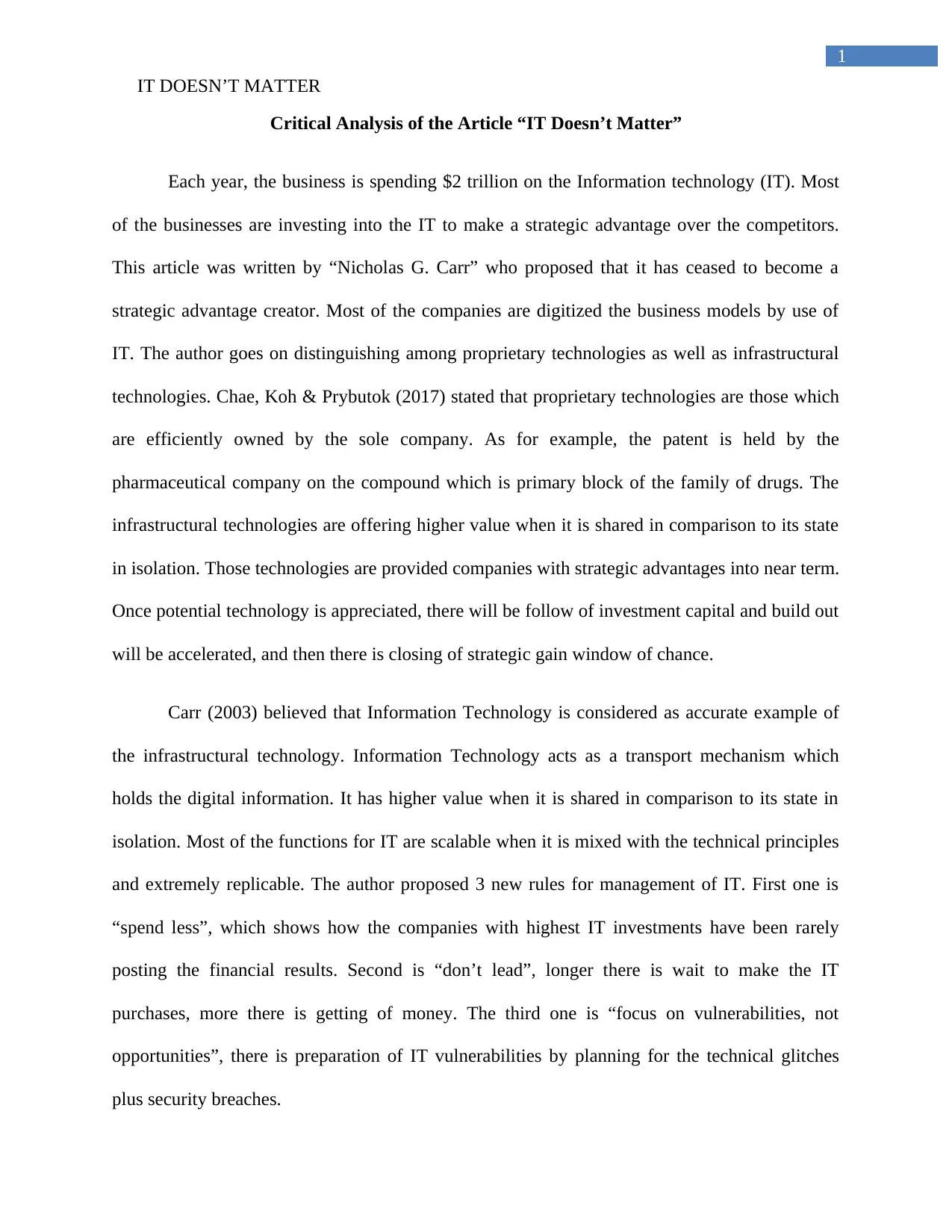
Critical Analysis of the Article “IT Doesn’t Matter”
Each year, the business is spending $2 trillion on the Information technology (IT). Most
of the businesses are investing into the IT to make a strategic advantage over the competitors.
This article was written by “Nicholas G. Carr” who proposed that it has ceased to become a
strategic advantage creator. Most of the companies are digitized the business models by use of
IT. The author goes on distinguishing among proprietary technologies as well as infrastructural
technologies. Chae, Koh & Prybutok (2017) stated that proprietary technologies are those which
are efficiently owned by the sole company. As for example, the patent is held by the
pharmaceutical company on the compound which is primary block of the family of drugs. The
infrastructural technologies are offering higher value when it is shared in comparison to its state
in isolation. Those technologies are provided companies with strategic advantages into near term.
Once potential technology is appreciated, there will be follow of investment capital and build out
will be accelerated, and then there is closing of strategic gain window of chance.
Carr (2003) believed that Information Technology is considered as accurate example of
the infrastructural technology. Information Technology acts as a transport mechanism which
holds the digital information. It has higher value when it is shared in comparison to its state in
isolation. Most of the functions for IT are scalable when it is mixed with the technical principles
and extremely replicable. The author proposed 3 new rules for management of IT. First one is
“spend less”, which shows how the companies with highest IT investments have been rarely
posting the financial results. Second is “don’t lead”, longer there is wait to make the IT
purchases, more there is getting of money. The third one is “focus on vulnerabilities, not
opportunities”, there is preparation of IT vulnerabilities by planning for the technical glitches
plus security breaches.
Document Page
2
IT DOESN’T MATTER
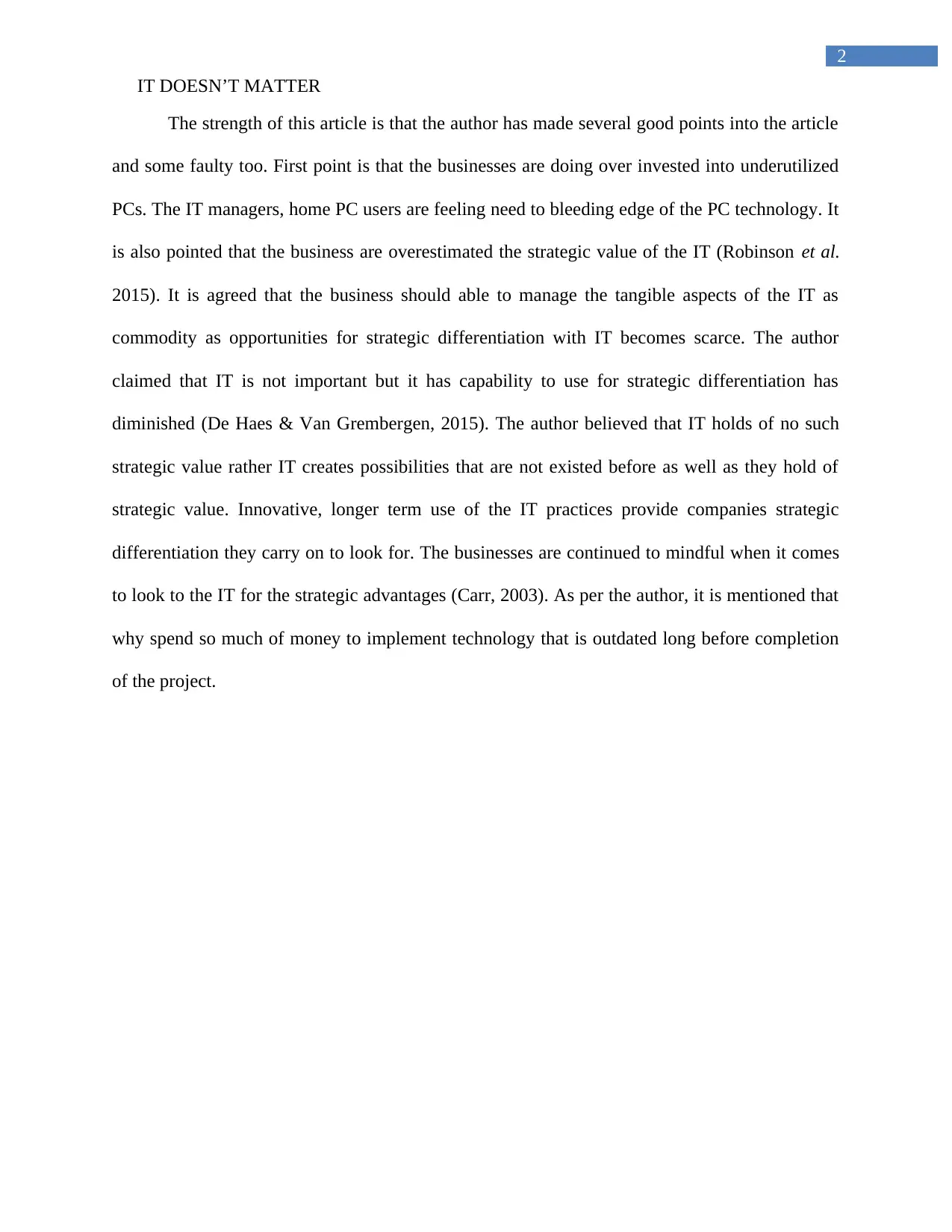
The strength of this article is that the author has made several good points into the article
and some faulty too. First point is that the businesses are doing over invested into underutilized
PCs. The IT managers, home PC users are feeling need to bleeding edge of the PC technology. It
is also pointed that the business are overestimated the strategic value of the IT (Robinson et al.
2015). It is agreed that the business should able to manage the tangible aspects of the IT as
commodity as opportunities for strategic differentiation with IT becomes scarce. The author
claimed that IT is not important but it has capability to use for strategic differentiation has
diminished (De Haes & Van Grembergen, 2015). The author believed that IT holds of no such
strategic value rather IT creates possibilities that are not existed before as well as they hold of
strategic value. Innovative, longer term use of the IT practices provide companies strategic
differentiation they carry on to look for. The businesses are continued to mindful when it comes
to look to the IT for the strategic advantages (Carr, 2003). As per the author, it is mentioned that
why spend so much of money to implement technology that is outdated long before completion
of the project.
Document Page
3
IT DOESN’T MATTER
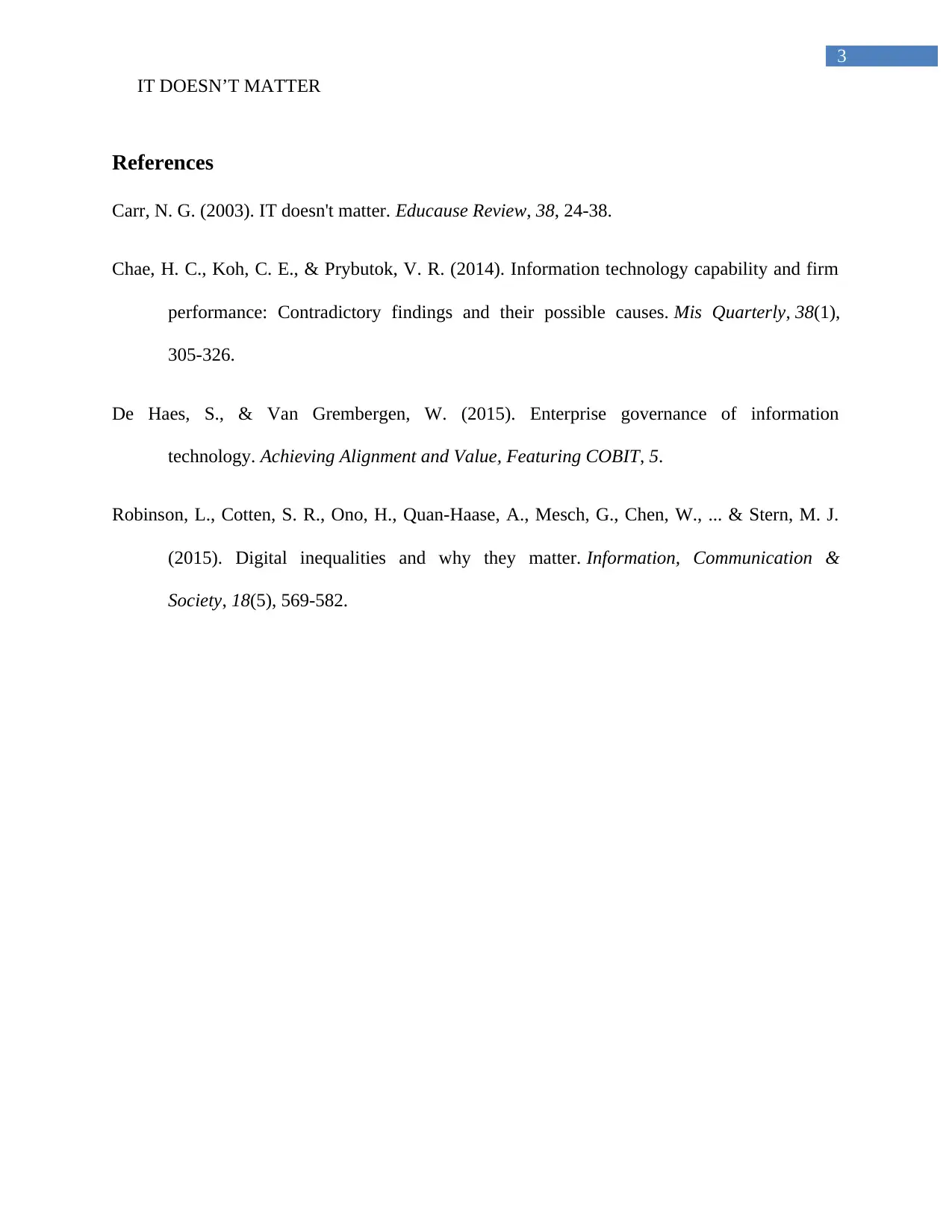
References
Carr, N. G. (2003). IT doesn't matter. Educause Review, 38, 24-38.
Chae, H. C., Koh, C. E., & Prybutok, V. R. (2014). Information technology capability and firm
performance: Contradictory findings and their possible causes. Mis Quarterly, 38(1),
305-326.
De Haes, S., & Van Grembergen, W. (2015). Enterprise governance of information
technology. Achieving Alignment and Value, Featuring COBIT, 5.
Robinson, L., Cotten, S. R., Ono, H., Quan-Haase, A., Mesch, G., Chen, W., ... & Stern, M. J.
(2015). Digital inequalities and why they matter. Information, Communication &
Society, 18(5), 569-582.
chevron_up_icon
1 out of 4
circle_padding
hide_on_mobile
zoom_out_icon
[object Object]