Critical Analysis of Readings: Early Childhood Education Assignment
VerifiedAdded on 2020/03/01
|13
|4538
|281
Homework Assignment
AI Summary
This assignment presents a critical analysis of readings related to early childhood education. It includes three discussion contributions (each 200 words) analyzing topics such as the importance of theories in understanding early childhood development, the difference between evaluation and critical reflection, and the differences between a curriculum approach and pedagogy. The assignment also features four reading analyses (each 200 words) focusing on pedagogical leadership, key ideas, reflections, and implications for practice based on the provided references. The readings cover various aspects including the use of tools by educators, strategies for teaching children, the significance of pedagogical synergies, the qualities of leadership in early childhood education, and the importance of reflective practices. The student reflects on how these ideas relate to their existing knowledge and the implications for their role as a pedagogical leader. The assignment demonstrates a deep understanding of the core concepts of early childhood education and their practical applications.
Student Name:
Student Number:
Tutorial campus and time:
Tutor:
ASSIGNMENT 1: CRITICAL ANALYSIS OF READINGS:
Discussion Contributions 3 x 200 Words
Your discussion contribution can have a response from another student within it with your
contributions either side. If this is how you present your discussion, the response from the other
student is not counted in the word count but both of your contributions are. Please do not
exceed the word count by any more than 10%.
What is the difference between Evaluation and Critical Reflection?
CO LLA PS E
Evaluation is ongoing learning process to collected information (keeping quality
documentation rather than quantity) and evidence about children or things. There are
many ways of gathering information about children in early childhood education and care
services. By using written observation methods to the most contemporary techniques,
such as digital media including photos slide shows, audio/video recording, photo jotting
and CD portfolios. Educators can use these evaluations to identify ideas when planning
their future curriculum. these ideas can expand on children's current interests and
identify new interests, providing more challenging experiences, improve resources,
Name…..……………..SN:………..:101899 Introduction to Pedagogical Leadership: Assignment 1: Spring 2016 P.1
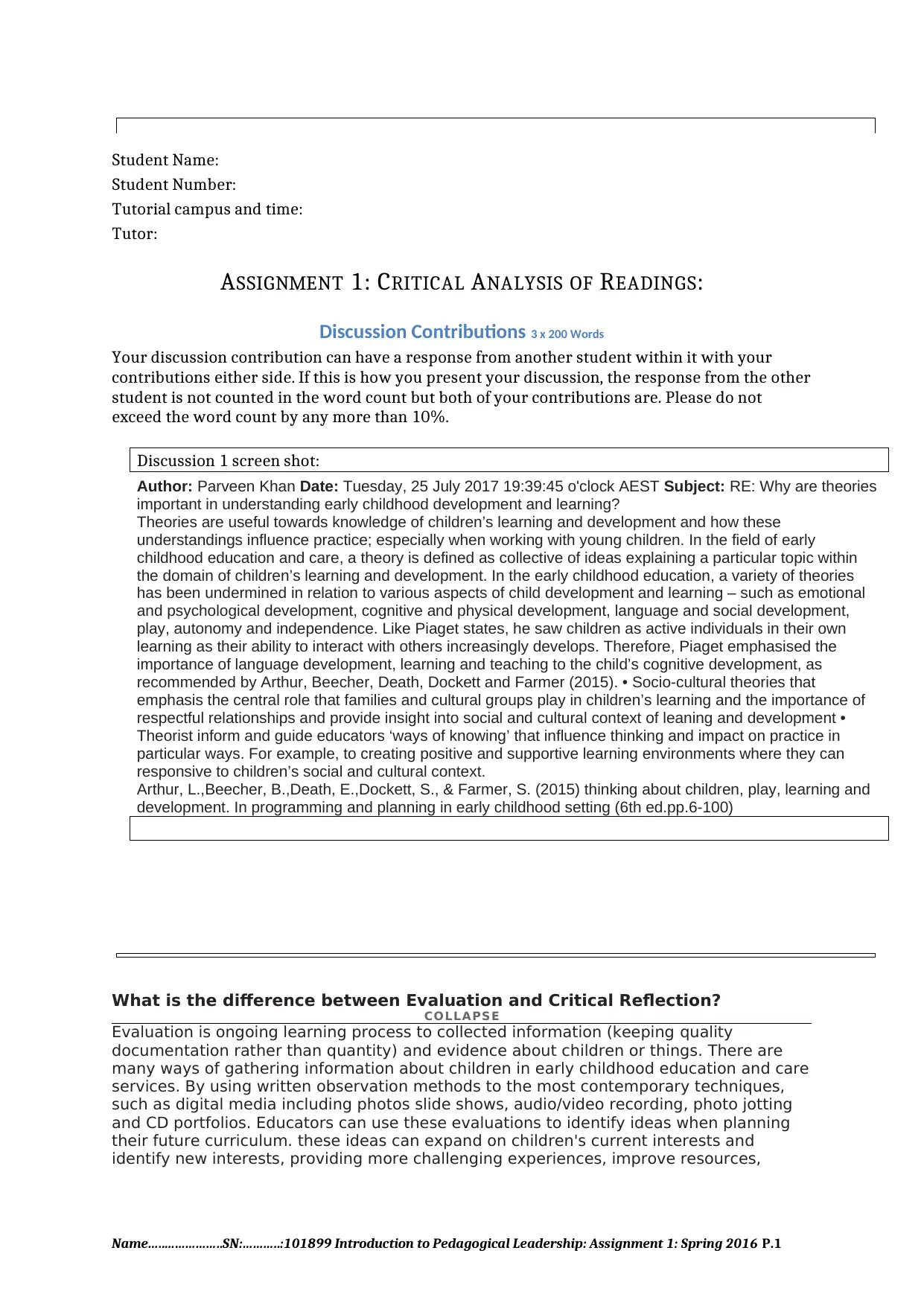
Discussion 1 screen shot:
Author: Parveen Khan Date: Tuesday, 25 July 2017 19:39:45 o'clock AEST Subject: RE: Why are theories
important in understanding early childhood development and learning?
Theories are useful towards knowledge of children’s learning and development and how these
understandings influence practice; especially when working with young children. In the field of early
childhood education and care, a theory is defined as collective of ideas explaining a particular topic within
the domain of children’s learning and development. In the early childhood education, a variety of theories
has been undermined in relation to various aspects of child development and learning – such as emotional
and psychological development, cognitive and physical development, language and social development,
play, autonomy and independence. Like Piaget states, he saw children as active individuals in their own
learning as their ability to interact with others increasingly develops. Therefore, Piaget emphasised the
importance of language development, learning and teaching to the child’s cognitive development, as
recommended by Arthur, Beecher, Death, Dockett and Farmer (2015). • Socio-cultural theories that
emphasis the central role that families and cultural groups play in children’s learning and the importance of
respectful relationships and provide insight into social and cultural context of leaning and development •
Theorist inform and guide educators ‘ways of knowing’ that influence thinking and impact on practice in
particular ways. For example, to creating positive and supportive learning environments where they can
responsive to children’s social and cultural context.
Arthur, L.,Beecher, B.,Death, E.,Dockett, S., & Farmer, S. (2015) thinking about children, play, learning and
development. In programming and planning in early childhood setting (6th ed.pp.6-100)
Discussion 3 screen shot:
Student Number:
Tutorial campus and time:
Tutor:
ASSIGNMENT 1: CRITICAL ANALYSIS OF READINGS:
Discussion Contributions 3 x 200 Words
Your discussion contribution can have a response from another student within it with your
contributions either side. If this is how you present your discussion, the response from the other
student is not counted in the word count but both of your contributions are. Please do not
exceed the word count by any more than 10%.
What is the difference between Evaluation and Critical Reflection?
CO LLA PS E
Evaluation is ongoing learning process to collected information (keeping quality
documentation rather than quantity) and evidence about children or things. There are
many ways of gathering information about children in early childhood education and care
services. By using written observation methods to the most contemporary techniques,
such as digital media including photos slide shows, audio/video recording, photo jotting
and CD portfolios. Educators can use these evaluations to identify ideas when planning
their future curriculum. these ideas can expand on children's current interests and
identify new interests, providing more challenging experiences, improve resources,
Name…..……………..SN:………..:101899 Introduction to Pedagogical Leadership: Assignment 1: Spring 2016 P.1
Discussion 1 screen shot:
Author: Parveen Khan Date: Tuesday, 25 July 2017 19:39:45 o'clock AEST Subject: RE: Why are theories
important in understanding early childhood development and learning?
Theories are useful towards knowledge of children’s learning and development and how these
understandings influence practice; especially when working with young children. In the field of early
childhood education and care, a theory is defined as collective of ideas explaining a particular topic within
the domain of children’s learning and development. In the early childhood education, a variety of theories
has been undermined in relation to various aspects of child development and learning – such as emotional
and psychological development, cognitive and physical development, language and social development,
play, autonomy and independence. Like Piaget states, he saw children as active individuals in their own
learning as their ability to interact with others increasingly develops. Therefore, Piaget emphasised the
importance of language development, learning and teaching to the child’s cognitive development, as
recommended by Arthur, Beecher, Death, Dockett and Farmer (2015). • Socio-cultural theories that
emphasis the central role that families and cultural groups play in children’s learning and the importance of
respectful relationships and provide insight into social and cultural context of leaning and development •
Theorist inform and guide educators ‘ways of knowing’ that influence thinking and impact on practice in
particular ways. For example, to creating positive and supportive learning environments where they can
responsive to children’s social and cultural context.
Arthur, L.,Beecher, B.,Death, E.,Dockett, S., & Farmer, S. (2015) thinking about children, play, learning and
development. In programming and planning in early childhood setting (6th ed.pp.6-100)
Discussion 3 screen shot:

Paraphrase This Document
Need a fresh take? Get an instant paraphrase of this document with our AI Paraphraser
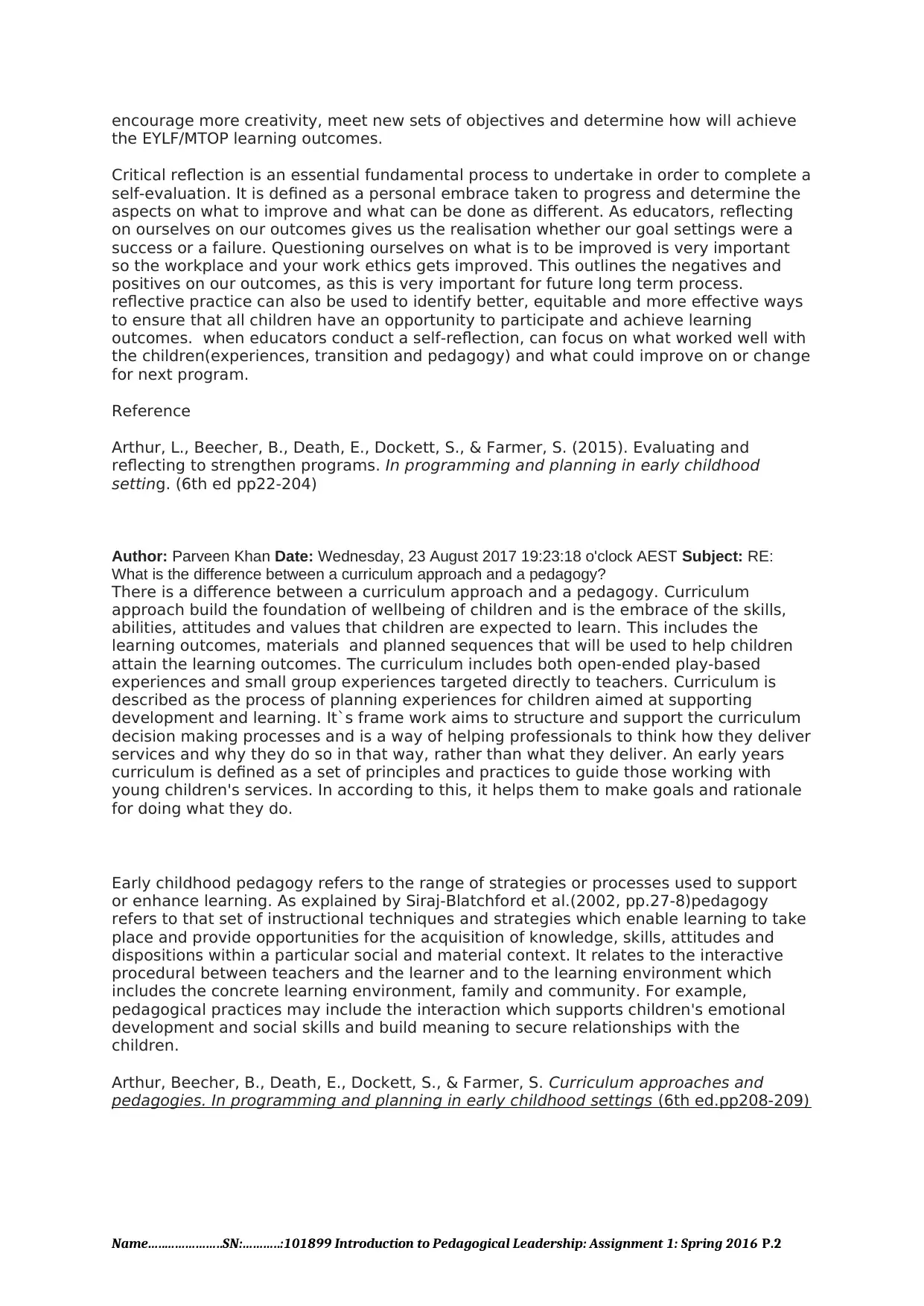
encourage more creativity, meet new sets of objectives and determine how will achieve
the EYLF/MTOP learning outcomes.
Critical reflection is an essential fundamental process to undertake in order to complete a
self-evaluation. It is defined as a personal embrace taken to progress and determine the
aspects on what to improve and what can be done as different. As educators, reflecting
on ourselves on our outcomes gives us the realisation whether our goal settings were a
success or a failure. Questioning ourselves on what is to be improved is very important
so the workplace and your work ethics gets improved. This outlines the negatives and
positives on our outcomes, as this is very important for future long term process.
reflective practice can also be used to identify better, equitable and more effective ways
to ensure that all children have an opportunity to participate and achieve learning
outcomes. when educators conduct a self-reflection, can focus on what worked well with
the children(experiences, transition and pedagogy) and what could improve on or change
for next program.
Reference
Arthur, L., Beecher, B., Death, E., Dockett, S., & Farmer, S. (2015). Evaluating and
reflecting to strengthen programs. In programming and planning in early childhood
setting. (6th ed pp22-204)
Author: Parveen Khan Date: Wednesday, 23 August 2017 19:23:18 o'clock AEST Subject: RE:
What is the difference between a curriculum approach and a pedagogy?
There is a difference between a curriculum approach and a pedagogy. Curriculum
approach build the foundation of wellbeing of children and is the embrace of the skills,
abilities, attitudes and values that children are expected to learn. This includes the
learning outcomes, materials and planned sequences that will be used to help children
attain the learning outcomes. The curriculum includes both open-ended play-based
experiences and small group experiences targeted directly to teachers. Curriculum is
described as the process of planning experiences for children aimed at supporting
development and learning. It`s frame work aims to structure and support the curriculum
decision making processes and is a way of helping professionals to think how they deliver
services and why they do so in that way, rather than what they deliver. An early years
curriculum is defined as a set of principles and practices to guide those working with
young children's services. In according to this, it helps them to make goals and rationale
for doing what they do.
Early childhood pedagogy refers to the range of strategies or processes used to support
or enhance learning. As explained by Siraj-Blatchford et al.(2002, pp.27-8)pedagogy
refers to that set of instructional techniques and strategies which enable learning to take
place and provide opportunities for the acquisition of knowledge, skills, attitudes and
dispositions within a particular social and material context. It relates to the interactive
procedural between teachers and the learner and to the learning environment which
includes the concrete learning environment, family and community. For example,
pedagogical practices may include the interaction which supports children's emotional
development and social skills and build meaning to secure relationships with the
children.
Arthur, Beecher, B., Death, E., Dockett, S., & Farmer, S. Curriculum approaches and
pedagogies. In programming and planning in early childhood settings (6th ed.pp208-209)
Name…..……………..SN:………..:101899 Introduction to Pedagogical Leadership: Assignment 1: Spring 2016 P.2
the EYLF/MTOP learning outcomes.
Critical reflection is an essential fundamental process to undertake in order to complete a
self-evaluation. It is defined as a personal embrace taken to progress and determine the
aspects on what to improve and what can be done as different. As educators, reflecting
on ourselves on our outcomes gives us the realisation whether our goal settings were a
success or a failure. Questioning ourselves on what is to be improved is very important
so the workplace and your work ethics gets improved. This outlines the negatives and
positives on our outcomes, as this is very important for future long term process.
reflective practice can also be used to identify better, equitable and more effective ways
to ensure that all children have an opportunity to participate and achieve learning
outcomes. when educators conduct a self-reflection, can focus on what worked well with
the children(experiences, transition and pedagogy) and what could improve on or change
for next program.
Reference
Arthur, L., Beecher, B., Death, E., Dockett, S., & Farmer, S. (2015). Evaluating and
reflecting to strengthen programs. In programming and planning in early childhood
setting. (6th ed pp22-204)
Author: Parveen Khan Date: Wednesday, 23 August 2017 19:23:18 o'clock AEST Subject: RE:
What is the difference between a curriculum approach and a pedagogy?
There is a difference between a curriculum approach and a pedagogy. Curriculum
approach build the foundation of wellbeing of children and is the embrace of the skills,
abilities, attitudes and values that children are expected to learn. This includes the
learning outcomes, materials and planned sequences that will be used to help children
attain the learning outcomes. The curriculum includes both open-ended play-based
experiences and small group experiences targeted directly to teachers. Curriculum is
described as the process of planning experiences for children aimed at supporting
development and learning. It`s frame work aims to structure and support the curriculum
decision making processes and is a way of helping professionals to think how they deliver
services and why they do so in that way, rather than what they deliver. An early years
curriculum is defined as a set of principles and practices to guide those working with
young children's services. In according to this, it helps them to make goals and rationale
for doing what they do.
Early childhood pedagogy refers to the range of strategies or processes used to support
or enhance learning. As explained by Siraj-Blatchford et al.(2002, pp.27-8)pedagogy
refers to that set of instructional techniques and strategies which enable learning to take
place and provide opportunities for the acquisition of knowledge, skills, attitudes and
dispositions within a particular social and material context. It relates to the interactive
procedural between teachers and the learner and to the learning environment which
includes the concrete learning environment, family and community. For example,
pedagogical practices may include the interaction which supports children's emotional
development and social skills and build meaning to secure relationships with the
children.
Arthur, Beecher, B., Death, E., Dockett, S., & Farmer, S. Curriculum approaches and
pedagogies. In programming and planning in early childhood settings (6th ed.pp208-209)
Name…..……………..SN:………..:101899 Introduction to Pedagogical Leadership: Assignment 1: Spring 2016 P.2
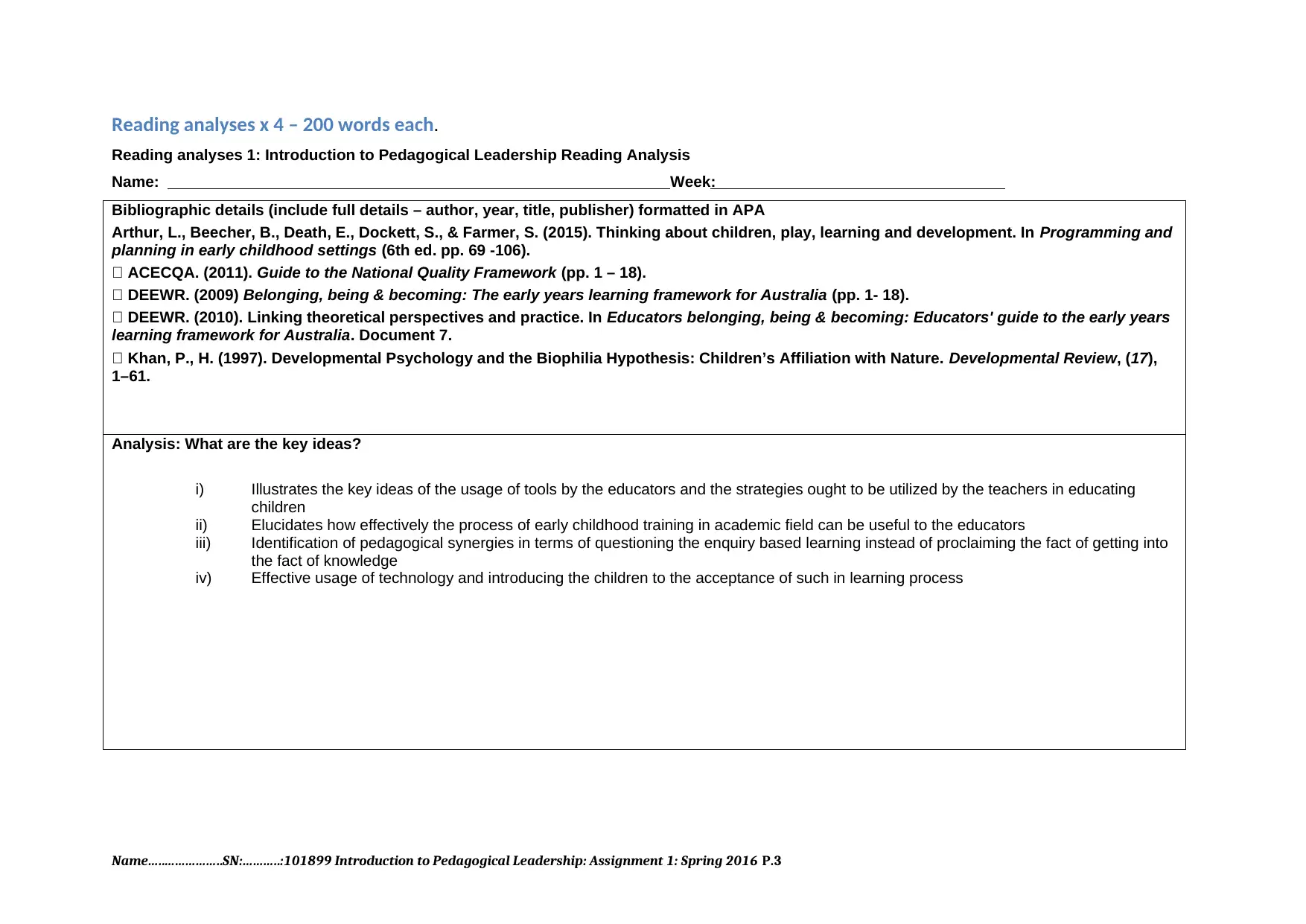
Reading analyses x 4 – 200 words each.
Reading analyses 1: Introduction to Pedagogical Leadership Reading Analysis
Name: Week:
Bibliographic details (include full details – author, year, title, publisher) formatted in APA
Arthur, L., Beecher, B., Death, E., Dockett, S., & Farmer, S. (2015). Thinking about children, play, learning and development. In Programming and
planning in early childhood settings (6th ed. pp. 69 -106).
ACECQA. (2011). Guide to the National Quality Framework (pp. 1 – 18).
DEEWR. (2009) Belonging, being & becoming: The early years learning framework for Australia (pp. 1- 18).
DEEWR. (2010). Linking theoretical perspectives and practice. In Educators belonging, being & becoming: Educators' guide to the early years
learning framework for Australia. Document 7.
Khan, P., H. (1997). Developmental Psychology and the Biophilia Hypothesis: Children’s Affiliation with Nature. Developmental Review, (17),
1–61.
Analysis: What are the key ideas?
i) Illustrates the key ideas of the usage of tools by the educators and the strategies ought to be utilized by the teachers in educating
children
ii) Elucidates how effectively the process of early childhood training in academic field can be useful to the educators
iii) Identification of pedagogical synergies in terms of questioning the enquiry based learning instead of proclaiming the fact of getting into
the fact of knowledge
iv) Effective usage of technology and introducing the children to the acceptance of such in learning process
Name…..……………..SN:………..:101899 Introduction to Pedagogical Leadership: Assignment 1: Spring 2016 P.3
Reading analyses 1: Introduction to Pedagogical Leadership Reading Analysis
Name: Week:
Bibliographic details (include full details – author, year, title, publisher) formatted in APA
Arthur, L., Beecher, B., Death, E., Dockett, S., & Farmer, S. (2015). Thinking about children, play, learning and development. In Programming and
planning in early childhood settings (6th ed. pp. 69 -106).
ACECQA. (2011). Guide to the National Quality Framework (pp. 1 – 18).
DEEWR. (2009) Belonging, being & becoming: The early years learning framework for Australia (pp. 1- 18).
DEEWR. (2010). Linking theoretical perspectives and practice. In Educators belonging, being & becoming: Educators' guide to the early years
learning framework for Australia. Document 7.
Khan, P., H. (1997). Developmental Psychology and the Biophilia Hypothesis: Children’s Affiliation with Nature. Developmental Review, (17),
1–61.
Analysis: What are the key ideas?
i) Illustrates the key ideas of the usage of tools by the educators and the strategies ought to be utilized by the teachers in educating
children
ii) Elucidates how effectively the process of early childhood training in academic field can be useful to the educators
iii) Identification of pedagogical synergies in terms of questioning the enquiry based learning instead of proclaiming the fact of getting into
the fact of knowledge
iv) Effective usage of technology and introducing the children to the acceptance of such in learning process
Name…..……………..SN:………..:101899 Introduction to Pedagogical Leadership: Assignment 1: Spring 2016 P.3
⊘ This is a preview!⊘
Do you want full access?
Subscribe today to unlock all pages.

Trusted by 1+ million students worldwide
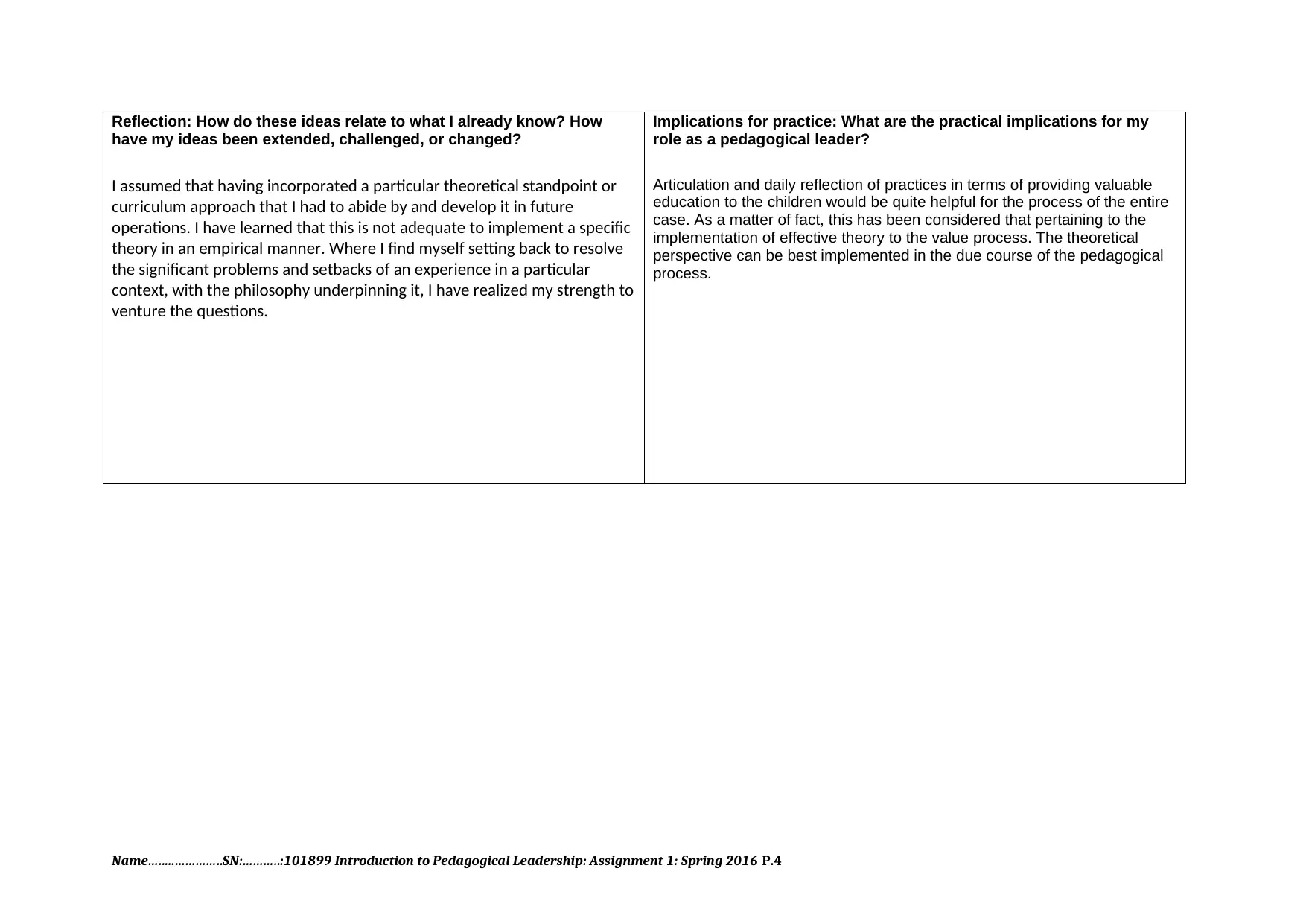
Reflection: How do these ideas relate to what I already know? How
have my ideas been extended, challenged, or changed?
I assumed that having incorporated a particular theoretical standpoint or
curriculum approach that I had to abide by and develop it in future
operations. I have learned that this is not adequate to implement a specific
theory in an empirical manner. Where I find myself setting back to resolve
the significant problems and setbacks of an experience in a particular
context, with the philosophy underpinning it, I have realized my strength to
venture the questions.
Implications for practice: What are the practical implications for my
role as a pedagogical leader?
Articulation and daily reflection of practices in terms of providing valuable
education to the children would be quite helpful for the process of the entire
case. As a matter of fact, this has been considered that pertaining to the
implementation of effective theory to the value process. The theoretical
perspective can be best implemented in the due course of the pedagogical
process.
Name…..……………..SN:………..:101899 Introduction to Pedagogical Leadership: Assignment 1: Spring 2016 P.4
have my ideas been extended, challenged, or changed?
I assumed that having incorporated a particular theoretical standpoint or
curriculum approach that I had to abide by and develop it in future
operations. I have learned that this is not adequate to implement a specific
theory in an empirical manner. Where I find myself setting back to resolve
the significant problems and setbacks of an experience in a particular
context, with the philosophy underpinning it, I have realized my strength to
venture the questions.
Implications for practice: What are the practical implications for my
role as a pedagogical leader?
Articulation and daily reflection of practices in terms of providing valuable
education to the children would be quite helpful for the process of the entire
case. As a matter of fact, this has been considered that pertaining to the
implementation of effective theory to the value process. The theoretical
perspective can be best implemented in the due course of the pedagogical
process.
Name…..……………..SN:………..:101899 Introduction to Pedagogical Leadership: Assignment 1: Spring 2016 P.4
Paraphrase This Document
Need a fresh take? Get an instant paraphrase of this document with our AI Paraphraser
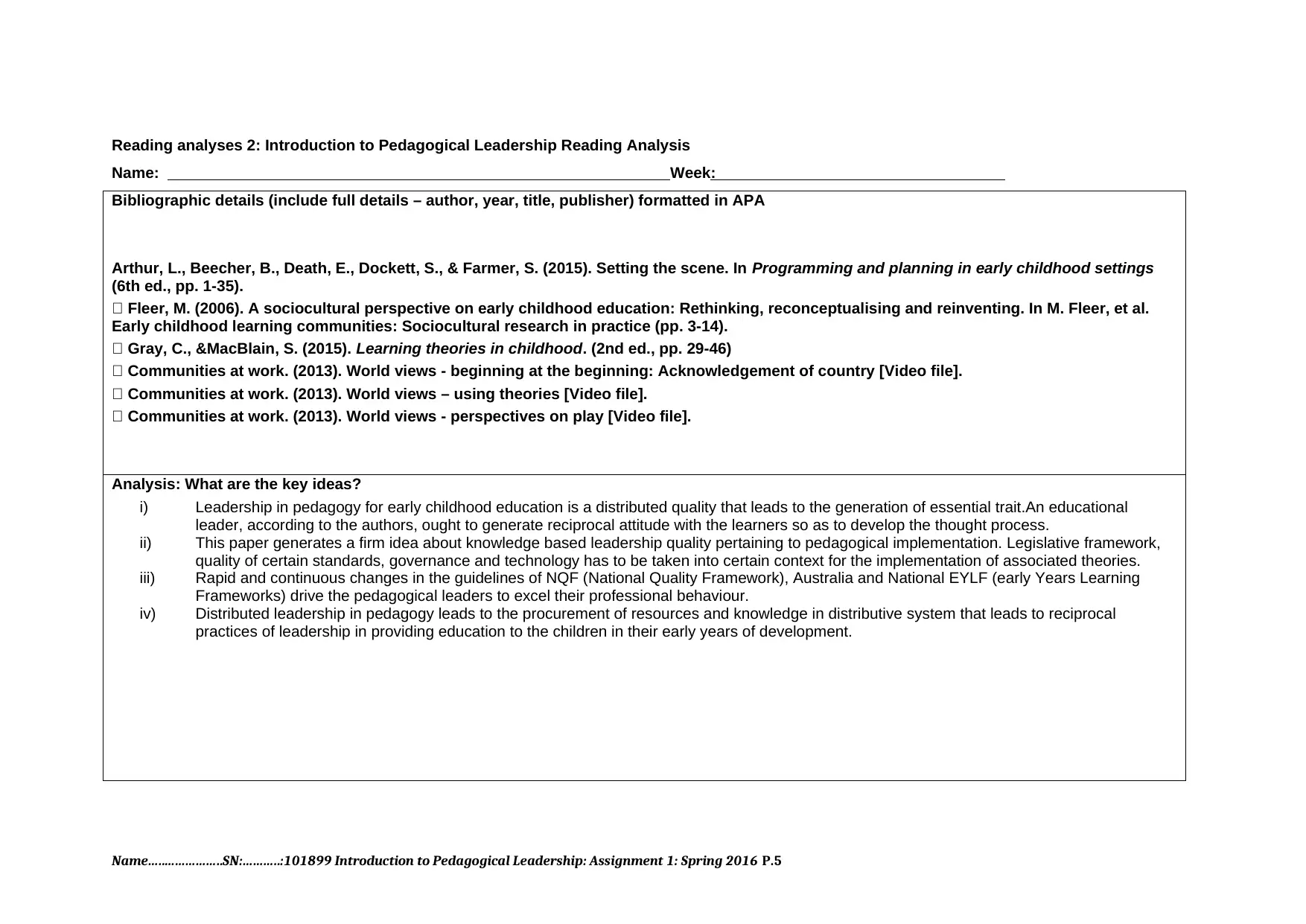
Reading analyses 2: Introduction to Pedagogical Leadership Reading Analysis
Name: Week:
Bibliographic details (include full details – author, year, title, publisher) formatted in APA
Arthur, L., Beecher, B., Death, E., Dockett, S., & Farmer, S. (2015). Setting the scene. In Programming and planning in early childhood settings
(6th ed., pp. 1-35).
Fleer, M. (2006). A sociocultural perspective on early childhood education: Rethinking, reconceptualising and reinventing. In M. Fleer, et al.
Early childhood learning communities: Sociocultural research in practice (pp. 3-14).
Gray, C., &MacBlain, S. (2015). Learning theories in childhood. (2nd ed., pp. 29-46)
Communities at work. (2013). World views - beginning at the beginning: Acknowledgement of country [Video file].
Communities at work. (2013). World views – using theories [Video file].
Communities at work. (2013). World views - perspectives on play [Video file].
Analysis: What are the key ideas?
i) Leadership in pedagogy for early childhood education is a distributed quality that leads to the generation of essential trait.An educational
leader, according to the authors, ought to generate reciprocal attitude with the learners so as to develop the thought process.
ii) This paper generates a firm idea about knowledge based leadership quality pertaining to pedagogical implementation. Legislative framework,
quality of certain standards, governance and technology has to be taken into certain context for the implementation of associated theories.
iii) Rapid and continuous changes in the guidelines of NQF (National Quality Framework), Australia and National EYLF (early Years Learning
Frameworks) drive the pedagogical leaders to excel their professional behaviour.
iv) Distributed leadership in pedagogy leads to the procurement of resources and knowledge in distributive system that leads to reciprocal
practices of leadership in providing education to the children in their early years of development.
Name…..……………..SN:………..:101899 Introduction to Pedagogical Leadership: Assignment 1: Spring 2016 P.5
Name: Week:
Bibliographic details (include full details – author, year, title, publisher) formatted in APA
Arthur, L., Beecher, B., Death, E., Dockett, S., & Farmer, S. (2015). Setting the scene. In Programming and planning in early childhood settings
(6th ed., pp. 1-35).
Fleer, M. (2006). A sociocultural perspective on early childhood education: Rethinking, reconceptualising and reinventing. In M. Fleer, et al.
Early childhood learning communities: Sociocultural research in practice (pp. 3-14).
Gray, C., &MacBlain, S. (2015). Learning theories in childhood. (2nd ed., pp. 29-46)
Communities at work. (2013). World views - beginning at the beginning: Acknowledgement of country [Video file].
Communities at work. (2013). World views – using theories [Video file].
Communities at work. (2013). World views - perspectives on play [Video file].
Analysis: What are the key ideas?
i) Leadership in pedagogy for early childhood education is a distributed quality that leads to the generation of essential trait.An educational
leader, according to the authors, ought to generate reciprocal attitude with the learners so as to develop the thought process.
ii) This paper generates a firm idea about knowledge based leadership quality pertaining to pedagogical implementation. Legislative framework,
quality of certain standards, governance and technology has to be taken into certain context for the implementation of associated theories.
iii) Rapid and continuous changes in the guidelines of NQF (National Quality Framework), Australia and National EYLF (early Years Learning
Frameworks) drive the pedagogical leaders to excel their professional behaviour.
iv) Distributed leadership in pedagogy leads to the procurement of resources and knowledge in distributive system that leads to reciprocal
practices of leadership in providing education to the children in their early years of development.
Name…..……………..SN:………..:101899 Introduction to Pedagogical Leadership: Assignment 1: Spring 2016 P.5
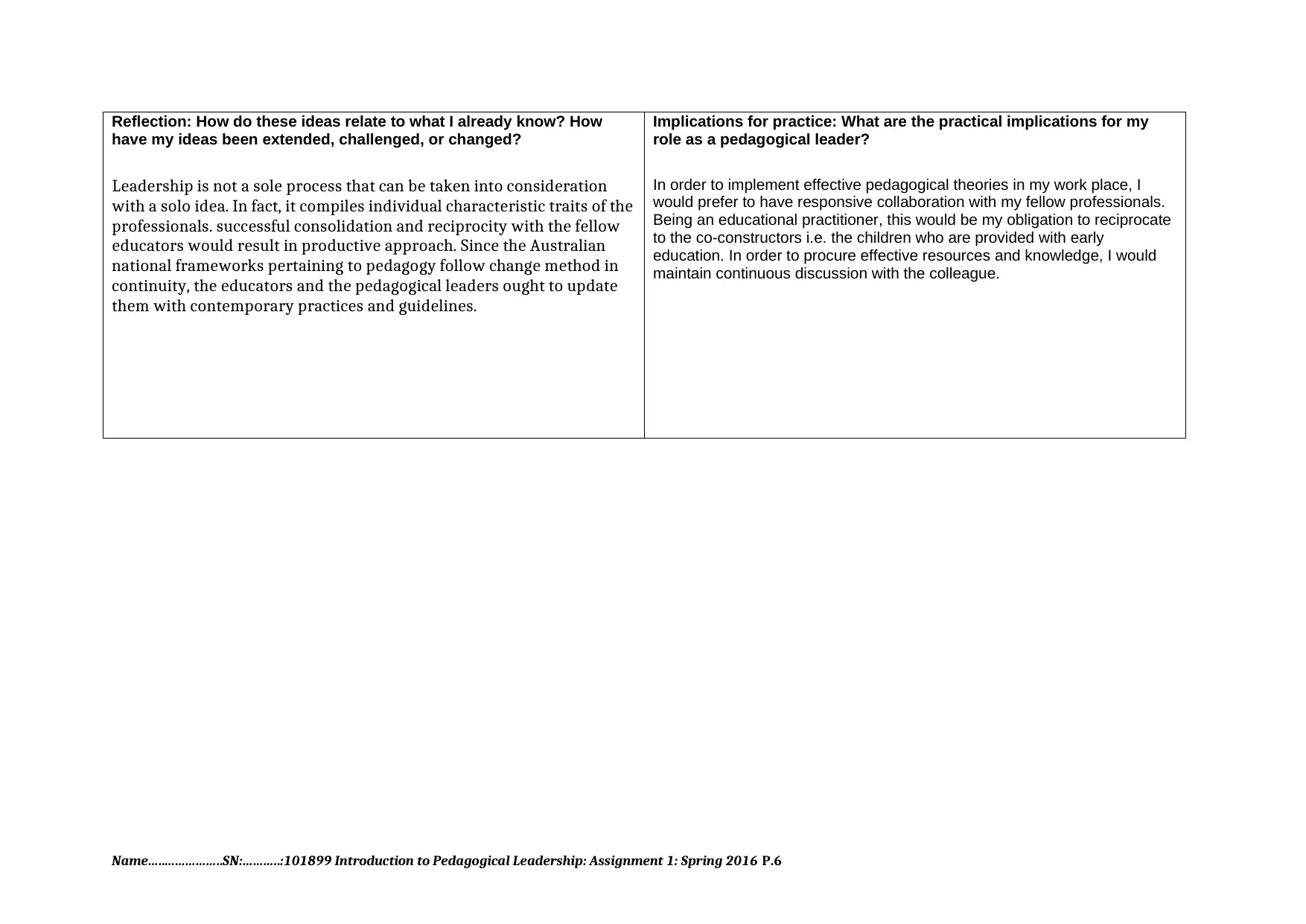
Reflection: How do these ideas relate to what I already know? How
have my ideas been extended, challenged, or changed?
Leadership is not a sole process that can be taken into consideration
with a solo idea. In fact, it compiles individual characteristic traits of the
professionals. successful consolidation and reciprocity with the fellow
educators would result in productive approach. Since the Australian
national frameworks pertaining to pedagogy follow change method in
continuity, the educators and the pedagogical leaders ought to update
them with contemporary practices and guidelines.
Implications for practice: What are the practical implications for my
role as a pedagogical leader?
In order to implement effective pedagogical theories in my work place, I
would prefer to have responsive collaboration with my fellow professionals.
Being an educational practitioner, this would be my obligation to reciprocate
to the co-constructors i.e. the children who are provided with early
education. In order to procure effective resources and knowledge, I would
maintain continuous discussion with the colleague.
Name…..……………..SN:………..:101899 Introduction to Pedagogical Leadership: Assignment 1: Spring 2016 P.6
have my ideas been extended, challenged, or changed?
Leadership is not a sole process that can be taken into consideration
with a solo idea. In fact, it compiles individual characteristic traits of the
professionals. successful consolidation and reciprocity with the fellow
educators would result in productive approach. Since the Australian
national frameworks pertaining to pedagogy follow change method in
continuity, the educators and the pedagogical leaders ought to update
them with contemporary practices and guidelines.
Implications for practice: What are the practical implications for my
role as a pedagogical leader?
In order to implement effective pedagogical theories in my work place, I
would prefer to have responsive collaboration with my fellow professionals.
Being an educational practitioner, this would be my obligation to reciprocate
to the co-constructors i.e. the children who are provided with early
education. In order to procure effective resources and knowledge, I would
maintain continuous discussion with the colleague.
Name…..……………..SN:………..:101899 Introduction to Pedagogical Leadership: Assignment 1: Spring 2016 P.6
⊘ This is a preview!⊘
Do you want full access?
Subscribe today to unlock all pages.
Trusted by 1+ million students worldwide
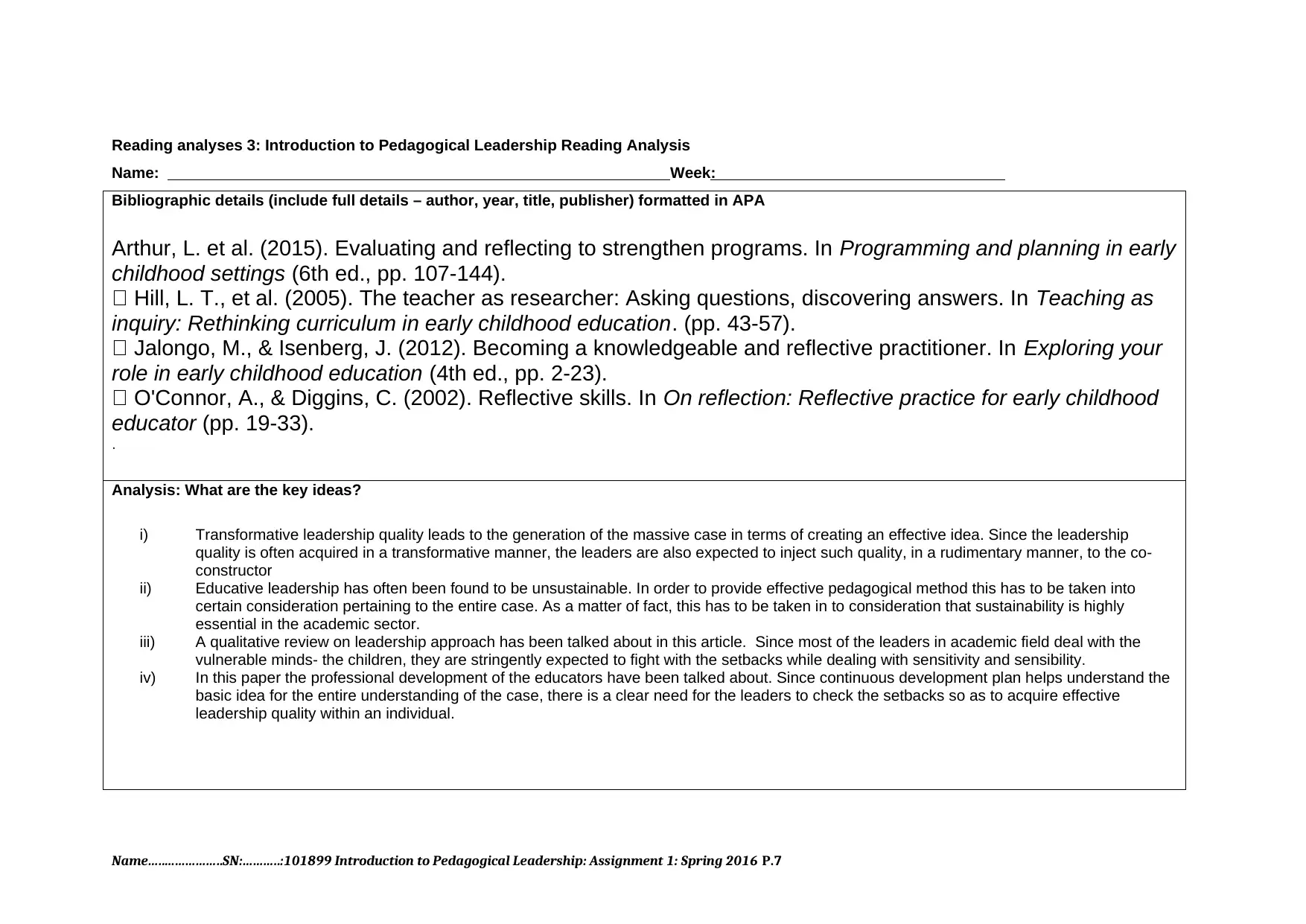
Reading analyses 3: Introduction to Pedagogical Leadership Reading Analysis
Name: Week:
Bibliographic details (include full details – author, year, title, publisher) formatted in APA
Arthur, L. et al. (2015). Evaluating and reflecting to strengthen programs. In Programming and planning in early
childhood settings (6th ed., pp. 107-144).
Hill, L. T., et al. (2005). The teacher as researcher: Asking questions, discovering answers. In Teaching as
inquiry: Rethinking curriculum in early childhood education. (pp. 43-57).
Jalongo, M., & Isenberg, J. (2012). Becoming a knowledgeable and reflective practitioner. In Exploring your
role in early childhood education (4th ed., pp. 2-23).
O'Connor, A., & Diggins, C. (2002). Reflective skills. In On reflection: Reflective practice for early childhood
educator (pp. 19-33).
.
Analysis: What are the key ideas?
i) Transformative leadership quality leads to the generation of the massive case in terms of creating an effective idea. Since the leadership
quality is often acquired in a transformative manner, the leaders are also expected to inject such quality, in a rudimentary manner, to the co-
constructor
ii) Educative leadership has often been found to be unsustainable. In order to provide effective pedagogical method this has to be taken into
certain consideration pertaining to the entire case. As a matter of fact, this has to be taken in to consideration that sustainability is highly
essential in the academic sector.
iii) A qualitative review on leadership approach has been talked about in this article. Since most of the leaders in academic field deal with the
vulnerable minds- the children, they are stringently expected to fight with the setbacks while dealing with sensitivity and sensibility.
iv) In this paper the professional development of the educators have been talked about. Since continuous development plan helps understand the
basic idea for the entire understanding of the case, there is a clear need for the leaders to check the setbacks so as to acquire effective
leadership quality within an individual.
Name…..……………..SN:………..:101899 Introduction to Pedagogical Leadership: Assignment 1: Spring 2016 P.7
Name: Week:
Bibliographic details (include full details – author, year, title, publisher) formatted in APA
Arthur, L. et al. (2015). Evaluating and reflecting to strengthen programs. In Programming and planning in early
childhood settings (6th ed., pp. 107-144).
Hill, L. T., et al. (2005). The teacher as researcher: Asking questions, discovering answers. In Teaching as
inquiry: Rethinking curriculum in early childhood education. (pp. 43-57).
Jalongo, M., & Isenberg, J. (2012). Becoming a knowledgeable and reflective practitioner. In Exploring your
role in early childhood education (4th ed., pp. 2-23).
O'Connor, A., & Diggins, C. (2002). Reflective skills. In On reflection: Reflective practice for early childhood
educator (pp. 19-33).
.
Analysis: What are the key ideas?
i) Transformative leadership quality leads to the generation of the massive case in terms of creating an effective idea. Since the leadership
quality is often acquired in a transformative manner, the leaders are also expected to inject such quality, in a rudimentary manner, to the co-
constructor
ii) Educative leadership has often been found to be unsustainable. In order to provide effective pedagogical method this has to be taken into
certain consideration pertaining to the entire case. As a matter of fact, this has to be taken in to consideration that sustainability is highly
essential in the academic sector.
iii) A qualitative review on leadership approach has been talked about in this article. Since most of the leaders in academic field deal with the
vulnerable minds- the children, they are stringently expected to fight with the setbacks while dealing with sensitivity and sensibility.
iv) In this paper the professional development of the educators have been talked about. Since continuous development plan helps understand the
basic idea for the entire understanding of the case, there is a clear need for the leaders to check the setbacks so as to acquire effective
leadership quality within an individual.
Name…..……………..SN:………..:101899 Introduction to Pedagogical Leadership: Assignment 1: Spring 2016 P.7
Paraphrase This Document
Need a fresh take? Get an instant paraphrase of this document with our AI Paraphraser
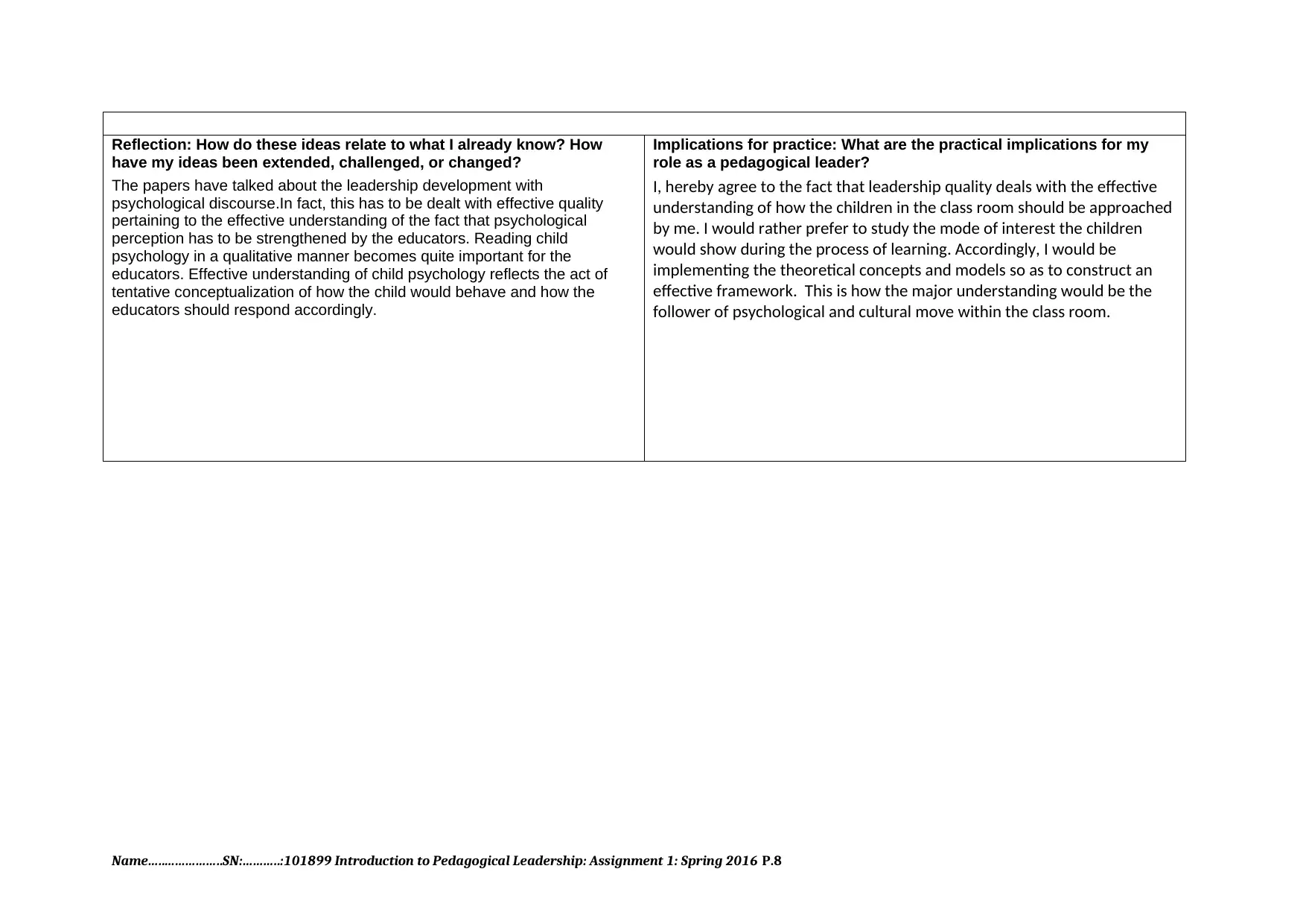
Reflection: How do these ideas relate to what I already know? How
have my ideas been extended, challenged, or changed?
The papers have talked about the leadership development with
psychological discourse.In fact, this has to be dealt with effective quality
pertaining to the effective understanding of the fact that psychological
perception has to be strengthened by the educators. Reading child
psychology in a qualitative manner becomes quite important for the
educators. Effective understanding of child psychology reflects the act of
tentative conceptualization of how the child would behave and how the
educators should respond accordingly.
Implications for practice: What are the practical implications for my
role as a pedagogical leader?
I, hereby agree to the fact that leadership quality deals with the effective
understanding of how the children in the class room should be approached
by me. I would rather prefer to study the mode of interest the children
would show during the process of learning. Accordingly, I would be
implementing the theoretical concepts and models so as to construct an
effective framework. This is how the major understanding would be the
follower of psychological and cultural move within the class room.
Name…..……………..SN:………..:101899 Introduction to Pedagogical Leadership: Assignment 1: Spring 2016 P.8
have my ideas been extended, challenged, or changed?
The papers have talked about the leadership development with
psychological discourse.In fact, this has to be dealt with effective quality
pertaining to the effective understanding of the fact that psychological
perception has to be strengthened by the educators. Reading child
psychology in a qualitative manner becomes quite important for the
educators. Effective understanding of child psychology reflects the act of
tentative conceptualization of how the child would behave and how the
educators should respond accordingly.
Implications for practice: What are the practical implications for my
role as a pedagogical leader?
I, hereby agree to the fact that leadership quality deals with the effective
understanding of how the children in the class room should be approached
by me. I would rather prefer to study the mode of interest the children
would show during the process of learning. Accordingly, I would be
implementing the theoretical concepts and models so as to construct an
effective framework. This is how the major understanding would be the
follower of psychological and cultural move within the class room.
Name…..……………..SN:………..:101899 Introduction to Pedagogical Leadership: Assignment 1: Spring 2016 P.8
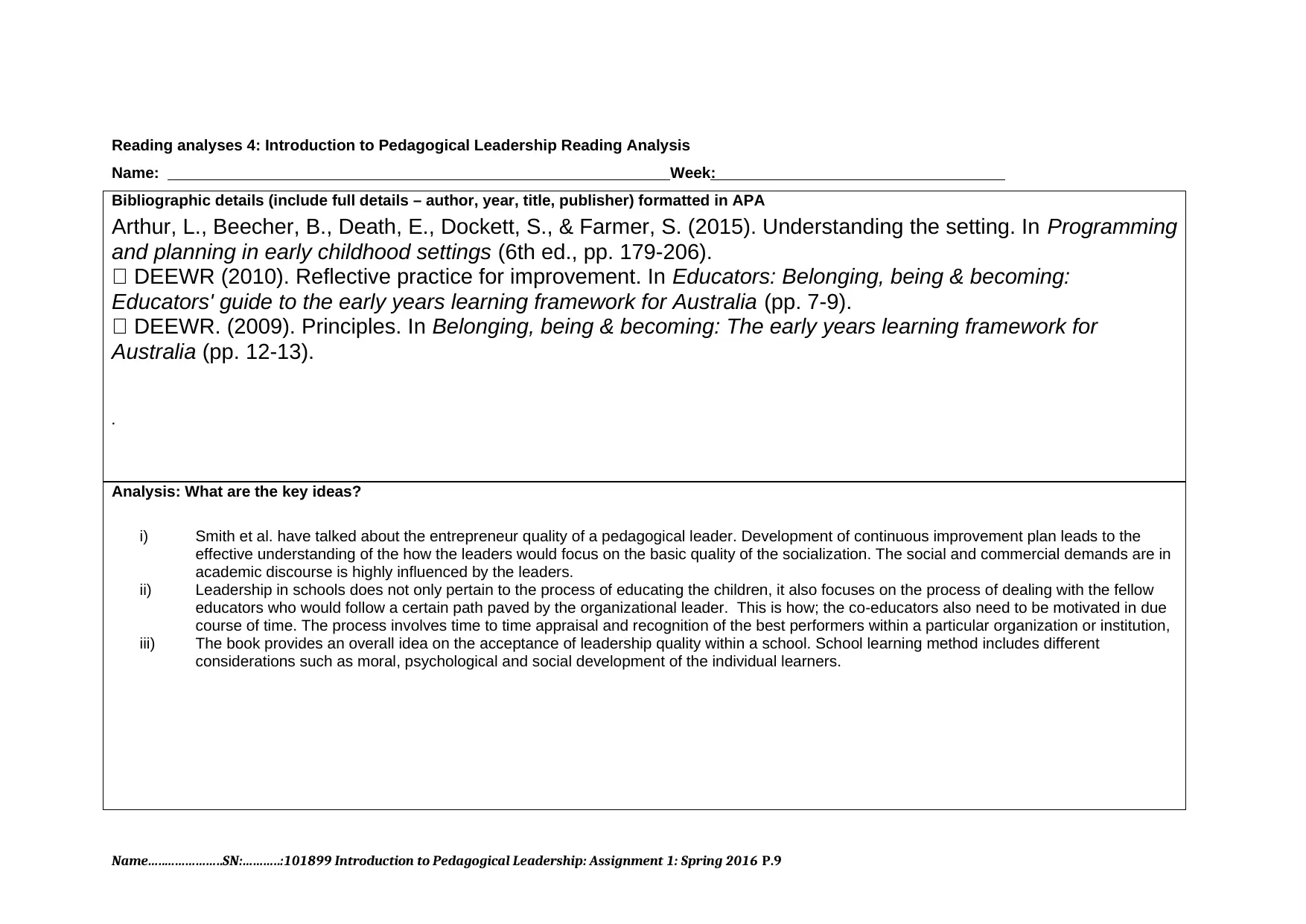
Reading analyses 4: Introduction to Pedagogical Leadership Reading Analysis
Name: Week:
Bibliographic details (include full details – author, year, title, publisher) formatted in APA
Arthur, L., Beecher, B., Death, E., Dockett, S., & Farmer, S. (2015). Understanding the setting. In Programming
and planning in early childhood settings (6th ed., pp. 179-206).
DEEWR (2010). Reflective practice for improvement. In Educators: Belonging, being & becoming:
Educators' guide to the early years learning framework for Australia (pp. 7-9).
DEEWR. (2009). Principles. In Belonging, being & becoming: The early years learning framework for
Australia (pp. 12-13).
.
Analysis: What are the key ideas?
i) Smith et al. have talked about the entrepreneur quality of a pedagogical leader. Development of continuous improvement plan leads to the
effective understanding of the how the leaders would focus on the basic quality of the socialization. The social and commercial demands are in
academic discourse is highly influenced by the leaders.
ii) Leadership in schools does not only pertain to the process of educating the children, it also focuses on the process of dealing with the fellow
educators who would follow a certain path paved by the organizational leader. This is how; the co-educators also need to be motivated in due
course of time. The process involves time to time appraisal and recognition of the best performers within a particular organization or institution,
iii) The book provides an overall idea on the acceptance of leadership quality within a school. School learning method includes different
considerations such as moral, psychological and social development of the individual learners.
Name…..……………..SN:………..:101899 Introduction to Pedagogical Leadership: Assignment 1: Spring 2016 P.9
Name: Week:
Bibliographic details (include full details – author, year, title, publisher) formatted in APA
Arthur, L., Beecher, B., Death, E., Dockett, S., & Farmer, S. (2015). Understanding the setting. In Programming
and planning in early childhood settings (6th ed., pp. 179-206).
DEEWR (2010). Reflective practice for improvement. In Educators: Belonging, being & becoming:
Educators' guide to the early years learning framework for Australia (pp. 7-9).
DEEWR. (2009). Principles. In Belonging, being & becoming: The early years learning framework for
Australia (pp. 12-13).
.
Analysis: What are the key ideas?
i) Smith et al. have talked about the entrepreneur quality of a pedagogical leader. Development of continuous improvement plan leads to the
effective understanding of the how the leaders would focus on the basic quality of the socialization. The social and commercial demands are in
academic discourse is highly influenced by the leaders.
ii) Leadership in schools does not only pertain to the process of educating the children, it also focuses on the process of dealing with the fellow
educators who would follow a certain path paved by the organizational leader. This is how; the co-educators also need to be motivated in due
course of time. The process involves time to time appraisal and recognition of the best performers within a particular organization or institution,
iii) The book provides an overall idea on the acceptance of leadership quality within a school. School learning method includes different
considerations such as moral, psychological and social development of the individual learners.
Name…..……………..SN:………..:101899 Introduction to Pedagogical Leadership: Assignment 1: Spring 2016 P.9
⊘ This is a preview!⊘
Do you want full access?
Subscribe today to unlock all pages.
Trusted by 1+ million students worldwide
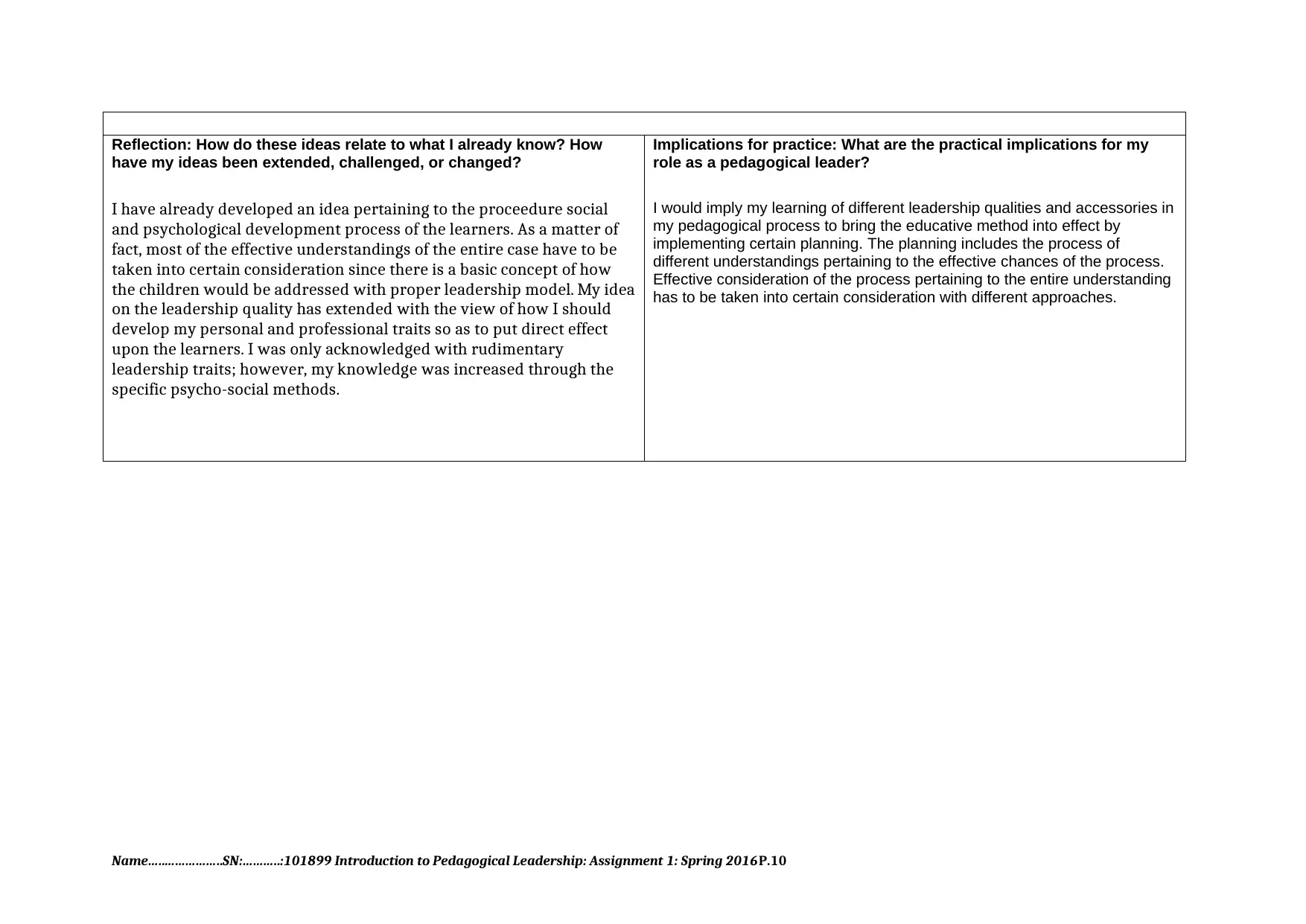
Reflection: How do these ideas relate to what I already know? How
have my ideas been extended, challenged, or changed?
I have already developed an idea pertaining to the proceedure social
and psychological development process of the learners. As a matter of
fact, most of the effective understandings of the entire case have to be
taken into certain consideration since there is a basic concept of how
the children would be addressed with proper leadership model. My idea
on the leadership quality has extended with the view of how I should
develop my personal and professional traits so as to put direct effect
upon the learners. I was only acknowledged with rudimentary
leadership traits; however, my knowledge was increased through the
specific psycho-social methods.
Implications for practice: What are the practical implications for my
role as a pedagogical leader?
I would imply my learning of different leadership qualities and accessories in
my pedagogical process to bring the educative method into effect by
implementing certain planning. The planning includes the process of
different understandings pertaining to the effective chances of the process.
Effective consideration of the process pertaining to the entire understanding
has to be taken into certain consideration with different approaches.
Name…..……………..SN:………..:101899 Introduction to Pedagogical Leadership: Assignment 1: Spring 2016P.10
have my ideas been extended, challenged, or changed?
I have already developed an idea pertaining to the proceedure social
and psychological development process of the learners. As a matter of
fact, most of the effective understandings of the entire case have to be
taken into certain consideration since there is a basic concept of how
the children would be addressed with proper leadership model. My idea
on the leadership quality has extended with the view of how I should
develop my personal and professional traits so as to put direct effect
upon the learners. I was only acknowledged with rudimentary
leadership traits; however, my knowledge was increased through the
specific psycho-social methods.
Implications for practice: What are the practical implications for my
role as a pedagogical leader?
I would imply my learning of different leadership qualities and accessories in
my pedagogical process to bring the educative method into effect by
implementing certain planning. The planning includes the process of
different understandings pertaining to the effective chances of the process.
Effective consideration of the process pertaining to the entire understanding
has to be taken into certain consideration with different approaches.
Name…..……………..SN:………..:101899 Introduction to Pedagogical Leadership: Assignment 1: Spring 2016P.10
Paraphrase This Document
Need a fresh take? Get an instant paraphrase of this document with our AI Paraphraser
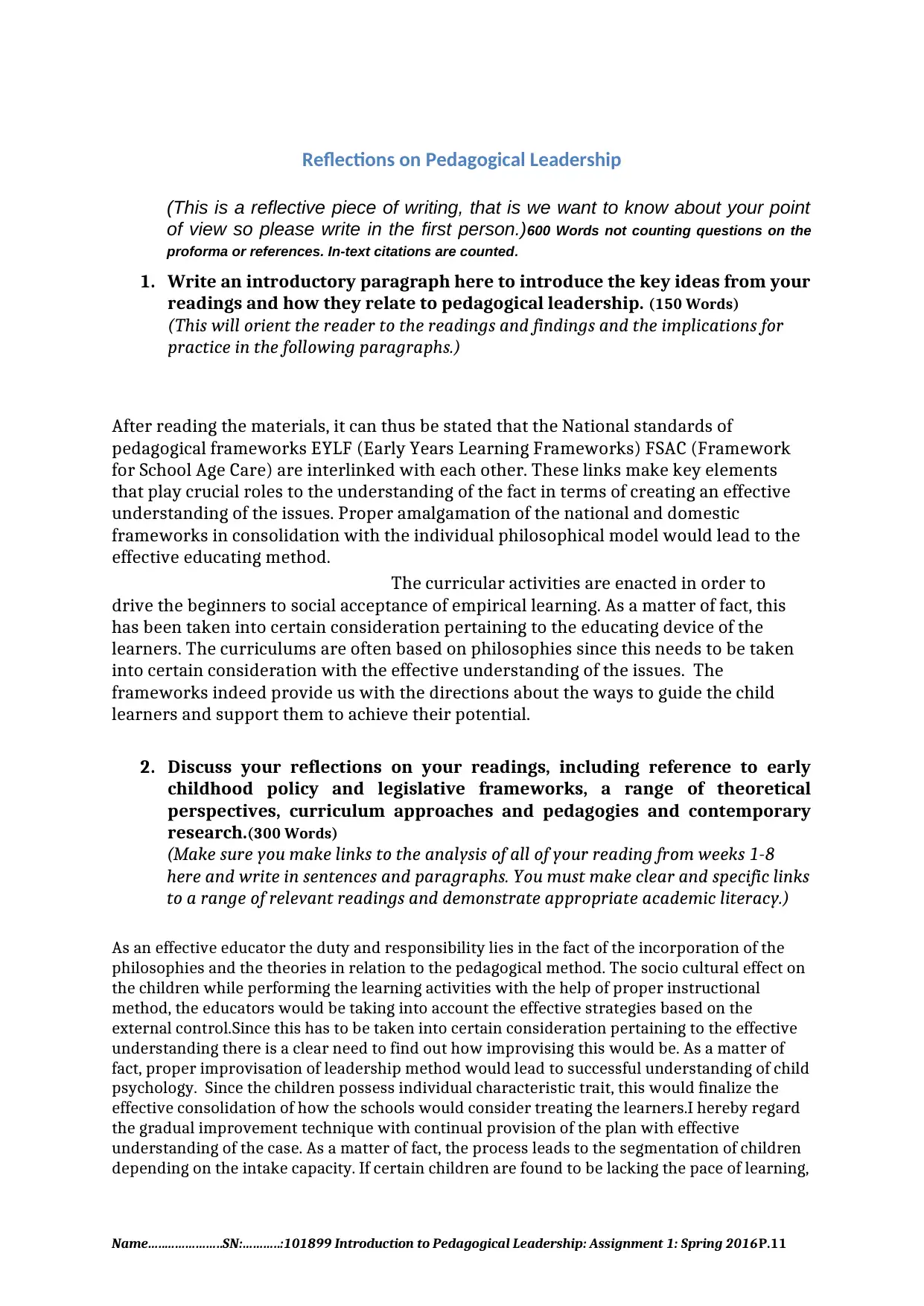
Reflections on Pedagogical Leadership
(This is a reflective piece of writing, that is we want to know about your point
of view so please write in the first person.)600 Words not counting questions on the
proforma or references. In-text citations are counted.
1. Write an introductory paragraph here to introduce the key ideas from your
readings and how they relate to pedagogical leadership. (150 Words)
(This will orient the reader to the readings and findings and the implications for
practice in the following paragraphs.)
After reading the materials, it can thus be stated that the National standards of
pedagogical frameworks EYLF (Early Years Learning Frameworks) FSAC (Framework
for School Age Care) are interlinked with each other. These links make key elements
that play crucial roles to the understanding of the fact in terms of creating an effective
understanding of the issues. Proper amalgamation of the national and domestic
frameworks in consolidation with the individual philosophical model would lead to the
effective educating method.
The curricular activities are enacted in order to
drive the beginners to social acceptance of empirical learning. As a matter of fact, this
has been taken into certain consideration pertaining to the educating device of the
learners. The curriculums are often based on philosophies since this needs to be taken
into certain consideration with the effective understanding of the issues. The
frameworks indeed provide us with the directions about the ways to guide the child
learners and support them to achieve their potential.
2. Discuss your reflections on your readings, including reference to early
childhood policy and legislative frameworks, a range of theoretical
perspectives, curriculum approaches and pedagogies and contemporary
research.(300 Words)
(Make sure you make links to the analysis of all of your reading from weeks 1-8
here and write in sentences and paragraphs. You must make clear and specific links
to a range of relevant readings and demonstrate appropriate academic literacy.)
As an effective educator the duty and responsibility lies in the fact of the incorporation of the
philosophies and the theories in relation to the pedagogical method. The socio cultural effect on
the children while performing the learning activities with the help of proper instructional
method, the educators would be taking into account the effective strategies based on the
external control.Since this has to be taken into certain consideration pertaining to the effective
understanding there is a clear need to find out how improvising this would be. As a matter of
fact, proper improvisation of leadership method would lead to successful understanding of child
psychology. Since the children possess individual characteristic trait, this would finalize the
effective consolidation of how the schools would consider treating the learners.I hereby regard
the gradual improvement technique with continual provision of the plan with effective
understanding of the case. As a matter of fact, the process leads to the segmentation of children
depending on the intake capacity. If certain children are found to be lacking the pace of learning,
Name…..……………..SN:………..:101899 Introduction to Pedagogical Leadership: Assignment 1: Spring 2016P.11
(This is a reflective piece of writing, that is we want to know about your point
of view so please write in the first person.)600 Words not counting questions on the
proforma or references. In-text citations are counted.
1. Write an introductory paragraph here to introduce the key ideas from your
readings and how they relate to pedagogical leadership. (150 Words)
(This will orient the reader to the readings and findings and the implications for
practice in the following paragraphs.)
After reading the materials, it can thus be stated that the National standards of
pedagogical frameworks EYLF (Early Years Learning Frameworks) FSAC (Framework
for School Age Care) are interlinked with each other. These links make key elements
that play crucial roles to the understanding of the fact in terms of creating an effective
understanding of the issues. Proper amalgamation of the national and domestic
frameworks in consolidation with the individual philosophical model would lead to the
effective educating method.
The curricular activities are enacted in order to
drive the beginners to social acceptance of empirical learning. As a matter of fact, this
has been taken into certain consideration pertaining to the educating device of the
learners. The curriculums are often based on philosophies since this needs to be taken
into certain consideration with the effective understanding of the issues. The
frameworks indeed provide us with the directions about the ways to guide the child
learners and support them to achieve their potential.
2. Discuss your reflections on your readings, including reference to early
childhood policy and legislative frameworks, a range of theoretical
perspectives, curriculum approaches and pedagogies and contemporary
research.(300 Words)
(Make sure you make links to the analysis of all of your reading from weeks 1-8
here and write in sentences and paragraphs. You must make clear and specific links
to a range of relevant readings and demonstrate appropriate academic literacy.)
As an effective educator the duty and responsibility lies in the fact of the incorporation of the
philosophies and the theories in relation to the pedagogical method. The socio cultural effect on
the children while performing the learning activities with the help of proper instructional
method, the educators would be taking into account the effective strategies based on the
external control.Since this has to be taken into certain consideration pertaining to the effective
understanding there is a clear need to find out how improvising this would be. As a matter of
fact, proper improvisation of leadership method would lead to successful understanding of child
psychology. Since the children possess individual characteristic trait, this would finalize the
effective consolidation of how the schools would consider treating the learners.I hereby regard
the gradual improvement technique with continual provision of the plan with effective
understanding of the case. As a matter of fact, the process leads to the segmentation of children
depending on the intake capacity. If certain children are found to be lacking the pace of learning,
Name…..……………..SN:………..:101899 Introduction to Pedagogical Leadership: Assignment 1: Spring 2016P.11
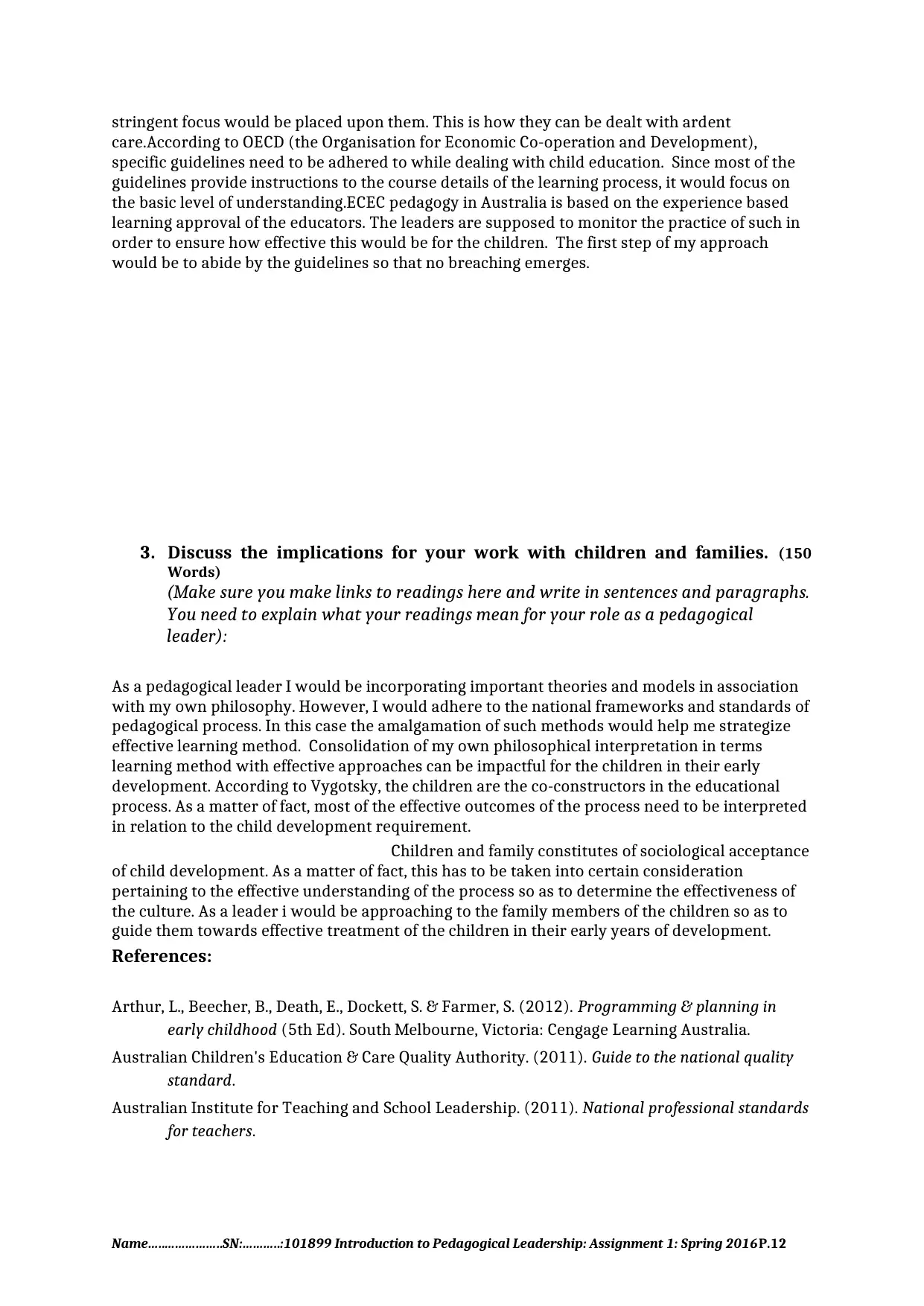
stringent focus would be placed upon them. This is how they can be dealt with ardent
care.According to OECD (the Organisation for Economic Co-operation and Development),
specific guidelines need to be adhered to while dealing with child education. Since most of the
guidelines provide instructions to the course details of the learning process, it would focus on
the basic level of understanding.ECEC pedagogy in Australia is based on the experience based
learning approval of the educators. The leaders are supposed to monitor the practice of such in
order to ensure how effective this would be for the children. The first step of my approach
would be to abide by the guidelines so that no breaching emerges.
3. Discuss the implications for your work with children and families. (150
Words)
(Make sure you make links to readings here and write in sentences and paragraphs.
You need to explain what your readings mean for your role as a pedagogical
leader):
As a pedagogical leader I would be incorporating important theories and models in association
with my own philosophy. However, I would adhere to the national frameworks and standards of
pedagogical process. In this case the amalgamation of such methods would help me strategize
effective learning method. Consolidation of my own philosophical interpretation in terms
learning method with effective approaches can be impactful for the children in their early
development. According to Vygotsky, the children are the co-constructors in the educational
process. As a matter of fact, most of the effective outcomes of the process need to be interpreted
in relation to the child development requirement.
Children and family constitutes of sociological acceptance
of child development. As a matter of fact, this has to be taken into certain consideration
pertaining to the effective understanding of the process so as to determine the effectiveness of
the culture. As a leader i would be approaching to the family members of the children so as to
guide them towards effective treatment of the children in their early years of development.
References:
Arthur, L., Beecher, B., Death, E., Dockett, S. & Farmer, S. (2012). Programming & planning in
early childhood (5th Ed). South Melbourne, Victoria: Cengage Learning Australia.
Australian Children's Education & Care Quality Authority. (2011). Guide to the national quality
standard.
Australian Institute for Teaching and School Leadership. (2011). National professional standards
for teachers.
Name…..……………..SN:………..:101899 Introduction to Pedagogical Leadership: Assignment 1: Spring 2016P.12
care.According to OECD (the Organisation for Economic Co-operation and Development),
specific guidelines need to be adhered to while dealing with child education. Since most of the
guidelines provide instructions to the course details of the learning process, it would focus on
the basic level of understanding.ECEC pedagogy in Australia is based on the experience based
learning approval of the educators. The leaders are supposed to monitor the practice of such in
order to ensure how effective this would be for the children. The first step of my approach
would be to abide by the guidelines so that no breaching emerges.
3. Discuss the implications for your work with children and families. (150
Words)
(Make sure you make links to readings here and write in sentences and paragraphs.
You need to explain what your readings mean for your role as a pedagogical
leader):
As a pedagogical leader I would be incorporating important theories and models in association
with my own philosophy. However, I would adhere to the national frameworks and standards of
pedagogical process. In this case the amalgamation of such methods would help me strategize
effective learning method. Consolidation of my own philosophical interpretation in terms
learning method with effective approaches can be impactful for the children in their early
development. According to Vygotsky, the children are the co-constructors in the educational
process. As a matter of fact, most of the effective outcomes of the process need to be interpreted
in relation to the child development requirement.
Children and family constitutes of sociological acceptance
of child development. As a matter of fact, this has to be taken into certain consideration
pertaining to the effective understanding of the process so as to determine the effectiveness of
the culture. As a leader i would be approaching to the family members of the children so as to
guide them towards effective treatment of the children in their early years of development.
References:
Arthur, L., Beecher, B., Death, E., Dockett, S. & Farmer, S. (2012). Programming & planning in
early childhood (5th Ed). South Melbourne, Victoria: Cengage Learning Australia.
Australian Children's Education & Care Quality Authority. (2011). Guide to the national quality
standard.
Australian Institute for Teaching and School Leadership. (2011). National professional standards
for teachers.
Name…..……………..SN:………..:101899 Introduction to Pedagogical Leadership: Assignment 1: Spring 2016P.12
⊘ This is a preview!⊘
Do you want full access?
Subscribe today to unlock all pages.
Trusted by 1+ million students worldwide

1 out of 13


Related Documents


Your All-in-One AI-Powered Toolkit for Academic Success.
+13062052269
info@desklib.com
Available 24*7 on WhatsApp / Email
![[object Object]](/_next/static/media/star-bottom.7253800d.svg)
Unlock your academic potential
Copyright © 2020–2026 A2Z Services. All Rights Reserved. Developed and managed by ZUCOL.