Evidence-Based Fall Prevention Strategies: A Research Appraisal

Verified

Added on  2023/06/03

|3
|502
|430
Essay
AI Summary
This essay critically appraises evidence-based research studies focusing on fall prevention strategies for elderly patients, who face a high risk of hospitalization due to falls. It uses the Clinical Appraisal Skills Programme (CASP) tool to evaluate three articles, examining the effectiveness of patient education, motivational factors, and multifactorial interventions in reducing fall rates. The essay also addresses medication errors and their impact on patient safety, highlighting the importance of clinical governance and shared responsibility among healthcare professionals to promote quality care and minimize risks. The analysis includes a summary table detailing the aims, methods, findings, strengths, and limitations of the selected studies, providing insights into best nursing practices and effective approaches for preventing injurious falls in acute care settings. Desklib provides access to similar essays and solved assignments for students.
Document Page
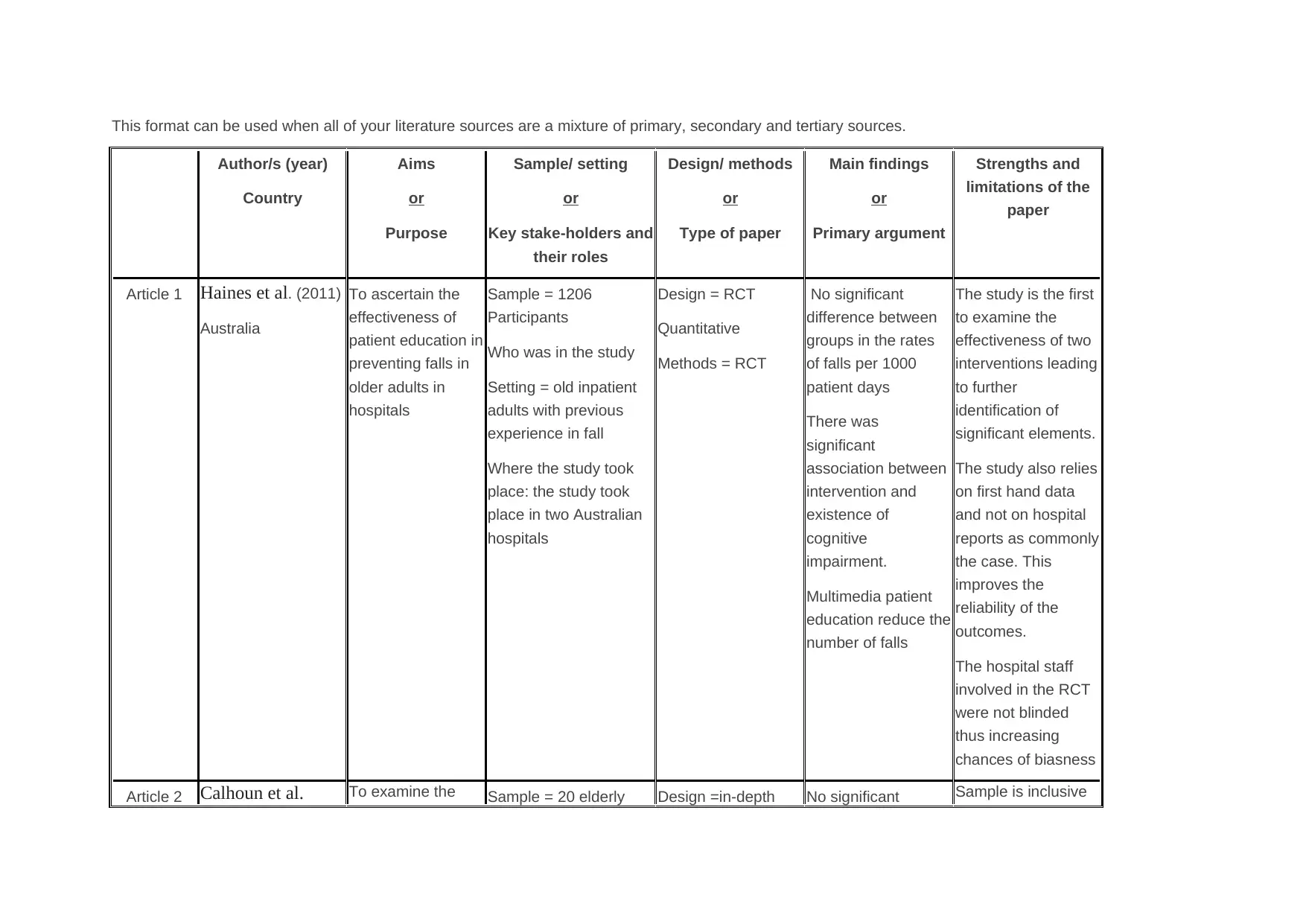
This format can be used when all of your literature sources are a mixture of primary, secondary and tertiary sources.
Author/s (year)
Country
Aims
or
Purpose
Sample/ setting
or
Key stake-holders and
their roles
Design/ methods
or
Type of paper
Main findings
or
Primary argument
Strengths and
limitations of the
paper
Article 1 Haines et al. (2011)
Australia
To ascertain the
effectiveness of
patient education in
preventing falls in
older adults in
hospitals
Sample = 1206
Participants
Who was in the study
Setting = old inpatient
adults with previous
experience in fall
Where the study took
place: the study took
place in two Australian
hospitals
Design = RCT
Quantitative
Methods = RCT
No significant
difference between
groups in the rates
of falls per 1000
patient days
There was
significant
association between
intervention and
existence of
cognitive
impairment.
Multimedia patient
education reduce the
number of falls
The study is the first
to examine the
effectiveness of two
interventions leading
to further
identification of
significant elements.
The study also relies
on first hand data
and not on hospital
reports as commonly
the case. This
improves the
reliability of the
outcomes.
The hospital staff
involved in the RCT
were not blinded
thus increasing
chances of biasness
Article 2 Calhoun et al. To examine the Sample = 20 elderly Design =in-depth No significant Sample is inclusive
tabler-icon-diamond-filled.svg

Paraphrase This Document

Need a fresh take? Get an instant paraphrase of this document with our AI Paraphraser
Document Page
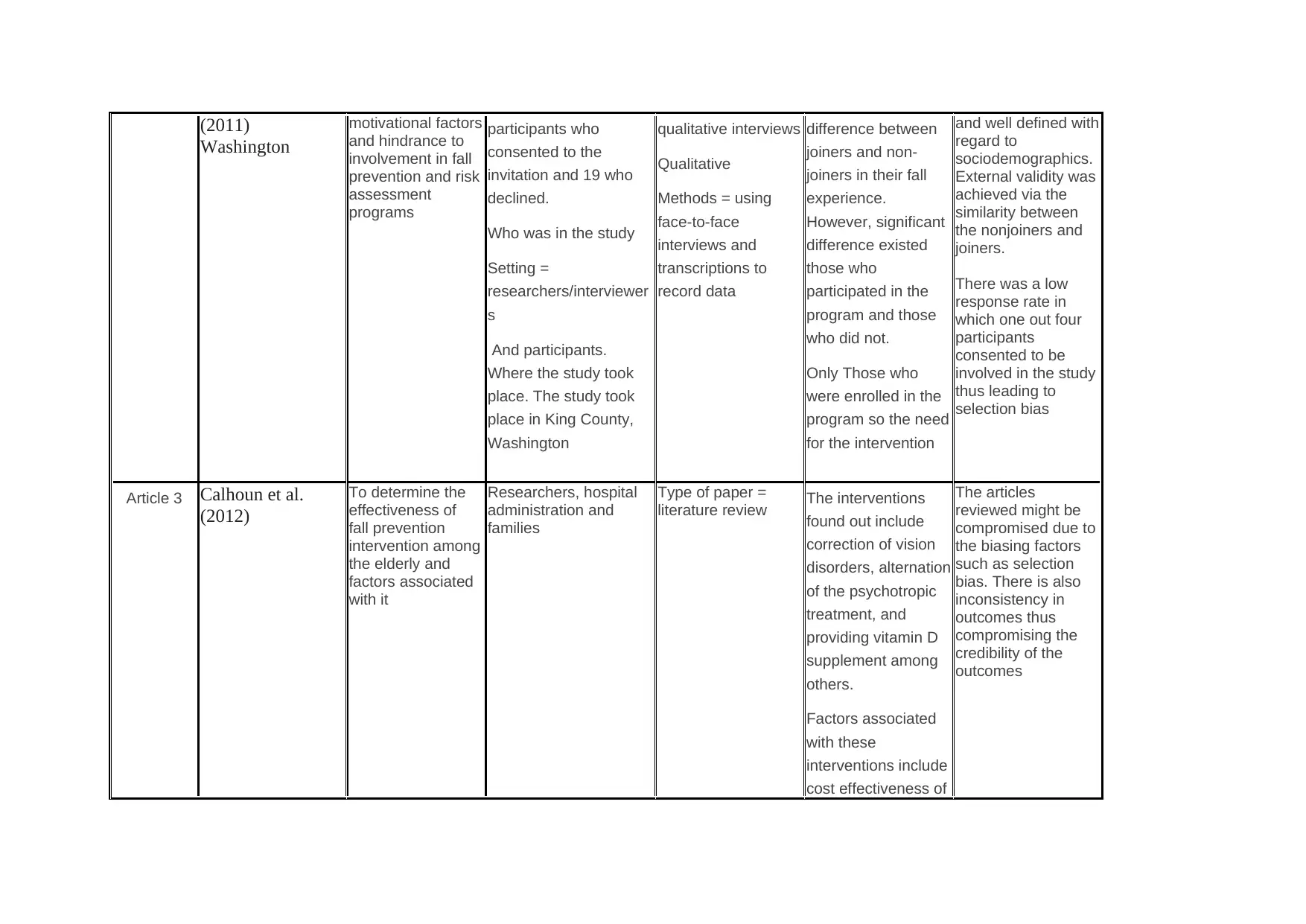
(2011)
Washington
motivational factors
and hindrance to
involvement in fall
prevention and risk
assessment
programs
participants who
consented to the
invitation and 19 who
declined.
Who was in the study
Setting =
researchers/interviewer
s
And participants.
Where the study took
place. The study took
place in King County,
Washington
qualitative interviews
Qualitative
Methods = using
face-to-face
interviews and
transcriptions to
record data
difference between
joiners and non-
joiners in their fall
experience.
However, significant
difference existed
those who
participated in the
program and those
who did not.
Only Those who
were enrolled in the
program so the need
for the intervention
and well defined with
regard to
sociodemographics.
External validity was
achieved via the
similarity between
the nonjoiners and
joiners.
There was a low
response rate in
which one out four
participants
consented to be
involved in the study
thus leading to
selection bias
Article 3 Calhoun et al.
(2012)
To determine the
effectiveness of
fall prevention
intervention among
the elderly and
factors associated
with it
Researchers, hospital
administration and
families
Type of paper =
literature review The interventions
found out include
correction of vision
disorders, alternation
of the psychotropic
treatment, and
providing vitamin D
supplement among
others.
Factors associated
with these
interventions include
cost effectiveness of
The articles
reviewed might be
compromised due to
the biasing factors
such as selection
bias. There is also
inconsistency in
outcomes thus
compromising the
credibility of the
outcomes
Document Page
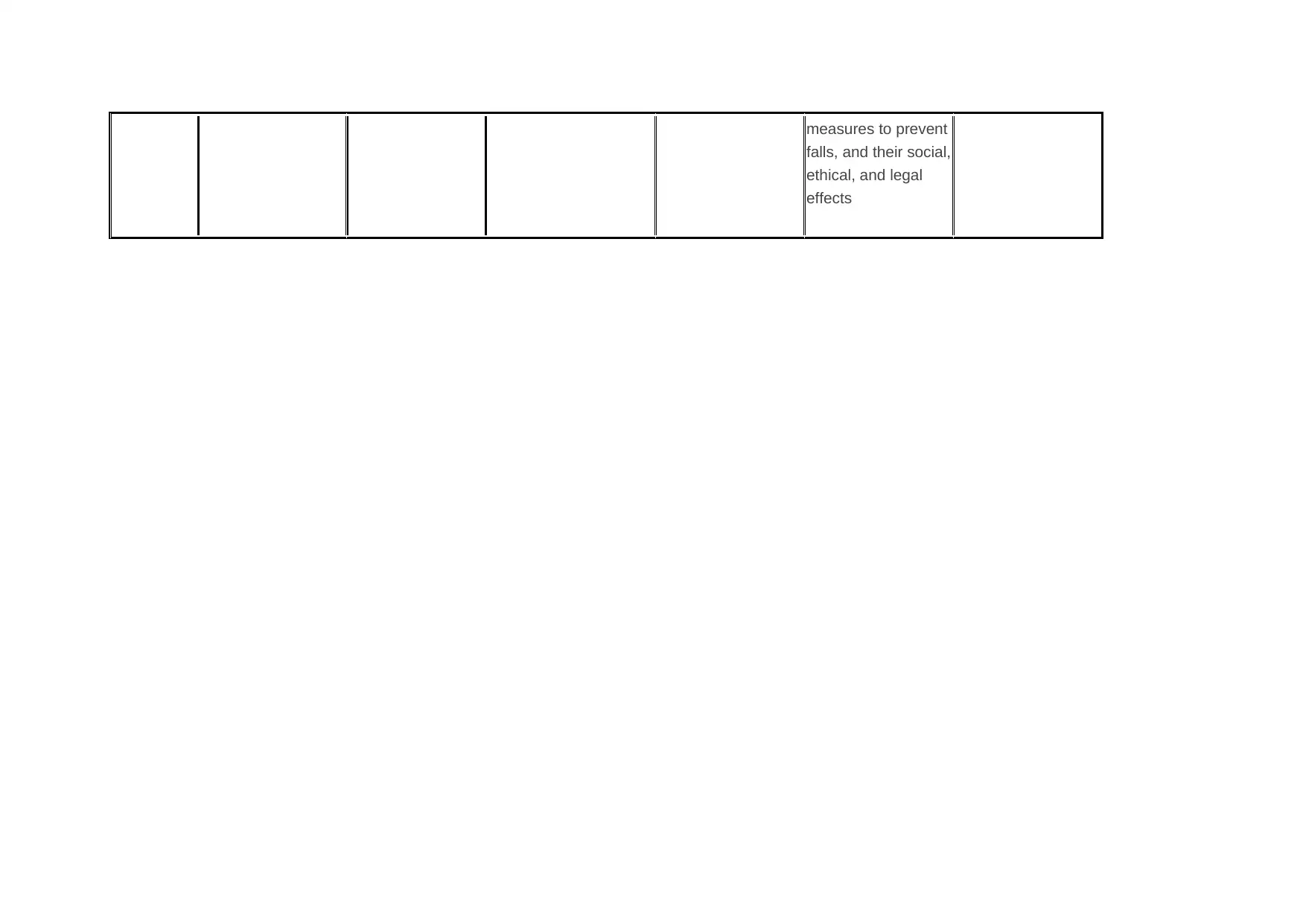
measures to prevent
falls, and their social,
ethical, and legal
effects
chevron_up_icon
1 out of 3
circle_padding
hide_on_mobile
zoom_out_icon
[object Object]