Clinical Trial and Systematic Review: A Critical Appraisal Report
VerifiedAdded on 2023/06/18
|8
|1826
|206
Report
AI Summary
This document presents a critical appraisal of a clinical trial focusing on the recovery rates of acute whiplash injury patients under different treatments (activity program vs. collar use) and a systematic review with meta-analysis related to conservative management of whiplash-associated disorders. The appraisal assesses the risk of bias in the clinical trial based on random sequence allocation, allocation concealment, blinding, incomplete outcome data, and selective reporting, ultimately accepting the authors' conclusion that active therapy results in a significant difference in recovery rate compared to collar use. The meta-analysis section evaluates the appropriateness of study inclusion, meta-analytical model choice, identifies key studies contributing to the pooled treatment effect, discusses factors contributing to heterogeneity, and assesses the accuracy of conservative treatment effects on cervical range of motion. The appraisal concludes by evaluating the clarity of the research questions, adherence to inclusion/exclusion criteria, literature search methodology, quality assessment of included studies, and the validity of data pooling and meta-analysis conclusions. Desklib offers a platform for students to access similar solved assignments and resources.
CRITICAL APPRAISAL
1
1
Paraphrase This Document
Need a fresh take? Get an instant paraphrase of this document with our AI Paraphraser

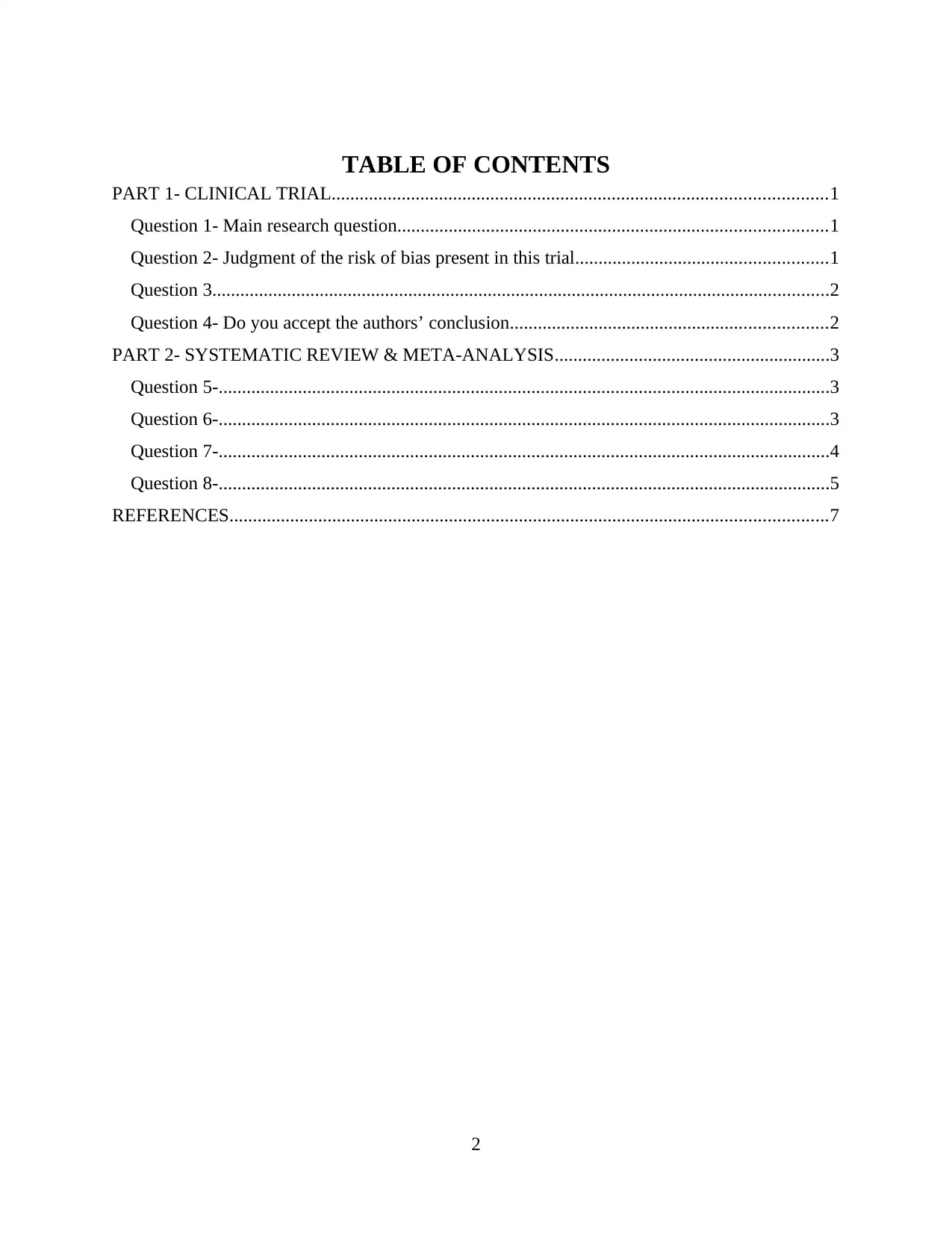
TABLE OF CONTENTS
PART 1- CLINICAL TRIAL..........................................................................................................1
Question 1- Main research question............................................................................................1
Question 2- Judgment of the risk of bias present in this trial......................................................1
Question 3....................................................................................................................................2
Question 4- Do you accept the authors’ conclusion....................................................................2
PART 2- SYSTEMATIC REVIEW & META-ANALYSIS...........................................................3
Question 5-...................................................................................................................................3
Question 6-...................................................................................................................................3
Question 7-...................................................................................................................................4
Question 8-...................................................................................................................................5
REFERENCES................................................................................................................................7
2
PART 1- CLINICAL TRIAL..........................................................................................................1
Question 1- Main research question............................................................................................1
Question 2- Judgment of the risk of bias present in this trial......................................................1
Question 3....................................................................................................................................2
Question 4- Do you accept the authors’ conclusion....................................................................2
PART 2- SYSTEMATIC REVIEW & META-ANALYSIS...........................................................3
Question 5-...................................................................................................................................3
Question 6-...................................................................................................................................3
Question 7-...................................................................................................................................4
Question 8-...................................................................................................................................5
REFERENCES................................................................................................................................7
2

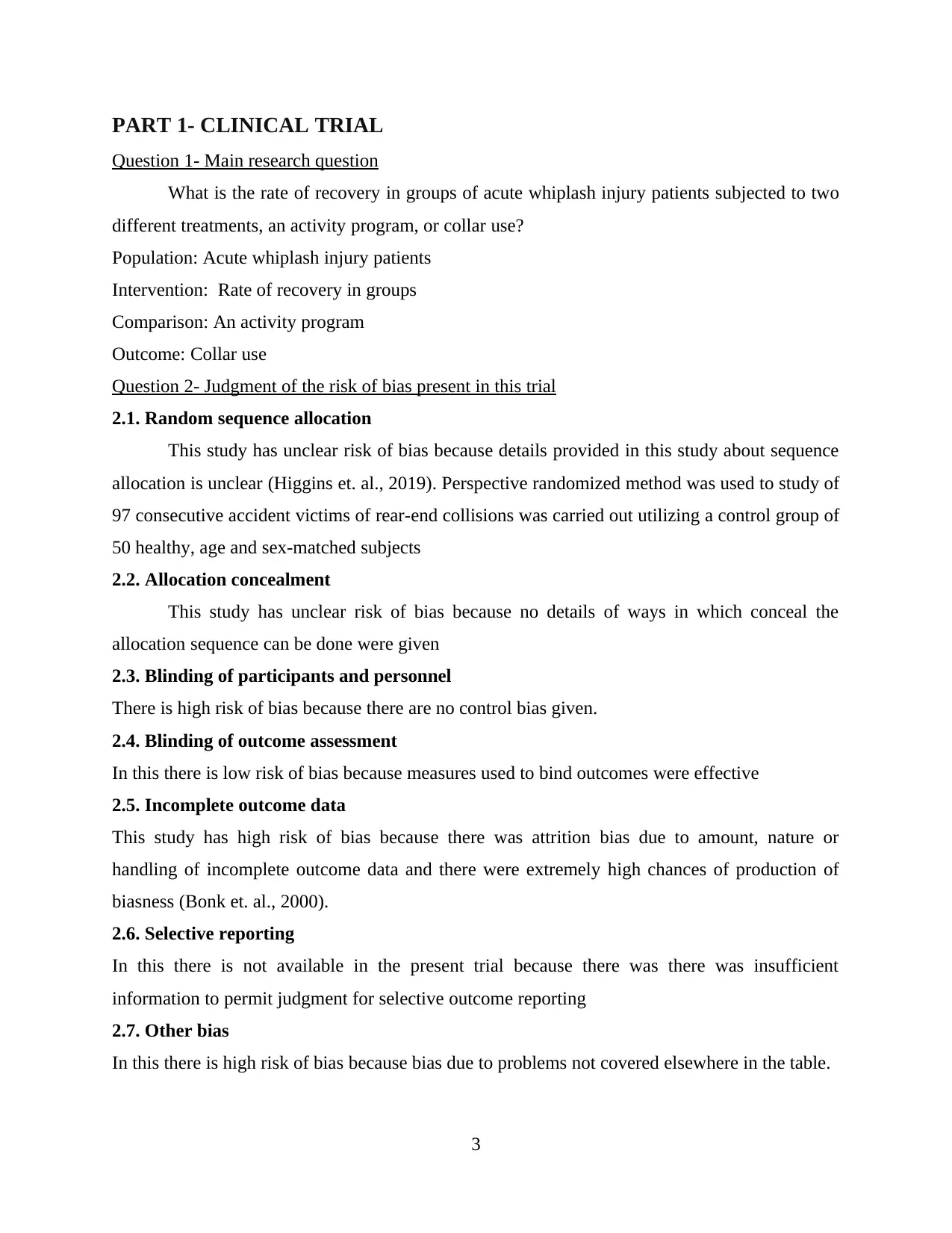
PART 1- CLINICAL TRIAL
Question 1- Main research question
What is the rate of recovery in groups of acute whiplash injury patients subjected to two
different treatments, an activity program, or collar use?
Population: Acute whiplash injury patients
Intervention: Rate of recovery in groups
Comparison: An activity program
Outcome: Collar use
Question 2- Judgment of the risk of bias present in this trial
2.1. Random sequence allocation
This study has unclear risk of bias because details provided in this study about sequence
allocation is unclear (Higgins et. al., 2019). Perspective randomized method was used to study of
97 consecutive accident victims of rear-end collisions was carried out utilizing a control group of
50 healthy, age and sex-matched subjects
2.2. Allocation concealment
This study has unclear risk of bias because no details of ways in which conceal the
allocation sequence can be done were given
2.3. Blinding of participants and personnel
There is high risk of bias because there are no control bias given.
2.4. Blinding of outcome assessment
In this there is low risk of bias because measures used to bind outcomes were effective
2.5. Incomplete outcome data
This study has high risk of bias because there was attrition bias due to amount, nature or
handling of incomplete outcome data and there were extremely high chances of production of
biasness (Bonk et. al., 2000).
2.6. Selective reporting
In this there is not available in the present trial because there was there was insufficient
information to permit judgment for selective outcome reporting
2.7. Other bias
In this there is high risk of bias because bias due to problems not covered elsewhere in the table.
3
Question 1- Main research question
What is the rate of recovery in groups of acute whiplash injury patients subjected to two
different treatments, an activity program, or collar use?
Population: Acute whiplash injury patients
Intervention: Rate of recovery in groups
Comparison: An activity program
Outcome: Collar use
Question 2- Judgment of the risk of bias present in this trial
2.1. Random sequence allocation
This study has unclear risk of bias because details provided in this study about sequence
allocation is unclear (Higgins et. al., 2019). Perspective randomized method was used to study of
97 consecutive accident victims of rear-end collisions was carried out utilizing a control group of
50 healthy, age and sex-matched subjects
2.2. Allocation concealment
This study has unclear risk of bias because no details of ways in which conceal the
allocation sequence can be done were given
2.3. Blinding of participants and personnel
There is high risk of bias because there are no control bias given.
2.4. Blinding of outcome assessment
In this there is low risk of bias because measures used to bind outcomes were effective
2.5. Incomplete outcome data
This study has high risk of bias because there was attrition bias due to amount, nature or
handling of incomplete outcome data and there were extremely high chances of production of
biasness (Bonk et. al., 2000).
2.6. Selective reporting
In this there is not available in the present trial because there was there was insufficient
information to permit judgment for selective outcome reporting
2.7. Other bias
In this there is high risk of bias because bias due to problems not covered elsewhere in the table.
3
⊘ This is a preview!⊘
Do you want full access?
Subscribe today to unlock all pages.

Trusted by 1+ million students worldwide

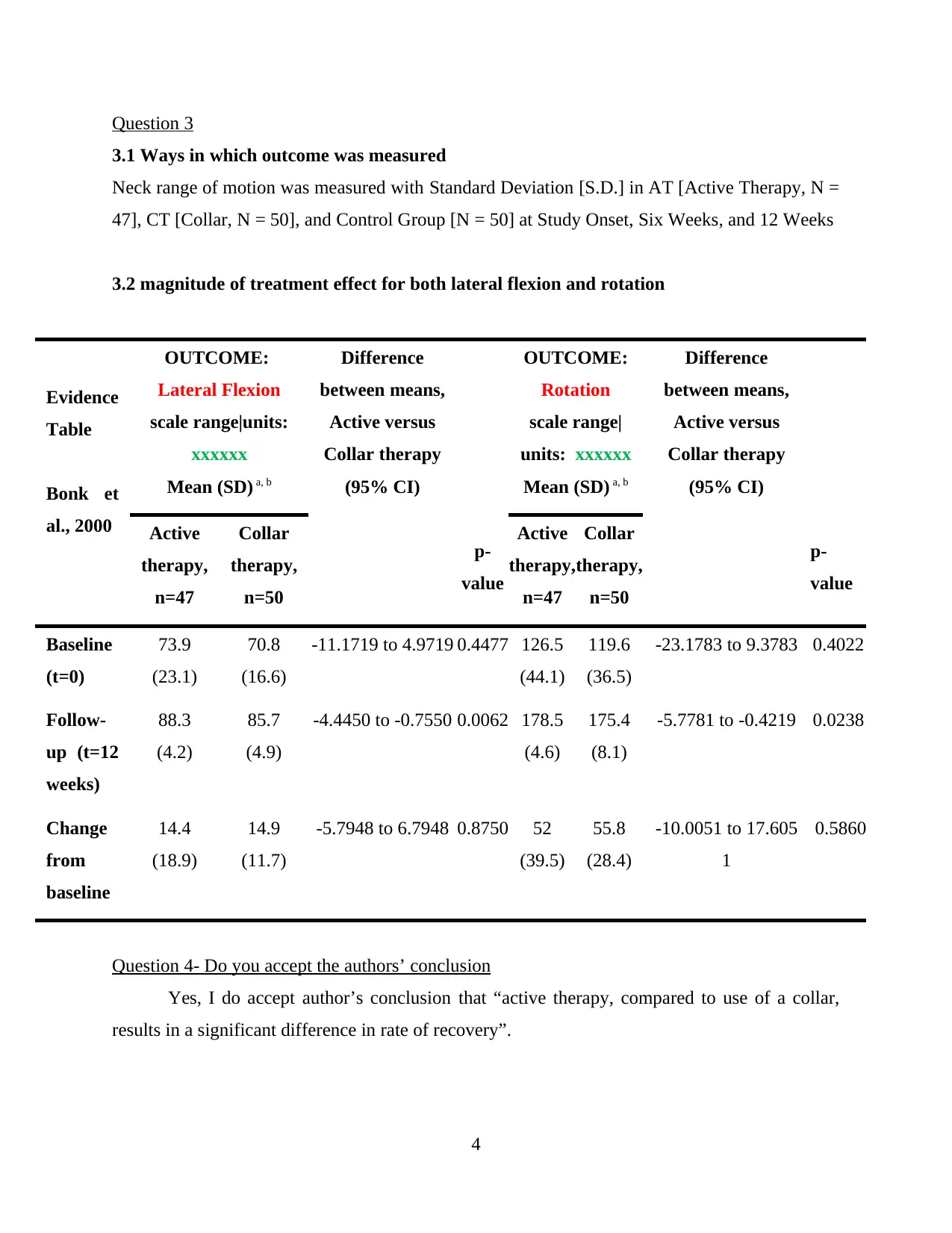
Question 3
3.1 Ways in which outcome was measured
Neck range of motion was measured with Standard Deviation [S.D.] in AT [Active Therapy, N =
47], CT [Collar, N = 50], and Control Group [N = 50] at Study Onset, Six Weeks, and 12 Weeks
3.2 magnitude of treatment effect for both lateral flexion and rotation
Evidence
Table
Bonk et
al., 2000
OUTCOME:
Lateral Flexion
scale range|units:
xxxxxx
Mean (SD) a, b
Difference
between means,
Active versus
Collar therapy
(95% CI)
p-
value
OUTCOME:
Rotation
scale range|
units: xxxxxx
Mean (SD) a, b
Difference
between means,
Active versus
Collar therapy
(95% CI)
p-
value
Active
therapy,
n=47
Collar
therapy,
n=50
Active
therapy,
n=47
Collar
therapy,
n=50
Baseline
(t=0)
73.9
(23.1)
70.8
(16.6)
-11.1719 to 4.9719 0.4477 126.5
(44.1)
119.6
(36.5)
-23.1783 to 9.3783 0.4022
Follow-
up (t=12
weeks)
88.3
(4.2)
85.7
(4.9)
-4.4450 to -0.7550 0.0062 178.5
(4.6)
175.4
(8.1)
-5.7781 to -0.4219 0.0238
Change
from
baseline
14.4
(18.9)
14.9
(11.7)
-5.7948 to 6.7948 0.8750 52
(39.5)
55.8
(28.4)
-10.0051 to 17.605
1
0.5860
Question 4- Do you accept the authors’ conclusion
Yes, I do accept author’s conclusion that “active therapy, compared to use of a collar,
results in a significant difference in rate of recovery”.
4
3.1 Ways in which outcome was measured
Neck range of motion was measured with Standard Deviation [S.D.] in AT [Active Therapy, N =
47], CT [Collar, N = 50], and Control Group [N = 50] at Study Onset, Six Weeks, and 12 Weeks
3.2 magnitude of treatment effect for both lateral flexion and rotation
Evidence
Table
Bonk et
al., 2000
OUTCOME:
Lateral Flexion
scale range|units:
xxxxxx
Mean (SD) a, b
Difference
between means,
Active versus
Collar therapy
(95% CI)
p-
value
OUTCOME:
Rotation
scale range|
units: xxxxxx
Mean (SD) a, b
Difference
between means,
Active versus
Collar therapy
(95% CI)
p-
value
Active
therapy,
n=47
Collar
therapy,
n=50
Active
therapy,
n=47
Collar
therapy,
n=50
Baseline
(t=0)
73.9
(23.1)
70.8
(16.6)
-11.1719 to 4.9719 0.4477 126.5
(44.1)
119.6
(36.5)
-23.1783 to 9.3783 0.4022
Follow-
up (t=12
weeks)
88.3
(4.2)
85.7
(4.9)
-4.4450 to -0.7550 0.0062 178.5
(4.6)
175.4
(8.1)
-5.7781 to -0.4219 0.0238
Change
from
baseline
14.4
(18.9)
14.9
(11.7)
-5.7948 to 6.7948 0.8750 52
(39.5)
55.8
(28.4)
-10.0051 to 17.605
1
0.5860
Question 4- Do you accept the authors’ conclusion
Yes, I do accept author’s conclusion that “active therapy, compared to use of a collar,
results in a significant difference in rate of recovery”.
4
Paraphrase This Document
Need a fresh take? Get an instant paraphrase of this document with our AI Paraphraser

PART 2- SYSTEMATIC REVIEW & META-ANALYSIS
Question 5-
5.1 Were inclusion of the study by Bonk et al appropriate
Yes, inclusion of Bonk et al study was appropriate because this study was selected as per
the inclusion and exclusion criteria defined by the author (Wiangkham et al., 2015). Not only
this Bonk et al study focused upon reviewing effective management of whiplash and this study
also focused upon conservative management for acute Whiplash Associated Disorder.
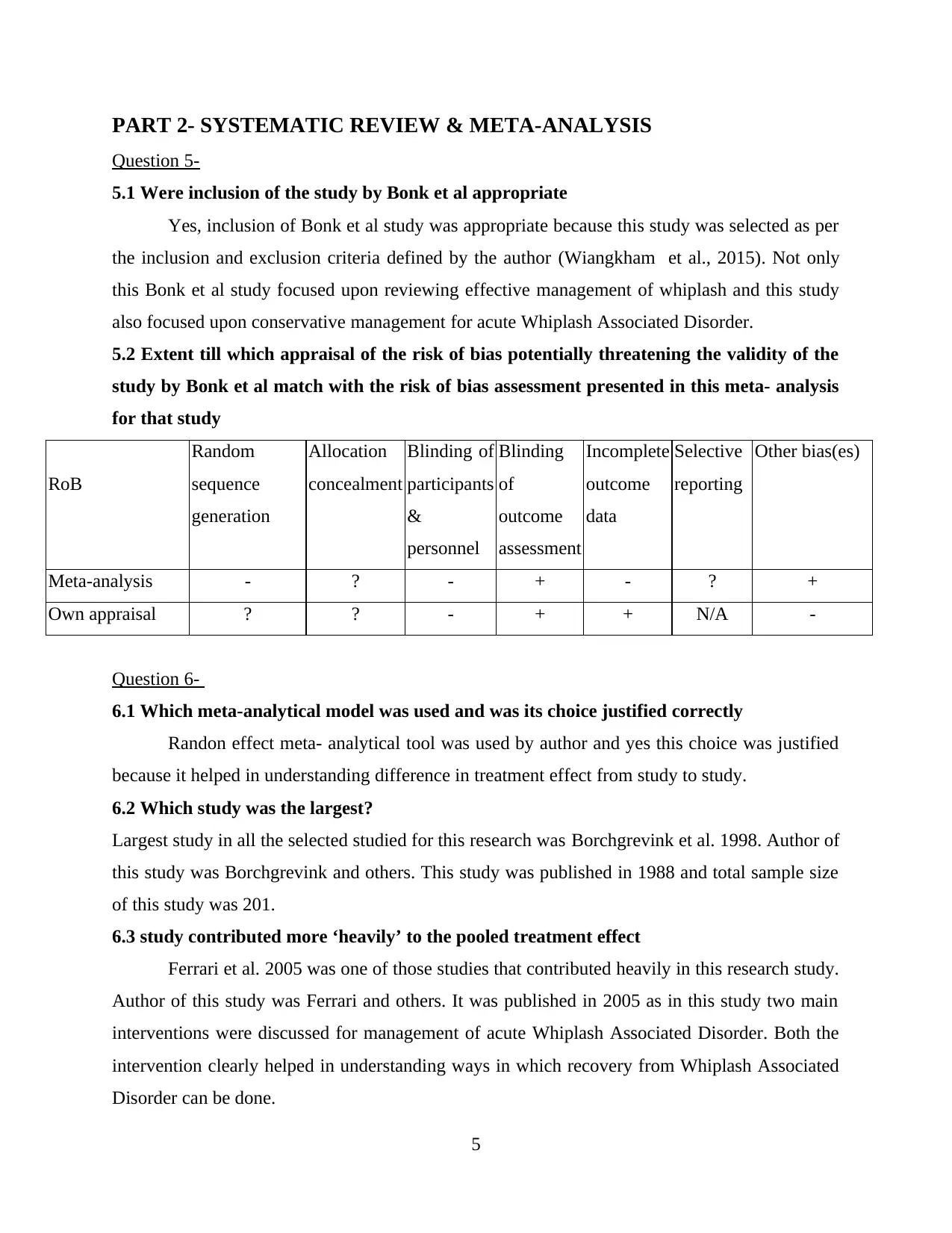
5.2 Extent till which appraisal of the risk of bias potentially threatening the validity of the
study by Bonk et al match with the risk of bias assessment presented in this meta- analysis
for that study
RoB
Random
sequence
generation
Allocation
concealment
Blinding of
participants
&
personnel
Blinding
of
outcome
assessment
Incomplete
outcome
data
Selective
reporting
Other bias(es)
Meta-analysis - ? - + - ? +
Own appraisal ? ? - + + N/A -
Question 6-
6.1 Which meta-analytical model was used and was its choice justified correctly
Randon effect meta- analytical tool was used by author and yes this choice was justified
because it helped in understanding difference in treatment effect from study to study.
6.2 Which study was the largest?
Largest study in all the selected studied for this research was Borchgrevink et al. 1998. Author of
this study was Borchgrevink and others. This study was published in 1988 and total sample size
of this study was 201.
6.3 study contributed more ‘heavily’ to the pooled treatment effect
Ferrari et al. 2005 was one of those studies that contributed heavily in this research study.
Author of this study was Ferrari and others. It was published in 2005 as in this study two main
interventions were discussed for management of acute Whiplash Associated Disorder. Both the
intervention clearly helped in understanding ways in which recovery from Whiplash Associated
Disorder can be done.
5
Question 5-
5.1 Were inclusion of the study by Bonk et al appropriate
Yes, inclusion of Bonk et al study was appropriate because this study was selected as per
the inclusion and exclusion criteria defined by the author (Wiangkham et al., 2015). Not only
this Bonk et al study focused upon reviewing effective management of whiplash and this study
also focused upon conservative management for acute Whiplash Associated Disorder.
5.2 Extent till which appraisal of the risk of bias potentially threatening the validity of the
study by Bonk et al match with the risk of bias assessment presented in this meta- analysis
for that study
RoB
Random
sequence
generation
Allocation
concealment
Blinding of
participants
&
personnel
Blinding
of
outcome
assessment
Incomplete
outcome
data
Selective
reporting
Other bias(es)
Meta-analysis - ? - + - ? +
Own appraisal ? ? - + + N/A -
Question 6-
6.1 Which meta-analytical model was used and was its choice justified correctly
Randon effect meta- analytical tool was used by author and yes this choice was justified
because it helped in understanding difference in treatment effect from study to study.
6.2 Which study was the largest?
Largest study in all the selected studied for this research was Borchgrevink et al. 1998. Author of
this study was Borchgrevink and others. This study was published in 1988 and total sample size
of this study was 201.
6.3 study contributed more ‘heavily’ to the pooled treatment effect
Ferrari et al. 2005 was one of those studies that contributed heavily in this research study.
Author of this study was Ferrari and others. It was published in 2005 as in this study two main
interventions were discussed for management of acute Whiplash Associated Disorder. Both the
intervention clearly helped in understanding ways in which recovery from Whiplash Associated
Disorder can be done.
5

6.4 What was pooled treatment effect
Effect of pooled treatment with their size and 95% CI have been explained below:
Pain intensity in /control interventions was 0.164 p value with -12.90, 2.19 95% CI.
Pain intensity of Active vs passive interventions at 1-3 years was less than < 0.001* p value
and 26.39, -10.08 95% CI.
6.5 Factors may contribute to heterogeneity in the studies by Borchgrevink et al. and Bonk
et al.
Heterogeneity in the study by Borchgrevink et al.= this study identified three different
interventions for management of management of acute Whiplash Associated Disorder that are:
Active therapy, Collar therapy, and Control. Yes, its heterogeneity reflected in the estimate of
heterogeneity reported in the meta-analysis. Control therapy I2 percentage at less than 3 months
is 70, active intervention I2 percentage at less than 3 months is76.3.
Heterogeneity in the study by Bonk et al.= this study identified two different interventions for
management of management of acute Whiplash Associated Disorder that are: Act-as-usual, and
Immobilisation. No its heterogeneity has not been reflected in the estimate of heterogeneity
reported in the meta-analysis.
Question 7-
7.1 Do you agree with the authors’ statement
Yes, I do agree with authors statement because this figure clearly helps in understanding
that 95% CI of standard/control interventions is less than 95% CI of Conservative intervention.
This clearly helps in understanding that conservative intervention was more effective than
standard/control intervention for pain reduction long term. This is because horizontal movement
of two studies as per the ES and weight from random effect analysis shows straight parallel lines
with positive result towards Conservative intervention.
7.2 Do you think the estimated effect of conservative treatment on cervical range of motion
is accurate
Quality of weights in random effect analysis of overall conservative treatment is 100
percent which show accuracy in its random effect analysis due to which I think that’s estimated
effect of conservative treatment on cervical range of motion is accurate
6
Effect of pooled treatment with their size and 95% CI have been explained below:
Pain intensity in /control interventions was 0.164 p value with -12.90, 2.19 95% CI.
Pain intensity of Active vs passive interventions at 1-3 years was less than < 0.001* p value
and 26.39, -10.08 95% CI.
6.5 Factors may contribute to heterogeneity in the studies by Borchgrevink et al. and Bonk
et al.
Heterogeneity in the study by Borchgrevink et al.= this study identified three different
interventions for management of management of acute Whiplash Associated Disorder that are:
Active therapy, Collar therapy, and Control. Yes, its heterogeneity reflected in the estimate of
heterogeneity reported in the meta-analysis. Control therapy I2 percentage at less than 3 months
is 70, active intervention I2 percentage at less than 3 months is76.3.
Heterogeneity in the study by Bonk et al.= this study identified two different interventions for
management of management of acute Whiplash Associated Disorder that are: Act-as-usual, and
Immobilisation. No its heterogeneity has not been reflected in the estimate of heterogeneity
reported in the meta-analysis.
Question 7-
7.1 Do you agree with the authors’ statement
Yes, I do agree with authors statement because this figure clearly helps in understanding
that 95% CI of standard/control interventions is less than 95% CI of Conservative intervention.
This clearly helps in understanding that conservative intervention was more effective than
standard/control intervention for pain reduction long term. This is because horizontal movement
of two studies as per the ES and weight from random effect analysis shows straight parallel lines
with positive result towards Conservative intervention.
7.2 Do you think the estimated effect of conservative treatment on cervical range of motion
is accurate
Quality of weights in random effect analysis of overall conservative treatment is 100
percent which show accuracy in its random effect analysis due to which I think that’s estimated
effect of conservative treatment on cervical range of motion is accurate
6
⊘ This is a preview!⊘
Do you want full access?
Subscribe today to unlock all pages.

Trusted by 1+ million students worldwide

Question 8-
Were main clinical question formulated clearly
Yes, the main clinical question of meta- analysis was formed clearly using PICO
framework in which intervention selected and another intervention with which it was compared
was also identified clearly. Whereas clinical question of systemic review was not formulated
clearly because intervention chosen and another management therapy with which it was required
to be compared were not identified clearly.
Did authors adhere defined inclusion and exclusion criteria
Yes, inclusion and exclusion criteria defined in systematic review were adhered by
researcher clearly and all the studies were selected on the basis of these criteria’s only. But
inclusion and exclusion criteria were not defined separately, in fact it was included in PRISMA
diagram only.
Did authors conduct reproducible and comprehensive search & selection of the literature
and documented its steps
Yes, author documented all the steps of conducing comprehensive and reproducible
search and selection of literature. Not only this, in fact detailed summary of all the studies
selected was also provided.
Did authors properly assess studies quality that were included
Yes, author did assess quality of studies included in systematic review properly. First of
all detailed summary of all the studies were provided then, summary of risk of bias assessment of
all the studies were conducted, then at last meta-analysis of all the studies was conducted.
Were study level data extracted correctly
Yes study level was extracted correctly and accurately using meta-data analysis.
Was pooling of data warranted and correct
Yes, pooling of data was warranted in an adequate manner. This report consisted of well-
reported trial to evaluate effectiveness of acute WADII management is warranted to enable
confidence in evidence for clinical practitioners, health policy-makers and researchers.
Was meta-analysis conclusion supported by the evidence
Summary of meta-analysis was provided but it was not concluded. As per the limitations
of this study high validity and reliability of key outcomes could not be calculated in a meta-
analysis due to an insufficient number of trials evaluating this outcome.
7
Were main clinical question formulated clearly
Yes, the main clinical question of meta- analysis was formed clearly using PICO
framework in which intervention selected and another intervention with which it was compared
was also identified clearly. Whereas clinical question of systemic review was not formulated
clearly because intervention chosen and another management therapy with which it was required
to be compared were not identified clearly.
Did authors adhere defined inclusion and exclusion criteria
Yes, inclusion and exclusion criteria defined in systematic review were adhered by
researcher clearly and all the studies were selected on the basis of these criteria’s only. But
inclusion and exclusion criteria were not defined separately, in fact it was included in PRISMA
diagram only.
Did authors conduct reproducible and comprehensive search & selection of the literature
and documented its steps
Yes, author documented all the steps of conducing comprehensive and reproducible
search and selection of literature. Not only this, in fact detailed summary of all the studies
selected was also provided.
Did authors properly assess studies quality that were included
Yes, author did assess quality of studies included in systematic review properly. First of
all detailed summary of all the studies were provided then, summary of risk of bias assessment of
all the studies were conducted, then at last meta-analysis of all the studies was conducted.
Were study level data extracted correctly
Yes study level was extracted correctly and accurately using meta-data analysis.
Was pooling of data warranted and correct
Yes, pooling of data was warranted in an adequate manner. This report consisted of well-
reported trial to evaluate effectiveness of acute WADII management is warranted to enable
confidence in evidence for clinical practitioners, health policy-makers and researchers.
Was meta-analysis conclusion supported by the evidence
Summary of meta-analysis was provided but it was not concluded. As per the limitations
of this study high validity and reliability of key outcomes could not be calculated in a meta-
analysis due to an insufficient number of trials evaluating this outcome.
7
Paraphrase This Document
Need a fresh take? Get an instant paraphrase of this document with our AI Paraphraser

REFERENCES
Books and Journals
Bonk, A.D., et. al., 2000. Prospective, randomized, controlled study of activity versus collar, and
the natural history for whiplash injury, in Germany. Journal of Musculoskeletal
Pain, 8(1-2), pp.123-132.
Higgins, J.P., et. al., 2019. Assessing risk of bias in a randomized trial. Cochrane handbook for
systematic reviews of interventions, pp.205-228.
Wiangkham, T., et al., 2015. The effectiveness of conservative management for acute whiplash
associated disorder (WAD) II: a systematic review and meta-analysis of randomised
controlled trials. PLoS One, 10(7), p.e0133415.
8
Books and Journals
Bonk, A.D., et. al., 2000. Prospective, randomized, controlled study of activity versus collar, and
the natural history for whiplash injury, in Germany. Journal of Musculoskeletal
Pain, 8(1-2), pp.123-132.
Higgins, J.P., et. al., 2019. Assessing risk of bias in a randomized trial. Cochrane handbook for
systematic reviews of interventions, pp.205-228.
Wiangkham, T., et al., 2015. The effectiveness of conservative management for acute whiplash
associated disorder (WAD) II: a systematic review and meta-analysis of randomised
controlled trials. PLoS One, 10(7), p.e0133415.
8
1 out of 8
Your All-in-One AI-Powered Toolkit for Academic Success.
+13062052269
info@desklib.com
Available 24*7 on WhatsApp / Email
Unlock your academic potential
Copyright © 2020–2026 A2Z Services. All Rights Reserved. Developed and managed by ZUCOL.