University Article Critique: EPSY 6330 Cognition and Instruction

Verified

Added on  2022/09/26

|5
|896
|21
Homework Assignment
AI Summary
This assignment presents a critical analysis of a non-scholarly article titled "Factors Influencing Learning" by Benjamin (2020). The student evaluates the article's discussion of human learning, including learner characteristics, motivational principles, and encoding activities. The critique examines the author's explanation of different learning types, such as perceptual and implicit learning, and how individual differences impact learning. The assignment highlights the author's points on incidental versus intentional learning, the role of practice, and the impact of metacognition and knowledge transfer on human learning. The student notes the article's strengths in providing a comprehensive overview for a general audience, while also pointing out the absence of detailed discussion on major learning theories. The critique concludes by acknowledging the article's informative nature and its consistency with learning theories, despite the lack of in-depth scientific information or direct references to specific learning theories. The student links the article's concepts to the cognitivist approach and expresses appreciation for the article's organization and clarity, emphasizing its value for those with limited prior knowledge of human learning.
Document Page
Running Head: PSYCHOLOGY 1
Educational Psychology EPSY
Critical Article
Name of University
tabler-icon-diamond-filled.svg

Paraphrase This Document

Need a fresh take? Get an instant paraphrase of this document with our AI Paraphraser
Document Page
PSYCHOLOGY 2
Introduction
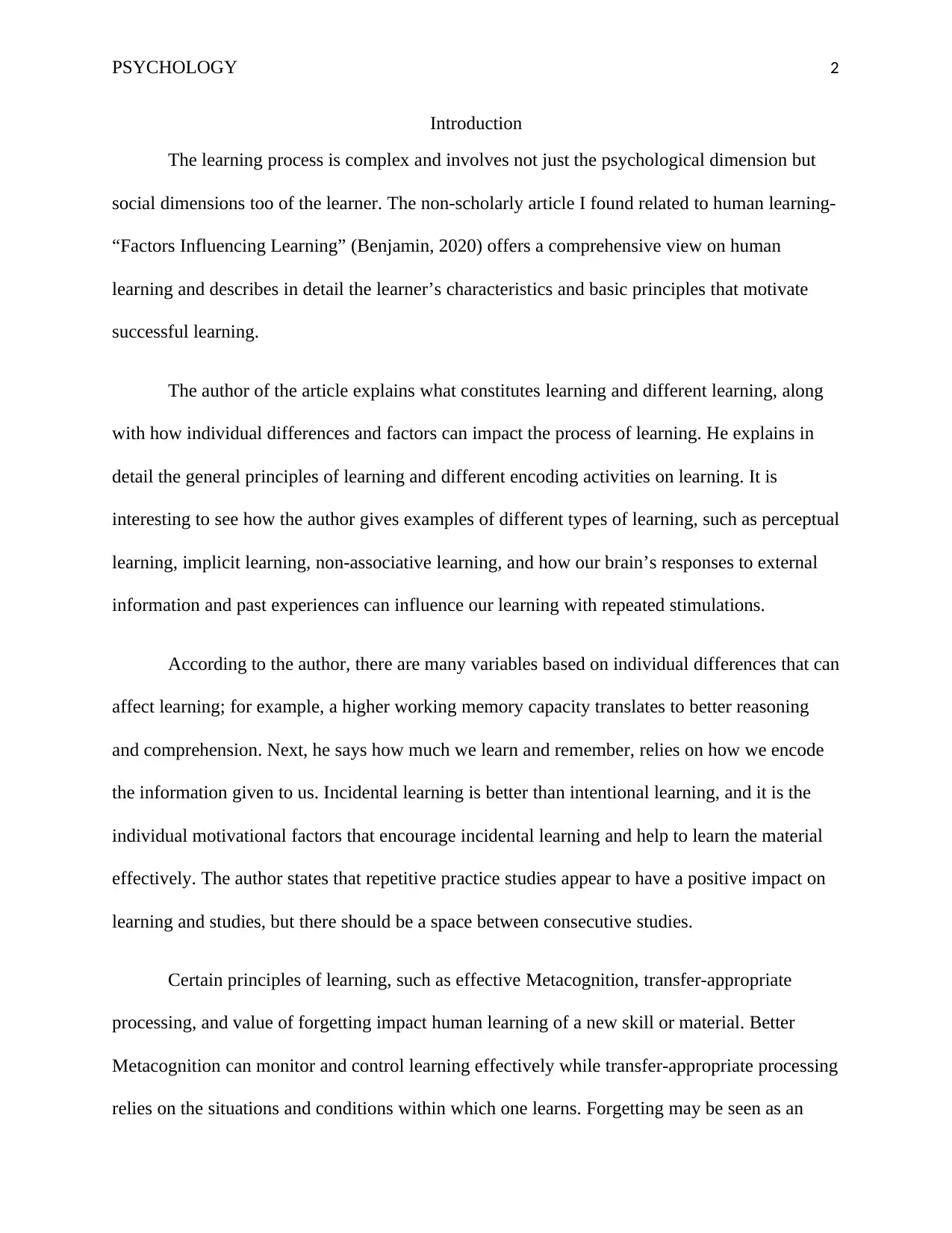
The learning process is complex and involves not just the psychological dimension but
social dimensions too of the learner. The non-scholarly article I found related to human learning-
“Factors Influencing Learning” (Benjamin, 2020) offers a comprehensive view on human
learning and describes in detail the learner’s characteristics and basic principles that motivate
successful learning.
The author of the article explains what constitutes learning and different learning, along
with how individual differences and factors can impact the process of learning. He explains in
detail the general principles of learning and different encoding activities on learning. It is
interesting to see how the author gives examples of different types of learning, such as perceptual
learning, implicit learning, non-associative learning, and how our brain’s responses to external
information and past experiences can influence our learning with repeated stimulations.
According to the author, there are many variables based on individual differences that can
affect learning; for example, a higher working memory capacity translates to better reasoning
and comprehension. Next, he says how much we learn and remember, relies on how we encode
the information given to us. Incidental learning is better than intentional learning, and it is the
individual motivational factors that encourage incidental learning and help to learn the material
effectively. The author states that repetitive practice studies appear to have a positive impact on
learning and studies, but there should be a space between consecutive studies.
Certain principles of learning, such as effective Metacognition, transfer-appropriate
processing, and value of forgetting impact human learning of a new skill or material. Better
Metacognition can monitor and control learning effectively while transfer-appropriate processing
relies on the situations and conditions within which one learns. Forgetting may be seen as an
Document Page
PSYCHOLOGY 3
enemy of the learning process, but it is a highly desirable part of the process as some forgetting
is essential for new learning.
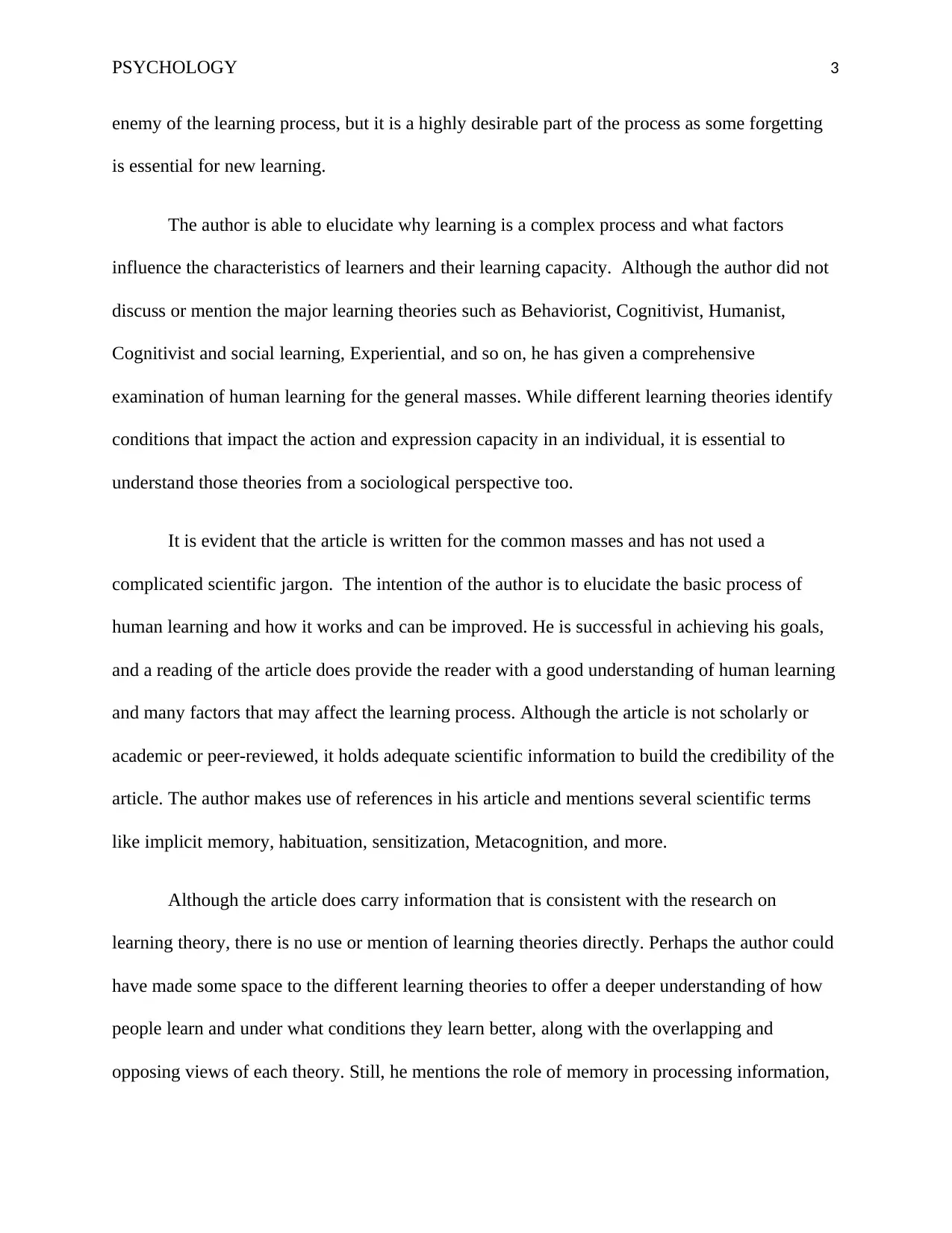
The author is able to elucidate why learning is a complex process and what factors
influence the characteristics of learners and their learning capacity. Although the author did not
discuss or mention the major learning theories such as Behaviorist, Cognitivist, Humanist,
Cognitivist and social learning, Experiential, and so on, he has given a comprehensive
examination of human learning for the general masses. While different learning theories identify
conditions that impact the action and expression capacity in an individual, it is essential to
understand those theories from a sociological perspective too.
It is evident that the article is written for the common masses and has not used a
complicated scientific jargon. The intention of the author is to elucidate the basic process of
human learning and how it works and can be improved. He is successful in achieving his goals,
and a reading of the article does provide the reader with a good understanding of human learning
and many factors that may affect the learning process. Although the article is not scholarly or
academic or peer-reviewed, it holds adequate scientific information to build the credibility of the
article. The author makes use of references in his article and mentions several scientific terms
like implicit memory, habituation, sensitization, Metacognition, and more.
Although the article does carry information that is consistent with the research on
learning theory, there is no use or mention of learning theories directly. Perhaps the author could
have made some space to the different learning theories to offer a deeper understanding of how
people learn and under what conditions they learn better, along with the overlapping and
opposing views of each theory. Still, he mentions the role of memory in processing information,
Document Page
PSYCHOLOGY 4
and memory holds an essential place in learning theories. He also uses the term Metacognition
and Knowledge Transfer, which is one of the key concepts of the cognitivist approach of
learning theory.
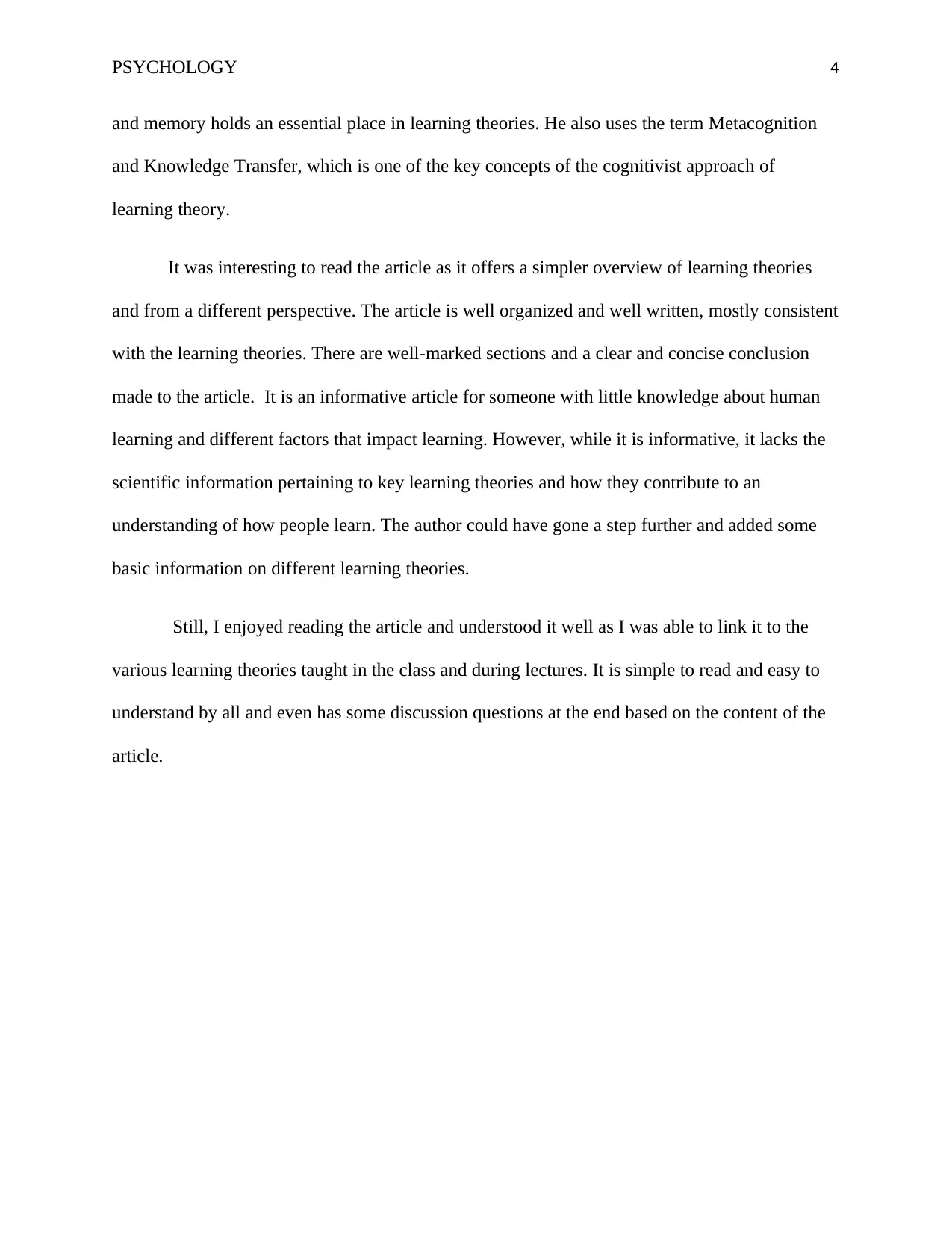
It was interesting to read the article as it offers a simpler overview of learning theories
and from a different perspective. The article is well organized and well written, mostly consistent
with the learning theories. There are well-marked sections and a clear and concise conclusion
made to the article. It is an informative article for someone with little knowledge about human
learning and different factors that impact learning. However, while it is informative, it lacks the
scientific information pertaining to key learning theories and how they contribute to an
understanding of how people learn. The author could have gone a step further and added some
basic information on different learning theories.
Still, I enjoyed reading the article and understood it well as I was able to link it to the
various learning theories taught in the class and during lectures. It is simple to read and easy to
understand by all and even has some discussion questions at the end based on the content of the
article.
tabler-icon-diamond-filled.svg

Paraphrase This Document

Need a fresh take? Get an instant paraphrase of this document with our AI Paraphraser
Document Page
PSYCHOLOGY 5
References
Benjamin, A. (2020). Factors Influencing Learning. nobaproject, retrieved from
https://nobaproject.com/modules/factors-influencing-learning
chevron_up_icon
1 out of 5
circle_padding
hide_on_mobile
zoom_out_icon
[object Object]