Critical Evaluation of Research Evidence in Nursing: HLSC122 Report
VerifiedAdded on 2020/04/21
|11
|2731
|29
Report
AI Summary
This report critically evaluates two research articles related to nursing, focusing on the use of pharmacological enhancements among university students and the relationship between nonmedical use of prescription stimulants, executive functioning, and academic outcomes. The report analyzes the authorship, research aims, design, and findings of each article, highlighting their strengths and weaknesses. It also identifies barriers to applying the research evidence in practice, such as sample size limitations and organizational issues. Furthermore, the report assesses how closely the research studies align with the PICO elements (Population, Intervention, Comparison, Outcome). The conclusion emphasizes the significance of the articles in providing evidence, while also acknowledging the potential barriers to implementing the findings in other contexts. The report provides a comprehensive overview of the research evidence and its implications for nursing practice.
Running head: NURSING 1
Nursing
Student Name:
Unit: HLSC122 Semester 2, 2017
Assessment 3: Critical Evaluation of Evidence
Word count:
Student name/student number
Nursing
Student Name:
Unit: HLSC122 Semester 2, 2017
Assessment 3: Critical Evaluation of Evidence
Word count:
Student name/student number

Paraphrase This Document
Need a fresh take? Get an instant paraphrase of this document with our AI Paraphraser
NURSING 2
Introduction
The evaluation of research evidence is imperative for any research work. The critical
review aids in the identification of research evidence that can be significant in the application of
the findings into an organization. The critical evaluation of the research evidence aims at finding
out crucial aspects invalidating a research or not (LoBiondo-Wood et al. 2016). The paper will
also look at the research methodologies that were used and their ability of the researcher to
address the research questions. In addition, the paper will look at the findings of the two
articles , and review their ability to address the aims , hypothesis or the research questions of
the study. Moreover, there is need to identify barriers that may be present and those that may
affect applicability of the research evidence (Kong et al. 2014). Lastly, the PICO elements are
identified as the guiding questions to research studies. The ability of a research to fully address
the elements of PICO is imperative. It is thus vital to check if the elements of PICO were
addressed as it is required.
Article 1
Hilt, E., Loeb, K., & France, A. G. (2014). Life context of pharmacological academic
performance enhancement among university students - a qualitative approach. BMC Medical
Ethics, 15(1), 23-23. doi:10.1186/1472-6939-15-23
PART A
Authorship
The authors are all qualified given that they are all affiliated to various universities and
specifically in the psychology/psychotherapy/psychiatry departments. It is certain that there may
Introduction
The evaluation of research evidence is imperative for any research work. The critical
review aids in the identification of research evidence that can be significant in the application of
the findings into an organization. The critical evaluation of the research evidence aims at finding
out crucial aspects invalidating a research or not (LoBiondo-Wood et al. 2016). The paper will
also look at the research methodologies that were used and their ability of the researcher to
address the research questions. In addition, the paper will look at the findings of the two
articles , and review their ability to address the aims , hypothesis or the research questions of
the study. Moreover, there is need to identify barriers that may be present and those that may
affect applicability of the research evidence (Kong et al. 2014). Lastly, the PICO elements are
identified as the guiding questions to research studies. The ability of a research to fully address
the elements of PICO is imperative. It is thus vital to check if the elements of PICO were
addressed as it is required.
Article 1
Hilt, E., Loeb, K., & France, A. G. (2014). Life context of pharmacological academic
performance enhancement among university students - a qualitative approach. BMC Medical
Ethics, 15(1), 23-23. doi:10.1186/1472-6939-15-23
PART A
Authorship
The authors are all qualified given that they are all affiliated to various universities and
specifically in the psychology/psychotherapy/psychiatry departments. It is certain that there may
NURSING 3
be some form of biases given that all the authors have relations from various learning
institutions. It is thus clear that the findings from the research may have an element of bias.
Research Aims
The aim of the research was to have an in-depth study on the drug-induced performance
through the use of prescribed stimulants and other illegal stimulants such as Methylphenidate
amongst college students. The study also aimed at comprehending the experiences of the
participants, the impact of the utilization of the stimulants and the factors that instigated the
students to use the stimulants (Lewis, 2015). The latter formed the justification of the study.
Design
Data for the research was majorly collected through interviews. The participants who
were primarily college students were engaged in face to face interviews. The sample
encompassed 18 healthy college students (Hilt, Loeb, & France, 2014). The questions that were
associated in the interviews were those that had a relationship with the environment of the
student. Again the face to face interviews was imperative in asking for more explanations for
questions that the incompletely answered.
The researcher ensured that those that were involved in the conducting of the interview
were equipped with interview skills. The total number of interviewers was 3 and 1 psychologist
(Hilt, Loeb & France, 2014). Moreover, the tape recording of interviews ensured that no data
was lost. The research methodology ensured that the researchers were able to acquire an in-
depth and well-researched knowledge appertaining to the study.
Findings
be some form of biases given that all the authors have relations from various learning
institutions. It is thus clear that the findings from the research may have an element of bias.
Research Aims
The aim of the research was to have an in-depth study on the drug-induced performance
through the use of prescribed stimulants and other illegal stimulants such as Methylphenidate
amongst college students. The study also aimed at comprehending the experiences of the
participants, the impact of the utilization of the stimulants and the factors that instigated the
students to use the stimulants (Lewis, 2015). The latter formed the justification of the study.
Design
Data for the research was majorly collected through interviews. The participants who
were primarily college students were engaged in face to face interviews. The sample
encompassed 18 healthy college students (Hilt, Loeb, & France, 2014). The questions that were
associated in the interviews were those that had a relationship with the environment of the
student. Again the face to face interviews was imperative in asking for more explanations for
questions that the incompletely answered.
The researcher ensured that those that were involved in the conducting of the interview
were equipped with interview skills. The total number of interviewers was 3 and 1 psychologist
(Hilt, Loeb & France, 2014). Moreover, the tape recording of interviews ensured that no data
was lost. The research methodology ensured that the researchers were able to acquire an in-
depth and well-researched knowledge appertaining to the study.
Findings
⊘ This is a preview!⊘
Do you want full access?
Subscribe today to unlock all pages.

Trusted by 1+ million students worldwide
NURSING 4
The findings of the research fully addressed the research aims, for instance, it was
identified that the use of the stimulants was instigated by other factors that related to the life of
the students other than achievement of academic performance (Frond, Liu & Bauman, 2013). In
addition, the findings were able to efficiently address the aim of identifying the other factors that
influenced the use of the stimulants.
Strengths and weaknesses
The strengths of the article appertain to its ability to precisely address the research aims.
In addition, use of face-face interviews aided in acquiring of relevant data that could fully inform
the research questions. In addition, the use of leading questions aided in the acquiring of relevant
data for the study but also was a factor that could bring out an element of biased findings for the
research. The other weakness will be on the use of a small sample that can make it difficult to
generalize the information to the study population.
Article 2
Munro, B. A., Weygand, L. L., Marraccini, M. E., & Ouster, D. R. (2017). The relationship
Between nonmedical use of prescription stimulants, executive functioning, and academic
Outcomes. Addictive Behaviors, 65, 250-257.
doi:http://dx.doi.org/10.1016/j.addbeh.2016.08.023
Authorship
All the authors of the article affiliated to different institutions majorly those that relate to
the field of Neuroscience and Psychology. It is impressive given that the research topic
The findings of the research fully addressed the research aims, for instance, it was
identified that the use of the stimulants was instigated by other factors that related to the life of
the students other than achievement of academic performance (Frond, Liu & Bauman, 2013). In
addition, the findings were able to efficiently address the aim of identifying the other factors that
influenced the use of the stimulants.
Strengths and weaknesses
The strengths of the article appertain to its ability to precisely address the research aims.
In addition, use of face-face interviews aided in acquiring of relevant data that could fully inform
the research questions. In addition, the use of leading questions aided in the acquiring of relevant
data for the study but also was a factor that could bring out an element of biased findings for the
research. The other weakness will be on the use of a small sample that can make it difficult to
generalize the information to the study population.
Article 2
Munro, B. A., Weygand, L. L., Marraccini, M. E., & Ouster, D. R. (2017). The relationship
Between nonmedical use of prescription stimulants, executive functioning, and academic
Outcomes. Addictive Behaviors, 65, 250-257.
doi:http://dx.doi.org/10.1016/j.addbeh.2016.08.023
Authorship
All the authors of the article affiliated to different institutions majorly those that relate to
the field of Neuroscience and Psychology. It is impressive given that the research topic
Paraphrase This Document
Need a fresh take? Get an instant paraphrase of this document with our AI Paraphraser
NURSING 5
appertains to the two fields. The fact that some of the authors practiced their profession in a
tertiary institution, there may be a conflict of interest that can jeopardize the result. For instance,
Marraccini is affiliated with numerous universities and also specializes in Psychology (Fain,
2017). The author has written many articles relating to psychology and received numerous
awards for the same. It can thus be stated that the authors incorporated profound skills in the
publishing of the article on the topic.
Research Aims
The research aimed at establishing if there was really the use of the prescribed stimulants
amongst college students. The other aim was to verify the relationship that exists between
NMUPs and EF amongst college participants. The author precisely justified that there was the
need to establish the effect that prescription stimulants had on college students in relation to their
academic progress, given that they were widely used by most of the students.
Design
The research design was majorly qualitative with the used of scales and tests. The rating
scales that tool are the BDEFS and SSQ. Information was also acquired in screening of the GPA
of the participants. It was imperative to acquire information on the GPA of the students given
that it was important to validate if the use of the prescribed stimulants had an effect of improving
the academic performance amongst the college users (Munro et al. 2017).
The utilization of the BDEFs was objective given that the participants were all above
the age of 18.(Grove, Burns & Gray, 2014).The instrument is crucial in the evaluation of the
participants that will be reporting EF deficits in various aspects like in self motivation,
appertains to the two fields. The fact that some of the authors practiced their profession in a
tertiary institution, there may be a conflict of interest that can jeopardize the result. For instance,
Marraccini is affiliated with numerous universities and also specializes in Psychology (Fain,
2017). The author has written many articles relating to psychology and received numerous
awards for the same. It can thus be stated that the authors incorporated profound skills in the
publishing of the article on the topic.
Research Aims
The research aimed at establishing if there was really the use of the prescribed stimulants
amongst college students. The other aim was to verify the relationship that exists between
NMUPs and EF amongst college participants. The author precisely justified that there was the
need to establish the effect that prescription stimulants had on college students in relation to their
academic progress, given that they were widely used by most of the students.
Design
The research design was majorly qualitative with the used of scales and tests. The rating
scales that tool are the BDEFS and SSQ. Information was also acquired in screening of the GPA
of the participants. It was imperative to acquire information on the GPA of the students given
that it was important to validate if the use of the prescribed stimulants had an effect of improving
the academic performance amongst the college users (Munro et al. 2017).
The utilization of the BDEFs was objective given that the participants were all above
the age of 18.(Grove, Burns & Gray, 2014).The instrument is crucial in the evaluation of the
participants that will be reporting EF deficits in various aspects like in self motivation,
NURSING 6
consciousness of time and in the control of emotions (Munro et al. 2017). Again, the
instrument is recommended to be utilized in a research context.
The scale is able to dictate the difficulties that are felt by the participant in regards
to EF. Lastly, it is paramount to discover that the tool is the most precise in screening categories
of EF and their prevalence in the normal human activities over a long time. The authors were
able to realize a multiple perspective session throughout their exercise that was very insightful
(Giger, 2016). The participants of the research were majorly 308 college students specifically
from public institutions based in the US.
Findings
Firstly, research results indicated that about 18.8% of the participants admitted to the
utilization of the prescription stimulants. The realization of this fully addressed the aim of
identifying the prevalence of the use of the prescribed stimulants amongst college students
(Craig et al. 2013). Secondly, participants that showcased EF deficits were seen to be the
greatest NMUPS and indicated lower GPAs contrary to those that did not exhibit EF deficits.
The finding addressed the research question on the relationship that EF deficiencies had on the
GPAs attained. Lastly, the authors found out that use of the prescribed stimulants for non
medical purposes had the effect of non-moderation of the relationship that existed between
Executive Functioning and GPA. The finding relates to the aim of achieving the relationship that
exists between the uses of the prescribed stimulants to academic performance that is reflected by
the GPA.
Strengths and weaknesses
consciousness of time and in the control of emotions (Munro et al. 2017). Again, the
instrument is recommended to be utilized in a research context.
The scale is able to dictate the difficulties that are felt by the participant in regards
to EF. Lastly, it is paramount to discover that the tool is the most precise in screening categories
of EF and their prevalence in the normal human activities over a long time. The authors were
able to realize a multiple perspective session throughout their exercise that was very insightful
(Giger, 2016). The participants of the research were majorly 308 college students specifically
from public institutions based in the US.
Findings
Firstly, research results indicated that about 18.8% of the participants admitted to the
utilization of the prescription stimulants. The realization of this fully addressed the aim of
identifying the prevalence of the use of the prescribed stimulants amongst college students
(Craig et al. 2013). Secondly, participants that showcased EF deficits were seen to be the
greatest NMUPS and indicated lower GPAs contrary to those that did not exhibit EF deficits.
The finding addressed the research question on the relationship that EF deficiencies had on the
GPAs attained. Lastly, the authors found out that use of the prescribed stimulants for non
medical purposes had the effect of non-moderation of the relationship that existed between
Executive Functioning and GPA. The finding relates to the aim of achieving the relationship that
exists between the uses of the prescribed stimulants to academic performance that is reflected by
the GPA.
Strengths and weaknesses
⊘ This is a preview!⊘
Do you want full access?
Subscribe today to unlock all pages.
Trusted by 1+ million students worldwide
NURSING 7
The strengths of the research are dictated by the authors precisely answering the research
questions and aims. In addition, the authors are able to use the precise and the most effective
research methodology for the research. The weakness lies in the inability of the researchers to
fully address the research gap (DiCenso, Guyatt, & Ciliska, 2014).
PART B
Barrier’s for the application of evidence in practice.
Firstly, the size of the research/study is one the barriers crucial factors to the application
of the evidence. In the context of the articles especially in the first article, the sample size is
small and thus generalization of the findings can be a problem. In addition, there are problems
with developing the evidence that was attained (Amour et al. 2014). When information cannot be
developed in regards to the evidence, and then it becomes difficult to apply the evidence.
Moreover, if there is lack of time for the findings of a research to be followed up, read through,
understood and implemented into an organization application is almost impossible (Sadeghi‐
Bazargani et al.2014). Then there are issues of organizational barriers and finding the best
evidence. In the latter, it can be resources or size that can make an organization to be unable to
apply the research evidence. (Stein et al.2017).
How closely the research studies provided align with the PICO question/elements.
The research studies closely relate to the PICO questions. To begin with, ‘P’, the
research studies address the problem that is the use of prescribed stimulants with the aim of
achieving academic performance (Stein, 2017). In addition, the study population is identified
which in our case is the college students. In the context of ‘I", the research studies look at an
investigation into the relationship between the use of the stimulants and the academic
The strengths of the research are dictated by the authors precisely answering the research
questions and aims. In addition, the authors are able to use the precise and the most effective
research methodology for the research. The weakness lies in the inability of the researchers to
fully address the research gap (DiCenso, Guyatt, & Ciliska, 2014).
PART B
Barrier’s for the application of evidence in practice.
Firstly, the size of the research/study is one the barriers crucial factors to the application
of the evidence. In the context of the articles especially in the first article, the sample size is
small and thus generalization of the findings can be a problem. In addition, there are problems
with developing the evidence that was attained (Amour et al. 2014). When information cannot be
developed in regards to the evidence, and then it becomes difficult to apply the evidence.
Moreover, if there is lack of time for the findings of a research to be followed up, read through,
understood and implemented into an organization application is almost impossible (Sadeghi‐
Bazargani et al.2014). Then there are issues of organizational barriers and finding the best
evidence. In the latter, it can be resources or size that can make an organization to be unable to
apply the research evidence. (Stein et al.2017).
How closely the research studies provided align with the PICO question/elements.
The research studies closely relate to the PICO questions. To begin with, ‘P’, the
research studies address the problem that is the use of prescribed stimulants with the aim of
achieving academic performance (Stein, 2017). In addition, the study population is identified
which in our case is the college students. In the context of ‘I", the research studies look at an
investigation into the relationship between the use of the stimulants and the academic
Paraphrase This Document
Need a fresh take? Get an instant paraphrase of this document with our AI Paraphraser
NURSING 8
performance and later on indicate that a relationship occurs to a small extent amongst students
that have no EF deficits. In the context of ‘C', it is the question of students with EF deficits and
those with no EF deficits. Lastly, in the ‘O’ section, the researchers indicate the effects of the use
of prescribed stimulants on the academic performance. PICO questions are smartly answered
throughout the research.
Conclusion
In conclusion, the two articles are significant in the scenario that was highlighted earlier
due to the evidence that they portray. It is also clear that the two articles give different
perspectives of the scenarios that equip the researcher with a wide range of data to borrow
information from. It is ideally important to note that the two articles deal with similar and
different variables and these aids in the researchers being able to attain data that appertains to the
various variables that can be associated with the study. The analysis of the critical evidence aids
in the analyzing if the articles are significant or not which relies on their reliability. It is clear that
the evidence that is given can be used or applied in other settings. It is also clear that there are
barriers that can bar the evidence from not being applied to the scenario or in another related
context (Upton et al. 2014). It is imperative to ensure that strategies are put in place, those that
will enable the evidence to be used in another practice.
performance and later on indicate that a relationship occurs to a small extent amongst students
that have no EF deficits. In the context of ‘C', it is the question of students with EF deficits and
those with no EF deficits. Lastly, in the ‘O’ section, the researchers indicate the effects of the use
of prescribed stimulants on the academic performance. PICO questions are smartly answered
throughout the research.
Conclusion
In conclusion, the two articles are significant in the scenario that was highlighted earlier
due to the evidence that they portray. It is also clear that the two articles give different
perspectives of the scenarios that equip the researcher with a wide range of data to borrow
information from. It is ideally important to note that the two articles deal with similar and
different variables and these aids in the researchers being able to attain data that appertains to the
various variables that can be associated with the study. The analysis of the critical evidence aids
in the analyzing if the articles are significant or not which relies on their reliability. It is clear that
the evidence that is given can be used or applied in other settings. It is also clear that there are
barriers that can bar the evidence from not being applied to the scenario or in another related
context (Upton et al. 2014). It is imperative to ensure that strategies are put in place, those that
will enable the evidence to be used in another practice.
NURSING 9
References
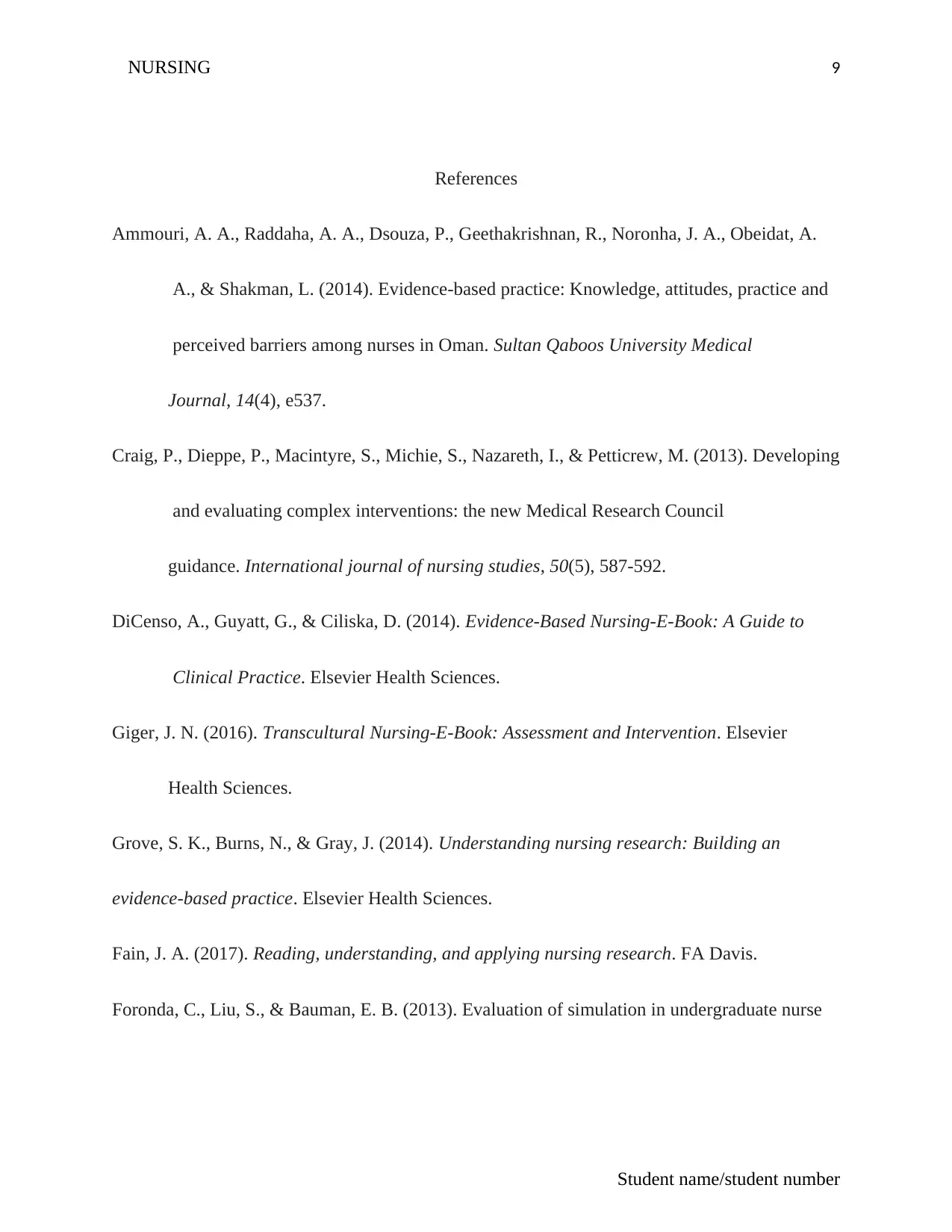
Ammouri, A. A., Raddaha, A. A., Dsouza, P., Geethakrishnan, R., Noronha, J. A., Obeidat, A.
A., & Shakman, L. (2014). Evidence-based practice: Knowledge, attitudes, practice and
perceived barriers among nurses in Oman. Sultan Qaboos University Medical
Journal, 14(4), e537.
Craig, P., Dieppe, P., Macintyre, S., Michie, S., Nazareth, I., & Petticrew, M. (2013). Developing
and evaluating complex interventions: the new Medical Research Council
guidance. International journal of nursing studies, 50(5), 587-592.
DiCenso, A., Guyatt, G., & Ciliska, D. (2014). Evidence-Based Nursing-E-Book: A Guide to
Clinical Practice. Elsevier Health Sciences.
Giger, J. N. (2016). Transcultural Nursing-E-Book: Assessment and Intervention. Elsevier
Health Sciences.
Grove, S. K., Burns, N., & Gray, J. (2014). Understanding nursing research: Building an
evidence-based practice. Elsevier Health Sciences.
Fain, J. A. (2017). Reading, understanding, and applying nursing research. FA Davis.
Foronda, C., Liu, S., & Bauman, E. B. (2013). Evaluation of simulation in undergraduate nurse
Student name/student number
References
Ammouri, A. A., Raddaha, A. A., Dsouza, P., Geethakrishnan, R., Noronha, J. A., Obeidat, A.
A., & Shakman, L. (2014). Evidence-based practice: Knowledge, attitudes, practice and
perceived barriers among nurses in Oman. Sultan Qaboos University Medical
Journal, 14(4), e537.
Craig, P., Dieppe, P., Macintyre, S., Michie, S., Nazareth, I., & Petticrew, M. (2013). Developing
and evaluating complex interventions: the new Medical Research Council
guidance. International journal of nursing studies, 50(5), 587-592.
DiCenso, A., Guyatt, G., & Ciliska, D. (2014). Evidence-Based Nursing-E-Book: A Guide to
Clinical Practice. Elsevier Health Sciences.
Giger, J. N. (2016). Transcultural Nursing-E-Book: Assessment and Intervention. Elsevier
Health Sciences.
Grove, S. K., Burns, N., & Gray, J. (2014). Understanding nursing research: Building an
evidence-based practice. Elsevier Health Sciences.
Fain, J. A. (2017). Reading, understanding, and applying nursing research. FA Davis.
Foronda, C., Liu, S., & Bauman, E. B. (2013). Evaluation of simulation in undergraduate nurse
Student name/student number
⊘ This is a preview!⊘
Do you want full access?
Subscribe today to unlock all pages.
Trusted by 1+ million students worldwide
NURSING 10
education: An integrative review. Clinical Simulation in Nursing, 9(10), e409-e416.
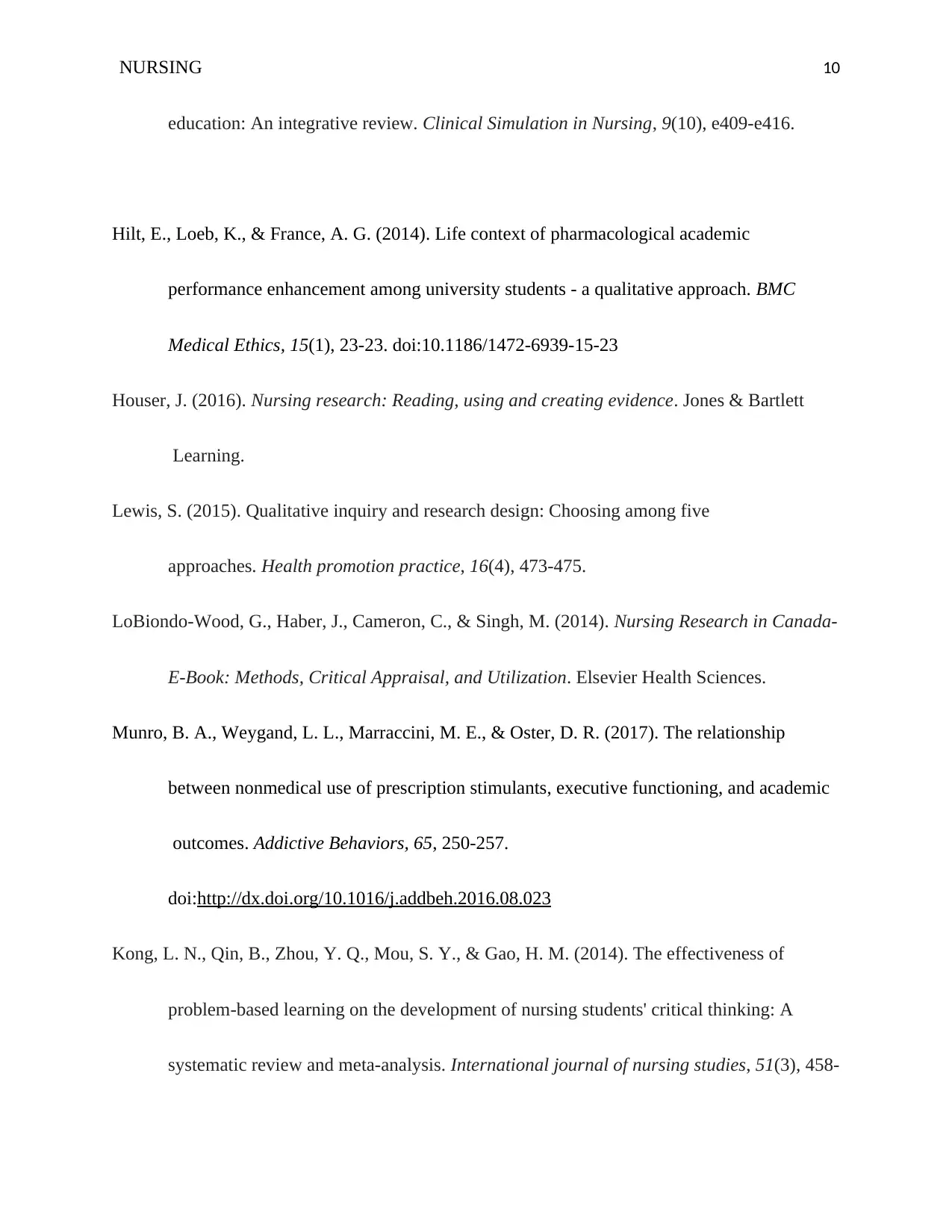
Hilt, E., Loeb, K., & France, A. G. (2014). Life context of pharmacological academic
performance enhancement among university students - a qualitative approach. BMC
Medical Ethics, 15(1), 23-23. doi:10.1186/1472-6939-15-23
Houser, J. (2016). Nursing research: Reading, using and creating evidence. Jones & Bartlett
Learning.
Lewis, S. (2015). Qualitative inquiry and research design: Choosing among five
approaches. Health promotion practice, 16(4), 473-475.
LoBiondo-Wood, G., Haber, J., Cameron, C., & Singh, M. (2014). Nursing Research in Canada-
E-Book: Methods, Critical Appraisal, and Utilization. Elsevier Health Sciences.
Munro, B. A., Weygand, L. L., Marraccini, M. E., & Oster, D. R. (2017). The relationship
between nonmedical use of prescription stimulants, executive functioning, and academic
outcomes. Addictive Behaviors, 65, 250-257.
doi:http://dx.doi.org/10.1016/j.addbeh.2016.08.023
Kong, L. N., Qin, B., Zhou, Y. Q., Mou, S. Y., & Gao, H. M. (2014). The effectiveness of
problem-based learning on the development of nursing students' critical thinking: A
systematic review and meta-analysis. International journal of nursing studies, 51(3), 458-
education: An integrative review. Clinical Simulation in Nursing, 9(10), e409-e416.
Hilt, E., Loeb, K., & France, A. G. (2014). Life context of pharmacological academic
performance enhancement among university students - a qualitative approach. BMC
Medical Ethics, 15(1), 23-23. doi:10.1186/1472-6939-15-23
Houser, J. (2016). Nursing research: Reading, using and creating evidence. Jones & Bartlett
Learning.
Lewis, S. (2015). Qualitative inquiry and research design: Choosing among five
approaches. Health promotion practice, 16(4), 473-475.
LoBiondo-Wood, G., Haber, J., Cameron, C., & Singh, M. (2014). Nursing Research in Canada-
E-Book: Methods, Critical Appraisal, and Utilization. Elsevier Health Sciences.
Munro, B. A., Weygand, L. L., Marraccini, M. E., & Oster, D. R. (2017). The relationship
between nonmedical use of prescription stimulants, executive functioning, and academic
outcomes. Addictive Behaviors, 65, 250-257.
doi:http://dx.doi.org/10.1016/j.addbeh.2016.08.023
Kong, L. N., Qin, B., Zhou, Y. Q., Mou, S. Y., & Gao, H. M. (2014). The effectiveness of
problem-based learning on the development of nursing students' critical thinking: A
systematic review and meta-analysis. International journal of nursing studies, 51(3), 458-
Paraphrase This Document
Need a fresh take? Get an instant paraphrase of this document with our AI Paraphraser
NURSING 11
469.
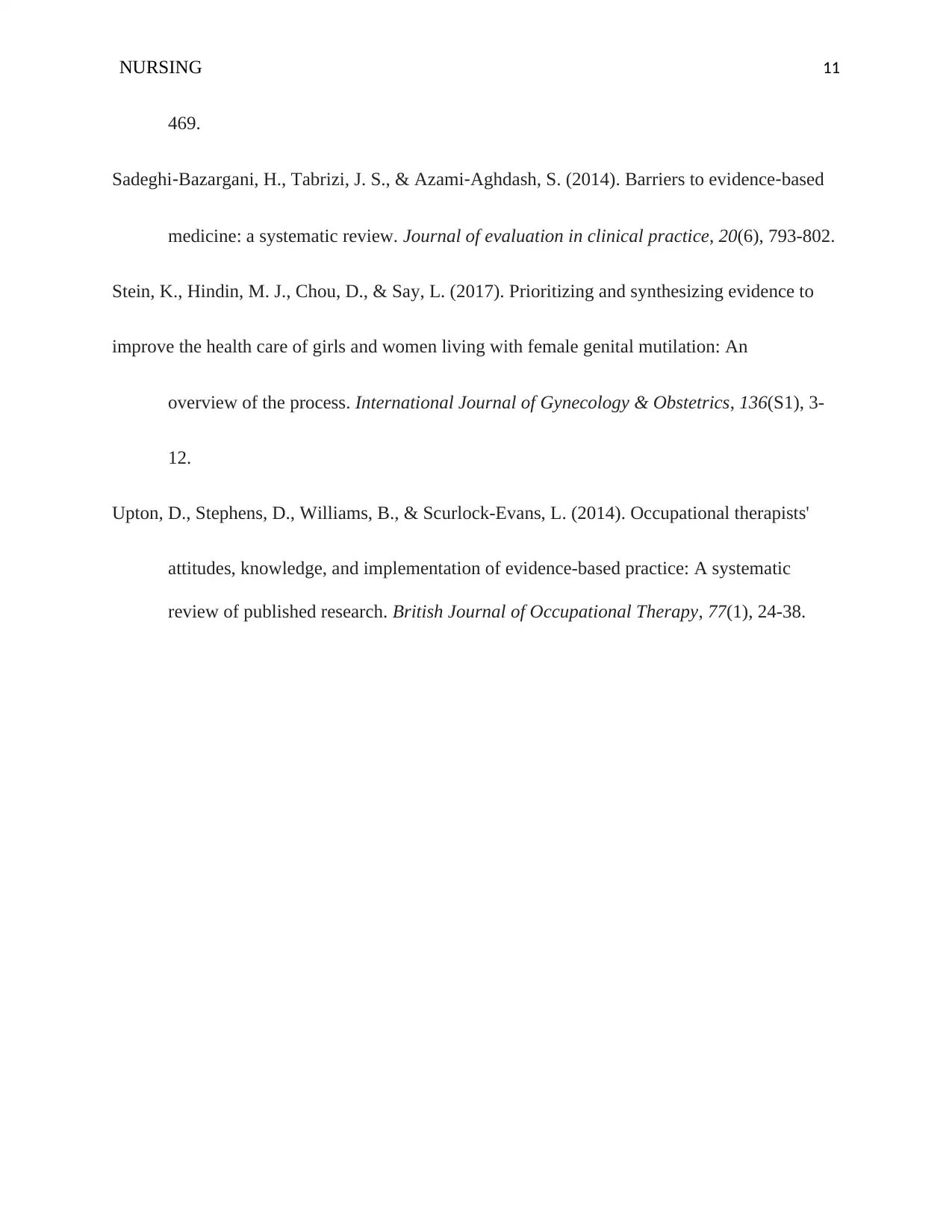
Sadeghi‐Bazargani, H., Tabrizi, J. S., & Azami‐Aghdash, S. (2014). Barriers to evidence‐based
medicine: a systematic review. Journal of evaluation in clinical practice, 20(6), 793-802.
Stein, K., Hindin, M. J., Chou, D., & Say, L. (2017). Prioritizing and synthesizing evidence to
improve the health care of girls and women living with female genital mutilation: An
overview of the process. International Journal of Gynecology & Obstetrics, 136(S1), 3-
12.
Upton, D., Stephens, D., Williams, B., & Scurlock-Evans, L. (2014). Occupational therapists'
attitudes, knowledge, and implementation of evidence-based practice: A systematic
review of published research. British Journal of Occupational Therapy, 77(1), 24-38.
469.
Sadeghi‐Bazargani, H., Tabrizi, J. S., & Azami‐Aghdash, S. (2014). Barriers to evidence‐based
medicine: a systematic review. Journal of evaluation in clinical practice, 20(6), 793-802.
Stein, K., Hindin, M. J., Chou, D., & Say, L. (2017). Prioritizing and synthesizing evidence to
improve the health care of girls and women living with female genital mutilation: An
overview of the process. International Journal of Gynecology & Obstetrics, 136(S1), 3-
12.
Upton, D., Stephens, D., Williams, B., & Scurlock-Evans, L. (2014). Occupational therapists'
attitudes, knowledge, and implementation of evidence-based practice: A systematic
review of published research. British Journal of Occupational Therapy, 77(1), 24-38.

1 out of 11


Related Documents


Your All-in-One AI-Powered Toolkit for Academic Success.
+13062052269
info@desklib.com
Available 24*7 on WhatsApp / Email
![[object Object]](/_next/static/media/star-bottom.7253800d.svg)
Unlock your academic potential
Copyright © 2020–2026 A2Z Services. All Rights Reserved. Developed and managed by ZUCOL.