Critical Evaluation on the Need for the Accounting Theory: A Deep Dive
VerifiedAdded on 2023/04/21
|10
|3294
|441
Essay
AI Summary
This essay provides a critical evaluation of the need for accounting theory, drawing upon Craig Deegan and Jeffrey Unerman's "Financial Accounting Theory." It examines normative theories like True Income and Decision Usefulness, as well as the positive Agency Theory, to assess the relevance and necessity of accounting theories in practical applications. The evaluation considers arguments for and against the importance of accounting theories, including their role in evaluating current practices, developing alternatives, and maintaining the reputation of the accounting profession. It also discusses the limitations of normative and positive theories, the influence of individual value judgments, and the impact of accounting theories on regulations, standardization, and cultural differences in accounting practices. The essay concludes that accounting theory is essential for understanding the true objective behind accounting information and resolving practical issues in the field.
Critical evaluation on the need of the Accounting
theory
Submitted By
Student’s Name:
Date:
Table of Contents
1 | P a g e
theory
Submitted By
Student’s Name:
Date:
Table of Contents
1 | P a g e

Paraphrase This Document
Need a fresh take? Get an instant paraphrase of this document with our AI Paraphraser
Introduction.................................................................................................................................................3
Brief evaluation of accounting theories.......................................................................................................3
Overall evaluation of the need of the accounting theory............................................................................3
Conclusion...................................................................................................................................................7
References...................................................................................................................................................9
Introduction
2 | P a g e
Brief evaluation of accounting theories.......................................................................................................3
Overall evaluation of the need of the accounting theory............................................................................3
Conclusion...................................................................................................................................................7
References...................................................................................................................................................9
Introduction
2 | P a g e
This paper is offering a critical evaluation of the need of three accounting theories based on the
book naming Financial Accounting Theory written by Craig Deegan and Jeffrey Unerman under
the publication of McGraw-Hill in its 2012 second edition. The primary focus of our evaluation
is to accept the need of the accounting theories or completely rejecting the idea of the need of
accounting theories. The major reason for such evaluation is that accounting is actually a
practical subject, but still accounting theories prevail. Hence it becomes important to understand
that whether they are at all relevant or not (Alieid, 2016).
The three major accounting theories as discussed in this critical evaluation based on the above
referred book are two normative theories like True income theories and decision usefulness
theories, one positive theory that is Agency theory. These theories will help in understanding the
importance as well as the need of the accounting theories in the regular work.
Brief evaluation of accounting theories
The first theory is the Income theory which says that at first it is role of accounting that is to be
decided and only thereafter to decide about the best measure of ascertaining profit. Until and
unless the role of the accounting is defined we cannot decide about the best measurement of the
profit (Alexander, 2016).
It is one of the normative theories that is aimed at providing the prescription as to what to do for
measuring the profit and it is a sort of stipulation.
The second theory is the decision usefulness theory which says that there are various users of the
accounting information; hence it becomes the duty to ask first to those users that what
information they want and thereafter think about supplying the same. Again it is to be kept in
mind that these users are actually the decision makers in their own field (Bizfluent, 2017).
The third theory is the agency theory which talks about the relationship between principals and
the agents, i.e., shareholders and the managers. As per this theory it is being explained that why
selecting a particular accounting method is a matter for consideration. At the same time the
organization has to bear the various costs like monitoring costs, bonding costs and residual costs
for maintaining such agency relationship (Choy, 2018).
Overall evaluation of the need of the accounting theory
There is no doubt here that accounting is a human activity, but the study of financial accounting
without having the knowledge of theories of accounting seems to quite irrational as it is the
accounting theories which consider the implications of the accounting information on the
behavior of the human being r in other words they explain why accounting theories are
important.
3 | P a g e
book naming Financial Accounting Theory written by Craig Deegan and Jeffrey Unerman under
the publication of McGraw-Hill in its 2012 second edition. The primary focus of our evaluation
is to accept the need of the accounting theories or completely rejecting the idea of the need of
accounting theories. The major reason for such evaluation is that accounting is actually a
practical subject, but still accounting theories prevail. Hence it becomes important to understand
that whether they are at all relevant or not (Alieid, 2016).
The three major accounting theories as discussed in this critical evaluation based on the above
referred book are two normative theories like True income theories and decision usefulness
theories, one positive theory that is Agency theory. These theories will help in understanding the
importance as well as the need of the accounting theories in the regular work.
Brief evaluation of accounting theories
The first theory is the Income theory which says that at first it is role of accounting that is to be
decided and only thereafter to decide about the best measure of ascertaining profit. Until and
unless the role of the accounting is defined we cannot decide about the best measurement of the
profit (Alexander, 2016).
It is one of the normative theories that is aimed at providing the prescription as to what to do for
measuring the profit and it is a sort of stipulation.
The second theory is the decision usefulness theory which says that there are various users of the
accounting information; hence it becomes the duty to ask first to those users that what
information they want and thereafter think about supplying the same. Again it is to be kept in
mind that these users are actually the decision makers in their own field (Bizfluent, 2017).
The third theory is the agency theory which talks about the relationship between principals and
the agents, i.e., shareholders and the managers. As per this theory it is being explained that why
selecting a particular accounting method is a matter for consideration. At the same time the
organization has to bear the various costs like monitoring costs, bonding costs and residual costs
for maintaining such agency relationship (Choy, 2018).
Overall evaluation of the need of the accounting theory
There is no doubt here that accounting is a human activity, but the study of financial accounting
without having the knowledge of theories of accounting seems to quite irrational as it is the
accounting theories which consider the implications of the accounting information on the
behavior of the human being r in other words they explain why accounting theories are
important.
3 | P a g e
⊘ This is a preview!⊘
Do you want full access?
Subscribe today to unlock all pages.

Trusted by 1+ million students worldwide
There are certain reasonable grounds provided that advocates the study of the accounting
theories like it is the basis on which current accounting practices are evaluated. It helps to
develop the suitable alternative current practices when the existing practices fail to meet the
desired expectation. Further it saves the reputation of the profession of the financial accounting
when it is blamed that accounting practices caused the failure for the company (Vieira, O’Dwyer,
& Schneider, 2017).
Again it is to be kept in mind that though there may be several accounting theories that are
prevalent in present days, but still there are no universally acceptable accounting theories on
which we can be considered as reliable.
Further there is strong evidence that various researchers have suggested the diversified role of
the accounting theory. At the same time it is the individual value judgment made by the
researcher that finally decides which accounting theory to accept and reject (Guragai, Hunt, Neri,
& Taylor, 2017).
From the stage of initial evaluation of the accounting theories it is seen that basically there are
two categories of theories commonly known as normative theories of accounting and the positive
theories of accounting. Normative theory clearly prescribes a particular requirement whereas no
such thing like prescription or the stipulation is provided by the Positive theories of accounting.
Each of these theories have their own limitations too. These limitations are described in detail in
the following section.
The major criticism of the normative theories are given that it is completely based on the
personal opinion of those who developed the theory by which they suggested what to do in a
particular situation. Further those provided the positive theories they say that the duty of
accounting theory is simply to reveal the facts and it is the user of the information who shall be
left with the decision of what is to be done on the basis of such information. Similarly lacking
the stipulated prescription is one of the major criticisms found in case of the positive theories
(Werner, 2017).
Now one important thing to be noted in this case is that unlike scientific theories it is not possible
to prove the accounting theories, but it should not be considered that it shall make it useless. This
can be well understood from the fact that suppose a theory was developed on the basis of certain
observations, but after the development of such theory few new observations were noticed that
was not supported by the accounting theory already developed (Sithole, Chandler, Abeysekera,
& Paas, 2017).
While making the evaluation of the accounting theory it is to be kept in mind that it is actually
the value judgment of the individual that ids the deciding factor while choosing a particular
accounting theory or in other words giving preference to a particular accounting theory.
4 | P a g e
theories like it is the basis on which current accounting practices are evaluated. It helps to
develop the suitable alternative current practices when the existing practices fail to meet the
desired expectation. Further it saves the reputation of the profession of the financial accounting
when it is blamed that accounting practices caused the failure for the company (Vieira, O’Dwyer,
& Schneider, 2017).
Again it is to be kept in mind that though there may be several accounting theories that are
prevalent in present days, but still there are no universally acceptable accounting theories on
which we can be considered as reliable.
Further there is strong evidence that various researchers have suggested the diversified role of
the accounting theory. At the same time it is the individual value judgment made by the
researcher that finally decides which accounting theory to accept and reject (Guragai, Hunt, Neri,
& Taylor, 2017).
From the stage of initial evaluation of the accounting theories it is seen that basically there are
two categories of theories commonly known as normative theories of accounting and the positive
theories of accounting. Normative theory clearly prescribes a particular requirement whereas no
such thing like prescription or the stipulation is provided by the Positive theories of accounting.
Each of these theories have their own limitations too. These limitations are described in detail in
the following section.
The major criticism of the normative theories are given that it is completely based on the
personal opinion of those who developed the theory by which they suggested what to do in a
particular situation. Further those provided the positive theories they say that the duty of
accounting theory is simply to reveal the facts and it is the user of the information who shall be
left with the decision of what is to be done on the basis of such information. Similarly lacking
the stipulated prescription is one of the major criticisms found in case of the positive theories
(Werner, 2017).
Now one important thing to be noted in this case is that unlike scientific theories it is not possible
to prove the accounting theories, but it should not be considered that it shall make it useless. This
can be well understood from the fact that suppose a theory was developed on the basis of certain
observations, but after the development of such theory few new observations were noticed that
was not supported by the accounting theory already developed (Sithole, Chandler, Abeysekera,
& Paas, 2017).
While making the evaluation of the accounting theory it is to be kept in mind that it is actually
the value judgment of the individual that ids the deciding factor while choosing a particular
accounting theory or in other words giving preference to a particular accounting theory.
4 | P a g e
Paraphrase This Document
Need a fresh take? Get an instant paraphrase of this document with our AI Paraphraser
In this case we need to focus on certain points while making any evaluation of the accounting
theories. These are looking into the fact that the argument in favor of a particular theory is
logical or whether one is satisfied with the assumptions made in the theory etc.
Further while making such evaluation one needs to be cautious enough in relation to the
dishonest tricks adopted by the researchers in order to support their individual research
(Heminway, 2017).
In this regard few of the major dishonest tricks adopted by the researcher are emotional toning of
words, diversion to another question or to a side issue.
Actually it is just because of the study of the accounting theory as a result of which the people
who are practicing in this field can get the idea about various facts like the measurement of the
various elements of accounting. Further it can provide the motivation to the organizations too to
disclose various types of information needed by several categories of the users... Further is the
source for motivation to those individuals who are busy in lobbying the various regulators in
support for certain specific sort of accounting methods, how to make a true measure of income
and when and how the capital market gets influenced by certain types of accounting information
(Linden & Freeman, 2017).
Again we can not expect it from the various theories of accounting that they shall perfectly
explain or predict the human behavior or may even can suggest that what type of information is
being sought by the users of financial information.
If we practically see that the accounting standards are framed under the guidance of the various
accounting theories which indicates the fact that users should have a reasonable amount of
knowledge about the business and economic activities and he or she should have the willingness
too to understand and study the accounting information. For which the knowledge of the various
theories of accounting is a mandatory requirement (Kachelmeier, Schmidt, & Valentine, 2018).
These accounting theories are also used to describe the benefits of regulation. Such types of
theories are basically of three types commonly known as public interest theory, capture theory of
regulation, private interest theory of regulation.
It cannot be denied that from the efficiency perspective and opportunistic perspective it is always
suggested that certain specific types of accounting methods are being suggested that also require
the study of the various accounting theories (Dichev, 2017).
The information presented in form of accounting information is much vital for a large group of
the people in making their wealth related decisions in which case it is generally expected that in
order to make these information more trustworthy they should be based on certain basic
principles for which the knowledge of the accounting theory seems to be justified.
5 | P a g e
theories. These are looking into the fact that the argument in favor of a particular theory is
logical or whether one is satisfied with the assumptions made in the theory etc.
Further while making such evaluation one needs to be cautious enough in relation to the
dishonest tricks adopted by the researchers in order to support their individual research
(Heminway, 2017).
In this regard few of the major dishonest tricks adopted by the researcher are emotional toning of
words, diversion to another question or to a side issue.
Actually it is just because of the study of the accounting theory as a result of which the people
who are practicing in this field can get the idea about various facts like the measurement of the
various elements of accounting. Further it can provide the motivation to the organizations too to
disclose various types of information needed by several categories of the users... Further is the
source for motivation to those individuals who are busy in lobbying the various regulators in
support for certain specific sort of accounting methods, how to make a true measure of income
and when and how the capital market gets influenced by certain types of accounting information
(Linden & Freeman, 2017).
Again we can not expect it from the various theories of accounting that they shall perfectly
explain or predict the human behavior or may even can suggest that what type of information is
being sought by the users of financial information.
If we practically see that the accounting standards are framed under the guidance of the various
accounting theories which indicates the fact that users should have a reasonable amount of
knowledge about the business and economic activities and he or she should have the willingness
too to understand and study the accounting information. For which the knowledge of the various
theories of accounting is a mandatory requirement (Kachelmeier, Schmidt, & Valentine, 2018).
These accounting theories are also used to describe the benefits of regulation. Such types of
theories are basically of three types commonly known as public interest theory, capture theory of
regulation, private interest theory of regulation.
It cannot be denied that from the efficiency perspective and opportunistic perspective it is always
suggested that certain specific types of accounting methods are being suggested that also require
the study of the various accounting theories (Dichev, 2017).
The information presented in form of accounting information is much vital for a large group of
the people in making their wealth related decisions in which case it is generally expected that in
order to make these information more trustworthy they should be based on certain basic
principles for which the knowledge of the accounting theory seems to be justified.
5 | P a g e
In this regard the contribution of the accounting theories in framing various accounting
regulations are too important as often we see few of the accounting theories become the part of
the regulations but few of them cannot make it (Lessambo, 2018).
The role of theories in the field of regulation can be well understood from the following
discussion. First theory of is public interest theory which says that the primary motive of
regulation should be to serve the society as a whole. Secondly the capture theory says that
though these regulations are introduced with the objective of serving the public interest but later
on this objective may not be achieved Similarly the economic interest group theory says that
groups are formed to protect the economic interest of the group. All these theories suggest that
the intention of the legislature was positive but finally it failed to achieve the same.
If we compare the above in the field of accounting then also we may find that though the purpose
of the accounting information is to serve the interest of the users to the best possible extent but
still it may fail due to the lack of proper fundamental principles which are being compensated by
the means of various theories of accounting.
Again it is well evidenced that there are huge difference in the accounting treatment of various
items at the national and international level now a days when this differences are being addressed
to harmonize the same in that case also the theories of accounting can play a significant role
(Raiborn, Butler, & Martin, 2016).
One new terminology that is standardization is also a very common aspect to be discussed in this
case. As often it is see that standardization is nothing but the imposition of certain rigid
principles, but these imposition may disrupt the practice of accounting too. In that case too it can
play a major role to resolve such issues.
Similarly the culture of a particular country too affects its accounting system. It is because these
culture decides its legal and taxation system etc. the legal. Hence such cultural differences across
the world in the presentation of the financial information can be well explained with the help of
the conceptual framework of accounting based on the accounting theory. This again works
against the international standardization of accounting system for which strong accounting
theory is demanded (Trieu, 2017).
Similarly one very common accounting practice of replacing historical cost with the current cost
is a matter of great debate now a days. When both of these method of accounting has its own
advantages, but which one to use when is the matter a judgement to be guided by appropriate
accounting theory.
Hence from the abovementioned discussion it is well evidenced that without accounting theory
the true objective behind the accounting information may somewhere be lost. It is because
framing of law May e important but what is more important is understanding the true intention of
framing such regulation. It is proved that the study of the accounting theory helps us in the same.
6 | P a g e
regulations are too important as often we see few of the accounting theories become the part of
the regulations but few of them cannot make it (Lessambo, 2018).
The role of theories in the field of regulation can be well understood from the following
discussion. First theory of is public interest theory which says that the primary motive of
regulation should be to serve the society as a whole. Secondly the capture theory says that
though these regulations are introduced with the objective of serving the public interest but later
on this objective may not be achieved Similarly the economic interest group theory says that
groups are formed to protect the economic interest of the group. All these theories suggest that
the intention of the legislature was positive but finally it failed to achieve the same.
If we compare the above in the field of accounting then also we may find that though the purpose
of the accounting information is to serve the interest of the users to the best possible extent but
still it may fail due to the lack of proper fundamental principles which are being compensated by
the means of various theories of accounting.
Again it is well evidenced that there are huge difference in the accounting treatment of various
items at the national and international level now a days when this differences are being addressed
to harmonize the same in that case also the theories of accounting can play a significant role
(Raiborn, Butler, & Martin, 2016).
One new terminology that is standardization is also a very common aspect to be discussed in this
case. As often it is see that standardization is nothing but the imposition of certain rigid
principles, but these imposition may disrupt the practice of accounting too. In that case too it can
play a major role to resolve such issues.
Similarly the culture of a particular country too affects its accounting system. It is because these
culture decides its legal and taxation system etc. the legal. Hence such cultural differences across
the world in the presentation of the financial information can be well explained with the help of
the conceptual framework of accounting based on the accounting theory. This again works
against the international standardization of accounting system for which strong accounting
theory is demanded (Trieu, 2017).
Similarly one very common accounting practice of replacing historical cost with the current cost
is a matter of great debate now a days. When both of these method of accounting has its own
advantages, but which one to use when is the matter a judgement to be guided by appropriate
accounting theory.
Hence from the abovementioned discussion it is well evidenced that without accounting theory
the true objective behind the accounting information may somewhere be lost. It is because
framing of law May e important but what is more important is understanding the true intention of
framing such regulation. It is proved that the study of the accounting theory helps us in the same.
6 | P a g e
⊘ This is a preview!⊘
Do you want full access?
Subscribe today to unlock all pages.
Trusted by 1+ million students worldwide
Similarly the argument that accounting is a practical profession having no scope of theoretical
discussion cannot be accepted. It is because without knowing the theory it shall be quite difficult
to actually solve the practical issue (Arnott, Lizama, & Song, 2017).
These accounting theories perform the role of the yardstick or a parameter on which the
foundation of the entire profession of accounting rests.
Though it might be true that theory changes from time to time, but it does not mean that they are
no more useful. Any theory developed is always based on the contemporary requirement of the
user. When such requirements change then the theory is bound to change, otherwise there won’t
be any relevance behind such development.
Accounting theory is the foundation stone to enrich the profession of accounting and its study s
mandatory in order to prove oneself as the best one (Hepp, 2018).
Again there are certain fundamental accounting assumptions on which the various financial
statement is relied upon. Hence such assumptions are based on the fundamental accounting
theory.
Conclusion
In nutshell it is to be said that at first it is to be understood that though the accounting is a human
activity with its practical application, but without the knowledge of the theories of accounting
such profession can not prosper or even the person who is practicing the same cannot make it
happen.
Without knowing the theory how can someone think about to practice this profession. There may
be a lot of limitations associated with the theories of accounting but as the knowledge advances
one theory substitutes the other and bring more perfection in it. Such a change is common too as
per the changing scenario of doing business. Hence it is to be said that without having the
knowledge of theories of accounting it becomes difficult to practice this profession properly.
Further it is actually those accounting theories that provides a sound logical structure to the
profession of accounting by upgrading its standards. It is because there should be some amount
of justification behind the treatment of any accounting item which is sought from the accounting
theories.
At the same time as it has been seen that though there are two types of accounting theories.
positive and normative theories and both have their own outstanding features associated with
them in order to justify their existence. Even it can not be said that only normative theories are
correct to be followed or only the positive theories of accounting are to be checked. Rather each
and every theory has its own significance and their proper use depends on the demand placed by
the specific condition.
7 | P a g e
discussion cannot be accepted. It is because without knowing the theory it shall be quite difficult
to actually solve the practical issue (Arnott, Lizama, & Song, 2017).
These accounting theories perform the role of the yardstick or a parameter on which the
foundation of the entire profession of accounting rests.
Though it might be true that theory changes from time to time, but it does not mean that they are
no more useful. Any theory developed is always based on the contemporary requirement of the
user. When such requirements change then the theory is bound to change, otherwise there won’t
be any relevance behind such development.
Accounting theory is the foundation stone to enrich the profession of accounting and its study s
mandatory in order to prove oneself as the best one (Hepp, 2018).
Again there are certain fundamental accounting assumptions on which the various financial
statement is relied upon. Hence such assumptions are based on the fundamental accounting
theory.
Conclusion
In nutshell it is to be said that at first it is to be understood that though the accounting is a human
activity with its practical application, but without the knowledge of the theories of accounting
such profession can not prosper or even the person who is practicing the same cannot make it
happen.
Without knowing the theory how can someone think about to practice this profession. There may
be a lot of limitations associated with the theories of accounting but as the knowledge advances
one theory substitutes the other and bring more perfection in it. Such a change is common too as
per the changing scenario of doing business. Hence it is to be said that without having the
knowledge of theories of accounting it becomes difficult to practice this profession properly.
Further it is actually those accounting theories that provides a sound logical structure to the
profession of accounting by upgrading its standards. It is because there should be some amount
of justification behind the treatment of any accounting item which is sought from the accounting
theories.
At the same time as it has been seen that though there are two types of accounting theories.
positive and normative theories and both have their own outstanding features associated with
them in order to justify their existence. Even it can not be said that only normative theories are
correct to be followed or only the positive theories of accounting are to be checked. Rather each
and every theory has its own significance and their proper use depends on the demand placed by
the specific condition.
7 | P a g e
Paraphrase This Document
Need a fresh take? Get an instant paraphrase of this document with our AI Paraphraser
Hence there is no doubt that accounting theories have their own relevance which can not be
denied under any circumstances irrespective of the size or nature of business for which the
accounting treatment is being demanded. Further the knowledge gained through the study of the
accounting theories need to be appropriately applied by using one’s own value judgements which
is influenced by a lot of factors. Hence careful consideration is being expected while making
such evaluation.
Again while criticizing a particular accounting theory one should not be too biased simply
because he or she wants to prove his or her own research work to be the correct one. Hence,
independent evaluation is expected.
References
Alexander, F. (2016). The Changing Face of Accountability. The Journal of Higher Education, 71(4), 411-
431.
8 | P a g e
denied under any circumstances irrespective of the size or nature of business for which the
accounting treatment is being demanded. Further the knowledge gained through the study of the
accounting theories need to be appropriately applied by using one’s own value judgements which
is influenced by a lot of factors. Hence careful consideration is being expected while making
such evaluation.
Again while criticizing a particular accounting theory one should not be too biased simply
because he or she wants to prove his or her own research work to be the correct one. Hence,
independent evaluation is expected.
References
Alexander, F. (2016). The Changing Face of Accountability. The Journal of Higher Education, 71(4), 411-
431.
8 | P a g e
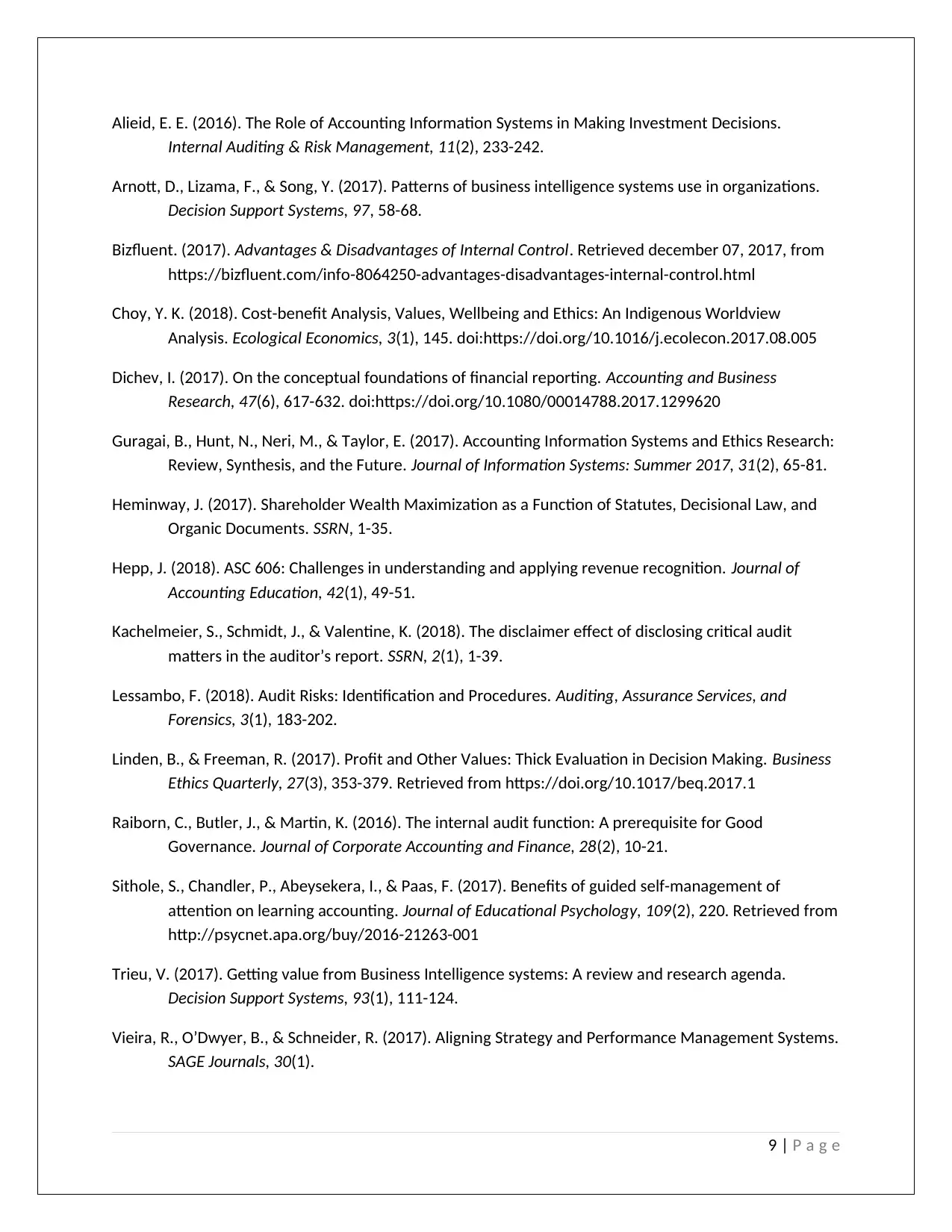
Alieid, E. E. (2016). The Role of Accounting Information Systems in Making Investment Decisions.
Internal Auditing & Risk Management, 11(2), 233-242.
Arnott, D., Lizama, F., & Song, Y. (2017). Patterns of business intelligence systems use in organizations.
Decision Support Systems, 97, 58-68.
Bizfluent. (2017). Advantages & Disadvantages of Internal Control. Retrieved december 07, 2017, from
https://bizfluent.com/info-8064250-advantages-disadvantages-internal-control.html
Choy, Y. K. (2018). Cost-benefit Analysis, Values, Wellbeing and Ethics: An Indigenous Worldview
Analysis. Ecological Economics, 3(1), 145. doi:https://doi.org/10.1016/j.ecolecon.2017.08.005
Dichev, I. (2017). On the conceptual foundations of financial reporting. Accounting and Business
Research, 47(6), 617-632. doi:https://doi.org/10.1080/00014788.2017.1299620
Guragai, B., Hunt, N., Neri, M., & Taylor, E. (2017). Accounting Information Systems and Ethics Research:
Review, Synthesis, and the Future. Journal of Information Systems: Summer 2017, 31(2), 65-81.
Heminway, J. (2017). Shareholder Wealth Maximization as a Function of Statutes, Decisional Law, and
Organic Documents. SSRN, 1-35.
Hepp, J. (2018). ASC 606: Challenges in understanding and applying revenue recognition. Journal of
Accounting Education, 42(1), 49-51.
Kachelmeier, S., Schmidt, J., & Valentine, K. (2018). The disclaimer effect of disclosing critical audit
matters in the auditor’s report. SSRN, 2(1), 1-39.
Lessambo, F. (2018). Audit Risks: Identification and Procedures. Auditing, Assurance Services, and
Forensics, 3(1), 183-202.
Linden, B., & Freeman, R. (2017). Profit and Other Values: Thick Evaluation in Decision Making. Business
Ethics Quarterly, 27(3), 353-379. Retrieved from https://doi.org/10.1017/beq.2017.1
Raiborn, C., Butler, J., & Martin, K. (2016). The internal audit function: A prerequisite for Good
Governance. Journal of Corporate Accounting and Finance, 28(2), 10-21.
Sithole, S., Chandler, P., Abeysekera, I., & Paas, F. (2017). Benefits of guided self-management of
attention on learning accounting. Journal of Educational Psychology, 109(2), 220. Retrieved from
http://psycnet.apa.org/buy/2016-21263-001
Trieu, V. (2017). Getting value from Business Intelligence systems: A review and research agenda.
Decision Support Systems, 93(1), 111-124.
Vieira, R., O’Dwyer, B., & Schneider, R. (2017). Aligning Strategy and Performance Management Systems.
SAGE Journals, 30(1).
9 | P a g e
Internal Auditing & Risk Management, 11(2), 233-242.
Arnott, D., Lizama, F., & Song, Y. (2017). Patterns of business intelligence systems use in organizations.
Decision Support Systems, 97, 58-68.
Bizfluent. (2017). Advantages & Disadvantages of Internal Control. Retrieved december 07, 2017, from
https://bizfluent.com/info-8064250-advantages-disadvantages-internal-control.html
Choy, Y. K. (2018). Cost-benefit Analysis, Values, Wellbeing and Ethics: An Indigenous Worldview
Analysis. Ecological Economics, 3(1), 145. doi:https://doi.org/10.1016/j.ecolecon.2017.08.005
Dichev, I. (2017). On the conceptual foundations of financial reporting. Accounting and Business
Research, 47(6), 617-632. doi:https://doi.org/10.1080/00014788.2017.1299620
Guragai, B., Hunt, N., Neri, M., & Taylor, E. (2017). Accounting Information Systems and Ethics Research:
Review, Synthesis, and the Future. Journal of Information Systems: Summer 2017, 31(2), 65-81.
Heminway, J. (2017). Shareholder Wealth Maximization as a Function of Statutes, Decisional Law, and
Organic Documents. SSRN, 1-35.
Hepp, J. (2018). ASC 606: Challenges in understanding and applying revenue recognition. Journal of
Accounting Education, 42(1), 49-51.
Kachelmeier, S., Schmidt, J., & Valentine, K. (2018). The disclaimer effect of disclosing critical audit
matters in the auditor’s report. SSRN, 2(1), 1-39.
Lessambo, F. (2018). Audit Risks: Identification and Procedures. Auditing, Assurance Services, and
Forensics, 3(1), 183-202.
Linden, B., & Freeman, R. (2017). Profit and Other Values: Thick Evaluation in Decision Making. Business
Ethics Quarterly, 27(3), 353-379. Retrieved from https://doi.org/10.1017/beq.2017.1
Raiborn, C., Butler, J., & Martin, K. (2016). The internal audit function: A prerequisite for Good
Governance. Journal of Corporate Accounting and Finance, 28(2), 10-21.
Sithole, S., Chandler, P., Abeysekera, I., & Paas, F. (2017). Benefits of guided self-management of
attention on learning accounting. Journal of Educational Psychology, 109(2), 220. Retrieved from
http://psycnet.apa.org/buy/2016-21263-001
Trieu, V. (2017). Getting value from Business Intelligence systems: A review and research agenda.
Decision Support Systems, 93(1), 111-124.
Vieira, R., O’Dwyer, B., & Schneider, R. (2017). Aligning Strategy and Performance Management Systems.
SAGE Journals, 30(1).
9 | P a g e
⊘ This is a preview!⊘
Do you want full access?
Subscribe today to unlock all pages.
Trusted by 1+ million students worldwide
Werner, M. (2017). Financial process mining - Accounting data structure dependent control flow
inference. International Journal of Accounting Information Systems, 25(1), 57-80.
10 | P a g e
inference. International Journal of Accounting Information Systems, 25(1), 57-80.
10 | P a g e

1 out of 10


Related Documents


Your All-in-One AI-Powered Toolkit for Academic Success.
+13062052269
info@desklib.com
Available 24*7 on WhatsApp / Email
![[object Object]](/_next/static/media/star-bottom.7253800d.svg)
Unlock your academic potential
Copyright © 2020–2026 A2Z Services. All Rights Reserved. Developed and managed by ZUCOL.