Critical Analysis of Mary Shelley's Frankenstein Essay
VerifiedAdded on 2023/05/28
|6
|1677
|467
Essay
AI Summary
This essay provides a detailed analysis of Mary Shelley's Frankenstein, exploring various themes and literary elements. The essay begins with an introduction to the novel and its central character, Victor Frankenstein, who creates a monster. It then delves into the themes of creation, responsibility, and the consequences of scientific ambition, as well as the Gothic elements present in the novel. The essay examines the complex relationship between Victor and his creation, highlighting the monster's isolation, longing for acceptance, and the creator's guilt and anxiety. The essay also touches on the political and social implications of the story, including the exploration of family relations and self-awareness. The essay utilizes scholarly sources to support its arguments and provides a comprehensive understanding of Frankenstein's significance in literature and its lasting impact.
Running Head: ENGLISH 1
Frankenstein story
Author's Name
Institutional Affiliation
Introduction
Frankenstein story
Author's Name
Institutional Affiliation
Introduction
Paraphrase This Document
Need a fresh take? Get an instant paraphrase of this document with our AI Paraphraser

EDUCATION 2
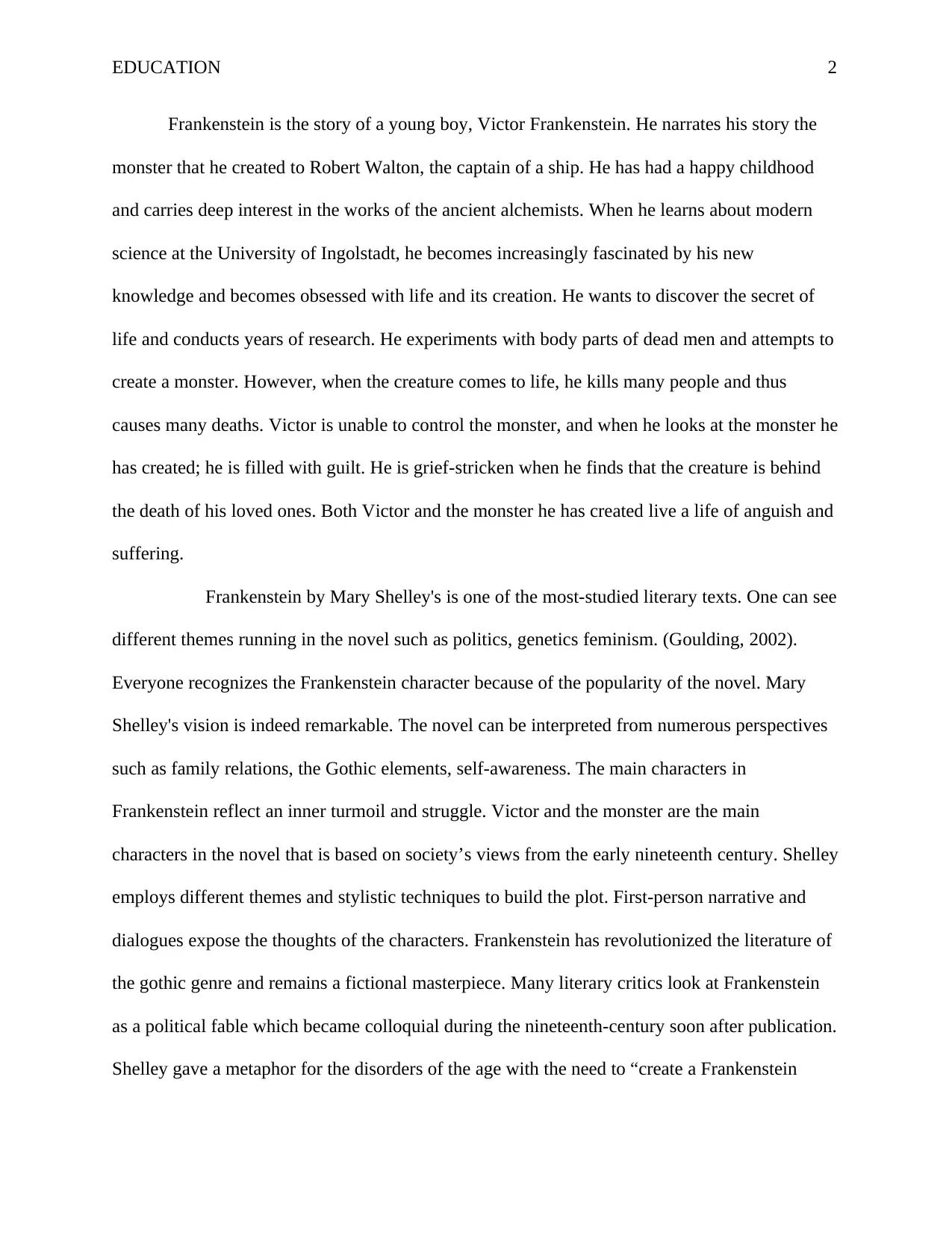
Frankenstein is the story of a young boy, Victor Frankenstein. He narrates his story the
monster that he created to Robert Walton, the captain of a ship. He has had a happy childhood
and carries deep interest in the works of the ancient alchemists. When he learns about modern
science at the University of Ingolstadt, he becomes increasingly fascinated by his new
knowledge and becomes obsessed with life and its creation. He wants to discover the secret of
life and conducts years of research. He experiments with body parts of dead men and attempts to
create a monster. However, when the creature comes to life, he kills many people and thus
causes many deaths. Victor is unable to control the monster, and when he looks at the monster he
has created; he is filled with guilt. He is grief-stricken when he finds that the creature is behind
the death of his loved ones. Both Victor and the monster he has created live a life of anguish and
suffering.
Frankenstein by Mary Shelley's is one of the most-studied literary texts. One can see
different themes running in the novel such as politics, genetics feminism. (Goulding, 2002).
Everyone recognizes the Frankenstein character because of the popularity of the novel. Mary
Shelley's vision is indeed remarkable. The novel can be interpreted from numerous perspectives
such as family relations, the Gothic elements, self-awareness. The main characters in
Frankenstein reflect an inner turmoil and struggle. Victor and the monster are the main
characters in the novel that is based on society’s views from the early nineteenth century. Shelley
employs different themes and stylistic techniques to build the plot. First-person narrative and
dialogues expose the thoughts of the characters. Frankenstein has revolutionized the literature of
the gothic genre and remains a fictional masterpiece. Many literary critics look at Frankenstein
as a political fable which became colloquial during the nineteenth-century soon after publication.
Shelley gave a metaphor for the disorders of the age with the need to “create a Frankenstein
Frankenstein is the story of a young boy, Victor Frankenstein. He narrates his story the
monster that he created to Robert Walton, the captain of a ship. He has had a happy childhood
and carries deep interest in the works of the ancient alchemists. When he learns about modern
science at the University of Ingolstadt, he becomes increasingly fascinated by his new
knowledge and becomes obsessed with life and its creation. He wants to discover the secret of
life and conducts years of research. He experiments with body parts of dead men and attempts to
create a monster. However, when the creature comes to life, he kills many people and thus
causes many deaths. Victor is unable to control the monster, and when he looks at the monster he
has created; he is filled with guilt. He is grief-stricken when he finds that the creature is behind
the death of his loved ones. Both Victor and the monster he has created live a life of anguish and
suffering.
Frankenstein by Mary Shelley's is one of the most-studied literary texts. One can see
different themes running in the novel such as politics, genetics feminism. (Goulding, 2002).
Everyone recognizes the Frankenstein character because of the popularity of the novel. Mary
Shelley's vision is indeed remarkable. The novel can be interpreted from numerous perspectives
such as family relations, the Gothic elements, self-awareness. The main characters in
Frankenstein reflect an inner turmoil and struggle. Victor and the monster are the main
characters in the novel that is based on society’s views from the early nineteenth century. Shelley
employs different themes and stylistic techniques to build the plot. First-person narrative and
dialogues expose the thoughts of the characters. Frankenstein has revolutionized the literature of
the gothic genre and remains a fictional masterpiece. Many literary critics look at Frankenstein
as a political fable which became colloquial during the nineteenth-century soon after publication.
Shelley gave a metaphor for the disorders of the age with the need to “create a Frankenstein

EDUCATION 3
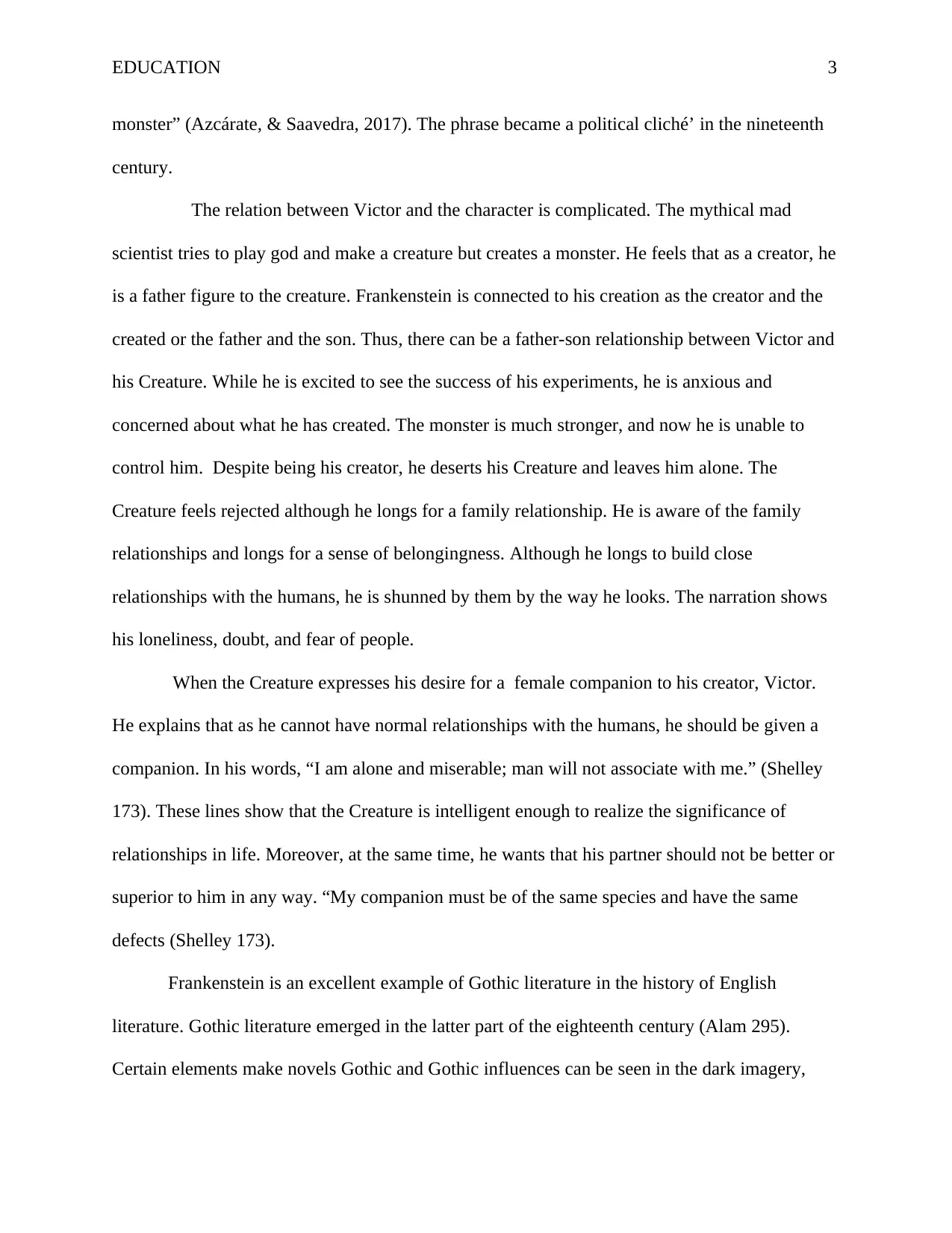
monster” (Azcárate, & Saavedra, 2017). The phrase became a political cliché’ in the nineteenth
century.
The relation between Victor and the character is complicated. The mythical mad
scientist tries to play god and make a creature but creates a monster. He feels that as a creator, he
is a father figure to the creature. Frankenstein is connected to his creation as the creator and the
created or the father and the son. Thus, there can be a father-son relationship between Victor and
his Creature. While he is excited to see the success of his experiments, he is anxious and
concerned about what he has created. The monster is much stronger, and now he is unable to
control him. Despite being his creator, he deserts his Creature and leaves him alone. The
Creature feels rejected although he longs for a family relationship. He is aware of the family
relationships and longs for a sense of belongingness. Although he longs to build close
relationships with the humans, he is shunned by them by the way he looks. The narration shows
his loneliness, doubt, and fear of people.
When the Creature expresses his desire for a female companion to his creator, Victor.
He explains that as he cannot have normal relationships with the humans, he should be given a
companion. In his words, “I am alone and miserable; man will not associate with me.” (Shelley
173). These lines show that the Creature is intelligent enough to realize the significance of
relationships in life. Moreover, at the same time, he wants that his partner should not be better or
superior to him in any way. “My companion must be of the same species and have the same
defects (Shelley 173).
Frankenstein is an excellent example of Gothic literature in the history of English
literature. Gothic literature emerged in the latter part of the eighteenth century (Alam 295).
Certain elements make novels Gothic and Gothic influences can be seen in the dark imagery,
monster” (Azcárate, & Saavedra, 2017). The phrase became a political cliché’ in the nineteenth
century.
The relation between Victor and the character is complicated. The mythical mad
scientist tries to play god and make a creature but creates a monster. He feels that as a creator, he
is a father figure to the creature. Frankenstein is connected to his creation as the creator and the
created or the father and the son. Thus, there can be a father-son relationship between Victor and
his Creature. While he is excited to see the success of his experiments, he is anxious and
concerned about what he has created. The monster is much stronger, and now he is unable to
control him. Despite being his creator, he deserts his Creature and leaves him alone. The
Creature feels rejected although he longs for a family relationship. He is aware of the family
relationships and longs for a sense of belongingness. Although he longs to build close
relationships with the humans, he is shunned by them by the way he looks. The narration shows
his loneliness, doubt, and fear of people.
When the Creature expresses his desire for a female companion to his creator, Victor.
He explains that as he cannot have normal relationships with the humans, he should be given a
companion. In his words, “I am alone and miserable; man will not associate with me.” (Shelley
173). These lines show that the Creature is intelligent enough to realize the significance of
relationships in life. Moreover, at the same time, he wants that his partner should not be better or
superior to him in any way. “My companion must be of the same species and have the same
defects (Shelley 173).
Frankenstein is an excellent example of Gothic literature in the history of English
literature. Gothic literature emerged in the latter part of the eighteenth century (Alam 295).
Certain elements make novels Gothic and Gothic influences can be seen in the dark imagery,
⊘ This is a preview!⊘
Do you want full access?
Subscribe today to unlock all pages.

Trusted by 1+ million students worldwide

EDUCATION 4
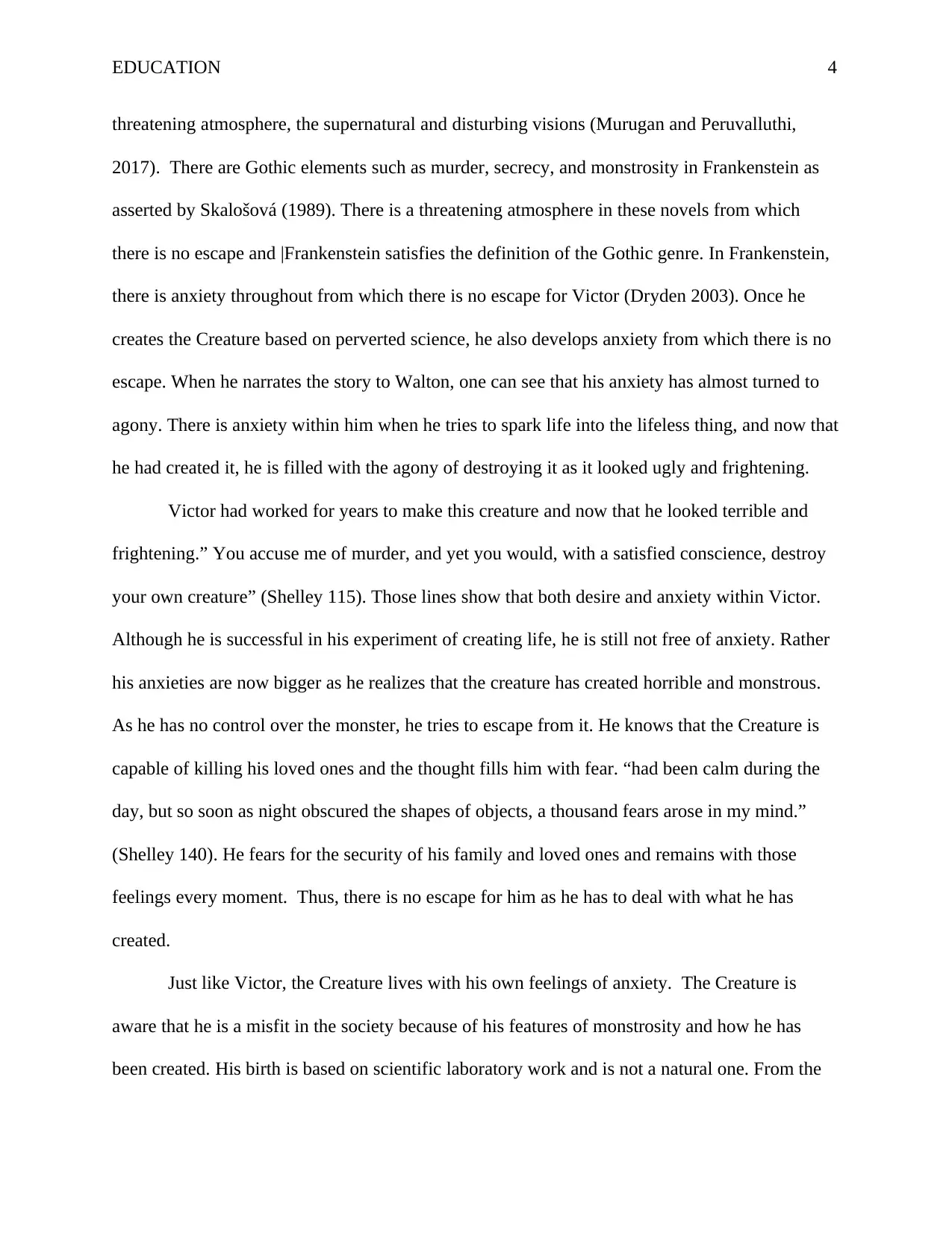
threatening atmosphere, the supernatural and disturbing visions (Murugan and Peruvalluthi,
2017). There are Gothic elements such as murder, secrecy, and monstrosity in Frankenstein as
asserted by Skalošová (1989). There is a threatening atmosphere in these novels from which
there is no escape and |Frankenstein satisfies the definition of the Gothic genre. In Frankenstein,
there is anxiety throughout from which there is no escape for Victor (Dryden 2003). Once he
creates the Creature based on perverted science, he also develops anxiety from which there is no
escape. When he narrates the story to Walton, one can see that his anxiety has almost turned to
agony. There is anxiety within him when he tries to spark life into the lifeless thing, and now that
he had created it, he is filled with the agony of destroying it as it looked ugly and frightening.
Victor had worked for years to make this creature and now that he looked terrible and
frightening.” You accuse me of murder, and yet you would, with a satisfied conscience, destroy
your own creature” (Shelley 115). Those lines show that both desire and anxiety within Victor.
Although he is successful in his experiment of creating life, he is still not free of anxiety. Rather
his anxieties are now bigger as he realizes that the creature has created horrible and monstrous.
As he has no control over the monster, he tries to escape from it. He knows that the Creature is
capable of killing his loved ones and the thought fills him with fear. “had been calm during the
day, but so soon as night obscured the shapes of objects, a thousand fears arose in my mind.”
(Shelley 140). He fears for the security of his family and loved ones and remains with those
feelings every moment. Thus, there is no escape for him as he has to deal with what he has
created.
Just like Victor, the Creature lives with his own feelings of anxiety. The Creature is
aware that he is a misfit in the society because of his features of monstrosity and how he has
been created. His birth is based on scientific laboratory work and is not a natural one. From the
threatening atmosphere, the supernatural and disturbing visions (Murugan and Peruvalluthi,
2017). There are Gothic elements such as murder, secrecy, and monstrosity in Frankenstein as
asserted by Skalošová (1989). There is a threatening atmosphere in these novels from which
there is no escape and |Frankenstein satisfies the definition of the Gothic genre. In Frankenstein,
there is anxiety throughout from which there is no escape for Victor (Dryden 2003). Once he
creates the Creature based on perverted science, he also develops anxiety from which there is no
escape. When he narrates the story to Walton, one can see that his anxiety has almost turned to
agony. There is anxiety within him when he tries to spark life into the lifeless thing, and now that
he had created it, he is filled with the agony of destroying it as it looked ugly and frightening.
Victor had worked for years to make this creature and now that he looked terrible and
frightening.” You accuse me of murder, and yet you would, with a satisfied conscience, destroy
your own creature” (Shelley 115). Those lines show that both desire and anxiety within Victor.
Although he is successful in his experiment of creating life, he is still not free of anxiety. Rather
his anxieties are now bigger as he realizes that the creature has created horrible and monstrous.
As he has no control over the monster, he tries to escape from it. He knows that the Creature is
capable of killing his loved ones and the thought fills him with fear. “had been calm during the
day, but so soon as night obscured the shapes of objects, a thousand fears arose in my mind.”
(Shelley 140). He fears for the security of his family and loved ones and remains with those
feelings every moment. Thus, there is no escape for him as he has to deal with what he has
created.
Just like Victor, the Creature lives with his own feelings of anxiety. The Creature is
aware that he is a misfit in the society because of his features of monstrosity and how he has
been created. His birth is based on scientific laboratory work and is not a natural one. From the
Paraphrase This Document
Need a fresh take? Get an instant paraphrase of this document with our AI Paraphraser

EDUCATION 5
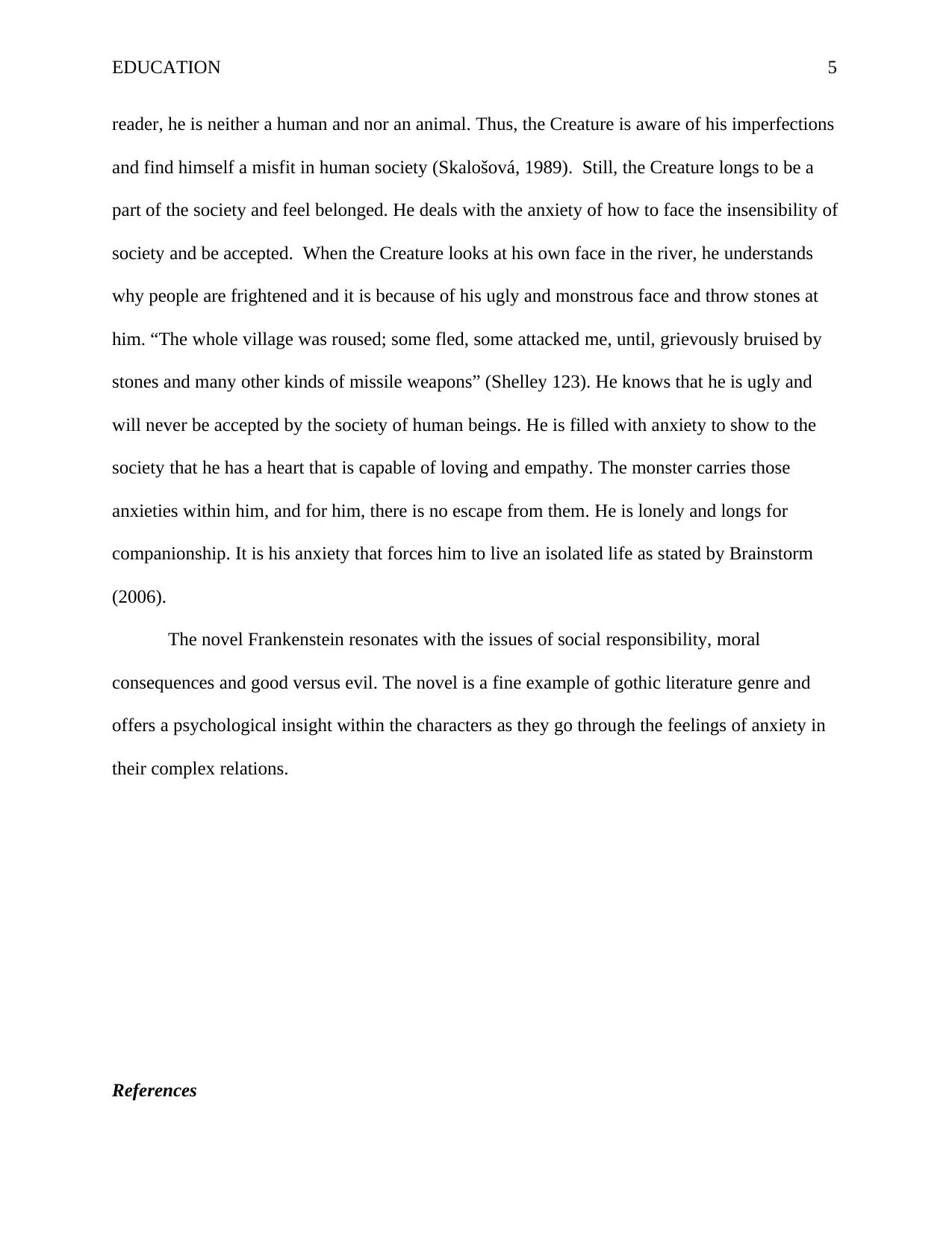
reader, he is neither a human and nor an animal. Thus, the Creature is aware of his imperfections
and find himself a misfit in human society (Skalošová, 1989). Still, the Creature longs to be a
part of the society and feel belonged. He deals with the anxiety of how to face the insensibility of
society and be accepted. When the Creature looks at his own face in the river, he understands
why people are frightened and it is because of his ugly and monstrous face and throw stones at
him. “The whole village was roused; some fled, some attacked me, until, grievously bruised by
stones and many other kinds of missile weapons” (Shelley 123). He knows that he is ugly and
will never be accepted by the society of human beings. He is filled with anxiety to show to the
society that he has a heart that is capable of loving and empathy. The monster carries those
anxieties within him, and for him, there is no escape from them. He is lonely and longs for
companionship. It is his anxiety that forces him to live an isolated life as stated by Brainstorm
(2006).
The novel Frankenstein resonates with the issues of social responsibility, moral
consequences and good versus evil. The novel is a fine example of gothic literature genre and
offers a psychological insight within the characters as they go through the feelings of anxiety in
their complex relations.
References
reader, he is neither a human and nor an animal. Thus, the Creature is aware of his imperfections
and find himself a misfit in human society (Skalošová, 1989). Still, the Creature longs to be a
part of the society and feel belonged. He deals with the anxiety of how to face the insensibility of
society and be accepted. When the Creature looks at his own face in the river, he understands
why people are frightened and it is because of his ugly and monstrous face and throw stones at
him. “The whole village was roused; some fled, some attacked me, until, grievously bruised by
stones and many other kinds of missile weapons” (Shelley 123). He knows that he is ugly and
will never be accepted by the society of human beings. He is filled with anxiety to show to the
society that he has a heart that is capable of loving and empathy. The monster carries those
anxieties within him, and for him, there is no escape from them. He is lonely and longs for
companionship. It is his anxiety that forces him to live an isolated life as stated by Brainstorm
(2006).
The novel Frankenstein resonates with the issues of social responsibility, moral
consequences and good versus evil. The novel is a fine example of gothic literature genre and
offers a psychological insight within the characters as they go through the feelings of anxiety in
their complex relations.
References

EDUCATION 6
Azcárate, A. L., & Saavedra, E. (2017). The metamorphosis of the myth of alchemy: Mary
Shelley’s frankenstein. Revista ICONO14 Revista Científica De Comunicación y
Tecnologías Emergentes, 15(1), 108-127.
Braanstorm, C. (2006). An analysis of the theme of alienation in Mary Shelley's Frankenstein.
Lulea university of Technology, 1(1), 1-24.
Dryden, L. (2003). The Modern Gothic and Literary Doubles: Stevenson." Oklahoma, 1(1), 1-
220.
Goulding, C. (2002). The Real Doctor Frankenstein? Journal of the Royal Society of Medicine
95(5), 257–259.
Murugan, R., and V. Peruvalluthi.( 2017 ).Postcolonial Gothic Hybrid in Arundhati Roy’s The
God of Small Things. Language in India,17(3), 149–157.
Skalošová, Ž. (1989). Monster and Monstrosity in Mary Shelley’s. Masaryk University,1 (1), 1-
60.
Shelley, M.S. (n.d.). Frankenstein. Free eBooks at Planet eBook.com, 1(1), 1–277
Azcárate, A. L., & Saavedra, E. (2017). The metamorphosis of the myth of alchemy: Mary
Shelley’s frankenstein. Revista ICONO14 Revista Científica De Comunicación y
Tecnologías Emergentes, 15(1), 108-127.
Braanstorm, C. (2006). An analysis of the theme of alienation in Mary Shelley's Frankenstein.
Lulea university of Technology, 1(1), 1-24.
Dryden, L. (2003). The Modern Gothic and Literary Doubles: Stevenson." Oklahoma, 1(1), 1-
220.
Goulding, C. (2002). The Real Doctor Frankenstein? Journal of the Royal Society of Medicine
95(5), 257–259.
Murugan, R., and V. Peruvalluthi.( 2017 ).Postcolonial Gothic Hybrid in Arundhati Roy’s The
God of Small Things. Language in India,17(3), 149–157.
Skalošová, Ž. (1989). Monster and Monstrosity in Mary Shelley’s. Masaryk University,1 (1), 1-
60.
Shelley, M.S. (n.d.). Frankenstein. Free eBooks at Planet eBook.com, 1(1), 1–277
⊘ This is a preview!⊘
Do you want full access?
Subscribe today to unlock all pages.

Trusted by 1+ million students worldwide
1 out of 6
Related Documents
Your All-in-One AI-Powered Toolkit for Academic Success.
+13062052269
info@desklib.com
Available 24*7 on WhatsApp / Email
Unlock your academic potential
Copyright © 2020–2025 A2Z Services. All Rights Reserved. Developed and managed by ZUCOL.