Report: Critical Analysis of Learning Design in Computer Education
VerifiedAdded on 2020/12/18
|15
|4691
|280
Report
AI Summary
This report presents a critical analysis of a learning design focused on computer education. The design incorporates a variety of assessment and pedagogical strategies to evaluate student learning, including pre-assessment tests, categorization of students based on their knowledge, and the use of accommodations for students with disabilities. It emphasizes meaningful performance assessments, portfolios, and a range of assessment tools like observation, tests, and running records. The design also highlights strategies such as providing test-taking tips, incorporating multiple intelligences, and utilizing various feedback mechanisms, like bubble answer sheets and point charts. The report justifies the design choices, emphasizing the importance of aligning assessment with student skills and knowledge levels. It aims to create an effective and structured educational environment.
Critical analysis of learning
design
design

Paraphrase This Document
Need a fresh take? Get an instant paraphrase of this document with our AI Paraphraser
TABLE OF CONTENTS
INTRODUCTION...........................................................................................................................1
PART 1............................................................................................................................................1
Evaluate, Select and Apply suitable assessment and other pedagogical strategies to ensure that
the assessment data is gathered is fair, reliable and valid......................................................1
PART 2............................................................................................................................................5
Justification of the design choices..........................................................................................5
CONCLUSION..............................................................................................................................10
REFERENCES..............................................................................................................................11
INTRODUCTION...........................................................................................................................1
PART 1............................................................................................................................................1
Evaluate, Select and Apply suitable assessment and other pedagogical strategies to ensure that
the assessment data is gathered is fair, reliable and valid......................................................1
PART 2............................................................................................................................................5
Justification of the design choices..........................................................................................5
CONCLUSION..............................................................................................................................10
REFERENCES..............................................................................................................................11
INTRODUCTION
The learning design refers to a process of designing the way of educating a student. It
includes the preparation of a description of each activity to be performed including
communication process, creation of learning environment, performance of educational activities,
etc. the present study shows a brief description of whole design of an assessment activity to be
performed by the teacher to make the students understand of various topics. It also shows a
description as to justify the design made earlier to be followed by the teacher. It shows a critical
analysis of the each activity set in the design of the learning process for the purpose of providing
a justification of the designed learning process.
PART 1
Evaluate, Select and Apply suitable assessment and other pedagogical strategies to ensure that
the assessment data is gathered is fair, reliable and valid.
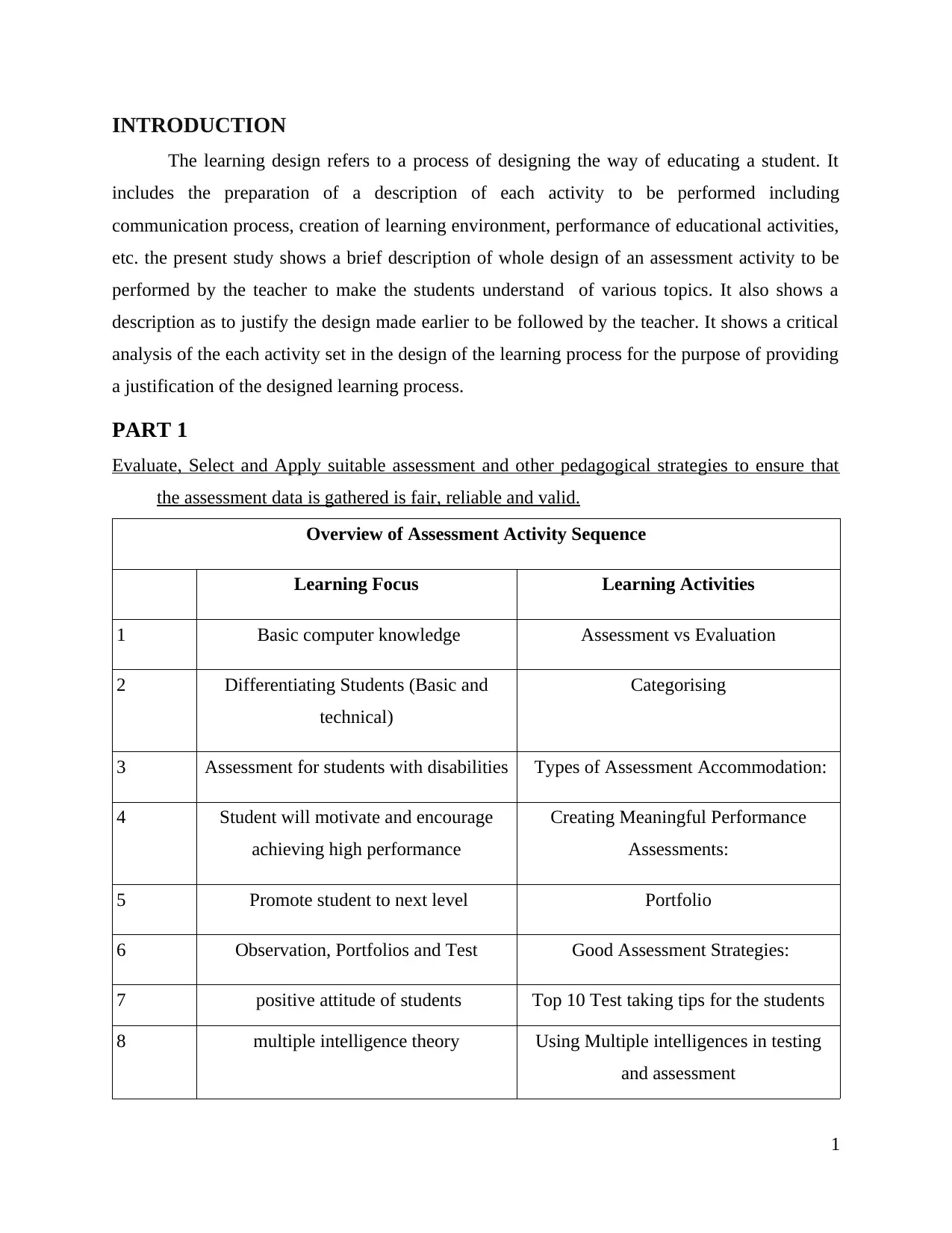
Overview of Assessment Activity Sequence
Learning Focus Learning Activities
1 Basic computer knowledge Assessment vs Evaluation
2 Differentiating Students (Basic and
technical)
Categorising
3 Assessment for students with disabilities Types of Assessment Accommodation:
4 Student will motivate and encourage
achieving high performance
Creating Meaningful Performance
Assessments:
5 Promote student to next level Portfolio
6 Observation, Portfolios and Test Good Assessment Strategies:
7 positive attitude of students Top 10 Test taking tips for the students
8 multiple intelligence theory Using Multiple intelligences in testing
and assessment
1
The learning design refers to a process of designing the way of educating a student. It
includes the preparation of a description of each activity to be performed including
communication process, creation of learning environment, performance of educational activities,
etc. the present study shows a brief description of whole design of an assessment activity to be
performed by the teacher to make the students understand of various topics. It also shows a
description as to justify the design made earlier to be followed by the teacher. It shows a critical
analysis of the each activity set in the design of the learning process for the purpose of providing
a justification of the designed learning process.
PART 1
Evaluate, Select and Apply suitable assessment and other pedagogical strategies to ensure that
the assessment data is gathered is fair, reliable and valid.
Overview of Assessment Activity Sequence
Learning Focus Learning Activities
1 Basic computer knowledge Assessment vs Evaluation
2 Differentiating Students (Basic and
technical)
Categorising
3 Assessment for students with disabilities Types of Assessment Accommodation:
4 Student will motivate and encourage
achieving high performance
Creating Meaningful Performance
Assessments:
5 Promote student to next level Portfolio
6 Observation, Portfolios and Test Good Assessment Strategies:
7 positive attitude of students Top 10 Test taking tips for the students
8 multiple intelligence theory Using Multiple intelligences in testing
and assessment
1
⊘ This is a preview!⊘
Do you want full access?
Subscribe today to unlock all pages.

Trusted by 1+ million students worldwide
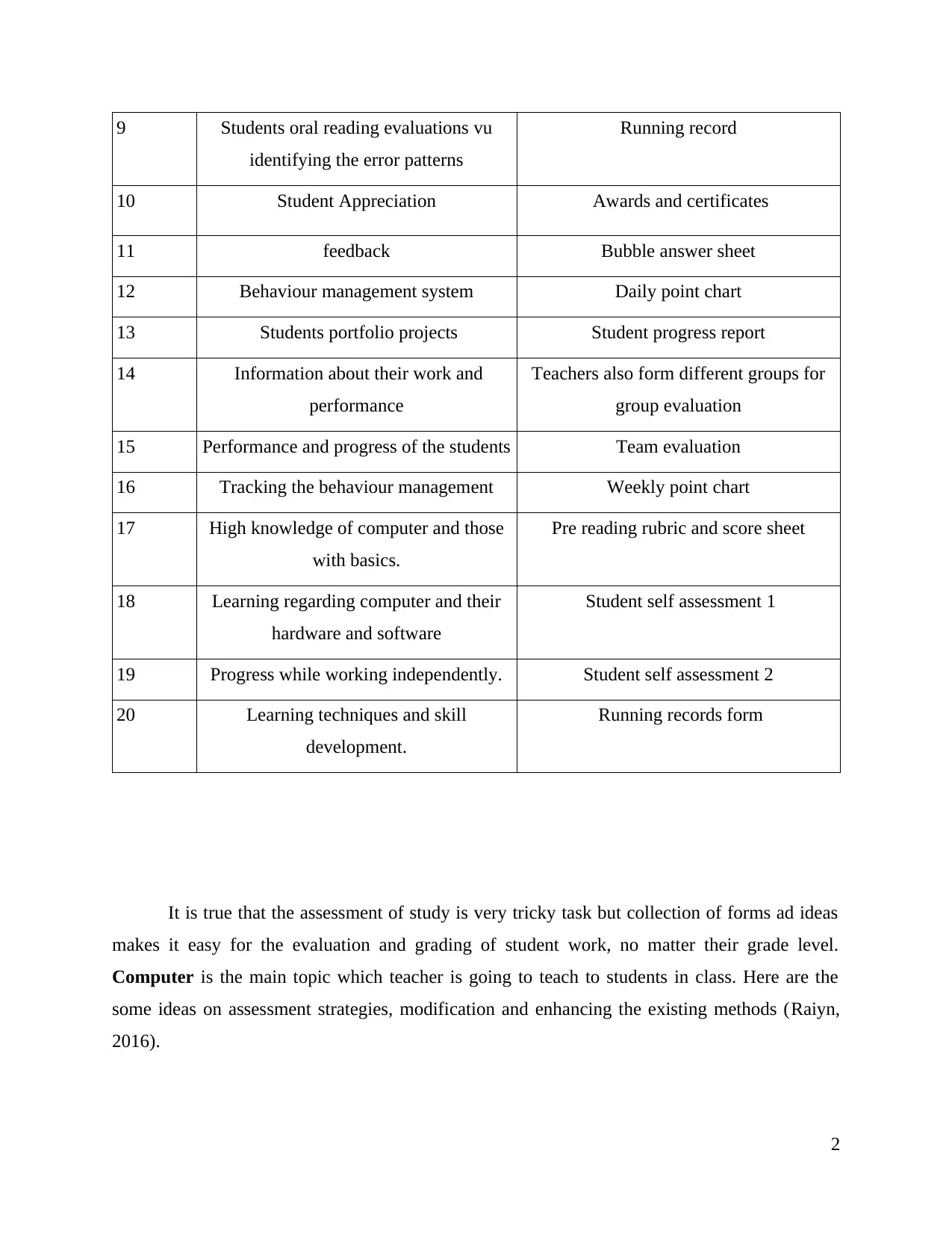
9 Students oral reading evaluations vu
identifying the error patterns
Running record
10 Student Appreciation Awards and certificates
11 feedback Bubble answer sheet
12 Behaviour management system Daily point chart
13 Students portfolio projects Student progress report
14 Information about their work and
performance
Teachers also form different groups for
group evaluation
15 Performance and progress of the students Team evaluation
16 Tracking the behaviour management Weekly point chart
17 High knowledge of computer and those
with basics.
Pre reading rubric and score sheet
18 Learning regarding computer and their
hardware and software
Student self assessment 1
19 Progress while working independently. Student self assessment 2
20 Learning techniques and skill
development.
Running records form
It is true that the assessment of study is very tricky task but collection of forms ad ideas
makes it easy for the evaluation and grading of student work, no matter their grade level.
Computer is the main topic which teacher is going to teach to students in class. Here are the
some ideas on assessment strategies, modification and enhancing the existing methods (Raiyn,
2016).
2
identifying the error patterns
Running record
10 Student Appreciation Awards and certificates
11 feedback Bubble answer sheet
12 Behaviour management system Daily point chart
13 Students portfolio projects Student progress report
14 Information about their work and
performance
Teachers also form different groups for
group evaluation
15 Performance and progress of the students Team evaluation
16 Tracking the behaviour management Weekly point chart
17 High knowledge of computer and those
with basics.
Pre reading rubric and score sheet
18 Learning regarding computer and their
hardware and software
Student self assessment 1
19 Progress while working independently. Student self assessment 2
20 Learning techniques and skill
development.
Running records form
It is true that the assessment of study is very tricky task but collection of forms ad ideas
makes it easy for the evaluation and grading of student work, no matter their grade level.
Computer is the main topic which teacher is going to teach to students in class. Here are the
some ideas on assessment strategies, modification and enhancing the existing methods (Raiyn,
2016).
2
Paraphrase This Document
Need a fresh take? Get an instant paraphrase of this document with our AI Paraphraser
Step 1: Assessment vs Evaluation: This is the first step which teacher will do before
starting the subject to teach. Teacher will conduct test for basic computer knowledge so that
teacher can understand the level of knowledge student have. After taking test, each student will
be given score on the basis of there knowledge (Csernoch, 2017). However, assessment and
evaluation is a continuous and ongoing process as it starts and continues till end. It is because it
polishes the knowledge and skills of students.
Step 2: Categorising: Once the evaluation and assessment process is over, teacher starts
categorising the students on the basis of their knowledge. There are two main categories in this
subject which are Basic knowledge of computer and Technical Knowledge. Students who needs
basic knowledge of computer will be teacher separately from other student. On the other hand,
students who have more knowledge and understanding of technical knowledge will be teach
separately (Pollock, 2015). So that, teacher can reveal talented students from the group. Another
benefit of categorising is that it does not waste the time of student and teacher both. Student who
have basic knowledge will acquire training and teaching of technical subjects like website
designing, software testing and others. On the other hand, students who are do not know the
basic knowledge of computer will get the basic knowledge and understanding of computer.
Step 3: Types of Assessment Accommodation: This is next step when teacher starts
selecting the types of assessment accommodation for students. Accommodations are the tools
and process which provides equal access to instruction and assessment for students with
disabilities (Newman, 2017). They are provided to level of playing field as it is fact that without
accommodation, disable student might nit able to accesses grade level instruction as well as
participate fully in assessments.
Step 4: Creating Meaningful Performance Assessments: This is one of the most
important step that teacher needs to consider it is because by this step it becomes clear to
understand the abilities and progress of students. It is very important that there must be clear
evaluation of the performance so that teacher could take actions accordingly. There are various
way's teacher could use like responses of students in class, direct observation, by taking test both
written and viva (Ceylan and Ozdilek, 2015). The meaningful assessment of performance is that
the student will motivate and encourage achieving high performance in the class. In addition to
3
starting the subject to teach. Teacher will conduct test for basic computer knowledge so that
teacher can understand the level of knowledge student have. After taking test, each student will
be given score on the basis of there knowledge (Csernoch, 2017). However, assessment and
evaluation is a continuous and ongoing process as it starts and continues till end. It is because it
polishes the knowledge and skills of students.
Step 2: Categorising: Once the evaluation and assessment process is over, teacher starts
categorising the students on the basis of their knowledge. There are two main categories in this
subject which are Basic knowledge of computer and Technical Knowledge. Students who needs
basic knowledge of computer will be teacher separately from other student. On the other hand,
students who have more knowledge and understanding of technical knowledge will be teach
separately (Pollock, 2015). So that, teacher can reveal talented students from the group. Another
benefit of categorising is that it does not waste the time of student and teacher both. Student who
have basic knowledge will acquire training and teaching of technical subjects like website
designing, software testing and others. On the other hand, students who are do not know the
basic knowledge of computer will get the basic knowledge and understanding of computer.
Step 3: Types of Assessment Accommodation: This is next step when teacher starts
selecting the types of assessment accommodation for students. Accommodations are the tools
and process which provides equal access to instruction and assessment for students with
disabilities (Newman, 2017). They are provided to level of playing field as it is fact that without
accommodation, disable student might nit able to accesses grade level instruction as well as
participate fully in assessments.
Step 4: Creating Meaningful Performance Assessments: This is one of the most
important step that teacher needs to consider it is because by this step it becomes clear to
understand the abilities and progress of students. It is very important that there must be clear
evaluation of the performance so that teacher could take actions accordingly. There are various
way's teacher could use like responses of students in class, direct observation, by taking test both
written and viva (Ceylan and Ozdilek, 2015). The meaningful assessment of performance is that
the student will motivate and encourage achieving high performance in the class. In addition to
3
this, with the assessment of performance, teacher could identify the future performance of the
student which is also one the best advantage of this step.
Step 5: Portfolio: After performing various assessment of performance of student,
different data will gather which help teacher to build portfolio of the students. It is one of the
great mode of assessment for the classroom (Bowness and et.al., 2017). It becomes easy and
effective for teacher to promote student to next level by making portfolio of student.
Step 6: Good Assessment Strategies: The word testing and assessment are often enough
to send goose bumps up in the arms of students and teachers. Teacher will include few
assessment strategies that help student through the anxious moment as well as assist them to
scope higher.
Assessment Tool Basic Description Examples
Observation Teacher will observe the
performance of student during
there activities in lab.
Oral reports
Debates
Science experiments
Projects
Portfolios Student will revise and refine
there work before selecting to
save it in portfolios (Bhagat
and Chang, 2015).
Art Collections
Writing Folders
Test Basically testing has time
limit.
Open book test
practical test
Quarterly test
Annual test
Step-9 Top 10 Test taking tips for the students
4
student which is also one the best advantage of this step.
Step 5: Portfolio: After performing various assessment of performance of student,
different data will gather which help teacher to build portfolio of the students. It is one of the
great mode of assessment for the classroom (Bowness and et.al., 2017). It becomes easy and
effective for teacher to promote student to next level by making portfolio of student.
Step 6: Good Assessment Strategies: The word testing and assessment are often enough
to send goose bumps up in the arms of students and teachers. Teacher will include few
assessment strategies that help student through the anxious moment as well as assist them to
scope higher.
Assessment Tool Basic Description Examples
Observation Teacher will observe the
performance of student during
there activities in lab.
Oral reports
Debates
Science experiments
Projects
Portfolios Student will revise and refine
there work before selecting to
save it in portfolios (Bhagat
and Chang, 2015).
Art Collections
Writing Folders
Test Basically testing has time
limit.
Open book test
practical test
Quarterly test
Annual test
Step-9 Top 10 Test taking tips for the students
4
⊘ This is a preview!⊘
Do you want full access?
Subscribe today to unlock all pages.
Trusted by 1+ million students worldwide
This resource will help students to perform at their best level sand also a chance to
improve their skills during testing situations. This also includes strategies having positive
attitude, how to manage their time, reviewing the answer and more other helpful hints. The
teachers can provide the test series through which students will able to develop the positive
attitude say thee are provided with the giant and tough puzzle which might be complicated to
solve but attitude of compulsory and efficiently doing it creates the positive attitude which will
help in further growth and success of the students as well. Some steps involved in this stage
which helps students in all way. The steps include having positive attitude, making a plan
strategy. The might before the exams students are required to haver a quick review of what is
going to come as their brain and body needs to sleep to function well and efficiently, morning up
the tests by quick revision. The another step includes the test time where the student are required
to keep their mind active. Managing time is another important step which is must and entail for
students to complete the test on time. Instead of sticking to one question students need to skip
that and should move forward to the next questions of the tests. Multiple choice questions are the
questions, neatness count and lastly completely doe with the test are some steps which are
required to understand and effectively and efficiently followed y the students so that they can
complete the test and learn some skills and also a chance to how their knowledge and experience
to their teachers.
Step-10 using Multiple intelligences in testing and assessment
Teachers need to use the multiple intelligence theory to assess the students with different
and innovative style of learning and varied academic strengths. As this theory shapes the way of
the students to understand, processes and use the malformation in the most effective and efficient
way. Multiple intelligence theories include mathematical, visual, kinaesthetic, linguistic,
interpersonal, intra personal, naturalist that is different intelligence techniques which helps in
overall growth of the student instead of restricting to the one area or one field.
Step- 11 Running record
This is generally performed to evaluate the students oral reading evaluations vu
identifying the error patterns which also help in tracking the students oral reading accuracy so
that they can understand and can effectively communicate what they have learnt.
Step- 12 Awards and certificates
5
improve their skills during testing situations. This also includes strategies having positive
attitude, how to manage their time, reviewing the answer and more other helpful hints. The
teachers can provide the test series through which students will able to develop the positive
attitude say thee are provided with the giant and tough puzzle which might be complicated to
solve but attitude of compulsory and efficiently doing it creates the positive attitude which will
help in further growth and success of the students as well. Some steps involved in this stage
which helps students in all way. The steps include having positive attitude, making a plan
strategy. The might before the exams students are required to haver a quick review of what is
going to come as their brain and body needs to sleep to function well and efficiently, morning up
the tests by quick revision. The another step includes the test time where the student are required
to keep their mind active. Managing time is another important step which is must and entail for
students to complete the test on time. Instead of sticking to one question students need to skip
that and should move forward to the next questions of the tests. Multiple choice questions are the
questions, neatness count and lastly completely doe with the test are some steps which are
required to understand and effectively and efficiently followed y the students so that they can
complete the test and learn some skills and also a chance to how their knowledge and experience
to their teachers.
Step-10 using Multiple intelligences in testing and assessment
Teachers need to use the multiple intelligence theory to assess the students with different
and innovative style of learning and varied academic strengths. As this theory shapes the way of
the students to understand, processes and use the malformation in the most effective and efficient
way. Multiple intelligence theories include mathematical, visual, kinaesthetic, linguistic,
interpersonal, intra personal, naturalist that is different intelligence techniques which helps in
overall growth of the student instead of restricting to the one area or one field.
Step- 11 Running record
This is generally performed to evaluate the students oral reading evaluations vu
identifying the error patterns which also help in tracking the students oral reading accuracy so
that they can understand and can effectively communicate what they have learnt.
Step- 12 Awards and certificates
5
Paraphrase This Document
Need a fresh take? Get an instant paraphrase of this document with our AI Paraphraser
Teachers can use the awards and certificates for the students to appreciate their efforts
and progress of the student which also helps them in motivating them.
Step- 13 Bubble answer sheets
For assessing the understanding regarding the computer knowledge given to the student
can be assessed by tool of bubble answer sheet through which they can fill in the answers and
can give feedback.
Step-14 Daily point chart
Using of the point chart will help the teachers in tracking different type of behaviour
management system.
Step-15 Student progress report
Using of this printable report will help to ascertain the progress of the students portfolio
projects
Step- 16 student progress self evaluation
With the help of class work lets students evaluate their own performance by filling the
comments This is very effective and efficient tool to encourage the students and their
performances.
Step-17 Teachers also form different groups for group evaluation
with the help of the group activity students participation and productivity can be
evaluated and is a good place through which students can be informed about their work and
performance they doing
Step-18Team evaluation
evaluating students progress within a team is also a tool for evaluating the performance
and progress of the students
Step-19 Weekly point chart
Total point of the four weeks for tracking the behaviour management towards learning the
computer in this chart.
Step-20 Pre reading rubric and score sheet
Using the rubric and scoring sheet so to grade the students after completion of pre
learning session plan. Grading is done on the basis of the students with high knowledge of
computer and those with basics.
Step -21 student self assessment 1
6
and progress of the student which also helps them in motivating them.
Step- 13 Bubble answer sheets
For assessing the understanding regarding the computer knowledge given to the student
can be assessed by tool of bubble answer sheet through which they can fill in the answers and
can give feedback.
Step-14 Daily point chart
Using of the point chart will help the teachers in tracking different type of behaviour
management system.
Step-15 Student progress report
Using of this printable report will help to ascertain the progress of the students portfolio
projects
Step- 16 student progress self evaluation
With the help of class work lets students evaluate their own performance by filling the
comments This is very effective and efficient tool to encourage the students and their
performances.
Step-17 Teachers also form different groups for group evaluation
with the help of the group activity students participation and productivity can be
evaluated and is a good place through which students can be informed about their work and
performance they doing
Step-18Team evaluation
evaluating students progress within a team is also a tool for evaluating the performance
and progress of the students
Step-19 Weekly point chart
Total point of the four weeks for tracking the behaviour management towards learning the
computer in this chart.
Step-20 Pre reading rubric and score sheet
Using the rubric and scoring sheet so to grade the students after completion of pre
learning session plan. Grading is done on the basis of the students with high knowledge of
computer and those with basics.
Step -21 student self assessment 1
6
this assessment sheet leads the student asked about what they have learned regarding the
computer and their hardware and software,
Step- 22 Student self assessment 2
With the help of the questions and checklist student assessment can be done in context to their
progress while working independently.
Step-23 Running records form
Using the blank running records for the assessment of individual students learning skills and
their progress in particular field of computer which helps in further decisions regarding the
students learning techniques and skill development.
PART 2
Justification of the design choices
Suitable assessment refers to a design of the assessment as per the skills, knowledge and
absorption level of the students. Further, the pedagogical scenario can be defined as the script
developed for the purpose of designing effective educational structured design. \
In the present study, computer education has been decided to be provided to the students.
For the purpose of providing effective computer eduction to the learners and make them
understand each point described by the teacher, an effective eduction learning structure has been
designed. The set structure can be termed as an effective structure due to the following reasons:
Encouraging contact among students and teacher: It is the basic principle of the
structure design. In this stage, teacher interacts with students and ask them to give their own
introduction. it leads in knowing each student's name and enhancing interaction with them as
well. Further, this process can also be done through taking class in which basic knowledge of
about the computer would be provided.
the teacher will provide a basic information about the computers. This stage will be
performed by the teacher as to check the knowledge level of the students. It helps the teacher in
observing each student's behaviour in the class and their interest in the subject as well. With the
help of this stage, the teacher can also evaluate the skill level of the students.
On the other hand, this stage may be failed as a specific student can have a good basic
knowledge about the computer, but not have interest in the subject as well. In this regard, the
observation of the teacher may get fail at this time.
7
computer and their hardware and software,
Step- 22 Student self assessment 2
With the help of the questions and checklist student assessment can be done in context to their
progress while working independently.
Step-23 Running records form
Using the blank running records for the assessment of individual students learning skills and
their progress in particular field of computer which helps in further decisions regarding the
students learning techniques and skill development.
PART 2
Justification of the design choices
Suitable assessment refers to a design of the assessment as per the skills, knowledge and
absorption level of the students. Further, the pedagogical scenario can be defined as the script
developed for the purpose of designing effective educational structured design. \
In the present study, computer education has been decided to be provided to the students.
For the purpose of providing effective computer eduction to the learners and make them
understand each point described by the teacher, an effective eduction learning structure has been
designed. The set structure can be termed as an effective structure due to the following reasons:
Encouraging contact among students and teacher: It is the basic principle of the
structure design. In this stage, teacher interacts with students and ask them to give their own
introduction. it leads in knowing each student's name and enhancing interaction with them as
well. Further, this process can also be done through taking class in which basic knowledge of
about the computer would be provided.
the teacher will provide a basic information about the computers. This stage will be
performed by the teacher as to check the knowledge level of the students. It helps the teacher in
observing each student's behaviour in the class and their interest in the subject as well. With the
help of this stage, the teacher can also evaluate the skill level of the students.
On the other hand, this stage may be failed as a specific student can have a good basic
knowledge about the computer, but not have interest in the subject as well. In this regard, the
observation of the teacher may get fail at this time.
7
⊘ This is a preview!⊘
Do you want full access?
Subscribe today to unlock all pages.
Trusted by 1+ million students worldwide
Readiness: The readiness provides information about the concentration and grasping
power of students. This observation of each student, makes the teacher to categories each
student. Categorising the students can help the tether in deciding what type of education process
need to be performed while educating the student. Further, this stage can also help the teacher in
deciding the level of information, teacher needs to provide to students.
For example, in case, students do not have a basic computer knowledge, the teacher will
need to start educating the students from the basics of computer knowledge. On the other hand,
if teacher observes that students have enough knowledge of the basics, the learning program can
be started from the technical level instead of the basic level.
In this regard, this stage helps in enhancing the effectiveness in the way of providing
information to students and make them understand and grasp each information provided.
Auditing and tactile primacy: As per this principle, the teacher needs to check level of
students by auditing their behaviour, skills and knowledge level. According to it the teacher can
provide the most useful accommodation to each student. The accommodation refers to the
supportive learning tools that can help the students in understanding the knowledge provided by
the teachers. For the purpose of effectively transferring the information, teacher needs to prepare
the assessments as per the skills and knowledge level of the students analysed earlier.
It helps the students in having a better understanding over the computer knowledge.
Although, as the basic level of the learning design may provide negative information to the
teacher about the level of students, the teacher may prepare the assessment of wrong level. That
may fail to make each learners understand the information provided.
Further, each student may have a different level of skill, knowledge and grasping power
as well. It is difficult to prepare assessment for each type of student. In this regard, a teacher may
fail at this stage, due to the wrong observation.
Responsive environment, short sessions: According to this principle, a responsive
environment in the class. the teacher should create such kind of environment in which students
could be able to give quick response and feedback. It can be achieved by providing the most
effective assessment to students. As just preparing an assessment for the student can never be
enough make them understand. In this regard, a further stage has also been designed in which the
teacher will analyse the knowledge of the student by analysing their own performance in the
8
power of students. This observation of each student, makes the teacher to categories each
student. Categorising the students can help the tether in deciding what type of education process
need to be performed while educating the student. Further, this stage can also help the teacher in
deciding the level of information, teacher needs to provide to students.
For example, in case, students do not have a basic computer knowledge, the teacher will
need to start educating the students from the basics of computer knowledge. On the other hand,
if teacher observes that students have enough knowledge of the basics, the learning program can
be started from the technical level instead of the basic level.
In this regard, this stage helps in enhancing the effectiveness in the way of providing
information to students and make them understand and grasp each information provided.
Auditing and tactile primacy: As per this principle, the teacher needs to check level of
students by auditing their behaviour, skills and knowledge level. According to it the teacher can
provide the most useful accommodation to each student. The accommodation refers to the
supportive learning tools that can help the students in understanding the knowledge provided by
the teachers. For the purpose of effectively transferring the information, teacher needs to prepare
the assessments as per the skills and knowledge level of the students analysed earlier.
It helps the students in having a better understanding over the computer knowledge.
Although, as the basic level of the learning design may provide negative information to the
teacher about the level of students, the teacher may prepare the assessment of wrong level. That
may fail to make each learners understand the information provided.
Further, each student may have a different level of skill, knowledge and grasping power
as well. It is difficult to prepare assessment for each type of student. In this regard, a teacher may
fail at this stage, due to the wrong observation.
Responsive environment, short sessions: According to this principle, a responsive
environment in the class. the teacher should create such kind of environment in which students
could be able to give quick response and feedback. It can be achieved by providing the most
effective assessment to students. As just preparing an assessment for the student can never be
enough make them understand. In this regard, a further stage has also been designed in which the
teacher will analyse the knowledge of the student by analysing their own performance in the
8
Paraphrase This Document
Need a fresh take? Get an instant paraphrase of this document with our AI Paraphraser
class. help the students in analysing the assessments. It can be determined as the most important
stage of the learning design.
This stage will help the students in gaining the actual meaning of the assessment prepared
by the teacher. It enhances the evaluation ability of the students. Further, it also helps in
analysing the actual ability of the teacher. Moreover, as far as stages of the learning stage are
also depends upon this stage of the design.
Bubble answer sheets has been designed for the purpose of taking better assessment of
the students. This design of the assessment enhances the effectiveness of assessment. Further, it
also reduces the burden of teacher to check the feedbacks of students over the assessments.
On the other hand, taking assessment through bubble design does not enhance the time
management ability of the students. Further, it also results in reducing the answer reviewing
ability of the students.
Encourage active learning: This principle says that teacher should provide effective
learning to each student as to encourage them to learn more actively. It can be achieved through
making and understand the progress of the student in their skill and knowledge, it is based on the
analysis of the performance assessment. This stage has been designed to take the test of students
through various ways like, debates, oral reports, written reports, art collections, open book test,
etc.
The teacher needs to select the best way of taking the assessments. They can choose any
one or two or more ways for this purpose. Although, this stage can also provide negative results
to the teacher in case of failure of selecting the most appropriate way of checking the
performance progress and preparing portfolios.
Emphasizing time on task: For achieving this principle, the Test taking part of the
learning design is can be an important part. It helps the students in enhancing their skills and
knowledge. As per the analysis, this stage also make the students becoming able to understand
the management of time, and analyse the questions as well. It enhances the skill of the students
in understanding the questions and reviewing the appropriate solution on their own. It makes the
mind of students more active to have a quick revision of each content taught in the class.
In this regard, this stage helps in enhancing the self understanding ability of the studenst.
Although at this stage, with the view to show the higher performance the students, may learn
9
stage of the learning design.
This stage will help the students in gaining the actual meaning of the assessment prepared
by the teacher. It enhances the evaluation ability of the students. Further, it also helps in
analysing the actual ability of the teacher. Moreover, as far as stages of the learning stage are
also depends upon this stage of the design.
Bubble answer sheets has been designed for the purpose of taking better assessment of
the students. This design of the assessment enhances the effectiveness of assessment. Further, it
also reduces the burden of teacher to check the feedbacks of students over the assessments.
On the other hand, taking assessment through bubble design does not enhance the time
management ability of the students. Further, it also results in reducing the answer reviewing
ability of the students.
Encourage active learning: This principle says that teacher should provide effective
learning to each student as to encourage them to learn more actively. It can be achieved through
making and understand the progress of the student in their skill and knowledge, it is based on the
analysis of the performance assessment. This stage has been designed to take the test of students
through various ways like, debates, oral reports, written reports, art collections, open book test,
etc.
The teacher needs to select the best way of taking the assessments. They can choose any
one or two or more ways for this purpose. Although, this stage can also provide negative results
to the teacher in case of failure of selecting the most appropriate way of checking the
performance progress and preparing portfolios.
Emphasizing time on task: For achieving this principle, the Test taking part of the
learning design is can be an important part. It helps the students in enhancing their skills and
knowledge. As per the analysis, this stage also make the students becoming able to understand
the management of time, and analyse the questions as well. It enhances the skill of the students
in understanding the questions and reviewing the appropriate solution on their own. It makes the
mind of students more active to have a quick revision of each content taught in the class.
In this regard, this stage helps in enhancing the self understanding ability of the studenst.
Although at this stage, with the view to show the higher performance the students, may learn
9
some bad habits like doing cheating, finding different ways to ask the questions to their class
fellows, etc.
Diverse the talent and ways of learning: Each student have different talent and learning
skills. for the purpose of make each of them learning effectively, a diversified learning
techniques can be used. In this design, the teacher will analyse develop different ways to make
the students understand and grasp each information provided as to enhance their skills and
knowledge about the computers. \
In this design, the teacher has decided to adopt the multiple intelligence theory. In this
design, teacher is going to use several ways like visual learning, linguistic leaning, mathematical
learning, etc. Type of way of providing education will be depend upon to topic to be taught, and
the observation level of students. In this regard, it will help the teacher in enhancing the
effectiveness in the learning system.
Although, teacher may fail to make students understand clearly, in case of failing in
choosing the method of multiple intelligence. It would result in reducing the understanding level
of students and enhancing the confusion about the topic taught through the specific methodology.
Awards and certificates: This stage has been designed to make the students self
motivated to learn about each topic taught in the class. At this stage, it has been decided to
provide the students award and certificates for their performance. The performance will be
observed at the testing level of the learning design.
This stage will make each student to have a regular revision of the each part of the
computer knowledge so that they could perform their best in the testing stage and gain the
awards and certificates.
Although, this stage may result in developing chaos in the class and enhance the lack of
coordination among the students. Each student would want not to help their follows due to the
competition of gaining the awards. In this order, this stage may result in reducing the helping
nature of the students.
Involvement of Emotional development: Developing the emotional intelligence in the
students is equally important. A daily chart can be used for achieving this principle. This system
has been designed to review the behaviours of the students. As development of effective and
good behaviour is also a major part of developing the skill and knowledge level of the students
along with providing them information about the latest technology of the computers,
10
fellows, etc.
Diverse the talent and ways of learning: Each student have different talent and learning
skills. for the purpose of make each of them learning effectively, a diversified learning
techniques can be used. In this design, the teacher will analyse develop different ways to make
the students understand and grasp each information provided as to enhance their skills and
knowledge about the computers. \
In this design, the teacher has decided to adopt the multiple intelligence theory. In this
design, teacher is going to use several ways like visual learning, linguistic leaning, mathematical
learning, etc. Type of way of providing education will be depend upon to topic to be taught, and
the observation level of students. In this regard, it will help the teacher in enhancing the
effectiveness in the learning system.
Although, teacher may fail to make students understand clearly, in case of failing in
choosing the method of multiple intelligence. It would result in reducing the understanding level
of students and enhancing the confusion about the topic taught through the specific methodology.
Awards and certificates: This stage has been designed to make the students self
motivated to learn about each topic taught in the class. At this stage, it has been decided to
provide the students award and certificates for their performance. The performance will be
observed at the testing level of the learning design.
This stage will make each student to have a regular revision of the each part of the
computer knowledge so that they could perform their best in the testing stage and gain the
awards and certificates.
Although, this stage may result in developing chaos in the class and enhance the lack of
coordination among the students. Each student would want not to help their follows due to the
competition of gaining the awards. In this order, this stage may result in reducing the helping
nature of the students.
Involvement of Emotional development: Developing the emotional intelligence in the
students is equally important. A daily chart can be used for achieving this principle. This system
has been designed to review the behaviours of the students. As development of effective and
good behaviour is also a major part of developing the skill and knowledge level of the students
along with providing them information about the latest technology of the computers,
10
⊘ This is a preview!⊘
Do you want full access?
Subscribe today to unlock all pages.
Trusted by 1+ million students worldwide

1 out of 15


Related Documents


Your All-in-One AI-Powered Toolkit for Academic Success.
+13062052269
info@desklib.com
Available 24*7 on WhatsApp / Email
![[object Object]](/_next/static/media/star-bottom.7253800d.svg)
Unlock your academic potential
Copyright © 2020–2026 A2Z Services. All Rights Reserved. Developed and managed by ZUCOL.