Critical Review of Leisure Assessment: Report Analysis

Verified

Added on  2023/06/09

|8
|1337
|405
Report
AI Summary
This report presents a critical review of a leisure assessment, specifically using the Leisure Satisfaction Measure (LSM). The assessment was conducted on a volunteer to evaluate their satisfaction with leisure activities across psychological, educational, social, relaxation, physiological, and aesthetic dimensions. The report details the assessment process, including the administration of the LSM, scoring, and interpretation of results. The findings indicate varying levels of satisfaction across different subscales, with the volunteer expressing lower satisfaction in psychological aspects. Based on the assessment, specific goals and objectives are proposed to enhance the volunteer's leisure satisfaction, focusing on activities that promote enjoyment, intellectual challenge, physical well-being, and aesthetic experiences. The report also evaluates the LSM's ease of use, value as an assessment tool, and potential problems, while also considering its applicability to different client groups. The conclusion emphasizes the LSM's utility in understanding and improving individual leisure satisfaction, highlighting the importance of activities that provide intellectual stimulation, stress relief, and aesthetic pleasure.
Document Page
Running head: LEISURE ASSESSMENT
Leisure Assessment
Name of the student
Name of the university
Author note
tabler-icon-diamond-filled.svg

Paraphrase This Document

Need a fresh take? Get an instant paraphrase of this document with our AI Paraphraser
Document Page
1LEISURE ASSESSMENT
Executive summary
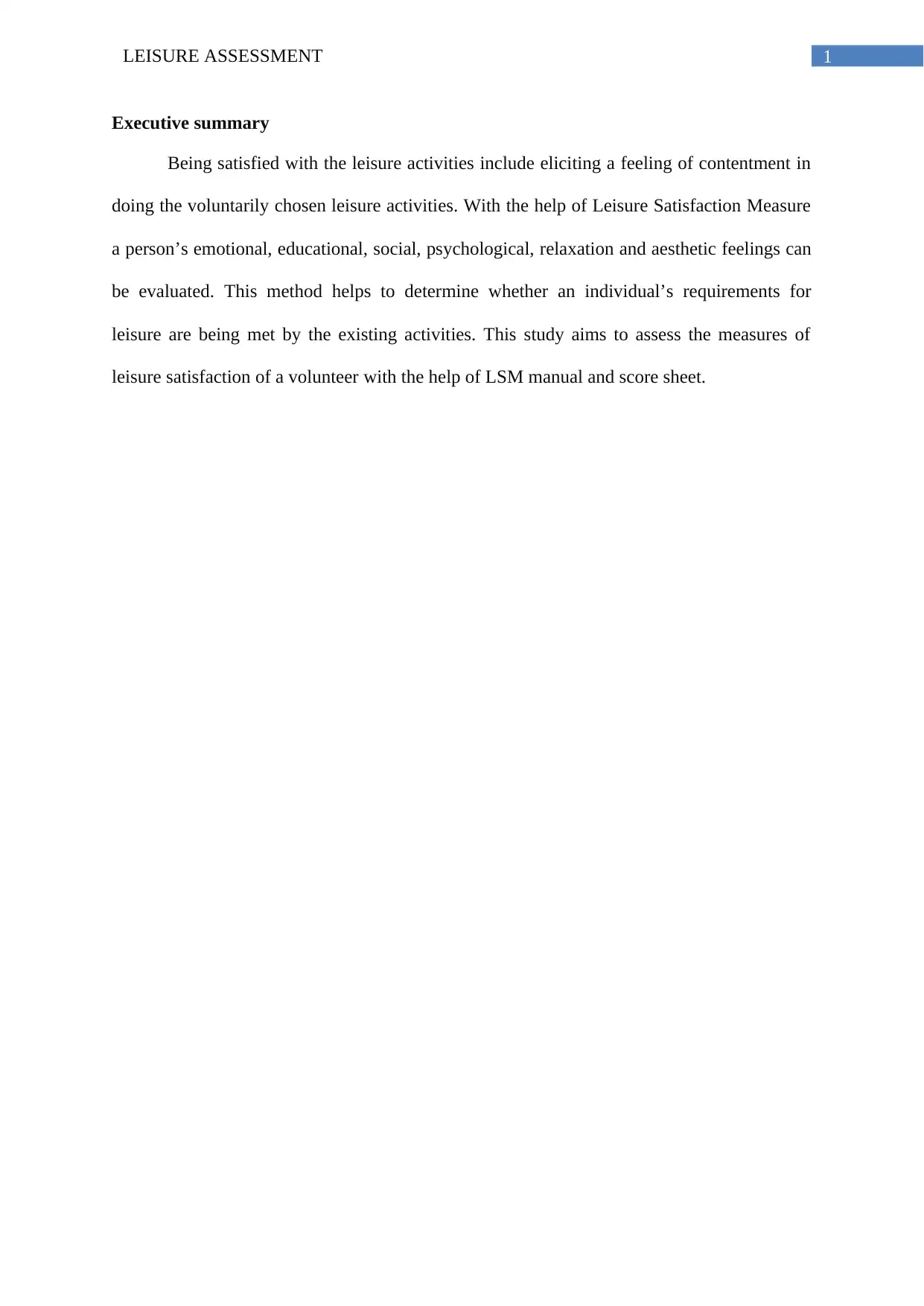
Being satisfied with the leisure activities include eliciting a feeling of contentment in
doing the voluntarily chosen leisure activities. With the help of Leisure Satisfaction Measure
a person’s emotional, educational, social, psychological, relaxation and aesthetic feelings can
be evaluated. This method helps to determine whether an individual’s requirements for
leisure are being met by the existing activities. This study aims to assess the measures of
leisure satisfaction of a volunteer with the help of LSM manual and score sheet.
Document Page
2LEISURE ASSESSMENT
Table of Contents
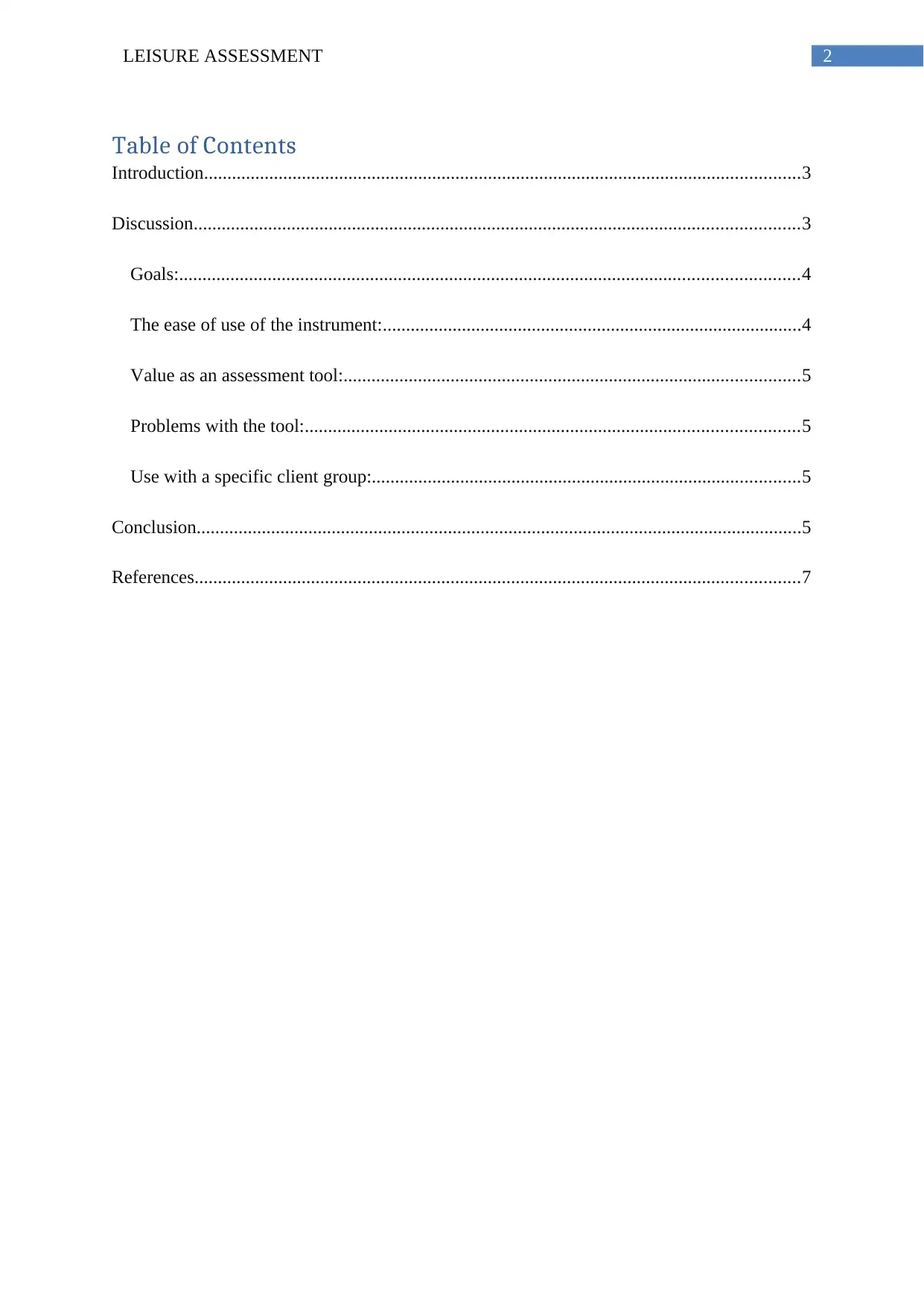
Introduction................................................................................................................................3
Discussion..................................................................................................................................3
Goals:.....................................................................................................................................4
The ease of use of the instrument:..........................................................................................4
Value as an assessment tool:..................................................................................................5
Problems with the tool:..........................................................................................................5
Use with a specific client group:............................................................................................5
Conclusion..................................................................................................................................5
References..................................................................................................................................7
Document Page
3LEISURE ASSESSMENT
Introduction
An individual’s attitude towards leisure depends on their psychological and
behavioural conditions. The chosen leisure assessment method is the Leisure Satisfaction
Measure (LSM) invented by Jacob Beard and Mounir Ragheb. The authors have defined the
term “leisure satisfaction” as the array of positive feelings one develop when they voluntarily
engage in chosen activities while spending leisure time and the degree to which they feel
content with the chosen acts (Lapa, 2013).
Discussion
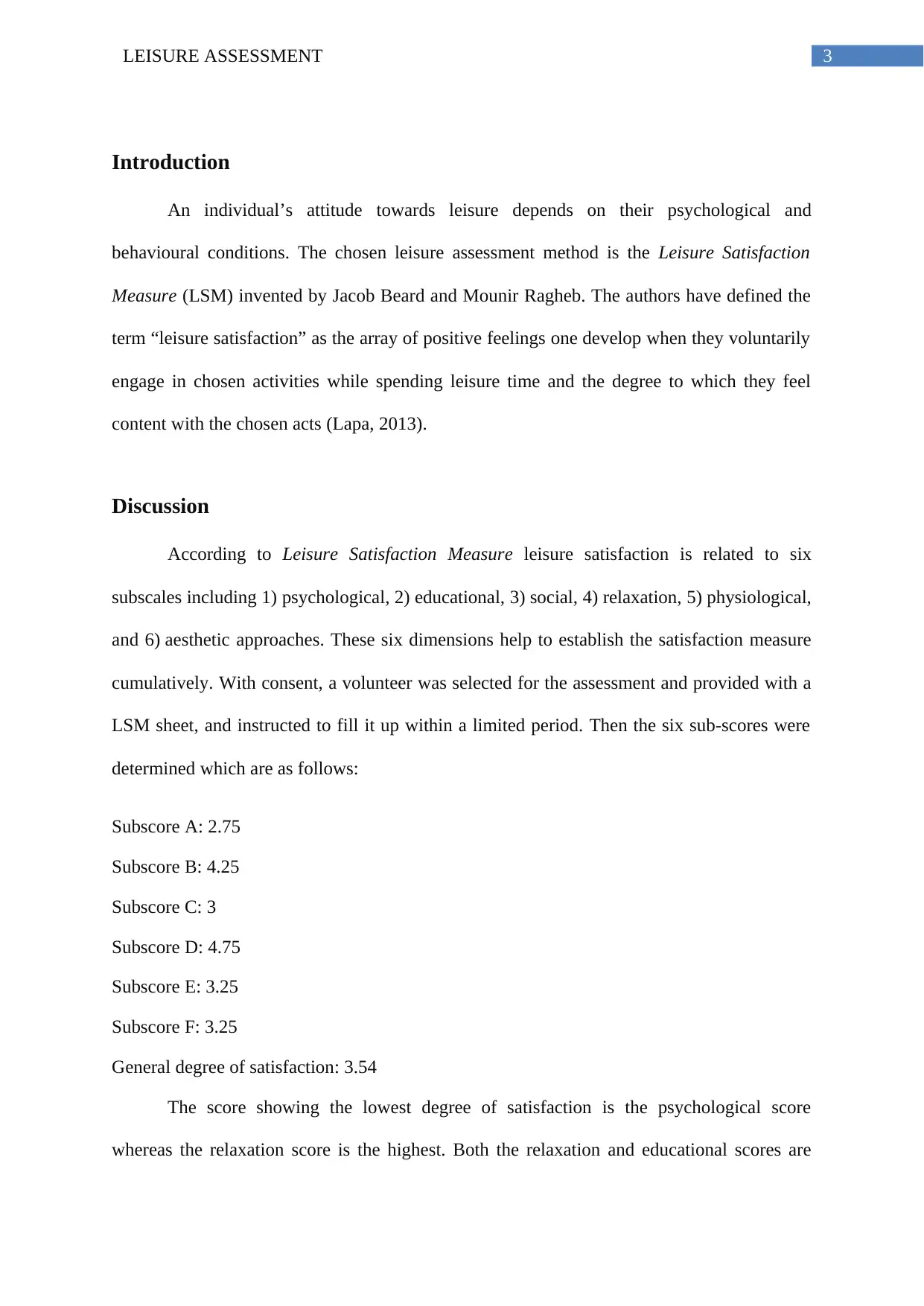
According to Leisure Satisfaction Measure leisure satisfaction is related to six
subscales including 1) psychological, 2) educational, 3) social, 4) relaxation, 5) physiological,
and 6) aesthetic approaches. These six dimensions help to establish the satisfaction measure
cumulatively. With consent, a volunteer was selected for the assessment and provided with a
LSM sheet, and instructed to fill it up within a limited period. Then the six sub-scores were
determined which are as follows:
Subscore A: 2.75
Subscore B: 4.25
Subscore C: 3
Subscore D: 4.75
Subscore E: 3.25
Subscore F: 3.25
General degree of satisfaction: 3.54
The score showing the lowest degree of satisfaction is the psychological score
whereas the relaxation score is the highest. Both the relaxation and educational scores are
tabler-icon-diamond-filled.svg

Paraphrase This Document

Need a fresh take? Get an instant paraphrase of this document with our AI Paraphraser
Document Page
4LEISURE ASSESSMENT
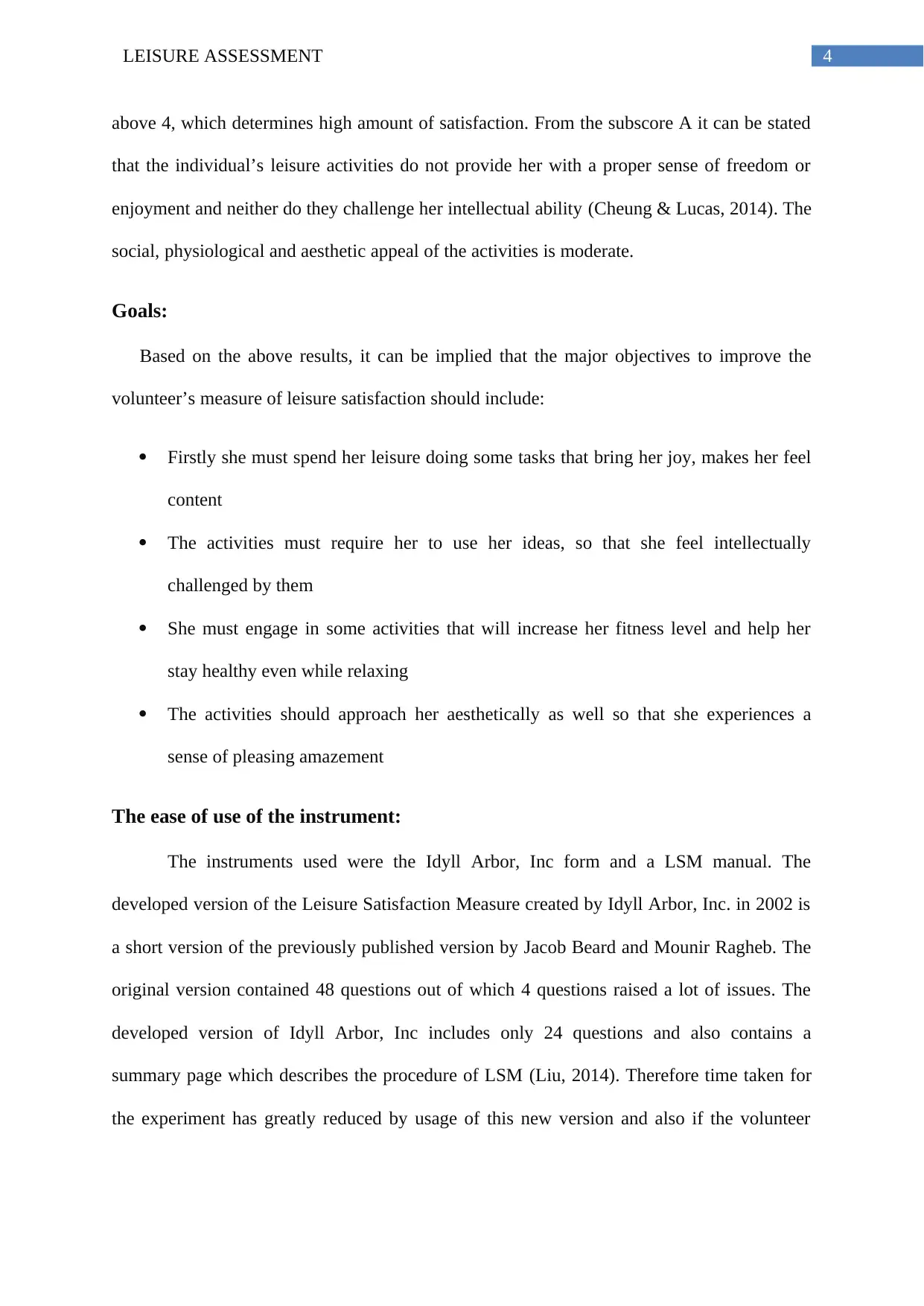
above 4, which determines high amount of satisfaction. From the subscore A it can be stated
that the individual’s leisure activities do not provide her with a proper sense of freedom or
enjoyment and neither do they challenge her intellectual ability (Cheung & Lucas, 2014). The
social, physiological and aesthetic appeal of the activities is moderate.
Goals:
Based on the above results, it can be implied that the major objectives to improve the
volunteer’s measure of leisure satisfaction should include:
Firstly she must spend her leisure doing some tasks that bring her joy, makes her feel
content
The activities must require her to use her ideas, so that she feel intellectually
challenged by them
She must engage in some activities that will increase her fitness level and help her
stay healthy even while relaxing
The activities should approach her aesthetically as well so that she experiences a
sense of pleasing amazement
The ease of use of the instrument:
The instruments used were the Idyll Arbor, Inc form and a LSM manual. The
developed version of the Leisure Satisfaction Measure created by Idyll Arbor, Inc. in 2002 is
a short version of the previously published version by Jacob Beard and Mounir Ragheb. The
original version contained 48 questions out of which 4 questions raised a lot of issues. The
developed version of Idyll Arbor, Inc includes only 24 questions and also contains a
summary page which describes the procedure of LSM (Liu, 2014). Therefore time taken for
the experiment has greatly reduced by usage of this new version and also if the volunteer
Document Page
5LEISURE ASSESSMENT
needs any assistance with the procedures they can ask the instructor or look for the answers
themselves at the summary page.
Value as an assessment tool:
The LMS manual is quite valuable in terms of its use in assessing leisure activities.
With each subscore it can critically evaluate the person’s social, psychological, aesthetic
needs, all in just one study (Shin & You, 2013). The entire study is completed within 30
minutes, at the maximum. The client is allowed 5-20 minutes to address all the 24 questions
and then the recreational therapist takes about 10 minutes to calculate the score. Therefore
study with a large number of subjects will not be very difficult or time consuming.
Problems with the tool:
Despite of having so many advantages, the LSM method does have a few setbacks.
The sheet does not contain a varied range of questions, all the questions are quite similar.
Also there is no definite method to verify the truthfulness of the answers the client is
providing (Zabriskie & Ward, 2013). The recreational therapist’s ability to make sure
whether the client is following all the instructions post the evaluation and if they are
modifying their activities accordingly is not easy to achieve and may even be impossible at
times.
Use with a specific client group:
The LSM tool can easily be used with any group of clients. For example if a study
involves adolescent school children, their leisure satisfaction can be very effectively be
measured by this method. Since all the questions are addressed in a lucid manner and
answering them involves a scale of 1-5, the children can go through the test easily (Chen, Li
& Chen, 2013).
Document Page
6LEISURE ASSESSMENT
Conclusion
Therefore it can be concluded that, the Leisure Satisfaction Measure method of Idyll
Arbor, Inc. is useful in determining the entire state of satisfaction one gets after doing some
activities in their leisure time. Various programs are there that can fulfil people’s need for
leisure activities which are mostly influenced by the individual’s curiosity and willingness to
engage in such activities and ultimately reward them with intellectual stimulation, stress
relief, healthy lifestyle and aesthetic enjoyment.
tabler-icon-diamond-filled.svg

Paraphrase This Document

Need a fresh take? Get an instant paraphrase of this document with our AI Paraphraser
Document Page
7LEISURE ASSESSMENT
References
Chen, Y. C., Li, R. H., & Chen, S. H. (2013). Relationships among adolescents’ leisure
motivation, leisure involvement, and leisure satisfaction: A structural equation
model. Social indicators research, 110(3), 1187-1199.
Cheung, F., & Lucas, R. E. (2014). Assessing the validity of single-item life satisfaction
measures: Results from three large samples. Quality of Life research, 23(10), 2809-
2818.
Lapa, T. Y. (2013). Life satisfaction, leisure satisfaction and perceived freedom of park
recreation participants. Procedia-Social and Behavioral Sciences, 93, 1985-1993.
Liu, H. (2014). Personality, leisure satisfaction, and subjective well-being of serious leisure
participants. Social Behavior and Personality: an international journal, 42(7), 1117-
1125.
Shin, K., & You, S. (2013). Leisure type, leisure satisfaction and adolescents’ psychological
wellbeing. Journal of Pacific Rim Psychology, 7(2), 53-62.
Zabriskie, R. B., & Ward, P. J. (2013). Satisfaction with family life scale. Marriage &
Family Review, 49(5), 446-463.
chevron_up_icon
1 out of 8
circle_padding
hide_on_mobile
zoom_out_icon
[object Object]