HSCI 1130 Assignment: Critical Analysis of LTBI Screening Study
VerifiedAdded on 2022/09/26
|6
|1268
|16
Homework Assignment
AI Summary
This assignment analyzes a cohort study by Usdin et al. (2017) investigating the feasibility and effectiveness of latent tuberculosis infection (LTBI) screening among recent migrants attending language classes in a community college setting. The study aimed to address the low participation in LTBI screening programs in primary care settings by implementing a community-based program. The analysis covers key aspects of the study, including the research question, study design (cohort study), the characteristics of the study population, and the observed outcomes such as treatment compliance and cost-effectiveness. The document critically examines the strengths and limitations of the study, including the relevance of the descriptive epidemiology, the statistical significance of the findings, potential biases (systematic and random errors), and the implications of the results in terms of the need for and efficacy of community-based LTBI screening programs. The analysis also addresses the study's conclusions, providing a rationalization statement based on the reported outcomes and their implications for public health strategies.
Running head: CRITICAL THINKING: LATENT TUBERCULOSIS
CRITICAL THINKING: LATENT TUBERCULOSIS
Name of the Student:
Name of the University:
Author note:
CRITICAL THINKING: LATENT TUBERCULOSIS
Name of the Student:
Name of the University:
Author note:
Paraphrase This Document
Need a fresh take? Get an instant paraphrase of this document with our AI Paraphraser

1CRITICAL THINKING: LATENT TUBERCULOSIS
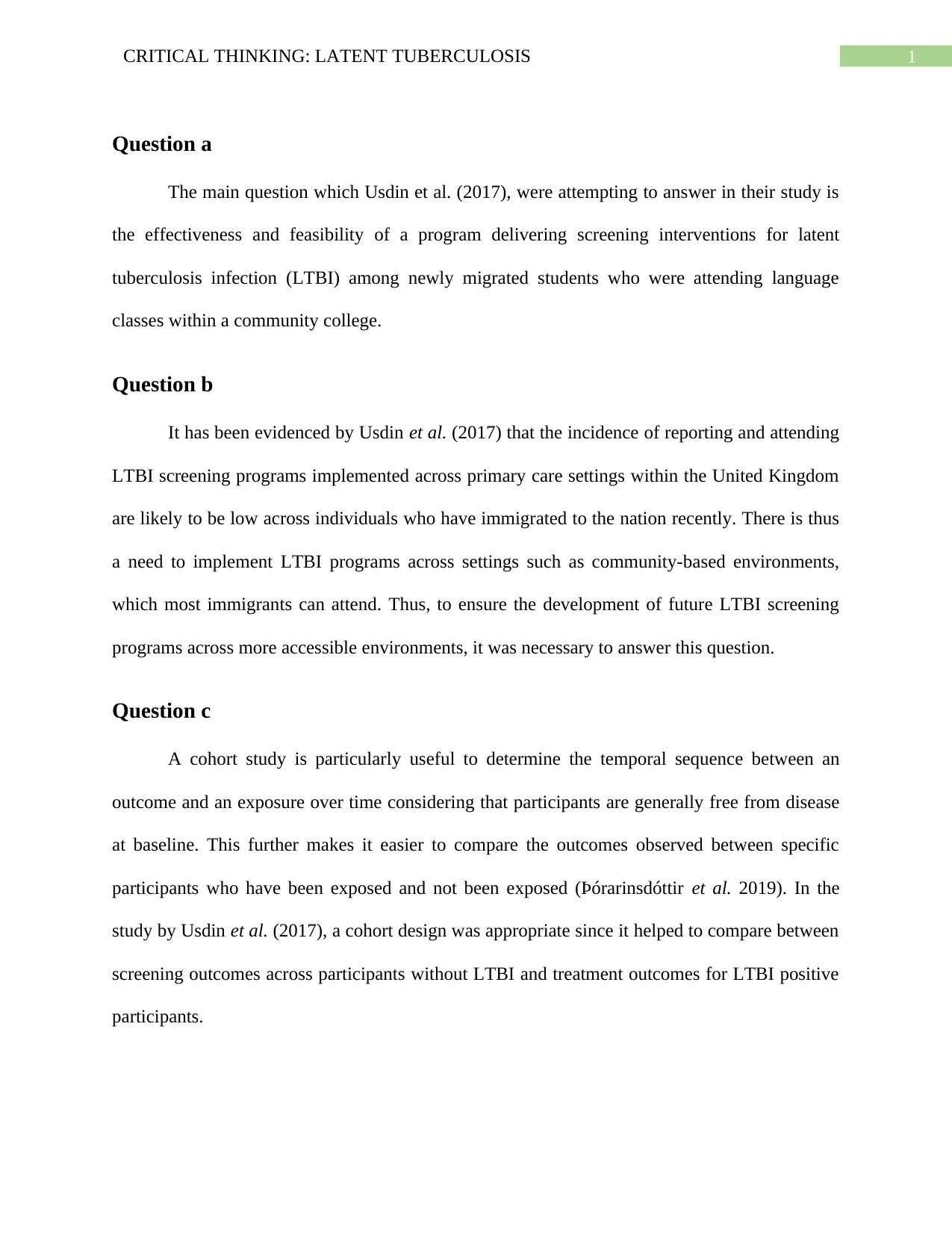
Question a
The main question which Usdin et al. (2017), were attempting to answer in their study is
the effectiveness and feasibility of a program delivering screening interventions for latent
tuberculosis infection (LTBI) among newly migrated students who were attending language
classes within a community college.
Question b
It has been evidenced by Usdin et al. (2017) that the incidence of reporting and attending
LTBI screening programs implemented across primary care settings within the United Kingdom
are likely to be low across individuals who have immigrated to the nation recently. There is thus
a need to implement LTBI programs across settings such as community-based environments,
which most immigrants can attend. Thus, to ensure the development of future LTBI screening
programs across more accessible environments, it was necessary to answer this question.
Question c
A cohort study is particularly useful to determine the temporal sequence between an
outcome and an exposure over time considering that participants are generally free from disease
at baseline. This further makes it easier to compare the outcomes observed between specific
participants who have been exposed and not been exposed (Þórarinsdóttir et al. 2019). In the
study by Usdin et al. (2017), a cohort design was appropriate since it helped to compare between
screening outcomes across participants without LTBI and treatment outcomes for LTBI positive
participants.
Question a
The main question which Usdin et al. (2017), were attempting to answer in their study is
the effectiveness and feasibility of a program delivering screening interventions for latent
tuberculosis infection (LTBI) among newly migrated students who were attending language
classes within a community college.
Question b
It has been evidenced by Usdin et al. (2017) that the incidence of reporting and attending
LTBI screening programs implemented across primary care settings within the United Kingdom
are likely to be low across individuals who have immigrated to the nation recently. There is thus
a need to implement LTBI programs across settings such as community-based environments,
which most immigrants can attend. Thus, to ensure the development of future LTBI screening
programs across more accessible environments, it was necessary to answer this question.
Question c
A cohort study is particularly useful to determine the temporal sequence between an
outcome and an exposure over time considering that participants are generally free from disease
at baseline. This further makes it easier to compare the outcomes observed between specific
participants who have been exposed and not been exposed (Þórarinsdóttir et al. 2019). In the
study by Usdin et al. (2017), a cohort design was appropriate since it helped to compare between
screening outcomes across participants without LTBI and treatment outcomes for LTBI positive
participants.

2CRITICAL THINKING: LATENT TUBERCULOSIS
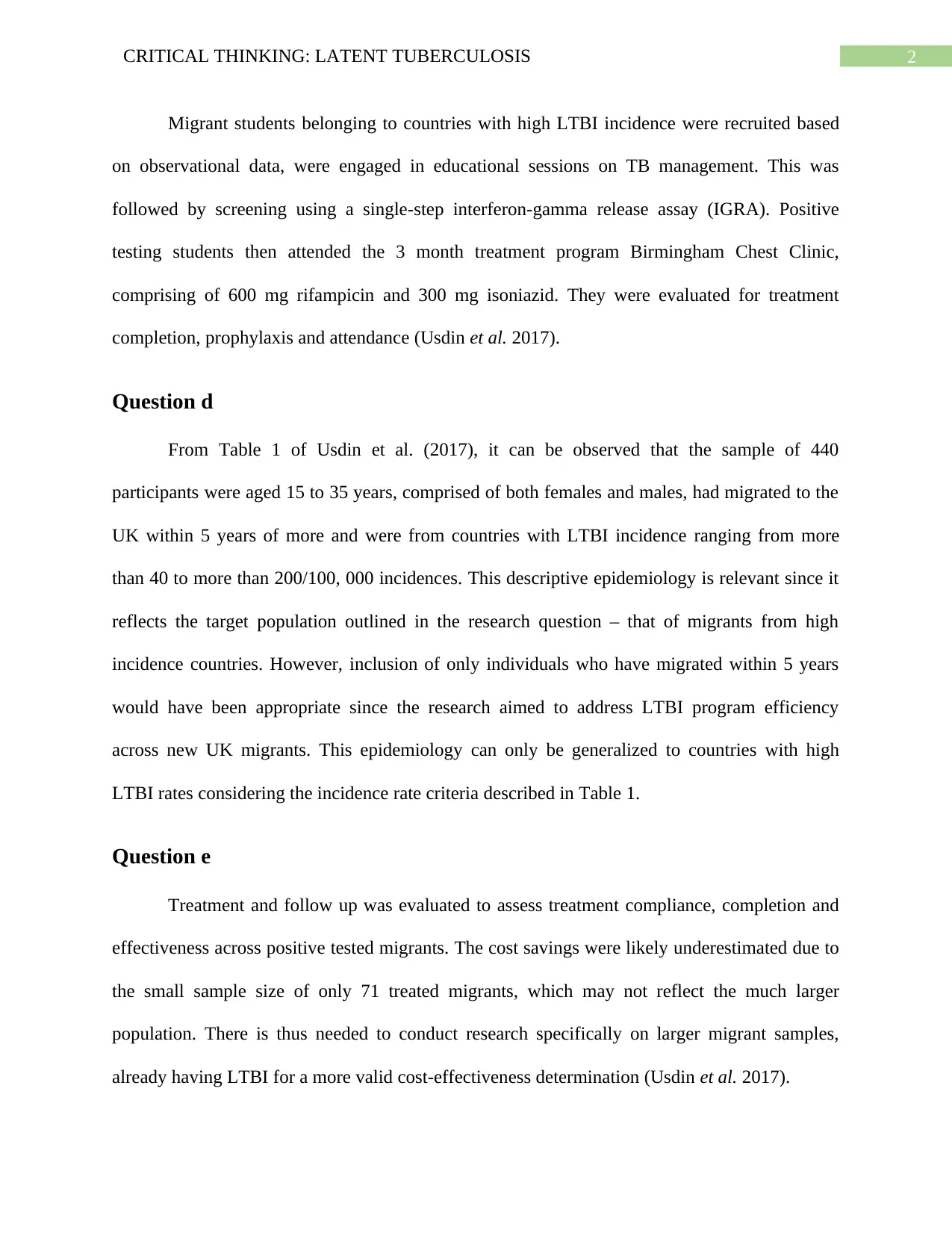
Migrant students belonging to countries with high LTBI incidence were recruited based
on observational data, were engaged in educational sessions on TB management. This was
followed by screening using a single-step interferon-gamma release assay (IGRA). Positive
testing students then attended the 3 month treatment program Birmingham Chest Clinic,
comprising of 600 mg rifampicin and 300 mg isoniazid. They were evaluated for treatment
completion, prophylaxis and attendance (Usdin et al. 2017).
Question d
From Table 1 of Usdin et al. (2017), it can be observed that the sample of 440
participants were aged 15 to 35 years, comprised of both females and males, had migrated to the
UK within 5 years of more and were from countries with LTBI incidence ranging from more
than 40 to more than 200/100, 000 incidences. This descriptive epidemiology is relevant since it
reflects the target population outlined in the research question – that of migrants from high
incidence countries. However, inclusion of only individuals who have migrated within 5 years
would have been appropriate since the research aimed to address LTBI program efficiency
across new UK migrants. This epidemiology can only be generalized to countries with high
LTBI rates considering the incidence rate criteria described in Table 1.
Question e
Treatment and follow up was evaluated to assess treatment compliance, completion and
effectiveness across positive tested migrants. The cost savings were likely underestimated due to
the small sample size of only 71 treated migrants, which may not reflect the much larger
population. There is thus needed to conduct research specifically on larger migrant samples,
already having LTBI for a more valid cost-effectiveness determination (Usdin et al. 2017).
Migrant students belonging to countries with high LTBI incidence were recruited based
on observational data, were engaged in educational sessions on TB management. This was
followed by screening using a single-step interferon-gamma release assay (IGRA). Positive
testing students then attended the 3 month treatment program Birmingham Chest Clinic,
comprising of 600 mg rifampicin and 300 mg isoniazid. They were evaluated for treatment
completion, prophylaxis and attendance (Usdin et al. 2017).
Question d
From Table 1 of Usdin et al. (2017), it can be observed that the sample of 440
participants were aged 15 to 35 years, comprised of both females and males, had migrated to the
UK within 5 years of more and were from countries with LTBI incidence ranging from more
than 40 to more than 200/100, 000 incidences. This descriptive epidemiology is relevant since it
reflects the target population outlined in the research question – that of migrants from high
incidence countries. However, inclusion of only individuals who have migrated within 5 years
would have been appropriate since the research aimed to address LTBI program efficiency
across new UK migrants. This epidemiology can only be generalized to countries with high
LTBI rates considering the incidence rate criteria described in Table 1.
Question e
Treatment and follow up was evaluated to assess treatment compliance, completion and
effectiveness across positive tested migrants. The cost savings were likely underestimated due to
the small sample size of only 71 treated migrants, which may not reflect the much larger
population. There is thus needed to conduct research specifically on larger migrant samples,
already having LTBI for a more valid cost-effectiveness determination (Usdin et al. 2017).
⊘ This is a preview!⊘
Do you want full access?
Subscribe today to unlock all pages.

Trusted by 1+ million students worldwide

3CRITICAL THINKING: LATENT TUBERCULOSIS
Question f
Variables like: migration within one year, females, 26 to 30 years and >300/100, 000
incidence rate were associated with TB positivity, as concluded from the Relative Risk (RR)
values. Individuals who have migrated to the UK within the last 1 year, are likely to test TB
positive (Usdin et al. 2017). Statistical significance associated in age variation was not relevant
since it does not reflect the confounders like low body mass, cancer, old age, existing HIV or
respiratory conditions – which are LTBI risk factors (Ali et al. 2016).
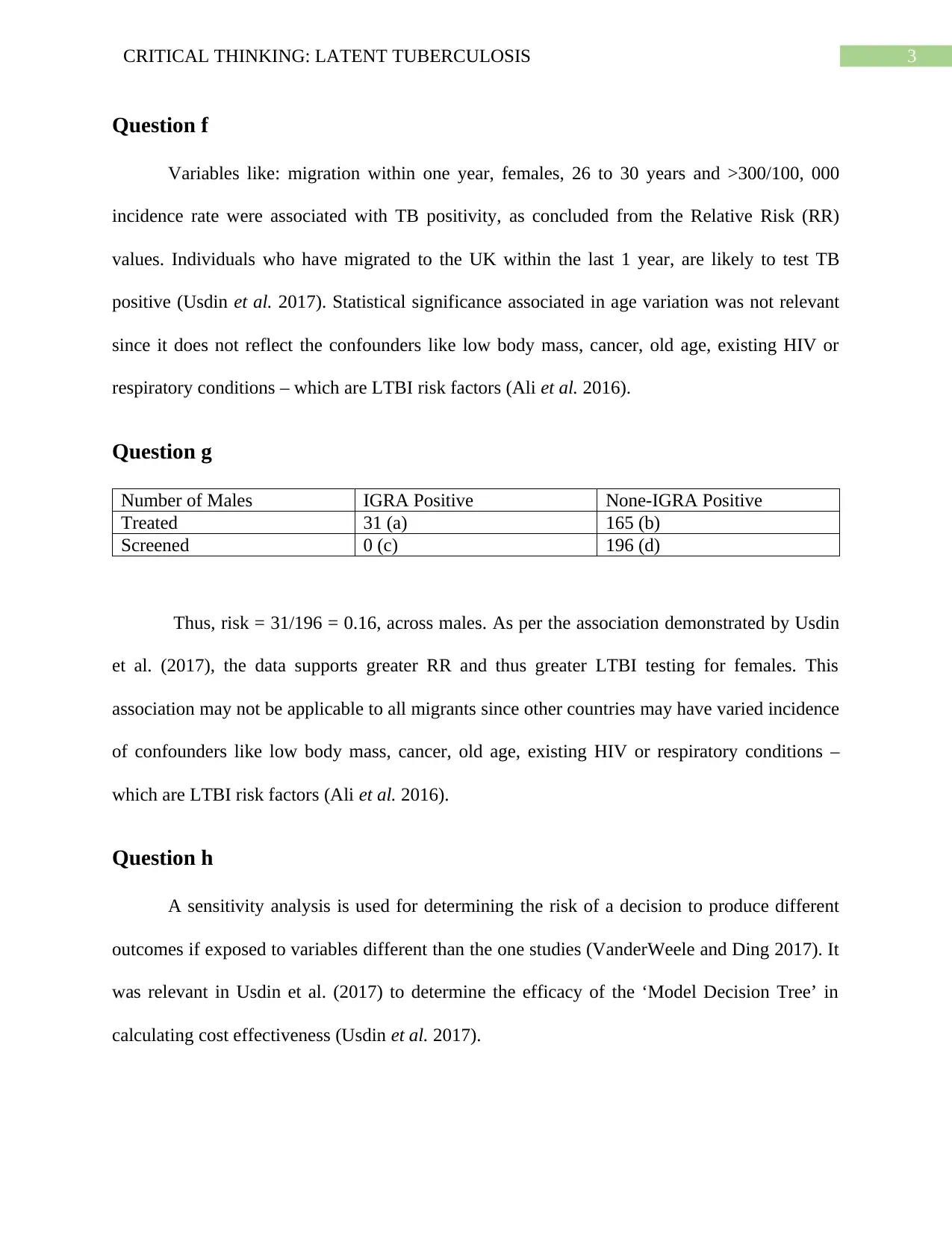
Question g
Number of Males IGRA Positive None-IGRA Positive
Treated 31 (a) 165 (b)
Screened 0 (c) 196 (d)
Thus, risk = 31/196 = 0.16, across males. As per the association demonstrated by Usdin
et al. (2017), the data supports greater RR and thus greater LTBI testing for females. This
association may not be applicable to all migrants since other countries may have varied incidence
of confounders like low body mass, cancer, old age, existing HIV or respiratory conditions –
which are LTBI risk factors (Ali et al. 2016).
Question h
A sensitivity analysis is used for determining the risk of a decision to produce different
outcomes if exposed to variables different than the one studies (VanderWeele and Ding 2017). It
was relevant in Usdin et al. (2017) to determine the efficacy of the ‘Model Decision Tree’ in
calculating cost effectiveness (Usdin et al. 2017).
Question f
Variables like: migration within one year, females, 26 to 30 years and >300/100, 000
incidence rate were associated with TB positivity, as concluded from the Relative Risk (RR)
values. Individuals who have migrated to the UK within the last 1 year, are likely to test TB
positive (Usdin et al. 2017). Statistical significance associated in age variation was not relevant
since it does not reflect the confounders like low body mass, cancer, old age, existing HIV or
respiratory conditions – which are LTBI risk factors (Ali et al. 2016).
Question g
Number of Males IGRA Positive None-IGRA Positive
Treated 31 (a) 165 (b)
Screened 0 (c) 196 (d)
Thus, risk = 31/196 = 0.16, across males. As per the association demonstrated by Usdin
et al. (2017), the data supports greater RR and thus greater LTBI testing for females. This
association may not be applicable to all migrants since other countries may have varied incidence
of confounders like low body mass, cancer, old age, existing HIV or respiratory conditions –
which are LTBI risk factors (Ali et al. 2016).
Question h
A sensitivity analysis is used for determining the risk of a decision to produce different
outcomes if exposed to variables different than the one studies (VanderWeele and Ding 2017). It
was relevant in Usdin et al. (2017) to determine the efficacy of the ‘Model Decision Tree’ in
calculating cost effectiveness (Usdin et al. 2017).
Paraphrase This Document
Need a fresh take? Get an instant paraphrase of this document with our AI Paraphraser

4CRITICAL THINKING: LATENT TUBERCULOSIS
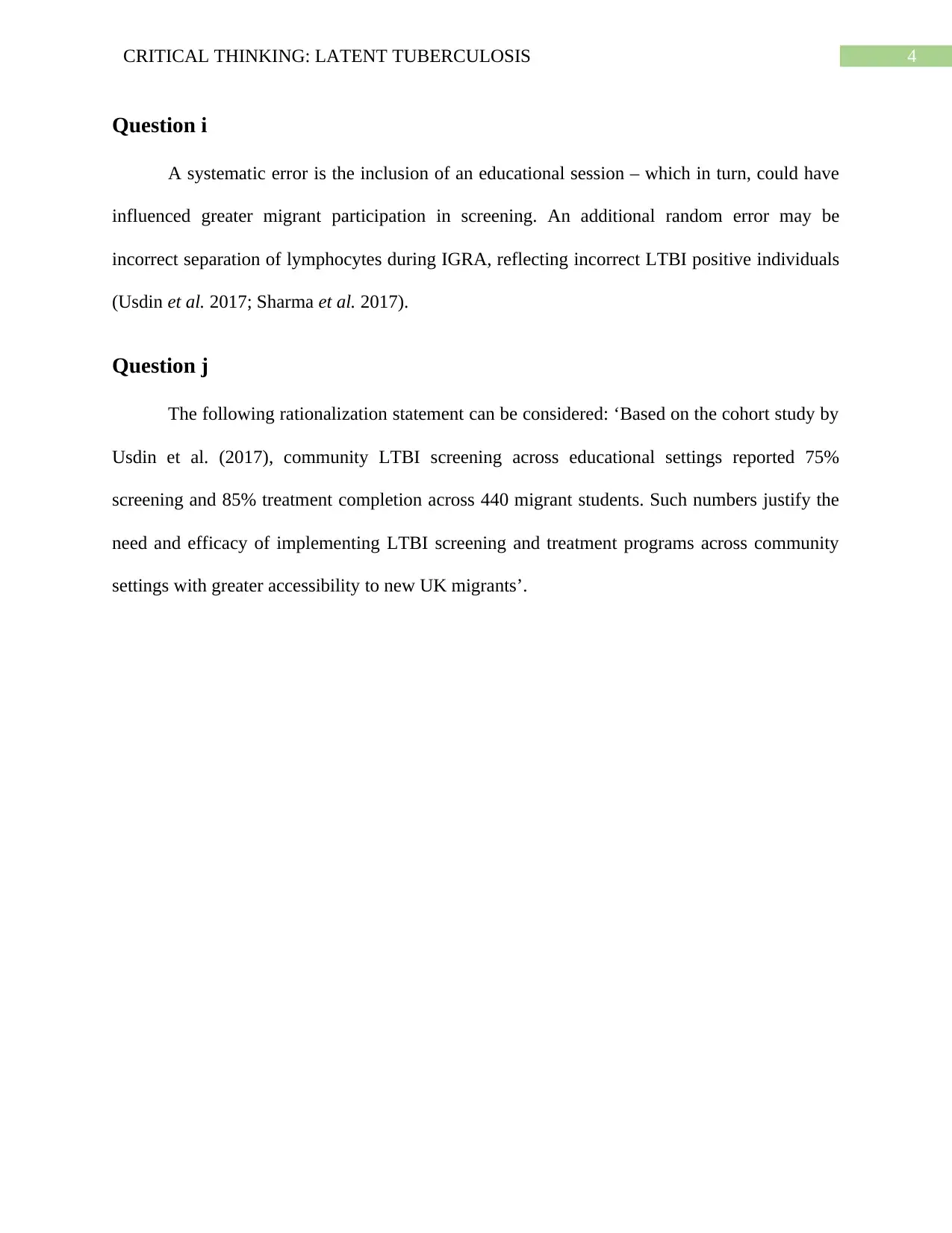
Question i
A systematic error is the inclusion of an educational session – which in turn, could have
influenced greater migrant participation in screening. An additional random error may be
incorrect separation of lymphocytes during IGRA, reflecting incorrect LTBI positive individuals
(Usdin et al. 2017; Sharma et al. 2017).
Question j
The following rationalization statement can be considered: ‘Based on the cohort study by
Usdin et al. (2017), community LTBI screening across educational settings reported 75%
screening and 85% treatment completion across 440 migrant students. Such numbers justify the
need and efficacy of implementing LTBI screening and treatment programs across community
settings with greater accessibility to new UK migrants’.
Question i
A systematic error is the inclusion of an educational session – which in turn, could have
influenced greater migrant participation in screening. An additional random error may be
incorrect separation of lymphocytes during IGRA, reflecting incorrect LTBI positive individuals
(Usdin et al. 2017; Sharma et al. 2017).
Question j
The following rationalization statement can be considered: ‘Based on the cohort study by
Usdin et al. (2017), community LTBI screening across educational settings reported 75%
screening and 85% treatment completion across 440 migrant students. Such numbers justify the
need and efficacy of implementing LTBI screening and treatment programs across community
settings with greater accessibility to new UK migrants’.

5CRITICAL THINKING: LATENT TUBERCULOSIS
References
Ai, J.W., Ruan, Q.L., Liu, Q.H. and Zhang, W.H., 2016. Updates on the risk factors for latent
tuberculosis reactivation and their managements. Emerging microbes & infections, 5(1), pp.1-8.
Sharma, S.K., Vashishtha, R., Chauhan, L.S., Sreenivas, V. and Seth, D., 2017. Comparison of
TST and IGRA in diagnosis of latent tuberculosis infection in a high TB-burden setting. PLoS
One, 12(1).
Þórarinsdóttir, H., Faurholt-Jepsen, M., Ullum, H., Frost, M., Bardram, J.E. and Kessing, L.V.,
2019. The validity of daily self-assessed perceived stress measured using smartphones in healthy
individuals: cohort study. JMIR mHealth and uHealth, 7(8), p.e13418.
Usdin, M., Dedicoat, M., Gajraj, R., Harrison, P., Kaur, H., Duffield, K., Walker, C.L., Akram,
Y., Aiyedun, V., Mohamed, H. and Zenner, D., 2017. Latent tuberculous screening of recent
migrants attending language classes: a cohort study and cost analysis. The International Journal
of Tuberculosis and Lung Disease, 21(2), pp.175-180.
VanderWeele, T.J. and Ding, P., 2017. Sensitivity analysis in observational research: introducing
the E-value. Annals of internal medicine, 167(4), pp.268-274.
References
Ai, J.W., Ruan, Q.L., Liu, Q.H. and Zhang, W.H., 2016. Updates on the risk factors for latent
tuberculosis reactivation and their managements. Emerging microbes & infections, 5(1), pp.1-8.
Sharma, S.K., Vashishtha, R., Chauhan, L.S., Sreenivas, V. and Seth, D., 2017. Comparison of
TST and IGRA in diagnosis of latent tuberculosis infection in a high TB-burden setting. PLoS
One, 12(1).
Þórarinsdóttir, H., Faurholt-Jepsen, M., Ullum, H., Frost, M., Bardram, J.E. and Kessing, L.V.,
2019. The validity of daily self-assessed perceived stress measured using smartphones in healthy
individuals: cohort study. JMIR mHealth and uHealth, 7(8), p.e13418.
Usdin, M., Dedicoat, M., Gajraj, R., Harrison, P., Kaur, H., Duffield, K., Walker, C.L., Akram,
Y., Aiyedun, V., Mohamed, H. and Zenner, D., 2017. Latent tuberculous screening of recent
migrants attending language classes: a cohort study and cost analysis. The International Journal
of Tuberculosis and Lung Disease, 21(2), pp.175-180.
VanderWeele, T.J. and Ding, P., 2017. Sensitivity analysis in observational research: introducing
the E-value. Annals of internal medicine, 167(4), pp.268-274.
⊘ This is a preview!⊘
Do you want full access?
Subscribe today to unlock all pages.

Trusted by 1+ million students worldwide
1 out of 6
Your All-in-One AI-Powered Toolkit for Academic Success.
+13062052269
info@desklib.com
Available 24*7 on WhatsApp / Email
Unlock your academic potential
Copyright © 2020–2026 A2Z Services. All Rights Reserved. Developed and managed by ZUCOL.