Critical Evaluation of Management Accounting Systems in Practice
VerifiedAdded on 2022/10/11
|13
|4187
|43
Report
AI Summary
This report critically evaluates the application of management accounting systems (MAS) by analyzing two journal articles focused on Australian and New Zealand companies. The report explores the use of various MAS modules, including ABC, TQM, JIT, and BSC, and their impact on managerial decision-making. The first journal article examines a multinational manufacturing company's adoption of MAS, highlighting challenges and the need for a tailored approach. The second journal article (not included in the provided text, but referenced) will be used to compare and contrast the findings. The analysis considers the relevance of these systems in the current business environment, emphasizing the importance of effective managerial decisions for achieving business goals. The report aims to provide insights into the merits and demerits of different MAS models and their application in the real world, contributing to a comprehensive understanding of their effectiveness.
Managerial Accounting
Unit Code- HI5017
Trimester - T2 2019
Student Name-
Student Number-
Word Count- 3080
1 | P a g e
Unit Code- HI5017
Trimester - T2 2019
Student Name-
Student Number-
Word Count- 3080
1 | P a g e

Paraphrase This Document
Need a fresh take? Get an instant paraphrase of this document with our AI Paraphraser
Abstract
The objective of this article is to find suitable alternatives to contemporary concept of
accounting with the latest introduction of management accounting system or MAS. Any
industry aspires for adoption of perfect management accounting system to perform in
better style. Management accounting system enhances the scope of best possible
management decision making through adoption of different modules of MAS available in
current business perspective. Through this article, we have to explore the application of
different modules of management accounting system in real-life companies of current
corporate world by consulting two case studies available in journal articles. This study
includes and depends upon these two journal articles, which had emphasized on the
practice of MAS to prove its worth for effective decision making by managers of the
business entity. This article will highlight the application of referred management
accounting system with its shortcomings featured in the considered journals. The
discussion will evolve in perspective of Australian and New Zealand companies, who
adopted latest modules of MAS by helping the managers for effective decision making.
Critical review of these two journal articles would provide necessary input about the
adoption of latest models of management accounting system with its merits and
demerits to understand the fruitfulness of such application in real business world. The
practice of management accounting system is entirely confined within the organization
with no such integrated relation of the outcome of such effort for external stakeholders
of the entity. The purpose of this practice is to enhance the level of performance of the
organization by effective managerial decision making. Different specific examples of
MAS would be considered with their subsequent relevance for the contemporary
business organizations. By critically evaluating the two journals through comparing and
contrasting the inherent observations of them, the output is to be identified for the
success of the applied methods of those management accounting systems with its
relevance in perspective of current uncertain business environment in global context.
Key Words- Management Accounting System; TQM; ABC; TDABC; JIT; BSC; Decision
Making
2 | P a g e
The objective of this article is to find suitable alternatives to contemporary concept of
accounting with the latest introduction of management accounting system or MAS. Any
industry aspires for adoption of perfect management accounting system to perform in
better style. Management accounting system enhances the scope of best possible
management decision making through adoption of different modules of MAS available in
current business perspective. Through this article, we have to explore the application of
different modules of management accounting system in real-life companies of current
corporate world by consulting two case studies available in journal articles. This study
includes and depends upon these two journal articles, which had emphasized on the
practice of MAS to prove its worth for effective decision making by managers of the
business entity. This article will highlight the application of referred management
accounting system with its shortcomings featured in the considered journals. The
discussion will evolve in perspective of Australian and New Zealand companies, who
adopted latest modules of MAS by helping the managers for effective decision making.
Critical review of these two journal articles would provide necessary input about the
adoption of latest models of management accounting system with its merits and
demerits to understand the fruitfulness of such application in real business world. The
practice of management accounting system is entirely confined within the organization
with no such integrated relation of the outcome of such effort for external stakeholders
of the entity. The purpose of this practice is to enhance the level of performance of the
organization by effective managerial decision making. Different specific examples of
MAS would be considered with their subsequent relevance for the contemporary
business organizations. By critically evaluating the two journals through comparing and
contrasting the inherent observations of them, the output is to be identified for the
success of the applied methods of those management accounting systems with its
relevance in perspective of current uncertain business environment in global context.
Key Words- Management Accounting System; TQM; ABC; TDABC; JIT; BSC; Decision
Making
2 | P a g e
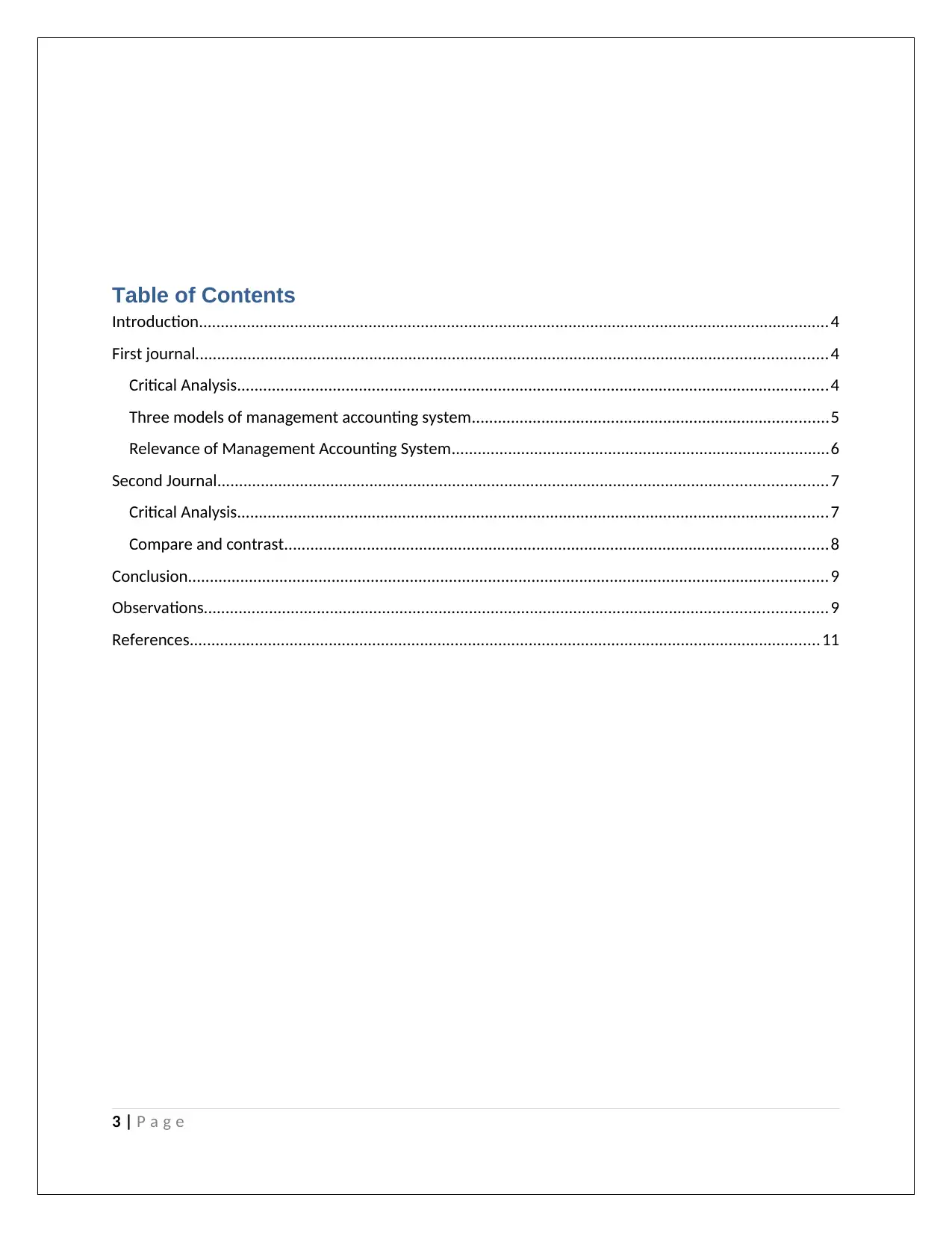
Table of Contents
Introduction.................................................................................................................................................4
First journal.................................................................................................................................................4
Critical Analysis........................................................................................................................................4
Three models of management accounting system..................................................................................5
Relevance of Management Accounting System.......................................................................................6
Second Journal............................................................................................................................................7
Critical Analysis........................................................................................................................................7
Compare and contrast.............................................................................................................................8
Conclusion...................................................................................................................................................9
Observations...............................................................................................................................................9
References.................................................................................................................................................11
3 | P a g e
Introduction.................................................................................................................................................4
First journal.................................................................................................................................................4
Critical Analysis........................................................................................................................................4
Three models of management accounting system..................................................................................5
Relevance of Management Accounting System.......................................................................................6
Second Journal............................................................................................................................................7
Critical Analysis........................................................................................................................................7
Compare and contrast.............................................................................................................................8
Conclusion...................................................................................................................................................9
Observations...............................................................................................................................................9
References.................................................................................................................................................11
3 | P a g e
⊘ This is a preview!⊘
Do you want full access?
Subscribe today to unlock all pages.

Trusted by 1+ million students worldwide
Introduction
Management accounting system is considered as an emerging tool in global business
scenario. This tool has different methods, which are followed by the managers of the
company as per applicability to the business to find the output and use the same for
effective managerial decision making. This tool is explored by western economists and
eminent personalities of accounting science. The same is spreading globally for
accomplishment of coveted result as per corporate objective by setting respective
strategies with subsequent implementation. This article demands different aspects of
discussion. There will be two journal articles used for discussion. In first part,
identification of three models or techniques of management accounting system is to be
explored as per first journal article. Second part requires the discussion of relevance of
management accounting methods for the contemporary business organizations with
samples to cite as evidence of this hypothesis. The third part of this article needs to
compare and contrast the hypothesis with another journal article discussing the method
of management accounting system in real life company. It is also to be confirmed
whether the second journal article endorses the concept as depicted in the first journal
article or it differs from the observations of the first journal article. This entire article will
put emphasis on the issues of application of management accounting methods in
Australian perspective. As it is, present business environment is vulnerable and most
competitive in current global business environment. This article will highlight the role of
management accounting system in present corporate business with its relevance of
implementing the same in corporate business to enjoy competitive edge to ensure
sustainability. This article will give ideas about these issues with the role of
management accounting system and implementation of certain management
accounting methods applicable for the specific business to succeed with future
prospects.
First journal
The first Journal in consideration for this discussion is: The Case of a Newly
Implemented Modern Management Accounting System in a Multinational
Manufacturing Company published in 2014. This article was published in
Australian Accounting, Business and Finance Journal in their eighth volume,
second issue and specific article number nine found in page numbers 121-137.
The writers of this journal are Daniel Watts; P.W.Senarath Yapa and Steven
Dellaportas. (Watts et al., 2014)
Critical Analysis
Adoption of management accounting methods is motivated by two criteria. One is
operational to serve the objective of changes for short term, and the other is
4 | P a g e
Management accounting system is considered as an emerging tool in global business
scenario. This tool has different methods, which are followed by the managers of the
company as per applicability to the business to find the output and use the same for
effective managerial decision making. This tool is explored by western economists and
eminent personalities of accounting science. The same is spreading globally for
accomplishment of coveted result as per corporate objective by setting respective
strategies with subsequent implementation. This article demands different aspects of
discussion. There will be two journal articles used for discussion. In first part,
identification of three models or techniques of management accounting system is to be
explored as per first journal article. Second part requires the discussion of relevance of
management accounting methods for the contemporary business organizations with
samples to cite as evidence of this hypothesis. The third part of this article needs to
compare and contrast the hypothesis with another journal article discussing the method
of management accounting system in real life company. It is also to be confirmed
whether the second journal article endorses the concept as depicted in the first journal
article or it differs from the observations of the first journal article. This entire article will
put emphasis on the issues of application of management accounting methods in
Australian perspective. As it is, present business environment is vulnerable and most
competitive in current global business environment. This article will highlight the role of
management accounting system in present corporate business with its relevance of
implementing the same in corporate business to enjoy competitive edge to ensure
sustainability. This article will give ideas about these issues with the role of
management accounting system and implementation of certain management
accounting methods applicable for the specific business to succeed with future
prospects.
First journal
The first Journal in consideration for this discussion is: The Case of a Newly
Implemented Modern Management Accounting System in a Multinational
Manufacturing Company published in 2014. This article was published in
Australian Accounting, Business and Finance Journal in their eighth volume,
second issue and specific article number nine found in page numbers 121-137.
The writers of this journal are Daniel Watts; P.W.Senarath Yapa and Steven
Dellaportas. (Watts et al., 2014)
Critical Analysis
Adoption of management accounting methods is motivated by two criteria. One is
operational to serve the objective of changes for short term, and the other is
4 | P a g e
Paraphrase This Document
Need a fresh take? Get an instant paraphrase of this document with our AI Paraphraser
strategic or for long term duration. (Hubbard et al., 2004). Main quest for change in
management accounting is with any of the above-said criterion or both; but the
main objective is strategic for any contemporary management accounting to serve
the need of the changed requirements of the organization. As per Chenchall and
Langfield-Smith (1999), four main steps are initiated with “triggers for adoption”,
‘System Characteristics”, “implementation issues” and ‘Outcome”. (Chenhall &
Langfield-Smith, 1999) The first step is related to the main factors of determining
the objective of adoption of a new management accounting system. The second
step pertains to outlining of the required steps as per the thoughts of the
management for this transition. The third step is related to process of coveted
change following with the focus in identified issues, which can assist the
implementation of new process of changed management accounting system. The
final part is to evaluate the change as per produced result and the expected
benefits the firm seeks for.
The sample company selected for this research is an US based Multi-national
Company engaged in manufacturing process with its physical presence in 27
countries and its sales network prevailed in more than 100 countries. The
company has regional head quarter in different countries including Australia at
Melbourne. For effectiveness of changing management accounting methods, the
researchers had done a qualitative analysis by interviewing the Managing Director
and Business Financial Manager of the company. To justify this study, relevant
data of other companies with same manufacturing process was gathered to
ensure proper comparison. The study revealed that the adopted management
accounting system of the company had faced certain challenges with uncertainty
about the adopted management accounting system. Although the basic
management accounting methods like ABC, TQM, JIT, (Mia, 2000)and BSC are
practiced in the company, the relevance and subsequent result of them for
managerial decision making was not properly utilized as per fundamental concept.
Of the above management accounting models, ABC and BSC were followed by
the firm without proper assessment of them. This lack of assessment happened
due to its cumbersome approach and production of non-coveted output it is the
observation of the management that the conventional models of management
accounting are not suitable for this business due to its nature of changed
environment.
Three models of management accounting system
Three different models followed by the firm as per journal one are Activity Based
Costing, Total Quality Management and Balance Score card. These models are
followed along with other management accounting system model Like Just in Time
5 | P a g e
management accounting is with any of the above-said criterion or both; but the
main objective is strategic for any contemporary management accounting to serve
the need of the changed requirements of the organization. As per Chenchall and
Langfield-Smith (1999), four main steps are initiated with “triggers for adoption”,
‘System Characteristics”, “implementation issues” and ‘Outcome”. (Chenhall &
Langfield-Smith, 1999) The first step is related to the main factors of determining
the objective of adoption of a new management accounting system. The second
step pertains to outlining of the required steps as per the thoughts of the
management for this transition. The third step is related to process of coveted
change following with the focus in identified issues, which can assist the
implementation of new process of changed management accounting system. The
final part is to evaluate the change as per produced result and the expected
benefits the firm seeks for.
The sample company selected for this research is an US based Multi-national
Company engaged in manufacturing process with its physical presence in 27
countries and its sales network prevailed in more than 100 countries. The
company has regional head quarter in different countries including Australia at
Melbourne. For effectiveness of changing management accounting methods, the
researchers had done a qualitative analysis by interviewing the Managing Director
and Business Financial Manager of the company. To justify this study, relevant
data of other companies with same manufacturing process was gathered to
ensure proper comparison. The study revealed that the adopted management
accounting system of the company had faced certain challenges with uncertainty
about the adopted management accounting system. Although the basic
management accounting methods like ABC, TQM, JIT, (Mia, 2000)and BSC are
practiced in the company, the relevance and subsequent result of them for
managerial decision making was not properly utilized as per fundamental concept.
Of the above management accounting models, ABC and BSC were followed by
the firm without proper assessment of them. This lack of assessment happened
due to its cumbersome approach and production of non-coveted output it is the
observation of the management that the conventional models of management
accounting are not suitable for this business due to its nature of changed
environment.
Three models of management accounting system
Three different models followed by the firm as per journal one are Activity Based
Costing, Total Quality Management and Balance Score card. These models are
followed along with other management accounting system model Like Just in Time
5 | P a g e
or JIT to ensure effective managerial decision making for the company in
perspective of inventory management. (Panayiotou & Tatsiopoulos, 2012)
Activity-based costing is such method of costing, which has the system of assigning
indirect costs and overhead to concerned products and relevant service. This
management accounting model is recognized to connect the relationship between
overhead activities, costs and manufactured products though assignment of indirect
costs allocated to relevant products with more authentic system than the practice of
traditional methods of costing. The shortcoming of this method is allocation of certain
indirect costs like salaries of office workers and management staffs tor respective
products. (Kenton, 2019)
Total Quality Management is described as a process with customer orientation aiming
for regular improvement of the business process and operation. This management
accounting model is designated to ensure that all related jobs executed by employees
should be directed towards common corporate objective to improve product or service
quality with enhancement of production or service process. This model demands
prioritization of decision making considering performance metrics for monitoring
progress. Basic principles of TQM are motivated by commitment from respective
management; empowerment of employees, strive for continuous improvement and
rendering service to the customers as main focal point. (Gnawali, 2017) (Mariana &
Mihaela, 2013)
Balance Scorecard is a type of performance metric, which is used by the management
for strategy fixation. This method is used for identification and subsequent improvement
of different internal operation of any business with their resultant external outcome. This
model is used for measurement and providing feedback to the management of any
organization. To employ this model, data collection is the main instrument required for
exercising the technique to get quantitative results. These results can be helpful for the
management to ensure better managerial decision of the organization. (Lim, 2019)
(Spacey, 2015)
Relevance of Management Accounting System
The first journal had critically analyzed the impact of different management accounting
models practiced by the referred company. The observation endorsed the
implementation of system including functionality, and is enabled to encompass different
business operations, but the company had chosen systems, which can prove its
relevance to the business operation of the company. For ensuring perfect managerial
decision, the company had implemented different management accounting models in
the forms of TQM, JIT, BSC, ABC (Blakely-Gray, 2018)and standard costing with
relevant benchmarking. Basic objective of this implementation is to ensure finding of
information based on these adapted techniques with its subsequent maximum possible
extraction of result for effective managerial decision making. But, the techniques used
and subsequent results retrieved were not fully utilized due to nature of the business.
The company is engaged in manufacturing process of simple nature with limited raw
6 | P a g e
perspective of inventory management. (Panayiotou & Tatsiopoulos, 2012)
Activity-based costing is such method of costing, which has the system of assigning
indirect costs and overhead to concerned products and relevant service. This
management accounting model is recognized to connect the relationship between
overhead activities, costs and manufactured products though assignment of indirect
costs allocated to relevant products with more authentic system than the practice of
traditional methods of costing. The shortcoming of this method is allocation of certain
indirect costs like salaries of office workers and management staffs tor respective
products. (Kenton, 2019)
Total Quality Management is described as a process with customer orientation aiming
for regular improvement of the business process and operation. This management
accounting model is designated to ensure that all related jobs executed by employees
should be directed towards common corporate objective to improve product or service
quality with enhancement of production or service process. This model demands
prioritization of decision making considering performance metrics for monitoring
progress. Basic principles of TQM are motivated by commitment from respective
management; empowerment of employees, strive for continuous improvement and
rendering service to the customers as main focal point. (Gnawali, 2017) (Mariana &
Mihaela, 2013)
Balance Scorecard is a type of performance metric, which is used by the management
for strategy fixation. This method is used for identification and subsequent improvement
of different internal operation of any business with their resultant external outcome. This
model is used for measurement and providing feedback to the management of any
organization. To employ this model, data collection is the main instrument required for
exercising the technique to get quantitative results. These results can be helpful for the
management to ensure better managerial decision of the organization. (Lim, 2019)
(Spacey, 2015)
Relevance of Management Accounting System
The first journal had critically analyzed the impact of different management accounting
models practiced by the referred company. The observation endorsed the
implementation of system including functionality, and is enabled to encompass different
business operations, but the company had chosen systems, which can prove its
relevance to the business operation of the company. For ensuring perfect managerial
decision, the company had implemented different management accounting models in
the forms of TQM, JIT, BSC, ABC (Blakely-Gray, 2018)and standard costing with
relevant benchmarking. Basic objective of this implementation is to ensure finding of
information based on these adapted techniques with its subsequent maximum possible
extraction of result for effective managerial decision making. But, the techniques used
and subsequent results retrieved were not fully utilized due to nature of the business.
The company is engaged in manufacturing process of simple nature with limited raw
6 | P a g e
⊘ This is a preview!⊘
Do you want full access?
Subscribe today to unlock all pages.
Trusted by 1+ million students worldwide
materials and simple steps in the process of manufacturing. The business process did
not match the complexity of ABC (Woodruff, 2019) or ABM including BSC and to certain
level of JIT. As all these techniques are inter-related with their subsequent results to be
connected to others, the complexity prevailed, which had made the use of management
accounting models cumbersome for the users. The company had found the effective
way to utilize the observations of applying these techniques by considering some main
features of the systems with individual contribution of them. The company insisted in
identifying some drivers of operational activities for allocation of overheads, running
some specific scorecards, exercising benchmarking process in internal and external
aspects, with application of JIT (KOOTANAEE et al., 2013) in some of the inventory
operations with subsequent innovation of tailor- made system of applying TQM to
ensure incorporation of safety. (Surum, n.d) (Woodruff, 2018)
The company is following SAP R/3 for its accounting operation. It is appeared that the
provision of management accounting system available in SAP R/3 is not matching the
requirements of the company’s business environment. To reach proper solution of quest
for effective management accounting system, the company had considered different
management accounting models to make a single system of utilized techniques to
match their requirement of outcome expected from effective management accounting
system. Both the MD and the BFM were clear about their ideas of implementing
management accounting techniques with the suitability of the same to ensure proper
feedback for effective managerial decision. Both the top officials had confirmed that the
company’s need was to find a tailor-made management accounting system to meet
effective managerial decision making by considering parts of different techniques
prevailed in the curriculum.
It is found from the observation of Chenchall and Langfield-Smith (1999) that the
adoption of any system is initiated by the knowledge of the system and is followed by
further expansion with gradual knowledge about the effectiveness of that system for the
company. the implemented techniques of management accounting system is proved to
be more complex for the users of the data and thus it proved to be more clumsy for the
users for managerial decision making. This situation of the company had forced them to
rollback the initiated process with further changes to the system. The company has
initiated a customized system known as “multi-level variance distribution”, which had
emphasized on the practice of tracking developed variances from Key Performance
Indicators and respective forecasted information with subsequent allocation of them to
the respective business at their Point of Sale or POS. From the study of this company,
it is revealed that standardized techniques of management accounting system is not
matching the needs of the company with its business process, which might be the
cause of lack of strategy fixation.
Second Journal
Critical Analysis
7 | P a g e
not match the complexity of ABC (Woodruff, 2019) or ABM including BSC and to certain
level of JIT. As all these techniques are inter-related with their subsequent results to be
connected to others, the complexity prevailed, which had made the use of management
accounting models cumbersome for the users. The company had found the effective
way to utilize the observations of applying these techniques by considering some main
features of the systems with individual contribution of them. The company insisted in
identifying some drivers of operational activities for allocation of overheads, running
some specific scorecards, exercising benchmarking process in internal and external
aspects, with application of JIT (KOOTANAEE et al., 2013) in some of the inventory
operations with subsequent innovation of tailor- made system of applying TQM to
ensure incorporation of safety. (Surum, n.d) (Woodruff, 2018)
The company is following SAP R/3 for its accounting operation. It is appeared that the
provision of management accounting system available in SAP R/3 is not matching the
requirements of the company’s business environment. To reach proper solution of quest
for effective management accounting system, the company had considered different
management accounting models to make a single system of utilized techniques to
match their requirement of outcome expected from effective management accounting
system. Both the MD and the BFM were clear about their ideas of implementing
management accounting techniques with the suitability of the same to ensure proper
feedback for effective managerial decision. Both the top officials had confirmed that the
company’s need was to find a tailor-made management accounting system to meet
effective managerial decision making by considering parts of different techniques
prevailed in the curriculum.
It is found from the observation of Chenchall and Langfield-Smith (1999) that the
adoption of any system is initiated by the knowledge of the system and is followed by
further expansion with gradual knowledge about the effectiveness of that system for the
company. the implemented techniques of management accounting system is proved to
be more complex for the users of the data and thus it proved to be more clumsy for the
users for managerial decision making. This situation of the company had forced them to
rollback the initiated process with further changes to the system. The company has
initiated a customized system known as “multi-level variance distribution”, which had
emphasized on the practice of tracking developed variances from Key Performance
Indicators and respective forecasted information with subsequent allocation of them to
the respective business at their Point of Sale or POS. From the study of this company,
it is revealed that standardized techniques of management accounting system is not
matching the needs of the company with its business process, which might be the
cause of lack of strategy fixation.
Second Journal
Critical Analysis
7 | P a g e
Paraphrase This Document
Need a fresh take? Get an instant paraphrase of this document with our AI Paraphraser
The second selected journal for this article is written by Davood Askarany and
Alexander William and Franklin-Smith. Name of the journal is Cost Benefit Analyses of
Organic Waste Composting Systems through the lens of Time Driven Costing. This
journal was published in Journal of Applied Management Accounting Research in 2014
with identification mark of Volume 132, Issue 2. (Askarany et al., 2014)
This journal has emphasized on the application of specific technique of management
accounting system in perspective of time driven activity-based costing (TDABC)
implementation by deriving its cost benefit analyses for the operation of one company
from New Zealand named Envirofert, engaged in production of organic waste
composting production for the farmers. (King, 2018) (Kaplan & Anderson, 2004)
This journal is related to cost benefit analysis practice of the referred company. This
company is engaged in production of organic composting fertilizers by converting
organic waste. (Cameron et al., 2004) Although this business has positive
environmental and sustainability aspects, conversion to composting is not yet ready to
replace usefulness of land filling due to uncertain and vulnerable business prospect of
the products. A clear and prudent cost-benefit analysis may be useful for the
stakeholders to use this composting approach. (Meyer-Kohlstock et al., 2013)
It is inferred that although the concept of ABC is a conventional technique of MAS, it
has got certain demerits, which can be replaced with Time Driven Activity Based
Costing or TDABC. It is noticed that the adoption of this technique is not even 30% by
different developed countries like Australia, New Zealand, and UK due to its complexity
for huge data requirement. TDABC technique is simple in application than that of ABC
demanding different cost drivers to derive cost price of service or product. TDABC does
not require the factors of cost drivers and multiple costs; instead it needs only the cost
of supplying the required capacity with the time duration using the referred capacity.
ABC method asks for specific time required for various production activities; while
TDABC method is based on estimation of gross time for necessary activities through
multiplication of number of required tasks by the time required for performing every task.
This method is applied to determine the cost-benefit analysis of two production process
practiced by the company. It is observed that this application of TDABC is proved to be
easier method to find out the efficiency of any production system at a fixed output level
with comparison for time taken to ensure certain level of output with total practical
output.
Compare and contrast
To compare both journals, it is found both the companies faced problem in application
of ABC technique. While manufacturing company referred in first journal had opted for
customized approach by selecting some part of ABC for their MAS technique, the
company referred in second journal had opted for Time driven ABC technique for
costing operation of its composting organic fertilizers to overcome the problems faced
for product costing.
8 | P a g e
Alexander William and Franklin-Smith. Name of the journal is Cost Benefit Analyses of
Organic Waste Composting Systems through the lens of Time Driven Costing. This
journal was published in Journal of Applied Management Accounting Research in 2014
with identification mark of Volume 132, Issue 2. (Askarany et al., 2014)
This journal has emphasized on the application of specific technique of management
accounting system in perspective of time driven activity-based costing (TDABC)
implementation by deriving its cost benefit analyses for the operation of one company
from New Zealand named Envirofert, engaged in production of organic waste
composting production for the farmers. (King, 2018) (Kaplan & Anderson, 2004)
This journal is related to cost benefit analysis practice of the referred company. This
company is engaged in production of organic composting fertilizers by converting
organic waste. (Cameron et al., 2004) Although this business has positive
environmental and sustainability aspects, conversion to composting is not yet ready to
replace usefulness of land filling due to uncertain and vulnerable business prospect of
the products. A clear and prudent cost-benefit analysis may be useful for the
stakeholders to use this composting approach. (Meyer-Kohlstock et al., 2013)
It is inferred that although the concept of ABC is a conventional technique of MAS, it
has got certain demerits, which can be replaced with Time Driven Activity Based
Costing or TDABC. It is noticed that the adoption of this technique is not even 30% by
different developed countries like Australia, New Zealand, and UK due to its complexity
for huge data requirement. TDABC technique is simple in application than that of ABC
demanding different cost drivers to derive cost price of service or product. TDABC does
not require the factors of cost drivers and multiple costs; instead it needs only the cost
of supplying the required capacity with the time duration using the referred capacity.
ABC method asks for specific time required for various production activities; while
TDABC method is based on estimation of gross time for necessary activities through
multiplication of number of required tasks by the time required for performing every task.
This method is applied to determine the cost-benefit analysis of two production process
practiced by the company. It is observed that this application of TDABC is proved to be
easier method to find out the efficiency of any production system at a fixed output level
with comparison for time taken to ensure certain level of output with total practical
output.
Compare and contrast
To compare both journals, it is found both the companies faced problem in application
of ABC technique. While manufacturing company referred in first journal had opted for
customized approach by selecting some part of ABC for their MAS technique, the
company referred in second journal had opted for Time driven ABC technique for
costing operation of its composting organic fertilizers to overcome the problems faced
for product costing.
8 | P a g e
Conclusion
This article provides clear idea of adopting different conventional MAS models with its
features and drawbacks in practical application of business environment. Two journal
articles are considered for this discussion. Both the researches reveal that the
theoretical approach of MAS techniques are not matching the requirements of the
management for effective managerial decision making, the article also showed the
transformation of theoretical models to the customized models by the two instances
showed in the journals. It is the basic criterion for the companies to identify their
requirements from MAS to determine which practice should be followed to get the
required output from the application of such techniques. A customized technique of
MAS can only be derived by the proper identification of management needs for effective
decision making. In the first journal, the customization was observed in the form of
selecting different parts of ABC, TQM, JIT and BSC; while the second journal had
suggested replacement of ABC by TDABC. All these changes in management
accounting practice by the companies can serve the management for effective decision
making in their business process including production costing. It is observed that current
global business trend is ever changing with more competition. Hence, the role of
effective MAS is compulsory to ascertain business strategies for attainment of corporate
objective and sustainability.
Observations
The need of this article is to guide the Australian management accountants for effective
exercise with different MAS techniques like ABC, TQM, JIT or BSC. To guide the
management accountants of Australia, derived outcomes from the journals are featured
hereunder refer to the subject of proper application of management accounting system
to ensure effective decision making by the managers:
1st journal
1) For management accounting system practice, external sources of information are
to be equally prioritized with internal financial information.
2) No technique of management accounting system is ready to suffice the need of
the management for decision making. Hence, the customization of techniques
considering the need of the management is to be devised.
3) The organization, Company A, had adopted four management accounting
techniques; namely Activity based costing (ABC), Total quality
management(TQM), Just in Time (JIT) and Balance Scorecard (BSC) with its
ability to meet the requirements of the management for their effective decision
making. Hence, parts of these techniques are considered for the MAS practice by
Company A. This concept endorses the requirement of flexibility for adoption by
9 | P a g e
This article provides clear idea of adopting different conventional MAS models with its
features and drawbacks in practical application of business environment. Two journal
articles are considered for this discussion. Both the researches reveal that the
theoretical approach of MAS techniques are not matching the requirements of the
management for effective managerial decision making, the article also showed the
transformation of theoretical models to the customized models by the two instances
showed in the journals. It is the basic criterion for the companies to identify their
requirements from MAS to determine which practice should be followed to get the
required output from the application of such techniques. A customized technique of
MAS can only be derived by the proper identification of management needs for effective
decision making. In the first journal, the customization was observed in the form of
selecting different parts of ABC, TQM, JIT and BSC; while the second journal had
suggested replacement of ABC by TDABC. All these changes in management
accounting practice by the companies can serve the management for effective decision
making in their business process including production costing. It is observed that current
global business trend is ever changing with more competition. Hence, the role of
effective MAS is compulsory to ascertain business strategies for attainment of corporate
objective and sustainability.
Observations
The need of this article is to guide the Australian management accountants for effective
exercise with different MAS techniques like ABC, TQM, JIT or BSC. To guide the
management accountants of Australia, derived outcomes from the journals are featured
hereunder refer to the subject of proper application of management accounting system
to ensure effective decision making by the managers:
1st journal
1) For management accounting system practice, external sources of information are
to be equally prioritized with internal financial information.
2) No technique of management accounting system is ready to suffice the need of
the management for decision making. Hence, the customization of techniques
considering the need of the management is to be devised.
3) The organization, Company A, had adopted four management accounting
techniques; namely Activity based costing (ABC), Total quality
management(TQM), Just in Time (JIT) and Balance Scorecard (BSC) with its
ability to meet the requirements of the management for their effective decision
making. Hence, parts of these techniques are considered for the MAS practice by
Company A. This concept endorses the requirement of flexibility for adoption by
9 | P a g e
⊘ This is a preview!⊘
Do you want full access?
Subscribe today to unlock all pages.
Trusted by 1+ million students worldwide
the strategy managers identifying the needs and reciprocal solution to meet the
needs.
4) Consideration of business nature is essential to practice management accounting
system by identification of proper technique. If the business is of simple nature,
complicated techniques should be avoided, as these applications add to
confusion for users due to their complexity with subsequent avoidance of these
practices.
2nd Journal
1) The company of organic waste composting production, named Envirofert faces
critical problem of cost-benefit analysis for the stakeholders. To justify their ideal
stand to run the business, the company needs to find proper MAS technique.
2) Time Driven Activity Based Costing (TDABC) is more flexible technique of MAS
than Activity Based Costing (ABC) with lesser requirement of data than of ABC.
It is more realistic for its consideration of different factors.
3) TDABC is applied through research and the observations endorses that the
exercise of this technique is more appropriate to the firm than ABC.
4) The applicability of TDABC is meeting the requirements raised by changing and
competitive nature of business. The outcome of TDABC may serve the purpose
for effective managerial decision making referred to Envirofert.
10 | P a g e
needs.
4) Consideration of business nature is essential to practice management accounting
system by identification of proper technique. If the business is of simple nature,
complicated techniques should be avoided, as these applications add to
confusion for users due to their complexity with subsequent avoidance of these
practices.
2nd Journal
1) The company of organic waste composting production, named Envirofert faces
critical problem of cost-benefit analysis for the stakeholders. To justify their ideal
stand to run the business, the company needs to find proper MAS technique.
2) Time Driven Activity Based Costing (TDABC) is more flexible technique of MAS
than Activity Based Costing (ABC) with lesser requirement of data than of ABC.
It is more realistic for its consideration of different factors.
3) TDABC is applied through research and the observations endorses that the
exercise of this technique is more appropriate to the firm than ABC.
4) The applicability of TDABC is meeting the requirements raised by changing and
competitive nature of business. The outcome of TDABC may serve the purpose
for effective managerial decision making referred to Envirofert.
10 | P a g e
Paraphrase This Document
Need a fresh take? Get an instant paraphrase of this document with our AI Paraphraser
References
Askarany, D., William, A. & Franklin-Smith, 2014. Cost Benefit Analyses of Organic Waste Composting
Systems through the Lens of Time Driven Activity-Based Costing. Journal of Applied Management
Accounting Research, 12(2).
Blakely-Gray, R., 2018. Activity-Based Costing for Small Business. [Online] Available at:
https://www.patriotsoftware.com/accounting/training/blog/activity-based-costing-small-business/
[Accessed 26 September 2019].
Cameron, E., How, N., Saggar, S. & Ross, C., 2004. The Cost-Benefits of Applying Biosolid Composts for
Vegetable, fruit and amize/sweetcorn Production Systems in New Zealand. Landcard Research, Series
27. UDC 628.477.3:330.13:633/635(931.
Chenhall, R. & Langfield-Smith, K., 1999. The Implementation of Innovative Management Accounting
Systems. Australian Accounting Review, 9(3), p.39.
Gnawali, A., 2017. Management Accounting Systems and Organizational Performance of Nepalese
Commercial Banks. The Journal of Nepalese Bussiness Studies, 10(1), pp.8-19.
Hubbard, G., G, P. & GA, T., 2004. Strategic Management, Thinking, Analysis and Action. 2nd ed.
Prentice.
Kaplan, R.S. & Anderson, S.R., 2004. Time-Driven Activity-Based Costing. [Online] Available at:
https://hbr.org/2004/11/time-driven-activity-based-costing [Accessed 26 September 2019].
Kenton, W., 2019. Activity-Based Costing. [Online] Available at:
https://www.investopedia.com/terms/a/abc.asp [Accessed 25 September 2019].
King, S., 2018. Time-Driven Activity-Based Costing - An Integral Part of Management Accounting. [Online]
Available at: https://www.growthforce.com/blog/time-driven-activity-based-costing-an-integral-part-of-
management-accounting [Accessed 26 September 2019].
KOOTANAEE, A.J., KOOTANAEE, S.G., SOLEHBONI, Z.A. & KOOTANAEE, A.J., 2013. Just-in-Time
manufacturing system, Revolution in Management Accounting From concept to implement.
International Review of Managment and Business research, 2(1), pp.133-48.
Lim, S., 2019. Balanced Scorecard. [Online] Available at:
https://www.investopedia.com/terms/b/balancedscorecard.asp [Accessed 26 September 2019].
Mariana, G.E. & Mihaela, D., 2013. MODEL OF MANAGEMENT ACCOUNTING FOR MERCHANDISES
SECTOR COMPANIES. University of Târgu Jiu, Economy Series, (2).
11 | P a g e
Askarany, D., William, A. & Franklin-Smith, 2014. Cost Benefit Analyses of Organic Waste Composting
Systems through the Lens of Time Driven Activity-Based Costing. Journal of Applied Management
Accounting Research, 12(2).
Blakely-Gray, R., 2018. Activity-Based Costing for Small Business. [Online] Available at:
https://www.patriotsoftware.com/accounting/training/blog/activity-based-costing-small-business/
[Accessed 26 September 2019].
Cameron, E., How, N., Saggar, S. & Ross, C., 2004. The Cost-Benefits of Applying Biosolid Composts for
Vegetable, fruit and amize/sweetcorn Production Systems in New Zealand. Landcard Research, Series
27. UDC 628.477.3:330.13:633/635(931.
Chenhall, R. & Langfield-Smith, K., 1999. The Implementation of Innovative Management Accounting
Systems. Australian Accounting Review, 9(3), p.39.
Gnawali, A., 2017. Management Accounting Systems and Organizational Performance of Nepalese
Commercial Banks. The Journal of Nepalese Bussiness Studies, 10(1), pp.8-19.
Hubbard, G., G, P. & GA, T., 2004. Strategic Management, Thinking, Analysis and Action. 2nd ed.
Prentice.
Kaplan, R.S. & Anderson, S.R., 2004. Time-Driven Activity-Based Costing. [Online] Available at:
https://hbr.org/2004/11/time-driven-activity-based-costing [Accessed 26 September 2019].
Kenton, W., 2019. Activity-Based Costing. [Online] Available at:
https://www.investopedia.com/terms/a/abc.asp [Accessed 25 September 2019].
King, S., 2018. Time-Driven Activity-Based Costing - An Integral Part of Management Accounting. [Online]
Available at: https://www.growthforce.com/blog/time-driven-activity-based-costing-an-integral-part-of-
management-accounting [Accessed 26 September 2019].
KOOTANAEE, A.J., KOOTANAEE, S.G., SOLEHBONI, Z.A. & KOOTANAEE, A.J., 2013. Just-in-Time
manufacturing system, Revolution in Management Accounting From concept to implement.
International Review of Managment and Business research, 2(1), pp.133-48.
Lim, S., 2019. Balanced Scorecard. [Online] Available at:
https://www.investopedia.com/terms/b/balancedscorecard.asp [Accessed 26 September 2019].
Mariana, G.E. & Mihaela, D., 2013. MODEL OF MANAGEMENT ACCOUNTING FOR MERCHANDISES
SECTOR COMPANIES. University of Târgu Jiu, Economy Series, (2).
11 | P a g e
Meyer-Kohlstock, D., Hädrich, G., Bidlingmaier, W. & Kraft, E., 2013. The value of composting in
Germany--economy, ecology, and legislation. Wate Management, 33(3), pp.536-39. doi: 10.1016/j.
Mia, L., 2000. Just-in-Time manufacturing, management accounting systems and profitability.
Accounting and Business Research, 30(2). DOI: 10.1080/00014788.2000.9728931.
Panayiotou, N. & Tatsiopoulos, I., 2012. Supporting the Design of a Management Accounting System of a
Company Operating in the Gas Industry with Business Process Modeling. HAL, pp.686-92. DOI:
10.1007/978-3-642-40361-3_87.
Spacey, J., 2015. 21 Management Accounting Techniques. [Online] Available at:
https://simplicable.com/new/management-accounting-techniques [Accessed 26 September 2019].
Surum, L.T., n.d. What Is the Meaning of Managerial Accounting System? [Online] Available at:
https://smallbusiness.chron.com/meaning-managerial-accounting-system-75599.html [Accessed 26
September 2019].
Watts, D., Yapa, P.W.S. & Dellaportas, S., 2014. The Case of a Newly Implemented Modern Management
Accounting System in a Multinational Manufacturing Company. Australian Accounting, Business and
Finance Journal, 8(2/9), pp.121-37. doi:10.14453/aabfj.v8i2.9.
Woodruff, J., 2018. What Is a Management Accounting System? [Online] Available at:
https://bizfluent.com/facts-5460765-management-accounting-system.html [Accessed 26 September
2019].
Woodruff, J., 2019. The Disadvantages & Advantages of Activity-Based Costing. [Online] Available at:
https://smallbusiness.chron.com/disadvantages-advantages-activitybased-costing-45096.html [Accessed
26 September 2019].
12 | P a g e
Germany--economy, ecology, and legislation. Wate Management, 33(3), pp.536-39. doi: 10.1016/j.
Mia, L., 2000. Just-in-Time manufacturing, management accounting systems and profitability.
Accounting and Business Research, 30(2). DOI: 10.1080/00014788.2000.9728931.
Panayiotou, N. & Tatsiopoulos, I., 2012. Supporting the Design of a Management Accounting System of a
Company Operating in the Gas Industry with Business Process Modeling. HAL, pp.686-92. DOI:
10.1007/978-3-642-40361-3_87.
Spacey, J., 2015. 21 Management Accounting Techniques. [Online] Available at:
https://simplicable.com/new/management-accounting-techniques [Accessed 26 September 2019].
Surum, L.T., n.d. What Is the Meaning of Managerial Accounting System? [Online] Available at:
https://smallbusiness.chron.com/meaning-managerial-accounting-system-75599.html [Accessed 26
September 2019].
Watts, D., Yapa, P.W.S. & Dellaportas, S., 2014. The Case of a Newly Implemented Modern Management
Accounting System in a Multinational Manufacturing Company. Australian Accounting, Business and
Finance Journal, 8(2/9), pp.121-37. doi:10.14453/aabfj.v8i2.9.
Woodruff, J., 2018. What Is a Management Accounting System? [Online] Available at:
https://bizfluent.com/facts-5460765-management-accounting-system.html [Accessed 26 September
2019].
Woodruff, J., 2019. The Disadvantages & Advantages of Activity-Based Costing. [Online] Available at:
https://smallbusiness.chron.com/disadvantages-advantages-activitybased-costing-45096.html [Accessed
26 September 2019].
12 | P a g e
⊘ This is a preview!⊘
Do you want full access?
Subscribe today to unlock all pages.
Trusted by 1+ million students worldwide

1 out of 13


Related Documents


Your All-in-One AI-Powered Toolkit for Academic Success.
+13062052269
info@desklib.com
Available 24*7 on WhatsApp / Email
![[object Object]](/_next/static/media/star-bottom.7253800d.svg)
Unlock your academic potential
Copyright © 2020–2026 A2Z Services. All Rights Reserved. Developed and managed by ZUCOL.