A Critical Analysis of the Poem 'Because I Could Not Stop For Death'

Verified

Added on  2021/06/16

|5
|1266
|89
Essay
AI Summary
This essay provides a critical analysis of Emily Dickinson's poem, 'Because I Could Not Stop For Death,' interpreting it as an allegorical narrative where the speaker encounters Death, personified as a gentleman. The analysis examines the poem's structure, rhythm, and rhyme, highlighting the speaker's initial naivete and the deceptive nature of Death. It explores the symbolism of the carriage journey through various landscapes, representing life's progression and the passage of time, and the eventual descent into a chilling, gothic setting that symbolizes the grave. The essay also discusses the poem's thematic concerns, including the inevitability of death, the illusion of control, and the contrast between the ordered world of the living and the disordered realm of death, referencing the influence of other works of literature and folklore. The essay concludes by emphasizing the tragic demise of the lady and the breakdown of order, as she is taken by death.
Document Page
Running head: Critical Analysis of the poem “Because I Could Not Stop For Death”
Because I could not stop for Death
-Emily Dickinson
Name of the Student
Name of the University
Author Note
tabler-icon-diamond-filled.svg

Paraphrase This Document

Need a fresh take? Get an instant paraphrase of this document with our AI Paraphraser
Document Page
1Critical Analysis of the poem “Because I Could Not Stop For Death”
Because I could not stop for Death
-Emily Dickinson
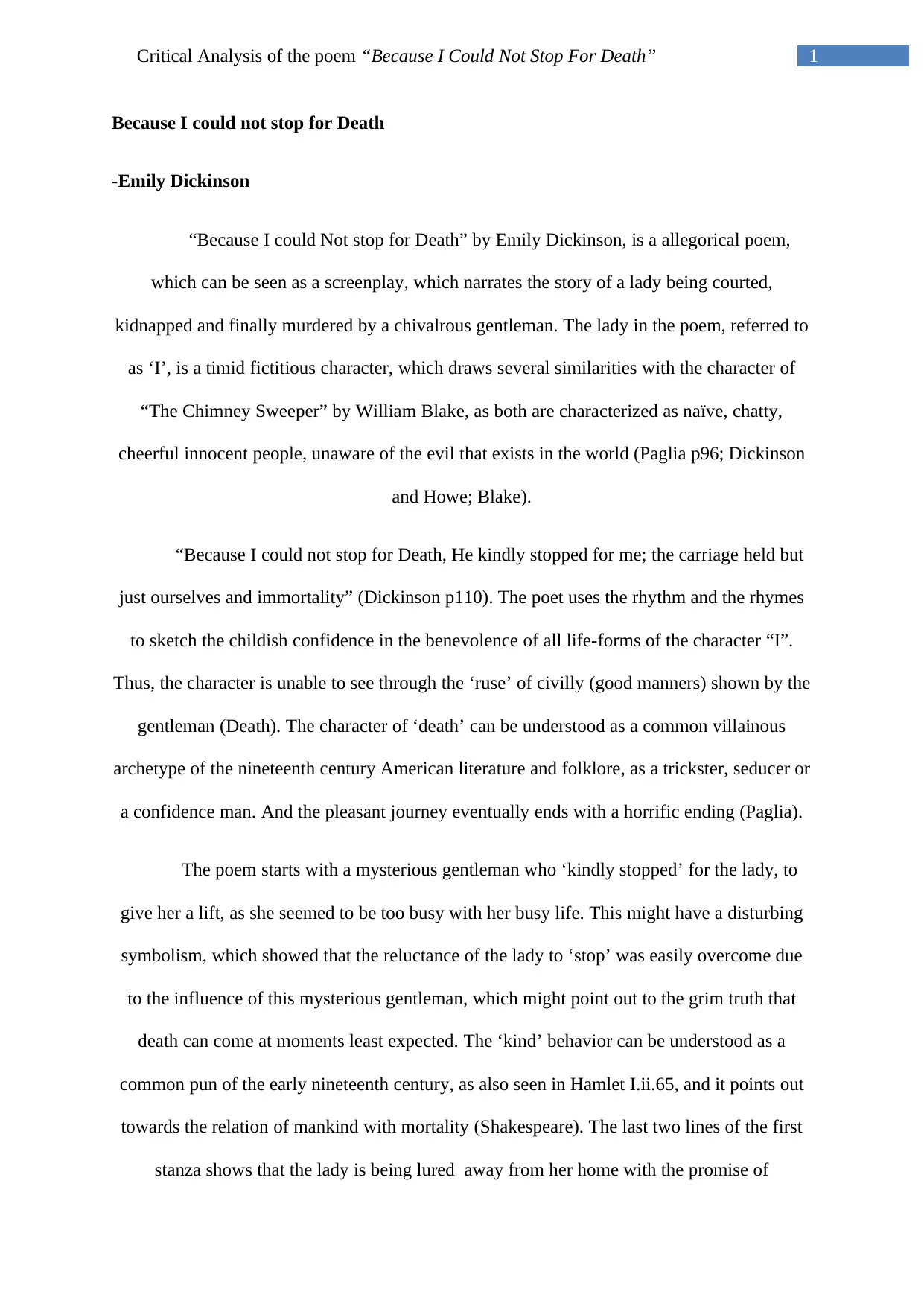
“Because I could Not stop for Death” by Emily Dickinson, is a allegorical poem,
which can be seen as a screenplay, which narrates the story of a lady being courted,
kidnapped and finally murdered by a chivalrous gentleman. The lady in the poem, referred to
as ‘I’, is a timid fictitious character, which draws several similarities with the character of
“The Chimney Sweeper” by William Blake, as both are characterized as naïve, chatty,
cheerful innocent people, unaware of the evil that exists in the world (Paglia p96; Dickinson
and Howe; Blake).
“Because I could not stop for Death, He kindly stopped for me; the carriage held but
just ourselves and immortality” (Dickinson p110). The poet uses the rhythm and the rhymes
to sketch the childish confidence in the benevolence of all life-forms of the character “I”.
Thus, the character is unable to see through the ‘ruse’ of civilly (good manners) shown by the
gentleman (Death). The character of ‘death’ can be understood as a common villainous
archetype of the nineteenth century American literature and folklore, as a trickster, seducer or
a confidence man. And the pleasant journey eventually ends with a horrific ending (Paglia).
The poem starts with a mysterious gentleman who ‘kindly stopped’ for the lady, to
give her a lift, as she seemed to be too busy with her busy life. This might have a disturbing
symbolism, which showed that the reluctance of the lady to ‘stop’ was easily overcome due
to the influence of this mysterious gentleman, which might point out to the grim truth that
death can come at moments least expected. The ‘kind’ behavior can be understood as a
common pun of the early nineteenth century, as also seen in Hamlet I.ii.65, and it points out
towards the relation of mankind with mortality (Shakespeare). The last two lines of the first
stanza shows that the lady is being lured away from her home with the promise of
Document Page
2Critical Analysis of the poem “Because I Could Not Stop For Death”
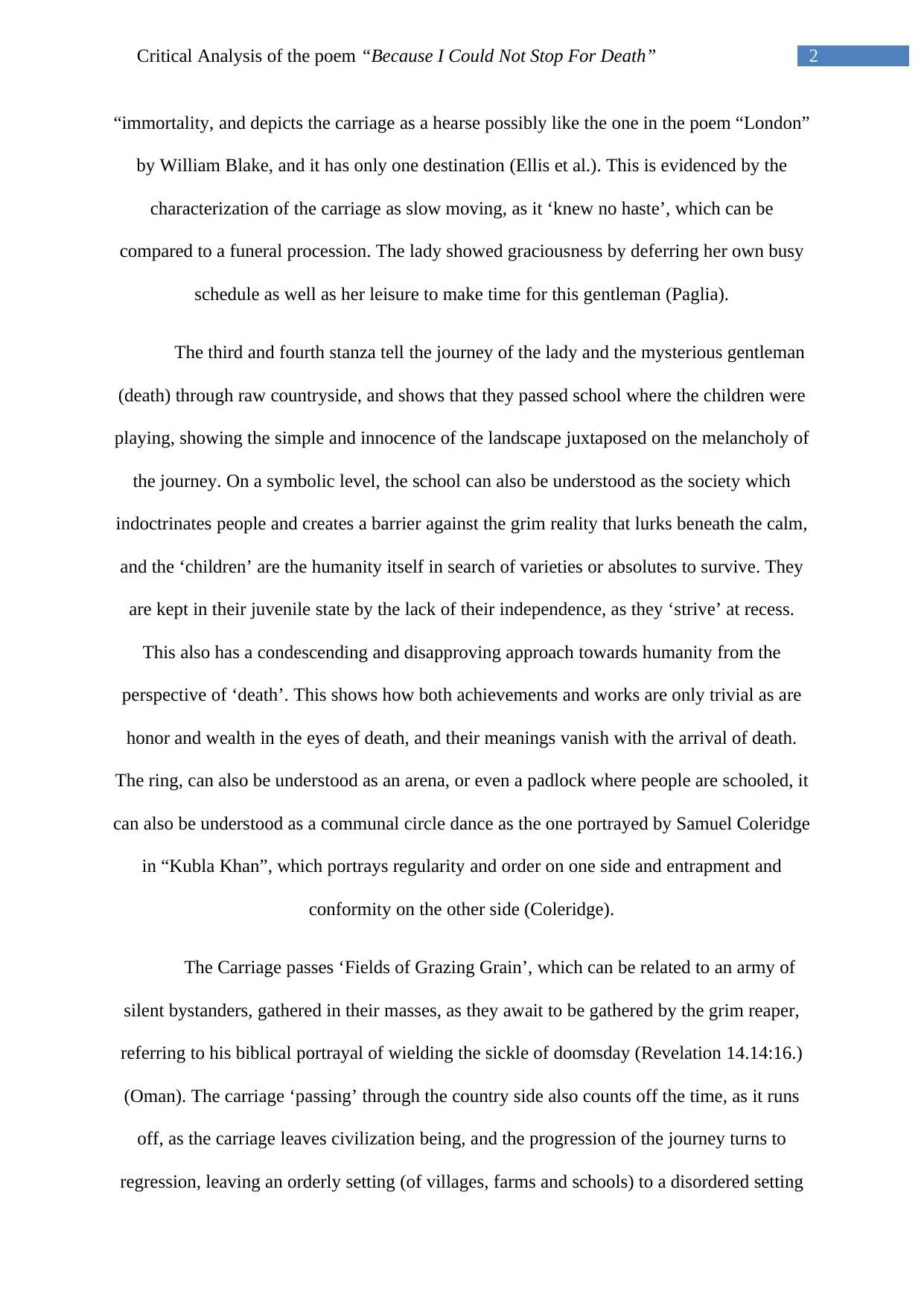
“immortality, and depicts the carriage as a hearse possibly like the one in the poem “London”
by William Blake, and it has only one destination (Ellis et al.). This is evidenced by the
characterization of the carriage as slow moving, as it ‘knew no haste’, which can be
compared to a funeral procession. The lady showed graciousness by deferring her own busy
schedule as well as her leisure to make time for this gentleman (Paglia).
The third and fourth stanza tell the journey of the lady and the mysterious gentleman
(death) through raw countryside, and shows that they passed school where the children were
playing, showing the simple and innocence of the landscape juxtaposed on the melancholy of
the journey. On a symbolic level, the school can also be understood as the society which
indoctrinates people and creates a barrier against the grim reality that lurks beneath the calm,
and the ‘children’ are the humanity itself in search of varieties or absolutes to survive. They
are kept in their juvenile state by the lack of their independence, as they ‘strive’ at recess.
This also has a condescending and disapproving approach towards humanity from the
perspective of ‘death’. This shows how both achievements and works are only trivial as are
honor and wealth in the eyes of death, and their meanings vanish with the arrival of death.
The ring, can also be understood as an arena, or even a padlock where people are schooled, it
can also be understood as a communal circle dance as the one portrayed by Samuel Coleridge
in “Kubla Khan”, which portrays regularity and order on one side and entrapment and
conformity on the other side (Coleridge).
The Carriage passes ‘Fields of Grazing Grain’, which can be related to an army of
silent bystanders, gathered in their masses, as they await to be gathered by the grim reaper,
referring to his biblical portrayal of wielding the sickle of doomsday (Revelation 14.14:16.)
(Oman). The carriage ‘passing’ through the country side also counts off the time, as it runs
off, as the carriage leaves civilization being, and the progression of the journey turns to
regression, leaving an orderly setting (of villages, farms and schools) to a disordered setting
Document Page
3Critical Analysis of the poem “Because I Could Not Stop For Death”
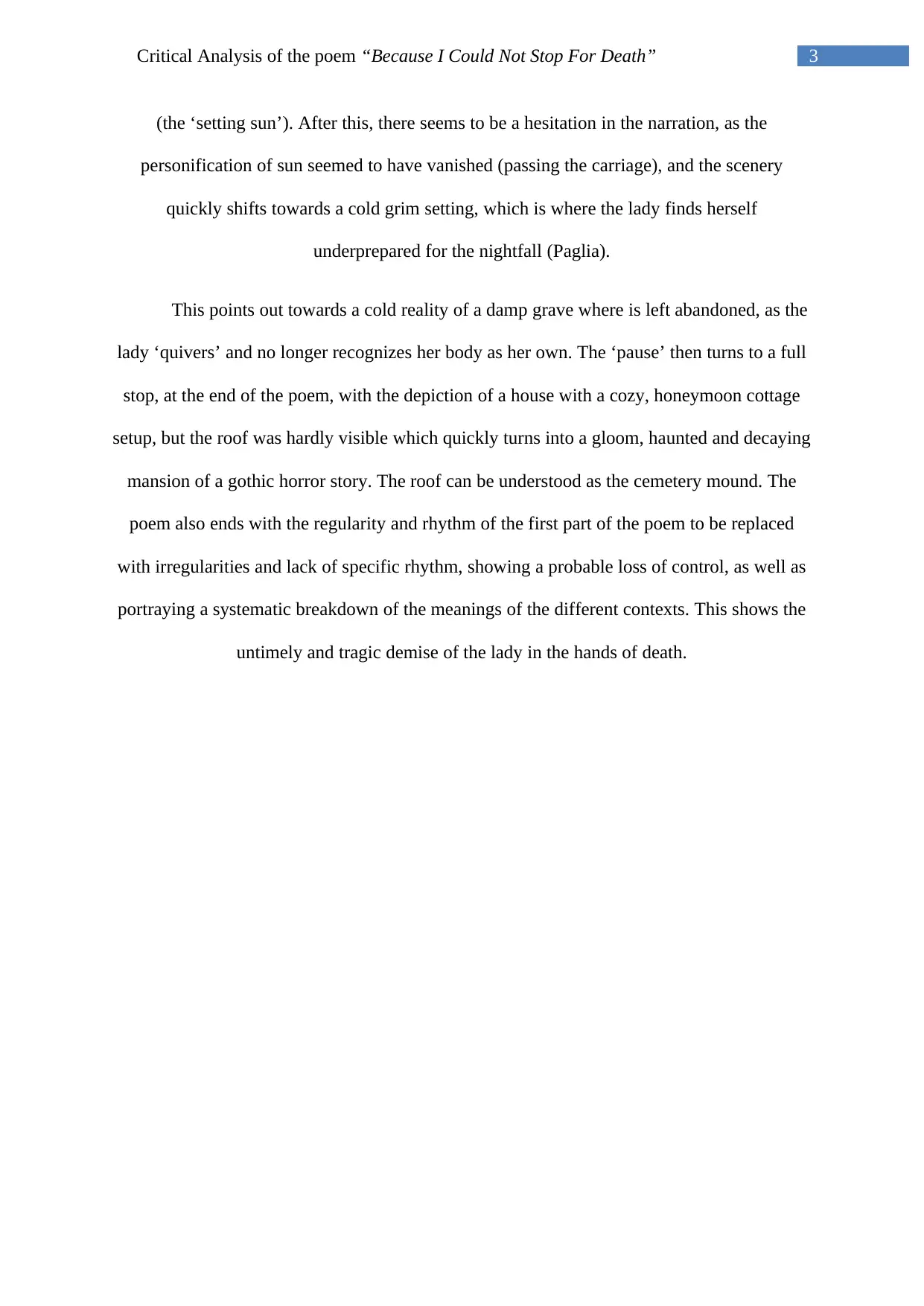
(the ‘setting sun’). After this, there seems to be a hesitation in the narration, as the
personification of sun seemed to have vanished (passing the carriage), and the scenery
quickly shifts towards a cold grim setting, which is where the lady finds herself
underprepared for the nightfall (Paglia).
This points out towards a cold reality of a damp grave where is left abandoned, as the
lady ‘quivers’ and no longer recognizes her body as her own. The ‘pause’ then turns to a full
stop, at the end of the poem, with the depiction of a house with a cozy, honeymoon cottage
setup, but the roof was hardly visible which quickly turns into a gloom, haunted and decaying
mansion of a gothic horror story. The roof can be understood as the cemetery mound. The
poem also ends with the regularity and rhythm of the first part of the poem to be replaced
with irregularities and lack of specific rhythm, showing a probable loss of control, as well as
portraying a systematic breakdown of the meanings of the different contexts. This shows the
untimely and tragic demise of the lady in the hands of death.
tabler-icon-diamond-filled.svg

Paraphrase This Document

Need a fresh take? Get an instant paraphrase of this document with our AI Paraphraser
Document Page
4Critical Analysis of the poem “Because I Could Not Stop For Death”
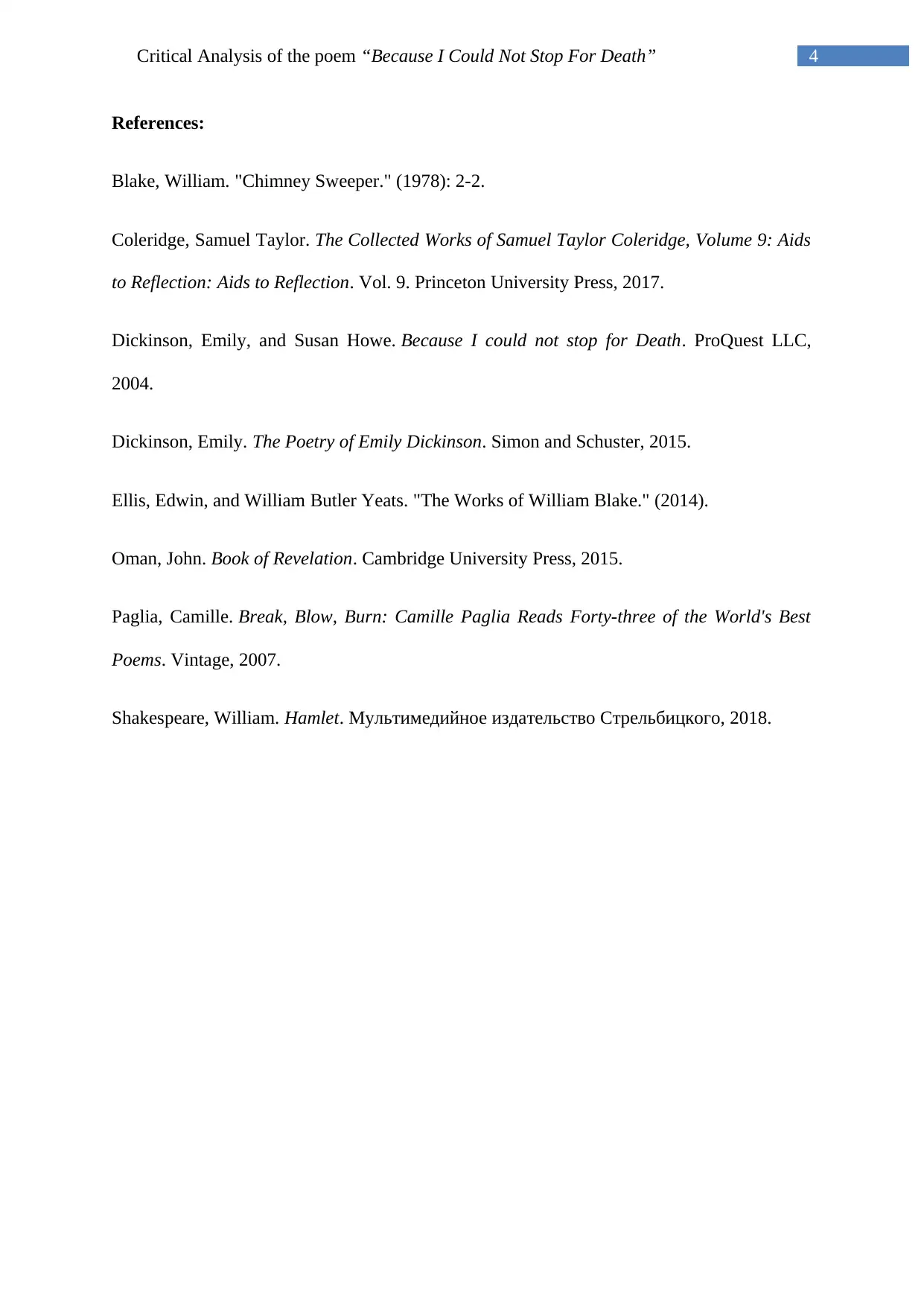
References:
Blake, William. "Chimney Sweeper." (1978): 2-2.
Coleridge, Samuel Taylor. The Collected Works of Samuel Taylor Coleridge, Volume 9: Aids
to Reflection: Aids to Reflection. Vol. 9. Princeton University Press, 2017.
Dickinson, Emily, and Susan Howe. Because I could not stop for Death. ProQuest LLC,
2004.
Dickinson, Emily. The Poetry of Emily Dickinson. Simon and Schuster, 2015.
Ellis, Edwin, and William Butler Yeats. "The Works of William Blake." (2014).
Oman, John. Book of Revelation. Cambridge University Press, 2015.
Paglia, Camille. Break, Blow, Burn: Camille Paglia Reads Forty-three of the World's Best
Poems. Vintage, 2007.
Shakespeare, William. Hamlet. Мультимедийное издательство Стрельбицкого, 2018.
chevron_up_icon
1 out of 5
circle_padding
hide_on_mobile
zoom_out_icon
[object Object]