Ethical Business Leadership: BUSI 2620 Critical Reflection Essay

Verified

Added on  2023/03/20

|4
|731
|53
Essay
AI Summary
This essay, written for a BUSI 2620 Business Ethics course at UOIT, provides a critical reflection on the traits and actions of ethical business leaders. The essay begins with an introduction defining ethical leadership and its significance. It then explores key traits such as conducting ethics audits, encouraging participation in decision-making, hiring ethical individuals, and defining personal and organizational values. The author emphasizes the importance of ethical practices for building reputation and making sound business decisions. The essay concludes by recommending adherence to ethical practices and reflecting on the author's personal leadership experiences. The essay follows a standard structure with an introduction, body paragraphs discussing the traits, and a conclusion. References from business ethics literature are included to support the arguments. This assignment demonstrates the student's understanding of ethical leadership principles and their practical application in a business setting.
Document Page
Running head: BUSINESS ETHICS 1
BUSINESS ETHICS
Student’s name
Date
Institution Affiliation
tabler-icon-diamond-filled.svg

Paraphrase This Document

Need a fresh take? Get an instant paraphrase of this document with our AI Paraphraser
Document Page
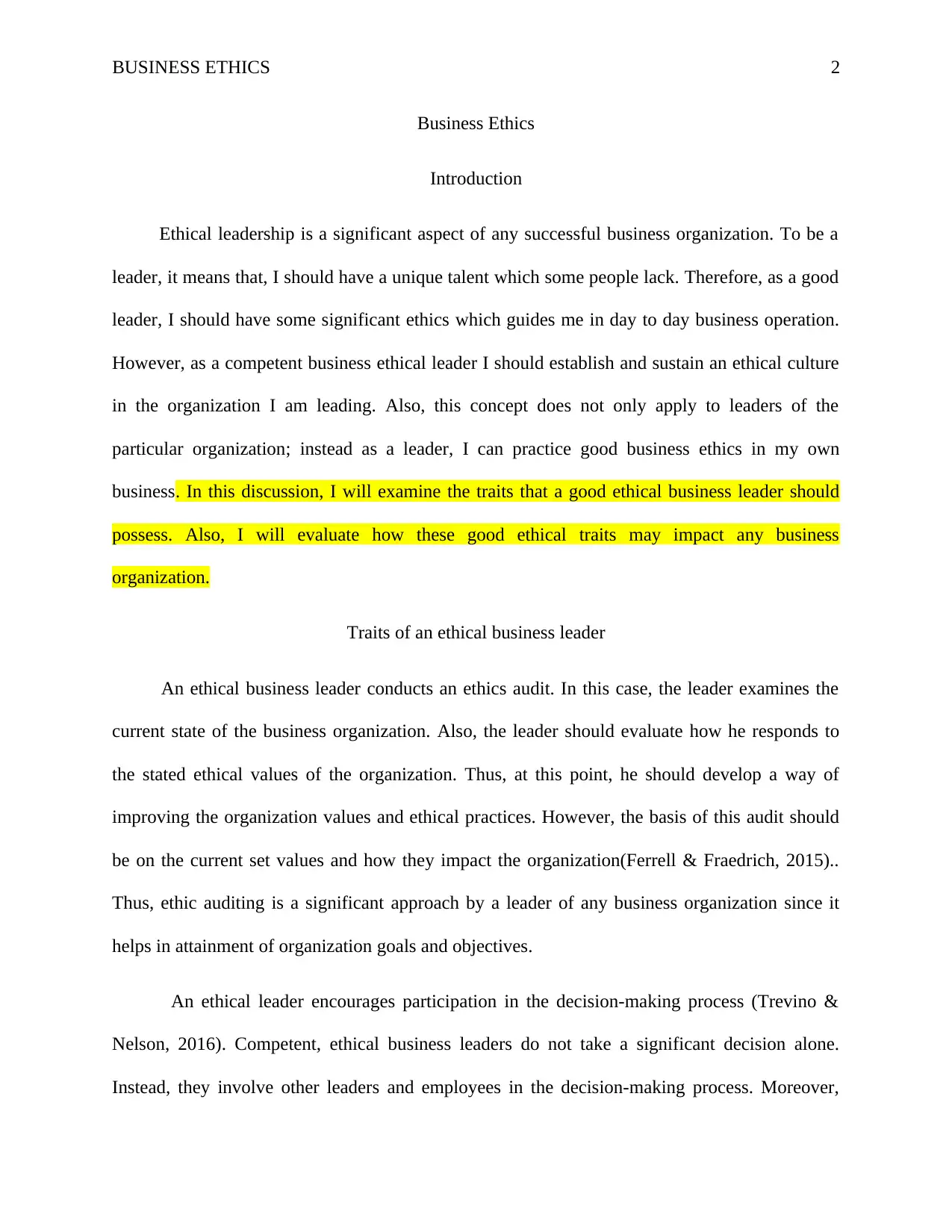
BUSINESS ETHICS 2
Business Ethics
Introduction
Ethical leadership is a significant aspect of any successful business organization. To be a
leader, it means that, I should have a unique talent which some people lack. Therefore, as a good
leader, I should have some significant ethics which guides me in day to day business operation.
However, as a competent business ethical leader I should establish and sustain an ethical culture
in the organization I am leading. Also, this concept does not only apply to leaders of the
particular organization; instead as a leader, I can practice good business ethics in my own
business. In this discussion, I will examine the traits that a good ethical business leader should
possess. Also, I will evaluate how these good ethical traits may impact any business
organization.
Traits of an ethical business leader
An ethical business leader conducts an ethics audit. In this case, the leader examines the
current state of the business organization. Also, the leader should evaluate how he responds to
the stated ethical values of the organization. Thus, at this point, he should develop a way of
improving the organization values and ethical practices. However, the basis of this audit should
be on the current set values and how they impact the organization(Ferrell & Fraedrich, 2015)..
Thus, ethic auditing is a significant approach by a leader of any business organization since it
helps in attainment of organization goals and objectives.
An ethical leader encourages participation in the decision-making process (Trevino &
Nelson, 2016). Competent, ethical business leaders do not take a significant decision alone.
Instead, they involve other leaders and employees in the decision-making process. Moreover,
Document Page
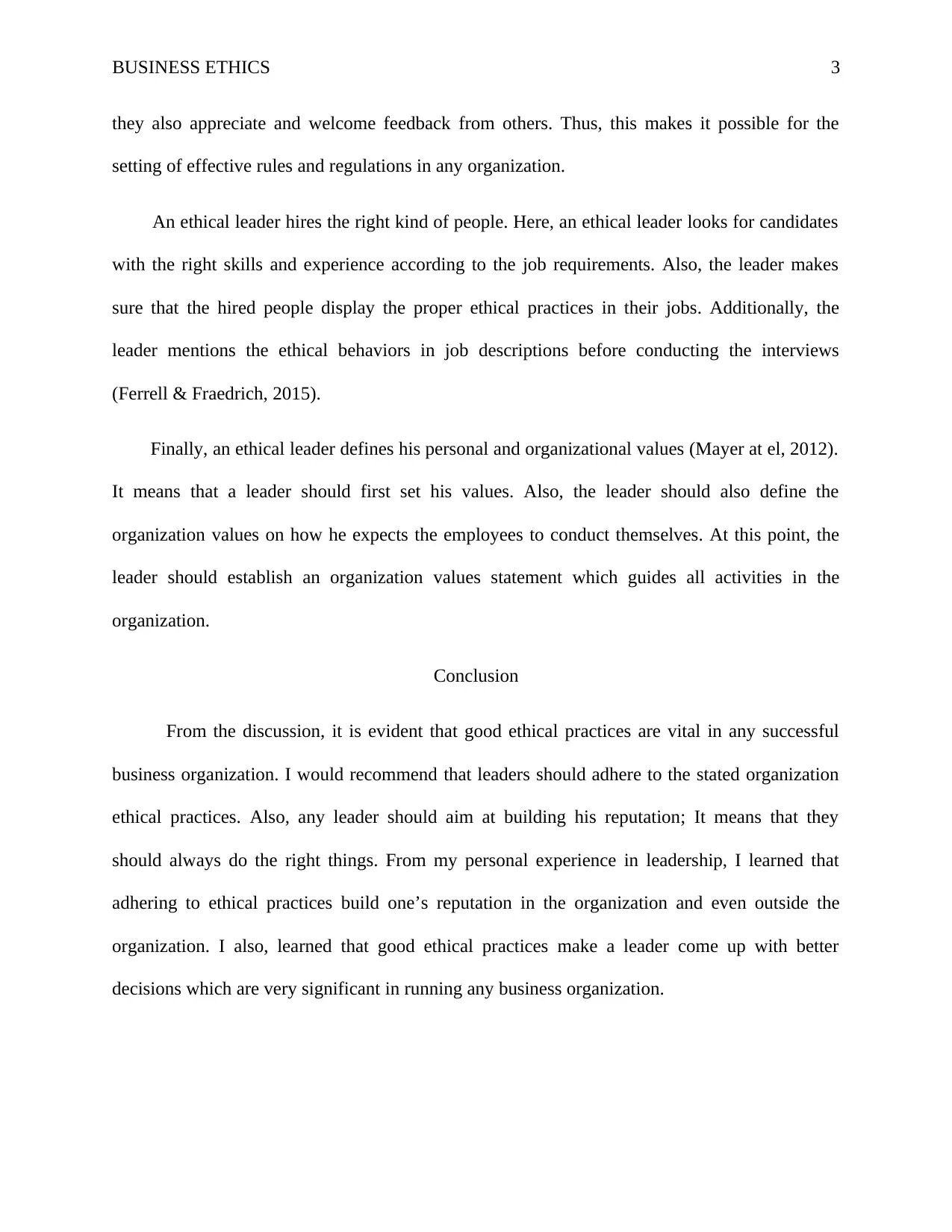
BUSINESS ETHICS 3
they also appreciate and welcome feedback from others. Thus, this makes it possible for the
setting of effective rules and regulations in any organization.
An ethical leader hires the right kind of people. Here, an ethical leader looks for candidates
with the right skills and experience according to the job requirements. Also, the leader makes
sure that the hired people display the proper ethical practices in their jobs. Additionally, the
leader mentions the ethical behaviors in job descriptions before conducting the interviews
(Ferrell & Fraedrich, 2015).
Finally, an ethical leader defines his personal and organizational values (Mayer at el, 2012).
It means that a leader should first set his values. Also, the leader should also define the
organization values on how he expects the employees to conduct themselves. At this point, the
leader should establish an organization values statement which guides all activities in the
organization.
Conclusion
From the discussion, it is evident that good ethical practices are vital in any successful
business organization. I would recommend that leaders should adhere to the stated organization
ethical practices. Also, any leader should aim at building his reputation; It means that they
should always do the right things. From my personal experience in leadership, I learned that
adhering to ethical practices build one’s reputation in the organization and even outside the
organization. I also, learned that good ethical practices make a leader come up with better
decisions which are very significant in running any business organization.
Document Page
BUSINESS ETHICS 4
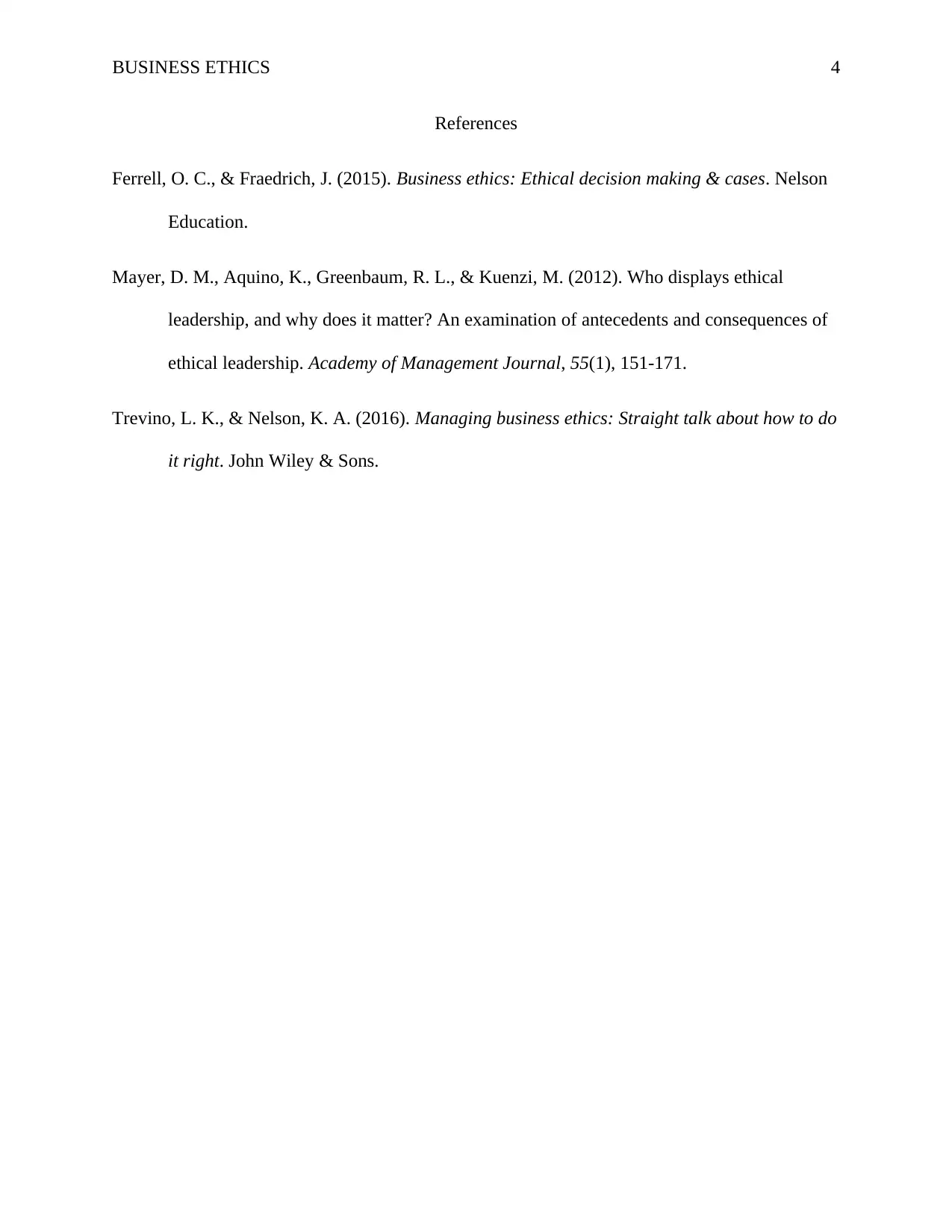
References
Ferrell, O. C., & Fraedrich, J. (2015). Business ethics: Ethical decision making & cases. Nelson
Education.
Mayer, D. M., Aquino, K., Greenbaum, R. L., & Kuenzi, M. (2012). Who displays ethical
leadership, and why does it matter? An examination of antecedents and consequences of
ethical leadership. Academy of Management Journal, 55(1), 151-171.
Trevino, L. K., & Nelson, K. A. (2016). Managing business ethics: Straight talk about how to do
it right. John Wiley & Sons.
chevron_up_icon
1 out of 4
circle_padding
hide_on_mobile
zoom_out_icon
[object Object]